
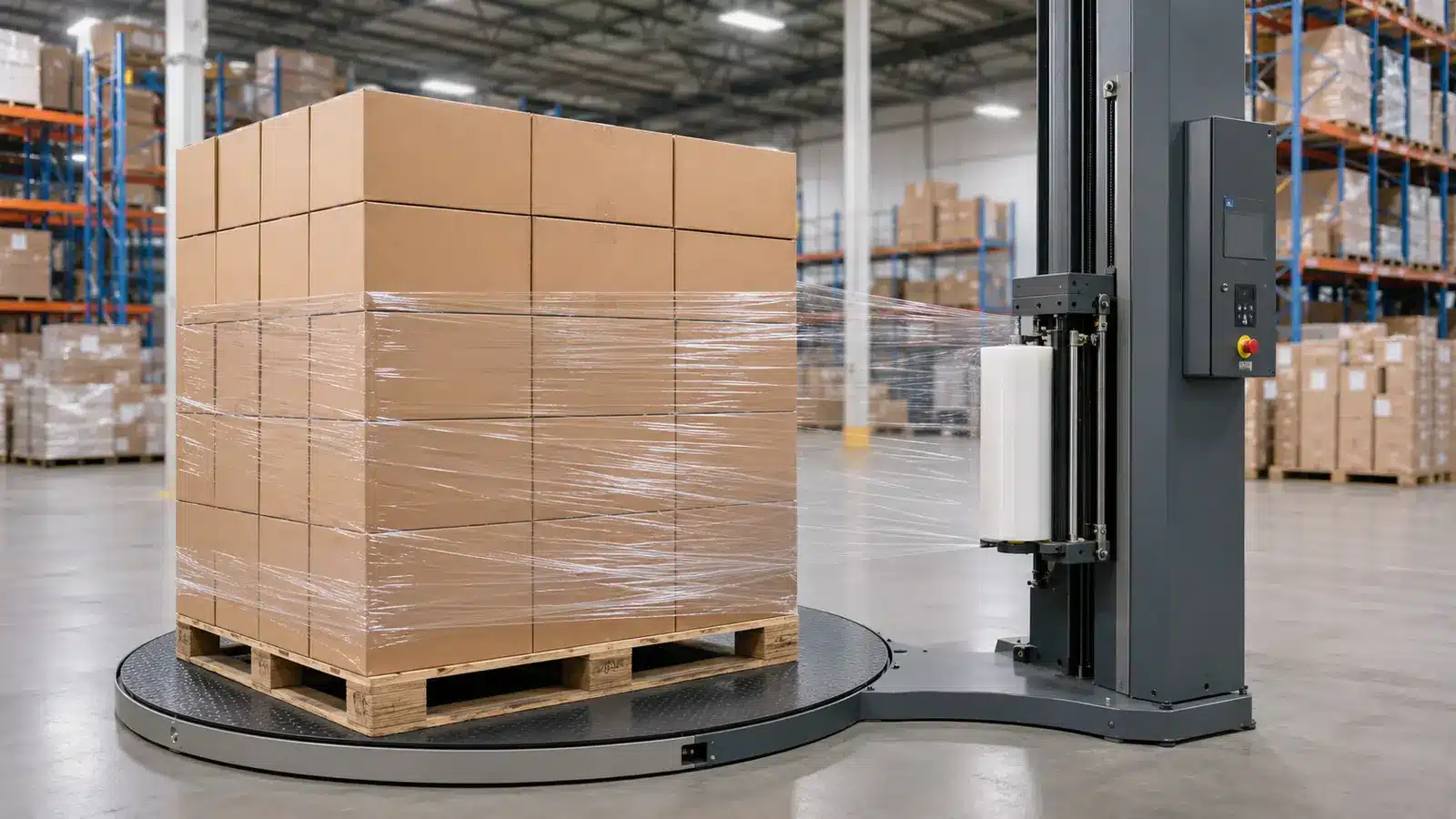
Stretch film looks simple: a thin, elastic web wrapped around cartons or products. In practice, it is a load-containment component whose performance depends on the film, the wrapper, the pallet pattern, and the distribution environment working together.
That distinction matters when a buyer is comparing cast and blown films, choosing a hand or machine roll, or trying to reduce grams per pallet. A specification that describes only thickness and roll length leaves out the variables that determine whether the load will still be stable after handling, vibration, temperature change, and time.
This guide explains what stretch film does, where it is used, which features matter, and how to move from a film data sheet to a validated wrap recipe.
What Is Stretch Film?
For polymer background, consult the NIH PubChem polyethylene overview before comparing finished-film claims.
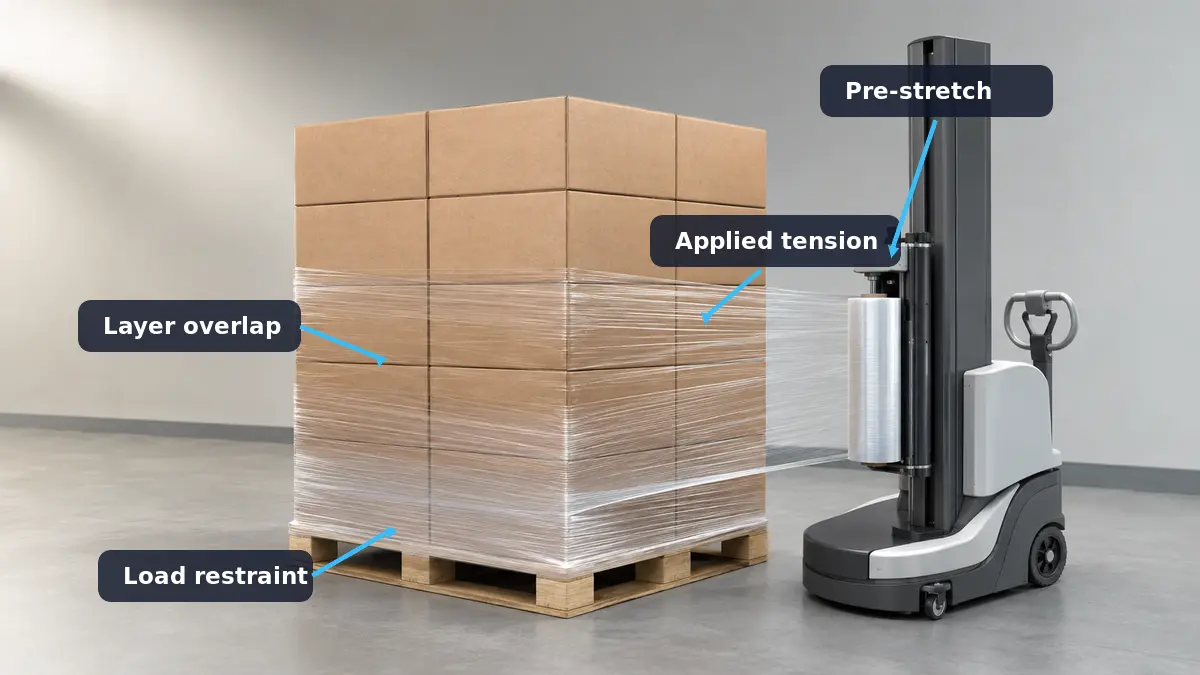
Stretch film—also called stretch wrap or pallet wrap—is a highly extensible plastic film used to bind products into a unit, often on a pallet. Most industrial stretch films are polyethylene-based. The film is stretched during application and held around the load. Its tendency to recover, together with the tension and number of layers applied, creates inward force that helps resist product movement.
The ASTM D4649 guide covers the selection, specification, and use of stretch films for unitizing, reinforcing, and palletizing in indoor storage and transport settings. That scope is a useful boundary: ordinary stretch film should not automatically be treated as an outdoor cover, a waterproof enclosure, or a substitute for packaging designed around a specific environmental hazard.
Stretch Film vs. Shrink Wrap
The names are similar, but the processes are different.
| Decision point | Stretch film | Shrink wrap |
|---|---|---|
| How it tightens | Applied under stretch and tension; recovery helps hold the load | Applied relatively loose, then heated so the material shrinks |
| Typical industrial role | Pallet unitization and bundling | Product grouping, overwrapping, or forming an enclosure |
| Heat equipment | Not required for the film to tighten | Required for the shrinking step |
| Main control variables | Pre-stretch, force-to-load, layers, overlap, pattern, anchoring | Film selection, sealing, heat profile, airflow, dwell time |
| Important boundary | Not inherently sealed or weatherproof | A shrink enclosure may be more complete, but seal and material design still determine protection |
Choose between them by packaging function, not by name. If the goal is repeatable pallet containment without heat, stretch film is usually the relevant system. If the goal requires a heat-formed enclosure, shrink film belongs in a different process evaluation.
How Stretch Film Creates Load Containment
Stretch wrapping is the process. Load containment is the result. A pallet can look tightly wrapped yet have weak or uneven force, poor attachment to the pallet, or enough internal movement to fail during distribution.
Stretch film performance begins when the web is elongated. On a machine, a powered pre-stretch carriage may turn the film rollers at different speeds so the web is stretched before it reaches the load. The wrapper then controls the additional force as the film is laid onto the pallet. Hand application uses the operator, dispenser, and walking path to perform the same basic functions with more natural variability.
Pre-Stretch and Elastic Recovery
Pre-stretch increases the applied length available from a roll. A film extended by 200% has a final length equal to three times its original length: the original 100% plus 200% extension. That arithmetic is useful for yield planning, but a high percentage is not automatically a better setting.
As the film is stretched, its force-to-stretch behavior changes. Too little stretch may leave yield unused. Too much may narrow the web, reduce puncture margin, or increase breaks at sharp corners. The correct operating window depends on the film formulation, thickness, wrapper carriage, speed, load geometry, and the force required at the load.
Elastic recovery describes the film's tendency to return toward its original dimensions after extension. Stress retention describes how much force remains while the extended film is held. ASTM D5459 addresses recovery, permanent deformation, and stress retention in the machine direction. These are useful film characteristics, but they do not describe the entire applied pallet. Research on stretch-film containment shows that machine settings, film stiffness, load geometry, and time-dependent behavior interact.
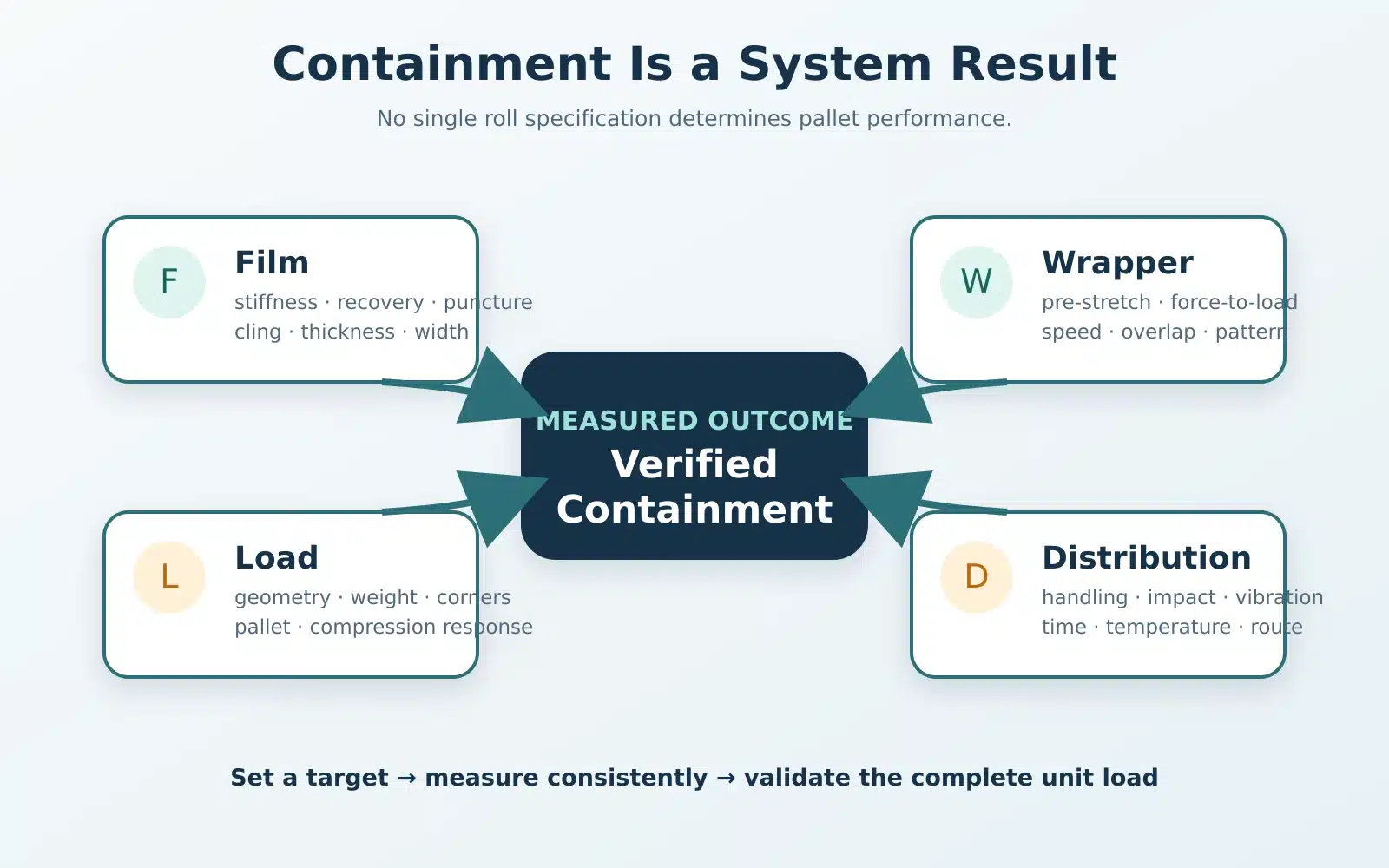
Containment Force Is a System Result
Containment force is often described as the cumulative inward force from the applied layers at a defined point on the load. It is influenced by at least five elements:
- the force in each layer as it reaches the load;
- the number and position of layers;
- film stiffness and retained stress;
- load shape, corners, gaps, and compression response; and
- changes after wrapping, including temperature and relaxation.
That is why wrap count alone is not a performance specification. The same number of revolutions can produce different results with a different film, carriage, force setting, or pallet pattern. A useful process sets a target, measures at consistent top, middle, and bottom locations, and monitors whether production stays within the approved window.
Common Stretch Film Applications
The most familiar application is securing corrugated cases to a pallet. Stretch film is also used for bundling long products, stabilizing bags or pails, containing mixed distribution-center loads, protecting surfaces from warehouse dust, and holding components during internal movement.
The application determines the film features that deserve attention.
| Application | Primary challenge | Film or process questions |
|---|---|---|
| Uniform case pallet | Repeatability and material efficiency | Can a controlled machine recipe meet the target with less variability? |
| Mixed distribution load | Irregular geometry and puncture points | Is the film tolerant of corners, gaps, and changing profiles? |
| Bagged or crushable product | Movement plus compression sensitivity | What force contains the load without deforming it? |
| Produce or chilled goods | Airflow and condensation | Is vented film required, and does the reduced web area still provide enough containment? |
| Metal components | Corrosion risk | Is a qualified VCI film suitable, and is a tension-wrapped load sufficiently enclosed? |
| Outdoor staging | UV, rain, wind, and temperature | Is the complete packaging system designed and validated for the exposure period? |
Palletizing, Warehousing, and Distribution
For routine palletizing, stretch film helps keep packages together while a forklift, conveyor, or truck moves the unit. It can also reduce the chance that individual cartons become separated during staging. Clear film preserves visibility of labels and load condition; opaque or tinted film can reduce casual visibility where that is a legitimate security requirement.
The film is only one component. Broken pallet boards, off-center weight, large voids, carton overhang, and unstable stacking patterns reduce the effectiveness of the wrap. A good wrapping standard starts with load preparation: inspect the pallet, center the load, keep heavy items low and balanced, control overhang, and address sharp edges before increasing film force.
Irregular, Sensitive, and Specialty Loads
Irregular loads need more puncture tolerance and a wrap pattern that reaches changing profiles. Edge protectors, top sheets, slip sheets, or containment aids may solve a problem more effectively than simply adding film.
Sensitive loads need a force ceiling as well as a stability target. Paper products, light cartons, open trays, and flexible containers may be crushed by aggressive settings. The best recipe is not the tightest one; it is the lowest-material process that remains stable without damaging the product.
Specialty films should be selected against a defined hazard. Vented stretch film allows airflow for some produce and chilled applications, but the openings change the containment system and require trials. UV-stabilized film can slow sunlight-related degradation for a stated exposure, but it does not by itself make a pallet weatherproof. VCI stretch film can support corrosion control for compatible metals, yet a tension-wrapped pallet may not provide the same enclosure integrity as a sealed VCI package.
Advantages—and the Tradeoffs Behind Them
Stretch film is popular because one material can adapt to many load sizes while being applied manually or at high machine speeds. When it is properly specified and controlled, it can provide:
- unitization without a heat-shrinking process;
- adjustable containment for different load zones;
- visible loads and scannable labels with clear films;
- protection from warehouse dust and incidental surface contact;
- material yield through controlled pre-stretch; and
- a measurable, repeatable process on suitable equipment.
Each advantage has a condition. Pre-stretch only saves material when the web remains intact and the final load meets its target. High wrap force only helps until it begins to crush packages or accelerate corner failures. Automation improves repeatability only when recipes, sensors, maintenance, and operator practices are controlled.
Benefits Depend on Correct Application
The main tradeoffs are practical:
- Containment versus compression: more force can stabilize rigid cartons but deform soft loads.
- Yield versus robustness: thinner film or more pre-stretch may reduce grams per pallet, but only within a stable operating window.
- Cling versus handling: enough cling keeps tails and layers together; excessive outside cling can make adjacent pallets stick.
- Coverage versus ventilation: a continuous web blocks dust better, while vented formats allow airflow.
- Manual flexibility versus consistency: hand wrapping fits low-volume or unusual work, while machines usually provide better control at sustained volume.
- Material reduction versus distribution loss: the smallest film weight is not a success if damage, rework, or rejected loads rise.
Time and environment also matter.
Manual wrapping presents ergonomic concerns because operators bend, walk around the pallet, and apply sustained force. WorkSafe Victoria identifies awkward posture and force as musculoskeletal-disorder risks and recommends eliminating or reducing the exposure where practicable. A machine can reduce that task, but guarding, training, lockout procedures, and preventive maintenance remain necessary.
Features and Specification Terms That Matter
Stretch-film data sheets contain many numbers. A buyer should separate roll geometry, film-property tests, and applied-load performance.
| Specification | What it describes | What it does not prove |
|---|---|---|
| Thickness in micron or mil | Nominal web thickness under a stated measurement method | Final containment or puncture survival on a specific load |
| Width and roll length | Roll geometry and nominal area | Net film weight or usable applied length after waste |
| Net film weight and core | Material purchased versus packaging weight | Pallets per roll without a wrap recipe |
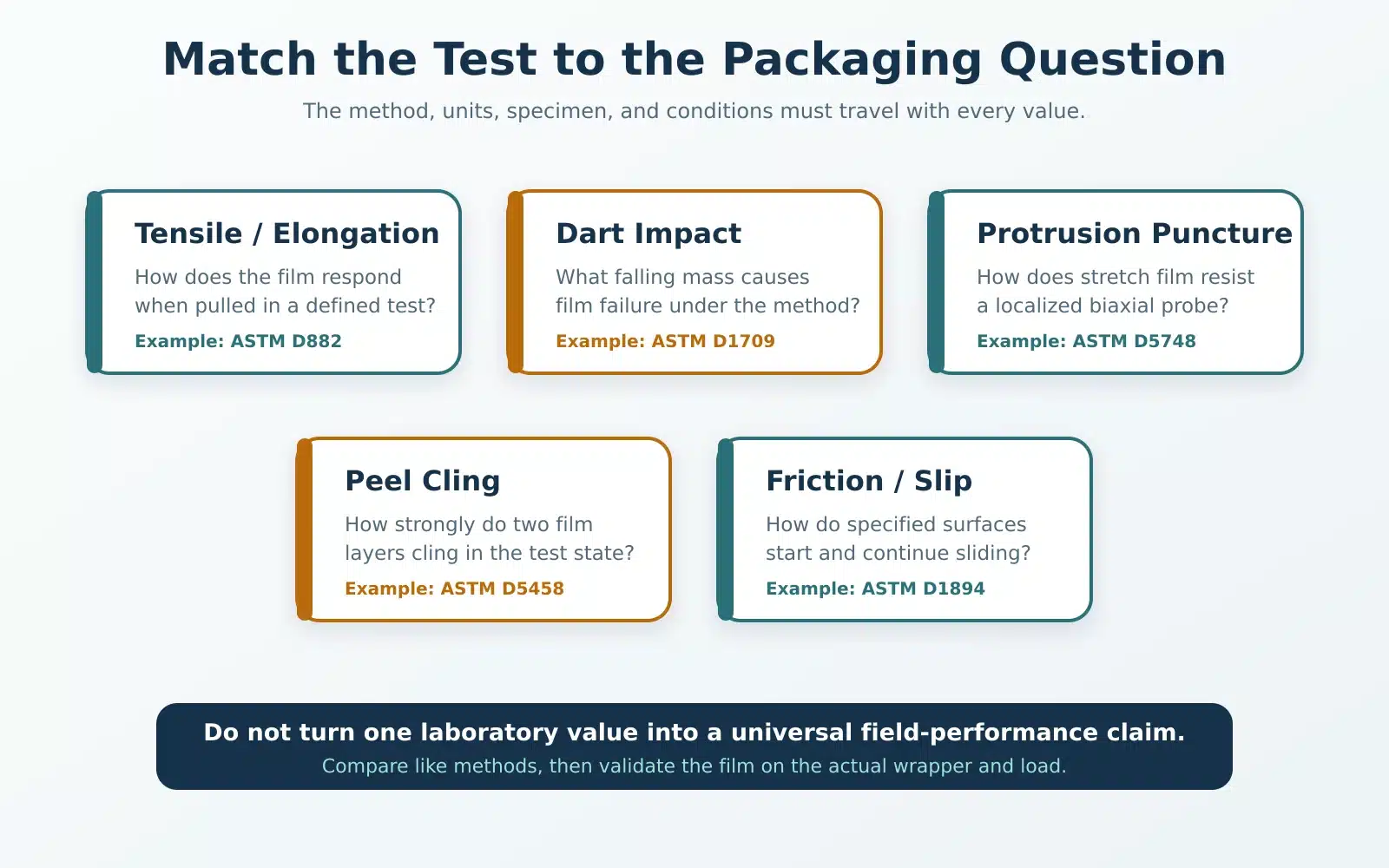
| Tensile and elongation | Film response in a tensile test | Field performance across every machine and load |
| Dart impact | Failure under a specified free-falling dart method | Protrusion puncture at a pallet corner |
| Protrusion puncture | Biaxial resistance to a probe under the test conditions | Tear propagation or distribution impact survival |
Thickness, Yield, and Roll Geometry
State thickness in a recognized unit and confirm the conversion. One mil is 0.001 inch, or 25.4 micrometres. In common North American stretch-film usage, 100 gauge is often treated as 1.00 mil, but buyers should put the actual mil or micron value on the specification rather than rely on trade shorthand.
Roll comparisons require width, nominal length, net film weight, core dimensions, and allowable tolerances. A long roll with a heavy core or a different web thickness is not directly comparable to another roll by price alone.
For planning, separate three quantities:
- Nominal roll length before application.
- Applied length available after measured stretch, minus start, tail, and break waste.
- Film used per pallet under the approved pattern.
Track kilograms or pounds of film per good pallet, not just rolls purchased. That metric captures changes in core, thickness, roll length, and waste.
Stretch, Cling, Tear, and Puncture Behavior
Stretch is not a single performance number. Yield point, ultimate elongation, recovery, stress retention, and force-to-stretch behavior can all influence application.
Cling helps adjacent layers remain together and keeps the film tail controlled. One-sided cling or slip constructions can be useful when pallet-to-pallet sticking is a concern. Confirm which side has cling and how the roll must be loaded.
Tear and puncture describe different events. A protruding carton corner produces a localized biaxial stress. A nick at a roll edge can propagate as a tear. Dart impact is another method again. ASTM D5748 specifically addresses protrusion puncture resistance of stretch wrap film, while ASTM D1709 covers impact resistance of plastic film by a free-falling dart. Compare values only when the methods, specimen preparation, thickness, units, and conditions are compatible.
Optical and Specialty Features
Clarity and low haze help operators inspect products and scan labels through the wrap. Tint or opacity can support identification or concealment. These features should not compromise label scanning, safety markings, or inspection requirements.
Other options include UV stabilization, antistatic behavior, venting, VCI chemistry, color, and outer-surface slip. Treat each as a qualified product attribute. Ask for the test method, target value, use conditions, shelf life, and any limitations rather than accepting a broad label.
Stretch Film Types and Application Formats
Stretch film is often classified by extrusion process and by application format. These classifications are useful starting points, not final performance rankings.
Cast vs. Blown Stretch Film
In blown-film extrusion, molten polymer passes through a circular die, forms a tube or bubble, and is cooled by air before being collapsed and wound. In cast-film extrusion, a flat web leaves a linear die and is rapidly cooled on water-cooled chill rolls.
Rapid cast cooling often supports high clarity, quiet unwind, and uniform gauge. Blown processes are commonly associated with toughness and puncture tolerance, with different optical and unwind characteristics. Modern multilayer formulations blur simple rules, so “cast” or “blown” alone should not be used as a proxy for performance.
Use the process label to narrow candidates, then compare the properties and applied-load results that matter. A cast film may be the best fit for a clear, high-speed case load; a blown film may suit an abrasive or irregular load. Either conclusion must be verified with the candidate grade and actual wrapper.
Hand, Machine, and Pre-Stretched Film
Hand film is made for manual application, usually in lighter rolls that fit a dispenser. It is useful for low volumes, variable locations, repair work, and loads that cannot reach a machine. Operator-to-operator variability, ergonomics, and measured stretch should be reviewed as volume grows.
Machine film is designed for powered wrappers. The film must match the carriage, roll dimensions, speed, prestretch system, and force-control range. A machine recipe can improve repeatability, but changing the film without revalidation may alter force, web width, break rate, and yield.
Pre-stretched hand film has already been elongated and rewound. It can reduce the pulling force needed during manual wrapping and make applied tension more consistent, though the final containment still depends on the pattern and load.
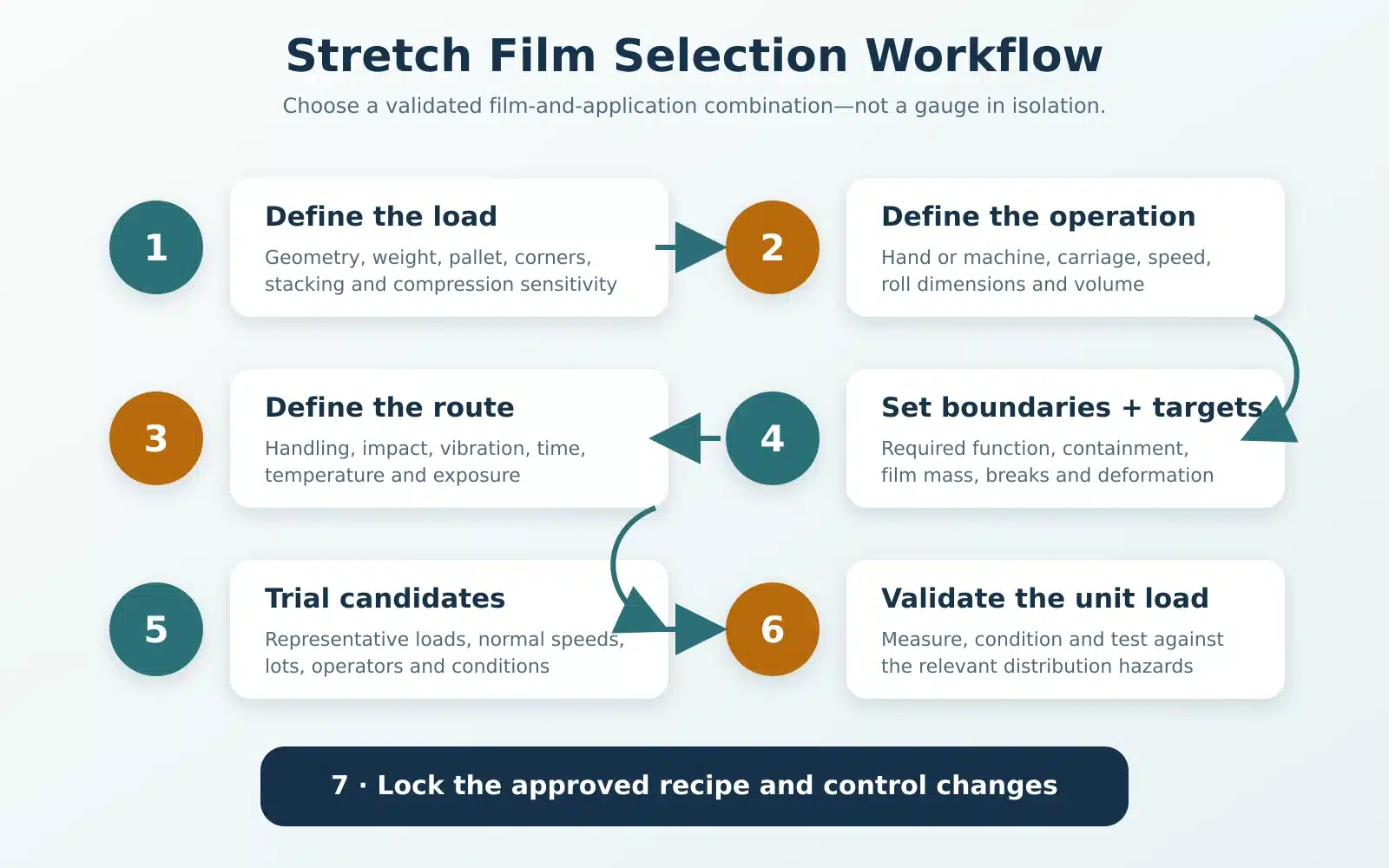
How to Select Stretch Film for a Load
Selection works best as a controlled decision rather than a gauge chart.
Use this sequence:
- Define the load. Record pallet footprint, height, weight, center of gravity, stacking pattern, carton strength, overhang, gaps, and puncture points.
- Define the operation. Record hand or machine application, wrapper model, carriage ratio or range, speed, film width, core, shift volume, and changeover constraints.
- Define the route. Note handling events, full-truckload or less-than-truckload movement, vibration, impacts, temperature, humidity, dwell time, and outdoor exposure.
- Define protection boundaries. Decide whether the film is for containment, dust reduction, concealment, airflow, UV exposure, corrosion control, or another stated function.
- Set measurable targets. Establish containment readings, film weight per pallet, break-rate limit, tail acceptance, load deformation limit, and distribution-test criteria.
- Trial qualified candidates. Run enough representative loads to capture normal variability.
- Lock the recipe. Document film code, lot, wrapper settings, wrap pattern, inspection points, and change-control rules.
Avoid choosing thickness from load weight alone. A heavy, uniformly stacked rigid load may have fewer puncture points than a lighter mixed load. A thin high-performance film may outperform a thicker general-purpose film on one system and fail on another. The purchase unit is a roll; the engineering unit is a validated film-and-application combination.
Application Control and Validation
A production standard should identify what the operator sets, what the process measures, and what triggers action. At minimum, record film identity, wrapper, carriage setting, force-to-load setting, rotation and carriage speeds, bottom and top wraps, overlap pattern, pallet attachment method, film weight per load, and containment readings.
Validate the Film, Machine, Load, and Distribution Cycle Together
Begin with a representative pallet, not an ideal display load. Measure the finished pallet at defined locations and inspect for loose zones, crushed cases, exposed corners, poor tails, web breaks, or incomplete pallet attachment. Repeat across normal lots, operators, shifts, and speeds.
Then test the complete unit against relevant hazards. ASTM D5414 is used to compare stretch-wrapped loads under laboratory horizontal impact; its own scope cautions that no direct universal correlation to field performance has been established. ASTM D6055 addresses mechanical handling of unitized loads, while ASTM D6179 addresses rough handling. ISTA 3E is a general simulation procedure for similar packaged products in unitized full-truckload shipments and evaluates the package and product together.
Choose a protocol that represents the real route. Moisture, pressure, unusual handling, temperature extremes, or a different distribution mode may require additional conditioning or a different test. EUMOS 40509 addresses dynamic load-unit rigidity on an acceleration bench; it is a load-stability framework, not a stand-alone film specification.
After approval, monitor drift. Revalidate when changing the film grade, thickness, supplier, roll geometry, wrapper, carriage, pallet, package, stacking pattern, load height, route, or target. A lower film weight is an improvement only if the complete acceptance criteria remain satisfied.
Material Reduction, Recycling, and Claim Boundaries
Material reduction should start with a stable baseline. Weigh applied film on representative pallets, measure the current containment profile, record damage and breaks, and then change one controlled variable at a time. Down-gauging without maintaining the target may simply move environmental and financial cost into product loss.
The US EPA waste-management hierarchy places source reduction ahead of recycling. In a stretch-wrap operation, that supports reducing unnecessary film when the packaging function is preserved. Practical actions include improving load preparation, repairing worn prestretch components, controlling wrap patterns, selecting a film with a suitable operating window, and eliminating avoidable start, tail, and break waste.
Recycling requires more than a polyethylene label. Collection programs vary. Film generally needs to be clean, dry, and free of incompatible materials; loose film can create problems in curbside material-recovery equipment. Commercial back-of-house collection may be different from consumer store drop-off. Confirm acceptance with the actual local collector or recycler.
Marketing language needs the same discipline. The FTC Green Guides say environmental claims should be truthful, not misleading, and supported by a reasonable basis. Avoid broad statements such as “eco-friendly” or unqualified “100% recyclable.” State the material, the intended collection route, relevant preparation, geographic availability, and the evidence supporting recycled-content or source-reduction claims.
Frequently Asked Questions
Does Thicker Stretch Film Always Perform Better?
No. Thickness can add material and may improve some resistance values, but final performance also depends on formulation, pre-stretch, force, layers, puncture points, and the load. Compare qualified films under the same measured application and distribution conditions.
How Can You Estimate Film Used per Pallet?
Start with the pallet perimeter and the actual number of revolutions, then account for spiral travel, overlap, top and bottom wraps, pallet attachment, and tails. Adjust nominal length using measured pre-stretch—not the carriage label alone—and subtract break and setup waste. For reliable cost control, weigh the applied film on representative good pallets and use that measured mass as the baseline.
Can Stretch Film Protect a Load from Rain?
It can reduce direct surface exposure, especially with a suitable top sheet, but ordinary pallet wrap is not a sealed weatherproof enclosure. Water can enter through the top, bottom, seams, punctures, or condensation. Outdoor or rain exposure requires a complete packaging design with a stated duration and validation.
Why Does Stretch Film Tear During Application?
Common causes include damaged roll edges, sharp load corners, excessive prestretch or force, incorrect film threading, worn rollers, poor alignment, high acceleration, contamination, cold film, or a grade that lacks the required puncture margin. Change one variable at a time and note whether the break follows the roll, a pallet location, or a machine cycle.
How Should Unused Stretch Film Rolls Be Stored?
Follow the film supplier's data sheet. Common controls include keeping rolls in original packaging in a clean, dry, ventilated area; protecting them from direct sunlight, heat, flame, solvents, moisture, and impact; and conditioning cold rolls before use. Shelf-life and temperature limits are product-specific.
What Information Should a Stretch Film RFQ Include?
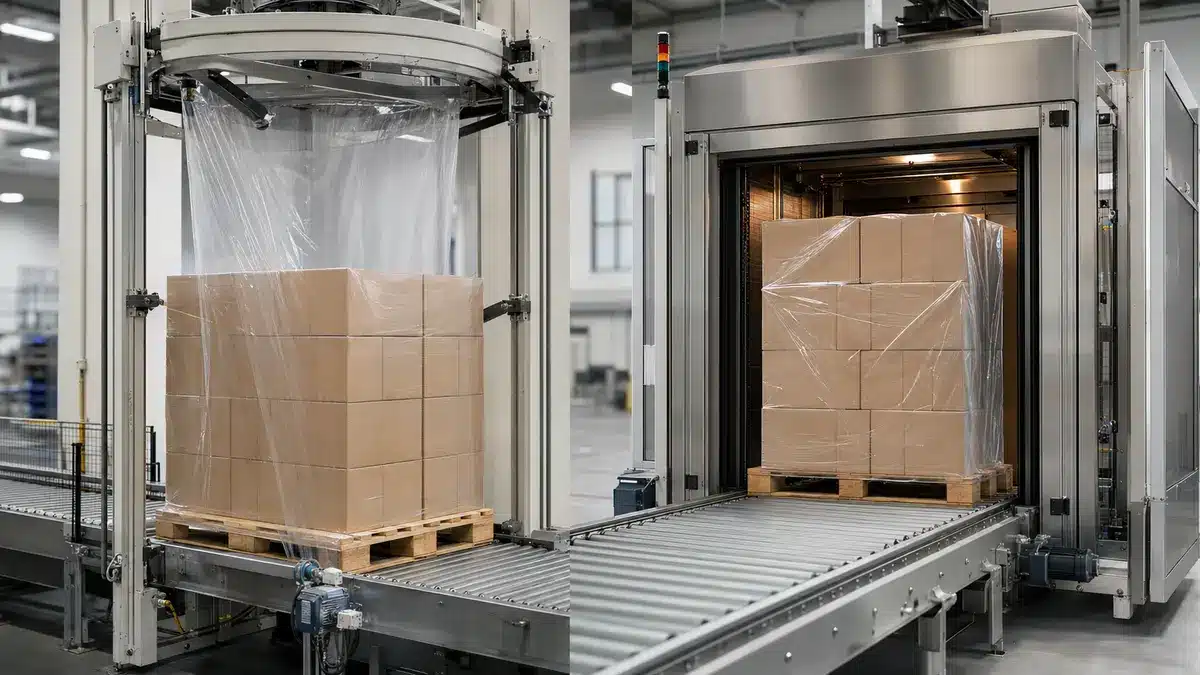
Include film type or performance objective, thickness in micron or mil, width, nominal length, net film weight, core dimensions, roll orientation, cling side, hand or machine use, wrapper model and carriage range, pallet dimensions, load weight and geometry, puncture points, route and environment, target containment, film weight per pallet, break-rate limit, test methods, tolerances, labeling, packing, sample-trial quantity, and change-notification requirements.
A strong RFQ asks the supplier to help meet a validated load outcome, not merely match an old gauge. If you are comparing candidates, provide representative load and equipment data and agree on the trial and acceptance method before production orders.
 English
 Japanese
 French
 Spanish
 Korean
 Italian
 Portuguese
 Dutch
Dutch Arabic
 Russian
 German