
Stretch film usage can be calculated in several units, but they answer different questions. Operations teams usually need kilograms per pallet, buyers need rolls per month, and finance needs cost per load. The most dependable method is to weigh film consumed across a representative run. A geometry-based model is useful for planning, provided it separates stretched film applied to the load from unstretched film taken from the roll. This guide shows both methods and explains where performance validation still matters.
Start With the Metric You Actually Need
For polymer background, consult the NIH PubChem polyethylene overview before comparing finished-film claims.
For polymer background, consult the NIH PubChem polyethylene overview before comparing finished-film claims.
Choose the output before collecting data. “Film usage” may mean linear length, mass, roll yield, or cost, and mixing these measures is a common source of purchasing errors.
| Required output | Formula basis | Best use |
|---|---|---|
| kg per pallet | Film mass consumed ÷ completed pallets | Current-use baseline and waste reporting |
| Unstretched metres per pallet | Applied stretched length ÷ stretch multiplier | Roll-yield estimate |
| Pallets per roll | Net usable film per roll ÷ film consumed per pallet | Inventory planning |
| Rolls per month | Monthly film mass ÷ net film mass per roll | Purchasing forecast |
| Cost per pallet | Film mass per pallet × price per kg | Film and process comparison |

For a running operation, kg per pallet is usually the strongest starting metric because it captures the actual wrap pattern, overlap, pre-stretch, tails, and normal operator or machine behavior. A length model is more useful before a trial, when comparing scenarios, or when checking whether plant records are internally consistent.
Method 1: Measure Actual Film Usage per Pallet
Use a controlled production sample rather than one conveniently wrapped pallet. Keep the film, load family, wrap recipe, and operating conditions stable during the sample.
- Weigh the installed roll immediately before the run and record the mass in kilograms.
- Wrap a representative group of pallets using the normal approved program.
- Count only completed, accepted pallets. Record breaks, restarts, rejected loads, and film discarded separately.
- Weigh the same roll immediately after the run.
- Subtract the ending mass from the starting mass, then divide by the number of accepted pallets.
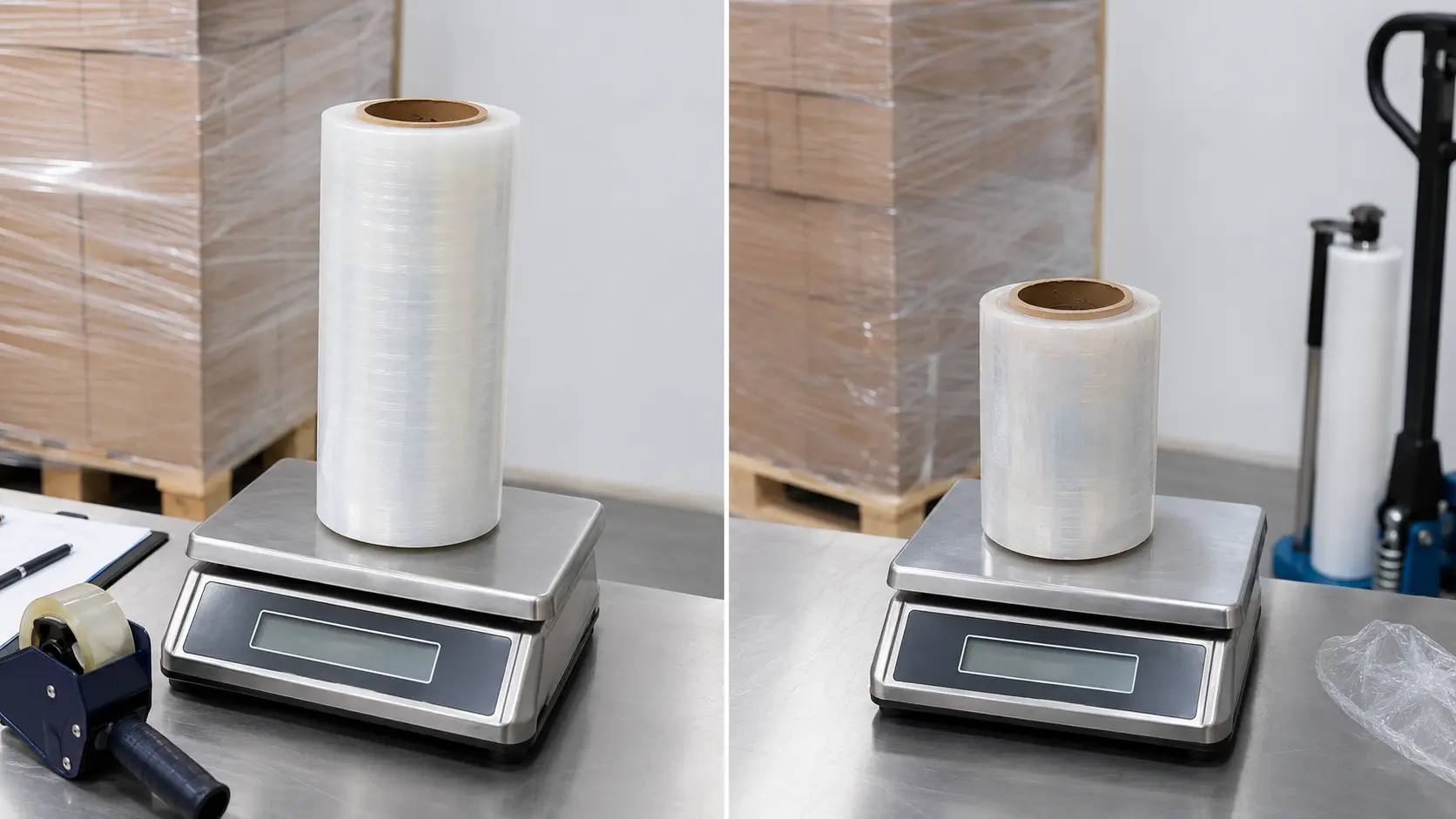
Film usage (kg/pallet) = (starting roll mass − ending roll mass) ÷ accepted pallets
If the starting and ending measurements use the same roll and core, core mass cancels. When measuring a full roll over its life instead, subtract the empty core from the gross roll mass to obtain net film mass.
For example, if a roll weighs 16.8 kg before a run and 12.0 kg afterward, 4.8 kg of film was consumed. If 20 accepted pallets were wrapped, measured usage is:
4.8 kg ÷ 20 pallets = 0.240 kg/pallet
Repeat the audit across enough normal loads and shifts to represent actual variation. A marked-line check can also estimate achieved stretch: mark an original length on the unstretched web, measure that line after application, and calculate (stretched length − original length) ÷ original length × 100. This practical procedure is described in the Packaging Blog usage guide and the Sumachay calculation guide. It is an operating check, not a tensile-property test.
Method 2: Estimate Usage From Pallet and Wrap Settings
When measured data are unavailable, estimate the stretched length applied to the load, then convert it back to unstretched roll length. Collect these inputs in one unit system:
- load length
Land widthW; - wrapped height
H; - film width
F; - overlap fraction
O, expressed as a decimal; - number of bottom and top revolutions;
- number of vertical passes;
- measured or verified pre-stretch percentage
S; - allowance for tails, clamps, breaks, and restarts.
For a rectangular load:
Pallet perimeter, P = 2 × (L + W)
The vertical advance per spiral revolution is approximately:
Rise per revolution, R = F × (1 − O)
If one pass travels the full wrapped height, the estimated spiral revolutions are:
Spiral revolutions = (H ÷ R) × number of vertical passes
A helical revolution is slightly longer than the horizontal perimeter because it also rises vertically:
Helical length per revolution = √(P² + R²)
The total stretched length applied is then:
Applied length ≈ P × (top revolutions + bottom revolutions) + helical length × spiral revolutions + tail/waste allowance
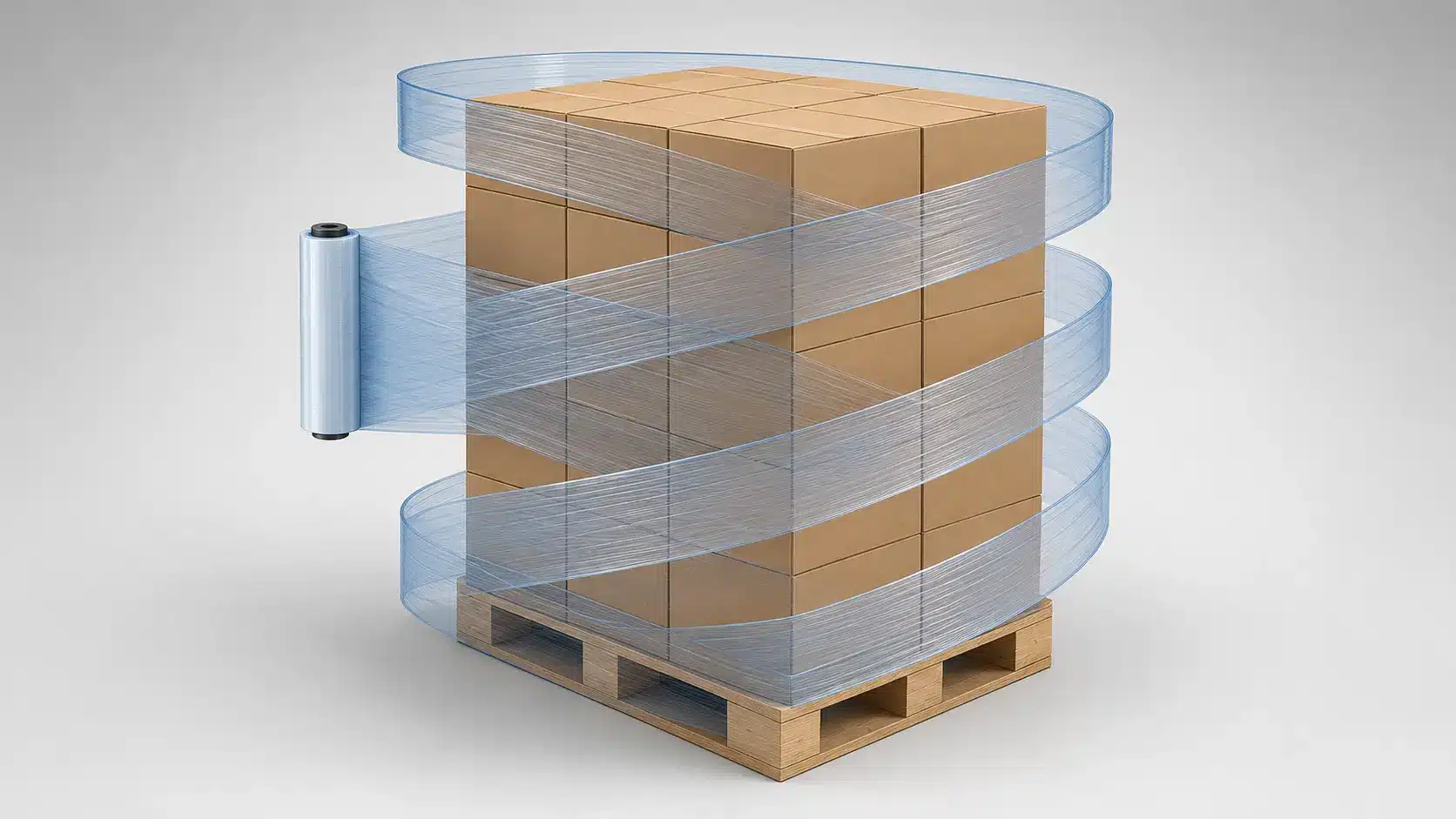
Finally, convert applied stretched length to original roll length:
Unstretched roll length consumed = applied length ÷ (1 + S/100)
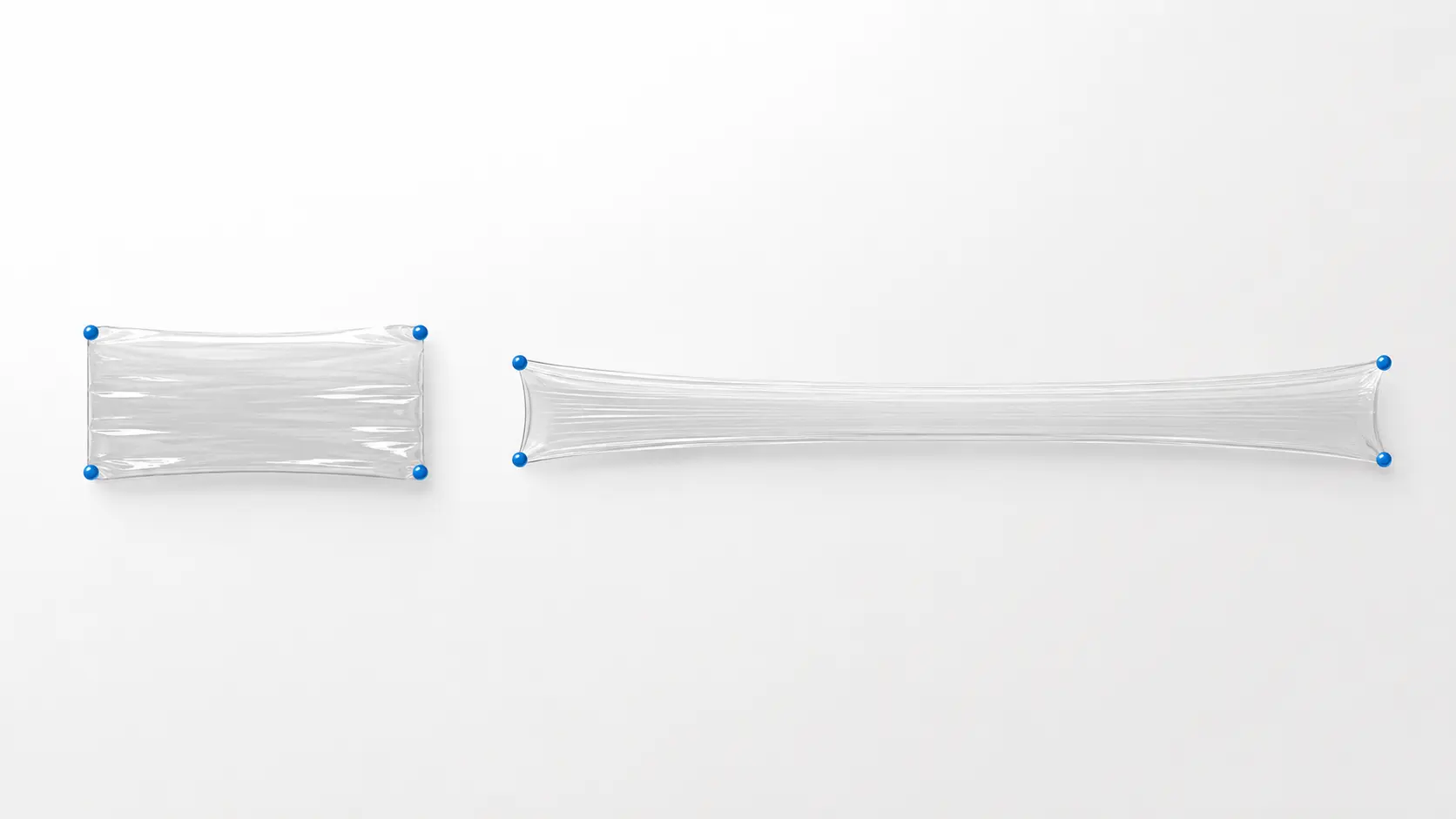
Under the elongation convention used here, 200% pre-stretch produces three times the original length, while 250% produces 3.5 times the original length. The same relationship is shown in guidance from U.S. Packaging & Wrapping and Robopac USA. Confirm how the machine, film supplier, or site defines its displayed percentage before using it.
Important: This geometry estimates material consumption. It does not determine the correct wrap recipe or prove that a load has adequate containment.
Irregular loads, protrusions, corner deformation, roping, banding, incomplete-height passes, and changing carriage speeds all move actual usage away from this simplified model.
Convert Film Length Into Mass
Mass equals volume multiplied by density. NIST defines mass density as mass divided by volume and gives the SI unit as kg/m³ in its Guide to the SI. For a uniform film web:
Film mass = width × thickness × unstretched length × density
With common metric packaging units, the shortcut is:
Mass (kg) = width (mm) × thickness (µm) × unstretched length (m) × density (g/cm³) ÷ 1,000,000
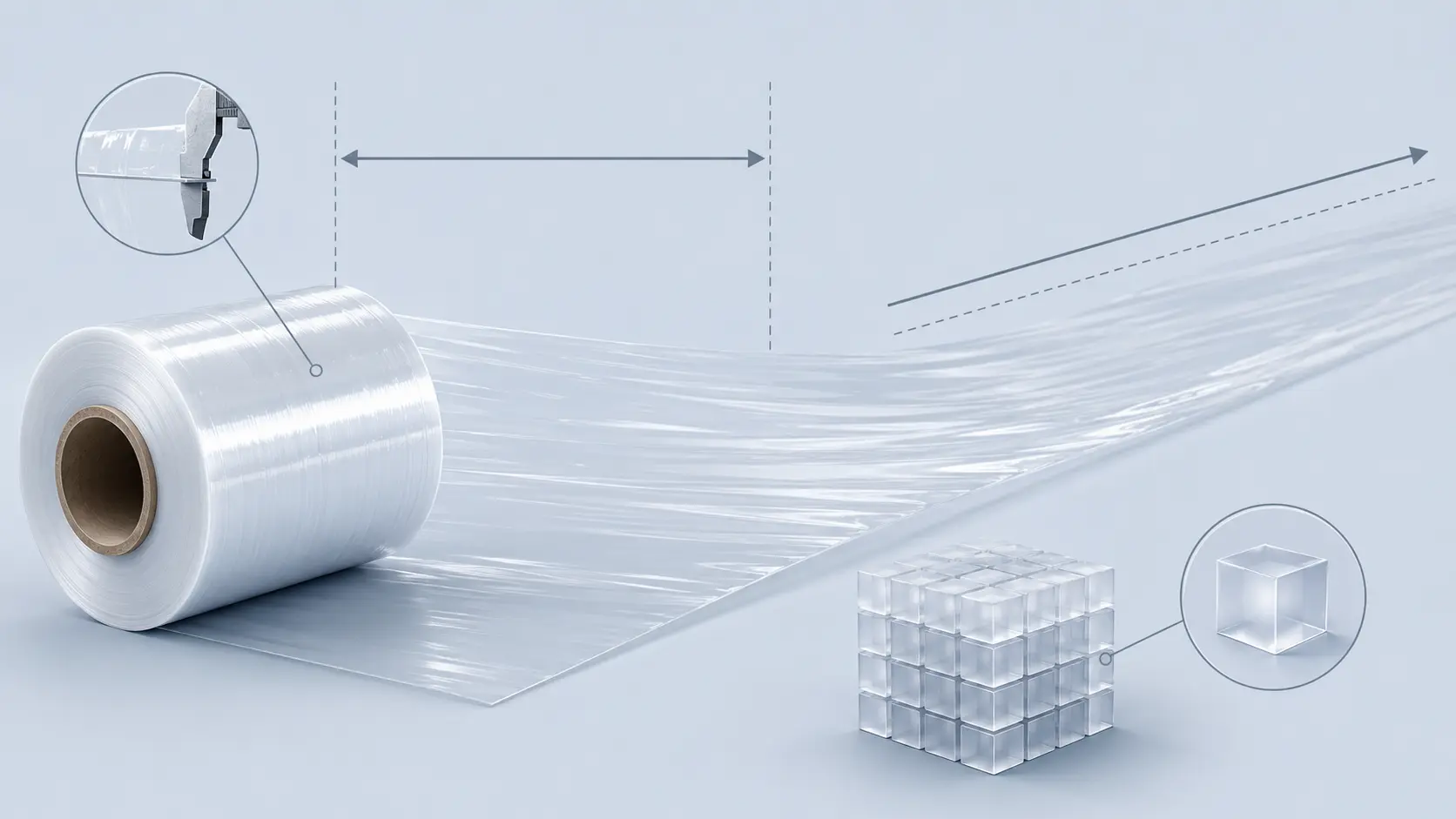
Every input must describe the same film:
- Use roll width, not pallet width.
- Use original nominal or measured thickness before application, not a stretched-web thickness.
- Use unstretched length taken from the roll, not stretched length on the load.
- Use density documented for the actual formulation or structure; do not assume that every stretch film has one universal density.
The equation is also a useful reasonableness check for roll specifications. It is not a substitute for weighing when thickness, density, roll length, or process losses are uncertain.
Worked Example: Monthly Usage and Roll Requirement
The following numbers are illustrative only. They are not recommended wrap settings and do not establish load safety.
- Rectangular load: 1.2 m long × 1.0 m wide × 1.5 m wrapped height
- Film width: 0.50 m
- Overlap: 50%, so rise per revolution is 0.25 m
- Vertical passes: two, one upward and one downward
- Bottom revolutions: three
- Top revolutions: two
- Tail and process allowance: 2.0 m of applied film
- Pre-stretch: 200%, using an applied-length multiplier of 3.0
- Film thickness: 20 µm
- Density used for this example: 0.92 g/cm³
- Monthly volume: 3,000 pallets
- Net film mass per roll: 16.0 kg
- Calculate perimeter:
2 × (1.2 + 1.0) = 4.4 m. - Calculate spiral revolutions:
(1.5 ÷ 0.25) × 2 = 12. - Calculate helical length:
√(4.4² + 0.25²) = 4.407 mper revolution. - Calculate applied length:
(4.4 × 5) + (4.407 × 12) + 2.0 = 76.88 m. - Convert to unstretched roll length:
76.88 ÷ 3.0 = 25.63 m. - Convert length to mass:
500 × 20 × 25.63 × 0.92 ÷ 1,000,000 = 0.236 kg/pallet. - Calculate monthly mass:
0.236 × 3,000 = 708 kg/month, rounded from the unrounded result. - Calculate roll demand:
708 ÷ 16.0 = 44.25 rolls, so at least 45 rolls are required before any inventory buffer.
Important: The result is an estimate built from assumed geometry, density, thickness, and achieved pre-stretch. Replace each value with a verified site input, then compare the result with a measured mass audit.
If the measured audit returns 0.240 kg per pallet, the estimated 0.236 kg is close enough to focus the investigation on normal process loss and rounding. If the difference is materially larger, examine the inputs and operating observations rather than forcing the measured result to match the model.
Calculate Cost per Pallet and Purchasing Volume
Use measured kg per pallet for purchasing once a representative audit is available.
Cost per pallet = measured kg per pallet × film price per kg
Monthly film mass = measured kg per pallet × pallets per month
Monthly rolls = monthly film mass ÷ net film mass per roll
Using the measured example of 0.240 kg per pallet, 3,000 pallets per month, a net roll mass of 16.0 kg, and an illustrative material price of 2.40 currency units per kg:
| Purchasing measure | Calculation | Result |
|---|---|---|
| Film cost per pallet | 0.240 × 2.40 | 0.576 currency units |
| Monthly film mass | 0.240 × 3,000 | 720 kg |
| Base monthly roll demand | 720 ÷ 16.0 | 45 rolls |
| Base monthly material cost | 720 × 2.40 | 1,728 currency units |
Round roll demand upward only after using unrounded mass values. Add a separately documented allowance for normal scrap, unusual load mix, supplier minimum order quantities, lead time, and safety stock. Keep freight, duties, cores, disposal, and other commercial items separate unless the quoted price explicitly includes them.
Comparing price per roll alone can be misleading when rolls have different net masses. Comparing cost per kg is better, but cost per accepted pallet is stronger because it also reflects the actual film consumed. Rocket Industrial illustrates this mass-based approach in its cost-per-load guide.
Why Estimated and Actual Usage Differ
Calculate the variance before changing the wrap recipe:
Usage variance (%) = (measured kg/pallet − estimated kg/pallet) ÷ estimated kg/pallet × 100
A difference is diagnostic, not automatically waste. Trace it through the likely causes:
- Measured use is higher extra top or bottom wraps overlap greater than assumed lower achieved pre-stretch long tails.
- Measured use is lower: fewer revolutions, smaller wrapped height, higher achieved pre-stretch, narrower overlap, shorter tails, or a lower actual mass per metre.
- Results vary by shift or line: recipe changes, load-family mix, equipment condition, operator technique, scale resolution, or incomplete recordkeeping.
- The model is consistently wrong: incorrect density, thickness, net roll mass, stretch convention, or a geometric assumption that does not match the actual film path.
Segment the audit by load.
Validate the Wrap, Not Just the Material Saving
Lower kg per pallet is valuable only when the applied wrap still performs its job. ASTM D4649-20(2025) covers guidance for stretch-film selection, specification, and application for indoor unitizing and palletizing. ASTM also lists D8314-20(2025) for performance testing of applied stretch films and stretch wrapping.
Warning: A consumption formula does not prove containment force, load stability, resistance to handling events, or transport suitability.
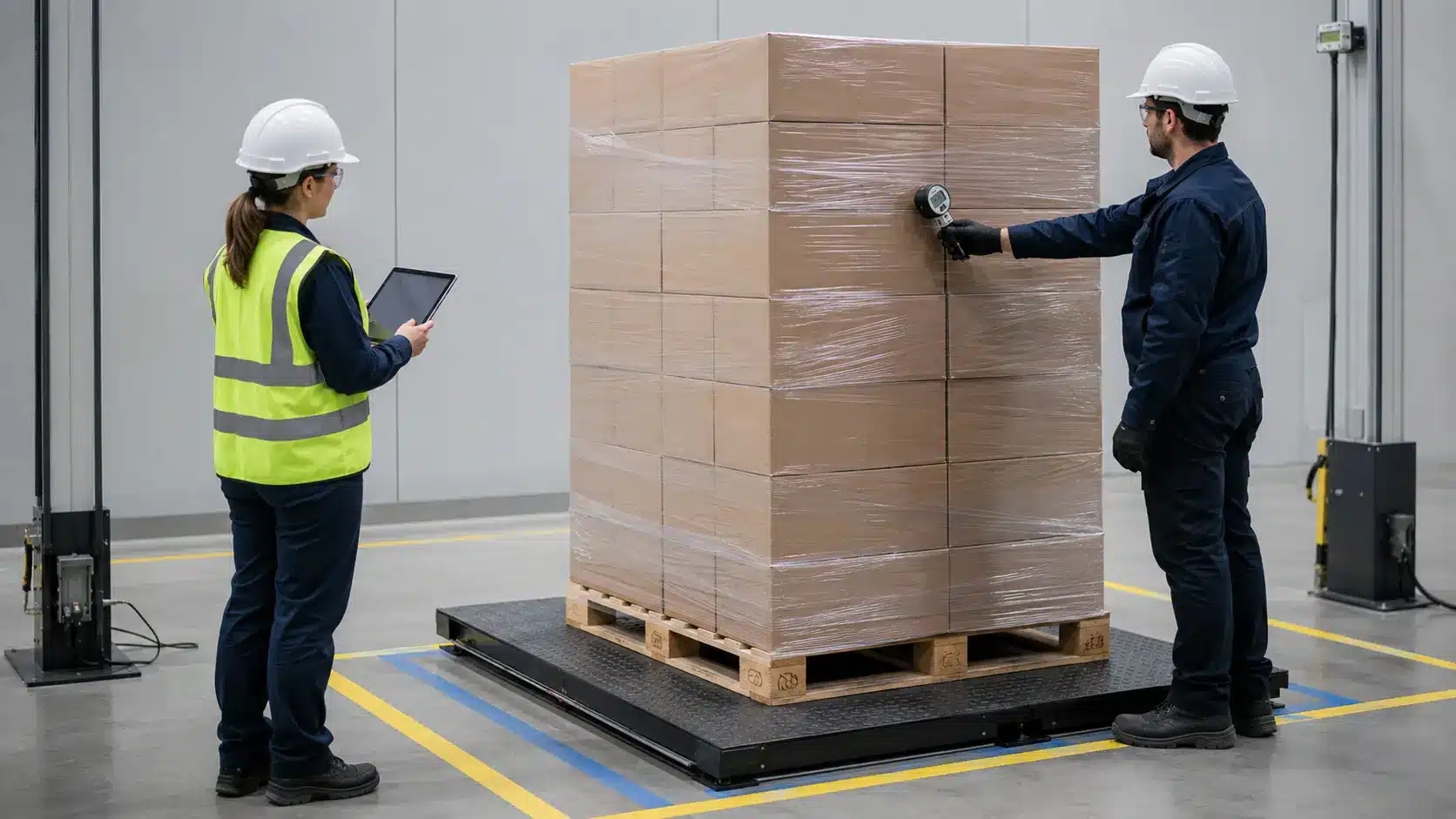
Before approving a reduced-consumption setting:
- define the load family and approved wrap specification;
- confirm actual pre-stretch, film breaks, overlap, and wrap placement;
- evaluate the applied wrap using methods appropriate to the load and distribution environment;
- document acceptance criteria, sample conditions, and results;
- revalidate after changing film, gauge, roll source, equipment, recipe, or load configuration.
ASTM scope information helps identify relevant guidance, but it does not certify a specific film, machine setting, pallet, or shipment. Outdoor exposure, extreme temperatures, sharp edges, and unstable loads require application-specific review.
Frequently Asked Questions
Does 250% pre-stretch mean 2.5 times or 3.5 times the original length?
Under the elongation convention used in this article, it means an increase equal to 2.5 times the original length, so the final length is 3.5 times the original. A 10 m original web therefore becomes 35 m. Confirm the convention used by the machine display or supplier before calculating.
Should core weight be included in film usage?
No, not when reporting film consumption. Use net film mass. If the same installed roll is weighed before and after a sample run, the unchanged core cancels. If gross full-roll mass is used, subtract the verified empty-core mass.
Can pallet dimensions alone predict exact usage?
No. Dimensions provide a geometric baseline, but exact usage also depends on film width, overlap, number and placement of revolutions, vertical passes, achieved pre-stretch, tails, breaks, irregular load shape, and the actual wrap program.
How many pallets can one roll wrap?
Divide net usable film per roll by measured film per pallet using the same unit. For mass, pallets per roll = net film kg per roll ÷ kg per pallet. For length, use unstretched roll length and unstretched length consumed per pallet. Round down for a conservative whole-pallet planning figure, then account separately for normal process loss.
Final Calculation Checklist
The most defensible result combines a measured baseline with a transparent estimate.
- Define the required output: kg per pallet, pallets per roll, rolls per month, or cost per pallet.
- Measure roll mass before and after a representative run and count accepted pallets.
- Record load dimensions, film width, overlap, revolutions, passes, tails, and achieved pre-stretch.
- If estimating, calculate applied length and divide by the verified stretch multiplier.
- Convert unstretched length to mass using matched width, thickness, and supplier-confirmed density.
- Forecast monthly mass and divide by verified net film mass per roll.
- Compare estimated and measured kg per pallet, then investigate the operating causes of the variance.
- Validate the applied wrap against the approved load and distribution requirements before reducing film.
Keep the raw measurements, unit conversions, assumptions, and acceptance results together. That record turns a one-time calculation into an auditable consumption baseline without mistaking lower material use for proven load performance.
Related Bestypack Resources
- How Many Pallets Can One Roll of Stretch Film Cover?
- Select the Appropriate Stretch Film Width and Thickness
- Shrink Wrap vs. Stretch Wrap: What’s the Difference?
- Black Stretch Wrap Film
- Stretch Film Thickness: What You Need to Know
- How to Reduce Stretch Film Thickness to Cut Costs?
- Machine Stretch Film Blown & Cast
Related Bestypack Resources
- How Many Pallets Can One Roll of Stretch Film Cover?
- Select the Appropriate Stretch Film Width and Thickness
- Shrink Wrap vs. Stretch Wrap: What’s the Difference?
- Black Stretch Wrap Film
- Stretch Film Thickness: What You Need to Know
- How to Reduce Stretch Film Thickness to Cut Costs?
- Machine Stretch Film Blown & Cast
 English
 Japanese
 French
 Spanish
 Korean
 Italian
 Portuguese
 Dutch
Dutch Arabic
 Russian
 German