
Flexible packaging film is not made by one universal line or one fixed recipe. A finished web may be extruded, oriented, treated, printed, coated, laminated, cured, slit, and converted, but the actual route depends on the package specification. The most reliable way to understand the process is to follow the controlled handoffs: each stage receives a defined input, changes the web in a measurable way, and releases it only after the relevant checks are complete.
The Process Starts with Packaging Requirements
For environmental claims, compare the design with the U.S. EPA’s recycling guidance and the actual local collection system.
For environmental claims, compare the design with the U.S. EPA’s recycling guidance and the actual local collection system.
Manufacturing begins before resin enters an extruder or an incoming film roll reaches a press. The first task is to translate the packed product, distribution route, filling operation, and target market into requirements that can be specified and verified. Without this step, a technically well-run line can still produce the wrong film.
Translate the product into measurable inputs
The design team should define the conditions the packaging must face, including:
- the product’s sensitivity to oxygen, moisture, light, aroma loss, grease, or chemicals;
- the filling process, fill temperature, sterilization or pasteurization exposure, if applicable;
- the package format, seal geometry, opening method, and required stiffness or flexibility;
- the packing-line direction, web width, registration needs, friction behavior, and sealing method;
- distribution loads, storage temperature and humidity, expected handling, and target shelf life;
- graphic appearance, transparency, gloss, surface feel, and print-protection needs; and
- the destination market, food-contact conditions, migration scope, labeling rules, and sustainability claims that require documentation.
These inputs describe risks and interfaces. They do not automatically select a polymer or prove a performance level. For example, a request for “high barrier” is incomplete until the permeant, target rate, test method, temperature, relative humidity, thickness, test side, and unit are defined.
Lock the material and process specification
The next step is to convert the inputs into a controlled specification. That record may identify the polymer or incoming substrate, layer order, total and layer thicknesses, treatment side, print side, coating or adhesive system, winding direction, finished width, roll length, core, splice rules, sampling plan, test methods, and acceptance criteria. For a laminate, it should also make the layer sequence unambiguous.
Important: A material name such as PE, PP, PET, PA, EVOH, or “metallized film” does not by itself prove barrier, sealability, heat resistance, food-contact status, or recyclability. Those conclusions depend on the exact structure, additives, thickness, processing history, test conditions, application, and market.
The approved specification becomes the common reference for raw-material release, production recipes, in-process checks, final testing, labeling, and change control. If a converter buys pre-made film rather than extruding it, the same logic applies: the incoming web must be identified and released against the agreed requirements before further processing.
Forming the Base Film
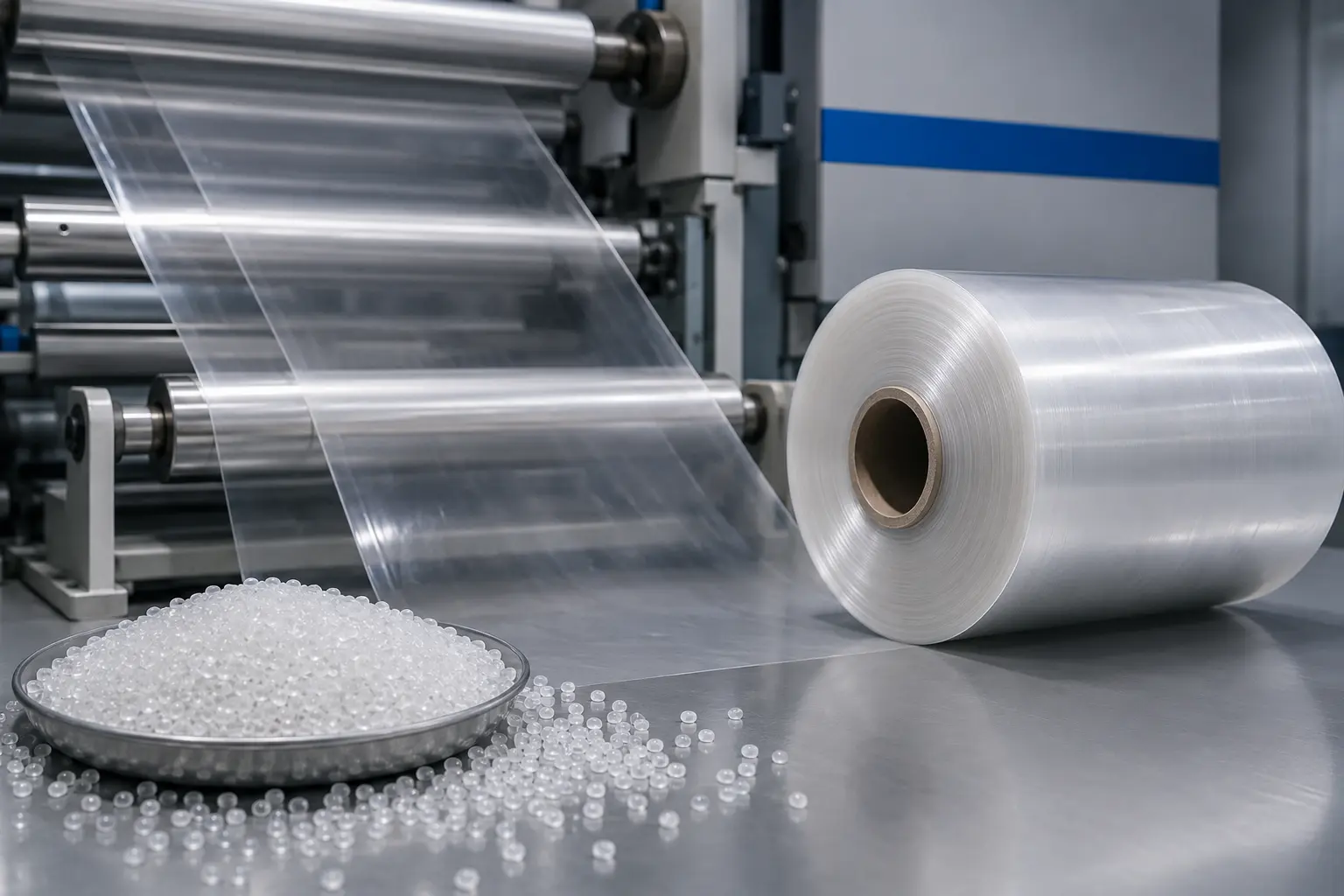
Film formation turns a polymer formulation into a continuous web. Resin handling, melting, filtration, flow distribution, cooling, thickness control, and winding all influence how consistently the web can be printed, laminated, slit, sealed, or run on a packaging machine. The three routes below describe different process architectures; they are not interchangeable guarantees of final performance.
Blown-film extrusion
In blown-film extrusion, one or more molten polymer streams pass through an annular die to form a tube. Air inflates the tube into a bubble while external or internal cooling removes heat. The bubble is stabilized, collapsed through a frame, drawn through nip rolls, and wound as layflat tubing or slit into webs.
Operators control variables such as melt condition, output, air flow, cooling, bubble geometry, haul-off, thickness profile, and winding. A coextrusion line can place different polymers in separate layers, but the number and identity of layers must come from the actual structure specification. Bubble behavior and cooling history affect gauge profile, optical appearance, mechanical balance, and downstream web handling, so release should be based on measured results rather than a general statement about “blown film.”
Cast-film extrusion
In cast-film extrusion, molten polymer leaves a flat die as a wide sheet and contacts a temperature-controlled chill roll. Rapid, controlled cooling solidifies the web before it passes through edge control, optional treatment, thickness measurement, trimming, and winding.
The route provides a direct flat-web path and can support close control of the die profile and winding geometry. However, actual clarity, gloss, thickness variation, friction, seal response, and mechanical properties depend on the formulation, layer design, cooling, line conditions, and test method. A cast route should therefore be selected through structure-specific trials, not through an assumption that every cast film behaves alike.
Biaxially oriented film
Biaxially oriented films add a controlled stretching sequence after an initial sheet is formed. Depending on the process, the web is stretched in the machine direction and transverse direction, then heat-set or otherwise stabilized before treatment, winding, and slitting. BOPP and BOPET are familiar examples, but the polymer, draw conditions, coating, and final layer design determine the usable result.
Orientation can substantially change dimensional, optical, and mechanical behavior. It can also create direction-dependent results. Tensile, shrinkage, tear, and dimensional data therefore need clearly identified machine-direction and transverse-direction methods and conditions. An oriented substrate may later be printed, coated, metallized, or laminated; those downstream operations create a new structure that must be evaluated as such.
Surface Preparation and Printing
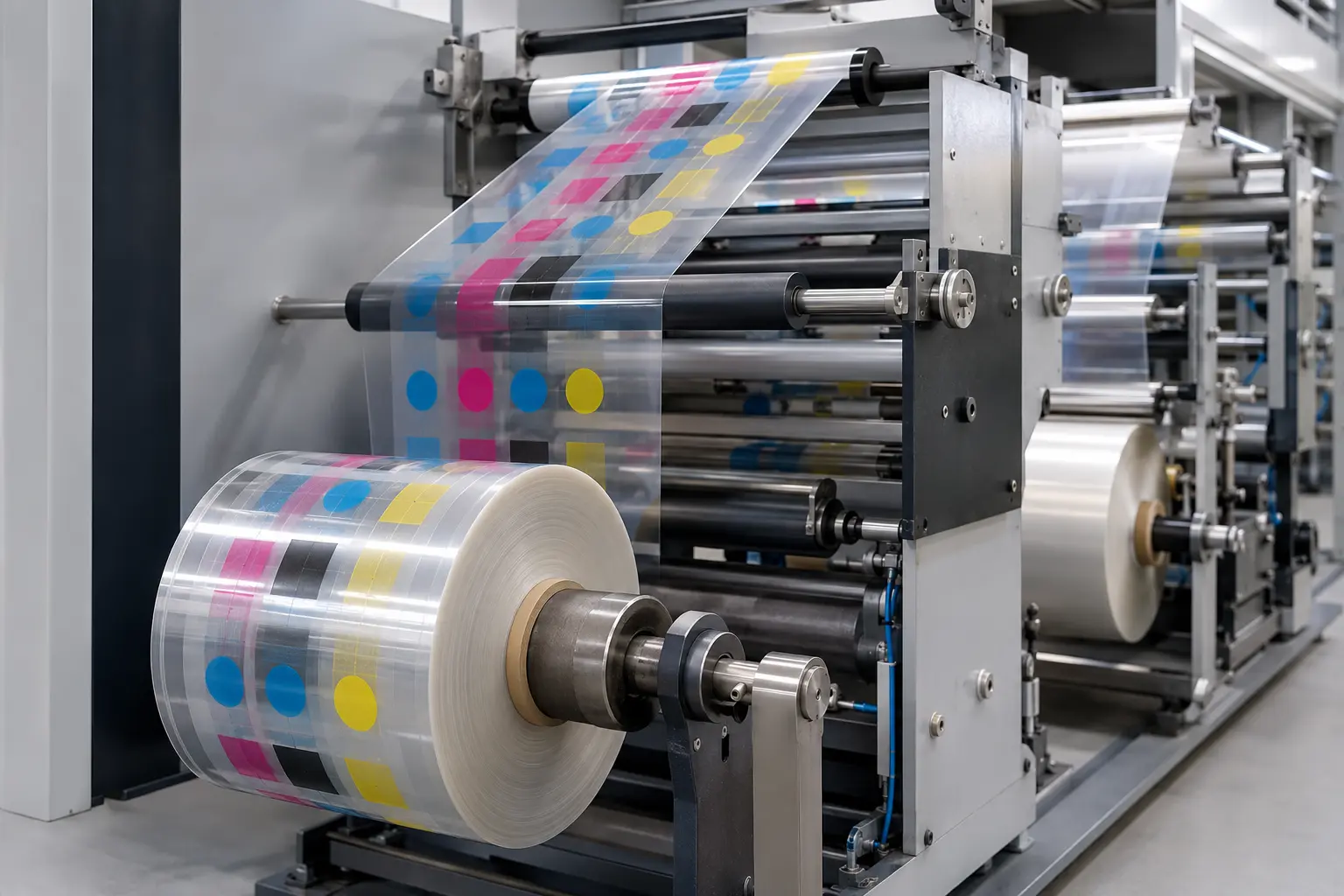
Printing places graphics and functional information on a moving web. Good print output depends on more than artwork: the substrate surface, treatment age, web tension, registration control, ink system, drying or curing capacity, and inspection plan must work as one process.
Surface treatment and web preparation
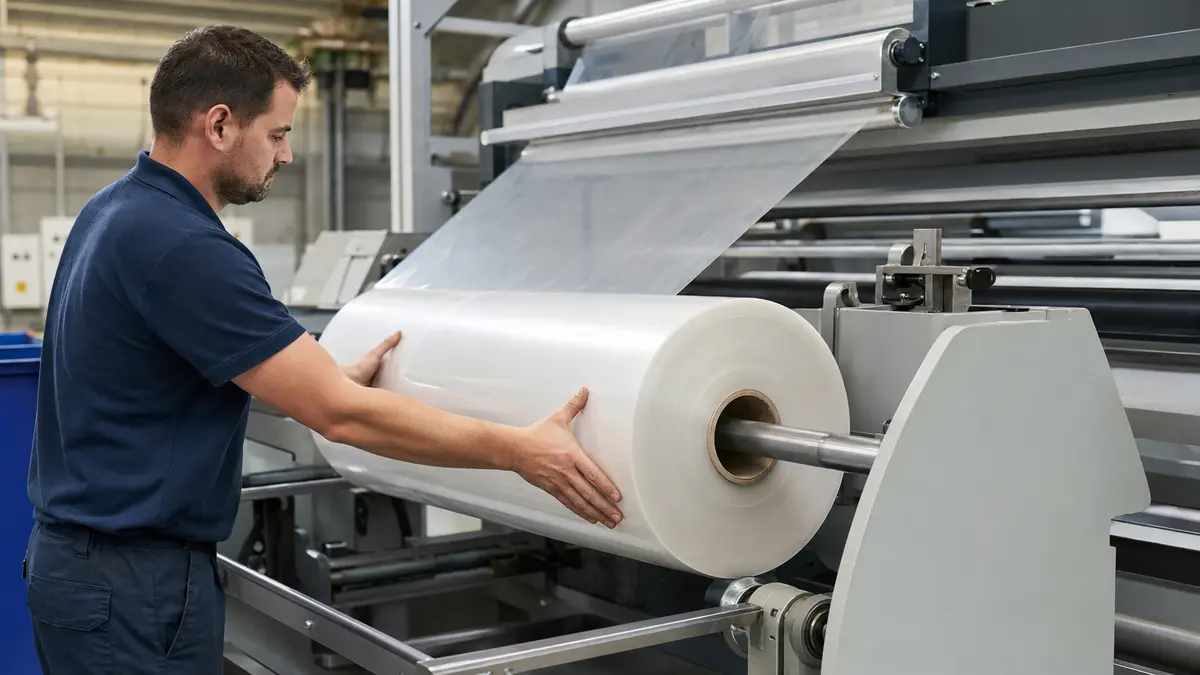
Before printing or coating, the incoming roll is checked against its identity, surface, width, winding, and defect requirements. The web is then unwound through controlled tension and guidance zones. Treatment such as corona or another approved method may be used when the substrate and ink or coating system require greater surface receptivity. The treated side and treatment status must remain traceable.
Web handling matters because a thin film can stretch, wrinkle, wander, or trap air if tension and alignment are poorly matched. The production record should connect the incoming roll ID, treatment condition, setup, and inspection result. A nominal treatment value alone is not a permanent promise of adhesion; the substrate, aging, storage, ink or coating, and measurement method also matter.
Printing and drying
A typical printing sequence is:
- Approve the artwork, color targets, repeat length, print side, and registration standard.
- Load and identify the released substrate roll, then establish stable web tension and guidance.
- Meter and transfer the approved ink system through the selected flexographic, gravure, digital, or other validated process.
- Dry or cure each color or coating sufficiently for the line speed and downstream process.
- Inspect registration, color, defects, and repeat consistency while keeping the printed roll traceable.
The U.S. EPA describes flexography as a relief-printing process in which raised flexible plate surfaces transfer ink to a substrate and notes its suitability for flexible packaging materials. That process description does not select an ink, dryer setting, treatment level, or color tolerance. Those values belong to the approved ink-substrate system and the converter’s validated operating window.
Coating and Lamination
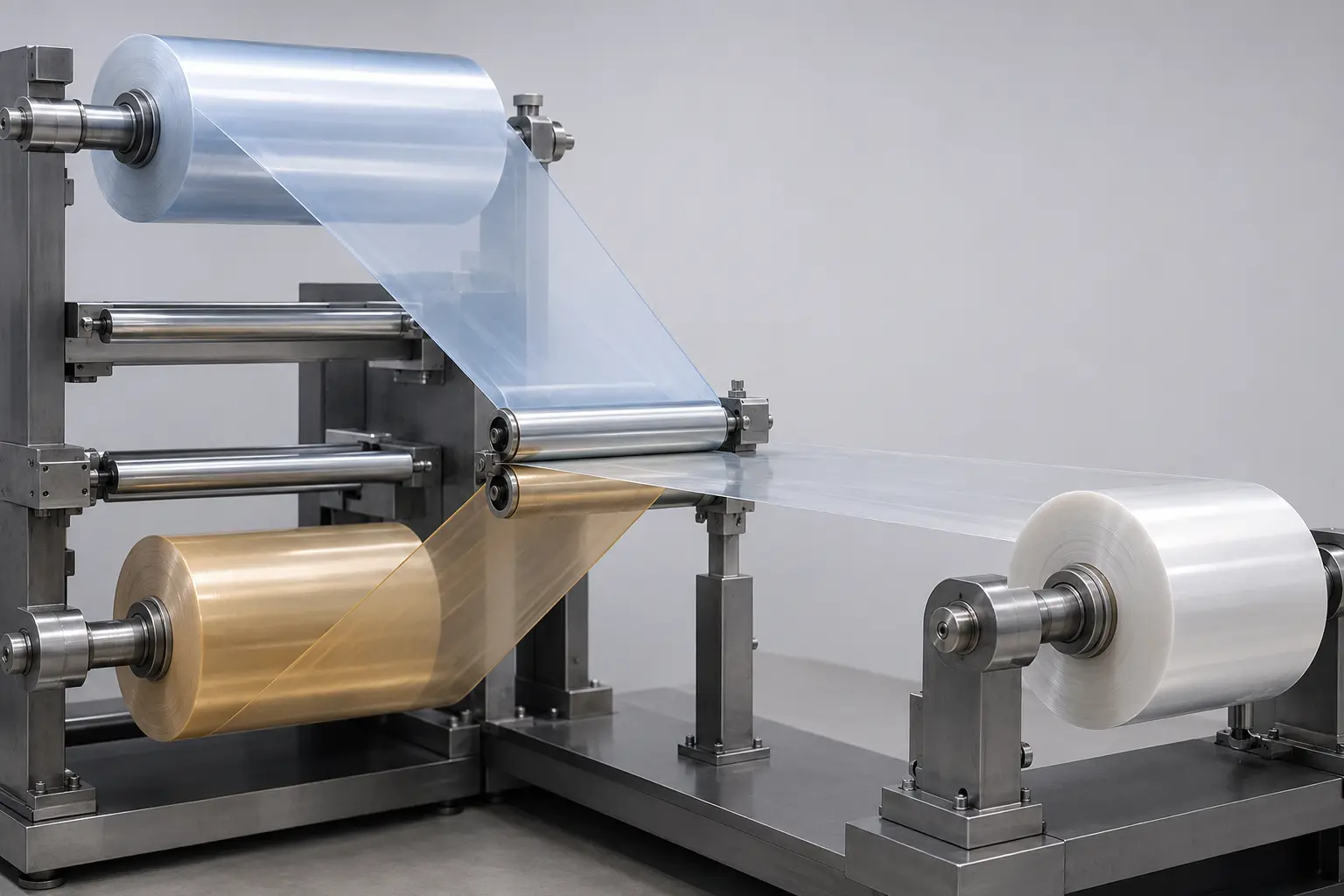
Many packages need functions that one web does not provide alone. Coating can add a defined surface function, while lamination combines two or more webs into one structure. Layer order matters: the outside, print location, barrier layer, sealant, adhesive or tie layer, and product-contact side must match the approved construction.
Adhesive lamination
In adhesive lamination, an adhesive is metered onto one web, and another web is joined under controlled pressure and tension. Depending on the system, solvent or water may be removed before the webs are combined, or a solventless reactive adhesive may develop its properties after lamination. The exact mixing, coat weight, drying, nip, winding, and curing conditions come from the adhesive supplier data and the validated structure.
The process record should link both parent rolls, the adhesive batch or components, mix data where applicable, coating and line conditions, the laminated roll ID, and required cure or conditioning status. Bond evaluation must consider the actual substrate pair, treatment, print coverage, adhesive, cure condition, and test method. A value from another structure cannot be transferred automatically.
Extrusion lamination and coating
Extrusion lamination introduces a molten polymer layer between webs and joins them at a nip, while extrusion coating applies a molten polymer to a substrate to form a coated web. Resin selection, melt condition, air gap, substrate preparation, nip conditions, cooling, and line speed interact with adhesion and finished-web behavior.
These routes can combine or coat films, paper, foil, or other approved substrates, but they do not eliminate the need for compatibility trials and end-use testing. A tie layer, primer, or surface treatment may still be required, depending on the construction.
Warning: Lamination does not automatically prove barrier, migration safety, seal performance, or package integrity. Those claims require the exact finished structure, complete process condition, appropriate conditioning or cure, and application-specific test evidence.
Curing, Slitting, Inspection, and Rewinding

Finishing converts a master roll into stable, identified rolls that meet the next process or customer interface. When curing or conditioning is required, starting downstream work too early can produce misleading bond results or create defects later. The approved material system, not a generic industry time, determines when the roll is ready.
A controlled finishing sequence is:
- Hold, cure, or condition the roll under the approved time and environmental requirements, and record when it becomes eligible for further processing.
- Verify roll identity, structure, cure status, and the slitting plan before loading it.
- Unwind the master roll with appropriate tension, guidance, and defect inspection.
- Trim edges and slit the web to the specified finished widths while managing debris, edge quality, and lane position.
- Rewind each lane to its specified direction, core, roll length or diameter, splice rules, and roll-build requirements.
- Inspect the finished rolls, assign unique roll IDs, label them, protect them for storage or transport, and link them to the parent roll and production record.
Slitting is more than cutting to width. Poor tension isolation, spreading, alignment, or winding can create telescoping, wrinkles, scratches, blocking, loose edges, or rolls that do not unwind consistently. The acceptable width tolerance, splice count, defect level, and roll geometry must be stated in the agreement; no single set of numbers fits every film or machine.
Converting Rollstock into Packaging Formats
Some manufacturing scopes end with printed or laminated rollstock. Others continue into premade pouches, bags, lidding, labels, or machine-ready components. This distinction matters because conversion introduces new geometry, seals, cuts, holes, and sometimes rigid fitments. It also changes what must be tested.
Pouch and bag making
A pouch machine unwinds the released web, guides it through forming, creates longitudinal and transverse seals as required, cools or stabilizes the seals, and cuts the web into individual packages. Registration controls connect the printed graphics to the cut and seal positions. Zippers, tear notches, hang holes, valves, or other approved features may be added in the designed sequence.
Seal temperature, pressure, dwell time, jaw design, web speed, layer orientation, and cooling interact. A laboratory seal-strength method such as ASTM F88/F88M can measure the force required to separate a strip containing a seal and can support process control, but the result is conditioned by specimen geometry and material behavior. It does not, by itself, prove leak tightness, opening experience, transport survival, or full-package integrity.
Fitments and final-package operations
Spouts, caps, valves, or other fitments create interfaces between flexible and rigid components. Their insertion and sealing require compatible materials, controlled alignment, a validated thermal or joining process, and package-level inspection. Filling may be a separate customer or co-packer operation and should not be presented as an inherent film-manufacturing step.
Final-package validation can include seal inspection, leak or integrity testing, dimensional checks, opening-force evaluation, filled-pack trials, distribution testing, and shelf-life work as appropriate. The method must match the package format and risk. A tensile, barrier, or seal result measured on flat film cannot automatically represent a formed, filled, and transported package.
Quality Control Is a Series of Gates
Quality control is most effective when each stage checks the characteristics it can create or disturb. Waiting until final inspection makes it harder to isolate the source of a problem. The control plan should therefore connect incoming release, process monitoring, intermediate roll approval, finished-film testing, and—when applicable—package validation.
In-process controls
Common in-process checks include resin.
Automated inspection and measurement can improve coverage, but they do not replace a defined sampling plan, calibrated equipment, response rules, or disposition authority. A detected deviation needs a documented action: adjust, segregate, rework under approval, investigate, or reject.
Final release tests
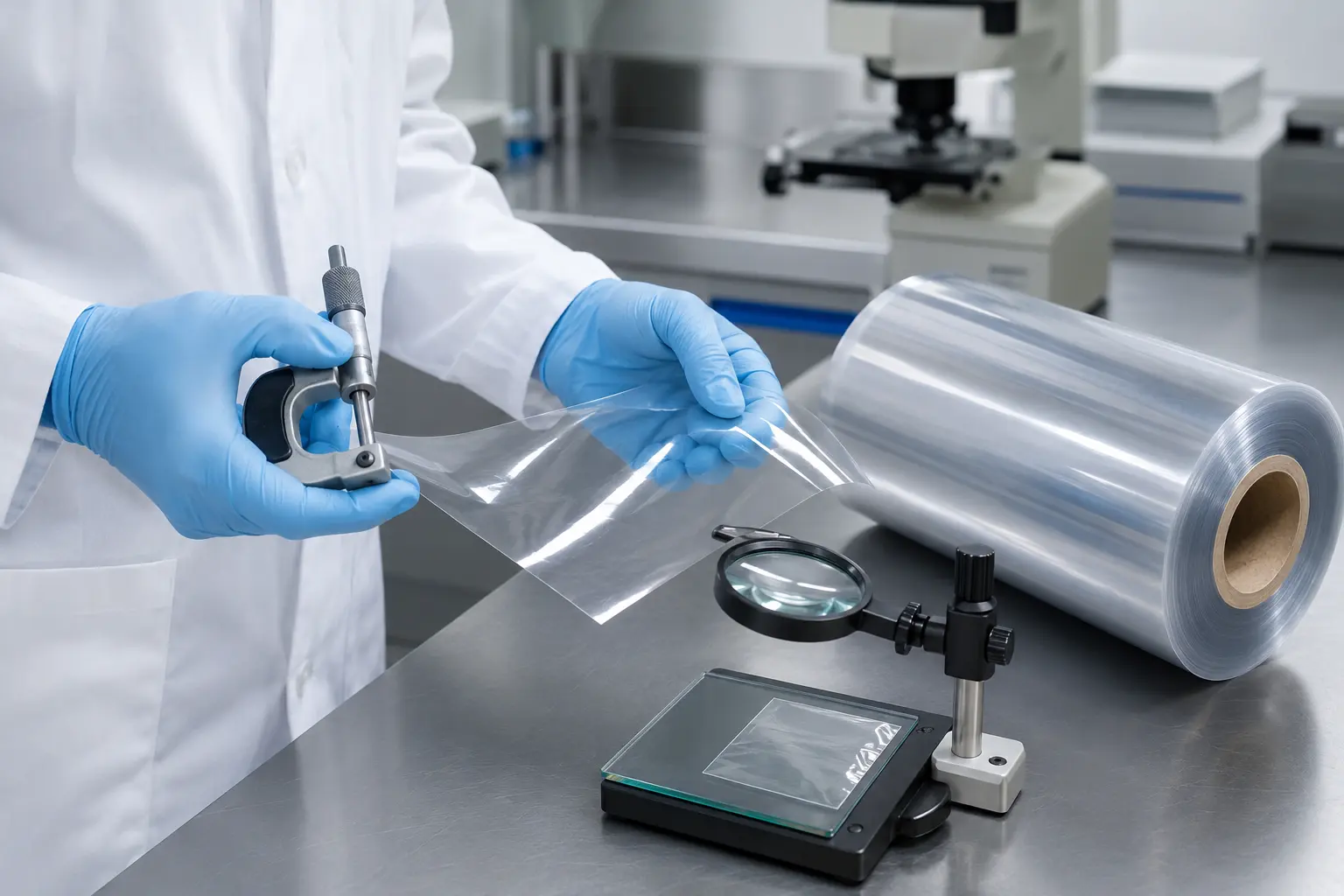
The final test set should be chosen from the risks in the specification. The examples below show what a method can address and what still must be agreed.
| Control question | Example method or check | Conditions that must be recorded | Boundary |
|---|---|---|---|
| Is thickness within the agreed profile? | Specified mechanical or non-contact thickness method | instrument, points, direction, units, statistics | One average can hide cross-web or down-web variation. |
| How does the film respond in tension? | ASTM D882 or an agreed ISO method | thickness, specimen direction, conditioning, speed, units | Results from different methods or MD/TD directions are not directly interchangeable. |
| Is the surface friction suitable for handling? | ASTM D1894 or agreed method | surface pair, orientation, specimen age, conditioning, speed | COF can change with surface, process history, additives, and aging. |
| Does a transparent film meet optical needs? | ASTM D1003 or agreed method | specimen state, conditioning, instrument procedure | Haze or transmittance does not prove print appearance or barrier. |
| What is the oxygen transmission rate? | ASTM D3985 or another agreed method | structure, thickness, temperature, relative humidity, test side, gas, units | OTR alone does not establish shelf life or whole-package performance. |
| What is the water-vapor transmission rate? | ASTM F1249 or another agreed method | structure, thickness, temperature, relative humidity, test side, units | WVTR results are condition-dependent and should not be generalized across structures. |
Note A test standard identifies a method not a universal acceptance limit Purchaser and supplier should agree on the current edition sampling specimen preparation conditioning units and acceptance criteria If the.
What Buyers Should Specify and Verify
A useful purchase specification connects the finished format to the evidence needed for release. Before approval, buyers should:
- provide the product, contact conditions, filling process, package drawing, machine interface, distribution environment, and target market;
- identify the exact structure or require the supplier to return a controlled layer sequence, total and layer thicknesses, treatment and print sides, coating or adhesive system, and sealant;
- define roll width, length or diameter, core, winding direction, splice rules, registration, defect criteria, sampling, units, and acceptance limits;
- request test reports that name the actual product or construction, sample or batch, method edition, conditions, direction, units, date, and laboratory;
- separate film-level evidence from seal, pouch, filled-package, distribution, and shelf-life evidence;
- verify food-contact or migration documentation against the exact structure, intended food or product, time, temperature, and destination market;
- require support for recyclability, recycled content, bio-based, or compostability claims at the finished-package level and in the intended collection or certification system;
- run print, lamination, sealing, and packing-line trials under documented conditions before commercial approval;
- approve a reference sample and keep its relationship to the specification and production lot clear; and
- establish change notification for resin grade, layer structure, additive, ink, adhesive, treatment, process route, site, test method, or other controlled input.
This checklist does not replace supplier qualification or application trials. Its purpose is to prevent a broad description such as “laminated PE film” from standing in for a complete, testable agreement.
Frequently Asked Questions
Does every flexible package go through every manufacturing step?
No A simple monolayer roll may be extruded treated slit and wound without printing or lamination A converter may purchase an oriented or cast substrate and begin with printing A printed laminate may be delivered as rollstock instead of being made into pouches The correct route.
What is the difference between film manufacturing and converting?
Film manufacturing commonly refers to forming a base web from polymer, for example by blown or cast extrusion or by an orientation process. Converting changes an existing web through treatment, printing, coating, lamination, slitting, rewinding, perforation, or package making. Companies use the terms differently, so the purchase order should state the exact start material and delivery format.
Which tests should appear in a flexible film specification?
It depends on the risks and application. Dimensions and roll construction are usually fundamental. Mechanical, optical, friction, barrier, seal, migration, package-integrity, and distribution tests should be added only when they answer a defined requirement. Each entry needs a method, edition, specimen condition, direction where relevant, units, sampling rule, and acceptance criteria. A copied list of test names without those details is not a complete control plan.
A Controlled Process Produces a Verifiable Film
The manufacturing process for flexible packaging film is best understood as a chain of controlled transitions. Requirements define the structure; film formation creates the base web; printing, coating, and lamination add designed functions; curing, slitting, and rewinding prepare stable rolls; and optional package conversion creates seals and final geometry. Quality gates connect the stages through traceable records and condition-specific tests.
Before approving a film, verify the exact construction, process scope, test methods, application conditions, package-level responsibilities, and change controls. That evidence—not a generic material name or process label—is what makes the finished film suitable for technical review.
Related Bestypack Resources
- BOPP Thermal Lamination Film
- Laminating Film Guide: What You Need to Know
- Differences:BOPP Film VS BOPET Film VS BOPA Film
- Polyester Film vs. PET Film: What Are the Differences?
- BOPP film: The Perfect Flexible Packaging Solution
 English
 Japanese
 French
 Spanish
 Korean
 Italian
 Portuguese
 Dutch
Dutch Arabic
 Russian
 German