
Plastic film is not one material but a broad group of thin polymer webs engineered for packaging, protection, processing, and technical uses. The right choice depends on more than the polymer name: grade, orientation, additives, coating, layer structure, thickness, converting method, equipment, and test conditions all affect performance. This guide compares common film families, explains their typical advantages and applications, and shows buyers how to turn a general material preference into a measurable specification and validation plan.
What Is Plastic Film?
For regulatory context, consult the U.S. FDA’s food-packaging guidance before approving an intended food-contact use.
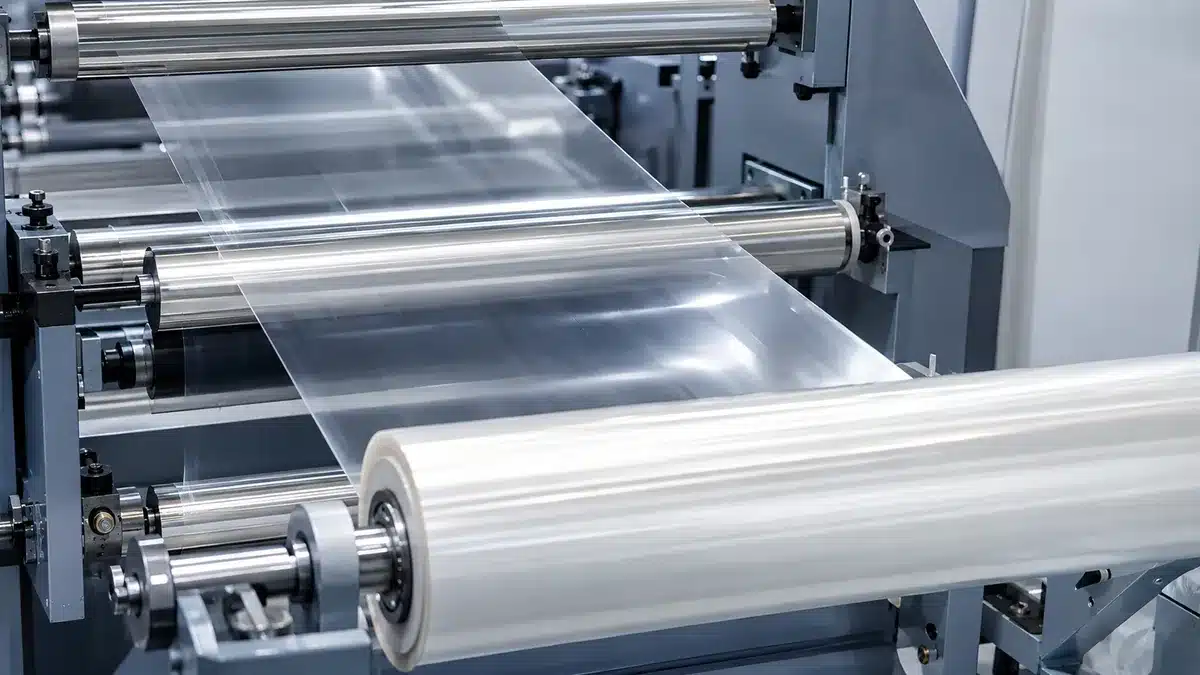
Plastic film is a continuous, flexible polymer web made by processes such as blown-film extrusion, cast extrusion, or extrusion followed by orientation. It may be supplied as a single layer, a coextruded structure, a coated or metallized substrate, or one web within a laminate. That construction—not the polymer name alone—determines what the film can reliably do in a specific package or process.
Film, Sheet, Grade, and Package Structure Are Different Terms
- Film
- A thin, flexible web. The exact film-versus-sheet boundary can depend on the referenced standard or commercial convention, so thickness should always be stated rather than inferred from the name.
- Polymer family
- The base chemistry, such as polyethylene (PE), polypropylene (PP), polyethylene terephthalate (PET), or polyamide (PA).
- Grade
- A specific resin or film formulation, which may include seal, slip, anti-block, anti-fog, UV, static-control, or other functions.
- Film structure
- The layers within one film, including their sequence, thicknesses, tie layers, additives, coatings, and surface treatments.
- Package structure
- The complete combination placed into service—for example, a printed outer web, barrier layer, adhesive, and sealant web formed into a pouch.
These terms should not be used interchangeably. A statement about a PET resin does not automatically describe a coated BOPET film, and a result for one laminated pouch cannot be transferred to every package containing the same polymer.
Why the Same Polymer Can Produce Different Film Performance
Molecular architecture, resin density, comonomer content, additives, orientation, crystallinity, thickness, and surface treatment can change how films made from the same polymer behave. Manufacturing variables can also create direction-dependent properties: the machine direction (MD) and transverse direction (TD) may not have the same tensile, tear, or shrink response.
Important: Treat a film-family description as a shortlisting aid, not a specification. Final claims should be tied to an identified grade and structure, a test method and edition, specimen conditioning, thickness, direction, units, and acceptance criteria.
How Manufacturing and Layer Structure Change Film Performance
Manufacturing route and layer construction are separate design decisions. The first shapes the web; the second combines functions. A useful comparison therefore asks both “How was this film made?” and “What role does each layer perform?”
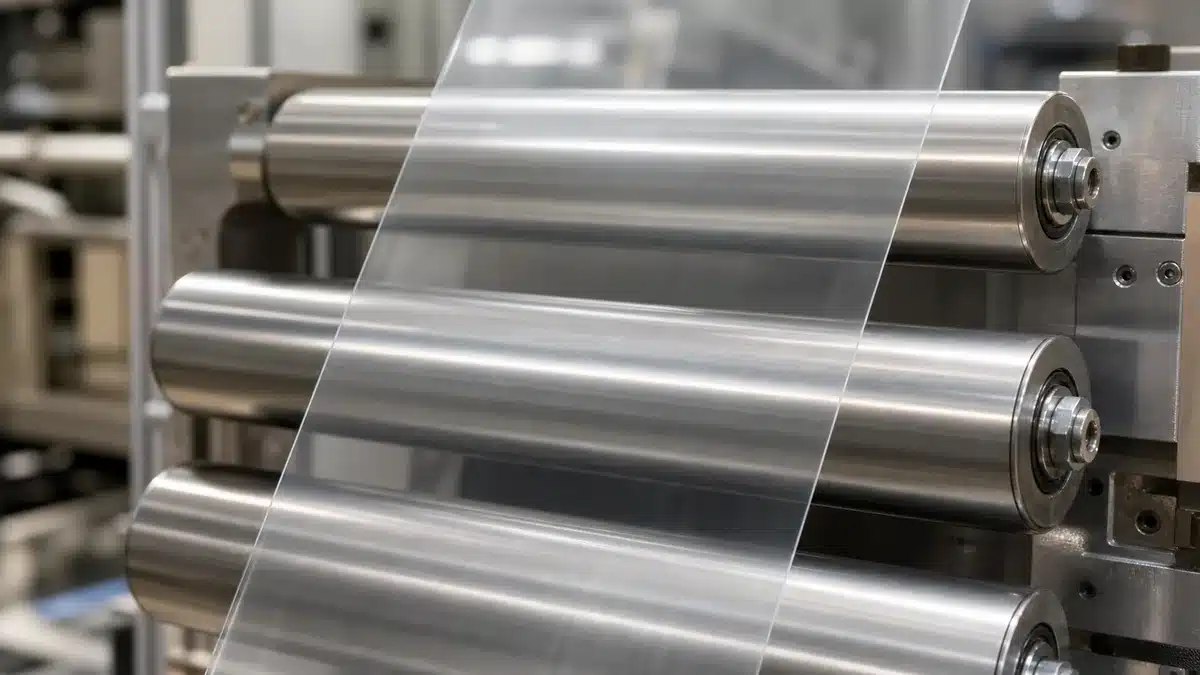
Blown, Cast, and Oriented Films
In blown-film extrusion molten polymer exits an annular die expands as a bubble cools and is collapsed into a web The process is widely used for PE films and can produce single or multilayer structures The balance between MD and TD properties depends on.
Cast-film extrusion sends the melt through a flat die onto chilled rolls. It is commonly associated with good gauge control and optical quality, although actual performance still depends on resin, die design, cooling, and line settings. CPP and many cast PE films are produced this way.
Orientation stretches a film in one or two directions and then stabilizes the structure. Biaxially oriented materials such as BOPP, BOPET, and BOPA are engineered for attributes such as stiffness, dimensional behavior, strength, or optics. The effect is not universally positive: orientation can also change tear propagation, shrink behavior, sealability, and directional balance.
Monolayer, Coextruded, Laminated, Coated, and Metallized Structures
- Monolayer film uses one continuous material formulation. It can be simple to specify, but one layer may not provide every required function.
- Coextruded film forms multiple molten layers in one film-making process. Individual layers may provide seal, toughness, stiffness, barrier, or adhesion functions.
- Laminated film bonds two or more prepared webs. This can combine a printable outer web with a barrier or sealant layer, but adhesives, curing, bond strength, and the complete layer sequence become part of the specification.
- Coated film adds a functional surface, such as a seal, barrier, primer, release, or print-receptive coating. Coating identity, coat weight, continuity, and compatibility matter.
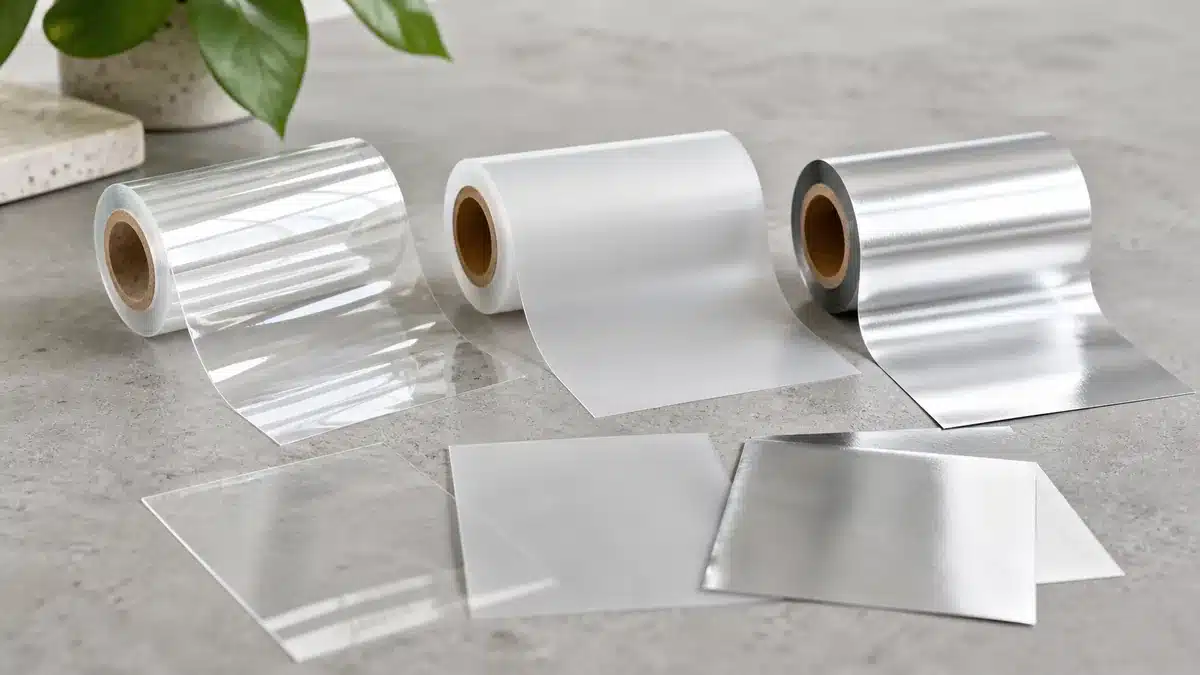
- Metallized film applies a thin metal layer, commonly to an oriented substrate. It may improve light or gas-barrier performance, but pinholes, flex cracking, optical density, coating continuity, and downstream converting can affect the result.
Note: A package may fail even when every individual substrate meets its own data sheet. Bonding, printing, slitting, pouch making, sealing, filling, distribution, and use can change the behavior of the assembled structure.
Major Types of Plastic Film and Their Typical Uses
The comparison below uses four consistent questions: What is the family? What role does it commonly serve? What advantages may be useful? What still has to be verified? It deliberately avoids universal performance numbers because grade, thickness, structure, and test conditions can shift those values substantially.
Polyethylene Films: LDPE, LLDPE, HDPE, and Oriented PE
PE is a broad family rather than a single film. LDPE is often selected for flexibility, processability, and sealing. LLDPE grades are commonly used where toughness, stretch, or puncture resistance is important. HDPE can add stiffness and heat resistance relative to lower-density PE grades, while oriented PE films can provide different stiffness, optics, or machinability for PE-based structures.
Typical roles include bags, liners, stretch and shrink applications, protective film, sealant layers, frozen-food packaging, and PE-focused structures designed for a particular recycling stream. However, density label alone does not establish seal initiation, hot tack, dart impact, tear, COF, food-contact status, or recyclability of the final package.
Polypropylene Films: BOPP and CPP
BOPP is biaxially oriented polypropylene. Clear, coated, cavitated, matte, metallized, label, and heat-sealable grades exist. It is often used as a print or outer web, overwrap, label facestock, tape substrate, or layer in snack and confectionery packaging because suitable grades can combine clarity, gloss, stiffness, and moisture resistance.
CPP is cast polypropylene. It is generally less stiff than BOPP and is frequently used as a sealant or inner web where clarity, flexibility, and sealing behavior are valued. Retort or specialty CPP applications require grades and complete structures validated for the intended thermal process; the term “CPP” alone does not prove that suitability.
Polyester Films: PET and BOPET
In flexible packaging, PET film often refers to an oriented polyester web, commonly BOPET. Suitable grades are used for print webs, labels, electrical insulation, release films, lidding, and laminates where dimensional stability, strength, optical quality, or resistance to converting heat is useful. PET is not normally selected as an unmodified sealant layer, so another material or coating may provide the package seal.
Temperature capability, barrier, chemical resistance, and food-contact status must be confirmed for the exact grade and structure. A general statement about PET bottles, sheet, or resin should not be transferred to a thin printed or laminated film.
Polyamide Films: PA and BOPA
Polyamide, often called nylon, is used in applications that need toughness, puncture resistance, flex-crack resistance, or forming behavior. Biaxially oriented polyamide (BOPA) is commonly used as a structural layer in vacuum, frozen-food, sharp-product, or other demanding laminates.
PA can contribute oxygen barrier under specified conditions, but moisture affects many polyamide properties. It is commonly combined with PE, PP, EVOH, foil, or other layers to provide seal and barrier functions. A dry-condition laboratory result should not be assumed to represent a humid package environment.
PVC and Polyolefin Shrink Films
PVC shrink film and polyolefin shrink film are used for display overwrap, bundling, tamper-evident presentation, sleeves, and other heat-shrink applications. “Polyolefin shrink film” may describe a multilayer formulation rather than one pure polymer. Shrink percentage, shrink force, seal behavior, optics, tunnel temperature, line speed, product sensitivity, and storage conditions all influence suitability.
Material choice may also be affected by customer policies, market requirements, recovery systems, and equipment ventilation. A trial on the actual sealer and shrink tunnel is more informative than selecting by film name alone.
Barrier and Specialty Layers: EVOH, Metallized Films, and Coatings
EVOH is commonly used as a thin oxygen-barrier layer within a coextruded structure and is usually protected by other layers. Its barrier response can change with humidity, so the full structure and test environment matter. Metallized films may add light protection and improve barrier when the coating remains continuous. Transparent barrier coatings, primers, seal coatings, and other functional layers can target specific needs without changing the main substrate name.
| Film family or feature | Common role | Typical reasons to shortlist it | Confirm before use |
|---|---|---|---|
| PE films | Sealant, bag, liner, stretch, protective or structural layer | Flexibility, sealability, toughness, moisture resistance | Grade, density, thickness, MD/TD data, seal window, COF, additives, use conditions |
| BOPP | Print web, overwrap, label, tape, laminate layer | Stiffness, optics, print surface, moisture resistance | Surface treatment, heat-seal design, oxygen-barrier need, tear behavior, temperature exposure |
| CPP | Sealant or inner web, clear packaging, specialty thermal structures | Seal response, clarity, flexibility | Seal curve, hot tack, blocking, COF, sterilization or retort evidence where relevant |
| BOPET | Print or structural outer web, technical film, laminate substrate | Dimensional stability, strength, optics, converting-heat resistance | Sealant design, barrier target, flex durability, grade-specific temperature and compliance data |
| PA/BOPA | Tough structural or forming layer | Puncture and flex resistance, toughness | Humidity conditioning, moisture response, sealant layer, barrier target, package trial |
| PVC or polyolefin shrink | Shrink overwrap or sleeve | Product conformity, presentation, bundling | Shrink curve and force, tunnel profile, seal, ventilation, product heat sensitivity |
Advantages—and Trade-Offs—of Plastic Film
Plastic films can place several functions into a thin, flexible web, but the useful question is not “What are the advantages of plastic film?” in isolation. It is “Which advantage is required, under what conditions, and what trade-off follows?”
Low Mass and Efficient Material Use
Films can provide containment or surface coverage with relatively little material compared with many rigid formats. They conform to products, ship as rolls, and run on automated converting or packaging equipment. These characteristics can reduce package mass or storage volume in a defined comparison.
The trade-off is that low mass does not automatically mean lower total environmental impact or lower cost. Product protection, scrap, line efficiency, secondary packaging, transport, recovery, and the comparison baseline all affect the result. Lightweighting is beneficial only while the package continues to meet protection and process requirements.
Tailored Protection and Sealability
Layer design can target moisture, oxygen, aroma, grease, light, puncture, static, or seal requirements. A sealant layer can be designed for a particular jaw temperature, dwell time, pressure, contamination condition, or packaging speed. A structural web can support printing and machinability while another layer addresses product protection.
No single property proves complete package performance. Oxygen transmission rate (OTR), water-vapor transmission rate (WVTR), seal strength, hot tack, puncture, and package integrity answer different questions. They need to be evaluated together for the finished structure and intended process.
Clarity, Printability, and Flexible Formats
Clear films can display a product, opaque or metallized webs can limit light exposure, and treated or coated surfaces can support printing and lamination. Films can form pouches, bags, lids, wraps, labels, sleeves, liners, or rollstock for form-fill-seal equipment.
Appearance still depends on haze, gloss, scuffing, ink system, treatment level, adhesive compatibility, curl, stiffness, and registration. A highly printable outer web may need a different inner layer for sealing or product contact.
The Trade-Offs: Heat, Barrier, Strength, Recovery, and Cost
- Improving one property may weaken another; high stiffness, easy tear, toughness, sealability, and shrink response do not always move together.
- Barrier layers can increase protection while making structure design, flex durability, or end-of-life sorting more complex.
- A lower-cost substrate may require extra thickness, coatings, or slower machine settings.
- A simplified single-polymer-family structure may improve compatibility with a target recycling pathway but still needs to meet protection, printing, sealing, and local collection requirements.
- Higher laboratory performance is not automatically valuable if it exceeds the application need or creates line problems.
Important: Compare alternatives at the level of the finished, converted package and the same functional unit. Resin price or film weight alone is not a complete cost, performance, or sustainability comparison.
Where Plastic Films Are Used
Plastic film applications extend far beyond one package format. The examples below show typical functions and the validation question that should accompany each application. They do not establish regulatory approval or guaranteed suitability.
Food and Beverage Packaging
Films are used in snack webs, bakery wraps, frozen-food bags, pouches, lids, sachets, vacuum packs, liners, labels, and multipack shrink. The structure may need a specific combination of sealability, hot tack, barrier, puncture resistance, optics, grease resistance, or low-temperature toughness.
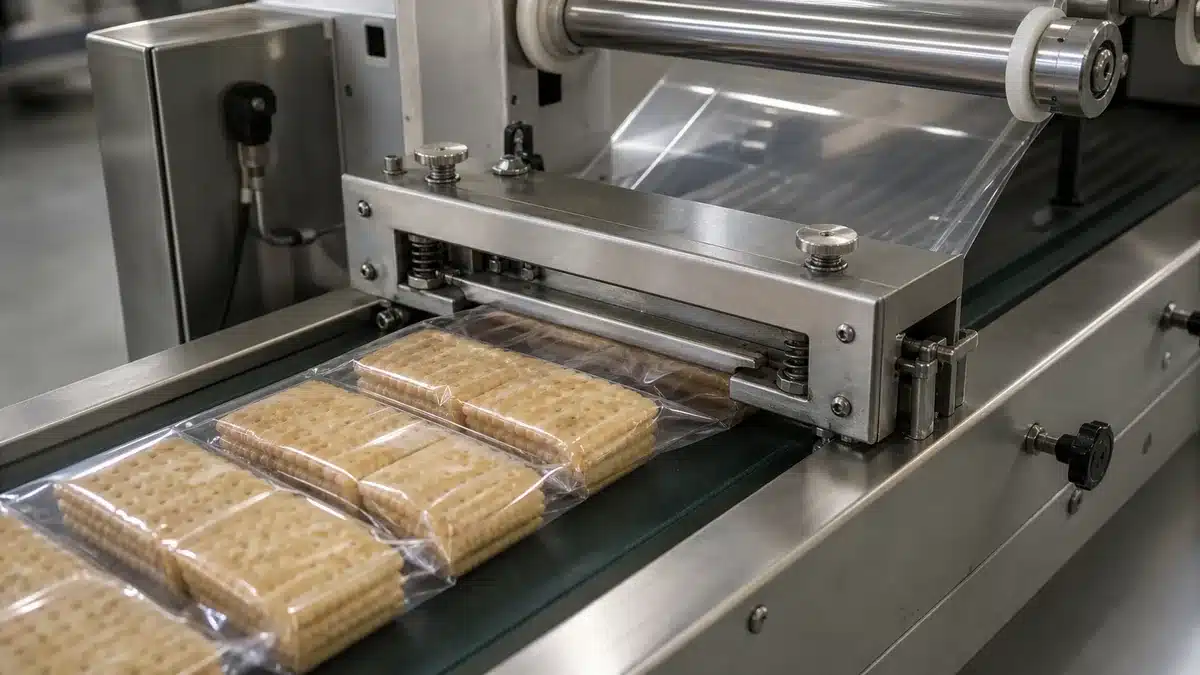
For food contact, the exact formulation and final construction must be supported for the target market, food type, temperature, and contact duration. The U.S. FDA maintains food-contact-substance resources, inventories, and conditions-of-use information; a generic polymer name is not a substitute for checking the applicable authorization and supporting documentation.
Industrial, Transport, and Protective Packaging
Stretch film stabilizes loads; shrink film bundles goods; liners separate or contain materials; masking and protective films shield surfaces; and heavy-duty bags hold industrial products. Important variables may include holding force, puncture, tear propagation, cling, slip, load profile, sharp edges, storage temperature, UV exposure, and handling method.
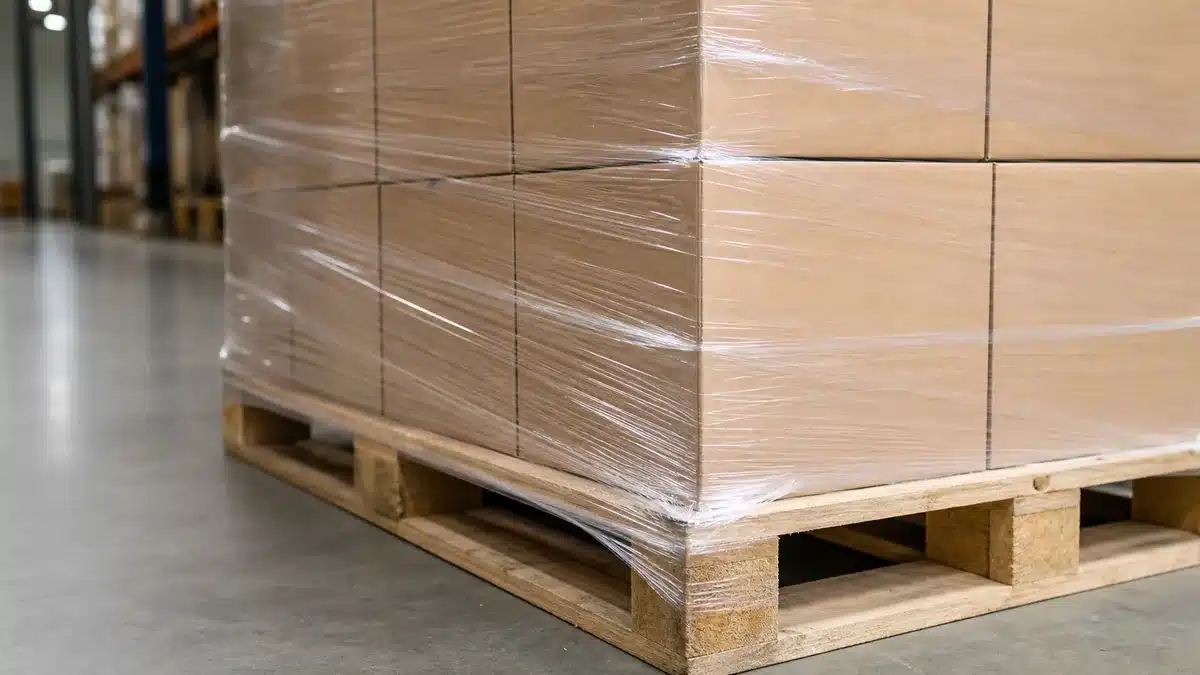
A laboratory tensile result alone does not predict pallet stability or distribution performance. The load, wrapping pattern, prestretch, containment force, corners, transport mode, and storage duration must be included in a trial.
Agriculture, Construction, and Building Applications
Films may be used for greenhouse covers, mulch, silage, vapor control, protective sheeting, geomembrane-related layers, and temporary weather protection. Outdoor applications can introduce UV radiation, temperature cycling, wind, soil contact, agrochemicals, installation stress, and long exposure periods.
Service-life or weatherability claims require a defined formulation and exposure protocol. An indoor packaging grade should not be assumed suitable for outdoor agricultural or construction use.
Electronics, Healthcare, Labels, and Technical Uses
Technical films can serve as release liners, electrical insulation, adhesive-tape backings, labels, surface-protection webs, optical layers, static-control packaging, medical-device packaging components, or process carriers. These uses may require tight control of cleanliness, extractables, dielectric properties, surface energy, dimensional stability, particulate generation, sterilization compatibility, or traceability.
| Application group | Main need | Evidence to request | Key limitation |
|---|---|---|---|
| Food packaging | Seal, barrier, product compatibility, line performance | Final structure, food-contact support, seal and barrier data under use conditions, package trial | Material identity alone does not prove food-contact suitability or shelf life |
| Pallet and industrial wrap | Load containment and damage resistance | Stretch/holding data, puncture or tear data, load trial, storage conditions | Film tensile strength alone does not predict pallet performance |
| Outdoor film | Weathering and mechanical durability | Formulation-specific exposure evidence and installation conditions | Generic polymer durability is not a service-life guarantee |
| Electronics or healthcare | Controlled surface, cleanliness, barrier, electrical or process behavior | Application-specific specification, change control, relevant compliance or validation documents | Packaging film use does not by itself prove antistatic, sterile-barrier, or medical suitability |
| Labels and technical conversion | Print, adhesion, release, dimensional and thermal behavior | Surface-treatment data, ink/adhesive trials, dimensional and temperature testing | A good substrate can still fail with an incompatible ink, adhesive, or process |
How to Choose the Right Plastic Film
Film selection works best as a sequence. Starting with a favorite polymer and then searching for an application can hide critical requirements; starting with the product, process, and failure risks makes the shortlist testable.
Start With the Product and Use Environment
- Define the product: solid, powder, liquid, oily, aromatic, sharp-edged, fragile, corrosive, or moisture-sensitive.
- Define the process: filling temperature, sterilization or pasteurization, freezing, vacuum, modified atmosphere, shrink tunnel, stretch wrapping, or another converting step.
- Define distribution and use: temperature, humidity, altitude, UV exposure, handling, stacking, drop or vibration risk, and intended life.
- Define the package format and opening method: rollstock, bag, pouch, lid, liner, label, sleeve, or protective web.
These inputs establish the failure modes the film must control. They also reveal when the complete package—not just a flat film specimen—must be tested.
Translate Required Functions Into Measurable Properties
Convert general words into testable requirements. “Strong” might mean tensile strength, elongation, puncture energy, tear propagation, seal strength, or load containment. “Clear” might require haze, total light transmission, gloss, or a visual defect limit. “Barrier” must identify the permeant, method, temperature, humidity, test side, thickness, and unit.
Avoid writing “good sealability” as an acceptance criterion. Define the sealant surfaces, jaw temperature range, pressure, dwell time, line speed, contamination condition, conditioning time, peel method, and minimum acceptable response for the application.
Match Converting and Packaging Equipment
Film must run through printing, coating, lamination, slitting, bag making, filling, sealing, shrinking, or wrapping without losing required properties. Specify width, thickness and tolerance, roll length, core, winding direction, splice rules, roll diameter, treatment side, print side, COF target, tension limits, and defect criteria where relevant.
Run trials at representative speed and temperature. A film that works during a short, slow setup may block, curl, slip, stretch, wrinkle, misregister, or seal inconsistently during production.
Check Market Access and Sustainability Claims at Final-Structure Level
Food-contact, migration, medical, pharmaceutical, and other regulated-use claims must match the exact product, market, use, temperature, contact time, and supporting document. Supplier declarations should be reviewed against the actual final construction, including inks, coatings, adhesives, recycled content, and non-plastic components.
Sustainability claims also require a defined scope. Separate design for recyclability from actual collection, sorting, and reprocessing in the target market. Distinguish recycled content from recyclability, bio-based content from biodegradability, and industrial compostability from home compostability. Assess the complete package, including closures, labels, print, adhesives, coatings, and residues.
Warning: Do not approve a food-contact, recycling, composting, or medical claim solely from a resin name, recycling symbol, supplier logo, or unrelated certificate. Request evidence tied to the exact grade, structure, market, and intended conditions.
Film Testing and Supplier Validation Checklist
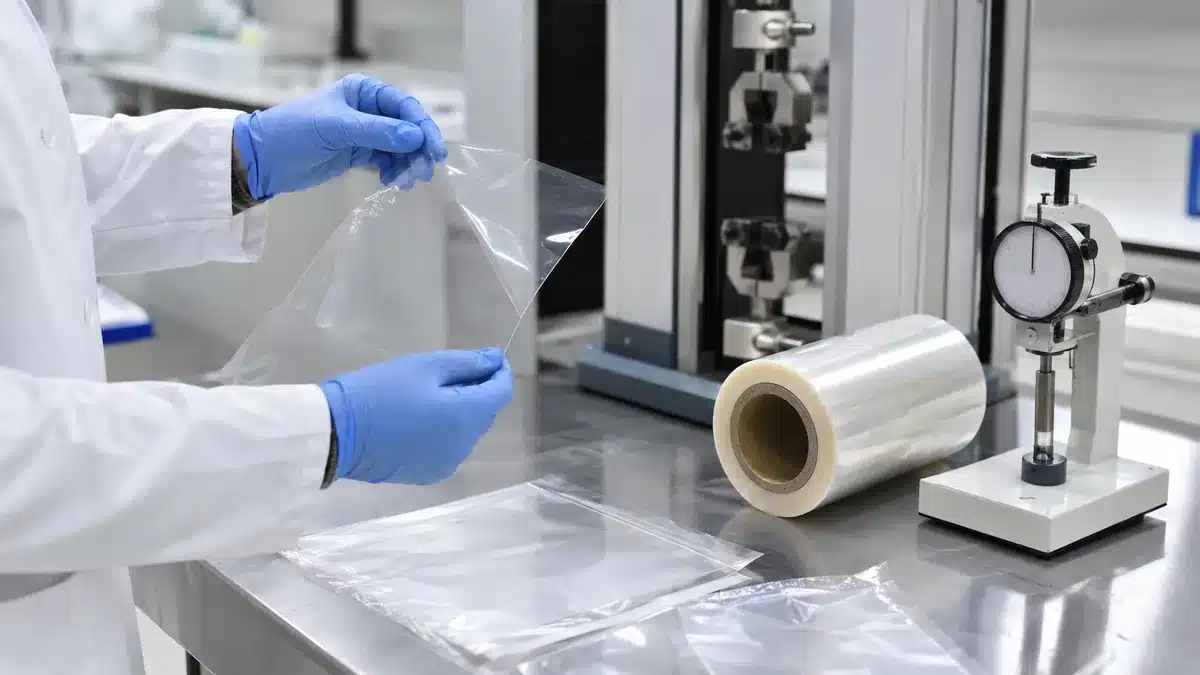
A comparable specification records what was tested and how. The latest applicable standard or an agreed customer method should be identified before testing; method editions, specimen preparation, and conditions can change the meaning of a result.
Mechanical, Optical, Surface, and Dimensional Tests
| Property | Common method family or approach | Record with the result | What it does not prove alone |
|---|---|---|---|
| Tensile and elongation | ASTM D882 or ISO 527-3, as applicable | Thickness, specimen geometry, MD/TD, conditioning, speed, grips, units | Puncture, tear, seal, or package durability |
| Tear propagation | ASTM D1922 or ISO 6383, as applicable | Direction, specimen preparation, thickness, method and units | Initiation force or controlled consumer opening |
| Impact or puncture | Applicable dart, probe, or package method | Impactor/probe, thickness, conditioning, orientation, failure definition | Performance against every product shape or distribution event |
| COF | ASTM D1894 or ISO 8295, as applicable | Film-to-film or other surface, side, age, temperature, speed, static/kinetic result | Runnability on every machine |
| Haze, transmission, and gloss | ASTM D1003, ASTM D2457, or agreed optical method | Instrument geometry, side, backing, thickness, units | Print quality or shelf appearance after scuffing |
| Thickness and dimensions | Agreed gauge and sampling method | Instrument, points, average/range, tolerance, width, roll and core data | Uniform functional performance across every roll |
Barrier, Seal, and Package-Integrity Tests
ASTM D3985-24 covers oxygen gas transmission through film, laminates, coextrusions, and coated substrates using a coulometric sensor. ASTM notes that OTR is an important determinant of package protection but is not the sole determinant; sampling, conditions, and acceptance criteria need agreement.
ASTM F1249-25 covers water-vapor transmission through flexible barrier materials using a modulated infrared sensor. Its published scope cautions that simple relationships among WVTR, thickness, and water-vapor pressure differential do not always apply.
For either OTR or WVTR, record the complete structure, thickness, test side, temperature, relative humidity or pressure conditions, units, conditioning, method edition, and laboratory. Do not compare values if these fields differ materially.
Seal strength methods such as ASTM F88 F88M and hot-tack methods such as ASTM F1921 F1921M address different stages of seal performance Record sealant surfaces jaw geometry temperature pressure dwell time conditioning specimen width peel mode and failure mode Leak.
Important: OTR, WVTR, seal strength, and mechanical tests are inputs to a package decision. Shelf life and package integrity normally require product-specific and process-specific validation as well.
What to Request From a Film Supplier
- Exact product, grade, and revision-controlled data sheet.
- Polymer and layer sequence, total thickness, relevant layer thicknesses, coatings, metallization, treatment side, and additives that affect use.
- Test reports showing method edition, conditions, units, thickness, MD/TD or test side, sample identity, date, and laboratory.
- Roll specification: width, tolerance, length or weight basis, core, maximum diameter, winding direction, splices, and defect limits.
- Applicable declaration or compliance documentation for the target market and use, with limitations stated.
- Change-control expectations for resin, formulation, layer structure, site, process, or test method.
- Representative samples and an agreed trial protocol on converting, packaging, and distribution equipment.
- Written acceptance criteria and a process for handling results that do not match.
Frequently Asked Questions About Plastic Film
Is There One Best Plastic Film for Packaging?
No. The best choice is the lowest-complexity structure that meets the product, process, distribution, market-access, presentation, and end-of-life requirements with an acceptable operating window. A film that is excellent for a dry snack overwrap may be unsuitable for a sharp frozen product, a retort pouch, an outdoor cover, or a technical release liner.
Does a Thicker Film Always Perform Better?
No. Thickness can influence stiffness, barrier, puncture, yield, sealing, and cost, but the relationship is not always linear and does not override resin, orientation, layers, defects, or test conditions. A better-designed thinner structure may outperform a thicker single layer for one function, while another application may genuinely need more gauge. Compare the same structure and method, then validate the package.
Can a Film Be Called Recyclable Based Only on Its Main Polymer?
No. Polymer identity is only one input. The complete package, layer percentages, barriers, coatings, inks, adhesives, labels, closures, residues, dimensions, collection system, sorting technology, and reprocessing market can affect the claim. Use the current assessment method for the target market and distinguish technical design compatibility from actual local recycling access.
What Information Is Needed Before Requesting a Quote?
Provide enough information to define both the film and its duty:
- product and target application;
- proposed package format and layer role;
- target thickness, width, roll length, core, diameter, and winding direction;
- printing, coating, lamination, sealing, shrink, or stretch process;
- barrier, mechanical, optical, surface, and dimensional targets with methods and conditions;
- target market, contact type, temperature, duration, and required documentation;
- annual volume, trial quantity, line speed, and acceptance criteria.
If some inputs are unknown, identify them as trial variables rather than replacing them with unsupported guarantees.
Turn the Film Name Into a Testable Specification
Plastic film families provide a useful starting vocabulary. PE, BOPP, CPP, BOPET, PA, shrink films, and specialty barrier layers each offer different design possibilities, but none is a complete answer by itself. A defensible decision connects the product and process to a defined grade, layer structure, dimensions, test methods, conditions, and acceptance limits.
Before approving a film, confirm three things:
- the data describes the same grade, thickness, direction, structure, and conditions you intend to buy;
- the converted package runs on representative equipment and protects the real product through its expected life; and
- compliance and sustainability statements apply to the final structure in the target market and use.
That approach turns a generic film comparison into a specification that a buyer, supplier, converter, laboratory, and quality team can evaluate consistently.
Related Bestypack Resources
- Flexible Food Packaging: A Guide to What You Need to Know
- Types of Flexible Packaging Films: A Complete Guide
- Manufacturing Process of Flexible Packaging Film
- PE Film Manufacturer&Supplier
 English
 Japanese
 French
 Spanish
 Korean
 Italian
 Portuguese
 Dutch
Dutch Arabic
 Russian
 German