
One roll can cover anything from only a few pallets to well over one hundred, but no responsible estimate starts with a fixed pallet count. The calculation needs two quantities: the usable film available after actual stretch and losses, and the applied film consumed by one approved wrap pattern. Divide the first by the second, round down to whole pallets, and then validate the result on the real line. This approach supports purchasing and inventory planning without turning film economy into a load-safety claim.
Short Answer: There Is No Universal Pallet Count
For polymer background, consult the NIH PubChem polyethylene overview before comparing finished-film claims.
For polymer background, consult the NIH PubChem polyethylene overview before comparing finished-film claims.
The useful answer is not “15 pallets,” “20 pallets,” or any other stand-alone number. It is:
Whole pallets per roll = usable film in the roll ÷ average film used per pallet
Usable film depends on the roll’s labeled length or net film mass, the stretch actually achieved during application, and material lost through tails, breaks, damage, or an unusable remainder. Film used per pallet depends on load dimensions, film width, overlap, top and bottom reinforcement, the number of passes, roping, and the approved wrap program.
Important: A higher calculated yield is an efficiency result, not proof of adequate containment. The chosen wrap pattern still needs performance validation for the actual load, handling system, storage conditions, and distribution route.
The Core Pallets-per-Roll Formula
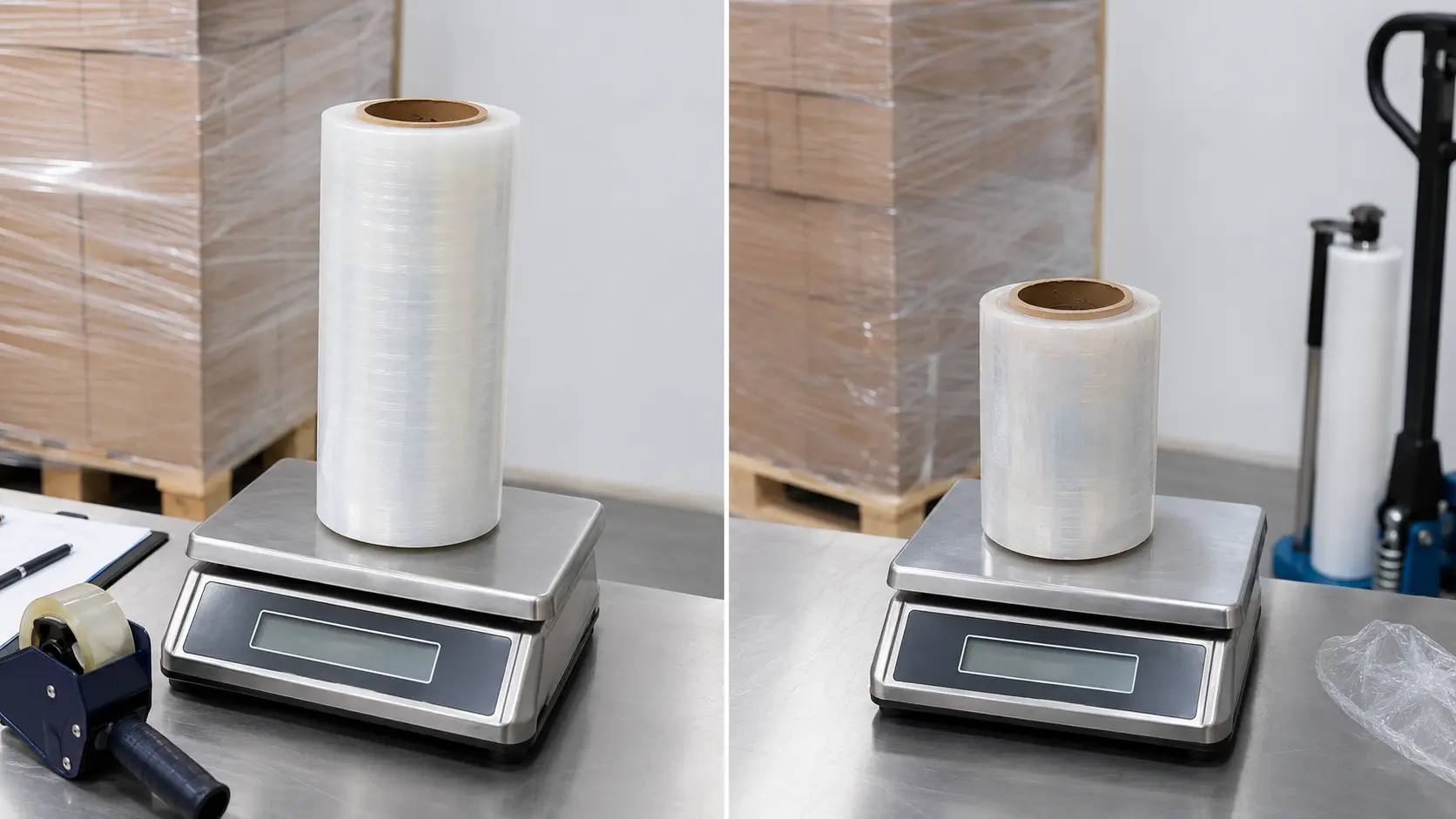
There are two practical ways to calculate roll yield. The length-based method is useful for estimating from specifications and wrap geometry. The weight-based method is usually stronger for auditing actual consumption because stretching changes film length but not film mass.
Length-Based Formula
Use the following relationship when the nominal roll length and achieved application stretch are known:
Usable applied length = nominal roll length × (1 + achieved stretch as a decimal) × utilization factor
Whole pallets per roll = floor (usable applied length ÷ applied film length per pallet)
“Floor” means round down. A result of 13.8 supports 13 complete pallets, not 14. If achieved stretch is 50%, enter 0.50, so the length multiplier is 1.50. If achieved stretch is 200%, enter 2.00, so the multiplier is 3.00.
The utilization factor represents the share of theoretical film that becomes usable applied film. For example, a planning assumption of 0.95 would reserve 5% for tails, breaks, damaged edges, or roll remainder. That number is an input to verify, not an industry constant.
Use the stretch actually delivered at the load, not only a film’s maximum laboratory elongation or a machine’s nominal setting. If the purchased film is already pre-stretched and its labeled roll length is the as-supplied length, do not add the manufacturing pre-stretch again.
Weight-Based Formula
For a plant trial, calculate with mass:
Whole pallets per roll = floor (usable net film mass per roll ÷ average applied film mass per pallet)
Usable net film mass excludes the core and any consistently unusable remainder. Average applied film mass per pallet can be measured by weighing the roll before and after wrapping a representative group of pallets, then dividing the mass loss by the number wrapped.
Do not apply a stretch multiplier to the mass formula. Stretching redistributes the same film mass over a greater length; it does not create additional kilograms of film. This method also captures the real wrap pattern, overlap, reinforcement, and operator or machine behavior in one measured denominator.
How to Estimate Applied Film per Pallet
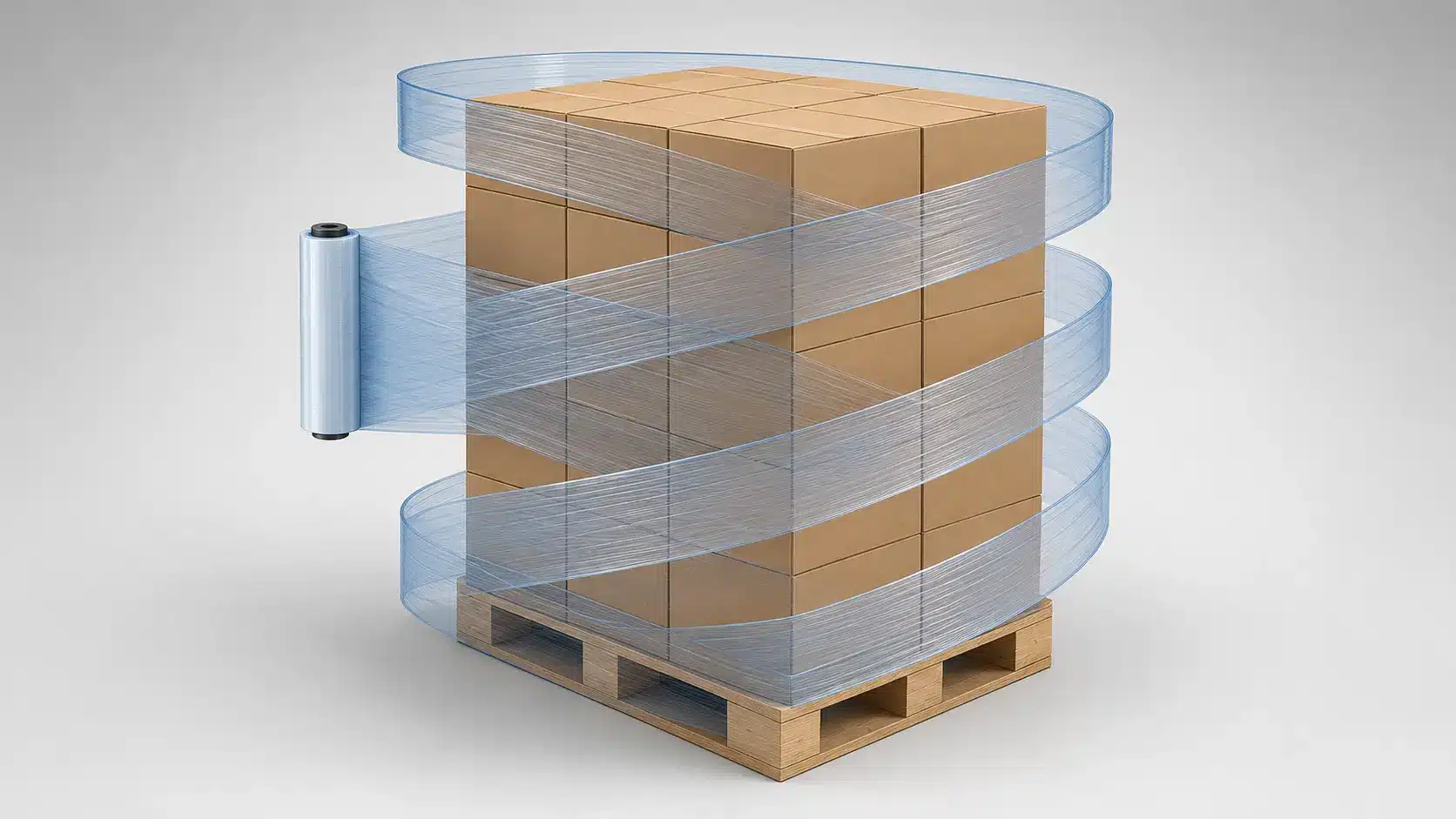
Before plant data are available, load geometry can provide a first estimate. Keep all dimensions in the same unit, state the assumed wrap pattern, and add film used for tying, tails, roping, top coverage, or other paths that the simple geometry does not represent.
Circumference-and-Revolutions Method
For a rectangular load:
Load circumference, C = 2 × (load length + load width)
Applied film per pallet ≈ C × effective revolutions + extra film
“Effective revolutions” means the total equivalent turns around the load across base wraps, spiral passes, top wraps, and reinforcement bands. For a 48 × 40 inch load, the circumference is 176 inches, or about 14.67 feet. Ten equivalent revolutions therefore use about 146.7 feet before tails or other extras.
This is a planning approximation. Film follows a diagonal path during a spiral pass, rounds corners, and may bridge recesses or protrusions. Irregular loads, sharp corners, deep underhang, overhang, or roping can make the actual path materially different from the rectangular perimeter.
Spiral-Wrap Method
For a spiral pattern, first estimate the vertical advance per revolution:
Vertical advance = film width × (1 − overlap fraction)
With 20-inch film and 50% overlap, the nominal advance is 10 inches per revolution. The approximate turns for one vertical pass are:
Turns per vertical pass ≈ wrapped height ÷ vertical advance
Add the specified base turns, top turns, reinforcement bands, and the return pass if the program travels both up and down. Then multiply total equivalent turns by the load circumference and add the extra film.
This method is only as good as its inputs Effective film width can be reduced by neck-down and programmed carriage speed does not always produce the assumed overlap at every load height Where.
Worked Examples for Hand and Machine Wrapping
The following numbers are hypothetical. They demonstrate the calculation only and do not describe a BestY Pack film, customer load, machine, test, or guaranteed yield.
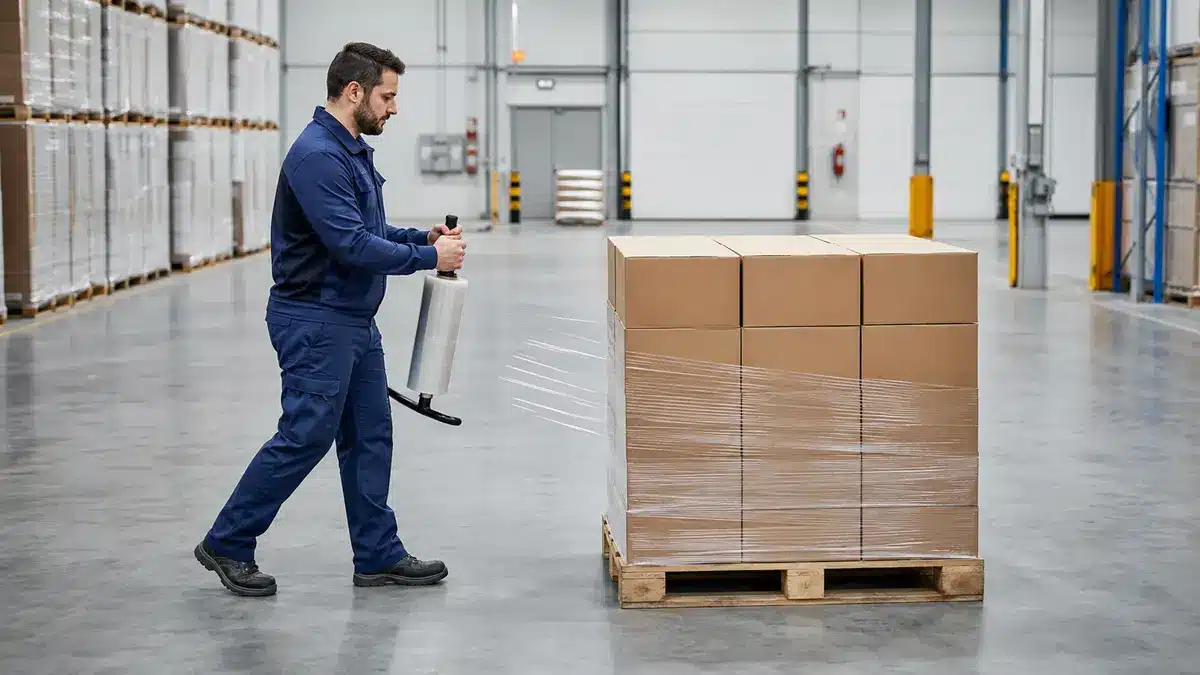
Hand-Wrapping Example
Assume:
- nominal roll length: 1,500 feet
- measured achieved stretch: 50%, entered as 0.50
- utilization factor: 0.95
- rectangular load: 48 × 40 inches
- effective revolutions: 10
- tails and other extra film: 8 feet per pallet
The usable applied length is:
1,500 × (1 + 0.50) × 0.95 = 2,137.5 feet
The load circumference is 14.67 feet, so estimated film per pallet is:
(14.67 × 10) + 8 = 154.7 feet per pallet
The roll yield is:
floor (2,137.5 ÷ 154.7) = 13 complete pallets
The unrounded result is about 13.8. A purchasing plan should not assume the fraction can finish another pallet, and it may need a further allowance if operators, loads, or break rates vary.
Machine-Wrapping Example
Assume:
- nominal roll length: 7,000 feet
- measured achieved pre-stretch: 200%, entered as 2.00
- utilization factor: 0.97
- verified average applied film: 215 feet per pallet
The usable applied length is:
7,000 × (1 + 2.00) × 0.97 = 20,370 feet
The roll yield is:
floor (20,370 ÷ 215) = 94 complete pallets
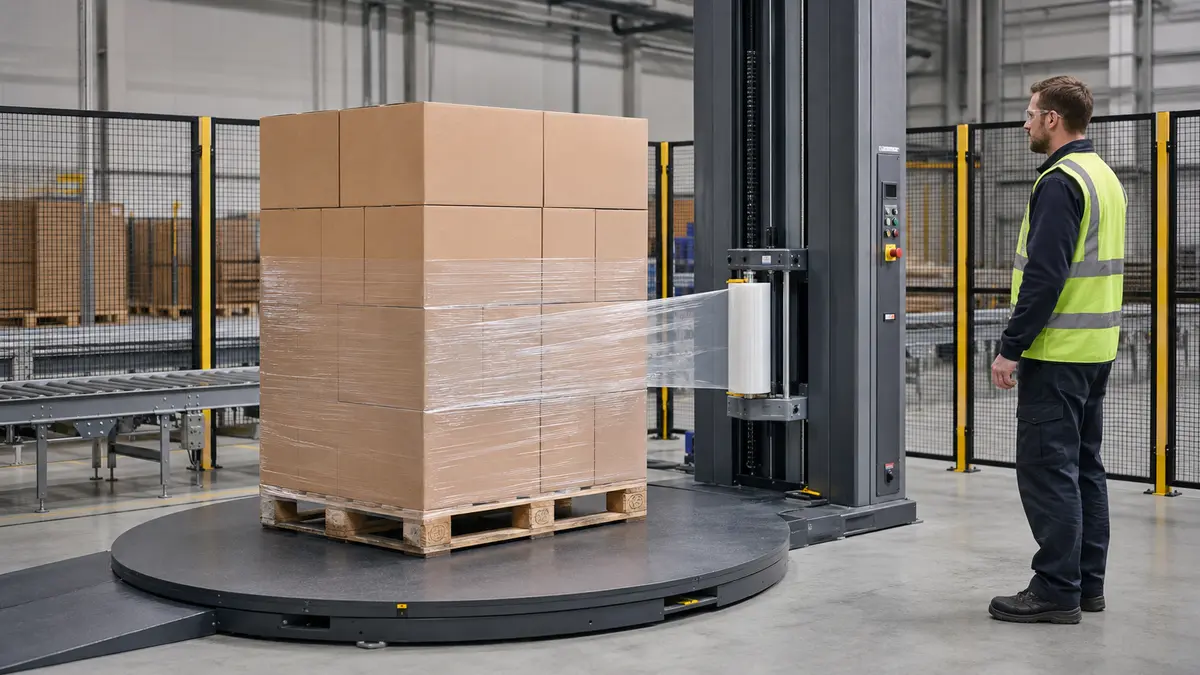
If actual applied film varies from 205 to 225 feet across the approved load family, the same roll would calculate to roughly 99 down to 90 complete pallets. That range is more useful for inventory planning than a single optimistic result. It also shows why a machine setting, nominal pre-stretch percentage, or roll length cannot establish yield by itself.
Variables That Change Roll Yield
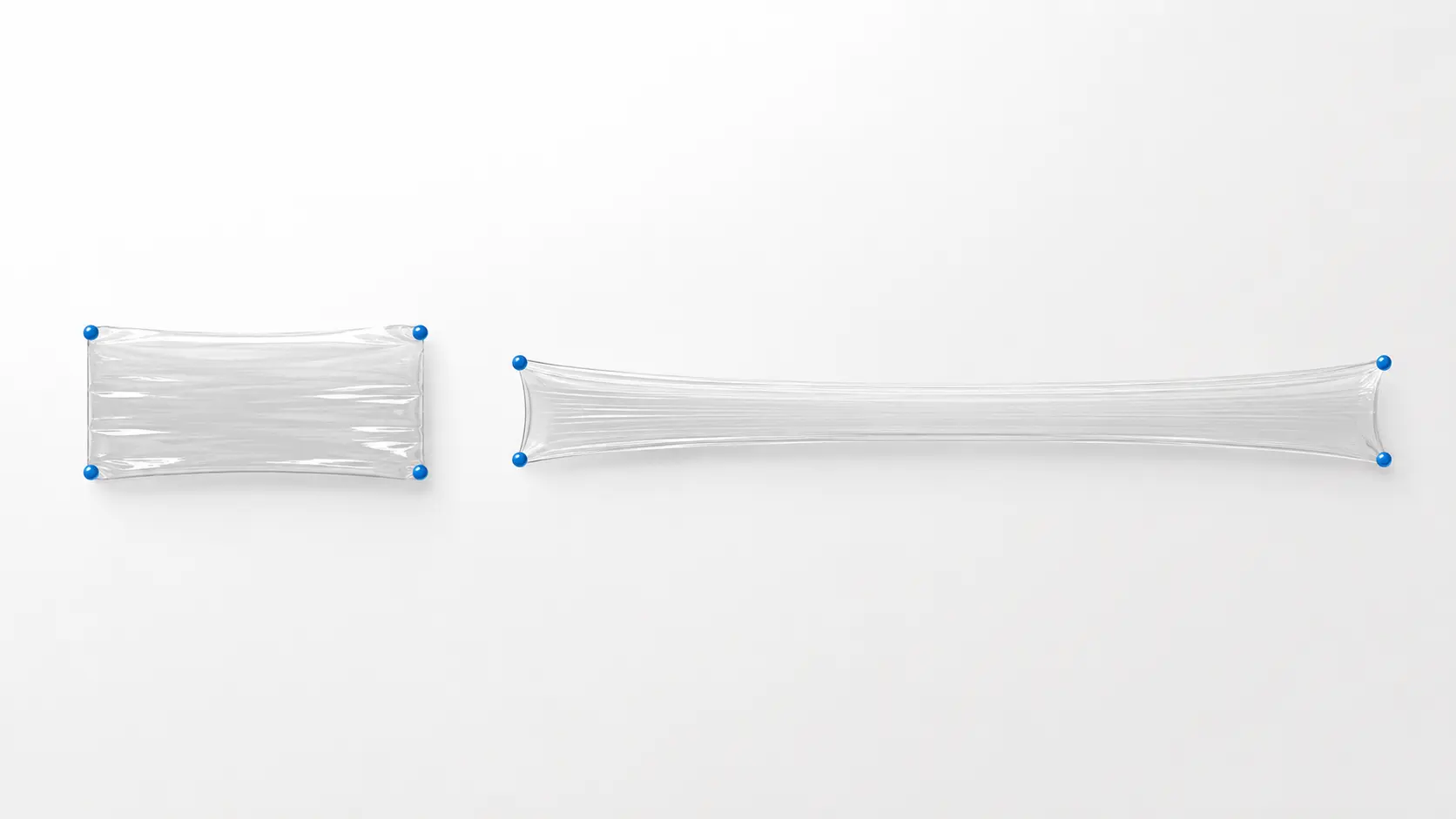
Use the same definition and measurement method when comparing shifts, films, suppliers, or machines. Otherwise, an apparent yield improvement may be a change in assumptions rather than a real reduction in consumption.
| Variable | How it affects the calculation | What to verify |
|---|---|---|
| Nominal roll length or net film mass | Sets the starting amount of film | Supplier roll specification, core or tare, and roll-to-roll tolerance |
| Achieved application stretch | Increases applied length per unit of unstretched roll length | Mark-and-measure result or verified film-delivery data under the actual program |
| Utilization and roll remainder | Reduces film available for complete pallets | Tails, breaks, edge damage, changeover waste, and unused film on discarded rolls |
| Load length, width, and height | Changes circumference and the number of spiral turns | Representative load dimensions, including overhang, underhang, and irregular profiles |
| Film width and effective overlap | Changes vertical advance and turn count | Effective width on the load, neck-down, carriage speed, and overlap at multiple heights |
| Base, top, and reinforcement wraps | Adds revolutions at selected zones | Approved recipe or observed operator pattern |
Important: Do not reduce revolutions, overlap, or reinforcement only to raise pallets per roll. First confirm that the revised pattern still meets the approved applied-wrap and unit-load performance requirements.
How to Validate the Estimate on Your Packaging Line
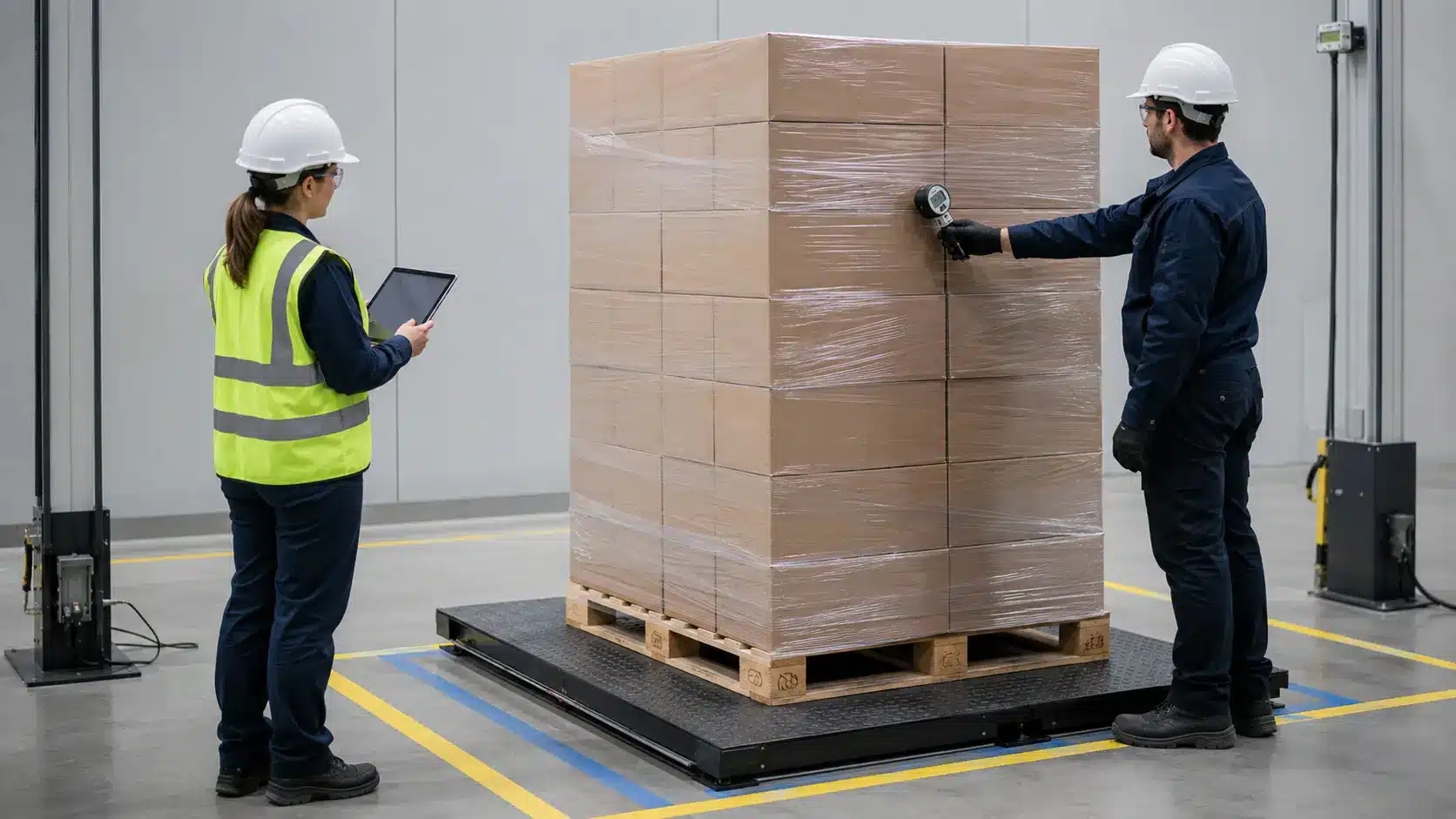
A short calculation is useful for budgeting, but a repeatable trial is the better basis for purchasing. Test representative load families separately; averaging unlike loads can hide the heavy users and overstate yield on difficult pallets.
Run a Roll-Weight Trial
- Define the load family, film identity, roll format, operator or machine, and approved wrap program before collecting data.
- Verify the scale is suitable for the roll mass and record the full roll’s gross mass.
- Wrap multiple representative pallets under normal production conditions. Include relevant shifts or operators when manual variation is part of the process.
- Weigh the remaining roll and calculate the mass loss. Record broken film, discarded material, and incomplete wraps rather than silently removing them from the result.
- Divide the net mass loss by the number of accepted pallets to obtain average applied film mass per pallet.
- Determine usable net film mass per roll by subtracting the core and the normal unusable remainder from the full roll mass.
- Divide usable net film mass by average applied mass per pallet, round down, and report both the average and observed range.
- Recheck applied-wrap performance and shipment outcomes under the defined load and distribution conditions before approving a material-reduction change.
The weight method avoids estimating stretch in the yield equation, but stretch still matters operationally. It affects film thickness on the load, wrap force, break behavior, and the number of layers needed to reach the approved performance.
Record the Conditions That Control Consumption
Keep enough context for another shift or supplier trial to reproduce the result:
- film grade or traceable roll identity, width, thickness, nominal length, and net film mass
- core mass, unusable remainder, and damaged or discarded film
- load dimensions, mass, geometry, edge condition, and product sensitivity
- hand or machine application, equipment identity, program, carriage speed, and turntable or arm speed
- achieved stretch or pre-stretch measurement method
- base wraps, top wraps, spiral passes, overlap, reinforcement, and roping
- applied wrap force or containment checks at defined load heights
- number of pallets measured, average consumption, range, and anomalies
- storage temperature, transport mode, handling events, and distribution test or field-observation basis
ASTM D4649-20(2025) provides a guide for selection, specification, and application of stretch films for indoor unitizing and palletizing. Applied-film and unit-load methods listed by ASTM address performance under defined mechanical handling, vibration, impact, or related conditions. Select the methods that match the intended distribution environment; a roll-yield trial alone is not a substitute.
Frequently Asked Questions
Does Thicker Film Always Cover Fewer Pallets?
It depends If two rolls have the same width and nominal length thickness does not change the length-based numerator If they instead have the same net film mass and width a thinner film generally contains more length subject to material density and manufacturing tolerances However the thinner film may need a.
Does a Wider Roll Cover More Pallets?
Not automatically. A wider web can cover more load height per turn and may reduce spiral revolutions at the same overlap. At the same net roll mass and thickness, however, greater width usually means less roll length. Width also changes handling, neck-down, overlap, and machine compatibility. Calculate from the actual roll format and approved pattern rather than treating width as a direct yield multiplier.
How Should Pre-Stretched Film Be Handled?
Start with the roll length as supplied and determine what additional elongation, if any, occurs during application. Do not multiply the labeled length by a manufacturing pre-stretch percentage that is already embodied in the product. For weight-based trials, do not use a stretch multiplier at all. Record whether “stretch percentage” refers to film manufacturing, a machine setting, or measured elongation at the load.
Can This Estimate Prove a Load Is Safe to Ship?
No. Pallets per roll measures material consumption. It does not by itself establish containment, resistance to puncture or tearing, resistance to handling, vibration or impact, or performance at extreme temperatures or outdoors. Validate the applied wrap and complete unit load under methods and conditions appropriate to the product, equipment, storage, and distribution route. Keep the calculation and the safety decision as linked but separate records.
Use a Range, Then Confirm Actual Consumption
Calculate roll yield from usable film divided by film per pallet, round down, and retain the assumptions. Use geometry for an early estimate, then replace it with a weight-based plant average and observed range. Plan inventory from the conservative end of that range, including normal waste and load mix. Any attempt to increase yield by changing film, stretch, overlap, or revolutions should trigger a separate performance review of the applied wrap and unit load. That is how a simple pallet-count question becomes a controlled packaging decision.
Related Bestypack Resources
- Black Stretch Wrap Film
- Select the Appropriate Stretch Film Width and Thickness
- Shrink Wrap vs. Stretch Wrap: What’s the Difference?
- Machine Stretch Film Blown & Cast
- How to Calculate the Usage of Stretch Film?
- How to Reduce Stretch Film Thickness to Cut Costs?
- Stretch Film Thickness: What You Need to Know
Related Bestypack Resources
- Select the Appropriate Stretch Film Width and Thickness
- Shrink Wrap vs. Stretch Wrap: What’s the Difference?
- Black Stretch Wrap Film
- Machine Stretch Film Blown & Cast
- How to Reduce Stretch Film Thickness to Cut Costs?
- Stretch Film Thickness: What You Need to Know
- How to Calculate the Usage of Stretch Film?
 English
 Japanese
 French
 Spanish
 Korean
 Italian
 Portuguese
 Dutch
Dutch Arabic
 Russian
 German