
Stretch film thickness tells you how much film material is present before application, but it does not tell you whether a pallet will remain stable. A useful specification combines nominal thickness with its unit, tolerance, measurement method, film design, wrapper settings, and performance on the actual load. For purchasing teams, the safest approach is to convert gauge into microns or mils, define the load and distribution risks, compare documented product data, and approve a candidate only after a controlled wrapping trial.
What Stretch Film Thickness Means
For polymer background, consult the NIH PubChem polyethylene overview before comparing finished-film claims.
For polymer background, consult the NIH PubChem polyethylene overview before comparing finished-film claims.
Thickness is the distance between the two surfaces of the film web Suppliers commonly express it in micrometres m mils or gauge Micrometres and mils are physical units Gauge as used for plastic film is a trade convention one gauge point is commonly treated as 0 01 mil Because commercial terms can be used differently.
Micron, Mil, and Gauge Explained
A micrometre is one millionth of a metre. A mil is one thousandth of an inch; it is not a millimetre. NIST’s conversion factors establish that 1 mil equals 0.0254 mm, or 25.4 µm. Under the common plastic-film convention, 100 gauge equals 1 mil, so 80 gauge corresponds to 0.80 mil or 20.32 µm.

| Common label | Nominal mil | Nominal micrometres |
|---|---|---|
| 40 gauge | 0.40 mil | 10.16 µm |
| 60 gauge | 0.60 mil | 15.24 µm |
| 80 gauge | 0.80 mil | 20.32 µm |
| 100 gauge | 1.00 mil | 25.40 µm |
| 120 gauge | 1.20 mil | 30.48 µm |
These are mathematical conversions of nominal labels, not evidence that every point across a roll has exactly that thickness. They also say nothing by themselves about puncture resistance, stretch window, stress retention, cling, or load containment.
Quick Conversion Formula and Examples
Use the following conversions when the supplier uses the common plastic-film gauge convention:
- Micrometres = mil × 25.4
- Mil = micrometres ÷ 25.4
- Mil = gauge ÷ 100
- Micrometres = gauge × 0.254
For example a stated 70-gauge film converts to 0 70 mil and 17 78 m A 23 m film.
Why Thickness Matters—but Does Not Determine Performance Alone
Thickness matters because, for the same area and material density, a thicker web contains more polymer. It can influence film mass, roll length at a given roll weight, resistance to local damage, and the force that develops during application. However, those relationships are not universal performance ratios. Changing the resin blend, layer design, orientation, processing conditions, or applied stretch can change results even when the nominal thickness stays the same.
What Typically Changes as Thickness Changes
If material density, film construction, width, and covered area are held constant, material mass per area changes in direct proportion to thickness. A 25 µm web contains 25% more material per area than a 20 µm web under those assumptions. That geometric fact can affect material use and the length available on a roll of fixed weight.

Performance does not necessarily rise by the same percentage. Within one film design and one test method, added thickness may improve the margin against a protrusion or reduce the chance that a small defect becomes a break. It may also require different application force or machine settings. Yet “thicker” is not a substitute for measured puncture energy, tensile behaviour, elastic recovery, stress retention, or an applied-load result.
The practical advantages of more thickness may include a larger damage margin on demanding loads. The limitations may include more polymer per wrapped area, different roll handling, and no assurance that the extra material is applied effectively. The correct comparison is performance per wrapped load under controlled settings, not price per roll or gauge alone.
Why Resin, Layer Design, Stretch, and Test Conditions Matter
Stretch films can use different polyethylene grades, resin blends, layer arrangements, tackifiers, and processing routes. Those design choices affect how the film stretches, resists puncture, recovers after extension, clings, and propagates a tear. “LLDPE” describes a polymer family; it does not define a complete stretch-film structure or a guaranteed property.
Application changes the web as well. Machine-direction pre-stretch, force-to-load, corner tension, wrap pattern, overlap, and the number of revolutions determine how the film is distributed on the pallet. Two films with the same nominal thickness can operate at different stretch levels and produce different containment-force profiles. Conversely, a thinner engineered film may outperform a thicker film in a particular trial, but that result cannot be transferred to another load or wrapper without validation.
Important: A thickness result is not a load-containment result. ASTM D6988 addresses thickness determination for plastic-film specimens, while ASTM D8314 addresses performance testing after stretch film has been applied to a unit load or test structure. Each measurement answers a different question.
Test data must retain its method and conditions. Puncture results should identify the test method, specimen condition, thickness, speed, probe geometry, and reported unit. Tensile or tear results should preserve machine direction (MD) and transverse direction (TD). Data from different methods or conditions should not be placed in a direct ranking.
How to Choose a Starting Thickness for Your Load
Start with the load, wrapper, and distribution environment—not with a generic gauge chart. The goal is to define a reasonable candidate for testing, then adjust film and settings together. A current film that performs acceptably can serve as a controlled baseline, provided its measured thickness, wrap pattern, and application settings are recorded.
Load Weight and Stability
Weight is relevant, but natural load stability is usually more informative than weight alone. A dense, interlocked load may resist movement better than a lighter, tall load with poor layer-to-layer contact. Describe:
- pallet footprint, load height, gross weight, and centre-of-gravity concerns;
- stacking pattern, gaps, overhang, underhang, and whether layers are interlocked;
- rigid, compressible, slippery, settling, or liquid-filled products;
- allowable compression and any product deformation under film force;
- current leaning, shifting, crushed corners, or transport-damage modes.
Use those facts to identify the required containment behaviour. Do not convert a pallet weight directly into a guaranteed gauge. The same weight can produce very different film demands when geometry and product movement change.
Corners, Edges, and Puncture Risk
Sharp corners, protrusions, rough surfaces, and gaps concentrate stress in a small area. A thicker film may provide more margin within the same film design, but formulation and stretch level also affect the result. ASTM D5748 is a laboratory method for protrusion puncture resistance of stretch wrap film; its outputs are tied to the specified specimen and test conditions, not to every field hazard.
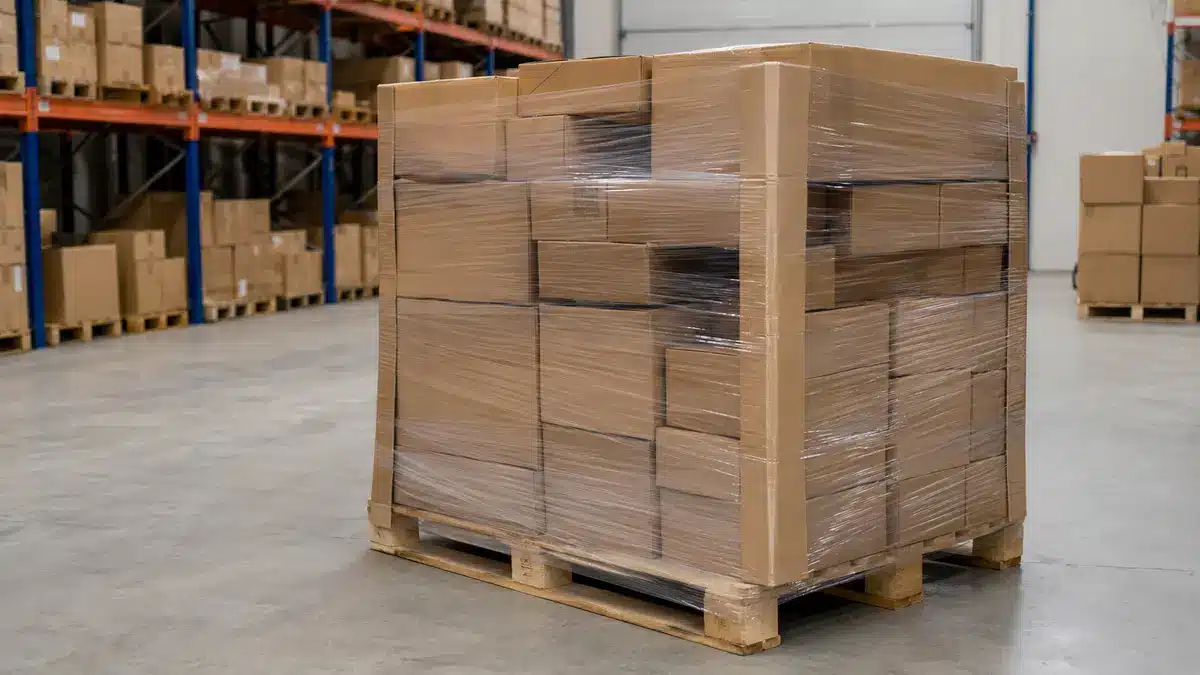
Document the corner radius, exposed metal or timber, carton damage, and any point where the film bridges a void. Candidate actions may include evaluating a different film design, reducing damaging corner tension, adjusting wrap placement, or adding edge protection. The approved solution should keep the load stable without hiding recurring film breaks or product damage.
Hand vs. Machine Application
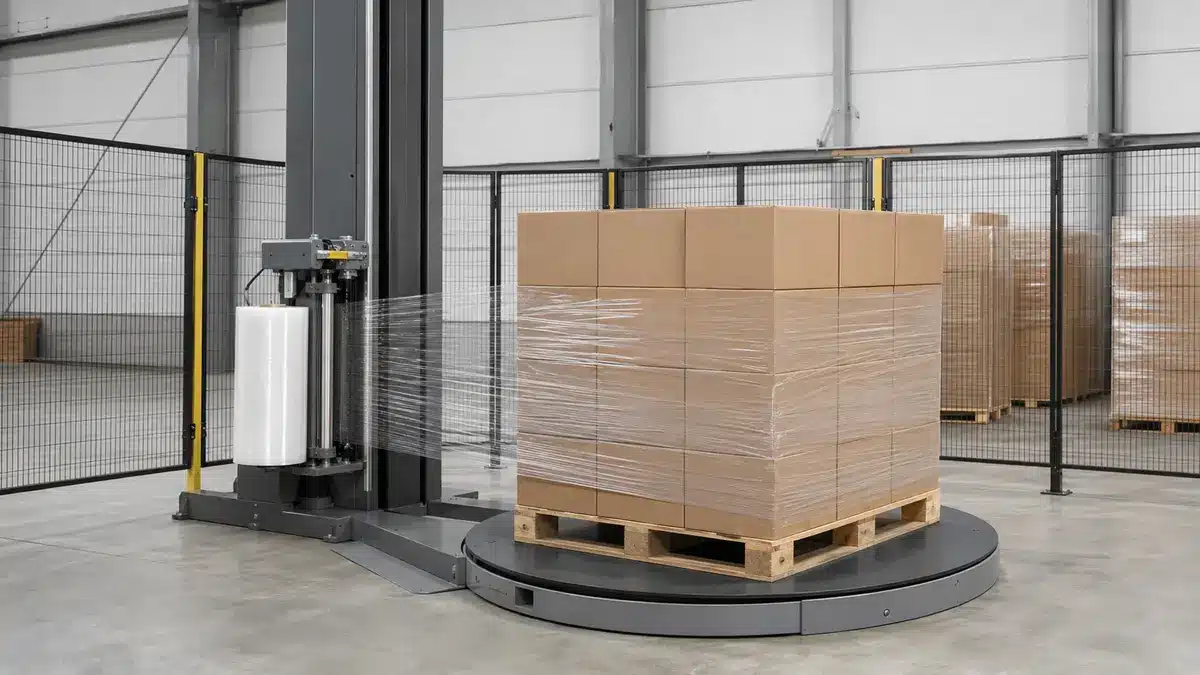
Hand and machine application create different control conditions. Manual wrapping depends on operator reach, walking speed, dispenser condition, overlap, and applied tension. A powered pre-stretch carriage can control stretch and film delivery more consistently, but only when rollers, gears, force settings, and the wrap recipe are maintained.

Specify the application system before selecting a film. Record whether the film is for hand use, a power-pre-stretch machine, or another delivery system; the available stretch range; force-to-load settings; wrap speed; film width; and the required roll dimensions. Do not assume machine film must be thicker, or that a thinner hand film will run correctly on a machine. The film and delivery system must be compatible.
Storage and Distribution Conditions
Temperature, dwell time, vibration, impact, repeated handling, and pallet transfers can change the demand on the wrapped load. ASTM D4649’s stretch-film application guide covers indoor unitizing and notes that extreme temperatures can negatively affect performance; it does not cover outdoor exposure. If outdoor storage, UV exposure, freezing, high heat, or long dwell is required, those conditions need a separate, product-specific specification and evidence plan.
Map the actual distribution route: warehouse moves, forklifts, clamp or push-pull handling, trailer or container transport, rail, and any known acceleration events. ASTM D5331 can compare unitizing films or wrap cycles under simulated mechanical handling, but its scope states that no direct correlation to field performance has been established. Use such testing as controlled evidence, then retain field monitoring for the real route.
True Gauge, Equivalent, and Pre-Stretched Film
These terms appear in the stretch-film market, but they are not interchangeable material specifications. Their use can vary by supplier, so the RFQ should ask for measured physical thickness and supporting data.
| Commercial description | Usual market meaning | What the buyer should verify |
|---|---|---|
| True gauge | Film marketed as physically close to its stated gauge conversion | Nominal µm or mil, tolerance, measurement method, sampling, and product-specific data |
| Equivalent or high-performance film | A film, often thinner than a legacy reference, claimed to provide comparable use performance | Actual measured thickness, exact product identity, comparison method, wrapper settings, load, and acceptance result |
| Pre-stretched film | Film extended before it is wound for sale, typically to reduce the force needed during manual application | Thickness as supplied, source-film description if relevant, pre-stretch definition, roll dimensions, application method, and load result |
“Equivalent to 80 gauge” should never replace the actual thickness field. It describes a claimed performance relationship, not a unit conversion. The comparison is meaningful only when the supplier identifies what performance was considered equivalent, how it was tested, and under which load and wrap conditions.
How to Verify Thickness and Tolerance
A nominal value is a target or label. A complete thickness specification also explains allowed variation and how conformance will be assessed. Without those fields, buyer and supplier may both use “20 µm” while applying different sampling locations, instruments, contact forces, rounding rules, or acceptance statistics.
Nominal Thickness vs. Average and Variation
An average can hide thin and thick areas. A roll may average near the nominal value while showing cross-web bands or machine-direction changes that affect processing and local damage risk. Conversely, a single low reading may not represent the roll if the sampling plan is undefined.
Agree on the form of the requirement:
- nominal thickness in µm, with mil as a secondary conversion if needed;
- whether the limit applies to individual readings, a sample average, a roll average, or a thickness profile;
- tolerance expressed in physical units or percent, including rounding;
- sampling locations across the width and along the roll;
- conditioning, instrument, method, and reporting precision;
- treatment of edges, splices, startup material, and disputed results.
There is no universal tolerance that this article can assign to every stretch film. The value must match the product, process capability, measurement system, and buyer’s risk.
Measurement Method and Sampling
ASTM D6988 provides a guide for determining plastic-film specimen thickness when thickness is used directly in property-test results ASTM D8136 provides a non-contact capacitance method that can generate profiles to characterize thickness variability in MD or TD A contact micrometer and.
Use a controlled sequence:
- Define whether the purpose is a spot check, an average, a cross-web profile, or property-test normalization.
- Identify the film condition: as supplied, conditioned specimen, or film sampled after application. Do not mix these states.
- Set the locations, number of readings, edge exclusions, and roll-selection rule before measuring.
- Record the instrument or standard, units, resolution, contact conditions where applicable, raw readings, summary statistic, and decision rule.
Note: Stretching reduces the applied web’s thickness and changes its state. A measurement on as-supplied film should not be presented as the thickness after a specified pre-stretch unless that applied state is separately measured and defined.
A Buyer’s RFQ and Trial Checklist
The RFQ should make candidate films comparable, while the trial should make the final decision on the actual wrapper and load. Keep the same load configuration and acceptance criteria when comparing candidates.
What to Send the Supplier
Provide enough detail for the supplier to recommend a testable product:
- pallet footprint, load height, gross weight, stacking pattern, and natural stability;
- product type, compressibility, surface friction, edge and protrusion risks, and allowable compression;
- hand or machine wrapper, carriage type, available pre-stretch, force-to-load controls, and line speed;
- current film identity if known, measured thickness, width, roll length, wrap pattern, overlap, and revolutions;
- film breaks, corner failures, load movement, damage, and film use per pallet;
- storage temperature and time, handling equipment, route, transport modes, and known hazards;
- required acceptance criteria, trial quantity, documentation, and change-control expectations.
What the Supplier Should Return
Request product-specific information rather than a generic family description:
- exact product or grade and whether it is intended for the stated hand or machine system;
- nominal thickness in µm and mil, any gauge label, tolerance, method, and sampling rule;
- width, roll length, core, roll dimensions, and declared basis for roll weight or yield;
- film construction description at the level the supplier is authorized to disclose;
- recommended application or pre-stretch window and the conditions behind it;
- relevant puncture, tensile, tear, cling, elastic-recovery, or stress-retention data with method, specimen condition, units, and MD/TD where applicable;
- applied-load or comparison evidence with the load, wrapper, settings, wrap cycle, timing, and acceptance criteria identified;
- a sample or trial roll tied to the same product identity and revision as the proposed supply.
If a field is unavailable, record it as a gap. Do not replace missing test conditions with adjectives such as “heavy duty,” “high performance,” or “premium.”
How to Validate the Actual Load
Run the approval in a fixed sequence:
- Establish a baseline using a repeatable load, current film, documented wrapper condition, and agreed acceptance criteria.
- Install the candidate film and record the product identity, roll, nominal and measured thickness, machine setup, pre-stretch or delivery settings, force-to-load controls, wrap pattern, overlap, and revolutions.
- Measure operational results such as film breaks, film used per load, cycle consistency, visible load deformation, and containment-force profile at defined heights and times where that measurement is part of the plan.
- Expose the wrapped load to the relevant handling, vibration, impact, dwell, and environmental conditions using an agreed test plan. ASTM D8314 is a guide for testing applied stretch film and wrapping equipment; other unit-load methods may be selected for the distribution hazards.
- Compare the result with the pre-agreed criteria, document failures, and change only controlled variables before a repeat. Retain the approved film revision and wrap recipe together.

A laboratory film property can help explain a result, but it cannot by itself approve a pallet. Likewise, a successful pallet trial applies to the tested load, film, equipment, settings, and hazards; changes require review.
Frequently Asked Questions
Is 80 Gauge Always the Best Standard Thickness?
No. Under the common convention, 80 gauge is about 20.32 µm, but that conversion does not make it universally suitable. The correct starting point depends on load stability, edges, wrapper, pre-stretch, wrap pattern, dwell, and distribution hazards. Treat 80 gauge as a nominal thickness label to evaluate, not as an automatic pass condition.
Can Thinner High-Performance Film Replace Thicker Conventional Film?
It depends. A thinner engineered film may meet the same acceptance criteria on a defined load, and it may reduce material per pallet. Approval requires the exact product, physical thickness, test conditions, wrapper settings, film use, and applied-load results. Do not transfer an “equivalent” claim to a different load, machine, or route without a controlled trial.
Should I Specify Microns or Gauge?
Specify micrometres as the primary physical unit and add mils if your buying system uses U.S. customary units. A gauge label may be included for commercial recognition, but it should not be the only field. State the nominal thickness, tolerance, measurement method, sampling plan, and product identity so that both parties can verify the same requirement.
Conclusion: Treat Thickness as One Part of Load Containment
Stretch film thickness is easy to convert but incomplete as a buying decision. A defensible approval connects measured thickness to the exact film, allowed variation, wrapper, wrap recipe, load, and distribution conditions. The key actions are straightforward:
- normalize gauge into µm and mil;
- request tolerance, method, sampling, and product-specific data;
- evaluate stability, edges, application, and route together;
- compare candidates under controlled settings; and
- retain the approved film and wrap recipe as one validated system.
Until those checks are complete, thickness is a candidate input—not proof of containment performance.
Related Bestypack Resources
- Stretch Film vs. Cling Film: What’s the Difference?
- Select the Appropriate Stretch Film Width and Thickness
- How Many Pallets Can One Roll of Stretch Film Cover?
 English
 Japanese
 French
 Spanish
 Korean
 Italian
 Portuguese
 Dutch
Dutch Arabic
 Russian
 German