
Reducing stretch film thickness can lower material use, but only when the thinner film still creates an accepted, stable load at a lower total cost. A gauge change that causes more revolutions, film breaks, rewraps, downtime, or transit damage is not a saving. The practical method is to establish a load-specific baseline, calculate cost per secured load, trial one candidate under controlled conditions, and approve it only after both packaging performance and economics pass.

Start With Cost per Secured Load, Not Film Thickness
For polymer background, consult the NIH PubChem polyethylene overview before comparing finished-film claims.
For polymer background, consult the NIH PubChem polyethylene overview before comparing finished-film claims.
Why a Lower Gauge Can Cost More
Down-gauging means moving to a film with a lower nominal thickness. It changes one input to a complete wrapping system that also includes the film formulation, load geometry, secondary packaging, wrapper, film-delivery system, wrap pattern, applied force, environment, and distribution route. Because those variables interact, thickness alone cannot predict either consumption or load stability.
A thinner candidate can cost more if operators add revolutions to compensate, if the web breaks frequently, or if a weak load-to-pallet bond allows the load to shift. Lost production time and rewrap material can erase an attractive price-per-roll comparison. More seriously, a marginal load may pass the wrapping line but fail during handling or transport. Both Allied Packaging and the IPS Stretch Wrap Guide warn that hidden costs can reverse the apparent saving.
What the Cost Metric Must Include
The core comparison is cost per secured, accepted load. Start with the measured film mass applied to one load and its delivered cost per unit mass. Then add observed costs associated with film breaks, restart labor, scrap, rewraps, line delay, rejected loads, and documented damage. Keep observed cost separate from risk estimates so the business case remains auditable.
Important: Compare the baseline and candidate against the same predefined acceptance criteria. A cheaper wrap that receives a lower stability standard is not an equivalent result.
Build a Reliable Baseline Before Down-Gauging
Segment Loads Into Comparable Families
Do not treat every pallet as the same test item. Group loads only when the variables that affect wrapping are sufficiently similar. At minimum, record:
- pallet footprint, load height, gross mass, and center-of-gravity concerns;
- column-stacked, interlocked, irregular, or mixed-case configuration;
- product and case rigidity, compression sensitivity, and tendency to settle;
- overhang, underhang, sharp corners, protrusions, gaps, and puncture points;
- slip sheets, corner boards, top sheets, straps, adhesives, or other stabilizers;
- handling method, storage time, temperature exposure, humidity exposure, and route hazards.
Gross mass matters, but it is not a stand-alone gauge selector. Two loads with the same mass can respond differently when their geometry, case strength, pallet fit, or transport environment differs. A trial result should therefore be approved for the tested load family, not automatically for every SKU.
Record Film, Wrapper, and Process Conditions
Create a baseline record before changing film. Identify the current film by supplier, product code, lot, nominal thickness and tolerance, width, net roll mass, application type, and delivered price. Record the wrapper and film-delivery system, along with the actual wrap recipe: prestretch setting or measured value, applied-force setting or measurement, top and bottom wrap counts, carriage travel, overlap, rotation or arm speed, load-to-pallet pattern, and film-tail treatment.
Measure actual film use rather than estimating from roll count alone. A cut-and-weigh method, roll-weight change, or another calibrated mass method can establish net film mass per load. Lantech’s technical overview likewise connects formulation, gauge, prestretch, containment, and cut-and-weigh measurement. Sample representative production across relevant shifts, operators, machines, and normal load variation. If the baseline is unstable or undocumented, fix that process first; otherwise the candidate comparison will be unreliable.

Calculate Film Cost per Load
Use Measured Film Mass
Use a consistent currency and mass unit:
Material cost per load = net film mass per load × delivered film cost per unit mass
If roll cores, packaging, freight, or rebates affect the delivered comparison, define the accounting convention once and apply it to both films. The Rocket Industrial cost explanation also uses film mass and price per unit mass to compare cost per load rather than roll price alone.
For the broader trial:
Observed trial cost per accepted load = material cost + break/restart cost + rewrap and scrap cost + measured reject or damage cost
Annualized material savings can be estimated as the material-cost difference per comparable load multiplied by the expected annual number of those loads. Keep the estimate separate from verified savings until the candidate has run through a representative production and distribution period.
Compare a Candidate With the Baseline
The following numbers are hypothetical and demonstrate the calculation only. They are not product specifications, customer results, or a recommended gauge change.
| Input | Baseline film | Candidate film |
|---|---|---|
| Measured net film mass per load | 0.45 kg | 0.32 kg |
| Delivered film cost | $2.40/kg | $2.70/kg |
| Material cost per load | $1.080 | $0.864 |
| Material-only difference | — | $0.216 lower |
The candidate shows a material-only saving of $0.216 per load in this illustration. It should not be approved on that result alone. If it adds break-restart time, requires extra revolutions, or increases the reject rate, those observed effects belong in the final comparison.
Run a Controlled Down-Gauging Trial
Screen Candidate Films on Evidence
Request candidate-specific documentation before putting a film on the wrapper The evidence package should identify nominal thickness and tolerance width application method lot traceability and any documented operating window If mechanical puncture tear cling or retention data are offered record the method specimen direction.
A marketing phrase such as “equivalent to a heavier gauge” is not a qualification result. Film formulation and construction can affect performance, but only the supplied documentation and a representative load trial can show whether a specific candidate is suitable for the intended process.
Change and Record Variables in a Fixed Sequence
Use a written protocol:

- Define acceptance criteria for the load before selecting the candidate. Include line performance, film use, containment or stability measurements, and distribution outcomes.
- Choose one representative load family and document its normal variation.
- Reconfirm the baseline film, recipe, film mass, cycle time, break rate, and accepted-load result.
- Install the candidate film and begin from a supplier- and equipment-supported setup. Record every setting; do not assume the baseline prestretch or force is safe for a different film.
- Adjust one controllable variable at a time in a fixed sequence. After each change, record film mass, cycle time, breaks, wrap appearance, measured containment, and load condition.
- Run the selected recipe for a representative production window and retain lot, shift, operator, machine, load-family, and result records.
Warning: Stop the trial when film breaks create an unsafe intervention, the load deforms beyond its acceptance limit, the load-to-pallet bond is lost, or another predefined safety criterion fails. Do not continue merely to reach a lower film-mass target.
Verify Containment and Distribution Performance
Check the Wrapped Load at the Line
Line checks confirm that the wrapper repeatedly creates the intended package. Use the same tools, measurement locations, and time interval after wrapping for both baseline and candidate. A useful record can include:
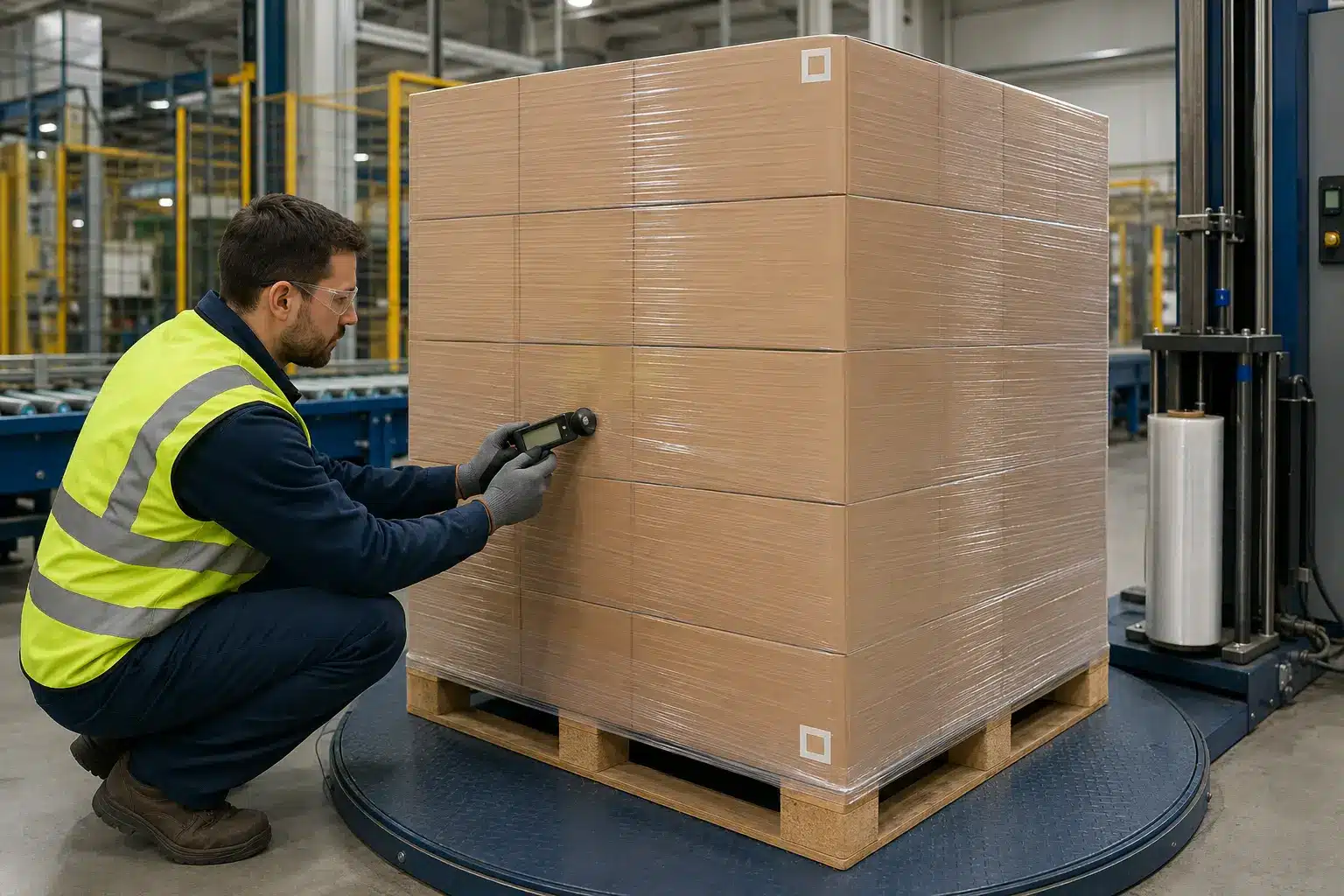
- containment or applied-force results at defined top, middle, and bottom locations;
- film coverage, overlap, neck-down, roping, tears, holes, edge damage, and tail security;
- load-to-pallet bond and evidence of load walking or base-layer movement;
- case crushing, corner deformation, product damage, or excessive compression;
- film breaks, stoppages, manual interventions, cycle time, and rewraps;
- film mass per accepted load and the number of revolutions used.
Visual appearance is useful for detecting defects, but a shiny or fully covered load does not by itself prove adequate containment. The target and measurement method must be tied to the load family and the shipper’s acceptance standard.
Use Route-Appropriate Performance Testing
Formal testing should represent the hazards and consequences of the intended distribution route. ASTM’s current packaging standards index lists ASTM D8314-20(2025) as a guide for performance testing of applied stretch films and wrapping, along with methods addressing horizontal impact, vibration, and mechanical handling of stretch-wrapped unitized loads. These documents help teams select and conduct relevant tests; they do not supply one universal pass value for every pallet.
For unitized loads of similar packaged products moving in a full-truckload environment, the ISTA 3E overview describes a general simulation procedure that can evaluate protective performance and load stability. EUMOS 40509 describes a dynamic method for evaluating unit-load rigidity and deformation. The correct protocol depends on the route, handling system, load, damage tolerance, regulatory or customer requirements, and available laboratory capability. Define pass/fail criteria before testing and document the film, recipe, load, conditioning, equipment, and observations.
Decide Whether the Savings Are Real
Add Hidden Operating and Failure Costs
Review the candidate and baseline over equivalent accepted loads.
| Cost or performance element | Measurement basis | Decision use |
|---|---|---|
| Film material | Net mass per accepted load × delivered cost per mass | Direct material comparison |
| Breaks and restarts | Events, downtime, and labor per trial window | Operating penalty |
| Extra revolutions or rewraps | Additional film mass, cycle time, and labor | Detects false down-gauging savings |
| Scrap and rejected loads | Recorded material and handling cost | Quality penalty |
| Product or package damage | Documented trial or distribution outcome | Performance gate and observed cost |
| Unmeasured future damage risk | Stated separately as a risk, not booked savings | Management review |
Procurement should not approve a candidate merely because its price per kilogram or price per roll is lower. Operations and quality should not reject it merely because its nominal thickness is lower. The decision rests on comparable, measured results.
Approve, Limit, or Reject the Candidate
- Approve when the candidate meets every performance criterion and produces a lower observed cost per accepted load over the defined trial scope.
- Limit approval when it passes only for certain load families, wrappers, routes, seasons, or operating windows. Make those limits part of the controlled specification.
- Reject or retest when performance fails, the process becomes unstable, records are incomplete, or apparent material savings are offset by added operating cost.
After approval, monitor film mass, breaks, recipes, containment checks, and failure signals at a defined frequency. Film lots, loads, operators, wrapper condition, and settings can drift. Atlantic Packaging’s stretch-film cost discussion emphasizes ongoing monitoring of containment, film stretch, revolutions, and machine behavior; the general principle is valuable even when a facility uses a different system.
Correct Common Down-Gauging Failures
Film Breaks Increase
Possible causes include film-edge damage, a candidate that is incompatible with the prestretch or force demand, damaged rollers, poor roll handling, sharp load contact points, excessive acceleration, or variation in film or load condition. Record where and when the break occurs. Inspect the roll, film path, rollers, load edges, and settings before changing the recipe. If correction requires an unsupported operating condition, reject the candidate.

Extra Wraps Erase the Savings
Operators may add revolutions when the load feels weak or when film coverage changes. The result can be a thinner film applied in greater mass than expected. Compare actual film mass, revolutions, overlap, cycle time, and containment profile with the baseline. Remove accidental overwrap only if the load still meets its acceptance criteria. Otherwise the candidate has not demonstrated a lower-cost solution.
The Load Loses Stability
First identify the failure mode: inadequate containment at one elevation, poor load-to-pallet bond, case deformation, pallet overhang, settling, a weak base, or route-specific motion. Check the load and pallet as well as the film. The response may involve revising palletization, secondary packaging, wrap pattern, film selection, or the allowed scope. Any change creates a new configuration that must be documented and retested; do not treat a failed candidate as approved after an informal adjustment.
Use a Buyer–Supplier Trial Checklist
Use one controlled brief and require the completed record back:

- Buyer: identify each load family, normal variation, pallet and secondary packaging, route, handling equipment, environment, current film, wrapper, film-delivery system, recipe, film mass, cycle time, break and damage history, and acceptance criteria.
- Buyer: state which variables may be adjusted, who may adjust them, the stop conditions, test methods, approval authority, and how long the monitored rollout will last.
- Supplier: provide the exact candidate code, nominal thickness and tolerance, width, lot identification, application guidance, compatible equipment assumptions, storage and handling conditions, and relevant test data with methods and units.
- Supplier: state what the supplied evidence supports and what still requires a line or distribution trial.
- Joint record: capture baseline and candidate film mass, delivered cost basis, settings, revolutions, containment measurements, breaks, downtime, rewraps, defects, test configuration, pass/fail result, and deviations.
- Approval record: define the permitted load families, wrappers, routes, operating window, film code, revision, monitoring frequency, and change-control trigger.
Frequently Asked Questions
Does a Thinner Stretch Film Always Use Less Plastic?
No. It uses less plastic only if the net film mass per accepted load decreases. More revolutions, additional overlap, break waste, and rewraps can offset the thickness reduction. Measure film mass rather than assuming a result from gauge.
How Far Can Stretch Film Thickness Be Reduced?
It depends on the exact film, load family, wrapper, recipe, environment, and distribution route. There is no universal minimum thickness. Reduce only through controlled candidates and stop at the lowest configuration that meets the predefined performance criteria with an acceptable process window.
Should Gauge or Pre-Stretch Be Changed First?
Treat them as separate recorded changes within one qualification plan. Establish the current baseline first. When the candidate film is installed, use an equipment- and film-supported starting condition, then adjust one variable at a time. A prestretch setting that works for one film may not be valid for another.
Can One Trial Result Apply to Every Pallet Load?
No. Approval applies to the tested and documented load family and conditions. Extend it only when the organization has evidence that the additional loads are equivalent for the relevant variables, or after those loads complete their own verification.
Conclusion: Reduce Gauge Only After the Load Passes
The safest route to lower stretch-film cost is not to select the thinnest roll. It is to find the lowest total-cost configuration that repeatedly produces an accepted load.
- Measure the current process and film mass by load family.
- Compare material cost per load, not roll price alone.
- Trial a documented candidate with controlled, recorded settings.
- Verify line containment and route-appropriate distribution performance.
- Include breaks, labor, rewraps, rejects, and observed damage in the decision.
- Limit approval to the proven scope and monitor drift after rollout.
When cost decreases and the load still passes the same acceptance standard, down-gauging is a defensible saving. When either condition fails, the thickness reduction is not ready for release.
Related Bestypack Resources
- How Many Pallets Can One Roll of Stretch Film Cover?
- Select the Appropriate Stretch Film Width and Thickness
- Machine Stretch Film Blown & Cast
- How to Calculate the Usage of Stretch Film?
- Cast Stretch Film
- Nano Stretch Film Manufacturer
 English
 Japanese
 French
 Spanish
 Korean
 Italian
 Portuguese
 Dutch
Dutch Arabic
 Russian
 German