
Vented stretch film is perforated pallet wrap designed to combine load unitization with planned airflow. It is useful when solid wrap would obstruct cooling, heat release, gas exchange, or drying, but it is not automatically the stronger, fresher, or safer choice. The correct film depends on the product, pallet geometry, wrapper, route, and airflow target. Buyers should treat ventilation and containment as separate requirements, specify both, and approve the film only after an actual-load trial and appropriate distribution validation.
What Is Vented Stretch Film?
For polymer background, consult the NIH PubChem polyethylene overview before comparing finished-film claims.
For polymer background, consult the NIH PubChem polyethylene overview before comparing finished-film claims.
Vented stretch film is a stretchable web with intentionally formed openings. The web still provides tension around a pallet, while the openings let air move through areas that would be covered by a continuous film. Suppliers may call it ventilated, perforated, breathable, air-flow, or air-permeable stretch film. Those names describe a function, not a complete specification.
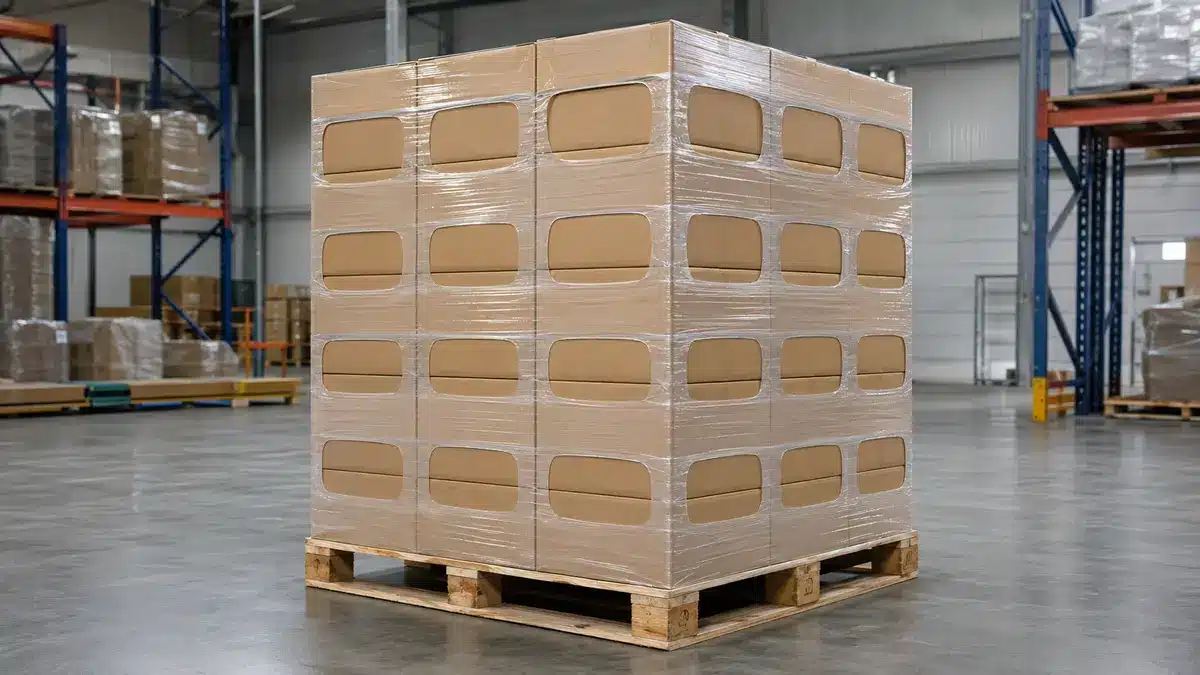
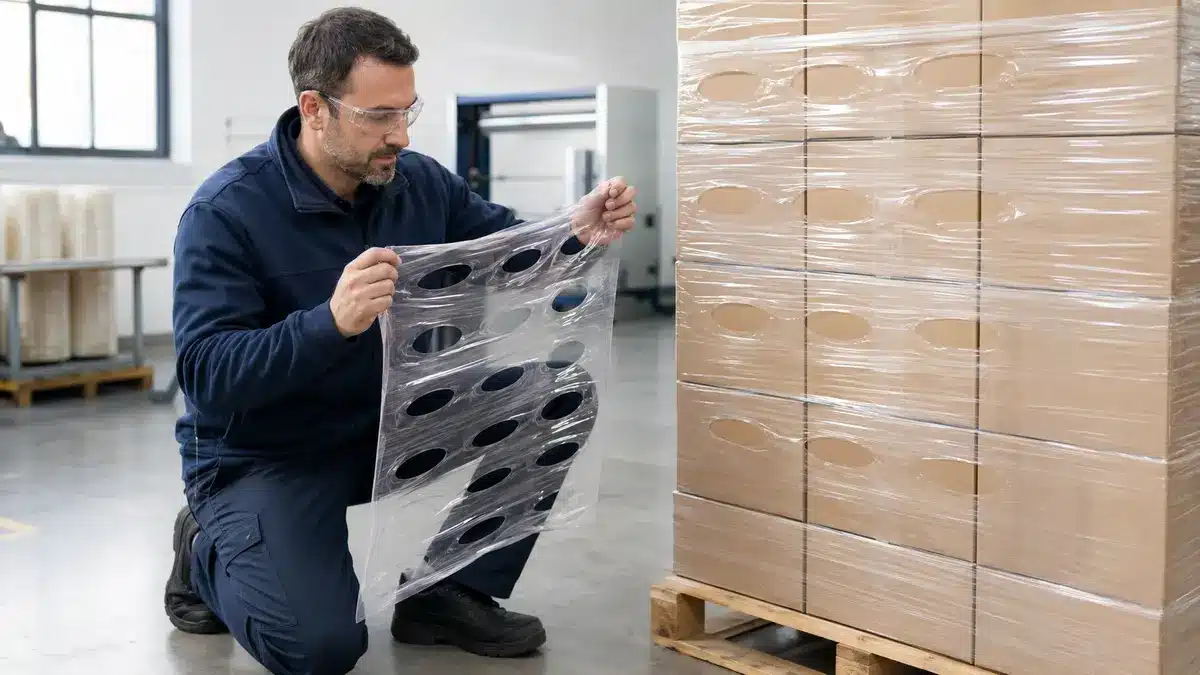
The actual construction can vary. Opening size, shape, spacing, reinforced strands, usable web width, thickness, stretch behavior, cling, and roll format all affect how a film runs and how it contains a load. A buyer therefore cannot select a film from the word “vented” alone.
How the Openings Change Airflow
The openings reduce the amount of continuous film blocking the sides of a pallet. This can help expose carton vents, crate openings, or gaps between products to circulating air. It can also give warm or damp air a route out of the wrapped load.
However, open area is only one part of the airflow system. Carton vents must remain aligned, pallet patterns must leave usable channels, and warehouse or trailer air must reach those channels. USDA and FAO guidance for fresh produce emphasizes airflow through packages and through the stacked load. A perforated outer wrap cannot correct blocked case vents, an unsuitable pallet pattern, or incorrect temperature control.
Vented Film vs. Solid Film vs. Netting
Solid stretch film uses a substantially continuous web. It can provide more surface coverage against dust, splash, and loose components, but each additional layer can restrict bulk airflow around the load. Vented film sacrifices some continuous coverage to create planned openings while retaining a stretchable web.
Netting is a different open-web format Depending on its construction it may not provide the same elastic recovery cling or application behavior as stretch film Roped film is another alternative narrow bands or ropes of film secure.
Where Vented Stretch Film Works Best
Vented stretch film is most relevant when airflow performs a defined job. Typical jobs include removing field or process heat, allowing cold air to reach packages, releasing moisture-laden air, or avoiding a continuous outer layer around products that need ventilation. It is less compelling when the load needs broad surface coverage, protection from weather or dust, or high resistance to sharp edges.
Fresh Produce and Cold-Chain Loads
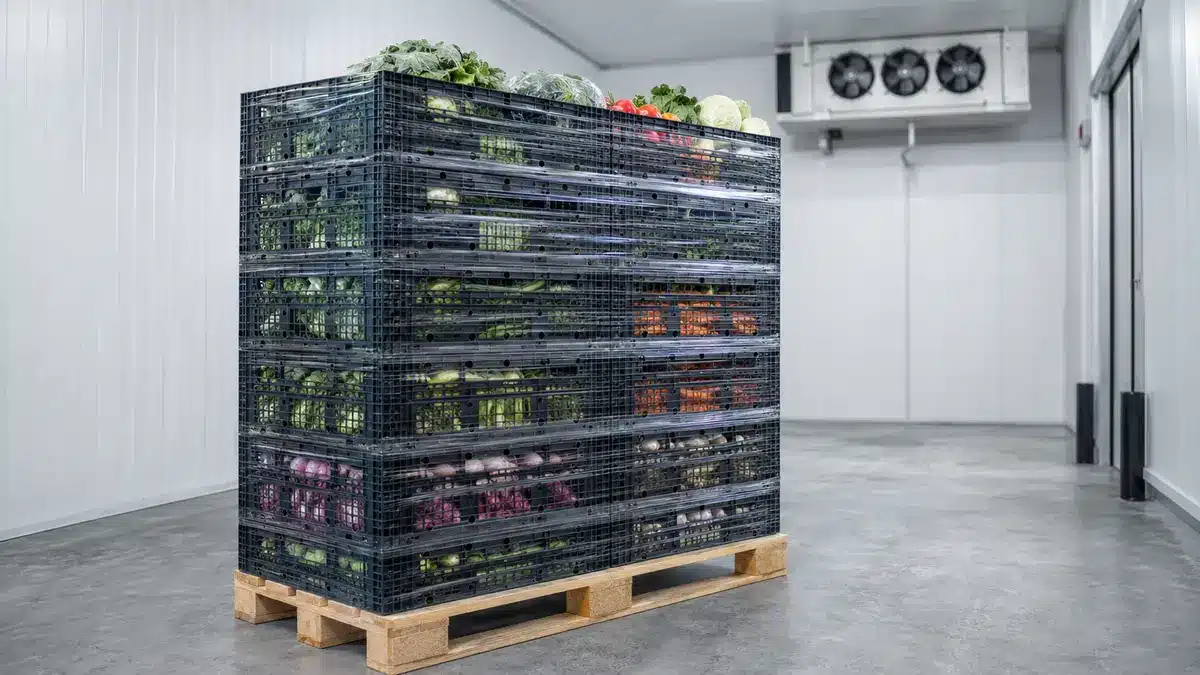
Produce pallets are a common use because respiration, field heat, cooling method, package vents, stacking pattern, temperature, and humidity interact. USDA transport guidance notes that vent locations and load patterns matter to airflow, while FAO guidance stresses that air must move through individual packages and the full stack. Vented stretch film may preserve those paths better than a continuous outer wrap.
That does not make the film a shelf-life or food-safety control by itself. The correct ventilation depends on the commodity, maturity, packaging, precooling process, temperature set point, relative humidity, and route. Too little airflow may slow cooling; too much exposure can contribute to moisture loss for some products. The shipper should define the commodity-specific target before choosing the film.
Warm Goods, Firewood, and Moisture-Sensitive Loads
Products wrapped while warmer than their storage environment can release heat into the pallet space. Examples may include bakery trays after cooling steps, containers leaving a warm process, or other goods that must continue equalizing with ambient conditions. Openings can provide a route for air exchange, but the product must still meet its own cooling, hygiene, and handling requirements.
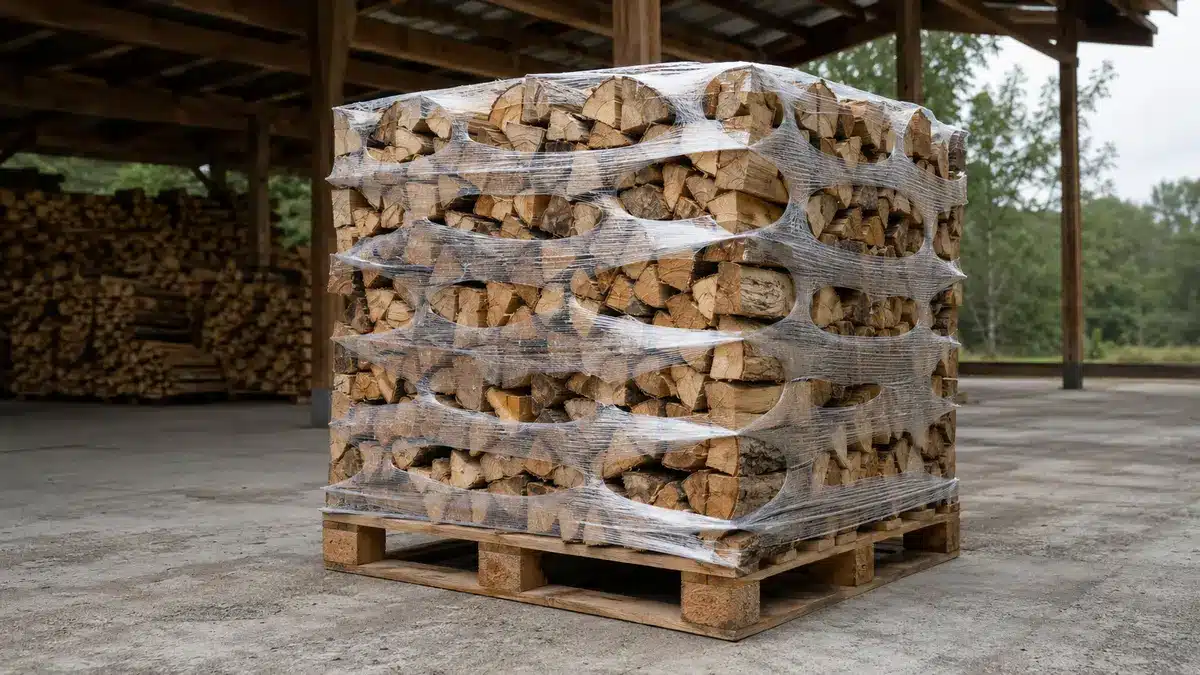
Firewood and other damp materials may also benefit from ventilation during suitable storage and transport. Vented film can unitize bundles while leaving open area for drying. It is not a weather barrier, and it does not prevent mold under all conditions. Moisture content, exposure time, rain, storage orientation, and local airflow still control the outcome.
Benefits and Tradeoffs
The main value of vented stretch film is not “more performance” in every direction. It is a deliberate exchange: less continuous coverage in return for more access to air. The decision is sound only when the load needs that exchange and the remaining web can still provide adequate containment.
Potential Operational Benefits
For an appropriate load, vented film may:
- Keep package or crate vents less obstructed.
- Allow cooling air to reach more of the pallet surface.
- Give warm or humid air a path out of the wrapped load.
- Reduce the need to leave large areas completely unrestrained.
- Improve visibility for inspection where openings expose the load.
- Support hand or machine unitization when a compatible grade and process are available.
These are potential system effects. Their size depends on the film, open-area pattern, number of layers, product, pallet pattern, environment, and wrapping process. A supplier data sheet or peer article cannot establish the result for a buyer’s pallet.
Containment and Protection Tradeoffs
Removing material changes how stress travels through the web. Depending on the opening pattern and reinforcement, the film may concentrate stress around perforations, expose edges, or provide less resistance to puncture and propagation than a continuous film. More layers can improve containment but can also cover openings and reduce the intended ventilation.
| Decision axis | Vented stretch film | Solid stretch film | Netting or roped alternative |
|---|---|---|---|
| Bulk airflow | Openings provide planned flow paths | Additional layers can restrict flow | Usually offers a high proportion of open area |
| Containment mechanism | Tension carried by the remaining web and any reinforcement | Tension distributed through a continuous web | Depends on strand, knot, or rope construction |
| Surface coverage | Partial | Broad | Limited |
| Edge and puncture exposure | Openings and strands require load-specific review | Continuous web may cover more edges | Load contact is concentrated in narrower elements |
| Application | Hand or machine grades may be available | Widely available in hand and machine grades | May need a different dispenser, pattern, or process |
| Best fit | Loads needing both unitization and defined ventilation | Loads prioritizing coverage and conventional containment | Loads prioritizing open area with suitable restraint geometry |
The table is a selection framework, not a performance ranking. The buyer must compare actual samples under the same load, equipment, and test conditions.
Types and Formats
The market uses overlapping names, so a format should be described with a drawing or sample as well as a product name. Record the open-area pattern, strand or lane dimensions, film width, thickness definition, roll dimensions, core, winding orientation, and intended application method.
Macro-Perforated Film
Macro-perforated film has visibly large openings distributed across the web. It is commonly considered when substantial side exposure is needed. The remaining lanes or reinforced sections carry the wrapping tension.
Do not assume that a larger opening automatically provides better pallet cooling. If the wrap pattern covers carton vents, if products block internal channels, or if the surrounding air is not moving at the required temperature, increasing open area may not solve the problem. Large openings may also change how the film handles corners and protrusions.
Micro-Perforated Film
Micro-perforated film uses smaller openings or punctures. It may be considered when the load needs some air or vapor exchange but also benefits from more continuous surface coverage.
“Micro” is not a universal engineering threshold. Ask for opening dimensions, spacing, total open-area calculation, tolerance, and how those values change after the film is stretched. A small unstretched hole can change shape significantly in application, so the installed condition matters more than an isolated roll sample.
Reinforced, Net-Like, and Roped Alternatives
Some vented films use reinforced lanes or strands around openings to carry tension. Other products use an open net construction rather than a perforated sheet. A roping process forms narrow bands from conventional or purpose-made film and places them at selected heights on the load.
These are alternatives, not interchangeable labels. A net may offer more open area but different recovery and handling. Roping may preserve airflow while concentrating restraint in fewer zones. Reinforced perforated film may run more like stretch film but still require specific tension and overlap settings. Compare the installed geometry and measured load response.
How to Choose Vented Stretch Film
Selection starts with the load, not the roll. A useful shortlist describes the product and airflow objective, the pallet’s mechanical risks, and the wrapping equipment. Only then should the buyer compare gauges, opening patterns, roll formats, and prices.
Define the Product and Airflow Requirement
State why air must move and where it must travel. Is the goal to remove heat, support forced-air cooling, avoid covering crate vents, release moisture-laden air, or allow drying? Record the product temperature at wrapping, target temperature, allowed cooling time, storage humidity, route duration, and any commodity-specific limits.
For fresh produce, identify the commodity, package, vent layout, pallet pattern, precooling method, and temperature program. For warm goods, define the temperature at which wrapping is permitted. For damp non-food products, define acceptable moisture condition and exposure. “Needs to breathe” is not a measurable requirement.
Assess the Load Profile and Damage Risks
Document pallet dimensions, height, weight, center of gravity, stack pattern, case strength, edge sharpness, protrusions, voids, and expected handling. A tall unstable pallet and a low uniform pallet may need very different restraint even if both require airflow.
Also state the protection that openings remove. If dust, rain, splash, light exposure, tamper evidence, or small-component retention matters, a vented film may require secondary protection or may be the wrong format. Do not solve an airflow problem by creating a larger contamination or damage risk.
Match Hand or Machine Application
Confirm whether the film is intended for manual use, a turntable wrapper, rotary arm, ring wrapper, or another system. For machine application, compare roll width, core, roll diameter, unwind direction, brake or prestretch system, carriage design, cut-and-clamp sequence, and allowable line speed.
| Input | What to document | Why it changes the choice |
|---|---|---|
| Airflow duty | Cooling, vent exposure, heat release, or drying target | Determines the required installed open area |
| Load geometry | Dimensions, corners, voids, and protrusions | Affects web stress and tear initiation |
| Containment target | Agreed measurement method and acceptance limit | Prevents open area from replacing load stability |
| Environment | Temperature, humidity, storage, and route | Changes film handling and product response |
| Wrapper | Type, carriage, prestretch, speed, and controls | Determines whether the web can run without distortion |
| Protection duty | Dust, splash, weather, and tamper needs | Reveals when a more open format is unsuitable |
Ask the supplier to recommend a starting setup, but treat it as a trial condition rather than an approved production recipe.
How to Apply and Optimize the Film
Optimization should change one controlled variable at a time. Begin with a supplier-supported sample and the actual pallet. Record the roll identity, environment, wrapper, settings, film use, cycle time, web breaks, installed opening pattern, containment observations, and product condition.
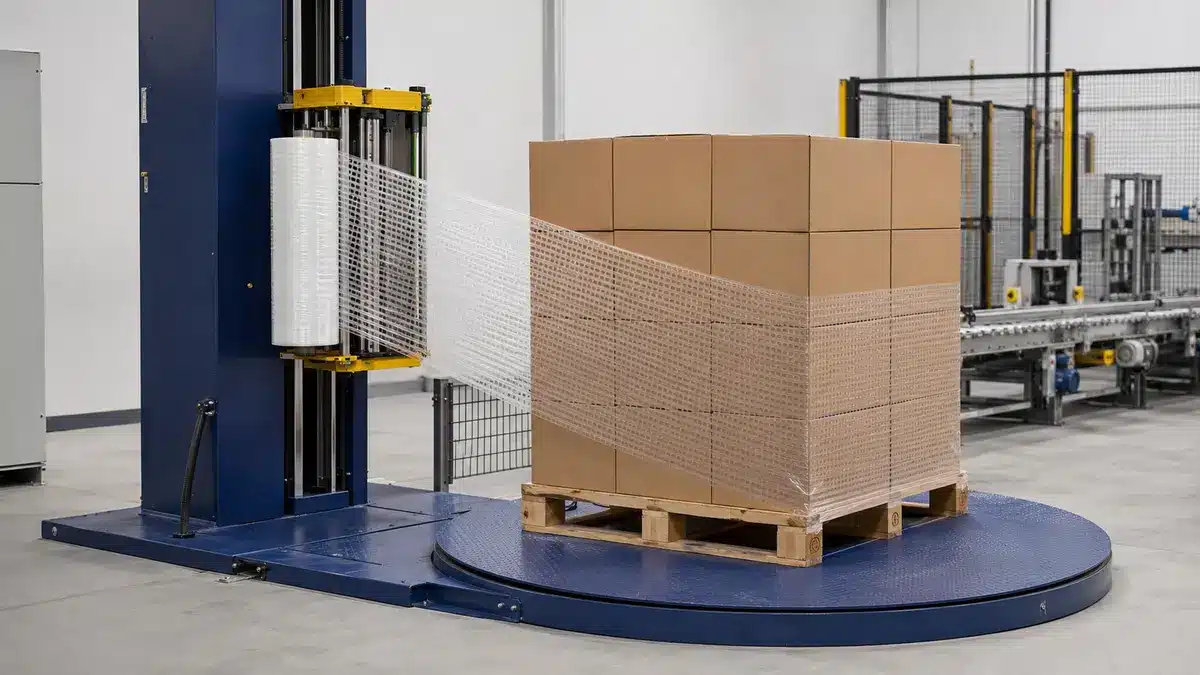
Establish Base Containment
- Confirm that the pallet itself is sound, the load is stacked as intended, and no sharp edge is likely to cut the web unexpectedly.
- Anchor the film using a method suitable for the load and equipment, then establish bottom restraint without blocking pallet entry or creating loose tails.
The base pattern should connect the load to the pallet while respecting forklift access and airflow needs. The correct number of wraps cannot be prescribed without the film, load, and containment target.
Adjust Tension, Overlap, and Wrap Pattern
- Start within the film and wrapper supplier’s permitted operating window. Observe neck-down, opening distortion, strand alignment, web breaks, corner stress, and cling.
- Adjust tension, overlap, carriage speed, and layer placement one variable at a time. Recheck both containment and installed open area after every change.
More tension is not automatically better. It can deform light cartons, enlarge openings, narrow the web, or trigger tears around perforations. More overlap can add restraint but may close the ventilation paths that justified the film.
Preserve the Intended Airflow Path
- Inspect the wrapped pallet from every side. Confirm that film lanes do not cover the case or crate vents needed by the cooling plan.
- Place the pallet in the actual cooling, storage, or staging arrangement and verify that neighboring pallets, walls, and trailer patterns do not block the route.
Important: A visually open wrap does not prove adequate airflow. The installed pallet pattern, surrounding air movement, product temperature, and package vents must work together.
If the wrap meets containment but not the airflow objective, change the pattern or format and repeat the trial. If it meets airflow but the load shifts, do not approve it merely because the product cools faster.
Testing and Validation
Validation has three levels: characterize the film, trial the complete pallet, and challenge the packaged load in a relevant distribution system. Passing one level does not replace the others.
Check Film Properties Under Stated Conditions
Request a specification or test report that identifies the exact film construction or grade, thickness definition, opening pattern, test method and edition, specimen direction, conditioning, equipment, result, unit, and tolerance. Useful property checks may include:
- Thickness and thickness variability using an agreed film method.
- Tensile properties in machine and transverse directions, with ASTM D882 or another agreed method.
- Static and kinetic coefficient of friction under stated conditions, with ASTM D1894 or another agreed method.
- Puncture behavior for stretch wrap, with ASTM D5748 or another agreed method.
- Cling, unwind, stretch, force, and recovery using clearly defined supplier or buyer methods.
- Open-area dimensions before and after the agreed application stretch.
Do not compare values across different methods, specimen directions, thicknesses, temperatures, or conditioning. A resin data sheet cannot replace a report for the finished perforated web.
Trial the Actual Pallet
Build representative pallets using production packages, stacking, pallet quality, corner boards or straps, and wrapper settings. Define pass/fail criteria before testing. Depending on the risk, observe or measure load movement, containment at agreed heights, film breaks, corner damage, package deformation, tail security, opening alignment, airflow or cooling response, condensation, and film consumption.
Repeat enough trials to reveal normal variation. Include the weakest credible package condition and the environmental extremes that the operation expects. Record failed trials as well as successful ones; otherwise the operating window may look wider than it is.
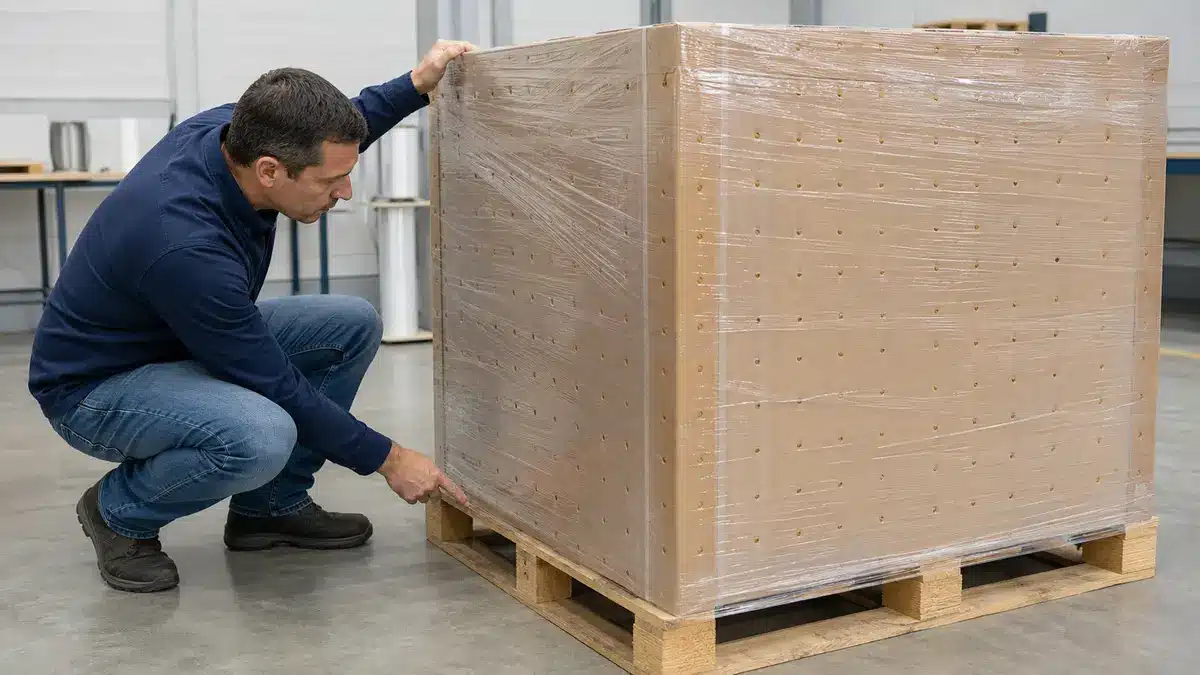
Validate the Distribution System
Choose a protocol that matches the actual route and objective. ISTA Procedure 3E, for example, is a general simulation for certain similar unitized loads moving by full truckload and can evaluate load stability, but its overview also notes that test levels may not represent a specific distribution system and that some conditions may not be covered.
The correct plan may therefore combine laboratory challenges with monitored shipments. Define damage, shift, temperature, moisture, and presentation limits in advance. Treat the product, package, pallet, wrap, handling, and route as one system.
Important: A film property result does not certify a pallet. A successful pallet trial does not automatically validate every load pattern, wrapper, temperature, or distribution route.
RFQ Checklist for Vented Stretch Film
Give every supplier the same input set and request comparable evidence:
- Product description, package type, pallet dimensions, height, weight, stack pattern, and center-of-gravity concerns.
- Reason for ventilation and the required airflow, cooling, heat-release, or drying outcome.
- Product temperature at wrapping, target temperature, humidity range, storage time, and route conditions.
- Required open-area pattern, including dimensions and tolerance in the installed condition.
- Hand or machine application, wrapper type, carriage or prestretch system, core, roll diameter, roll orientation, and target speed.
- Required containment measurement, acceptance limit, and sampling plan.
- Edge, puncture, dust, splash, weather, visibility, and tamper requirements.
- Exact material or construction declaration, thickness definition, dimensions, and roll tolerance.
- Applicable test methods, editions, conditions, units, direction, sample identity, and report date.
- Trial-roll quantity, recommended starting settings, change-control process, lot traceability, packaging, storage, and handling instructions.
- Target-market food-contact or other regulatory documents only when the film’s actual use requires them.
- Full-construction recyclability information and local collection assumptions, without an unconditional environmental claim.
A complete RFQ makes quotations easier to compare and exposes missing evidence before a line trial.
Frequently Asked Questions
Can Vented Stretch Film Run on a Standard Wrapper?
It depends. Some vented films are made for conventional stretch-wrapping equipment, but compatibility is not automatic. The opening pattern and reinforced lanes must pass through the carriage without snagging or distorting, and the roll, core, unwind direction, prestretch system, tension control, cut-and-clamp sequence, and speed must fit the wrapper. Run a controlled trial and document the approved operating window.
Is Vented Stretch Film Suitable for Freezer Use?
It depends on the exact film and application. Request evidence for unwind, stretch, cling, impact or tear behavior, and tail retention at the relevant conditioning and use temperatures. Also verify the pallet after temperature cycling. A generic statement that a vented film is “freezer safe” does not establish performance for every formulation, wrapper, load, or duration.
Is Vented Stretch Film Recyclable?
Possibly, but not from the word “vented” alone. Recyclability depends on the complete construction, including polymer grades, additives, colors, labels, tapes, contamination, and any other components, as well as the target market’s collection, sorting, and reprocessing system. APR guidance can help assess PE-film design in North America, but local acceptance and the exact finished product still need confirmation.
When Is Solid Stretch Film the Better Choice?
Solid film is often the better starting point when ventilation is unnecessary and the load needs broad surface coverage, protection from dust or splash, retention of small items, or conventional high-throughput wrapping. It may also be preferable when perforations create unacceptable edge or snag risks. Compare both formats on the actual load instead of assuming that a specialty film is automatically superior.
Final Verification Before Approval
Vented stretch film is a system choice, not a stand-alone cure for heat, moisture, or load instability. Approval should confirm four things:
- The product and package have a defined ventilation requirement.
- The installed openings connect to a usable airflow path.
- The remaining web and wrap pattern meet the agreed containment and protection criteria.
- The exact film, wrapper settings, pallet, environment, and distribution route have been validated with traceable records.
If any one of these conditions is missing, keep the status at trial rather than production approval. The most defensible specification combines a drawing or sample, stated test conditions, an approved wrapper window, actual-load results, and change control for future lots or constructions.
Related Bestypack Resources
- Stretch Film vs. Cling Film: What’s the Difference?
- How Many Pallets Can One Roll of Stretch Film Cover?
- How to Reduce Stretch Film Thickness to Cut Costs?
- Select the Appropriate Stretch Film Width and Thickness
- Black Stretch Wrap Film
- Shrink Wrap vs. Stretch Wrap: What’s the Difference?
- Stretch Film Thickness: What You Need to Know
Related Bestypack Resources
- Stretch Film vs. Cling Film: What’s the Difference?
- How Many Pallets Can One Roll of Stretch Film Cover?
- How to Reduce Stretch Film Thickness to Cut Costs?
- Select the Appropriate Stretch Film Width and Thickness
- Shrink Wrap vs. Stretch Wrap: What’s the Difference?
- Stretch Film Thickness: What You Need to Know
- Black Stretch Wrap Film
 English
 Japanese
 French
 Spanish
 Korean
 Italian
 Portuguese
 Dutch
Dutch Arabic
 Russian
 German