
The appropriate stretch film is not chosen from pallet weight or gauge alone. Start with the load, the wrapping method, and the risks the unit will face. Then choose a width the operator or machine can apply consistently, express thickness in an unambiguous unit, and test the combined film-and-wrap setup on the actual load. This approach gives purchasing, engineering, and quality teams a specification they can compare and verify instead of relying on a generic size chart.
Define the Load Before You Choose Film
For polymer background, consult the NIH PubChem polyethylene overview before comparing finished-film claims.
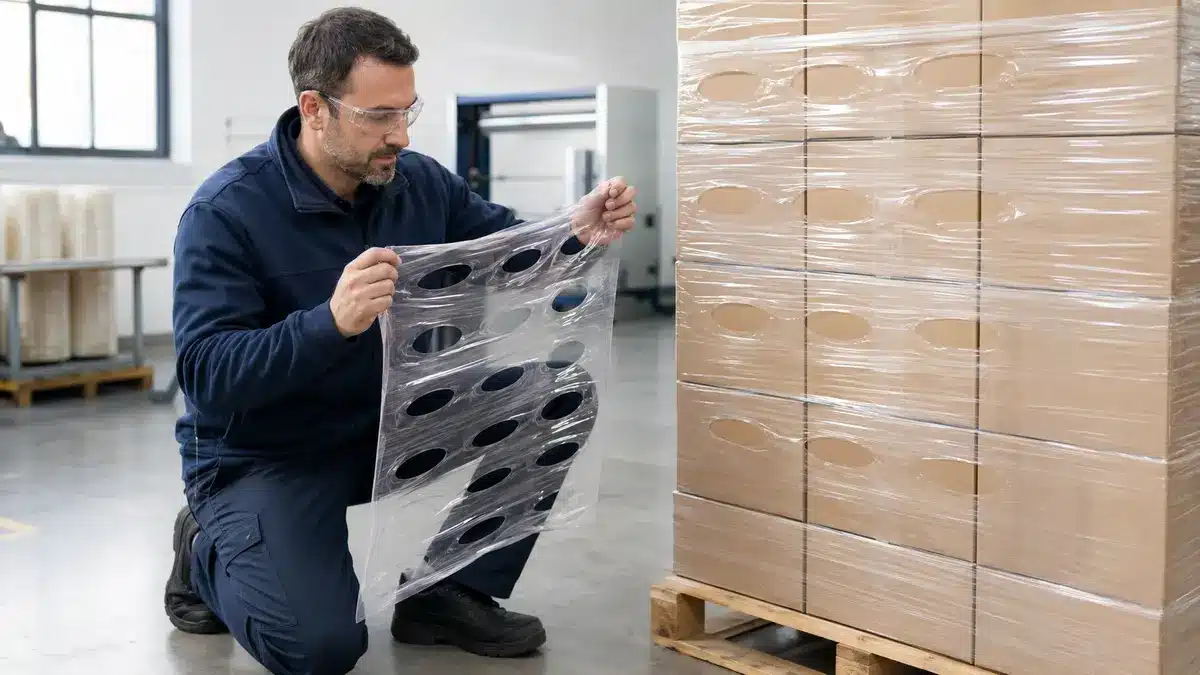
For polymer background, consult the NIH PubChem polyethylene overview before comparing finished-film claims.
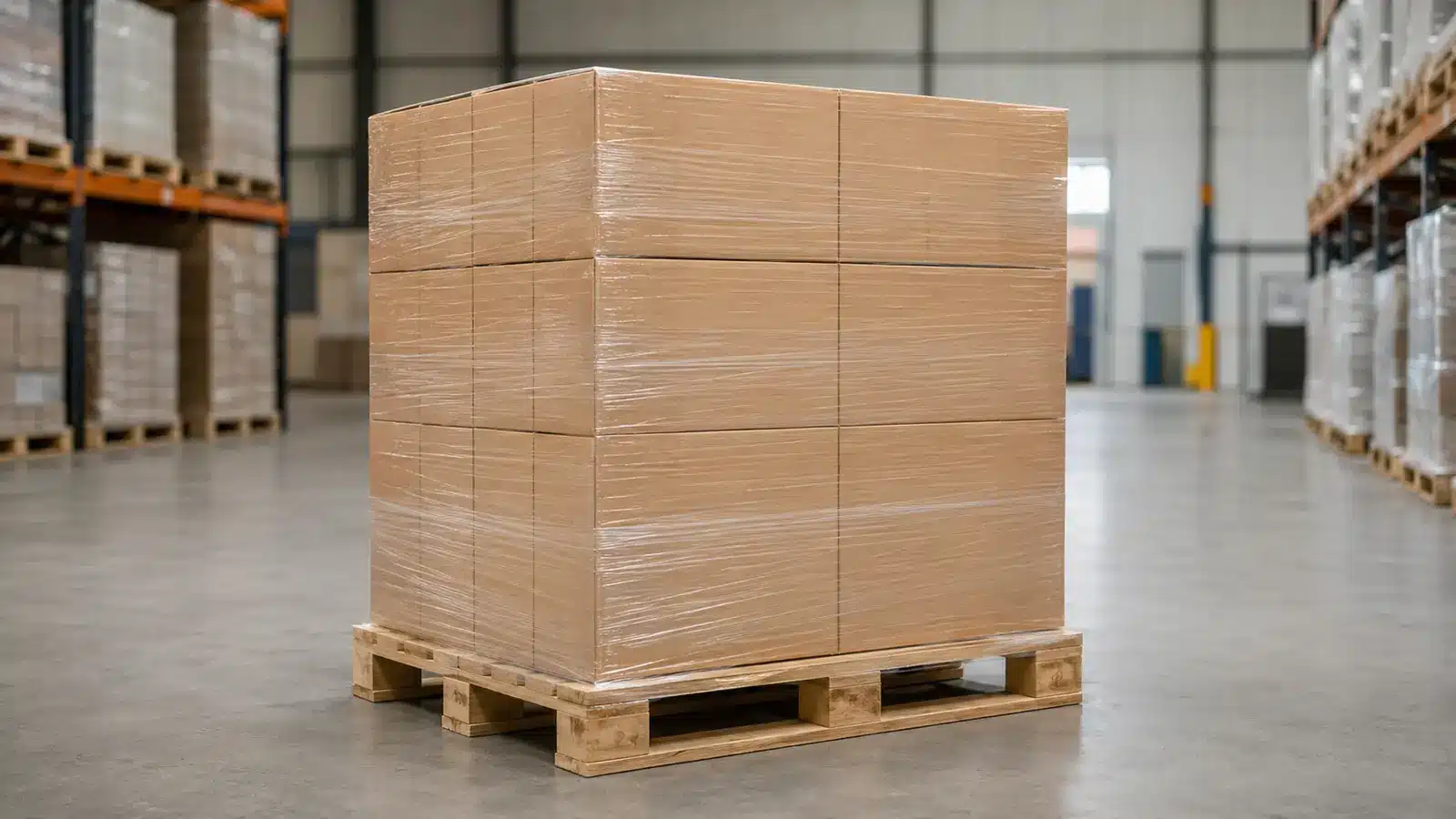
Width and thickness are outputs of the application brief, not the first inputs. A useful brief describes the load, the pallet, the wrap process, and the handling route in enough detail for a supplier or internal trial team to reproduce the application.
Record the Load Profile
Record the variables that change how the film contacts and restrains the load:
- Pallet length and width, total loaded height, and gross mass
- Load geometry: square, round, irregular, recessed, or overhanging
- Unit pattern: interlocked, column-stacked, bagged, bundled, or mixed
- Product rigidity and compression sensitivity
- Sharp corners, projections, voids, straps, or exposed pallet edges
- Surface friction and whether the outer packages can slide
- Whether the load changes during production or remains consistent
Mass matters, but it does not describe the complete challenge. A compact, rigid load and a tall, flexible load can have the same mass while imposing very different puncture, movement, and compression risks.
Identify Handling and Transit Risks
Map the route from the wrapper to the destination. Include conveyor transfers, forklift handling, warehouse dwell, vehicle vibration, braking and cornering, temperature exposure, and any repeated loading or unloading. Also note whether the film is expected only to unitize the load or whether the packaging system must provide additional dust, moisture, tamper, or top-cover protection.
Important: ASTM D4649 covers stretch-film selection and application for indoor environments and enclosed transport. Outdoor exposure or extreme temperatures require separate, product-specific evidence and validation.
Select a Width That Fits the Wrapping Method
Width affects how much height each revolution covers, the overlap between courses, the number of revolutions, edge behavior, and the operator’s or machine’s ability to control the web. A width is appropriate only when it fits both the load geometry and the application equipment.
Width for Hand Application
For hand wrapping, start with the dispenser and the operator’s working method. A wider roll can cover more height per pass, but it can also be heavier and harder to control around short, irregular, or low loads. A narrower roll can improve access and local reinforcement, yet may require more revolutions and more opportunities for inconsistent overlap.
During a hand-wrap trial, observe whether the operator can:
- Maintain the intended overlap from the pallet base to the top
- Keep the film aligned without excessive neck-in or edge folding
- Apply repeatable tension without frequent film breaks
- Reach low and high areas without unsafe posture
- Complete the pattern without unnecessary revolutions
Choose the width that produces a repeatable wrap pattern under normal working conditions, not the width that looks most efficient on roll dimensions alone.
Width for Machine Application
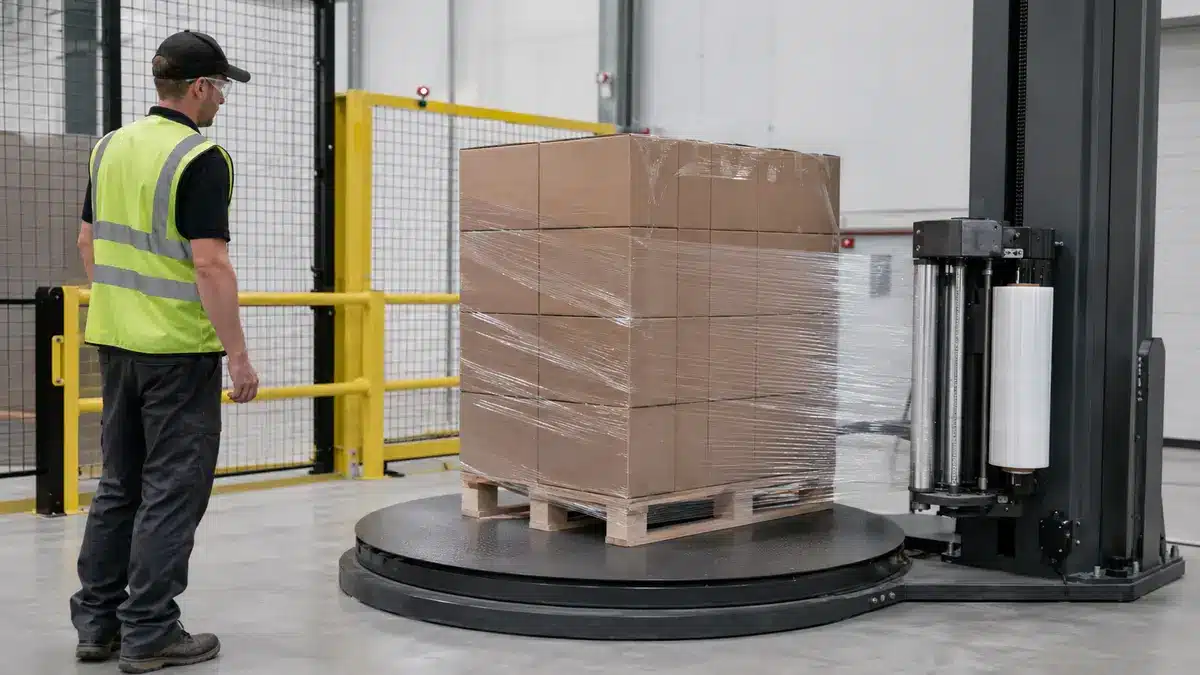
For machine application, the wrapper defines the first boundary. Confirm the permitted film width, core, roll diameter, roll mass, carriage design, pre-stretch system, film-delivery path, and sensor requirements. A roll that physically fits the carriage may still unwind poorly or fail to track at production speed.
Then check the relationship among film width, load height, carriage travel, overlap, top and bottom reinforcement, and any roping or banding steps. Changing width can change the number and position of layers even when the programmed wrap count appears unchanged.
Important: Do not substitute a new width into an existing machine recipe without a controlled trial. Keep the original settings and results available so the effect of width can be separated from changes in tension, pre-stretch, speed, or wrap pattern.
Specify Thickness in Gauge, Mil, or Micron

Thickness must be stated as a measured dimension, not just as a marketing grade. Use one primary unit in the purchase specification and add a mathematical conversion only when buyers and suppliers work in different unit systems. Also identify the measurement method and any documented tolerance.
Use Unit Conversions Correctly
In common North American stretch-film usage, 100 gauge corresponds to 1.00 mil. One mil is 0.001 inch, and 1 mil equals 25.4 micrometres (µm). The conversion is:
| Gauge | Mil | Micron (µm) |
|---|---|---|
| 60 | 0.60 | 15.24 |
| 80 | 0.80 | 20.32 |
| 100 | 1.00 | 25.40 |
These figures are unit conversions, not load ratings. In an RFQ, write the requested nominal thickness in micron or mil, state whether “gauge” means measured thickness, and request the applicable tolerance and test method. ASTM D6988 is a guide for determining the thickness of plastic-film test specimens when thickness is used in other test results.
Do Not Treat Thickness as a Strength Guarantee
Two films with the same nominal thickness can behave differently because of resin selection, layer construction, manufacturing process, orientation during application, cling system, and variability across the roll. Test results can also change with specimen preparation, thickness measurement, test speed, grip setup, temperature, and other method conditions.
ASTM D882, for example, explains that tensile results depend on controlled specimen and test conditions. A tensile value is useful only when the method, direction, specimen, and conditions are comparable. It does not by itself demonstrate puncture resistance, elastic recovery, stress retention, or the stability of a wrapped pallet.
Terms such as “equivalent gauge” or “performance film” may describe a supplier’s commercial positioning rather than a standardized thickness class. Ask for the actual measured thickness and the evidence used to support the claimed application performance.
Evaluate Width and Thickness Together
Width, thickness, overlap, number of layers, applied stretch, wrap force, film delivery, and load geometry work as one system. Changing one variable can alter the effect of the others. Use a small candidate matrix to decide what each trial needs to prove.
| Load or process condition | Width decision to evaluate | Thickness or performance decision to evaluate | Trial focus |
|---|---|---|---|
| Uniform cartons on a consistent pallet | Coverage and repeatable overlap | Lowest candidate thickness that still meets the approved load criteria | Film use, edge behavior, and load stability |
| Sharp corners or projections | Web control around stress points and local reinforcement | Puncture and tear behavior under the actual wrap pattern | Breaks during wrapping and damage after handling |
| Tall, flexible, or compression-sensitive load | Layer placement at the top, middle, and base | Holding behavior without unacceptable package deformation | Movement, compression, and retained containment |
| Machine wrapping at production speed | Carriage fit, tracking, and programmed overlap | Stable delivery through the pre-stretch system | Unwind, breaks, neck-in, and repeatability |
| Variable mixed loads | Width that operators or recipes can control across the range | Candidate specification with a defined operating window | Worst-case loads and changeover control |
This matrix is a trial plan, not a recommendation table. A thicker film does not automatically correct poor overlap or an unstable stacking pattern. A wider film does not automatically reduce film use if the machine recipe, overlap, or web control is unsuitable.
Validate the Choice on the Actual Load

The final selection should be based on a controlled application trial using representative film rolls, loads, equipment, and handling conditions. The aim is to learn whether the complete system meets agreed acceptance criteria and can be repeated.
Control the Wrapping Settings
Use a written sequence:
- Identify each candidate roll by supplier, grade, lot, width, measured or declared thickness, length or net film mass, and roll format.
- Record the wrapper, dispenser, carriage, pre-stretch configuration, film tension or force settings, speed, wrap pattern, overlap, and number of top, middle, and bottom revolutions.
- Select representative loads, including the most difficult approved geometry rather than only an easy pallet.
- Keep variables constant when comparing one width or thickness with another. If a setting must change, document the change as a separate trial condition.
- Record temperature and other environmental conditions that could affect the film or load.
The record must be detailed enough for another operator or shift to repeat the trial. Without that control, a film change can be confused with a machine-setting or operator change.
Check the Wrapped Load and Record Results
First inspect the application: web tracking, film breaks, holes, edge tears, neck-in, folded edges, loose tails, poor load-to-pallet bonding, and unacceptable package compression. Then evaluate the wrapped unit against the handling and transport risks defined in the brief.
Applicable methods may include ASTM guidance and tests for applied stretch film, mechanical handling, horizontal impact, vibration, cling, elastic recovery, or stress retention. Select the method and current edition that match the actual risk, define the specimen or unit load, and agree on the acceptance criteria before testing. A film-property result and a unit-load result answer different questions.
Approve a candidate only when the dimensions, roll identity, settings, load description, method, conditions, observations, and acceptance result are recorded. If the load or wrapper later changes, review whether the approval still applies.
Write a Comparable Purchase Specification
A quotation is comparable only when every supplier is asked to quote the same application and measurement basis. Transfer the approved trial conditions into a controlled specification.
| Specification field | What to state |
|---|---|
| Intended application | Load type, pallet dimensions, loaded height, mass range, handling route, and indoor or other verified environment |
| Application method | Hand dispenser or identified wrapper and film-delivery configuration |
| Film identity | Supplier grade or SKU, construction description when disclosed, cast/blown or pre-stretched status as applicable |
| Width | Nominal width, unit, and documented tolerance |
| Thickness | Nominal micron or mil, whether gauge is a measured-thickness term, test method, and documented tolerance |
| Roll format | Core dimensions roll length or net film mass roll diameter roll mass and winding direction where… |
Do not fill missing fields with assumptions. Request a current technical data sheet, certificate of analysis when appropriate, or a sample for controlled evaluation. Product-specific claims—such as thickness tolerance, puncture, tensile, cling, stretch, recovery, or compliance—need documents that identify the exact grade and applicable conditions.
Frequently Asked Questions
Is a wider stretch film always more efficient?
No. A wider web can cover more load height per revolution, but efficiency depends on overlap, web control, load height, machine recipe, roll handling, and the number of acceptable wrapped loads produced. Compare total film used and approved results under the same trial conditions.
Is a thicker stretch film always safer?
No. Added thickness may change resistance to some forms of damage, but safety depends on the film construction, application settings, load stability, package compression, and handling route. A thickness change must be validated on the actual load.
Can gauge alone determine the allowable pallet weight?
No. Gauge is a thickness expression, not a universal pallet-capacity rating. Load geometry, rigidity, sharp edges, stacking pattern, coefficient of friction, wrap pattern, applied stretch, layer placement, and transport conditions all affect the result. Use load-specific trial and test evidence.
How should equivalent and true-gauge films be compared?
Compare declared and measured thickness in a common unit, then compare relevant test data produced under the same method and conditions. Finally, run both films on the same representative load with controlled wrapper settings. The labels alone do not establish equivalent performance.
A Practical Selection Rule
Use the narrowest decision process, not the thinnest or widest film by assumption:
- Define the real load, wrapper, route, and acceptance criteria.
- Choose a width that the operator or machine can apply consistently.
- State thickness in a common unit with a measurement method and documented tolerance.
- Compare candidates with the same wrap settings, then adjust one variable at a time.
- Approve the complete film-and-wrap system on representative loads.
- Put the approved dimensions, settings, evidence, and change controls into the purchase specification.
That sequence turns width and thickness from isolated catalog numbers into a repeatable packaging decision.
Related Bestypack Resources

- How Many Pallets Can One Roll of Stretch Film Cover?
- Stretch Film Thickness: What You Need to Know
- How to Reduce Stretch Film Thickness to Cut Costs?
- Black Stretch Wrap Film
- Shrink Wrap vs. Stretch Wrap: What’s the Difference?
- Machine Stretch Film Blown & Cast
 English
 Japanese
 French
 Spanish
 Korean
 Italian
 Portuguese
 Dutch
Dutch Arabic
 Russian
 German