
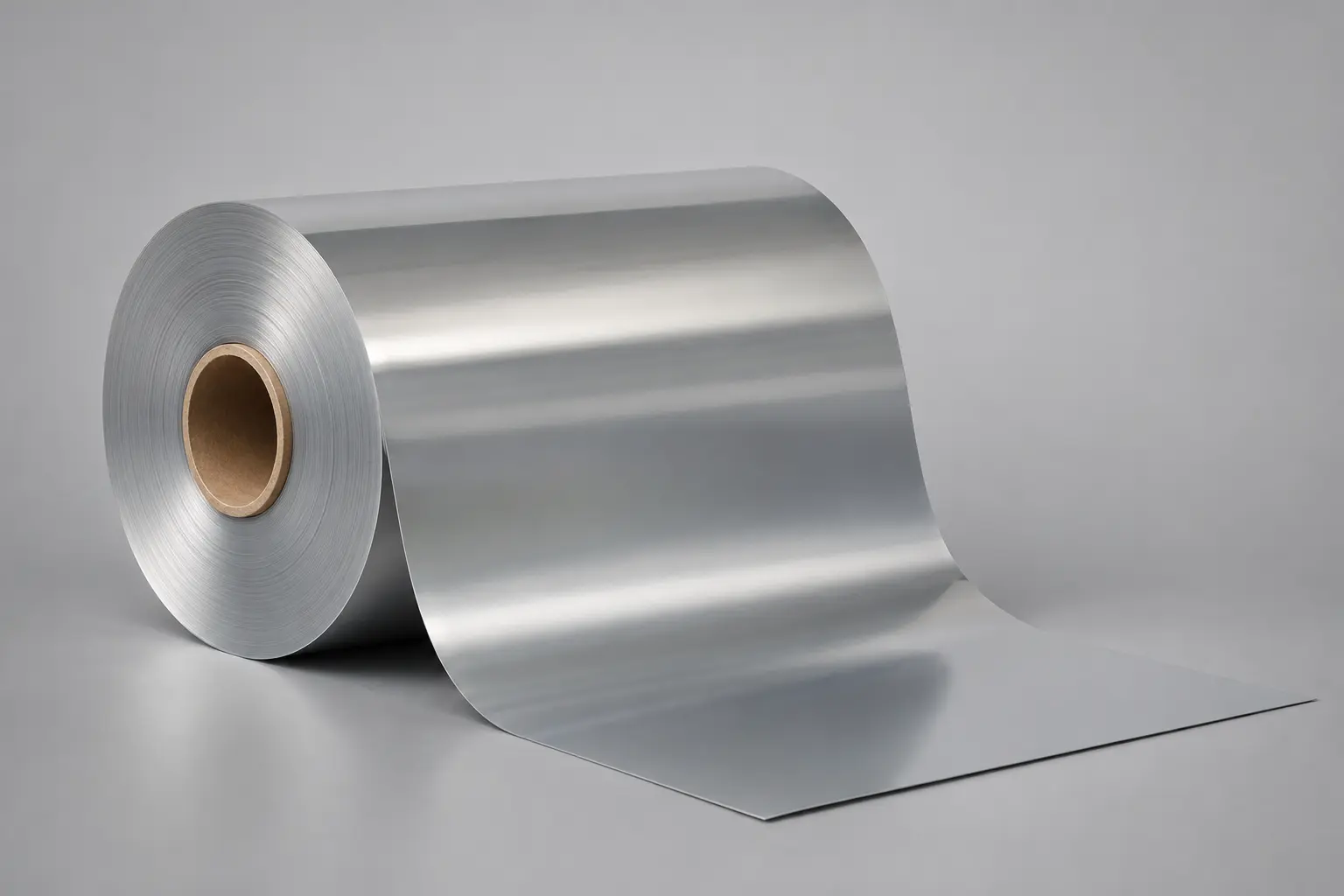
PET metallized film combines a biaxially oriented polyester substrate with an extremely thin deposited metal layer, usually aluminum. The result is a lightweight, reflective film used when a laminate needs stronger protection from oxygen, moisture, aroma, or light than clear PET alone can provide. Yet “metallized PET” is a material family, not a complete specification. Grade, surface, barrier test conditions, laminate design, converting process, food-contact use, and end-of-life route must all be validated for the finished package.
What Is PET Metallized Film?
For U.S. food-contact context, review the eCFR polymer provisions before approving a finished-film claim.
For U.S. food-contact context, review the eCFR polymer provisions before approving a finished-film claim.
PET metallized film is commonly made by depositing aluminum onto one surface of biaxially oriented polyethylene terephthalate It keeps the PET substrate’s useful web strength and dimensional stability while adding an opaque reflective surface and a substantially different barrier profile The deposited layer is much thinner.
PET, BOPET, and MetPET terminology
PET identifies the polymer, polyethylene terephthalate. BOPET means the PET film has been stretched in both machine and transverse directions to develop a balanced film substrate. MetPET, metallized PET, metallized BOPET, and aluminized PET are commonly used for BOPET carrying a deposited metal layer. Those labels do not reveal the film gauge, surface treatment, optical density, barrier level, or which side is intended for printing or lamination.
Film versus aluminum foil
Metallized PET should not be described as foil simply because it looks metallic Foil is a self-supporting metal sheet metallized PET is a polymer film with a thin metal coating That difference affects flex-crack behavior dead fold opacity conductivity sealing strategy conversion and recycling A shiny appearance therefore cannot establish functional equivalence The correct comparison starts with the required barrier.
How PET Film Is Metallized
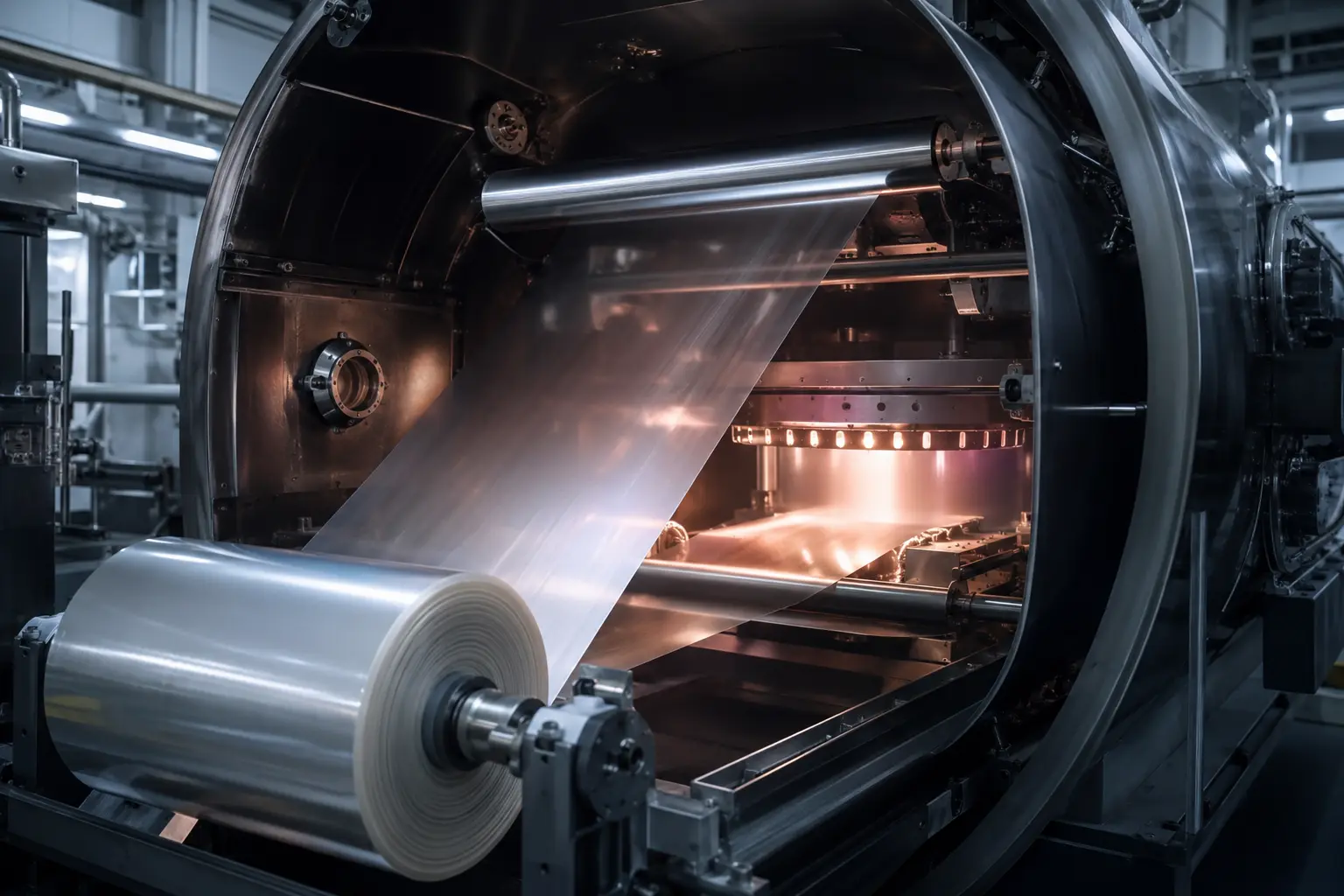
Vacuum metallization is a controlled coating process. Aluminum is heated inside a low-pressure chamber until it vaporizes, then condenses onto the moving PET web. The apparent simplicity hides several interacting controls: base-film cleanliness, surface chemistry, vacuum stability, evaporation rate, web temperature, line speed, winding, and downstream handling all influence the continuity and adhesion of the metal layer.
Base-film and surface preparation
The PET surface must be clean, flat, and appropriate for the intended metal bond. Additives, contamination, scratches, gels, treatment level, or surface roughness can affect deposition and create weak or discontinuous areas. Some grades use a modified or coated surface to improve metal adhesion; others provide a separate treated surface for ink or laminating adhesive. The converter must identify the metal side, the treated non-metal side, and any primer or coating rather than assuming both faces behave alike.
Vacuum deposition and metal-layer control
In the chamber, a controlled aluminum vapor reaches the moving web and forms the metallic layer. Process control aims for a consistent deposit across the web and through the roll. Optical density is often used as a practical production indicator, but it is not a complete substitute for oxygen- or water-vapor-transmission testing. Similar optical readings can still mask differences caused by pinholes, substrate quality, metal adhesion, or later damage.
The production workflow can be summarized as:
- Select and condition the correct PET base film.
- Clean and prepare the intended metallizing surface.
- Evacuate the chamber and stabilize the deposition process.
- Deposit aluminum while controlling web speed, temperature, and coating uniformity.
- Rewind under controlled tension and protect the metal surface from damage.
- Inspect, slit, sample, and grade the roll against the agreed specification.
Winding, slitting, and inspection
The metal surface is vulnerable to abrasion, blocking, scratching, and transfer if winding pressure or handling is poorly controlled. Slitting can introduce edge damage or debris, while excessive tension can create wrinkles or stretch the web. Inspection should therefore combine visual and roll-quality checks with agreed functional tests. A roll that looks uniformly bright may still fail a metal-bond, barrier, or lamination requirement.
Key Performance Properties—and Their Limits
Metallization can improve several useful functions at once, but the improvement is neither automatic nor universal. Performance depends on PET grade, metal continuity, coatings, thickness, storage, conversion history, and the finished laminate. Reported values should always be tied to a test method, specimen, conditioning, temperature, humidity, units, and tested side when relevant.
Oxygen, moisture, aroma, and light barrier
The aluminum layer creates a longer and more difficult path for oxygen and water vapor and provides strong opacity to visible light. This can help protect oxidation-sensitive foods, aromas, flavors, colors, oils, and other light-sensitive contents. However, pinholes, scratches, metal pick-off, flexing, seal defects, and poorly formed package features can degrade the barrier that was measured on flat film.
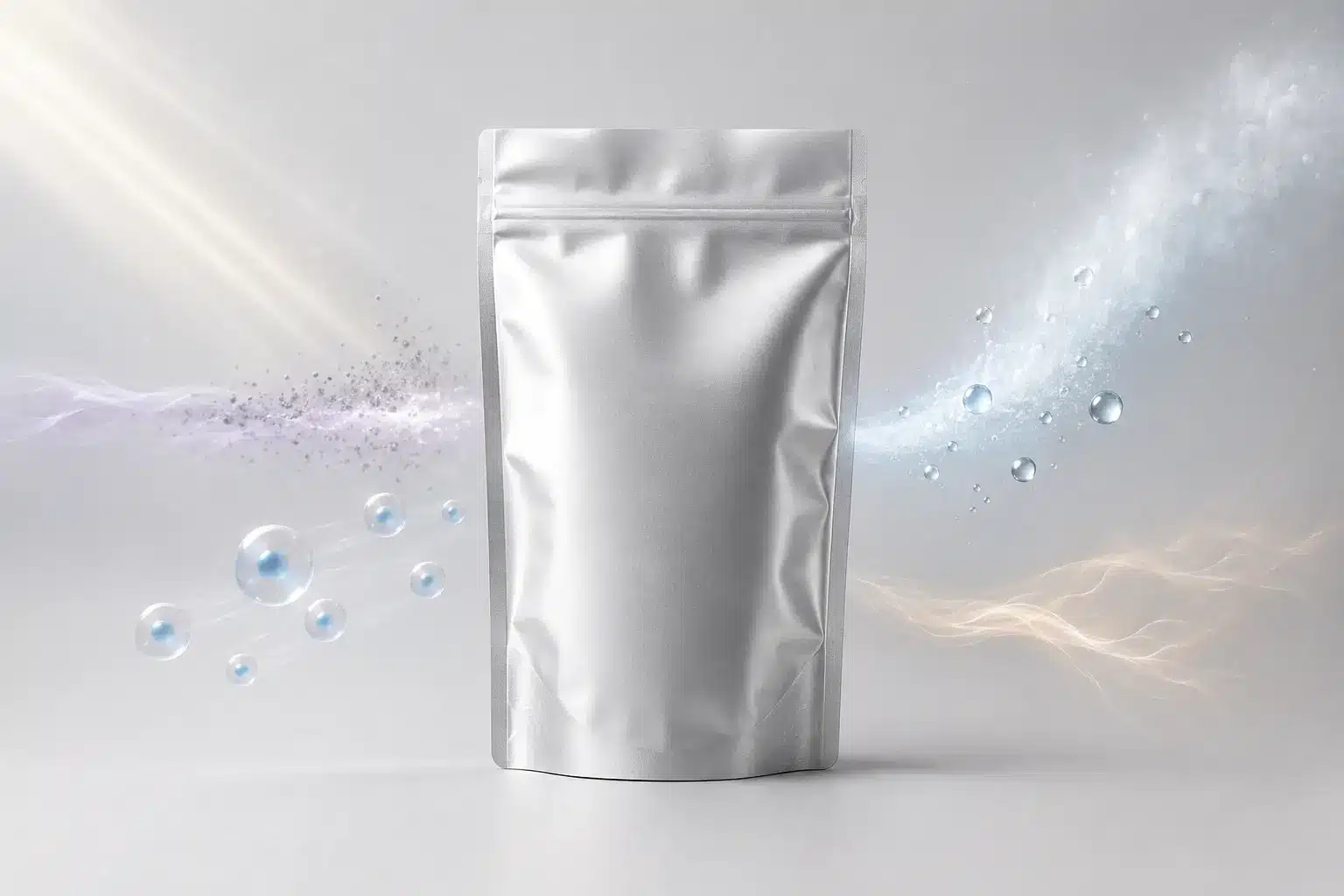
ASTM D3985-24 covers oxygen transmission testing for films and laminates using a coulometric sensor while ASTM F1249-25 covers water-vapor transmission testing with a modulated infrared sensor An OTR or WVTR value is meaningful only with its method and conditions Finished-package shelf life also depends on seals package area.
Important: Supplier data sheets may show valid typical values for a named grade, but those figures do not become a universal metallized-PET specification or a finished-package guarantee. Confirm the grade, units, temperature, relative humidity, sample orientation, and whether the value applies before or after lamination and flexing.
Mechanical, thermal, optical, and electrical behavior
The BOPET substrate normally contributes.
Mechanical, shrinkage, coefficient-of-friction, optical-density, and metal-bond results must be read as separate properties. A high optical density does not prove adequate bond strength; a strong flat film does not prove flex-durability; and PET’s temperature capability does not establish the heat resistance of inks, adhesives, coatings, seals, or the packaged product.
Common Grades, Surfaces, and Constructions
“Metallized PET” covers grades designed for different priorities. Two films with the same nominal gauge may differ in surface chemistry, metal adhesion, barrier enhancement, roughness, winding behavior, optical density, or suitability for printing and lamination. Qualification should be based on the exact grade and surface designation, not a generic material name.
Standard, high-barrier, and enhanced-adhesion grades
Common functional categories include:
- Standard metallized PET for general barrier and decorative laminate use.
- High- or ultra-high-barrier grades that use tighter substrate and deposition control, and sometimes additional barrier or protective coatings.
- Enhanced metal-bond grades for structures exposed to demanding adhesives, extrusion lamination, or product conditions.
- Print- or adhesion-treated grades with a designated non-metal surface for inks or adhesives.
- Chemically resistant, heat-stable, release, conductive, or specialty optical grades for technical applications.
These categories are not interchangeable. A supplier’s technical data sheet should state the intended surface, available thickness, winding direction, typical values, test methods, and limitations.
Typical laminate roles
Metallized PET is frequently a barrier and print-support layer inside a multi-layer structure. A separate PE, CPP, or other sealant web may provide heat sealing, product contact, puncture resistance, or low-temperature seal performance. Paper, BOPP, polyamide, or another PET layer may add stiffness, toughness, appearance, or processing functions.
The correct layer order depends on where the graphics sit, which surface receives adhesive, whether the metal needs protection, and what touches the product. Structures such as printed PET/adhesive/MetPET/sealant or printed outer film/adhesive/MetPET can be useful conceptual examples, but they are not ready-to-run specifications. Adhesive chemistry, coat weight, curing, residual solvents, sealant choice, and product compatibility still require trials.
Where PET Metallized Films Are Used
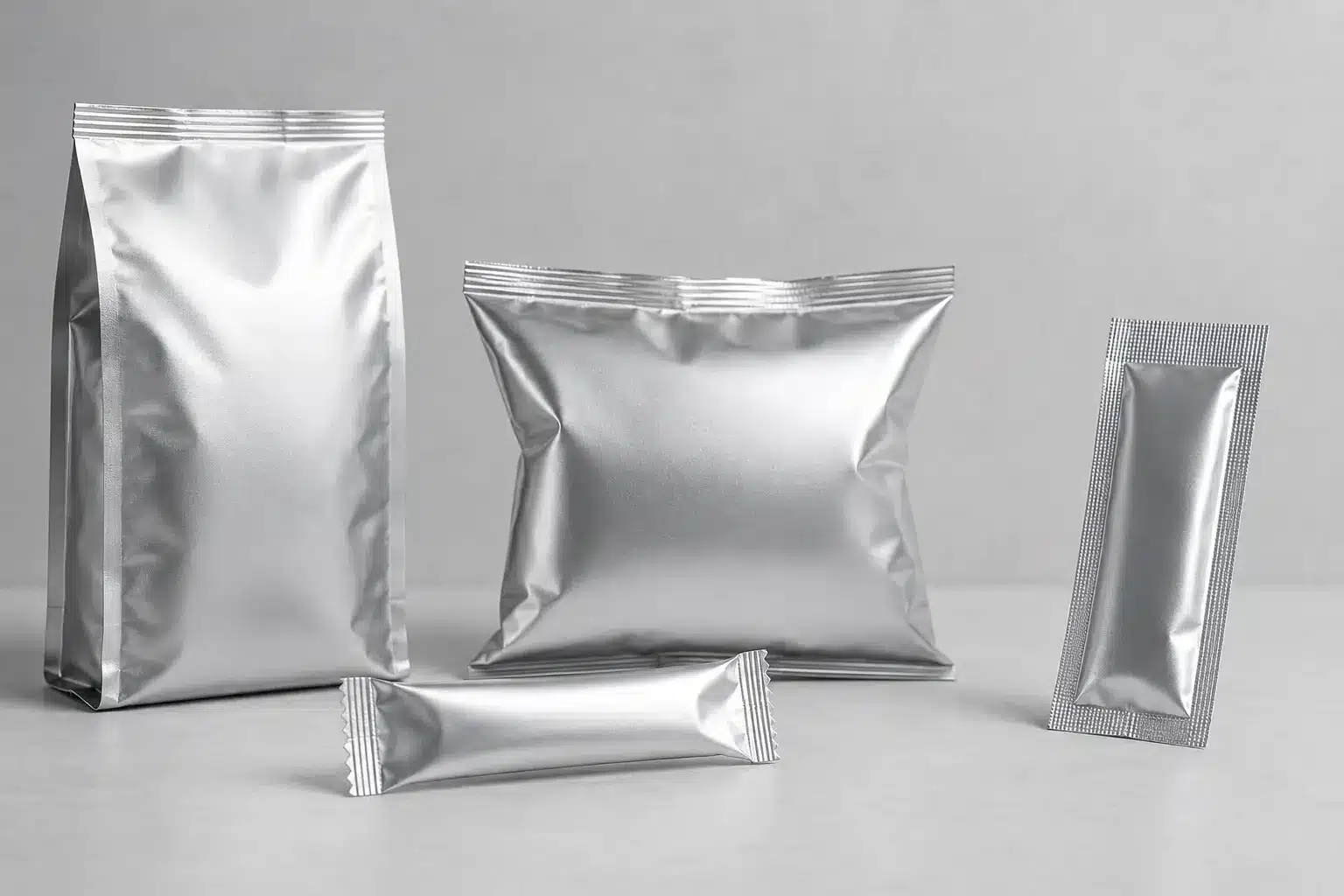
Metallized PET is considered when a project needs a combination of barrier, opacity, reflective appearance, web strength, and low material mass. Application names are only a starting point; actual suitability follows from the product’s sensitivity, required shelf life, converting route, package geometry, filling conditions, and target market.
Flexible packaging
| Application scenario | Main protection need | What to verify | Important limitation |
|---|---|---|---|
| Coffee, tea, and dry beverage products | Aroma, oxygen, moisture, and light | Barrier after lamination, seals, valves, and distribution flexing | Flat-film data does not predict the complete pack |
| Snacks and confectionery | Moisture, oxygen, light, and shelf appearance | Seal integrity, flex durability, COF, and machinability | Metallized PET usually needs a separate sealant |
| Powders and nutritional products | Moisture, oxygen, and odor control | Product compatibility, migration, seal contamination, and drop performance | Food-contact status is structure and use specific |
| Pet food and dry food | Aroma, oxygen, moisture, and mechanical handling | Laminate toughness, seals, folds, and storage conditions | Heavy or sharp contents may need added toughness |
| Lidding and specialty pouches | Barrier, dimensional stability, and graphics | Peel or seal behavior, heat exposure, and product contact | PET identity alone does not establish sealability |
Labels, insulation, and technical uses
Outside flexible food packaging, metallized PET may be used in decorative labels, reflective insulation, cable or electrical constructions, thermal-control systems, window treatments, and specialty graphics. These uses may prioritize reflectivity, emissivity, conductivity, dielectric behavior, dimensional stability, or appearance rather than food-package barrier. Electrical or thermal applications require their own methods and safety standards; packaging OTR or WVTR data cannot qualify them.
How Metallized PET Compares with Alternative Materials
No single barrier material wins every application. A defensible comparison uses the same decision axes and evaluates the finished structure.
| Material option | Typical strengths | Typical trade-offs | Best question to ask |
|---|---|---|---|
| Metallized PET | Strong oxygen, moisture, aroma, and light protection with PET web properties and metallic appearance | Opaque; metal layer can be damaged; usually requires lamination to a sealant; structure may complicate recycling | Does the grade retain required barrier after converting and distribution? |
| Aluminum foil | Very high barrier when intact, opacity, dead fold, and heat resistance | Can pinhole or flex-crack depending on gauge and handling; heavier; different converting and recycling route | Is foil-level barrier necessary after flexing and forming? |
| Metallized BOPP | Good moisture-barrier potential, lower density, and options with integrated heat sealing | Lower heat and dimensional stability than PET in many comparisons; oxygen barrier and processing behavior are grade specific | Is moisture, sealing, or dimensional stability the dominant requirement? |
| Transparent AlOx- or SiOx-coated PET | Transparency plus enhanced barrier and PET dimensional stability | Coating durability, cost, retort or flex performance, and supplier capability vary | Is product visibility worth the different barrier and converting risk? |
| Clear PET | Transparency, print support, strength, and dimensional stability | Lower barrier than an appropriate metallized or oxide-coated grade | Is the baseline barrier sufficient for the product and shelf-life target? |
The table is qualitative. Final selection should use comparable test conditions, actual laminate samples, and the complete package—not isolated marketing descriptions.
Converting and Processing Considerations
Metallized PET must survive printing, lamination, curing, slitting, forming, sealing, and distribution without unacceptable metal damage or loss of adhesion. A converter should lock the surface map and winding direction before the trial: which side is metal, which side is treated, which side receives ink or adhesive, and which layer faces the product.
Printing and lamination
Some grades provide a non-metal surface specifically modified for inks or adhesives; others allow selected systems on the metal side. Compatibility is not universal. Ink and adhesive chemistry, surface energy, primer, coat weight, drying, cure time, residual solvent, nip pressure, and web temperature can all affect bond and appearance. A documented trial should check initial and aged bonds, metal pick-off, tunneling, curl, odor, and barrier after lamination.
Important: Do not assume a water-based, solvent-based, solventless, extrusion-lamination, or extrusion-coating process is compatible because another metallized PET grade used it successfully. Follow the exact grade’s technical instructions and validate the complete structure.
Web handling, sealing, and downstream operations
Control tension and nip pressure to avoid wrinkles, scratches, blocking, or metal transfer. Protect roll edges and the metallized face during transport and storage. Confirm coefficient of friction and static behavior at operating conditions, because both can affect feeding and winding.
Metallized PET is normally not the heat-seal layer unless the selected grade has a proven sealing function. Validate the chosen sealant’s initiation temperature, hot tack, seal window, pressure, dwell time, and contamination tolerance on the actual machine. Also assess gusseting, zipper insertion, laser scoring, perforation, valves, and microwave or metal-detection requirements; each operation can change package behavior.
How to Specify and Validate Metallized PET Film
A useful specification connects the roll to the final package. It should let different suppliers quote the same task and let quality teams distinguish a material issue from a converting issue.

- Define the application brief. Record the product, pack format, fill process, target shelf life, storage, distribution, light sensitivity, aroma sensitivity, and end market.
- Define the construction. State each layer’s material and role, total and layer gauges, sealant, adhesive or extrusion layer, ink location, product-contact surface, and metal-side orientation.
- Specify roll geometry. Include width, tolerance, roll length or weight, core, maximum roll diameter, splice rules, winding direction, and packaging.
- Choose measurable film requirements. Consider thickness, optical density, metal bond, treatment level, COF, tensile or shrinkage behavior, and appearance defects only where they matter to the process.
- Specify barrier methods and conditions. State OTR and WVTR methods, temperature, relative humidity, units, specimen orientation, conditioning, and whether testing is on raw film, laminate, flexed laminate, or finished pack.
- Review documentation. Obtain the current technical data sheet, specification, certificate of analysis format, safety information, regulatory declarations, change-control terms, and traceability expectations.
- Run converting trials. Check printing, adhesive cure, bond development, metal pick-off, slitting, winding, sealing, and machine performance.
- Validate the finished package. Test seals, leaks, barrier, flexing, drops or distribution hazards, product compatibility, sensory risks, and shelf life using protocols appropriate to the actual package.
- Set release criteria. Agree sampling, acceptance limits, retest rules, nonconformance handling, and the difference between typical data and guaranteed specification values.
Food-Contact and Regulatory Documentation
PET, aluminum, or a familiar laminate description does not by itself establish food-contact compliance. The applicable requirements depend on the market, every layer and substance, the food type, direct or indirect contact, contact time and temperature, processing, and intended conditions of use.
For an EU food-contact evaluation, the file may need to address:
- Regulation (EC) No 1935/2004 general safety, inertness, traceability, and documentation principles.
- Commission Regulation (EC) No 2023/2006 on good manufacturing practice.
- Commission Regulation (EU) No 10/2011 for applicable plastic layers, including composition restrictions, overall and specific migration, test conditions, and Declaration of Compliance requirements.
- National rules or measures for components not fully harmonized at EU level, such as certain inks, adhesives, coatings, or metal-related aspects.
- The final article’s maximum foreseeable food, time, temperature, and processing conditions.
Other markets require their own review. A declaration should identify the material or grade, manufacturing site where relevant, applicable legislation, limitations, date or version, and supporting evidence. It should not be silently extended to another thickness, coating, adhesive, laminate, food, or use condition.
Important: “Food grade” is not a substitute for a current, scope-matched compliance package and migration assessment.
Recyclability and End-of-Life Considerations
Metallization uses far less aluminum than foil but low metal mass does not automatically make the final package recyclable Flexible packs often combine PET with.
CEFLEX testing reports that exposed.
A responsible end-of-life assessment should:
- Identify every material and its percentage in the finished pack.
- Select the target collection and recycling stream in a named market.
- Check current design-for-recycling guidance for that stream.
- Evaluate size, shape, color, print, metallization, adhesives, closures, and residues together.
- Run sorting or recycling tests when the design falls outside recognized guidance.
- Keep “recyclable,” “recycled content,” “bio-based,” and “compostable” claims separate and evidence based.
Common Failure Modes and Troubleshooting
Troubleshooting should begin with the symptom, affected roll and position, process history, and retained samples. The table lists likely directions for investigation—not remote diagnoses.
| Symptom | Possible causes | Checks to run | Do not assume |
|---|---|---|---|
| Patchy appearance or pinholes | Base-film contamination, surface defects, unstable deposition, scratching | Map defects across web and roll; inspect substrate; compare optical density and barrier | Brightness alone proves barrier |
| Low metal bond or metal pick-off | Wrong surface, weak treatment, incompatible adhesive, incomplete cure, excessive stress | Confirm side and grade; measure treatment; review chemistry, coat weight, cure, peel failure mode | All adhesives work on the metal side |
| Barrier worse after lamination or flexing | Metal damage, adhesive interaction, wrinkles, pinholes, folds, poor seals | Test raw film, laminate, flexed laminate, and finished pack under matched conditions | Raw-film OTR/WVTR predicts the pouch |
| Wrinkles, curl, or telescoping | Tension imbalance, gauge profile, heat, nip pressure, winding hardness | Review roll profile, tension logs, temperature, alignment, and storage | The metallizer is the only possible cause |
| Delamination, odor, or tunneling | Incompatible chemistry, insufficient cure, residual solvent, product attack | Check mix ratio, drying, cure, retained solvent, bond aging, and product exposure | Initial bond proves long-term performance |
| Seal leaks | Wrong sealant, contamination, narrow window, temperature/pressure/dwell variation | Seal curves, hot tack, contamination trials, leak testing, jaw mapping | Metallized PET itself provides the seal |
When a failure appears, preserve traceability: supplier, grade, batch, roll, slit position, date, storage, process settings, and sample orientation. Change one controlled variable at a time so the corrective action can be verified.

Final Selection Checklist
PET metallized film can be a strong barrier and appearance component, but selection should remain evidence led. Before approval, confirm that the qualification file contains:
- A clear product, package, shelf-life, process, distribution, and market brief.
- The exact film grade, thickness, surface treatments, metal side, winding direction, and roll geometry.
- A complete laminate drawing with layer roles, inks, adhesives, coatings, sealant, and product-contact surface.
- Comparable OTR and WVTR requirements with methods, temperature, humidity, units, conditioning, and specimen state.
- Relevant optical-density, metal-bond, treatment, COF, mechanical, thermal, and appearance criteria.
- Current technical, quality, traceability, change-control, and regulatory documents.
- Trial evidence for printing, lamination, slitting, winding, sealing, and special operations.
- Finished-package evidence for barrier, seal integrity, flexing, distribution, product compatibility, and shelf life.
- A market-specific end-of-life assessment for the entire package.
The safest conclusion is conditional: approve a named metallized PET grade only for the validated construction, process window, product, and market. If any of those inputs changes, review the evidence before carrying the approval forward.
Related Bestypack Resources
- PET Reflective Film
- PET Film Guide: Properties, Advantages, Applications
- The Uses and Advantages of PET Film
- Metallized Film Manufacturer&Supplier
- Metallized Film
 English
 Japanese
 French
 Spanish
 Korean
 Italian
 Portuguese
 Dutch
Dutch Arabic
 Russian
 German