
PET film combines a useful balance of stiffness, dimensional stability, optical quality, and process resistance. Those qualities make it a common substrate in flexible packaging, labels, electrical insulation, graphics, and industrial laminates. Yet “PET film” is a material family, not a complete specification. Orientation, grade, thickness, treatment, coating, metallization, and the other layers in a structure can all change performance. This guide explains where PET film adds value, where it has limits, and what a buyer should verify before approving a film or finished construction.
What Is PET Film?
For U.S. food-contact context, review the eCFR polymer provisions before approving a finished-film claim.
For U.S. food-contact context, review the eCFR polymer provisions before approving a finished-film claim.
PET, Polyester Film, and BOPET
PET is polyethylene terephthalate, a thermoplastic polyester. The term can describe resin, rigid sheet, molded packaging, fibers, or film, so the format must always be stated. In film markets, “polyester film” commonly means PET film.
BOPET means biaxially oriented PET film. It is stretched in the machine direction (MD) and transverse direction (TD) during manufacture. Many packaging and technical PET films are BOPET, but PET film and BOPET should not be treated as perfect synonyms: an amorphous, cast, coated, heat-sealable, or otherwise specialized PET construction may have a different manufacturing history and performance profile.
Why Biaxial Orientation Matters
Stretching a film in two directions reorganizes its polymer structure. In a well-controlled BOPET process, orientation contributes to stiffness, tensile behavior, dimensional control, and optical uniformity. The balance between MD and TD also matters; results measured in one direction cannot automatically be assigned to the other.
Orientation does not create one universal property set Resin design draw ratios heat setting additives thickness and subsequent treatment all influence the finished film Buyers should therefore use BOPET as a category.
Common PET Film Variants
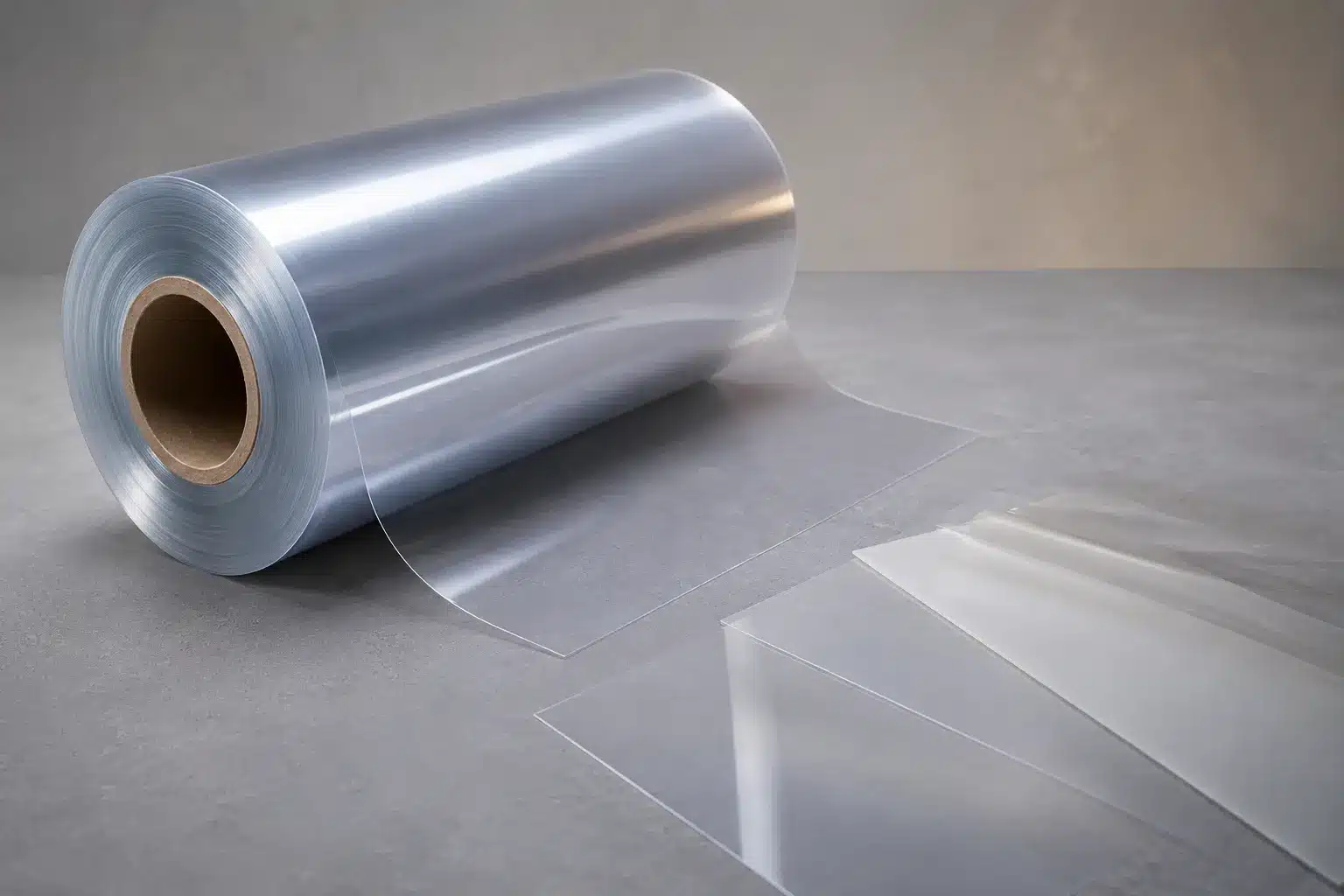
Commercial PET films are engineered for different functions. Common categories include clear, white, opaque, matte, treated, coated, heat-sealable, metallized, low-shrink, and electrical-insulation grades. Some are designed as printable outer webs; others act as lidding, release, carrier, optical, or insulating substrates.
These labels describe an intended function not a complete construction For example heat-sealable PET may use a coextruded or coated sealing surface while metallized PET adds a very thin metal layer The side to be.
Key Properties of PET Film
Mechanical and Dimensional Behavior
PET film is commonly selected when a web needs stiffness and dimensional stability. Those traits can support web transport, print registration, die cutting, lamination, and the handling of thin substrates. Tensile strength, elongation, modulus, tear behavior, puncture behavior, and shrinkage are separate properties, however; a strong tensile result does not prove resistance to every damage mode.
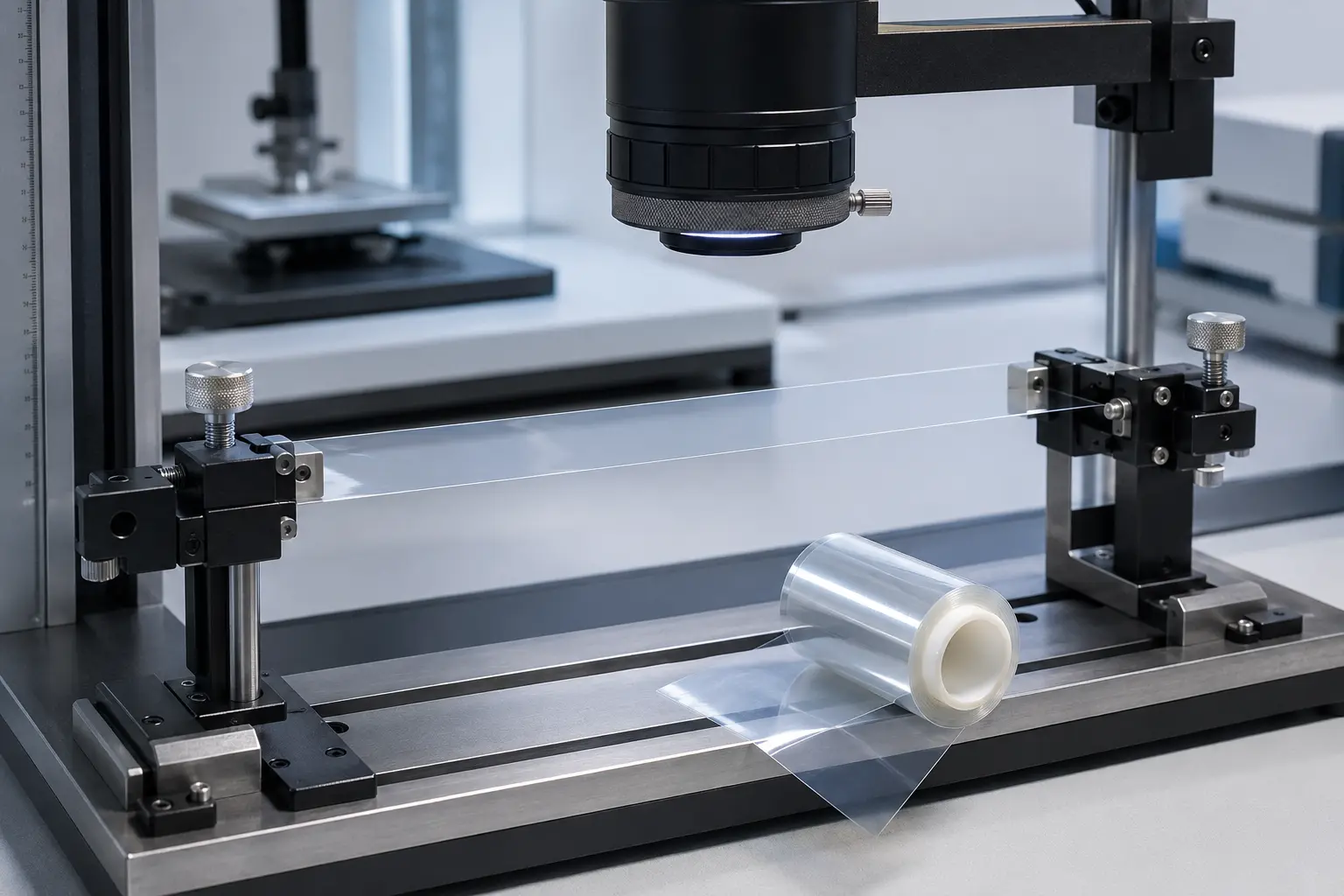
For thin plastic sheeting, tensile data may be generated under ASTM D882 or ISO 527-3. A useful report identifies the film grade, nominal and measured thickness, specimen direction, conditioning, test speed, units, and method version. Results from different methods or MD/TD directions should not be directly ranked without a justified correlation.
Optical and Surface Behavior
Clear PET grades can provide high transparency, controlled haze, and gloss, while white, matte, or filled grades deliberately produce different appearances. ASTM D1003 is commonly used for haze and luminous transmittance, but the test method, sample condition, thickness, and surface treatment remain part of the result.
Surface behavior is equally important in converting. Treatment or primer may improve wetting and adhesion for inks, adhesives, or coatings. Slip and antiblock choices affect winding and machine handling. ASTM D1894 covers static and kinetic coefficients of friction, yet COF can vary with the tested faces, speed, temperature, surface aging, and additive migration. A single value cannot guarantee behavior on a specific line.
Thermal and Chemical Behavior
PET film is valued for retaining dimensions through process conditions that would distort some softer films. This can help during printing, drying, lamination, sealing-jaw contact, or selected high-temperature applications. The usable temperature range is nevertheless grade- and time-dependent. Heat-setting history, load, dwell time, shrinkage target, coatings, adhesives, and adjacent layers all influence the allowable process window.
PET also resists many oils, greases, and chemicals, but “chemical resistant” is not an unlimited claim. Compatibility should be checked against the actual substance, concentration, temperature, contact time, stress, and cleaning environment. A base-film result does not automatically validate a printed, coated, or laminated structure.
Barrier and Electrical Behavior
Uncoated PET can contribute an oxygen and aroma barrier, while its water-vapor barrier may not be the best choice when compared with some polyolefin films. Actual oxygen transmission rate (OTR) and water-vapor transmission rate (WVTR) depend on grade, thickness, temperature, relative humidity, test face, and construction. Coatings, metallization, and laminations can change those rates substantially.
ASTM D3985 and ASTM F1249 are examples of methods used for OTR and WVTR. A comparable report states the method version, units, temperature, humidity, specimen thickness, test direction or face, conditioning, and whether the sample is a mono-film or complete laminate.
Certain PET grades are also used as dielectric films. Electrical suitability requires grade-specific values and the applicable insulation, voltage, temperature, aging, and safety standards; a generic statement about PET does not approve a film for an electrical design.
Important: Material-family descriptions are useful for screening. They do not replace a grade-specific data sheet, controlled test report, conversion trial, or finished-package validation.
Advantages of PET Film
Reliable Web Handling and Print Registration
Stiffness and dimensional stability can help PET travel predictably through printing, coating, laminating, and slitting equipment. A stable web may support repeat length, color-to-color registration, and controlled tension, especially when the process includes heat. A smooth surface and appropriate treatment can also support high-quality graphics.
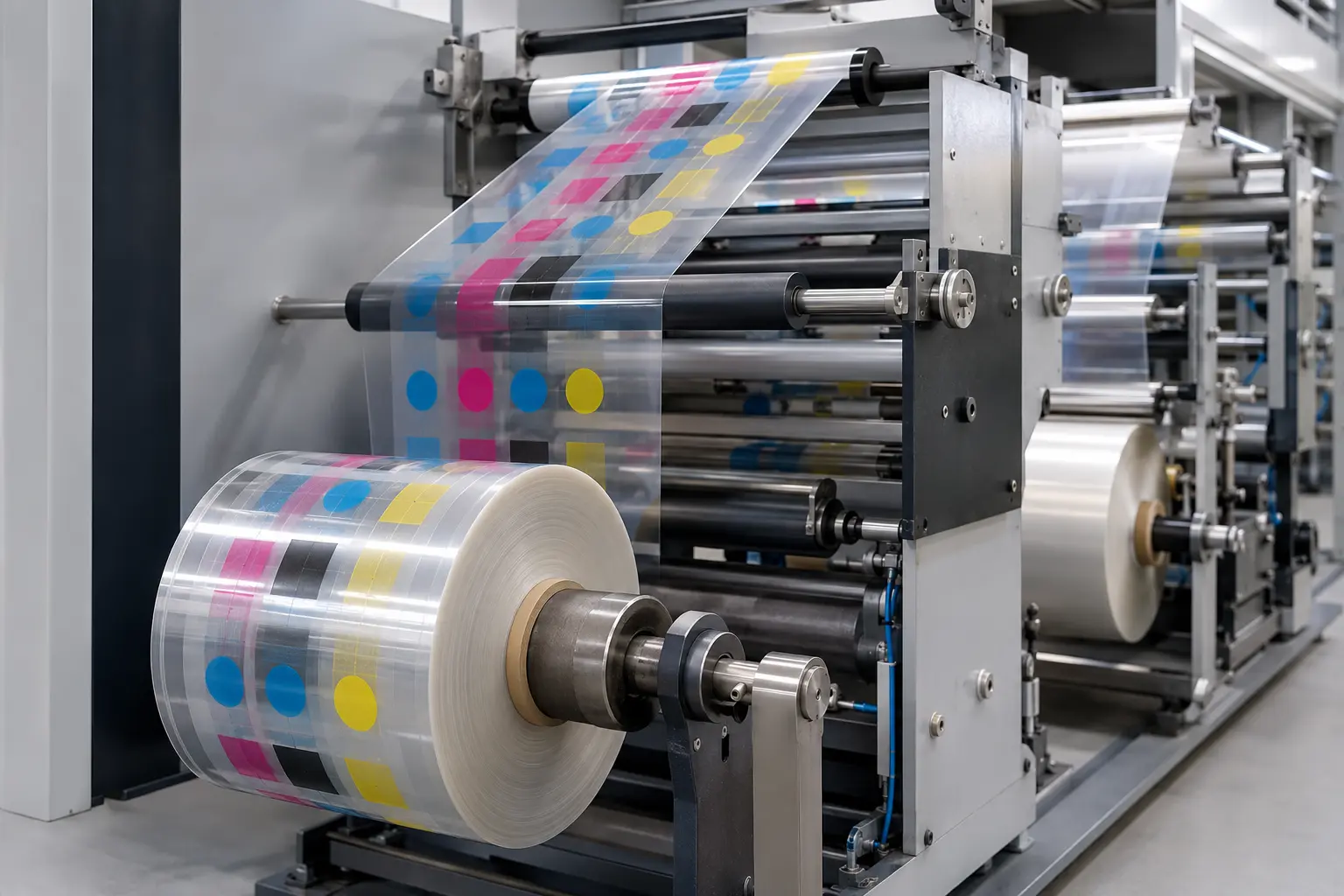
The practical benefit is reduced process variation, not automatic line compatibility. Roll build, flatness, gauge profile, splice quality, surface condition, static behavior, COF, winding tension, and equipment settings still have to fit the converter’s line.
Useful Performance at Low Gauge
Because oriented PET can combine stiffness and tensile performance, it may deliver a required outer-web or carrier function at a relatively thin gauge. This can reduce bulk or create room for another functional layer in a laminate.
Down-gauging is safe only when the thinner construction maintains printing, handling, barrier, seal, abuse, and package-integrity requirements. The economic unit should be the qualified package or usable converted area, not film thickness alone. Yield, density, waste, line efficiency, and failure risk can change the real cost.
A Versatile Platform for Functional Layers
PET provides a stable substrate for primers, hard coats, release coatings, barrier coatings, metal deposition, adhesives, and other functional layers. It can therefore serve as a structural or printable web while another layer supplies sealability, moisture protection, light barrier, peel behavior, or product-contact performance.
This versatility is valuable because functions can be assigned deliberately. It also creates a verification burden: every coating, adhesive, ink, and companion film changes the construction that must be tested and assessed.
Limitations and Trade-Offs
Base PET Is Not a Universal Sealant
Many standard BOPET grades are used as outer or supporting webs rather than as the sealant surface. Reliable sealing may require a heat-sealable PET grade, a coating, or a laminated PE, CPP, or other sealant layer.
Seal strength is meaningful only with the two sealing surfaces, temperature, pressure, dwell time, specimen width, conditioning, peel method, and failure mode defined. ASTM F88/F88M measures seal strength for flexible barrier materials, but even a good laboratory seal does not by itself prove hot tack, contamination tolerance, leak resistance, or performance on a production line.
Barrier and Durability Depend on Construction
Unqualified phrases such as “high barrier,” “puncture resistant,” or “tear resistant” hide important distinctions. Base PET, coated PET, metallized PET, and PET-containing laminates can have very different OTR, WVTR, light barrier, flex-crack, tear-propagation, and puncture behavior. Metallization defects or laminate flexing can also affect barrier after conversion and distribution.
The package should be designed from the product’s failure modes. Oxygen sensitivity, moisture gain or loss, aroma transfer, light exposure, sharp contents, drop events, and seal stress may call for different layers and tests. No single PET property proves shelf life or complete-package integrity.
Recycling and Compliance Are Package-Specific
PET is a recognized polymer in established recycling systems, but that fact does not make every PET film or PET-containing laminate recyclable in every market. Format, dimensions, collection access, sorting, inks, coatings, adhesives, metallization, labels, closures, and other polymers can affect compatibility with a target stream. APR and RecyClass guidance therefore evaluates package features and testing protocols, not the polymer name alone.
Food-contact status is similarly specific. The complete material and its components must be assessed for the destination market, food type, contact side, temperature, and duration. EU Regulation No 10/2011 and U.S. FDA food-contact frameworks do not support a blanket “food-safe PET film” claim.
Warning: Do not use a resin name, recycling symbol, management certificate, or supplier statement as a substitute for the current documents required for the exact grade, structure, use, and market.
PET Film Applications
Flexible Packaging
In flexible packaging, BOPET commonly serves as a printed outer web, structural layer, or carrier for a barrier coating or metal layer. It may appear in pouches, sachets, lidding, flow-wrap, or rollstock when the design needs stiffness, graphics, heat resistance, or an oxygen-barrier contribution.
The sealant and product-contact functions often come from another layer. The approved structure must match the contents, filling and sealing process, shelf-life target, distribution hazards, and applicable food-contact or product-safety requirements.

Labels, Graphics, and Release Applications
PET film is used for durable labels, graphic overlays, membrane-switch components, release liners, and printing or coating carriers. Its dimensional stability and surface quality can be useful where registration, die cutting, clarity, or a consistent coated surface matters.
Selection should address print or coating chemistry, treatment side, adhesion, release force, scratch exposure, outdoor aging, static control, flatness, and liner behavior. A graphics grade is not automatically a food-packaging or electrical grade.
Electrical and Electronic Uses
Selected PET films are used in motor, transformer, cable, capacitor, flexible-circuit, display, and membrane-switch constructions. Their roles can include electrical insulation, spacing, support, optical protection, or processing carrier functions.
These are engineered applications. Film thickness, dielectric properties, thermal class, flame behavior, hydrolysis or aging resistance, cleanliness, coatings, and regulatory requirements must be verified against the device design. Packaging-film data should not be transferred into an electrical specification.
Industrial and Specialty Uses
PET can also serve in tapes, pressure-sensitive constructions, protective laminates, solar and battery components, stamping or transfer processes, shims, and other technical uses. The film may be chosen for flatness, strength, heat response, release behavior, clarity, or the ability to receive a functional coating.
Specialty uses often depend more on the surface or composite than on the PET core alone. Qualification should cover the complete converted material and the stresses it will experience in manufacture and service.
How Coatings and Laminations Change Performance
Surface Treatment and Primers
Corona or other surface treatment can raise surface energy, while primers can promote compatibility with selected inks, adhesives, or coatings. Treatments may decay or become contaminated during storage and handling, so the treated side, test method, minimum requirement, production date, packaging, and storage conditions should be controlled.
Wetting is only one part of adhesion. The ink or adhesive chemistry, cure, coat weight, residual solvent, surface cleanliness, and aging conditions can determine whether the bond survives conversion and use.
Coatings and Metallization
Coatings can add heat sealability, release, abrasion resistance, antistatic behavior, UV response, or improved gas barrier. Metallization can add opacity, reflectivity, and a stronger light or gas-barrier contribution. Transparent inorganic coatings can target barrier while retaining visibility.
Performance depends on coating identity, thickness, uniformity, adhesion, pinholes, flexing, and test conditions. Barrier should be measured on the actual coated or metallized grade and, when relevant, again after lamination, creasing, forming, or distribution simulation.
Laminations and Sealant Layers
Lamination allows PET to supply stiffness, printability, or thermal stability while another web supplies sealing, toughness, moisture barrier, chemical compatibility, or product contact. This division of functions is common, but the result is a new material system.
Adhesive choice, cure, bond strength, residuals, print position, layer sequence, total and individual thicknesses, and sealant identity all matter. The final specification should show the layer order from outside to inside and define which surface is tested. Component data cannot be added together to predict finished-laminate performance.

Important: Whenever PET is modified or combined, repeat the tests that govern the final use. A base-film certificate does not automatically cover a coated, printed, metallized, or laminated version.
PET Film vs Other Packaging Films
No film family is universally superior. The following comparisons are screening tendencies; commercial grades, thickness, orientation, additives, coatings, and laminate design can change the outcome.
| Comparison | PET tendency | Alternative tendency | Selection implication |
|---|---|---|---|
| PET vs BOPP | Higher stiffness and dimensional stability; useful heat resistance and oxygen-barrier contribution | Lower density and often stronger moisture-barrier and native sealing options | Screen PET for stable print/outer webs; screen BOPP where low density, moisture barrier, or sealability dominates |
| PET vs PE and CPP | Stiffer structural or outer web; usually needs a defined seal surface | Softer, tougher sealant webs with broad packaging use | Combine roles in a laminate or choose a mono-web only after handling and seal trials |
| PET vs BOPA | Stable, clear substrate with balanced strength | Often selected when toughness, flex resistance, and puncture performance dominate | Test the actual package when sharp contents or flexing are critical |
PET vs BOPP
PET is often shortlisted for dimensional stability, heat resistance, and a stable print surface. BOPP can be attractive for its lower density, moisture-barrier performance, and range of sealable grades. Oxygen and moisture behavior should be compared using the same units and conditions, while cost should be compared per qualified package or usable area rather than per kilogram alone.
PET vs PE and CPP
PE and CPP commonly act as flexible sealant or product-contact layers. PET more often supplies the stiffer printed or supporting layer. This is why PET/PE and PET/CPP concepts are common, but those names are incomplete: grade, thickness, adhesive, print position, food-contact status, and seal conditions still require definition.
PET vs BOPA
BOPA, or biaxially oriented polyamide film, is frequently considered for demanding toughness and puncture applications. PET may offer a different balance of dimensional stability, optics, and cost. Humidity response, barrier, tear, puncture, flexing, and converting behavior should be tested on representative structures rather than inferred from polymer-family reputations.
How to Specify and Validate PET Film
Define the Application and Process
Start with the packaged product or technical function, not a preferred polymer. Record:
- the required role of the PET layer;
- contents, contact side, filling process, use temperature, and shelf-life target;
- printing, coating, laminating, slitting, sealing, forming, and line-speed conditions;
- mechanical, optical, barrier, electrical, and dimensional failure modes; and
- destination markets, compliance documents, and recycling-design target.
These inputs determine whether the project needs clear BOPET, a treated printing grade, coated or metallized PET, heat-sealable PET, an electrical grade, or a different film family.
Request Comparable Technical Data
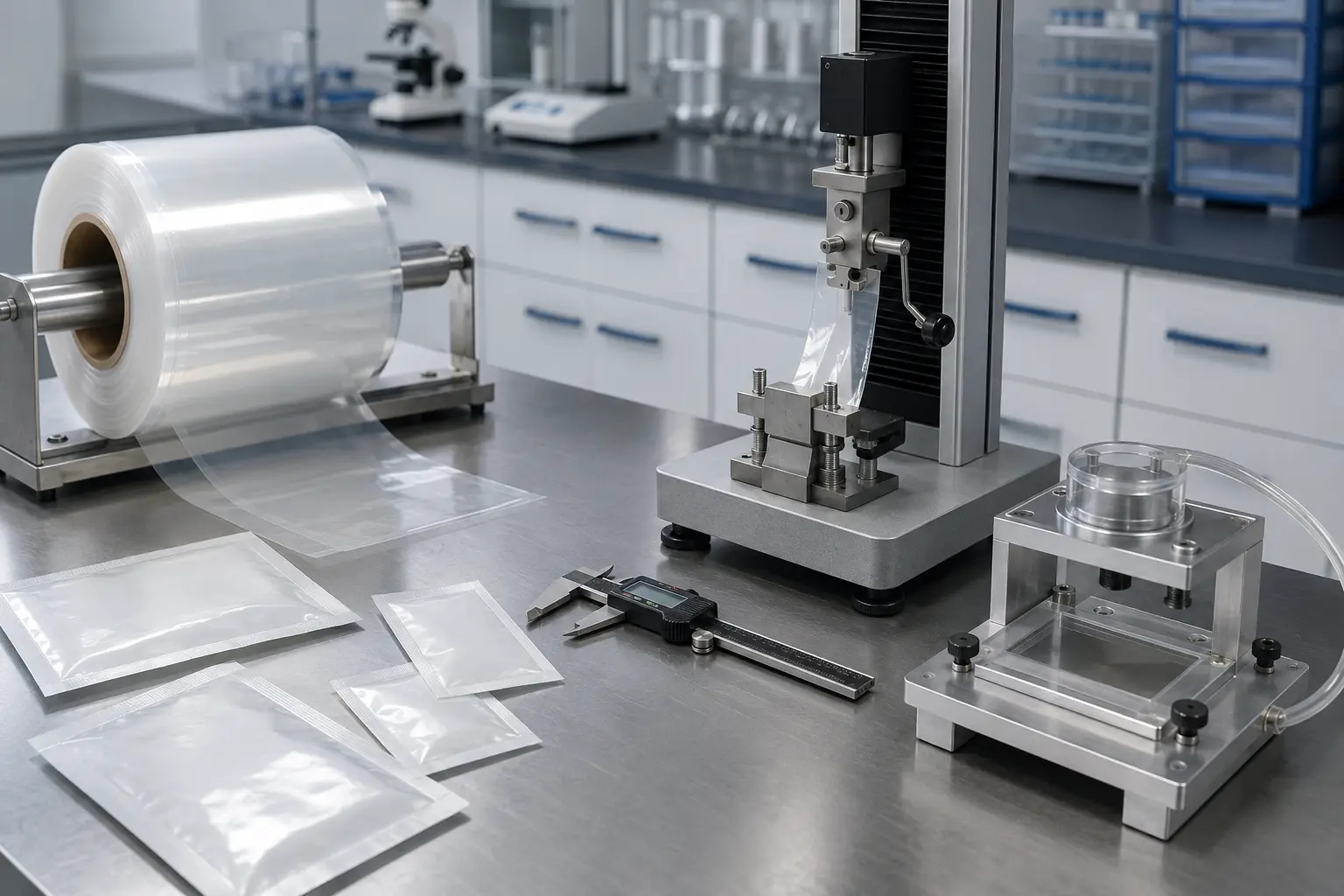
Ask the supplier to identify the exact grade, film type, thickness and tolerance, width, winding and core details, treatment side, surface finish, and storage life. For each critical value, request the test method and version, units, temperature, humidity, conditioning, specimen direction or face, and sample description.
For a laminate, record the complete outside-to-inside layer sequence, individual thicknesses, adhesive and coating identities, print position, cure conditions, and product-contact layer. Food-contact, recycled-content, or other compliance documents should identify the legal entity, site or product scope, market, intended use, date, and limitations.
Run Converting and Package Trials
Use a staged approval rather than relying on a data sheet alone:
- inspect roll condition, identification, dimensions, and certificate traceability;
- confirm critical laboratory properties using agreed methods;
- run the film through printing, coating, lamination, slitting, sealing, or forming at representative settings;
- evaluate the converted structure for adhesion, appearance, barrier, seals, integrity, and relevant abuse; and
- document the approved settings, acceptance criteria, sample, and change-control requirements.
A trial should represent production equipment and the intended package. If the grade, thickness, treatment, coating, adhesive, ink, sealant, supplier site, or process window changes, reassess the tests affected by that change.
Frequently Asked Questions
Can PET Film Be Heat Sealed?
It depends. Standard BOPET is often used as a supporting or outer web, while sealing is provided by a coating, a coextruded heat-seal surface, or a laminated sealant such as PE or CPP. Confirm the two seal surfaces, temperature, pressure, dwell time, hot-tack need, peel method, and production-line window.
Is PET Film a High-Barrier Material?
Not as an unconditional category claim. Base PET can contribute oxygen and aroma resistance, but OTR and WVTR vary with grade, thickness, humidity, temperature, and construction. Metallization, barrier coatings, or laminations may produce much lower transmission rates. Compare actual results under the same method, units, and conditions.
Is PET Film Food Safe?
It depends on the exact film and use. Resin, additives, coatings, inks, adhesives, recycled content, and other layers must be covered for the target market, food type, contact side, temperature, and duration. Request the current declaration and supporting migration or compliance documentation required for the complete construction.
Can PET Film Be Recycled?
It depends on format and the local system. A clean PET article may be technically compatible with a defined PET stream, but flexible films and multilayer packs can face collection, sorting, and reprocessing limits. Evaluate the complete package against current local guidance from the target recycling program; do not infer recyclability from the PET name or symbol alone.
Related Bestypack Resources
- PET and PETG Films: What’s the Difference?
- Soft Touch Polyester Film Matte PET Film
- PET Twist Film
- The Uses and Advantages of PET Film
- BOPET
 English
 Japanese
 French
 Spanish
 Korean
 Italian
 Portuguese
 Dutch
Dutch Arabic
 Russian
 German