
Polyethylene film is not one material with one fixed set of properties. The label can refer to different resin families, manufacturing routes, layer structures, and end-use formats. That is why two films described as “PE” may run differently, seal at different conditions, or fail in different ways. This guide separates those classification axes, compares the main PE film families, connects them to common applications, and shows packaging buyers how to turn a material shortlist into a measurable specification and validation plan.
How PE Film Types Are Classified
For polymer background, consult the NIH PubChem polyethylene overview before comparing finished-film claims.
PE film is a thin, flexible web made wholly or partly from polyethylene. Polyethylene is a semicrystalline thermoplastic, but its chain branching, density, molecular-weight distribution, comonomer, additives, and processing history can vary. Those variables influence how a resin melts, crystallizes, and behaves after conversion into film.
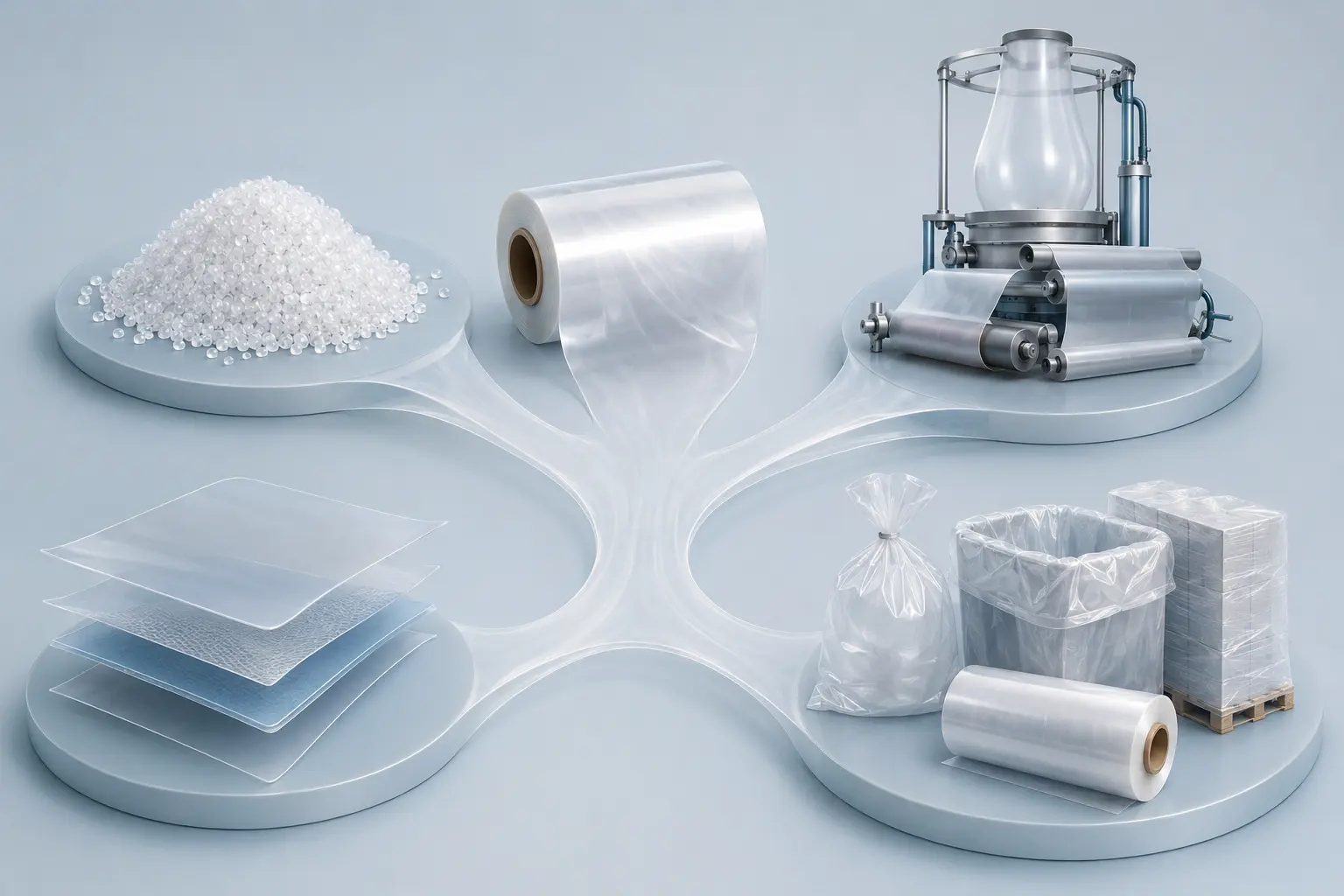
The first practical rule is to identify what a label describes. “LLDPE,” “blown film,” “coextruded film,” and “stretch film” are not four competing materials. They describe, respectively, a resin family, a manufacturing route, a layer-building method, and an application format.
Resin Family Is One Classification Axis
Density-family labels describe the polymer or resin:
- LDPE is low-density polyethylene made with substantial chain branching.
- LLDPE is linear low-density polyethylene, normally produced by copolymerizing ethylene with an alpha-olefin.
- mLLDPE is an industry label commonly used for metallocene-catalyzed LLDPE grades. It is a subset of the broader linear low-density family, not a completely separate polymer.
- MDPE is medium-density polyethylene.
- HDPE is high-density polyethylene with a more linear, more crystalline structure than lower-density families.
These names are useful starting points, not finished-film specifications. Two LLDPE grades can differ in comonomer, density, melt index, molecular-weight distribution, additive package, and approved use. A converter may also blend several PE grades to balance processing and performance.
Processing and Construction Are Separate Axes
Film can be made by a blown or cast process It can be monolayer coextruded into several layers laminated to another web or oriented after extrusion.
Important: A process or format name does not reveal the complete resin recipe, layer order, thickness, treatment, additive package, or test result. Ask for all relevant axes before comparing two quotations.
LDPE Film: Flexible and Easy to Process
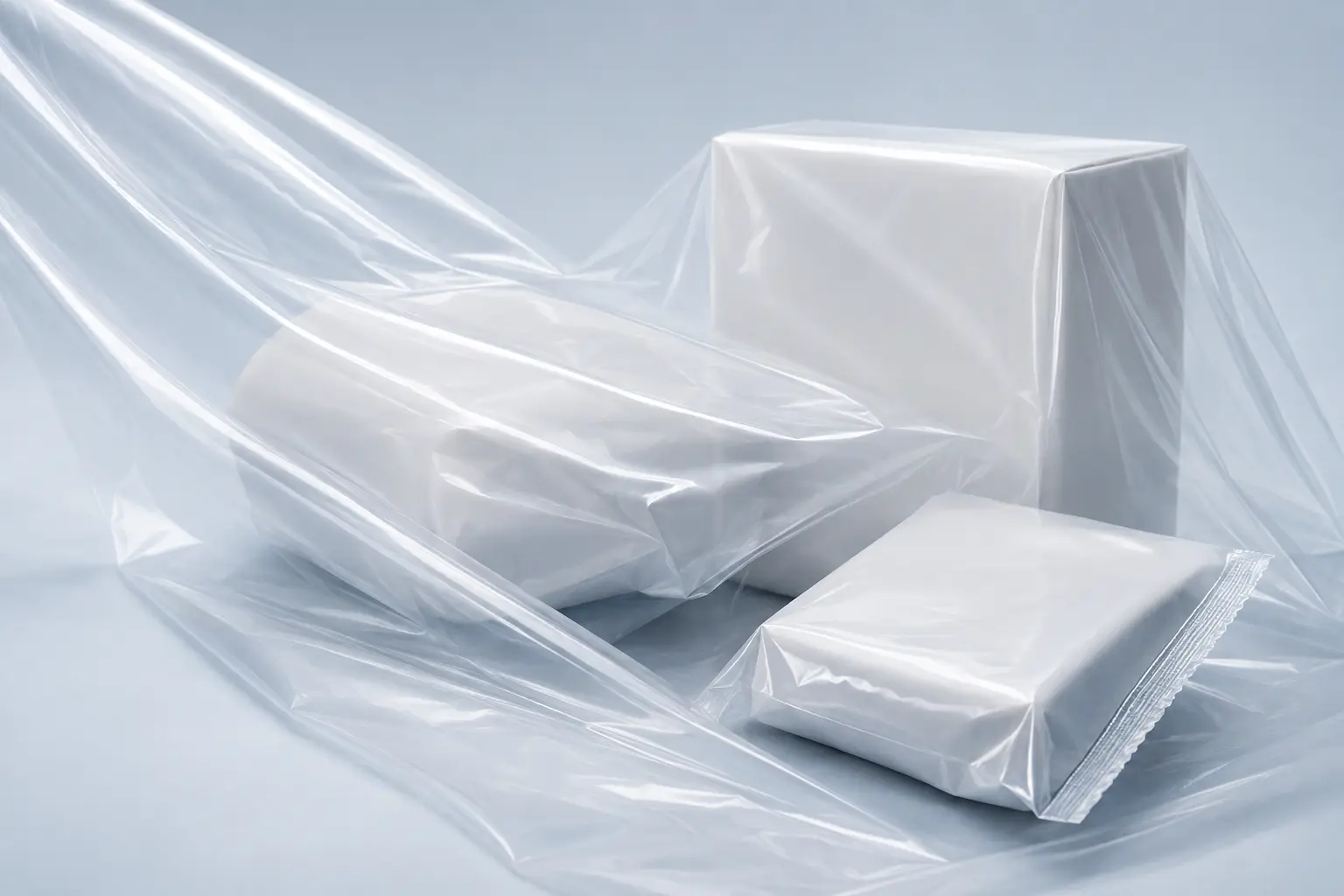
LDPE is the traditional low-density PE family. Long-chain branching gives the melt behavior that has made LDPE useful in extrusion coating, blown film, shrink-film blends, and sealant applications. Finished behavior still depends on grade, thickness, line conditions, and any blended resin.
Typical Features of LDPE Film
Compared under similar conditions, LDPE film is commonly associated with:
- soft and flexible handling;
- good melt strength and forgiving processing behavior;
- potentially good surface gloss and clarity;
- heat-seal capability suitable for many flexible-packaging structures;
- useful shrink response in grades and structures designed for shrink applications; and
- moisture resistance typical of PE, while oxygen and aroma barrier remain limited unless another material or coating supplies that function.
The trade-off is that a conventional LDPE film may provide less puncture or tensile performance than a properly selected LLDPE-rich structure at the same nominal thickness. That is a tendency, not a rule. Orientation, thickness profile, additives, and blend design can change the result.
Common LDPE Film Applications
LDPE appears in general-purpose bags, garment and textile packaging, liners, shrink bundling film, overwraps, extrusion-coated structures, and heat-seal layers. Its processability can also make it a useful blend component when a converter needs to improve bubble stability, melt strength, or shrink behavior.
For an actual project, “LDPE film” is too broad. A supplier brief should add film-making route, layer structure, thickness and tolerance, sealant side, surface treatment, slip and antiblock needs, optical requirements, and the relevant mechanical tests.
LLDPE and mLLDPE Films: Toughness and Stretch
LLDPE has a mostly linear backbone with controlled short-chain branching introduced through comonomers. Film grades cover a wide range of densities and melt indices. Their toughness-to-stiffness balance can differ substantially, which is why the exact grade and blend matter more than the acronym alone.
What LLDPE Changes
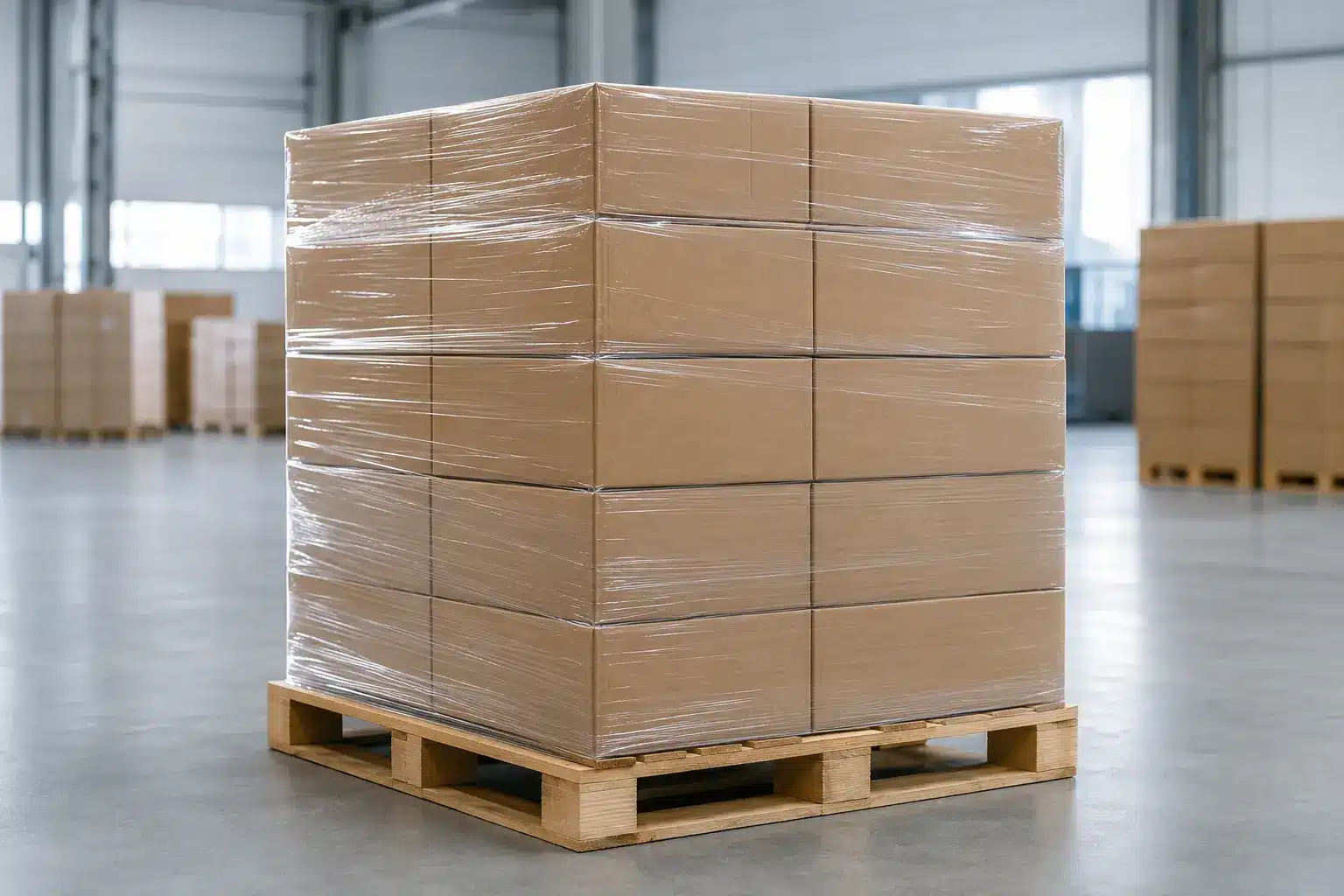
In many comparable film structures, LLDPE is selected to improve puncture resistance, tensile performance, elongation, or abuse resistance relative to conventional LDPE. These traits make it common in stretch wrap, heavy-duty sacks, industrial liners, agricultural films, and the tougher layers of coextruded packaging.
LLDPE can be processed by blown or cast routes, but it may not behave like LDPE on the same line. Melt rheology affects pressure, motor load, bubble stability, drawdown, and gauge control. Converters frequently use blends or line-specific grade selections rather than making a simple one-for-one resin substitution.
Where mLLDPE Fits
Metallocene catalysts can provide tighter control over molecular architecture and comonomer distribution. Commercial mLLDPE grades are often considered when a film needs a refined balance of sealing, toughness, optics, or downgauging potential. None of those outcomes is automatic.
The buyer should ask for the exact grade designation, density, melt index and test conditions, comonomer if relevant, intended layer, blend percentage, additive package, and converting route. Then the buyer should test the finished film, not rely on a resin brochure.
Important: “Metallocene” describes how a resin family was produced. It does not prove a seal window, hot-tack result, puncture value, or line speed for a finished package.
HDPE and MDPE Films: Stiffness and Handling
As PE becomes more linear and crystalline, density and stiffness generally increase. Higher-density films can provide useful handling and moisture-barrier characteristics, but they usually give up some softness, stretch, or transparency compared with lower-density alternatives.
HDPE Film
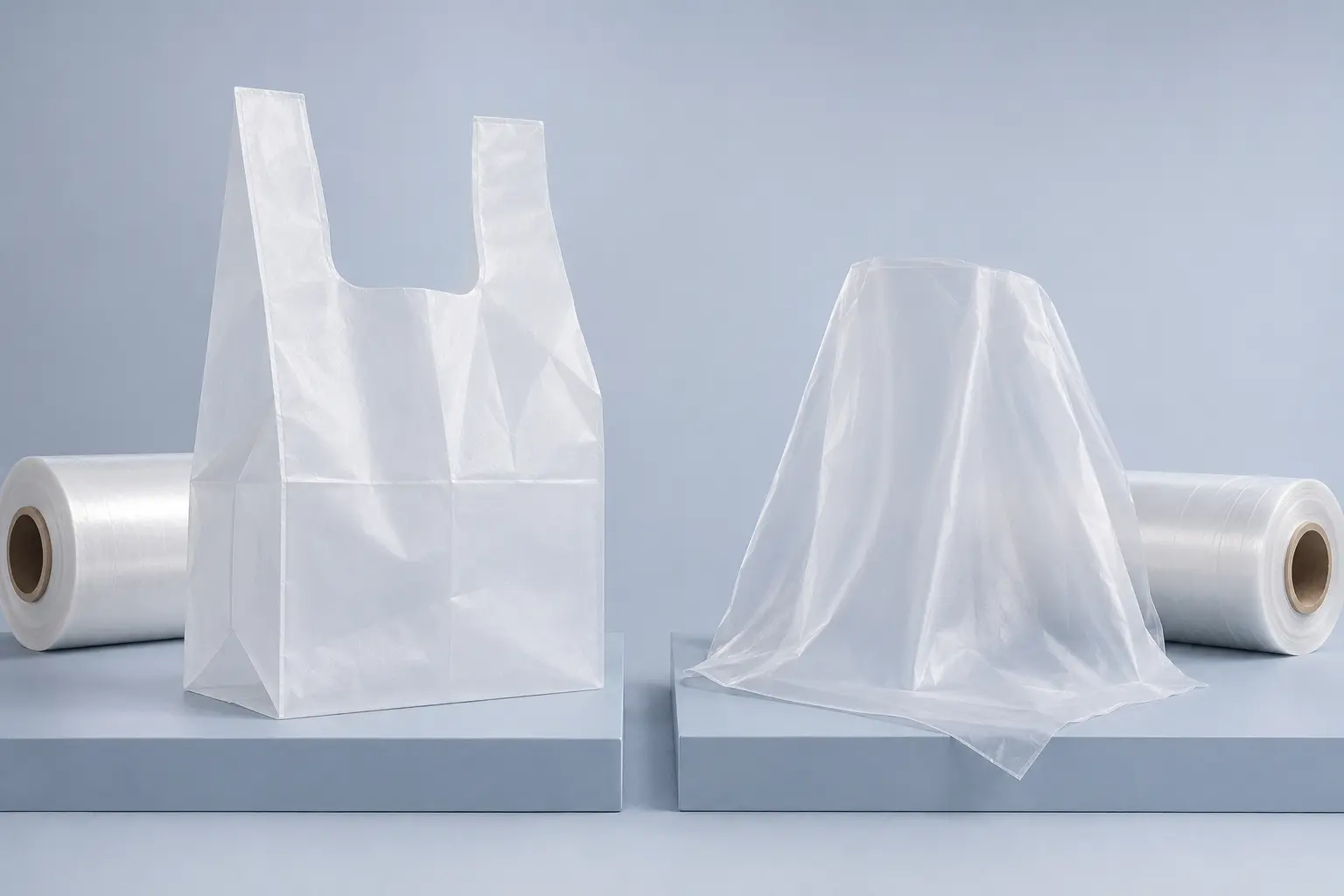
HDPE film is commonly recognized by its stiff, crisp or “paper-like” feel and lower transparency. It can offer high tensile strength in the developed direction, good moisture resistance, and the possibility of using a relatively thin web for applications such as retail bags, produce bags, merchandise bags, liners, and release or interleaving films.
Film orientation matters. A high machine-direction result does not automatically mean equally high transverse performance, tear resistance, or puncture resistance. For thin HDPE films, the test direction and specimen conditioning are essential parts of the data.
MDPE Film
MDPE occupies an intermediate density region, but the name still covers multiple grades and structures. It may be considered when a project needs more stiffness than a low-density structure while retaining more toughness or flexibility than a highly crystalline HDPE film.
Applications can include sacks, liners, shrink-film blends, packaging films, and some construction or agricultural sheeting. The useful comparison is not the label “medium” versus “high.” It is the finished film’s measured balance of stiffness, impact, tear, sealability, optical properties, and processing behavior under the intended conditions.
Blown, Cast, and Oriented PE Films
A resin family becomes a film only after processing. The film-making route changes cooling, orientation, thickness profile, surface condition, and the balance between machine-direction and transverse-direction properties.
Blown Film Versus Cast Film
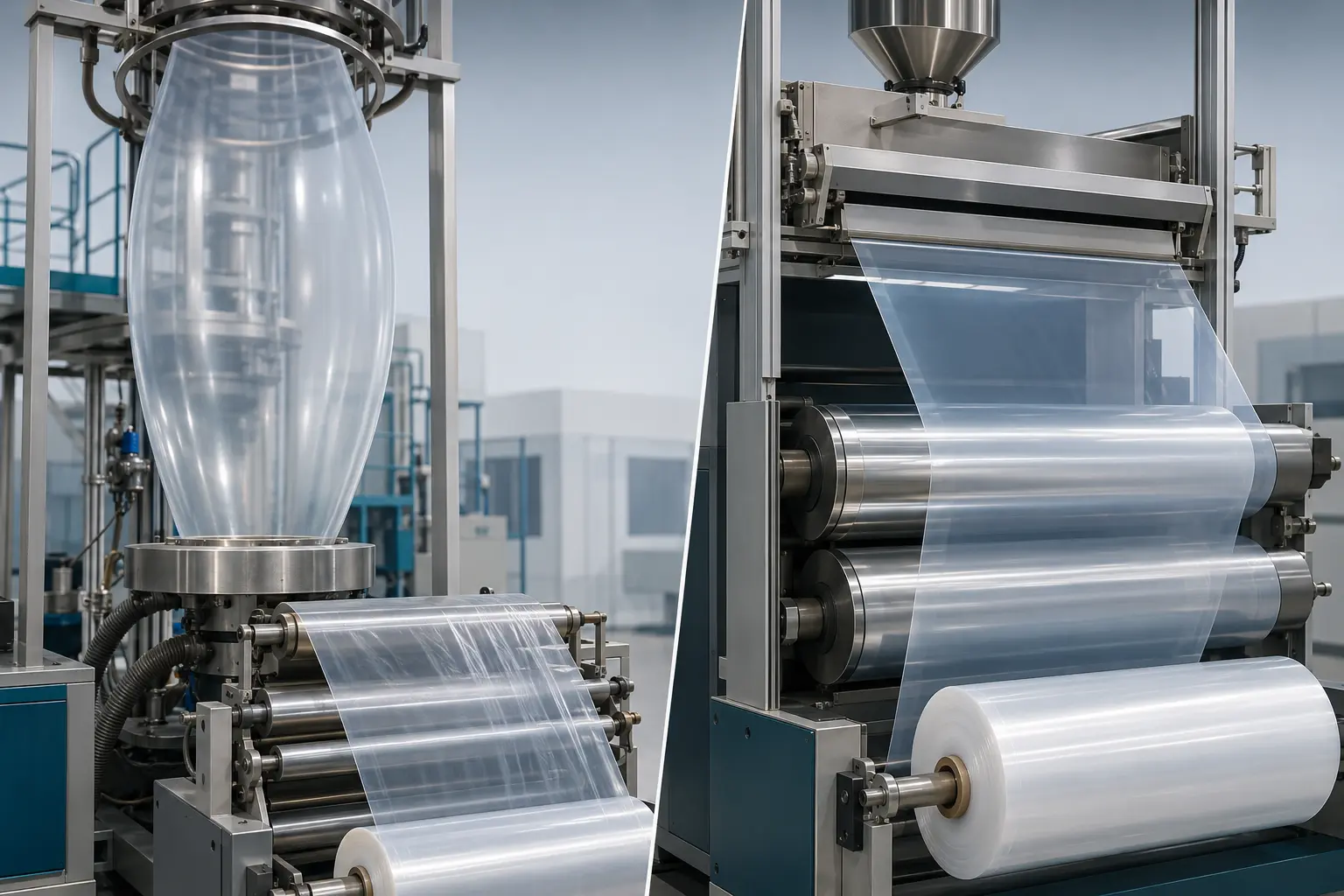
In blown-film extrusion, molten polymer exits an annular die as a tube, inflates into a bubble, cools, collapses, and is wound. Bubble geometry and take-up create orientation in two directions. Blown film is widely used for bags, liners, shrink films, agricultural films, and multilayer flexible packaging.
In cast-film extrusion, polymer exits a flat die onto chilled rolls. Rapid cooling and direct web handling can support high output, flatness, and controlled thickness when the grade and line are matched. Cast LLDPE structures are common in stretch film and can also serve other packaging uses.
Neither route is universally better. Compare the candidate films for the actual task: gauge profile, optics, cling, tear balance, puncture, stretch, shrink, sealing, surface treatment, blocking, winding quality, and machine behavior.
MDO-PE and BOPE Films
Machine-direction-oriented PE, or MDO-PE, is stretched mainly along the machine direction after film formation. Biaxially oriented PE, or BOPE, is stretched in both the machine and transverse directions. Orientation can increase stiffness and change optics, tear behavior, dimensional response, and convertibility.
Oriented PE may be used as a print or structural web in designs intended to keep more of the package within the PE family. However, the orientation process, grade, layer construction, inks, coatings, adhesives, sealant web, closures, and local recycling stream all affect the final result. “BOPE” or “mono-PE” is not by itself a recyclability certificate.
Functional PE Film Formats and Applications
Application names describe what the film must do. They do not identify one resin or one structure. A stretch film and a shrink film can both contain LLDPE, for example, while requiring very different orientation, recovery, cling, sealing, and thermal behavior.
Bags, Liners, and Sealant Webs
General bags and liners may use LDPE, LLDPE, HDPE, MDPE, or blends. The selection changes with load, sharp edges, drop exposure, bag-making method, closure, transparency, stiffness, and cost. Heavy-duty sacks and industrial liners often emphasize puncture, impact, tear balance, and seal integrity.
In laminated pouches, a PE-rich inner web can provide sealing and product-contact functions while another layer supplies printing, stiffness, temperature resistance, or barrier. The complete laminate—not the PE layer alone—determines final package performance.
Stretch, Shrink, and Protective Films
Stretch film commonly uses LLDPE-rich cast or blown structures because elastic extension, puncture resistance, cling, load retention, and unwind behavior must work together. Machine stretch film also needs stable gauge, consistent pre-stretch behavior, and compatibility with the wrapper.
PE shrink film may use LDPE, LLDPE, MDPE, or blends selected for orientation, shrink force, shrink temperature profile, optics, sealability, and package geometry. A laboratory free-shrink result does not alone predict tunnel appearance or load stability.
Protective films add another variable: the adhesive or tack layer. Surface energy, clean removal, aging, temperature, pressure, and the protected substrate must be evaluated as a system.
Agricultural and Construction Films
Greenhouse covers, mulch films, silage wraps, vapor retarders, covers, and construction sheeting can all be PE-based. Their service conditions may include ultraviolet exposure, weathering, soil contact, chemicals, mechanical installation, and long storage.
These uses require application-specific stabilization and testing. A generic clear PE film should not be assumed to have an outdoor lifetime, pesticide resistance, flame behavior, or building-code status. The supplier must identify the intended use, test basis, and limitations.
How the Main PE Film Types Compare
The matrix below shows common.
| PE film family | Typical handling tendency | Common strengths to investigate | Common trade-offs to investigate | Frequent film uses |
|---|---|---|---|---|
| LDPE | Soft, flexible, often glossy | Melt strength, processability, sealability, shrink response | Puncture and tensile efficiency versus tougher linear grades | General bags, liners, shrink blends, sealant and coating layers |
| LLDPE | Flexible and tougher | Puncture, stretch, impact, tensile performance | Processing response, optics, stiffness, and tear balance | Stretch film, heavy sacks, liners, agricultural film, tough coextruded layers |
| mLLDPE | Grade-dependent low-density film resin | Seal, toughness, optics, or downgauging potential | Cost, process window, blocking, blend and line compatibility | High-performance sealant layers, stretch film, tough packaging structures |
| MDPE | Intermediate stiffness and flexibility | Toughness-stiffness balance, handling, moisture resistance | Optics, seal response, and grade availability | Sacks, liners, blends, packaging and selected sheeting |
| HDPE | Stiff, crisp, often translucent or opaque | Stiffness, tensile efficiency, moisture resistance, thin-web handling | Stretch, softness, transparency, tear anisotropy, sealing | Retail and produce bags, liners, interleaving and thin industrial films |
Important Do not compare supplier data unless the film.
How to Select and Specify PE Film
Film selection works best as.
Define the Product, Package, and Machine
- Describe the packed product, including dimensions, mass, edges, oils, chemicals, powders, moisture, and temperature.
- Define the package format, opening and closure, seal geometry, print or lamination needs, and expected appearance.
- Record the filling or wrapping equipment, sealing system, line speed, tension, pre-stretch, shrink tunnel, and web path.
- Map storage and distribution risks such as stacking, vibration, drops, puncture, cold chain, heat, humidity, ultraviolet exposure, and shelf time.
- Identify the target market and any food-contact, product-safety, transport, or environmental-claim requirements.
This information narrows the resin and structure options without pretending that one family wins every application.
Turn Needs Into Measurable Specifications
Specify dimensions and methods, not adjectives. Useful fields can include:
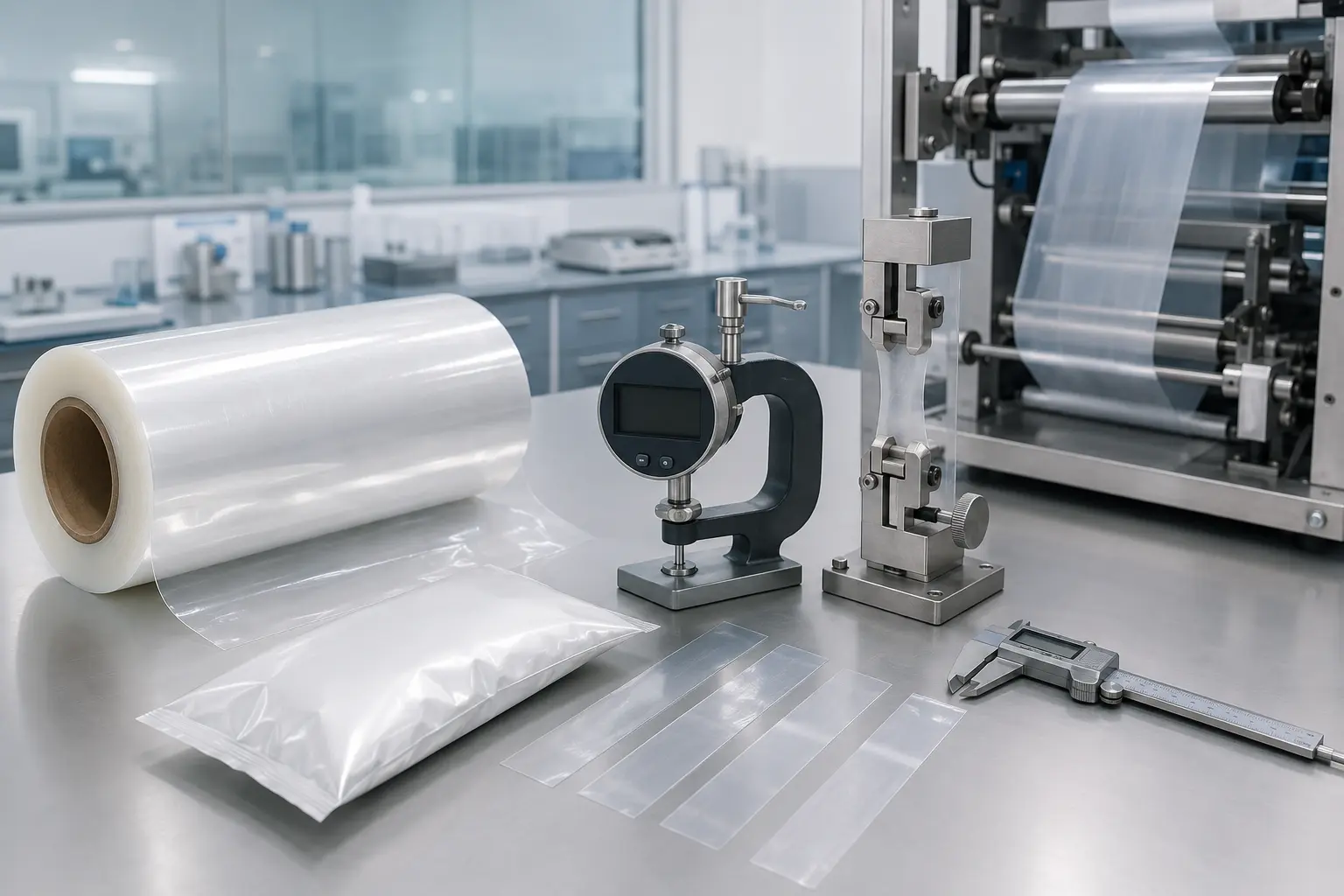
- nominal thickness, allowed tolerance, measurement method, and sampling plan;
- width, roll length or mass, core, roll diameter, splice policy, winding direction, and roll quality;
- film structure, layer order, intended seal side, treatment side, printing or lamination surface, and additives;
- tensile properties in MD and TD, with method, speed, conditioning, specimen, and units;
- tear, dart impact, puncture, or bag-drop method matched to the failure risk;
- coefficient of friction, cling, blocking, haze, gloss, or wetting tension when those affect conversion;
- seal-strength, hot-tack, seal-initiation, or shrink tests with temperature, pressure, dwell, substrate, and result definition; and
- OTR or WVTR only when barrier matters, with temperature, relative humidity, thickness, test side, gas, and units.
ASTM and ISO methods are not interchangeable labels. For example, ASTM D882-26 and ISO 527-3:2018 both address tensile testing of thin plastic film or sheet, but a buyer should not combine results without confirming specimen and procedural equivalence. Current ASTM listings also identify methods such as D1922-23 for propagation tear, D1709-24 for dart impact, D1894-24 for coefficient of friction, and D2732-14(2025) for unrestrained linear thermal shrinkage.
Validate Samples Under Actual Conditions
Run incoming-film tests first, then convert the candidate on the intended equipment. Record line settings, environmental conditions, downtime, trim, seal defects, wrinkles, blocking, web tracking, and roll handling. Package the real product or a justified simulant, then perform the storage, distribution, and end-use tests tied to the risk assessment.
Approval should reference the tested sample, batch, structure, thickness, test reports, machine conditions, and agreed acceptance criteria. If the supplier changes the resin, blend, additive, layer split, treatment, manufacturing route, or site, the change-control process should decide whether requalification is necessary.
Food Contact, Recycling, and Claim Boundaries
PE is used widely in packaging, but the polymer name alone does not establish a legal or environmental claim. The finished article includes resin, additives, colorants, inks, coatings, adhesives, and other components, each with its own scope.
Food-Contact Status Is Use-Specific
In the United States, 21 CFR 177.1520 covers specified olefin polymers subject to identity, specifications, extractives, and conditions in the regulation. That is not permission to label every PE film “FDA approved.” A supplier should identify the exact grade and finished structure, intended food type, contact time, temperature, conditions of use, applicable limitations, and supporting declaration or evidence.
In the European Union, plastic food-contact materials are assessed under Regulation (EC) No 1935/2004 and Commission Regulation (EU) No 10/2011, including current amendments. Composition, migration, declaration, traceability, and intended-use conditions must be reviewed for the complete article. Evidence for one market or use cannot be generalized globally.
Mono-PE Does Not Automatically Mean Recyclable
A package described as mono-PE may still contain different PE densities plus inks, coatings, adhesives, tie layers, barrier materials, labels, closures, or contamination. Recyclability depends on the complete design and its compatibility with a defined collection, sorting, and recycling stream.
RecyClass publishes design-for-recycling guidance and testing routes for European packaging streams. Other markets use different systems. Any “recyclable,” “recycled content,” or broader environmental claim should be substantiated and qualified for the target market, as reflected in the FTC Green Guides for U.S. environmental marketing.
Important: “PE,” “mono-material,” and a resin identification code are design clues. They are not proof of local collection, successful sorting, reprocessing quality, recycled-content percentage, or legal claim eligibility.
PE Film Buyer Checklist
Use one comparison form for every candidate supplier and film:
- application, packed product, package drawing, load, hazards, and target shelf life;
- resin family or blend, exact grade where disclosed, layer structure, layer split, and total thickness;
- film process, orientation, additives, color, treatment, print, coating, and lamination details;
- width, gauge tolerance, roll build, core, winding, splices, packaging, storage, and conditioning;
- mechanical, optical, surface, seal, shrink, barrier, and package tests with methods and conditions;
- target machine, settings, speed, temperature, tension, and trial quantity;
- food-contact, chemical, outdoor, recycled-content, or recyclability documents applicable to the exact structure and market;
- sample ID, lot, manufacturing site, report number, report date, and change-control policy; and
- what the evidence supports, what it does not support, and which results still require line or package validation.
Important: A completed checklist organizes evidence. It does not replace current declarations, test reports, approved samples, or a signed specification.
Frequently Asked Questions
Which PE Film Is the Strongest?
It depends on the failure mode. LLDPE-rich films are often selected for puncture, stretch, and impact; HDPE can provide high stiffness and tensile efficiency; LDPE can support processing and toughness in specific structures. “Strongest” is not meaningful until you define direction, thickness, test method, conditioning, and whether the risk is tensile break, tear propagation, puncture, impact, or seal failure.
Is LDPE or LLDPE Better for Packaging?
Neither is universally better. LDPE may be preferred for melt strength, processing, softness, optics, sealing, or shrink response. LLDPE may be preferred for puncture, stretch, impact, or downgauging potential. Many commercial films blend them or place them in different layers. Compare finished structures on the intended line and package.
Does HDPE Film Have Better Barrier?
HDPE commonly provides stronger moisture-barrier performance than lower-density PE under comparable thickness and test conditions because of its higher crystallinity. That does not make it a high oxygen- or aroma-barrier material, and the comparison can change with thickness, orientation, humidity, additives, and layer structure. Use matched OTR or WVTR tests when shelf life depends on barrier.
Can PE Film Be Recycled?
Sometimes, depending on the complete package and local system. Clean PE film may be technically compatible with a PE recycling stream, but inks, coatings, adhesives, barrier layers, labels, closures, residues, format, and local collection access can change the outcome. Check the relevant design guideline and claim rule for the target market; do not use the resin name as proof.
Match the Grade, Structure, and Test Plan
The useful question is not “Which PE is best?” It is “Which grade, blend, process, and layer structure meets this package’s measured requirements on this machine and through this distribution route?” LDPE, LLDPE, mLLDPE, MDPE, and HDPE each offer useful tendencies, while blown, cast, coextruded, and oriented formats reshape those tendencies.
Before approval, confirm:
- the exact film identity and construction;
- the application, equipment, market, and use conditions;
- comparable test methods, directions, units, and conditioning;
- line, package, storage, and distribution performance;
- current food-contact or environmental-claim evidence where applicable; and
- change control for any material, structure, process, or site revision.
A disciplined validation plan turns the broad label “PE film” into a controlled packaging specification.
 English
 Japanese
 French
 Spanish
 Korean
 Italian
 Portuguese
 Dutch
Dutch Arabic
 Russian
 German