
BOPA film is a biaxially oriented polyamide film used when flexible packaging needs toughness, puncture resistance, clarity, and useful oxygen or aroma barrier. It is rarely the entire package by itself. Buyers normally select a BOPA grade, then combine it with print, barrier, adhesive, and sealant layers that fit the product and process. The right choice therefore depends on humidity, converting conditions, laminate design, test methods, and package trials—not on a single datasheet value.
What Is BOPA Film, and What Does Biaxial Orientation Change?
For regulatory context, consult the U.S. FDA’s food-packaging guidance before approving an intended food-contact use.
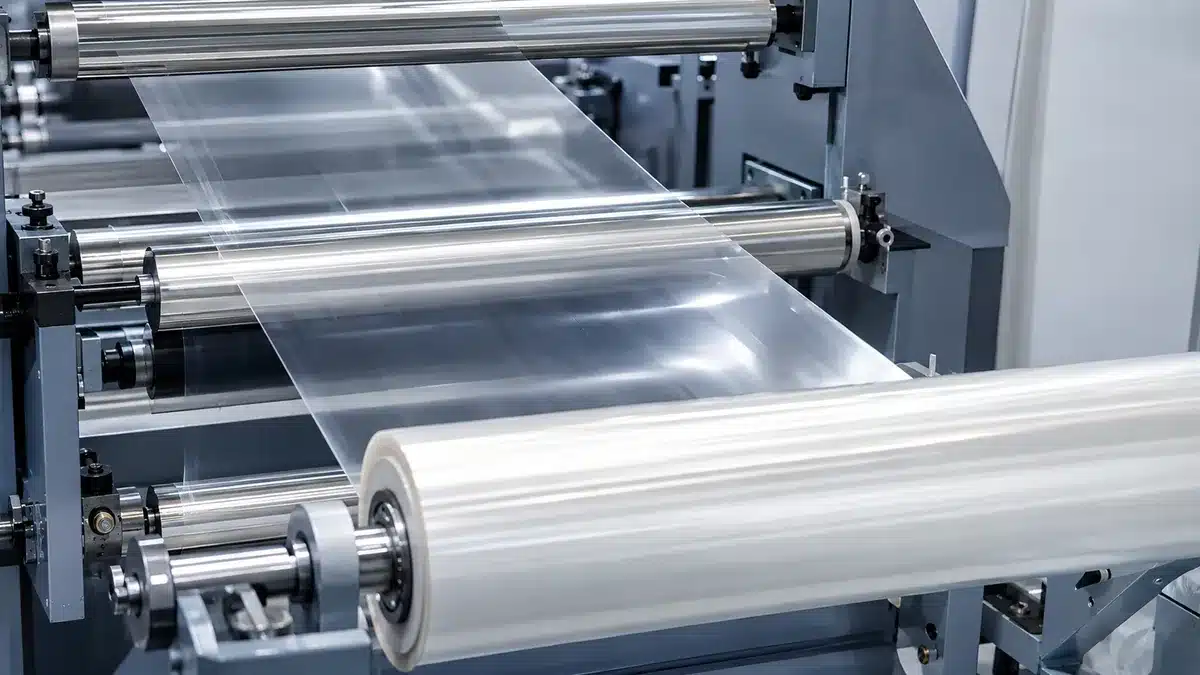
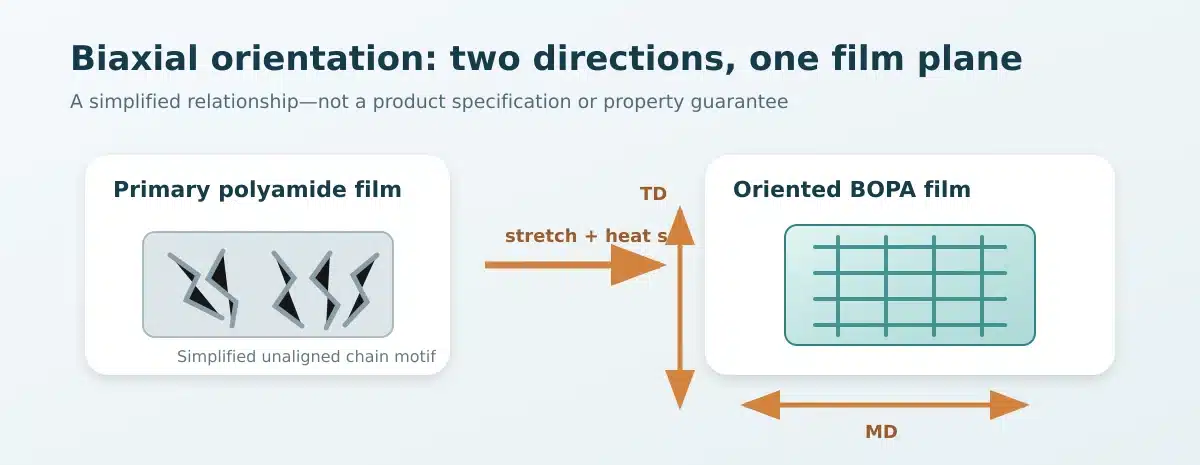
BOPA is polyamide film stretched in two directions: the machine direction (MD) and transverse direction (TD). The process aligns polymer chains within the film plane and is followed by thermal stabilization. Compared with an unoriented film made from a similar polyamide, this creates a more balanced, controlled web for printing, coating, metallizing, and lamination.
Orientation does not create one fixed property package. Resin type, stretch history, heat setting, thickness, surface treatment, and moisture conditioning all affect the final result. “BOPA” should therefore be treated as a material and process family, not as a universal grade.
BOPA, BON, and OPA Terminology
BOPA means biaxially oriented polyamide. BON means biaxially oriented nylon, while OPA is a shorter form of oriented polyamide. Suppliers may use these terms for broadly similar film families. However, “nylon film” alone is wider: it can also describe cast, blown, unoriented, mono-layer, or coextruded polyamide films.
When reviewing an offer, confirm the polymer family, whether the web is biaxially oriented, the orientation route, treatment side, gauge, and intended application. A label such as “nylon 15 μm” does not establish those details.
From Polyamide Resin to an Oriented Film
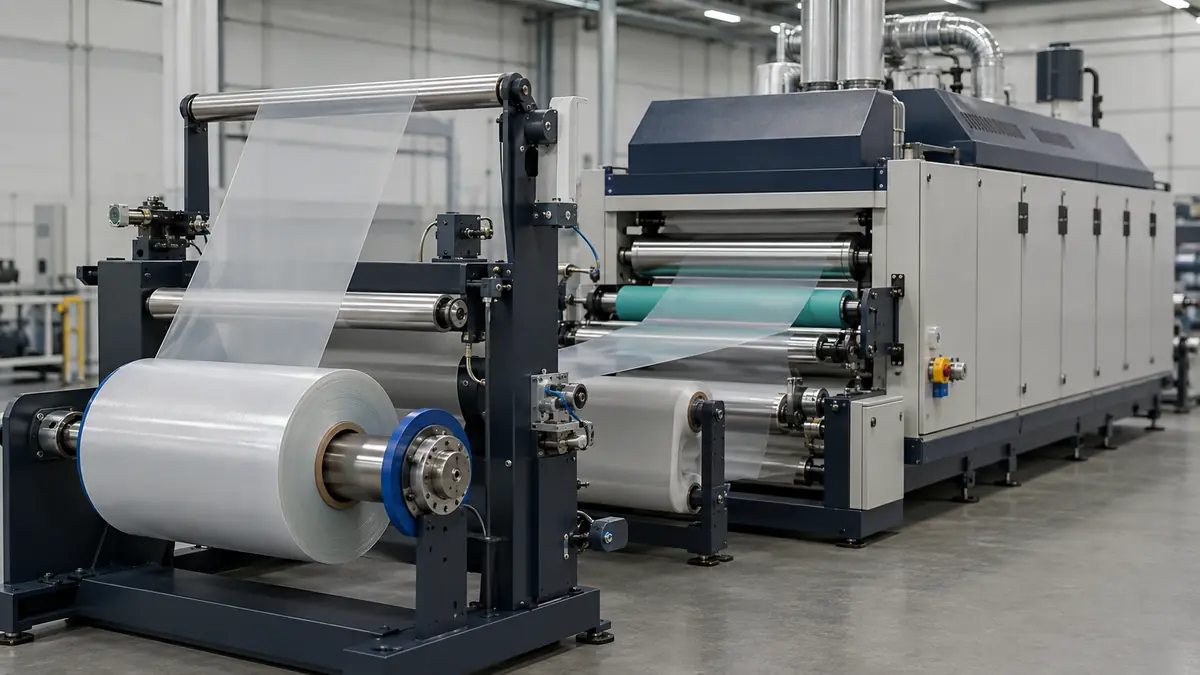
Most packaging BOPA starts with a film-grade polyamide resin, often from the PA6 family. The producer melts and extrudes the resin into a primary film, rapidly cools it, reheats it, and stretches it in MD and TD. Heat setting then stabilizes the oriented structure before winding and slitting.
The useful mental model is directional: extrusion creates the base film; stretching organizes it in two axes; heat setting controls residual movement; conditioning brings hygroscopic polyamide toward a defined moisture state. Each step changes how the web behaves later on a press or laminator.
How Are BOPA Films Manufactured?
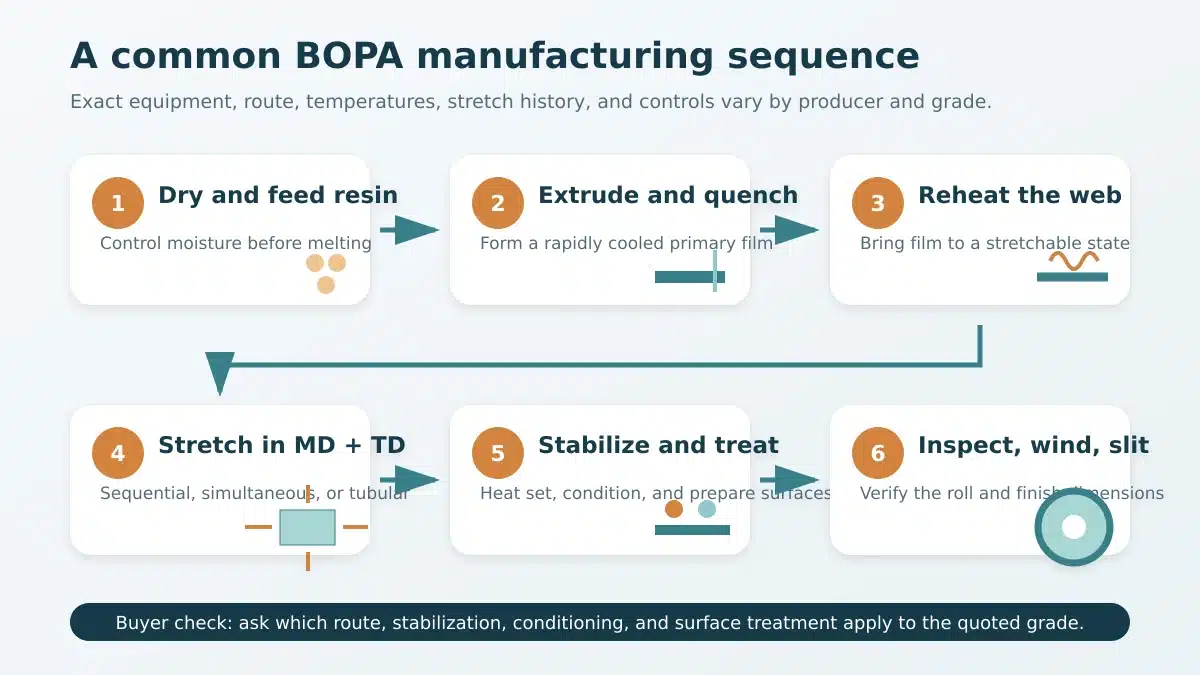
BOPA production begins with moisture-controlled resin handling and extrusion. A rapidly quenched primary film is then reheated to a stretchable state. The film is oriented in two directions, thermally stabilized, treated if required, conditioned, inspected, wound, and slit. Producers use different orientation routes, so two films with the same polymer and thickness can still behave differently.
A practical process flow is:
- Dry and feed the polyamide resin.
- Melt, filter, extrude, and rapidly quench a primary film.
- Reheat and stretch the film in MD and TD.
- Heat-set or anneal the oriented web.
- Condition and apply the specified surface treatment.
- Inspect, wind, age as required, and slit to roll dimensions.
Sequential, Simultaneous, and Tubular Orientation
In sequential tenter processing, the web is stretched in one direction and then the other, commonly MD followed by TD. Simultaneous tenter systems stretch both directions within one stretching zone. Tubular or double-bubble processing expands a reheated tube so orientation develops around and along the bubble.
These routes create different stress histories and process-control challenges. None is automatically best. A converter should ask which route produced the quoted grade and validate registration, shrink, curl, mechanical balance, and barrier under its own conditions.
Heat Setting, Conditioning, and Surface Treatment
Heat setting reduces uncontrolled shrink and helps stabilize dimensions after stretching. Conditioning matters because polyamide absorbs water from the air. The absorbed moisture acts as a plasticizer: it changes stiffness, elongation, toughness, and web dimensions. Film that reaches a different moisture state between testing and converting may not run the same way.
Surface treatment supports ink, coating, or adhesive wetting. Treatment may be supplied on one side or both sides, and it can change during storage. Confirm the treated side and test its current surface condition rather than relying only on the production certificate.
Which BOPA Properties Matter in Packaging?
The most valuable BOPA properties are usually toughness, resistance to puncture and flex cracking, transparency, printability, and oxygen or aroma barrier. These benefits are most useful in a complete laminate. BOPA is not normally chosen as the primary moisture barrier or sealant.
Property data only becomes comparable when the specimen and conditions match. Record film or laminate identity, thickness, MD or TD direction, conditioning, temperature, relative humidity, method edition, and units. A “high barrier” claim without those details is not a usable specification.
Mechanical and Optical Performance
Mechanical data may include tensile strength, elongation, impact, puncture, tear, flex-crack resistance, and thermal shrink. Optical data may include haze, luminous transmittance, gloss, and clarity. Each answers a different question. For example, tensile strength does not predict resistance to a sharp bone, while an impact result does not establish seal strength.
Orientation also makes direction important. Ask for MD and TD results where the method applies. For visual packaging, measure the actual printed or laminated structure when adhesive, coating, or heat exposure may change haze or appearance. A clear base film does not guarantee a clear finished pouch.
Oxygen and Aroma Barrier, Moisture Uptake, and Conditioning
BOPA can provide useful resistance to oxygen and aroma transmission, but its behavior is humidity-dependent. Water interacts with polyamide and changes molecular mobility. As moisture increases, the film generally becomes less stiff and more extensible. Barrier and dimensional behavior can also shift.
Report oxygen transmission rate with the method, temperature, relative humidity, thickness, structure, test side, and units. ASTM D3985 measures steady-state oxygen transmission through films and laminates using a coulometric sensor, but the method itself notes that OTR is not the sole predictor of package protection.
For moisture-sensitive products, evaluate the laminate’s water-vapor transmission rate rather than assuming the BOPA layer will provide the needed protection. PE, CPP, foil, metallization, or another barrier layer may carry that function.
What Are BOPA’s Main Advantages and Limitations?
BOPA earns its place when several demanding needs occur together. It offers a strong balance of toughness, flexibility, puncture resistance, clarity, flex-crack resistance, and oxygen or aroma barrier. That combination is valuable for vacuum packs, frozen products, sharp contents, and laminates exposed to repeated flexing.
The same material also creates design and process constraints:
- Moisture sensitivity: humidity changes stiffness, elongation, dimensions, and barrier behavior. Control storage, conditioning, and test atmosphere.
- No default seal layer: standard BOPA usually needs PE, CPP, or another compatible sealant.
- Limited moisture barrier: add a suitable layer when water-vapor protection is critical.
- Edge and notch sensitivity: protect roll edges and avoid damage that can start web breaks.
- Heat and tension sensitivity: excessive heat or unstable tension can affect dimensions, registration, curl, and winding.
- Laminate complexity: extra layers, adhesives, curing, and testing add cost and qualification work.
The selection question is not whether BOPA is “better.” It is whether its mechanical and barrier contribution reduces package risk enough to justify the laminate and converting burden. If puncture or oxygen exposure is minor, a simpler BOPP, BOPET, PE, or PP structure may be more efficient.
Which BOPA Film Types and Surface Options Are Available?
BOPA suppliers organize portfolios differently, but most offerings can be classified by function. The key variables are surface treatment, added barrier technology, residual shrink, forming behavior, and resistance to the target thermal or chemical process. Commercial names are not standardized, so translate the name into a measurable requirement.
Plain, Treated, Coated, Metallized, and Specialty BOPA
| BOPA category | What changes | Typical reason to specify it | What to confirm |
|---|---|---|---|
| Plain or general-purpose | Base oriented polyamide web | Lamination, coating, or controlled downstream treatment | Treatment status, side, gauge, slip, and winding |
| One-side treated | One surface prepared for ink, coating, or adhesive | Reverse printing or two-layer laminates | Which side is treated and current surface condition |
| Two-side treated | Both surfaces prepared | Middle web in triplex or more complex laminates | Compatibility with ink, coating, and both adhesives |
| Coated or high-barrier | Functional organic or inorganic coating added | Higher gas/aroma barrier or another specialty function | Coating chemistry, flex durability, test conditions, and food-contact status |
| Metallized | Thin metal layer applied | Higher light, oxygen, or aroma barrier | Optical density, metal adhesion, pinholes, and flex performance |
| Specialty grade | Shrink, cold-forming, retort, battery, or other tailored behavior | A defined process or end use | Exact grade, process window, regulatory documents, and validation data |
Do not substitute categories based on thickness alone. A 15 μm one-side-treated printing grade and a 15 μm two-side-treated retort grade may require different adhesives, curing, handling, and compliance documents.
How Does BOPA Work in Multilayer Laminate Structures?
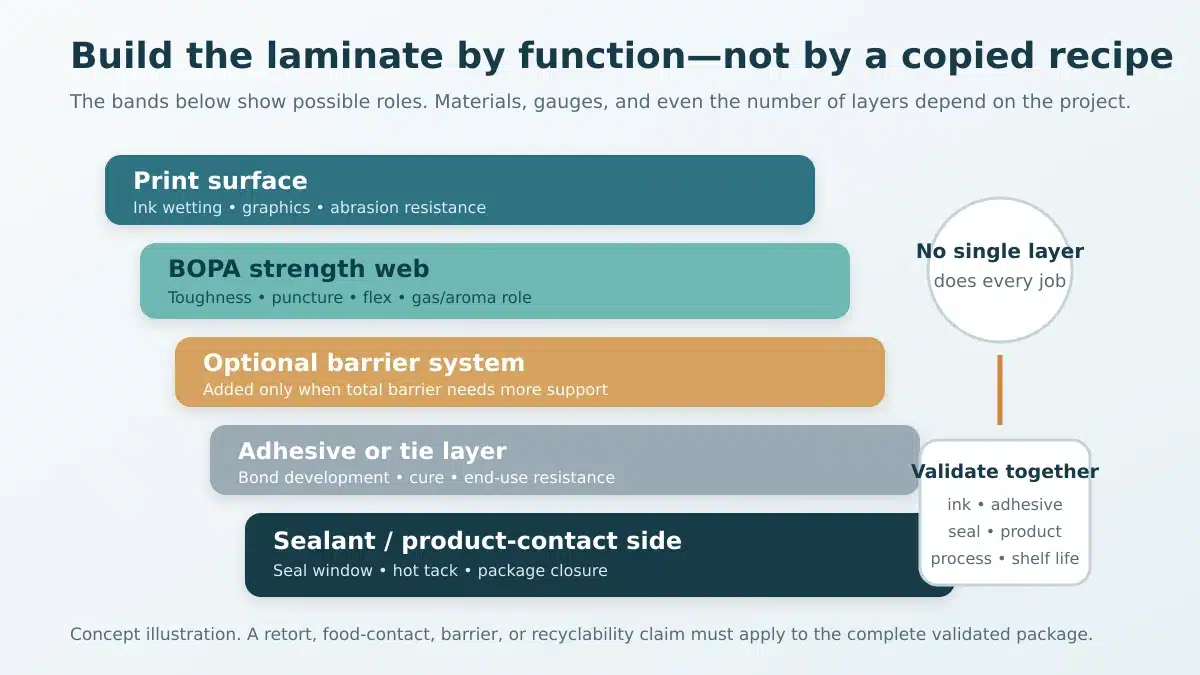
A laminate works when each layer has a clear job. BOPA commonly contributes toughness, puncture resistance, flex durability, print support, and useful gas or aroma barrier. Another layer normally provides heat sealing and much of the moisture barrier. Additional webs or coatings may provide higher oxygen, light, or chemical protection.
Print Web, Strength Layer, Barrier Layer, and Sealant Roles
An illustrative two-layer structure is reverse-printed BOPA laminated to PE. BOPA supports graphics and mechanical protection, while PE supplies sealing and moisture resistance. BOPA/CPP follows similar role logic and can suit PP-based sealing needs. More demanding structures may add foil, metallized film, EVOH, or a coated barrier web.
Think in functions rather than recipes:
- Print surface: supports ink wetting, registration, appearance, and abrasion resistance.
- Strength web: resists puncture, flexing, handling, and distribution damage.
- Barrier system: controls oxygen, aroma, moisture, light, or chemicals at declared conditions.
- Sealant: creates the seal window, hot tack, contamination resistance, and package closure.
- Adhesive or tie layer: bonds unlike materials and must survive filling, storage, and thermal processing.
A published stack is only a starting point. Gauge, treatment, ink, adhesive, cure, sealant, food, filling process, and shelf-life target must be validated together. Retort suitability belongs to the complete package and process—not to the BOPA layer alone.
Where Is BOPA Used—and When Is Another Film Better?
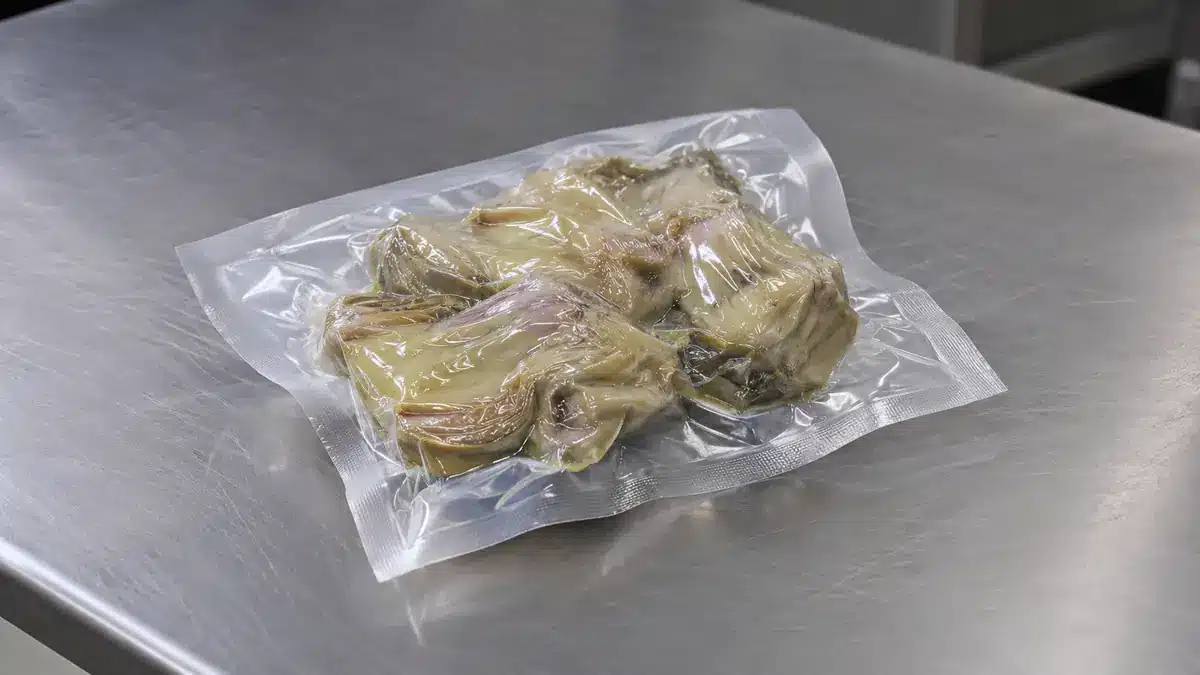
BOPA is widely considered for vacuum meat and cheese packs, frozen foods, puncture-prone products, processed foods, liquid or paste pouches, and selected retort laminates. It can also support industrial, pharmaceutical, or technical structures when toughness and gas barrier matter. The application name alone is not enough; the dominant failure risk should drive selection.
Application-Fit Selection Matrix
| Material family | Puncture and flex toughness | Oxygen/aroma role | Moisture role | Stiffness and dimensional control |
|---|---|---|---|---|
| BOPA | Strong | Useful, humidity-dependent | Usually needs support | Balanced, condition-dependent |
| BOPET | Moderate to strong; relatively stiff | Useful as a print/barrier support web | Usually needs support | Strong print and dimensional stability |
| BOPP | Moderate; can be brittle in some demanding conditions | Limited without coating/metallization | Stronger moisture role | Stiff, clear, efficient |
| Cast PA | Tough and formable | Useful | Usually needs support | Less orientation-driven stiffness |
| PE or oriented PE | Flexible and sealable; grade-dependent toughness | Limited without barrier layer | Strong moisture role | Lower stiffness unless oriented or engineered |
Use the table as a shortlist, not a verdict. A material can only be compared fairly at the same gauge, structure, environment, and test conditions. If recycling design is a priority, assess the complete package against the applicable local design guide and collection system. A BOPA-containing laminate is neither automatically recyclable nor automatically non-recyclable.
How Should Converters Print, Laminate, and Handle BOPA?
BOPA converts reliably when moisture, surface, edge condition, tension, heat, adhesive cure, and winding are controlled as one system. Keep unused rolls in their protective barrier wrap. Avoid damaged edges, water exposure, and uncontrolled acclimation. Confirm which surface is treated before threading the web.
Start trials with stable, conservative tension and only the heat needed for drying and cure. BOPA can respond differently from BOPET or BOPP because moisture changes its modulus and dimensions. Record ambient conditions, roll age, gauge, web path, oven settings, tension zones, adhesive mix, coating weight, nip, cure time, and winding conditions.
Process Windows and Common Failure Modes
| Symptom | First variables to check | Why it matters |
|---|---|---|
| Poor ink or adhesive wetting | Correct side, current treatment, contamination, ink/adhesive compatibility | Treatment and surface condition control wetting and bond formation |
| Register drift or web elongation | Moisture state, heat, draw, tension balance, gauge | Hygroscopic conditioning and web stress change dimensions |
| Curl after lamination | MD/TD tension balance, moisture mismatch, heat history, layer modulus | Dissimilar webs can store unequal stress |
| Tunneling or local delamination | Coating uniformity, solvent removal, nip, cure, winding stress, web tension | Bond development and residual stress interact |
| Web breaks from the edge | Edge damage, slitting quality, alignment, tension peaks | Nylon film can be sensitive to notches and damaged edges |
| Blocking, static, or poor winding | Surface slip, static control, roll hardness, temperature, tension taper | Surface and winding behavior affect roll stability |
Change one controlled variable at a time during diagnosis. Universal dyne, tension, oven, or cure settings are unsafe because equipment, ink, adhesive, gauge, and structure differ.
How Should Buyers Test and Specify BOPA Film?
A useful specification connects the package risk to a method, specimen, condition, unit, and acceptance rule. It also defines the roll and surface that must arrive at the converter. Supplier data can screen candidates, but the final laminate and package still need trials under filling, distribution, storage, and shelf-life conditions.
Test Plan and RFQ Checklist
Build the test plan around these groups:
- Identity and dimensions: polymer/grade, thickness and tolerance, width, roll length, core, maximum roll diameter and weight, splice rules, and winding direction.
- Mechanical: tensile strength and elongation in MD/TD, impact or puncture method, tear or flex testing where relevant, and thermal shrink.
- Optical and surface: haze/transmittance, gloss if needed, treated side, surface test method, coefficient of friction against the defined counterface, and aging interval.
- Barrier: OTR and WVTR for the specified film or laminate, with temperature, RH, test side, thickness, method edition, and units.
- Converting: ink and adhesive family, printing/lamination route, expected heat and tension exposure, sealant pairing, cure, and end-use process.
- Quality and documentation: lot traceability, certificate of analysis, change-control terms, defect limits, sampling plan, shelf life, storage instructions, and complaint process.
- Regulatory: intended food or technical use, target market, contact type, time and temperature, migration or declaration documents, and any application-specific restrictions.
For method-aware comparisons, check the current standard before testing. At the time of this guide, relevant catalog pages include ASTM D3985 for OTR, D882 for tensile properties of thin sheeting, D1894 for film friction, F1249 for WVTR, and D1003 for haze and luminous transmittance. These methods define measurement scope; they do not set a universal BOPA pass value.
BOPA Film FAQs
Does BOPA Film Heat-Seal by Itself?
Standard BOPA is generally not selected as the heat-seal layer. Most packages pair it with PE, CPP, or another sealant designed for the required seal-initiation temperature, hot tack, contamination resistance, and final seal strength. Specialty constructions may differ, so confirm the exact grade and complete laminate rather than assuming sealability from the word “BOPA.”
Is BOPA the Same as Nylon Film?
BOPA is a type of nylon or polyamide film, but not every nylon film is BOPA. Nylon film may be cast, blown, unoriented, biaxially oriented, mono-layer, or coextruded. BON and OPA are common alternative terms for oriented polyamide. Ask the supplier to state the polymer family, orientation route, grade, gauge, and treatment.
How Does Humidity Affect BOPA Film?
Polyamide absorbs moisture from air. The water acts as a plasticizer, which can reduce stiffness and increase elongation, flexibility, and toughness. Dimensions and barrier behavior may also change. Store rolls in protective wrap, condition and test them consistently, and record temperature and relative humidity whenever data or press behavior is compared.
Can BOPA Be Used in Retort Packaging?
Yes, suitable BOPA grades can be used in retort laminates. The claim must apply to the exact grade and complete structure. Validate the ink, adhesive, barrier layers, sealant, seals, food, sterilization cycle, storage period, and target-market food-contact documents. A general-purpose BOPA datasheet does not prove that a pouch is retort-ready.
Can BOPA-Based Packaging Be Recycled?
It depends on the complete package and the real recycling system Design.
What Information Does a BOPA Supplier Need for a Recommendation?
Provide the packed product package.
 English
 Japanese
 French
 Spanish
 Korean
 Italian
 Portuguese
 Dutch
Dutch Arabic
 Russian
 German