
Heat-shrinkable film can protect, display, collate, and identify products with one conforming layer. Its real advantage is not simply that it gets smaller when heated. Value appears when the film’s shrink behavior, seal system, optics, strength, and regulatory status are matched to a product and a packaging line.
That distinction matters because “shrink film” describes a process family, not one interchangeable material. Polyolefin (POF), polyethylene (PE), and polyvinyl chloride (PVC) grades can behave very differently. A clear retail overwrap, a heavy beverage bundle, and a printed shrink sleeve solve different problems. The right comparison is therefore not film versus no film in the abstract; it is the total performance of two fully specified packaging systems.
This guide explains the advantages buyers can verify, the limits that marketing summaries often omit, and the evidence to request before approving a film.
How Does Heat-Shrinkable Film Create Packaging Value?
For U.S. food-contact context, review the eCFR polymer provisions before approving a finished-film claim.
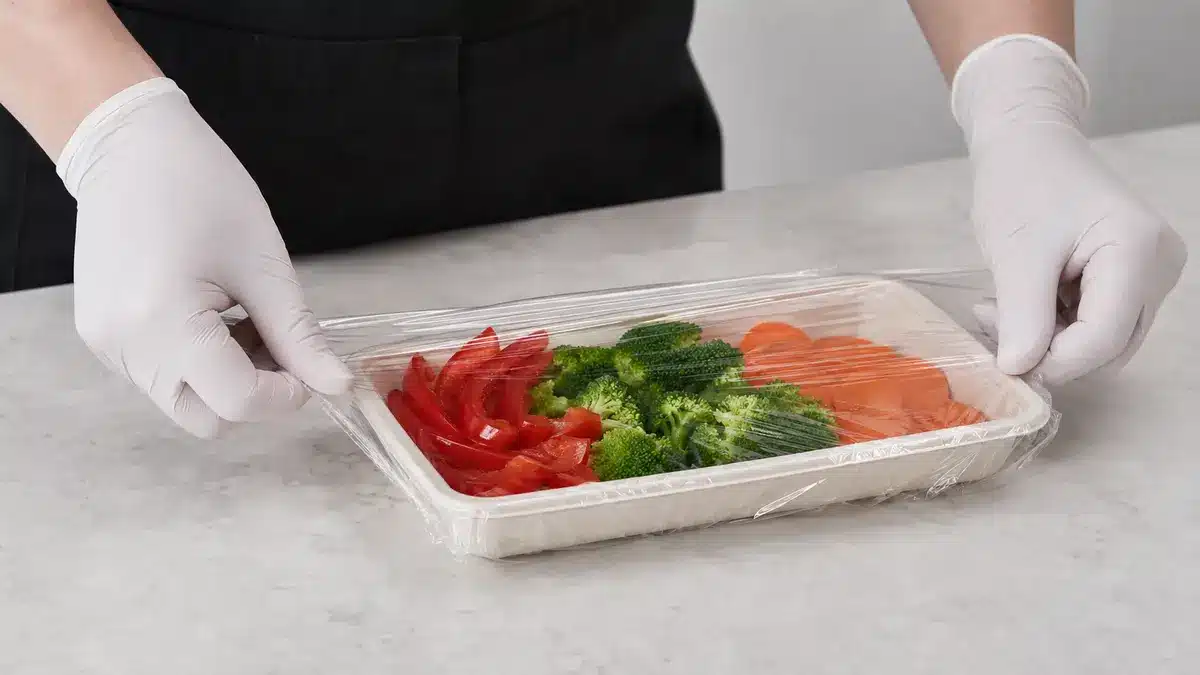
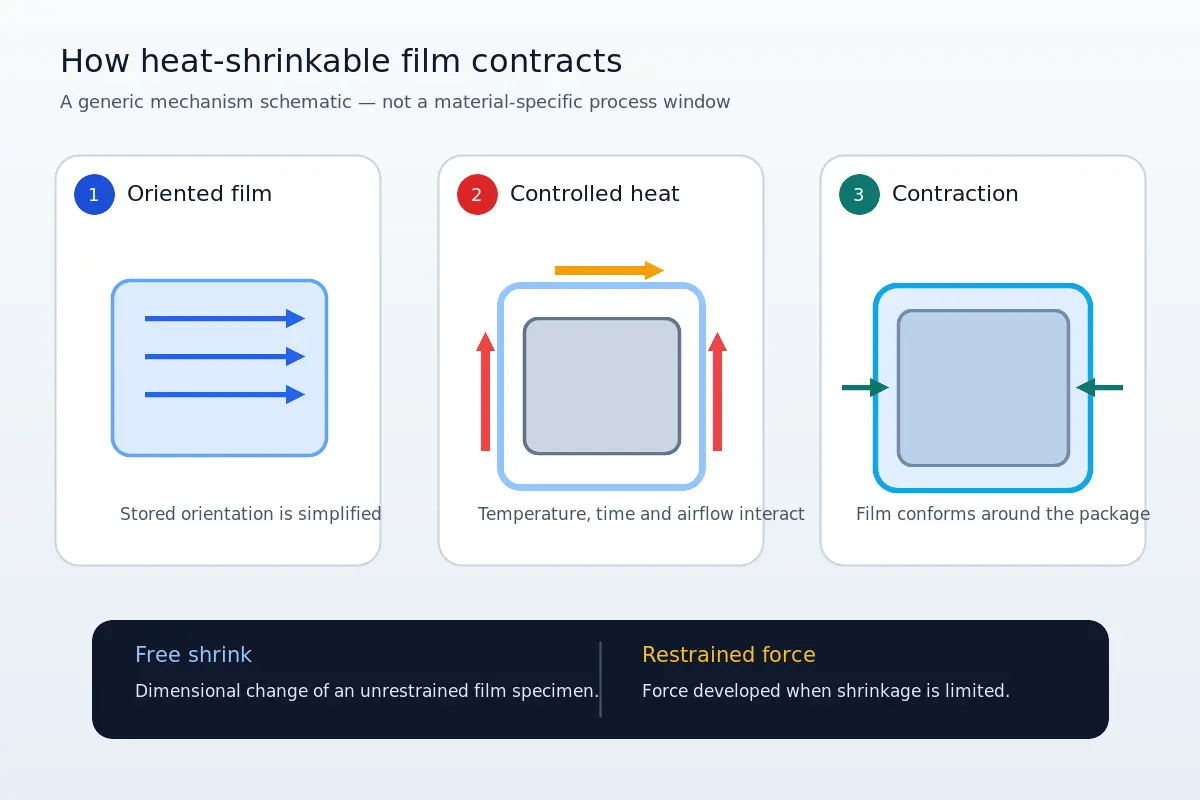
Heat-shrinkable film is manufactured with molecular orientation. During production, the film is stretched under controlled conditions and that oriented structure is temporarily held in place. When the film is reheated in a tunnel or by another controlled heat source, it tends to recover toward a less-oriented state. The resulting contraction draws the material around the product.
That controlled recovery can turn a loose web into a close-fitting package. The pack may use less empty volume than a rigid outer container, hold several items together, and preserve visibility. It can also conform to irregular shapes that would require multiple rigid package sizes. These are system-level possibilities, not automatic film properties.
Two measurements should not be confused. Unrestrained shrink describes dimensional change at a specified temperature; ASTM D2732 is a relevant laboratory method. Shrink force or tension describes how strongly the film acts while restrained; ASTM D2838 addresses that different question. A high-shrink film can still be unsuitable if its force distorts a carton, crushes a tray, or pulls a bundle out of alignment.
From oriented film to a conforming pack
The useful sequence is orientation, sealing, heating, recovery, and cooling. Each step creates a control point. Weak or contaminated seals may open before shrink completes. Excess heat can damage a sensitive product, while insufficient or uneven heat can leave wrinkles and “dog-ears.” Air must also escape from many packages, so perforation and seal layout influence the finished result. A conforming pack is therefore evidence of a balanced material-and-process window—not proof that more heat or more shrink is better.
Which Product-Protection Advantages Can It Provide?
Shrink film can provide a sacrificial surface between a product and routine handling. A close overwrap helps reduce direct contact with dust, abrasion, fingerprints, and minor scuffing. It can retain loose components, keep a multipack together, and make an opened or torn package easier to notice. For printed goods, cartons, and consumer products, that combination may reduce cosmetic rejects.
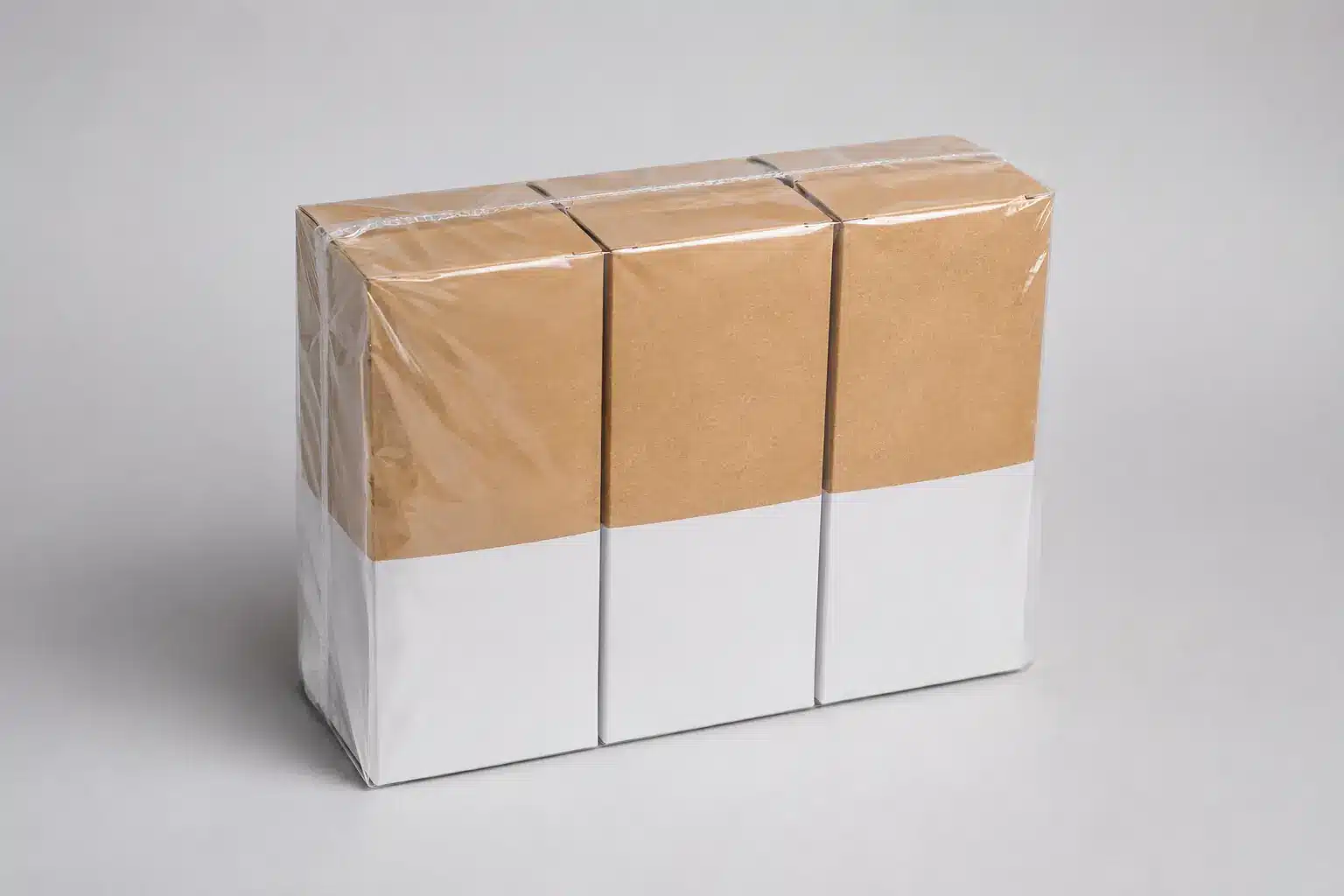
Protection remains hazard-specific. Resin, thickness, impact resistance, tear propagation, seal quality, sharp corners, and unsupported spans all affect durability. A thin film with excellent optics may be the wrong choice for a product with hard edges. A tougher structure may still fail where a seal crosses a corner. Likewise, a film that performs well in a controlled drop may not tolerate vibration, compression, or repeated handling on the actual distribution route.
ASTM D4169 provides a framework for laboratory performance testing of shipping units, while ASTM D5276 addresses free-fall drops of loaded containers. Neither method says that a particular shrink film is “protective” by itself. The test specimen must be the complete, production-representative package, and the chosen cycle must match the intended hazards.
Protection starts with the hazard, not the film label
Start the specification with failure modes: dust on the product, scuffed graphics, punctures at corners, loose items, seal opening, water exposure, or collapsed bundles. Then assign a measurable response to each risk. Conventional shrink overwrap should not be called hermetic or waterproof without package-level evidence; seams, vents, perforations, and openings can admit liquid. When moisture barrier or long shelf life is critical, ask for transmission data and a validated package design rather than relying on the word “wrapped.”
How Can Shrink Film Improve Presentation and Product Visibility?
A well-run clear overwrap can keep the product visible while producing a compact, orderly outline. It can reduce loose flaps, hold cartons square, and create a consistent surface for retail handling. Printed shrink films and sleeves can also carry graphics across complex container shapes, creating a large decoration area without hiding the underlying pack architecture.
“Clear” is not a complete optical specification. ASTM D1003 measures haze and luminous transmittance for transparent plastics. ASTM D2457 covers specular gloss at defined geometries. These properties answer different questions: haze affects how distinctly an object is seen through the film, while gloss describes reflected appearance. Buyers may also need limits for gels, scratches, blocking, wrinkles, burn-through, seal width, and color.
The converting and shrinking process can change the final appearance. Excessive film width can create large corner folds. Poor air evacuation can cause ballooning. Uneven airflow can distort graphics or leave one side looser than another. For printed sleeves, artwork must be compensated for predictable, nonuniform shrink around shoulders, recesses, and changes in diameter.
Translate shelf appeal into measurable specifications
Use a signed production sample as the visual master, then add objective criteria where possible. Record haze and gloss test conditions, film thickness, package dimensions, seal location, acceptable wrinkle and dog-ear limits, print registration tolerance, and inspection lighting. Evaluate at the beginning, middle, and end of a production run. This makes “premium appearance” a repeatable acceptance decision instead of a subjective promise.
How Does It Support Bundling and Unitization?
Shrink film can collate cans, bottles, cartons, and other products into a handling unit. PE shrink film is widely used for unsupported bundles, pad-supported packs, and tray-supported packs. Openings can be designed for cooling or hand access, and printed film can combine containment with retail identification.
The advantage is architectural flexibility. An unsupported bundle minimizes secondary components but asks the film and product geometry to carry more of the handling load. A pad improves the base and may help layer control. A tray adds edge support, stacking assistance, and merchandising function at the cost of more material and handling. The correct option depends on product stiffness, bundle mass, stacking pattern, conveyor transfers, pallet pattern, and route severity.
Shrink force must also be balanced. Too little force can allow product migration; too much can deform lightweight containers or buckle labels and trays. Openings, perforations, seal position, gauge distribution, and cooling all change the load path.
Match bundle architecture to handling load
Use a three-way trial rather than assuming the lightest pack is best:
| Architecture | Primary advantage | Key verification |
|---|---|---|
| Unsupported bundle | Fewer secondary components | Carry integrity, product migration, puncture and pallet stability |
| Pad-supported bundle | Better base control with limited material | Pad retention, wet handling and conveyor transfers |
| Tray-supported bundle | Edge and stacking support | Compression, tray deformation and retail opening |
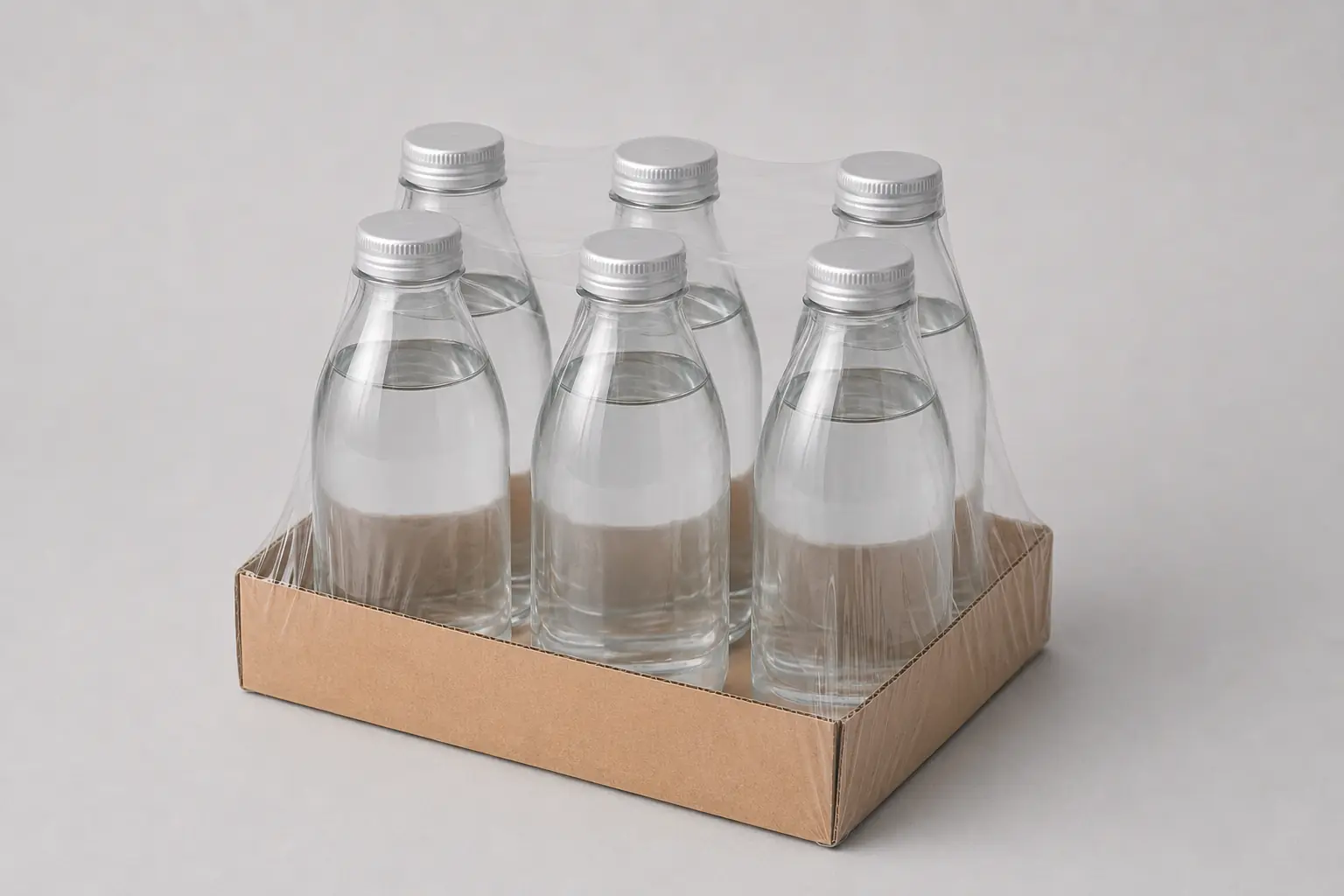
Test the finished bundle through representative conditioning, handling, vibration, compression, and drops. ISTA 3K is one reference for fast-moving consumer-goods distribution, while ASTM D4577 addresses container compression under constant load. The test plan should follow the actual distribution system, not a generic claim that the pack is “unitized.”
Can Heat-Shrinkable Film Improve Packaging Efficiency?
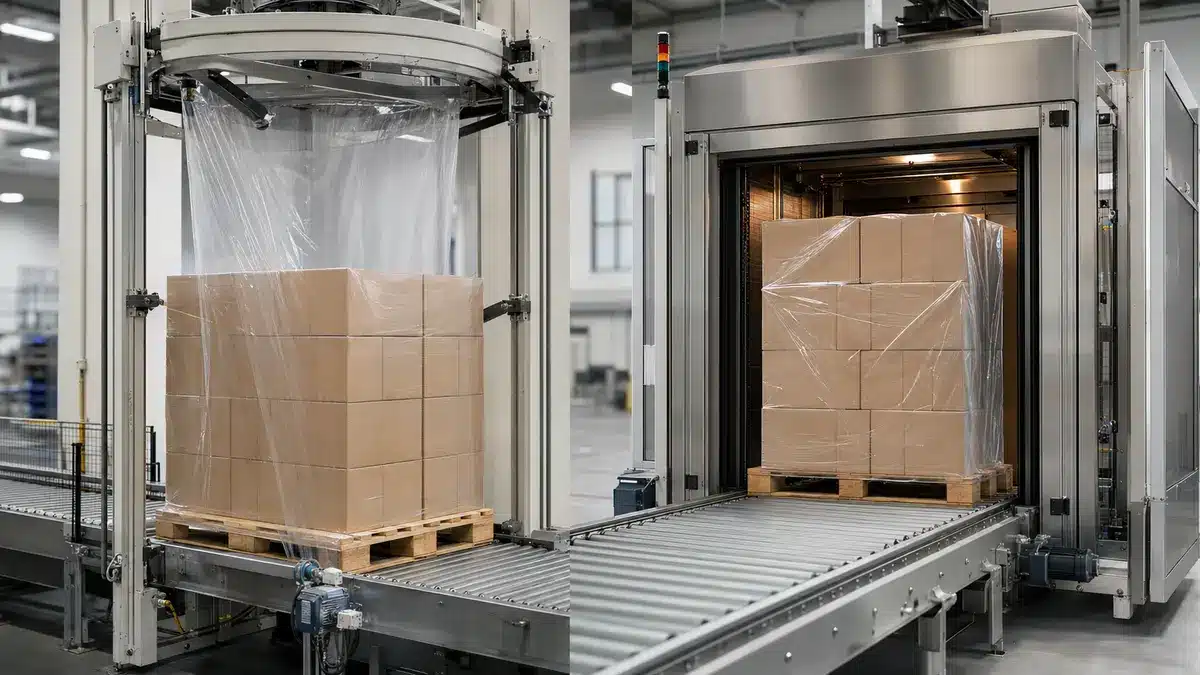
It can—but the useful metric is cost per accepted pack, not price per roll. A lower film price may be erased by poor yield, extra downtime, slower tunnel speed, weak seals, rework, or product damage. A higher-priced film may be economical if it runs thinner, reduces rejects, or widens the operating window. Supplier case studies can reveal possible levers, but they do not establish a universal savings rate.
Material cost starts with film area, thickness, density, and purchase price. The Pro Pac yield reference notes that coated or treated films can differ from generic density assumptions, so calculations should be checked against the actual grade and roll specification. Add trim, setup scrap, splices, and changeover waste.
Line performance should be separated into availability, performance, and quality—the standard OEE logic described by OEE.com. This prevents a nominal speed increase from hiding additional rejects or downtime.
Calculate total cost per accepted pack
Use the same run window for both candidates:
Cost per accepted pack = (film + labor + energy + planned and unplanned downtime + scrap + rework + damaged product) / accepted packs.
Record good packs, total packs, average speed while running, stops by cause, startup scrap, seal rejects, appearance rejects, and energy under equivalent conditions. Treat downgauging as a controlled engineering change: confirm seal integrity, puncture performance, shrink appearance, distribution performance, and roll handling before claiming savings. The winning film is the one with the lowest verified system cost while every critical requirement still passes.
How Flexible Is Heat-Shrinkable Film Across Products and Equipment?
The material family supports many applications because suppliers can vary resin blends, orientation, layers, slip, seal behavior, optics, shrink force, and thickness. That range lets converters target anything from a light retail overwrap to a heavy collation bundle. It does not mean a single roll can move between every product and machine without qualification.
POF is commonly considered for clear retail overwraps where optics, balanced shrink, and broad sealing behavior matter. PE is common in heavier bundling and collation because grades can provide toughness and useful bundle force. PVC can provide useful shrink and optical behavior in certain applications but brings a different processing and material-management profile. These are selection tendencies, not guaranteed properties.
Supplier data illustrate how much variation exists within one family. For example, a Clysar low-energy-grade data sheet reports grade-specific sealing and shrink-force behavior. Those values apply to that product under stated conditions; they cannot be transferred to every POF film.
POF, PE, and PVC deliver different kinds of flexibility
| Decision axis | POF tendency | PE tendency | PVC tendency |
|---|---|---|---|
| Typical role | Clear retail overwrap and multipacks | Heavier bundles and collation | Selected retail overwrap or sleeve uses |
| Engineering focus | Optics, seal window, balanced shrink | Toughness, gauge, bundle force | Heat response, optics, equipment and material controls |
| Trial priority | Seal appearance and tunnel window | Load stability and puncture | Distortion, heat profile and handling requirements |
Before changing film, document machine type, sealing system, maximum web width, roll diameter, perforation, conveyor speed, tunnel zones, airflow, cooling, and product heat tolerance. Expect to tune seal temperature and dwell, tunnel temperature, airflow, and line speed. Compatibility is demonstrated by a stable process window and accepted packs, not merely by fitting the roll on the unwind.
What Advantages Matter for Food and Consumer Goods?
For food and consumer goods, shrink film can combine visibility, grouping, surface protection, and tamper indication in a compact format. It may keep labels and printed cartons cleaner, retain promotional combinations, and make accidental opening more apparent. Those functions can be valuable, but regulatory and safety claims must be attached to the exact material and use.
In the United States, the FDA food-contact framework evaluates substances and authorized uses, and provisions such as 21 CFR 177.1520 include specifications and conditions for certain olefin polymers. In the European Union, Regulation (EU) No 10/2011 provides a framework for plastic materials intended to contact food. A label such as “PE” or “POF” is not, by itself, evidence that every additive, layer, ink, or use condition complies.
Food contact and tamper indication require separate evidence
Request a current declaration that identifies the film grade, regulatory basis, intended food types, contact time and temperature, and applicable limitations. Confirm whether film contacts food directly or only an outer package. Migration or other compliance evidence must match the intended use.
Tamper indication is a separate design function. A band or overwrap may reveal opening only if its construction makes interference visible and the user can recognize the evidence. In regulated categories, follow the category-specific rules; for example, 21 CFR 211.132 addresses tamper-evident packaging for certain over-the-counter human drug products. Do not convert “tamper-evident” into “tamper-proof,” and do not use a food-contact statement as proof of tamper performance.
What Sustainability Advantages Are Real—and Which Need Proof?
Shrink film can sometimes reduce package mass or eliminate a larger secondary component. That is a measurable advantage when the comparison uses the same functional unit—such as grams of packaging per accepted product delivered without damage. Lightweighting that raises breakage, rejects, or product loss may shift impact rather than reduce it.
Recyclability is a different question. In the United States, 16 CFR 260.12 says recyclable claims should reflect whether a package can be collected, separated, or otherwise recovered through an established program. Design compatibility matters, but access also matters. A technically compatible PE film may not be accepted in a local collection system, and labels, inks, adhesives, metallization, residue, or mixed materials may affect sorting and reprocessing.
In Europe, the packaging policy landscape is governed increasingly by the Packaging and Packaging Waste Regulation. Design assessments should use the applicable requirements and current technical guidance for the target market rather than importing a claim from another jurisdiction.
Separate material reduction from end-of-life performance
Use a claim ledger with four separate lines:
- Material efficiency: grams per accepted pack and reduction versus a named baseline.
- Recycled content: percentage, mass-balance rules if relevant, and supporting chain-of-custody evidence.
- Design compatibility: results against an applicable guide such as the APR Design Guide or RecyClass guidelines.
- Real-world access: collection, sorting, and reprocessing availability for the market where the claim appears.
Avoid blanket terms such as “eco-friendly,” “green,” or “100% recyclable” unless the full claim can be substantiated and appropriately qualified. Material reduction is not an end-of-life claim, and a resin identification does not prove collection access.
How Should Buyers Verify the Claimed Advantages?
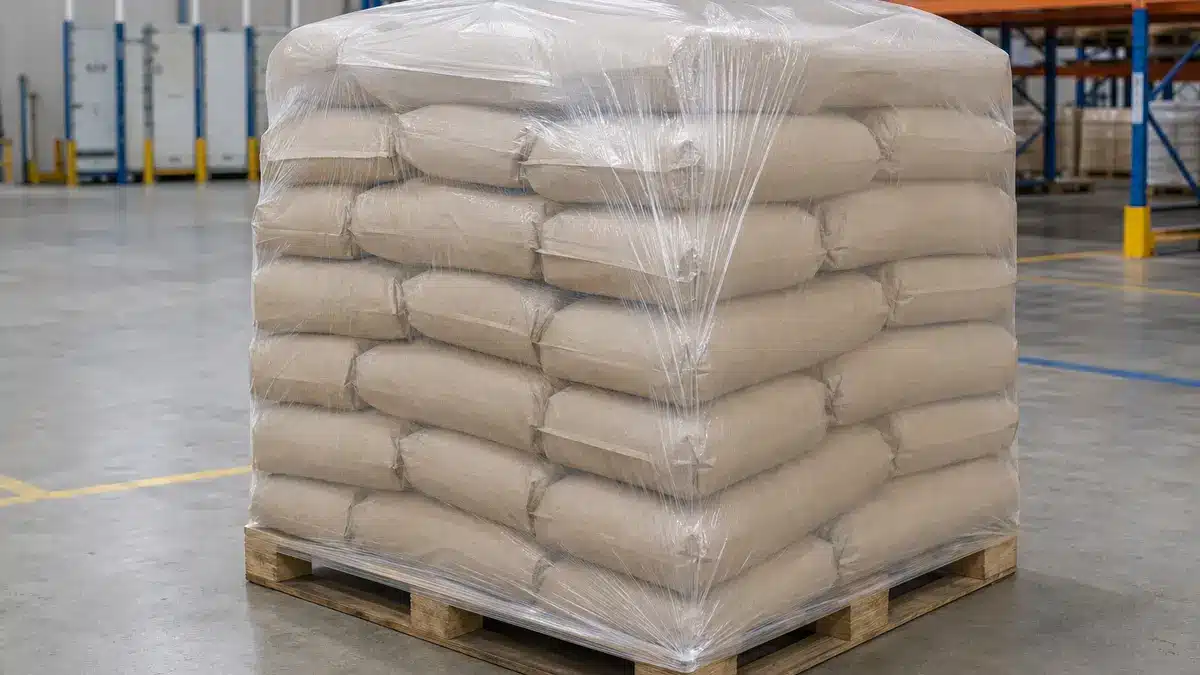
Turn every claimed benefit into a specification, a test, and a decision rule. A supplier data sheet is the starting point because it identifies the grade and typical properties. It is not a finished package guarantee. Buyers should define incoming-film checks, machine-window trials, finished-pack acceptance, and distribution validation before commercial approval.
Relevant film methods may include ASTM D2732 for unrestrained linear shrink, ASTM D882 for tensile properties of thin sheeting, ASTM D1709 for dart impact, and ASTM F1306 for slow-rate penetration. A seal-strength method such as ASTM F88/F88M may be relevant where its scope and specimen preparation fit the seal construction. Standards describe methods; they do not supply one universal pass limit.
Use a datasheet-to-line-trial acceptance ladder
- Define the package: product, dimensions, weight, sharp points, contact status, distribution route, appearance criteria, and heat sensitivity.
- Qualify documents: current TDS, specification, certificate or lot data, regulatory declarations for the intended use, change-control terms, and traceability.
- Screen the film: verify thickness, shrink response by direction and temperature, force where relevant, optics, impact or penetration, and seal behavior using agreed methods and conditioning.
- Map the process window: run low, nominal, and high practical settings for seal, tunnel temperature, airflow, and speed. Record good-pack rate and defects.
- Validate the package: use production-equivalent packs in distribution and storage tests that represent the route.
- Approve and monitor: sign a golden sample, set incoming and in-process limits, and define requalification triggers.
This ladder exposes trade-offs early. It also gives procurement a defensible basis for comparing suppliers without assuming that the lowest gauge, highest shrink percentage, or lowest roll price is automatically better.
Frequently Asked Questions
Is heat-shrinkable film the same as stretch film?
No Stretch film is applied under tension and relies mainly.
Which shrink film is best for retail packaging?
There is no universal best film. For a clear retail overwrap, buyers often evaluate POF for optics and sealing range, but the decision should include product shape, required shrink force, seal appearance, puncture risk, line type, throughput, regulatory status, and local end-of-life requirements. Use production samples and a line trial.
Does shrink film make a package waterproof?
Not automatically. A shrink overwrap can shed incidental moisture and reduce direct exposure, but seams, seals, vents, perforations, and open ends may let water enter. If waterproof or moisture-barrier performance is required, define the exposure and test the complete package to an agreed acceptance criterion.
Can heat-sensitive products be shrink wrapped?
Sometimes. Feasibility depends on the product’s temperature limit, exposure time, package geometry, film activation range, tunnel type, airflow, and conveyor speed. Lower-energy films or a shorter, better-controlled heat profile may help, but only instrumented trials with the actual product can establish a safe operating window.
Is heat-shrinkable film recyclable?
Some structures may be technically compatible with a film-recycling stream, but the answer depends on resin, layers, labels, inks, adhesives, contamination, collection access, sorting, and local program rules. Qualify claims for the target market and check current program acceptance. Do not infer recyclability from “PE,” “POF,” or a recycling symbol alone.
What should a buyer request from a supplier?
Request the exact grade specification.
 English
 Japanese
 French
 Spanish
 Korean
 Italian
 Portuguese
 Dutch
Dutch Arabic
 Russian
 German