
Centerfold, single-wound, and shrink tubing are not three resin families. They are three ways of presenting a shrinkable web to a packaging process. That distinction matters because a familiar polymer name does not guarantee that a roll will load, track, seal, or fit a specific wrapper.
One terminology note comes first: “single wrap” is ambiguous. The established roll-form terms are single-wound film and flat film. This guide keeps the requested title, but uses “single-wound” in the technical discussion. The practical objective is not to crown one format as best. It is to identify the format your equipment can form, the dimensions your package needs, and the exact grade that can pass a controlled line trial.
First, Separate Roll Form from Film Material
For regulatory context, consult the U.S. FDA’s food-packaging guidance before approving an intended food-contact use.
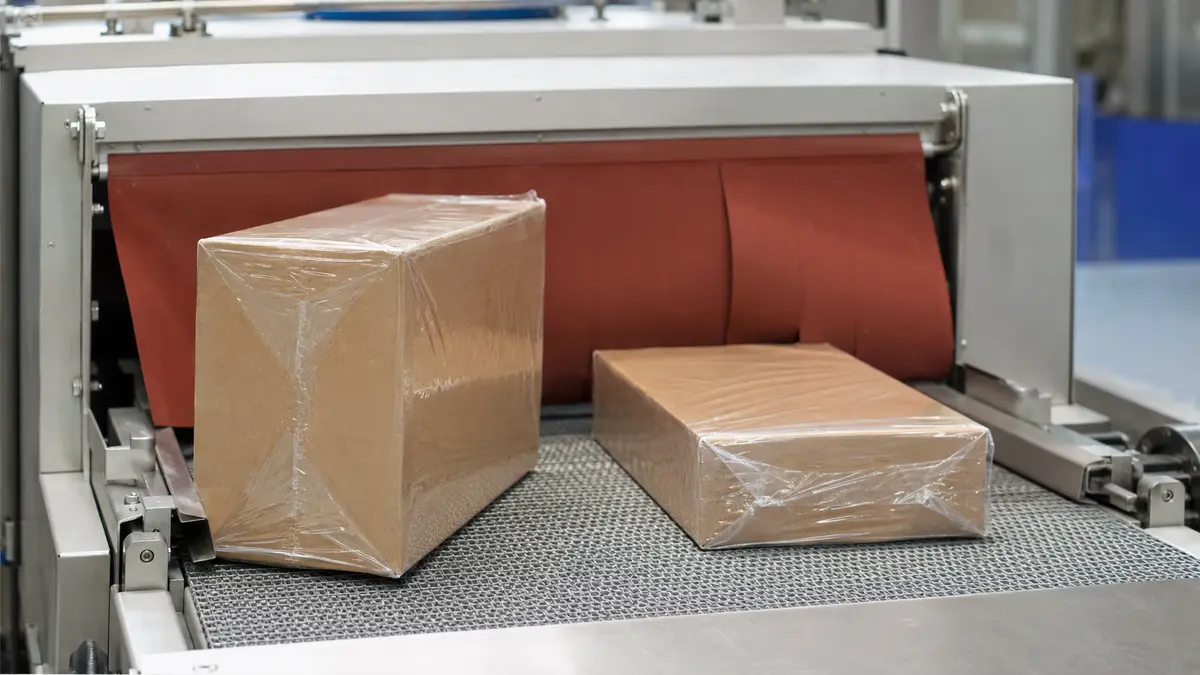
Clysar defines single-wound film as flat film wound on a core. Centerfold and tubing describe other physical web presentations. None of these labels, by itself, specifies polymer family, layer structure, orientation, shrink force, seal window, thickness, food-contact status, or suitability for a particular line.
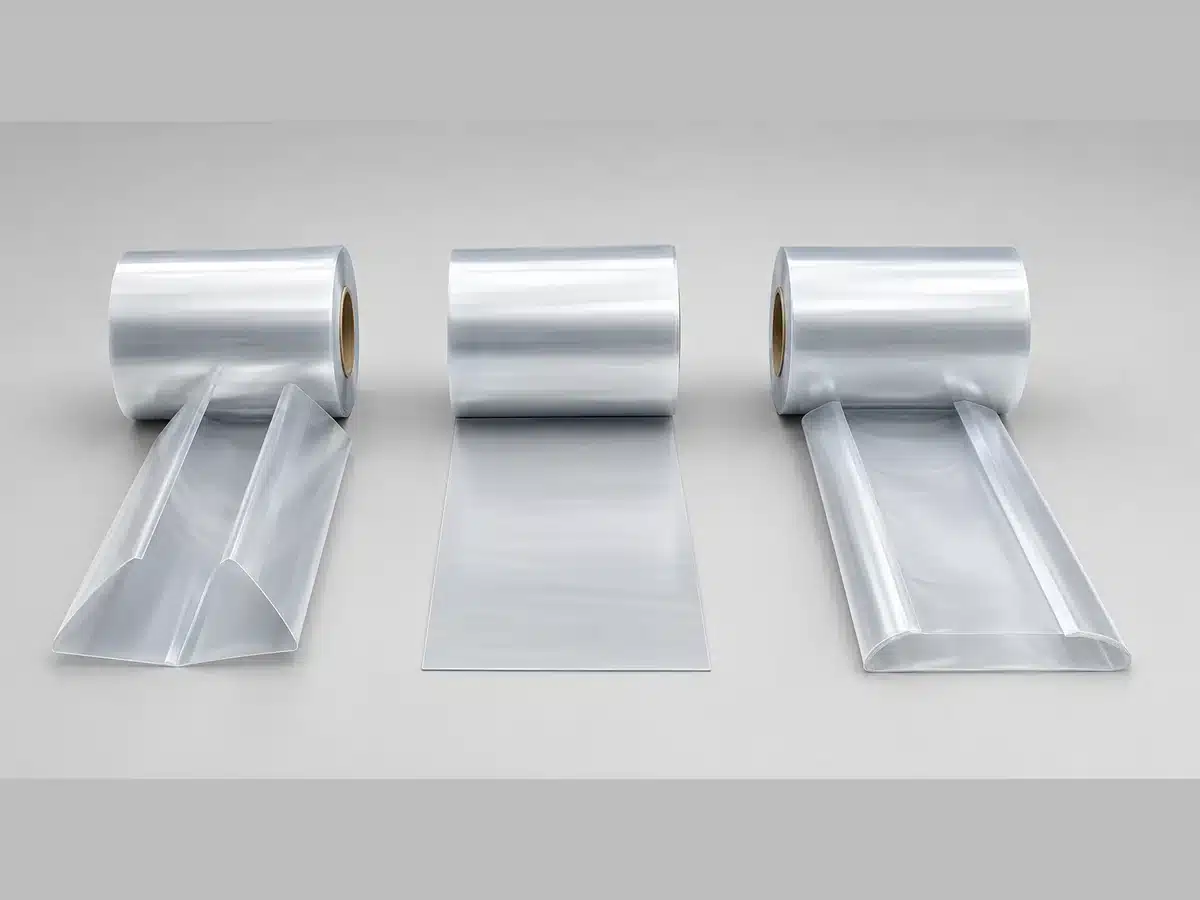
Roll presentation and resin grade answer different questions
Think of a shrink-film specification as three linked decisions:
- Roll presentation: centerfold, single-wound flat film, or layflat tubing.
- Film construction: the supplier’s exact resin family, multilayer structure, grade, thickness, and options such as perforation.
- Application path: the wrapper, former, sealer, tunnel, product orientation, and target output.
Changing only one layer can change the result A polyolefin grade offered as folded and flat web may have different roll lengths handling needs or stock status A wrapper that accepts one centerfold width may reject another roll because of core ID outside diameter.
What suppliers usually mean by “single wrap”
Do not place “single wrap” alone on an RFQ. If you mean one unfolded web, write single-wound (flat) shrink film and add the required width convention. If you mean a package wrapped once around a product, describe the intended seal pattern and machine path instead. Clear terminology prevents a supplier from quoting a web form that is physically different from the one your equipment expects.
The distinction also protects material comparisons. Polyolefin, PVC, and polyethylene are material categories; centerfold, flat film, and tubing are converting or roll-presentation choices. Evaluate both, but never substitute one decision for the other.
Centerfold Shrink Film: A Prefolded Web for Opening and Sealing
Centerfold film begins as a flat web folded lengthwise. On the roll, one longitudinal edge is the fold and the opposite side opens into two layers. This built-in pocket lets an operator or wrapper place the product between the layers before the remaining edges are sealed.
Fold, open side, and roll width
Suppliers commonly quote centerfold width as the folded width. Under that convention, a 500 mm centerfold web opens to approximately 1,000 mm of full web width. “Commonly” is important: put the convention in writing rather than relying on an assumed catalog habit.
The opened width still does not equal usable package circumference. The package needs clearance for product height, registration or tracking, seal placement, shrink behavior, and the wrapper’s geometry. A screening formula can help select a trial width, but supplier and machine confirmation should decide the roll order.
Also record the fold orientation and unwind direction. The fold must approach the product and guides correctly, and uneven folding or tracking can create wrinkles, unstable seals, or wasted trim. Air must escape after the film is closed; an appropriate perforation or other venting method helps prevent the sealed bag from remaining ballooned in the tunnel.
L-bar and side-seal paths
An L-bar sealer is a natural centerfold path. The product enters between the layers, and the L-shaped bar cuts and seals the open sides in one cycle. Plexpack’s description of L-bar equipment also notes the role of perforation in venting trapped air before the package shrinks.
Centerfold can appear on side-seal systems as well but side sealer is a machine category not proof of universal web compatibility Confirm the machine’s film path maximum width core and OD limits perforation arrangement seal technology and product range The OEM manual and a.
Single-Wound Shrink Film: One Flat Web, Formed on the Machine
Single-wound film is one flat web wound directly onto a core. Unlike centerfold, it has no prefolded pocket. The machine must guide and form the web around the product, or add a centerfolder before a centerfold-fed sealing path.
How a flat web becomes a package
On a lap-seal wrapper, the flat web is drawn across a forming plow. The former wraps the film around the product, the longitudinal edges overlap—commonly under the product—and the overlap is joined. An end-seal device then separates the continuous sleeve into individual packages. Texwrap describes this flat-film path and distinguishes it from L-bar and side-seal configurations.
That forming path can reduce visible side trim and place the longitudinal seal away from a display face. It also binds the film width and forming hardware to the product geometry. A dedicated former can be efficient for long runs of a stable product size, yet less convenient when dimensions change frequently.
Another arrangement uses a centerfolder to turn single-wound film into a folded web in line. This can expand sourcing or roll-length options, but it adds a component that must be aligned, cleaned, maintained, and set correctly after a roll change.
Longer runs, forming hardware, and changeover
Some supplier datasheets list approximately twice the single-wound footage of the corresponding centerfold roll at the same gauge. For example, IPG’s shrink-film brochure publishes paired centerfold and single-wound lengths for specific grades. Treat this as product-specific evidence, not an industry conversion rule.
Longer rolls can reduce roll changes, but footage is only one part of uptime. Check maximum roll OD and weight, lifting or hoist needs, unwind tension, safe handling, splice policy, actual changeover time, and whether the required width is stocked or custom. A longer roll that exceeds the unwind or handling system is not an operational advantage.
Shrink Tubing: A Continuous Sleeve with Open Ends
Layflat tubing is a continuous seamless tube pressed flat and wound onto a core. In its flattened state, it has two folded edges. When a length is cut from the roll, the sleeve is open at its ends rather than along a longitudinal side.
Layflat width, two folds, and end seals
For a perfectly circular tube, layflat width is half the circumference. Brentwood Plastics gives the geometric relationship, but real packages are rarely perfect circles and need process clearance. Product corners, cross-section changes, seal allowance, film thickness, shrink percentage, and loading friction all matter. Therefore, treat the geometry as a starting calculation and ask the supplier to confirm the trial size.
Tubing can be cut to different lengths and sealed at one or both ends, allowing one width to serve products whose lengths vary. It can also eliminate the need to create a longitudinal seam. However, the remaining end seals still need adequate area, strength, and appearance, and trapped air still needs a controlled escape path.
When tubing helps—and when loading becomes the constraint
Tubing is worth screening when a pre-existing sleeve simplifies the package, especially for long products or families that share a cross-section but vary in length. The critical question is how the product enters. It must be inserted through an open end, or the line must otherwise cut and position the sleeve around it.
Large end features, fragile surfaces, sharp edges, attached cables, or difficult manual handling can make that loading path impractical. In those cases, a centerfold pocket or a machine-formed flat web may be easier. Packaging layflat tubing should also not be confused with electrical heat-shrink tubing, which is designed for a different application and specification system.
Centerfold vs Single-Wound vs Tubing: Same-Axis Comparison
Use the following table to eliminate formats that cannot work before comparing film grades.
| Decision axis | Centerfold | Single-wound | Shrink tubing |
|---|---|---|---|
| Web on the roll | Flat web folded lengthwise | One flat, unfolded web | Continuous tube pressed flat |
| Width to state | Folded width, plus opened-width convention | Full flat-web width | Layflat tube width |
| Product loading | Between two prefolded layers | Into a web formed by the machine | Through an open end or sleeve-loading system |
| Forming hardware | Fold already supplied | Forming plow or centerfolder may be required | Tube already exists |
| Longitudinal seam | Fold on one side; machine may create side/end seals | Lap, side, or other machine-made longitudinal seal | No added longitudinal seam for seamless tubing |
| End closure | Created by the sealer path | Created downstream after forming | One or both cut ends sealed as required |
These are typical starting points, not guaranteed compatibility. Do not rank the formats by cost or speed without the exact grade, gauge, roll build, wrapper, product mix, labor method, and trial data.
Measure and Specify the Roll Without Ambiguity
The fastest way to receive incomparable quotations is to request only “500 mm shrink film.” The fastest way to reduce that risk is to name the physical width and the machine limits.
State exactly what the width means
- Centerfold: folded width, with the approximate opened width stated separately.
- Single-wound: full flat-web width.
- Tubing: layflat width, not diameter and not an assumed package circumference.
Record product dimensions in the orientation they have at the sealer. Include the maximum dimension and tolerance for every SKU in scope, not just a nominal carton drawing. If a supplier formula is used to screen width, identify the formula and its allowance so that both parties can review the assumption.
Build a complete roll callout
A procurement-ready callout can follow this structure:
Film: supplier and exact grade (or performance brief); form: centerfold / single-wound / layflat tubing; thickness: nominal value, unit, and tolerance; width: value, tolerance, and folded/full/layflat convention; roll build: length or net weight, core ID, maximum OD, maximum gross roll weight; orientation: wind/unwind, treated or printed side if applicable; options: perforation pattern and location; quality: splice count and marking, edge and winding requirements, roll label and lot traceability; packing: suspension/carton/pallet method and storage conditions.
Maximum OD and roll weight are equipment and safety limits, not optional commercial details. The IoPP rollstock specification guide emphasizes relating roll dimensions to handling equipment. The specification should also identify who approves deviations and whether a supplier may change the roll build while keeping the same film name.
Match the Format to Product, Equipment, and Throughput
Start with the installed machine’s documented web path. Then use product and operating constraints to choose the next format to trial.
| Operating situation | Likely starting point | Verify before trial |
|---|---|---|
| Existing L-bar sealer; varied retail products | Centerfold | Seal-bar envelope, folded width, core/OD, venting, tunnel range |
| Lap-seal wrapper; long runs of stable dimensions | Single-wound | Former size, overlap/seal method, flat-web width, roll handling |
| Side-seal wrapper; mixed product lengths | Machine-approved centerfold or flat-web path | OEM film path, side-seal setup, trim extraction, speed and spacing |
| Long products sharing a similar cross-section | Tubing may be useful | End-loading access, layflat clearance, cut length, end-seal strength |
| Frequent width changes and limited lifting equipment | Centerfold may simplify handling | Actual stock rolls, changeover time, roll weights, SKU coverage |
| High-output line seeking fewer roll changes | Single-wound may merit a trial | Maximum OD/weight, hoist, splice strategy, custom lead time |
Product heat sensitivity, sharp corners, soft or crushable surfaces, and required seal position can overturn the first choice. Output targets must also include sustained good packages per hour—not only the wrapper’s advertised maximum. Scrap, rewraps, jams, warm-up, roll changes, and inspection time belong in the calculation.
The result of this matrix is a shortlist. Production approval comes only after the exact film and roll build run on the actual equipment with defined acceptance criteria.
Qualify the Exact Film on the Actual Line
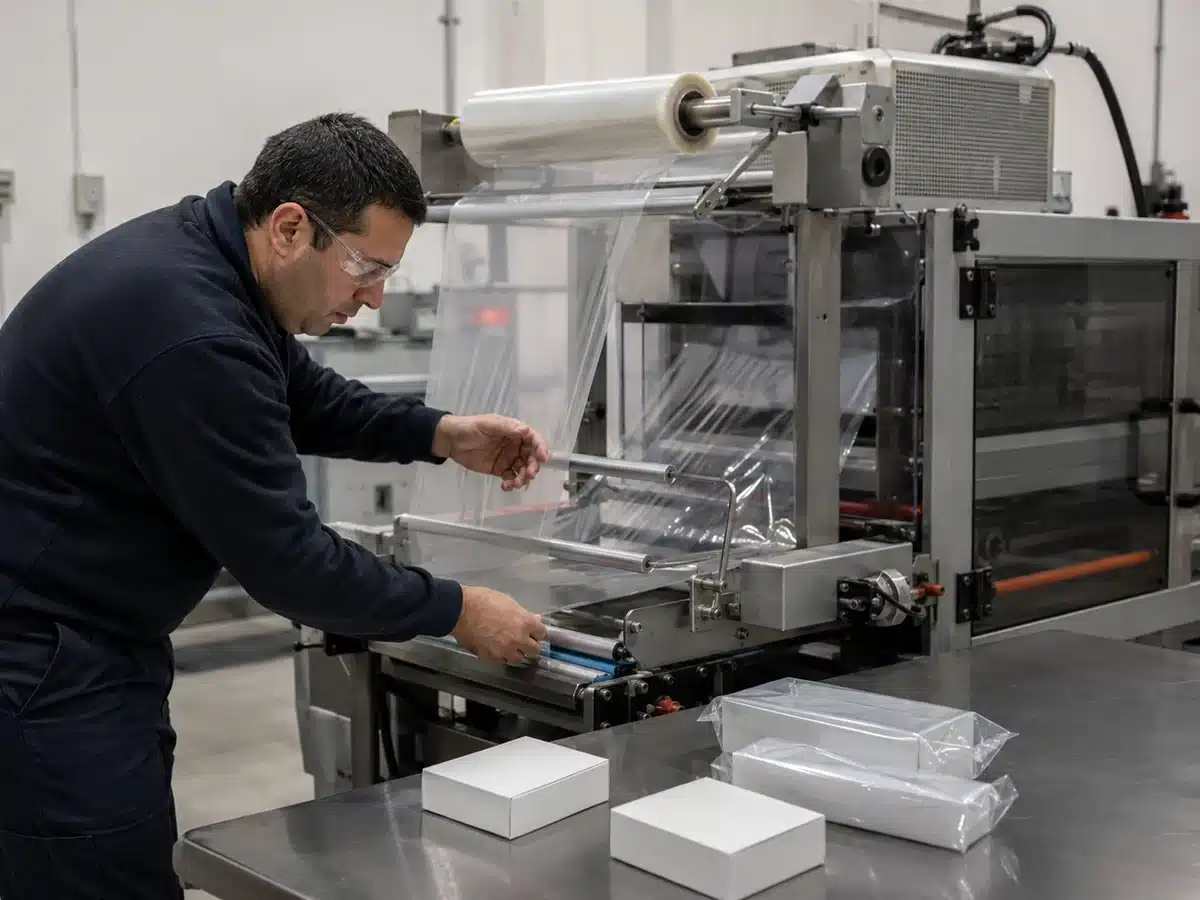
A laboratory property and a production result answer different questions. Standards let teams compare defined properties under defined conditions. A line trial reveals how the supplied roll, machine settings, product, operators, and environment interact.
Match each property to a method and condition
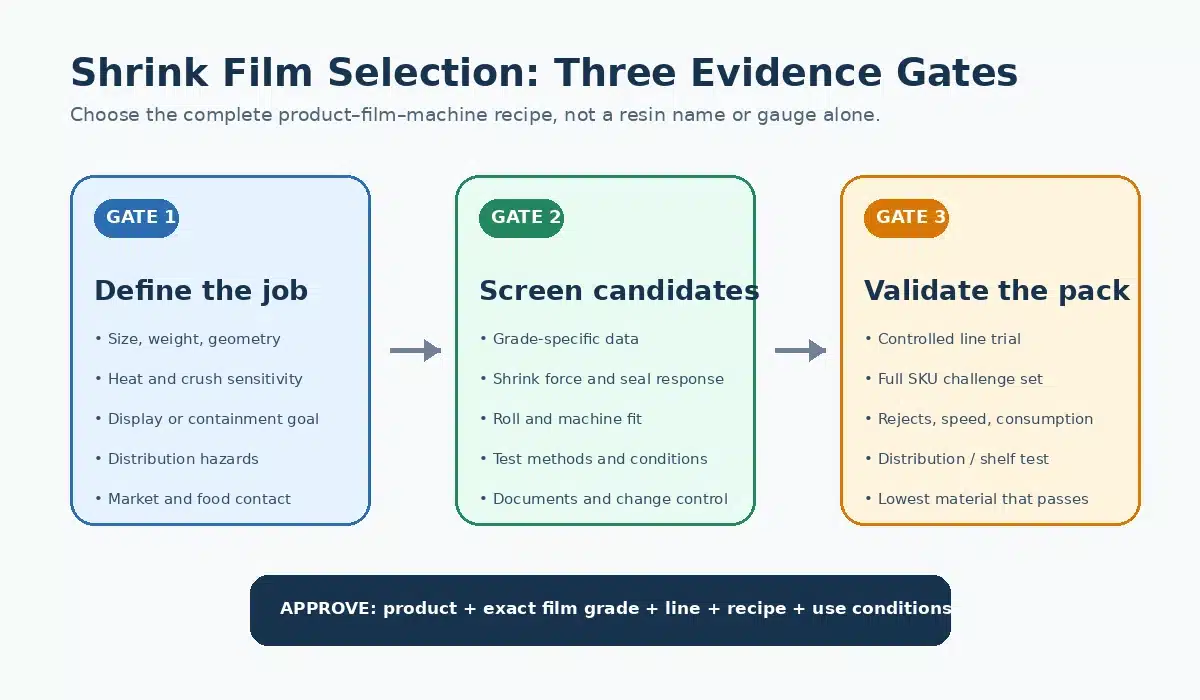
The current ASTM plastics catalog lists D2732-14(2025), D2838-18(2026), and D882-26. ASTM F88/F88M-23 covers seal strength for flexible barrier materials.
| Evidence | What it characterizes | What must accompany the result |
|---|---|---|
| ASTM D2732 | Unrestrained linear thermal shrinkage | Edition, specimen direction, temperature, exposure and conditioning |
| ASTM D2838 | Shrink tension, shrink force, orientation-release stress | Edition, procedure, restraint, temperature, thickness and direction |
| ASTM D882 | Tensile properties of thin plastic film/sheeting | Edition, specimen geometry, direction, conditioning and test rate |
| ASTM F88/F88M | Force to separate a sealed strip and failure mode | Edition, specimen width, technique, grip setup, rate and failure mode |
| Supplier datasheet | Typical or limiting values for one named grade | Grade, gauge, method, units, conditions, revision date and disclaimer |
Datasheets often say that values.
Run a controlled qualification trial
- Freeze the input: exact grade, form, gauge, width, roll build, lot, product SKU, orientation, and environmental conditions.
- Record the machine: wrapper and tunnel identifiers, forming parts, seal technology, perforation, tunnel-zone settings, air controls, and conveyor speed.
- Define the window: use the supplier and OEM guidance to set safe starting conditions; change one controlled factor at a time.
- Measure operations: sustained good packs per hour, film use per accepted pack, scrap, jams, roll-change time, and interventions.
- Inspect packages: seal continuity and failure mode, wrinkles, dog-ears, burn-through, holes, product distortion, clarity, and agreed dimensions.
- Challenge the range: run relevant product and process extremes, not only the easiest SKU at nominal conditions.
- Approve the callout: retain the sample, settings, observations, acceptance decision, and change-control requirements.
Kallfass recommends trial batches and fine-tuning for seal integrity, shrinkage, appearance, speed, film use, and product protection. The trial should produce your acceptance evidence; this article cannot supply universal limits for it.
RFQ Checklist for Shrink Film Rollstock
Send enough information for the supplier to quote the same problem you intend to solve:
- product dimensions, tolerances, weight, orientation, surface and edge profile;
- wrapper, former, sealer and tunnel make/model, plus film-path and roll limits;
- current film label or datasheet, current roll callout, settings, and observed failure modes;
- required good packs per hour, changeover pattern, SKU range, shift schedule and handling method;
- target roll form, or permission for the supplier to recommend one with reasons;
- package appearance, protection, seal-position and heat-sensitivity requirements;
- storage, distribution and compliance conditions, with the destination market identified;
- annual volume, trial quantity, delivery location and required date.
Ask the supplier to return:
- the exact grade, construction, form, gauge, width convention and tolerances;
- roll length or weight, core ID, OD, gross weight, wind, perforation and splice policy;
- a current technical datasheet with test methods, conditions, units and typical-versus-limit status;
- roll labels, lot traceability, certificate or inspection-document options, and storage guidance;
- MOQ, lead time, stock/custom status, trial-roll details and technical support plan;
- written notice requirements for changes to grade, structure, gauge, additives, site, process or roll build.
Documentation makes quotations comparable and supports traceability. It does not replace the application trial or create evidence of a supplier capability that has not been verified.
Frequently Asked Questions
Is centerfold film twice its stated width when opened?
Commonly, yes—when the supplier states the folded width. A 500 mm folded web would then open to approximately 1,000 mm. Confirm the convention on the quotation and roll label; do not infer package fit from that doubling alone.
Is “single wrap” the same as single-wound film?
Not reliably. “Single-wound film” or “flat film wound on a core” is the clearer roll-form description. If “single wrap” means something else in your plant, define the web geometry and seal path in the RFQ.
Can centerfold film run on a side-seal machine?
Sometimes. It depends on the specific machine’s web path, guides, seal technology, trim handling, width, core, OD and control setup. Verify the OEM documentation and run the proposed roll rather than relying on the category name “side sealer.”
When should I use shrink tubing instead of centerfold?
Consider tubing when a continuous sleeve and variable cut length simplify the package, and when the product can be inserted through an open end without damage or excessive labor. Verify layflat clearance, end-seal design, venting and loading ergonomics on the real product.
Are POF, PVC and PE available in all three roll forms?
Do not assume they are. Availability varies by supplier, grade, gauge, width, order quantity and market. Ask for the exact construction and form, then confirm that the quoted grade has the required technical and compliance documentation.
What should I send a supplier before requesting samples?
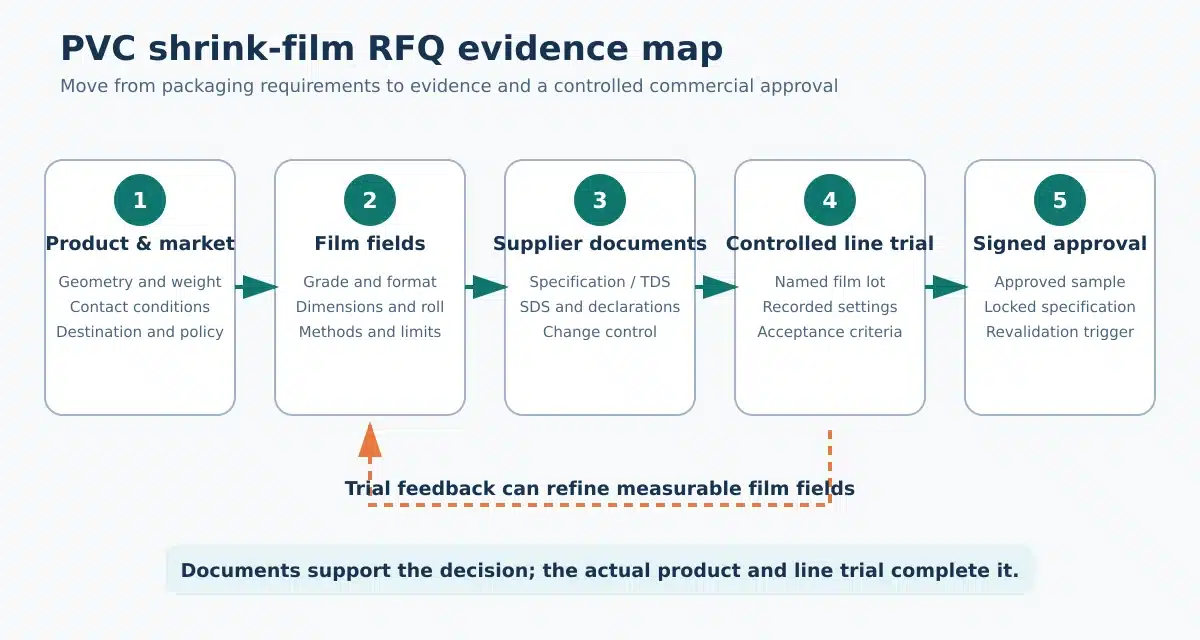
Send product dimensions and orientation, photos or drawings, machine models and roll limits, current film information, failure examples, target output, package requirements and the intended market. Ask the supplier to label the sample with its complete callout and to propose starting conditions and trial criteria without treating them as production approval.
 English
 Japanese
 French
 Spanish
 Korean
 Italian
 Portuguese
 Dutch
Dutch Arabic
 Russian
 German