
The best cold-chain packaging solution for food is not a single box, film, or coolant. It is a qualified system built around the food’s acceptable condition, the distribution lane, the expected exposure time, and the physical hazards of handling. A defensible design coordinates the primary food package, insulation, refrigerant or active cooling, outer protection, monitoring, and operating instructions. Buyers should therefore compare complete pack-outs and their evidence, then verify the selected configuration with representative food, loads, routes, seasons, and acceptance criteria.
What Cold Chain Packaging Must Do for Food
For regulatory context, consult the U.S. FDA’s food-packaging guidance before approving an intended food-contact use.
Cold-chain packaging must preserve an environment in which the food remains within its defined safety and quality limits while the shipment is stored, handled, and transported. Temperature control is central, but it is not the only job. The system must also contain the food, resist leakage and contamination, tolerate compression and impact, manage condensation, and remain practical for packing, labeling, transport, receiving, and disposal or return.
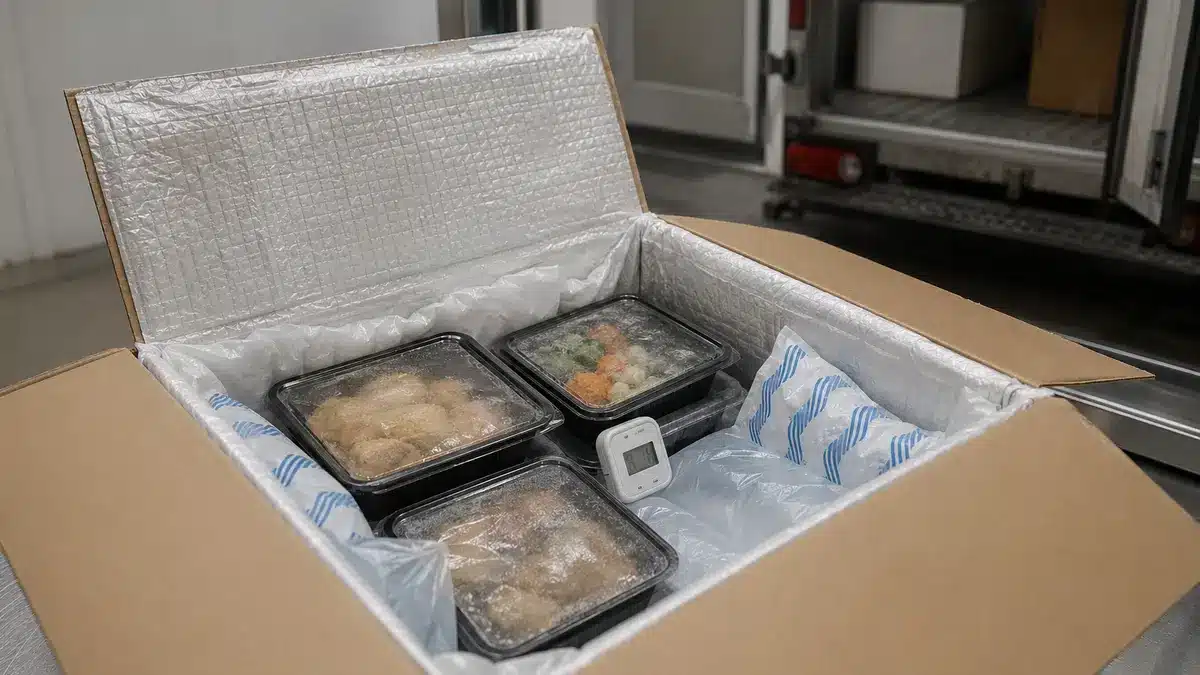
An insulated carton is not the whole solution. Heat enters through walls, joints, openings, and handling events. Refrigerant position can create hot or cold zones, while low temperature may change primary-package stiffness and seal behavior. A thermal pass cannot correct an open seal, and a durable pouch cannot correct an unsuitable thermal design.
The control target must come from the food and process. A chilled ready-to-eat product, fresh produce, frozen seafood, and an ingredient shipped for further processing can have different limits and different consequences of an excursion. Codex describes the cold chain as continuity from receiving through processing, transport, storage, and retail, while the FDA sanitary transportation rule addresses practices such as inadequate refrigeration, sanitation, and protection during transport. Neither source supplies a universal pack-out. The shipper still has to define the food-specific limits and prove that the operating system can maintain them.
Start With the Food and Distribution Lane
A useful specification starts with a design basis, not a material list. It defines the required condition, duration, route, handling, and success criteria. Without these inputs, unlike supplier systems can appear comparable.
Define the Product Condition and Acceptance Criteria
Record whether the food is chilled, frozen, or under another controlled condition, and which limits protect safety, quality, or both. Use the validated process, hazard analysis, shelf-life work, customer requirements, and applicable market rules—not a generic label.
The packaging team also needs the product’s starting condition, load mass, pack dimensions, headspace, orientation, and sensitivity to freezing, thawing, dehydration, oxygen, moisture, light, odor transfer, or crushing. If the primary package contacts food, the intended food type, contact time, and temperatures—including filling, storage, transport, and any later heating—belong in the regulatory evidence request. The FDA food-contact overview and the consolidated EU Regulation 10/2011 make clear why the actual material, component, and intended conditions matter.
Acceptance criteria should distinguish product temperature, air temperature, package integrity, appearance, leakage, and remaining shelf life. A data logger reading within the target band does not by itself show that every seal remained intact or that the food retained the required quality. Each result needs its own method and decision rule.
Map Duration, Ambient Exposure, and Handling Hazards
Design time is longer than the carrier’s advertised transit time. It can include pre-packing, staging, collection, sorting, customs, weekend delay, last-mile delivery, and the time before the receiver opens or transfers the product. Seasonal exposure, sunlight, hot or cold docks, vehicle set points, door openings, and load position can all change the thermal burden.
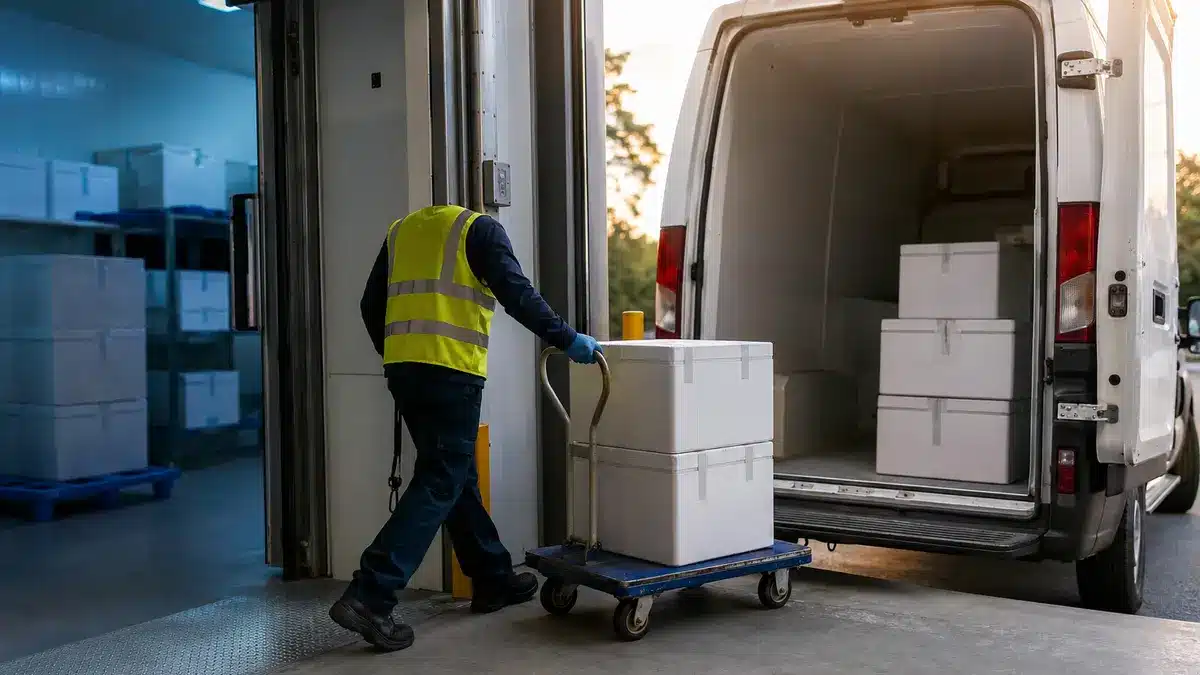
Use a lane matrix to connect operating conditions with packaging evidence:
| Design input | Questions to document | Packaging implication | Evidence to request |
|---|---|---|---|
| Product and starting condition | What is packed, at what initial condition, and with what load mass? | Defines thermal mass, payload layout, and direct-contact risks | Product specification and approved packing condition |
| Route and duration | Which modes, hubs, delays, and handoffs are realistic? | Sets the exposure profile and contingency time | Lane history, carrier plan, and seasonal assumptions |
| Ambient exposure | What hot and cold extremes, docks, or sun loads are credible? | Drives insulation, refrigerant, and orientation trials | Measured lane data or a justified test profile |
| Physical handling | Will the pack face drops, vibration, stacking, puncture, or leakage risk? | Defines outer protection and package-integrity tests | Distribution test plan and acceptance criteria |
| Receiving process | Who reads the monitor, inspects the pack, and decides disposition? | Determines device placement, instructions, and deviation workflow | Receiving SOP and decision record |
Air shipments add mode-specific requirements. IATA notes that perishable shipments need appropriate identification and that shipments using dry ice require the relevant dangerous-goods marking and rules. Those requirements should be mapped before the coolant and package are finalized, not discovered after a pack-out has passed a chamber test.
Build the Packaging System by Layer
Cold-chain performance depends on several packaging levels doing different jobs. The most reliable specifications state which level owns each function and how the levels interact.

Primary Packaging Protects the Food
Primary packaging directly contains or contacts the food. Depending on the format, it may need to provide containment, seal integrity, puncture resistance, oxygen or moisture control, light protection, aroma retention, tamper evidence, and compatibility with filling, vacuum, gas flushing, freezing, thawing, reheating, or retail display.
A material family alone cannot prove these functions. Performance varies with grade, orientation, thickness, layer order, additives, adhesives, printing, converting, sealant, and conditioning. Food-contact status is tied to the finished materials and intended use. Buyers should request the complete structure, applicable documents, and representative package data.
The primary pack also influences thermal behavior. Air-filled headspace, trays, absorbent pads, product geometry, and pack orientation affect heat transfer and refrigerant contact. Leakage can wet insulation or corrugated board, while sharp bones, frozen corners, or rigid product edges can challenge a flexible film during handling.
Secondary and Tertiary Packaging Protect the Pack-Out
Secondary packaging groups units and.
These levels need compatible dimensions and load paths. Excess void permits movement and convection; over-compression can damage insulation, block airflow, deform the primary pack, or move coolant. A wet or crushed outer can lose handling strength even if insulation remains thermally capable.
The operating design should therefore specify the complete bill of materials component orientation payload position number and condition.
Compare Passive, Active, and Hybrid Temperature Control
Passive, active, and hybrid systems solve the same problem through different operating models. Compare them on the lane, payload, failure modes, infrastructure, reuse process, and evidence—not on insulation material or purchase price alone.
When Passive Packaging Fits
A passive system uses insulation and conditioned refrigerants without powered temperature regulation inside the shipper. It can be practical for parcel or pallet shipments with defined duration, repeatable packing, qualified profiles, and limited need for intervention during transit. It has no compressor or battery to operate, but its performance depends heavily on component conditioning, pack-out accuracy, closure, orientation, payload, and exposure.
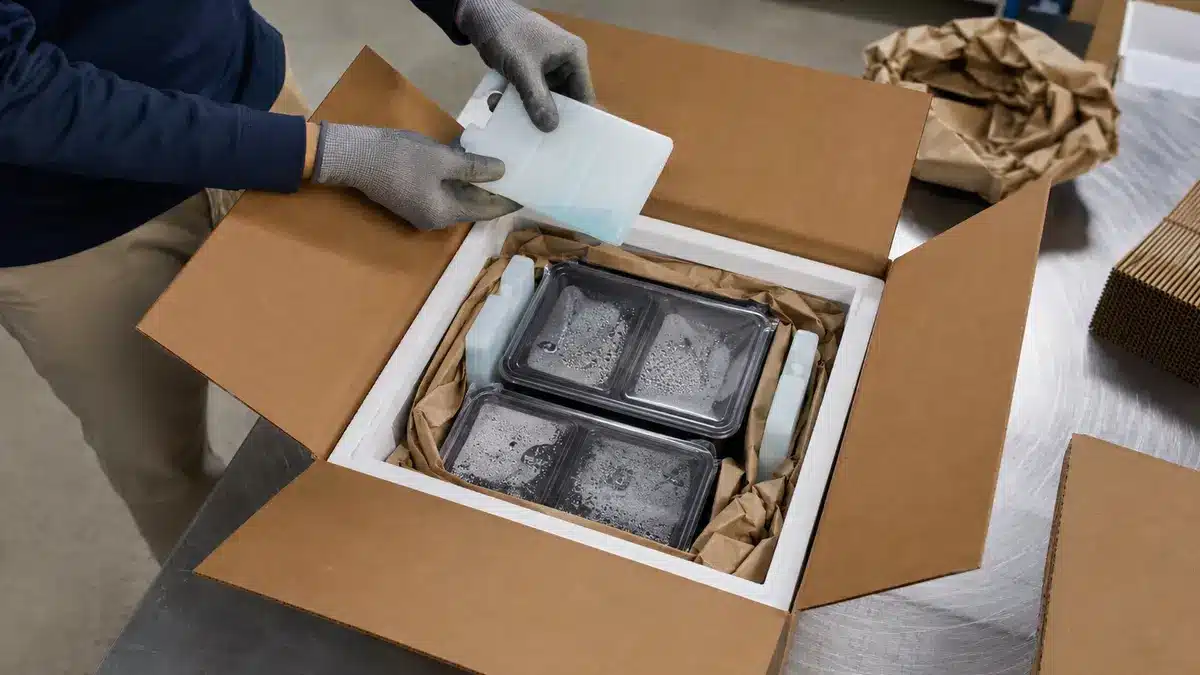
Passive systems are not automatically simple. Seasons or payload sizes may require separate configurations, and tolerance to normal assembly variation matters.
When Active or Hybrid Control Is More Defensible
Active systems use powered refrigeration, heating, or controlled containers. They may fit long or variable routes, large loads, or repeated access, but introduce power, maintenance, calibration, airflow, alarm, and contingency dependencies. Hybrid systems add passive protection for vulnerable handoffs or emergency hold time; their interfaces must be defined and tested.
| Comparison dimension | Passive system | Active system | Hybrid system |
|---|---|---|---|
| Temperature control | Stored thermal capacity and insulation | Powered regulation in the controlled space | Powered control plus passive protection for selected legs |
| Key design dependency | Conditioning and repeatable pack-out | Equipment capability, power, airflow, and maintenance | Interface between active and passive segments |
| Typical operational risk | Assembly error or exposure beyond qualified duration | Power, alarm, set-point, or equipment failure | Handoff error and incompatible procedures |
| Qualification focus | Complete pack-out under justified profiles | Loaded equipment, airflow, control, alarms, and route use | Each segment plus the transfer between them |
| Cost question | Cost and waste per successful shipment | Equipment, service, repositioning, and utilization | Added complexity versus risk reduction |
No row declares a universal winner. The best choice is the system whose risks can be controlled, documented, and economically repeated for the actual lane.
Select Insulation and Refrigerants as a System
Insulation slows heat flow; refrigerants absorb heat or hold a defined phase-change condition. Neither component should be selected in isolation, because their interaction with payload mass, geometry, ambient profile, and pack-out arrangement determines the temperature history.
Match Insulation to the Thermal and Physical Design
Common insulated shippers use foams.
Thin insulation can increase payload space yet puncture or poor fit can reduce performance Molded insulation offers repeatable geometry but may consume storage volume Flexible liners depend on correct folding and closure Reusable.
Compare insulation in the complete shipper using the intended payload, coolant arrangement, closure, and external profile. Include physical tests when drops, vibration, stacking, moisture, or repeated use could alter the thermal configuration.
Choose Refrigerants With Conditioning and Transport Rules in Mind
Gel packs, ice packs, phase-change materials, and dry ice serve different conditions. Specify phase behavior, conditioning tolerance, dimensions, placement, food separation, and transport mode. “More coolant” changes weight, gradients, payload space, cost, and local-freezing risk; it is not a design rule.
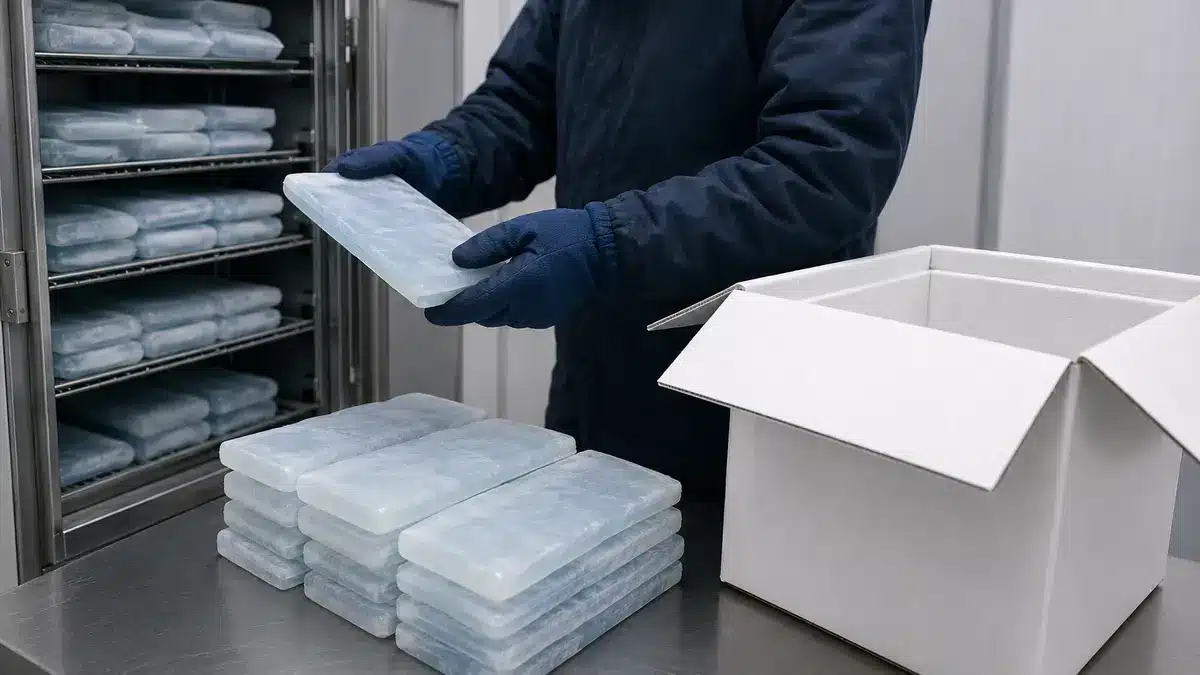
Dry ice can support frozen.
Important: Refrigerant conditioning is part of the validated configuration. A pack conditioned at a different temperature, placed in a different orientation, or substituted by mass alone may create a different thermal result.
The final pack-out should define who conditions the refrigerant, how the condition is verified, the allowable staging time, the exact placement sequence, and what to do when a component is missing or outside specification.
Protect Package Integrity in Cold Conditions
Cold conditions can change stiffness and seal behavior. Handling concentrates stress at folds, corners, closures, and product edges; a crack, channel, or puncture can cause leakage, contamination, dehydration, barrier loss, or weakening of the outer pack.
Validate Toughness, Seals, Barrier, and Leakage Control
Test the finished primary package, not just a film specimen. Representative samples should include the actual structure, thickness, print and laminate construction, sealant, closure, fill product or justified simulant, headspace, and production sealing conditions. Conditioning should reflect the intended cold exposure before drop, compression, vibration, flexing, puncture, leakage, or seal evaluations.
The test plan should separate distinct questions:
- Low-temperature toughness asks whether the material and formed package resist cracking, flex damage, and puncture under representative conditioning.
- Seal evaluation asks whether the production seal remains continuous and strong enough after filling, cooling, handling, and distribution.
- Leakage or integrity testing asks whether the complete package maintains containment under the selected method and detection limit.
- Barrier testing asks for oxygen or water-vapor transmission under a stated method, temperature, humidity, thickness, test side, and unit.
- Food-contact review asks whether every relevant component and intended use condition is covered for the target market.
Do not compare OTR, WVTR, seal strength, or puncture values across different methods and conditions as if they were equivalent. A high film value also does not prove a formed pouch, tray, lid, valve, or closure will pass. The package-level result must be tied to the sample description and test conditions.
Condensation deserves separate attention. Moisture can reduce corrugated strength, lift labels, blur instructions, promote slip, or enter an absorbent component. Leakage from the food must not be confused with condensation from the thermal system; the response and root cause are different.
Qualify, Monitor, and Control the Pack-Out
Qualification shows what a defined configuration can do under a defined challenge. Operating control keeps later shipments close enough to that qualified configuration for the evidence to remain relevant. Both are necessary.
Separate Thermal Qualification From Distribution Testing
ISTA Standard 7E provides science-based heat and cold profiles for.
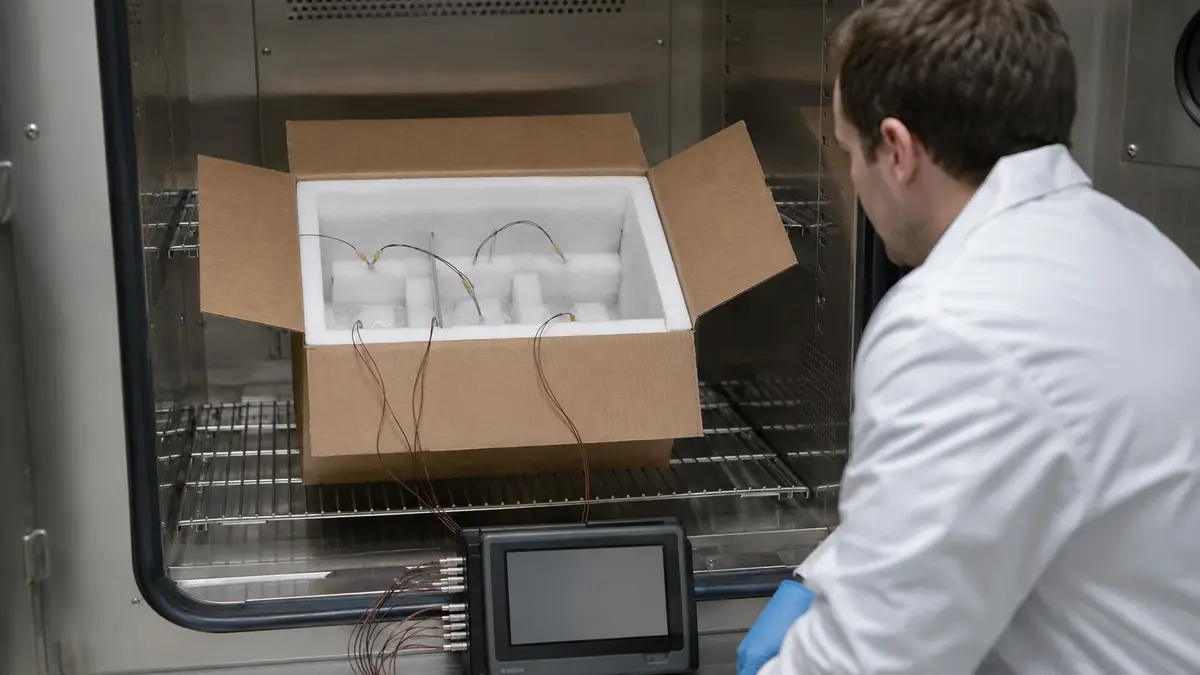
Thermal qualification and physical distribution testing answer different questions. Thermal work measures temperature behavior; distribution testing challenges the packaged product with relevant drops, vibration, compression, shock, orientation, or handling. When the hazards interact, sequence or combine conditioning and physical testing so the final inspection reflects the real risk.
A disciplined program follows this order:
- Freeze the design basis, bill of materials, payload, pack-out instructions, and acceptance criteria.
- Verify incoming components and refrigerant conditioning before assembling test samples.
- Instrument the payload at justified hot and cold risk locations, not only at the easiest point to reach.
- Run the thermal profile and physical distribution challenges defined by the protocol.
- Inspect temperature records, primary package integrity, leakage, seals, product condition, and outer-package damage against separate criteria.
- Document deviations, root causes, retest decisions, and the exact configuration that passed.
One successful test should not be generalized to untested seasons, payloads, routes, or substitutions. The evidence belongs to the tested configuration.
Control Pack-Out, Monitoring, Receiving, and Deviations
Convert the passed configuration into.
Monitoring should match the decision. A time-temperature indicator may answer a threshold question; an electronic logger provides a trace. Accuracy, calibration, response time, position, start/stop method, and data ownership affect interpretation. Air, package-space, and food temperatures are not interchangeable.
Warning: A monitor alarm is a prompt for a defined assessment, not automatic proof that food is unsafe or acceptable. Disposition should follow the product’s deviation procedure, exposure history, hazard analysis, and qualified authority.
At receipt, personnel need instructions for inspection, temperature-data retrieval, quarantine, escalation, and record retention. These steps close the loop between packaging evidence and real shipments.
Create an RFQ and Change-Control Record
An effective RFQ lets suppliers respond to the same design basis and separates proposed performance from verified evidence. It should request:
- Food category, pack format, fill process, product starting condition, target condition, acceptance criteria, and shelf-life context.
- Primary package structure, dimensions, load mass, case count, headspace, closure, and known leakage, puncture, barrier, or condensation risks.
- Origin, destination, transport modes, service level, route duration, seasonal ambient assumptions, hubs, customs, weekends, and contingency time.
- Passive, active, or hybrid operating constraints, including power, return logistics, pack-out labor, refrigerant conditioning, dry-ice restrictions, and carrier rules.
- Proposed bill of materials, component tolerances, assembly sequence, payload capacity, monitor position, and closure method.
- Thermal and distribution test protocols, sample descriptions, profiles, sensor locations, acceptance criteria, reports, deviations, and configuration traceability.
- Food-contact and market documents for the actual finished materials and intended conditions of use.
- Unit cost, freight weight and cube, packing time, damage or excursion risk, disposal or reuse process, and the basis for any sustainability claim.
The change-control record should identify what triggers review or requalification. Typical triggers include a new food or fill weight, different starting condition, route or carrier, longer duration, seasonal profile, component supplier, material structure, thickness, coolant, pack size, monitor, pack-out sequence, manufacturing process, or acceptance criterion.
A documented risk assessment can decide whether existing evidence remains applicable, limited confirmation is enough, or full requalification is needed. An uncontrolled substitution based only on a similar material name, dimension, or price is not defensible.
Frequently Asked Questions
What Is the Best Cold-Chain Packaging for Food?
It depends. The best solution is the lowest-risk, repeatable system that maintains the food’s defined condition and package integrity through the actual lane. Compare complete configurations using the same payload, exposure, hazards, operating constraints, acceptance criteria, and total cost. No component is “best” without qualification evidence.
Can Insulated Packaging Replace Refrigerated Transport?
Sometimes, for a defined shipment. A qualified passive shipper may cover a parcel or last-mile lane without a refrigerated vehicle. Do not extend that conclusion beyond the tested route, duration, exposure, payload, contingency, and operating procedure.
When Should a Food Shipment Use Dry Ice?
Dry ice may fit a frozen product when the package, route, carrier, and receiving process are designed for it. It can overcool chilled food and affect materials. Check current dangerous-goods, ventilation, marking, quantity, and carrier requirements for the mode, then qualify the actual pack-out.
Does a Thermal Test Prove the Food Package Is Safe?
No. A thermal test can show temperature performance for the tested configuration and protocol. Food safety also depends on the product process, hazard controls, primary-package integrity, sanitation, actual exposure, and regulatory responsibilities. Package leakage, seal failure, contamination, or an unsuitable food-contact component can remain a problem even when logged temperatures meet the thermal acceptance criteria.
What Should Trigger Cold-Chain Packaging Requalification?
Any change that could alter heat flow, payload temperature, component performance, pack-out repeatability, physical protection, monitoring, or lane exposure should be assessed. Examples include material or supplier changes, new dimensions, payloads, refrigerants, routes, seasons, carriers, pack-out instructions, production processes, or acceptance criteria. Document the risk assessment and the reason for confirmation testing or full requalification.
Related Bestypack Resources
- The Ultimate Guide: All Types of Foam Packaging
- Flexible Food Packaging A Guide to What You
- What Are the Different Types of Common Insulation Packaging?
- Heat Sealable Film Guide: Applications, Types, Functions
- CPP Films: Optimal Flexible Packaging Solutions
- The Difference Between Polyolefin, PVC and Polyethylene
- Ultimate Guide to BOPE Film: Benefits, Applications, Types
 English
 Japanese
 French
 Spanish
 Korean
 Italian
 Portuguese
 Dutch
Dutch Arabic
 Russian
 German