
Foam packaging is not one material. It is a family of cellular materials and package formats used to cushion, block, brace, protect surfaces, fill voids, or control heat transfer. The right choice depends on the product’s damage modes, mass, geometry, distribution route, reuse plan, and recovery options—not on a resin name or density alone. Buyers should shortlist candidates, request condition-specific data, build prototypes, and test the complete packaged product before releasing a design.
What Foam Packaging Is—and What It Cannot Prove
For test and specification context, review ISO’s packaging-material standards and record the exact method, conditions, direction, and units.
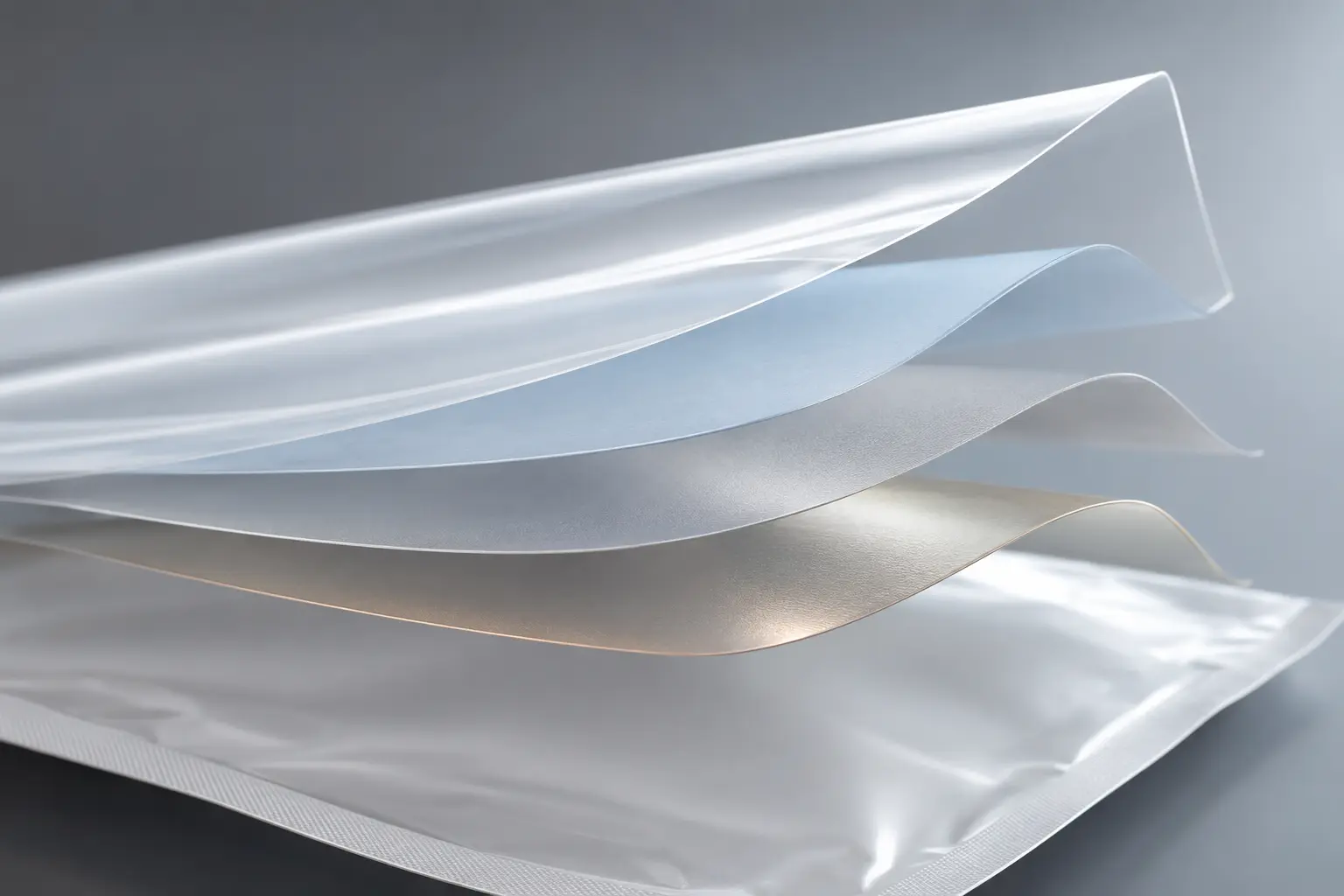
Foam packaging places a compressible cellular layer between a product and the hazards it may encounter. Depending on its geometry, the foam may absorb some shock energy, reduce product movement, spread a load over a larger area, prevent abrasion, or help slow heat transfer. A complete pack may combine several of these functions: a molded end cap can locate an appliance, a soft pad can protect a finish, and an insulated wall can support a temperature-control strategy.
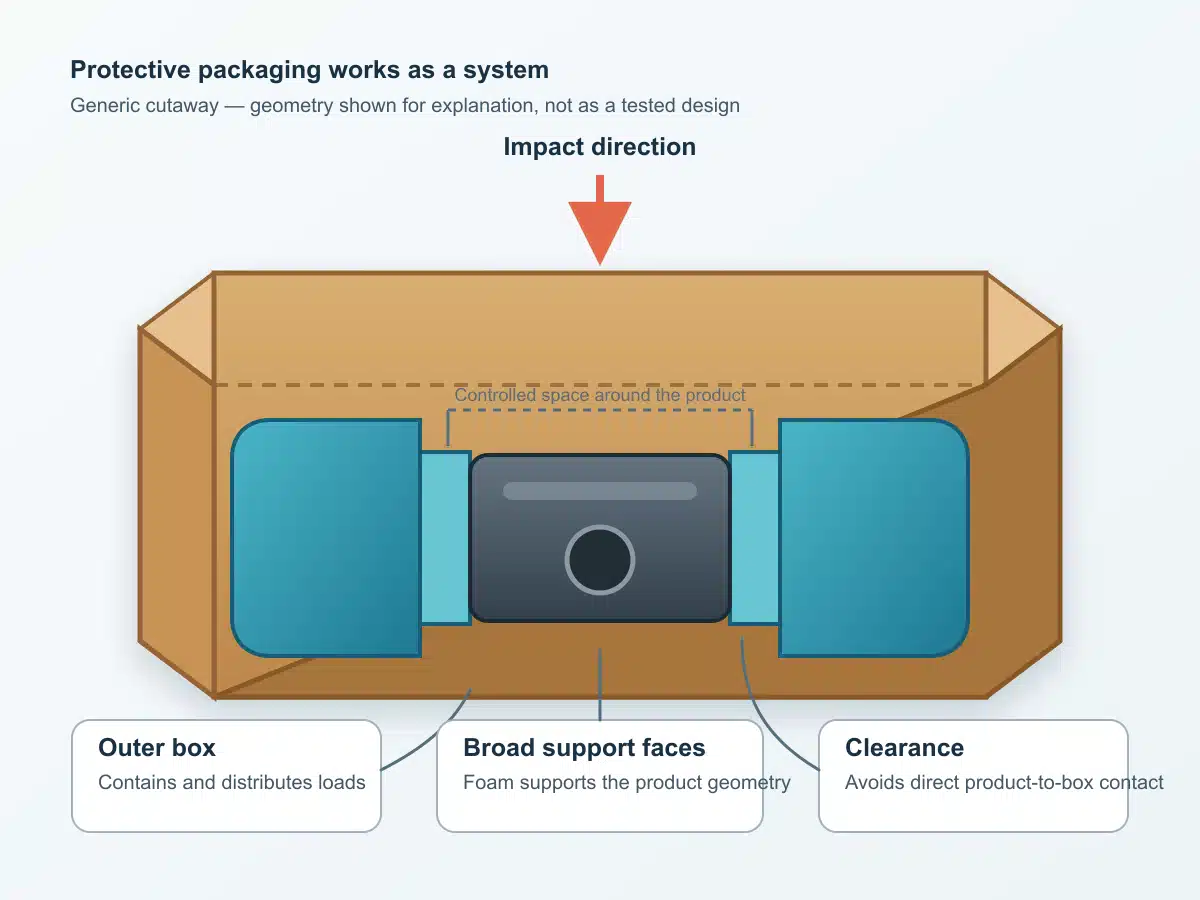
These functions are related, but they are not interchangeable. A material that resists compression may be too stiff for a fragile lightweight product. A soft foam that prevents scratches may not control a severe drop. Thermal insulation data do not establish the duration of a cold-chain shipper, and an antistatic color does not prove an electrical-resistance classification.
Material-family descriptions are therefore screening tools. They help a team decide which samples and data to request. They do not establish that a particular grade, thickness, contact area, or package will protect a product in a defined route. ASTM D1596 explicitly limits dynamic cushioning results to the material and test conditions used; package geometry and other variables can change the transmitted shock. The final design decision belongs to a documented product-package validation program.
Important: Do not approve a foam design from a generic material label, density, or marketing claim. Connect the exact grade and construction to the product, package geometry, distribution hazards, acceptance criteria, and test evidence.
The Three Axes of Foam Packaging: Resin, Cell Structure, and Format
Foam names often mix three different classification axes. Keeping them separate makes supplier discussions clearer and prevents false comparisons.
| Classification axis | What it describes | Examples | Why it matters |
|---|---|---|---|
| Polymer family | The base polymer or polymer system | PE, PU, PS, PP, EVA | Influences the range of possible mechanical, chemical, thermal, and converting behavior |
| Cell structure | How open or enclosed the cells are | Open-cell, closed-cell, reticulated | Influences airflow, liquid uptake, compression response, and surface feel |
| Supplied format | How the cushioning system is made and used | Sheet, plank, molded part, convoluted pad, loose fill, foam-in-place | Controls geometry, tooling, assembly, volume efficiency, and package-level behavior |
A fourth label may describe a function rather than a new base material. “Antistatic,” “conductive,” “flame-retardant,” and “bio-based” identify a formulation, treatment, or claim that needs its own evidence. Two visually similar PE foams may have different cell size, density, additives, crosslinking, surface behavior, and cushion curves.
Open-cell vs. closed-cell foam
Open-cell foams contain interconnected pores that allow air to move through much of the structure. Flexible polyurethane is a common packaging example. These foams can conform gently around irregular or delicate surfaces, but their response to compression, humidity, liquids, and repeated loading varies by grade.
Closed-cell foams contain cells that are largely enclosed. Many PE, EPP, EPS, XPS, and EVA products fall into this broad category. They often offer lower liquid uptake and a firmer response than flexible open-cell foams, but “closed-cell” is not a performance specification. Water resistance, recovery, stiffness, dimensional stability, and chemical compatibility still require grade-specific evidence.
Material family vs. functional treatment
A functional treatment should be written as a requirement attached to a material and test method For example ESD-sensitive electronics is a hazard static-dissipative foam with supplier-reported resistance tested under stated conditioning is a candidate.
Polyethylene Foam: PE, EPE, and XLPE
Polyethylene foam is widely fabricated into pads, trays, corner blocks, case inserts, sheet wrap, and laminated assemblies. EPE usually refers to expanded polyethylene, while XLPE refers to cross-linked polyethylene foam. Suppliers may also use brand or process names, so the commercial label should always be connected to a technical data sheet and a physical sample.
PE-family foams are commonly shortlisted when a package needs a relatively resilient closed-cell cushion, surface protection, moisture tolerance, or fabrication from sheet and plank. Crosslinking can produce a finer, more uniform appearance and different mechanical behavior, which may be useful for presentation packaging or precision-cut inserts. Those general tendencies do not make every XLPE grade stronger or every EPE grade more economical in the finished pack.
Typical advantages include clean fabrication, a range of firmness options, and the ability to laminate layers or combine the foam with corrugated board and other substrates. Limitations can include bulky storage, waste from subtractive cutting, permanent deformation after severe loading, and recovery pathways that depend on local collection and the finished construction.
Where PE-family foams fit
PE-family candidates are often evaluated for industrial components, electronics, instruments, reusable cases, appliances, and products with surfaces that must not rub against a corrugated wall. The package engineer still needs the product mass, bearing area, fragility or damage threshold, expected drop and vibration hazards, temperature range, surface compatibility, and required reuse cycles.
For a heavy item, a firmer grade may resist excessive compression; for a delicate light item, that same grade may transmit too much shock. Use cushion data at the intended thickness and static loading to select prototypes. Confirm that adhesives, cleaners, oils, coatings, and product surfaces are compatible rather than assuming compatibility from the PE name.
Polyurethane Foam: Flexible PU and Reticulated Variants
Flexible polyurethane foam is usually selected for softness, conformability, and its ability to support delicate shapes with relatively low contact pressure. It is commonly cut into case interiors, lid pads, convoluted sets, and inserts for instruments or display-sensitive products. An open-cell structure can also permit airflow, which distinguishes many flexible PU products from closed-cell PE candidates.
The trade-off is that flexible PU is not a single performance class. Firmness, density, compression set, recovery, cell size, airflow, humidity response, chemical resistance, and aging can differ substantially. A soft feel during hand inspection does not establish dynamic cushioning performance. Some grades may also retain particles, liquids, or odors in ways that matter for clean environments or presentation.
Reticulated polyurethane has a deliberately open skeletal structure. It is often used where airflow, drainage, filtration, or controlled porosity is part of the application. Those functions are not automatically packaging benefits; they should be tied to a specific product requirement.
Where PU foam fits
Flexible PU is often considered for lightweight or delicate equipment, optical or cosmetic surfaces, presentation cases, lid restraint, and irregular shapes that benefit from gentle conformity. It can be supplied as flat sheet, convoluted foam, die-cut parts, or machined inserts.
Before approval, check whether the product can tolerate direct contact, whether moisture or contaminants can enter the cells, how the foam recovers after repeated compression, and whether the cushioning response matches the expected static load. For medical, food, cleanroom, or controlled-emission applications, use an application-specific material file; a generic PU description cannot establish suitability.
Polystyrene Foam: EPS and XPS
Expanded polystyrene (EPS) is made by expanding and molding polystyrene beads. In packaging it commonly appears as molded end caps, corner blocks, insulated boxes, panels, or loose-fill shapes. Its rigid lightweight structure can locate a product, distribute compressive loads, provide cushioning within a designed load range, and contribute thermal insulation.
Extruded polystyrene (XPS) is made as a continuous closed-cell board or sheet and is usually cut or fabricated rather than bead-molded into a product-specific shape. It is more familiar in insulation applications but may be used in package components where its sheet form and thermal behavior fit the design.
EPS can be cost-effective at scale when molded geometry and tooling are justified. It can also fracture or shed particles under some handling conditions, take substantial storage volume, and be difficult to route through local recovery systems. XPS has different structure and fabrication economics; the terms should not be treated as interchangeable.
Molded protection, insulation, and design limits
A molded EPS part can integrate ribs, cavities, and load-bearing features that hold a product away from the outer box. That geometry can be as important as the foam itself. Thin sections, sharp transitions, unsupported projections, and concentrated loads may create weak points. Tooling changes also cost more than modifying a fabricated insert.
For insulated shipping, the foam is only one part of a thermal system. Wall thickness, joints, closure, payload, refrigerant, ambient profile, pack-out procedure, and shipment duration all influence performance. Material data cannot qualify a temperature-controlled shipper. Use a documented thermal test plan for the complete pack-out and route.
Note: The US EPA states that very few US curbside programs accept polystyrene foam. Availability differs by location, so a “recyclable” resin identity is not a sufficient end-of-life claim.
EPP, EVA, and Specialty Functional Foams
Some requirements point beyond PE, PU, and polystyrene. Expanded polypropylene (EPP), ethylene-vinyl acetate (EVA), and function-specific foams may be useful when the package must survive repeated impacts, provide a particular finish, control static electricity, or meet another documented condition.
EPP and EVA
EPP is a molded closed-cell polypropylene foam commonly considered for durable dunnage, returnable containers, automotive components, and other multi-cycle systems. It can recover after repeated loading better than many rigid single-trip candidates, but reuse is not automatic. The molded geometry, hinges or attachments, cleaning process, damage-inspection rule, reverse-logistics rate, and actual cycle count determine whether the system delivers value.
EVA foam is available across a broad range of firmness, color, texture, and formulation. It is often fabricated into display inserts, case interiors, seals, pads, and components that require a fine surface or controlled flexibility. The vinyl acetate content and formulation influence behavior, so “EVA” alone cannot establish chemical, thermal, cushioning, or compliance performance.
Antistatic, conductive, flame-retardant, and bio-based claims
Special functions require a complete claim record. For ESD control, define the protected device, packaging zone, target electrical-resistance range, conditioning, test method, and duration of performance. For flame behavior, identify the exact standard, specimen construction, thickness, orientation, and acceptance level. Do not infer either property from color or supplier category.
Bio-based content describes feedstock origin, not necessarily biodegradability or compostability. A compostable claim needs a recognized test framework, certification scope, target facility type, and access to a collection pathway. Flame-retardant, antimicrobial, food-contact, low-emission, and recycled-content claims likewise need grade-specific documents. Until that evidence is available, treat the feature as a procurement question, not an article conclusion.
Warning: Functional treatments can change cushioning, adhesion, aging, recovery, recycling, or surface-contact behavior. Revalidate the actual treated grade rather than applying results from an untreated base foam.
Common Foam Packaging Formats and Converting Methods
The same polymer can perform differently when supplied as a thin wrap, laminated block, molded end cap, convoluted lid pad, loose-fill piece, or foam-in-place system. Format selection affects tooling, labor, storage volume, tolerances, replaceability, and the way loads enter the cushion.
Fabricated, molded, loose-fill, and foam-in-place systems

| Format | Typical design value | Main qualification question | Important limitation |
|---|---|---|---|
| Sheet, plank, wrap | Fast sampling, layered builds, surface protection | Are thickness, seams, lamination, and contact area controlled? | Cutting can create scrap and assembled layers can shift |
| Die-cut or CNC-cut insert | Precise cavities and low-to-medium tooling commitment | Are minimum wall widths, tolerances, and orientation adequate? | A snug cosmetic fit does not prove shock protection |
| Molded part | Integrated ribs, corners, and repeatable high-volume geometry | Does tooling reproduce the validated geometry and density? | Design changes may require tool changes |
| Convoluted pad | Flexible restraint across varying shapes | Does peak geometry create acceptable contact and compression? | Point contact and compression set may vary |
| Loose fill | Void filling for mixed shapes | Is the product prevented from migrating through the fill? | Settlement, dust, and inconsistent placement can reduce control |
| Foam-in-place | Conforms around complex or variable products | Are mixing, expansion, film, box, cure, and operator steps controlled? | Process variability affects the finished cushion |
Foam-in-place deserves separate treatment because it is formed inside the package. ASTM D4168 evaluates the film, foam, and box together as used. That package-level approach should not be replaced by data for an unrelated prefabricated foam specimen.
How to Choose Foam Packaging for a Real Product
A reliable selection process starts with the product and route, not a favorite material. The goal is to eliminate unsuitable candidates, request comparable evidence, and prototype a small number of defensible systems.
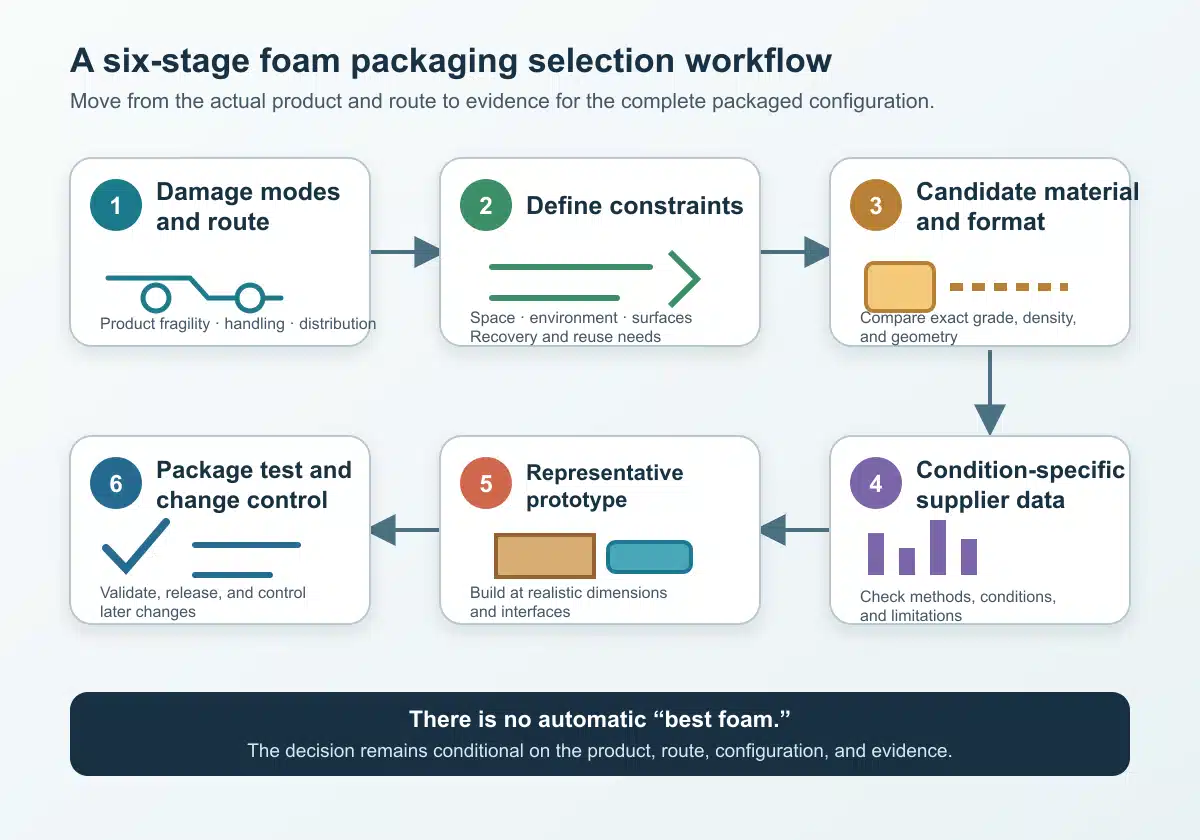
Start with damage modes and distribution hazards
| Input | Questions to answer | How it changes the shortlist |
|---|---|---|
| Product fragility | What fails first: alignment, glass, solder joints, housing, finish, seal, or calibration? | Establishes allowable shock, vibration, abrasion, and compression limits |
| Mass and bearing area | How is weight carried in each likely package orientation? | Determines static loading on each cushion face |
| Distribution route | Parcel, pallet, air, ocean, courier, returnable loop, or mixed route? | Defines likely drops, vibration, compression, handling, and climate |
| Surface and cleanliness | Can the product tolerate particles, rub, plasticizer transfer, moisture, or odor? | Screens cell structure, fabrication, liners, and contact materials |
| Temperature and chemicals | What temperatures, cleaners, oils, adhesives, or refrigerants are present? | Requires compatibility and conditioning checks |
| ESD or regulated use | Is there an electrical, food-contact, medical, or flame requirement? | Requires grade-specific methods and documentation |
Do not turn this matrix into an automatic material answer. Each row supplies constraints. A candidate remains on the shortlist only when the supplier can provide relevant data and a prototype can be tested.
Translate requirements into a supplier brief
Use a consistent brief so suppliers respond on the same basis:
- Describe the product, mass, dimensions, center of gravity, sensitive surfaces, and permitted support points.
- State known damage modes, fragility information, and acceptance criteria. Mark estimates as estimates.
- Describe the shipping unit, orientation, route, handling method, climate, stacking, and expected reuse cycles.
- Request the exact polymer family, grade, density, cell structure, thickness, tolerances, fabrication method, and conditioning requirements.
- Request cushion curves or compression data at relevant thicknesses, static loads, drop conditions, and repeat-impact sequence. Ask for the method and specimen details.
- Identify ESD, cleanliness, chemical, thermal, food-contact, flame, recycled-content, or end-of-life documentation that applies to the actual grade.
- Agree on prototype quantities, inspection criteria, test procedure, sample conditioning, failure definition, change control, and production verification.
The brief should also identify what a supplier response does not prove. A resin declaration does not establish package performance; a cushion curve does not establish a complete shipping system; and a successful laboratory sample does not authorize uncontrolled changes to density, source, geometry, adhesive, or processing.
From Cushion Curves to Packaged-Product Validation
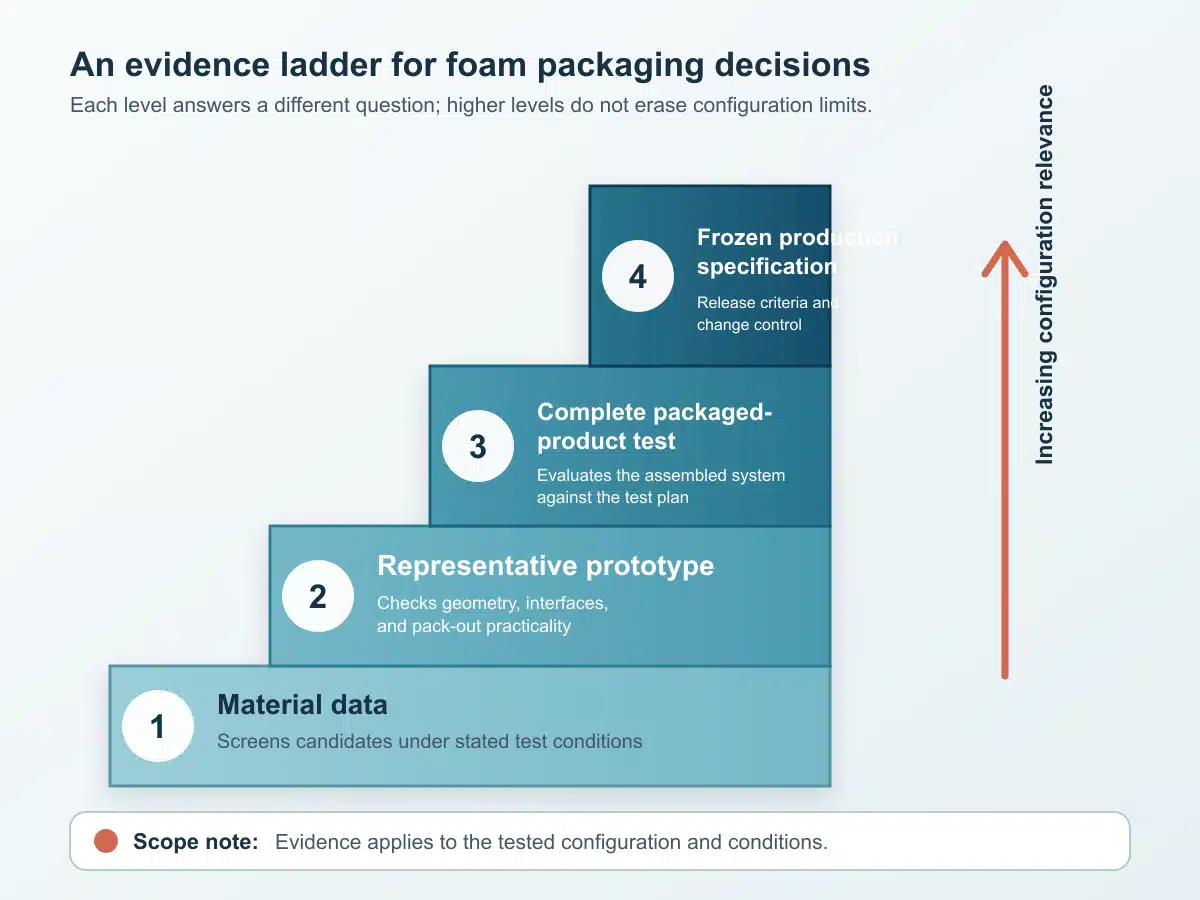
Foam selection moves through an evidence ladder. Each step answers a different question, and no step should be promoted beyond its scope.
What a cushion curve can tell you
A dynamic cushion curve relates.
When reviewing a curve, confirm the exact grade, density, thickness, drop height or input severity, static load range, number and order of impacts, temperature and humidity conditioning, and whether the first drop is treated separately from later drops. Do not digitize an unlabeled marketing graph and treat it as a design guarantee. If conditions differ from the project, request new data or test samples.
Prototype and test the complete package
Use a staged validation chain:
- Characterize the product. Record dimensions, mass properties, sensitive components, surface constraints, operating checks, and failure criteria.
- Characterize candidate materials. Verify grade identity, dimensions, tolerances, conditioning, cushion or compression behavior, and any functional treatment.
- Build representative prototypes. Use production-intent geometry, outer packaging, seams, adhesives, films, closures, payload, and assembly instructions.
- Select the distribution test. Match the procedure and intensity to the actual route. ISTA advises understanding how packages are shipped, handled, and stored before selecting a test.
- Run the agreed sequence. ASTM D4169 provides a distribution-cycle framework for evaluating a shipping unit through sequential hazards; other procedures may fit parcel, unitized-load, or custom environments.
- Inspect product and package. Apply predefined acceptance criteria, document transmitted events when instrumented, and record both product damage and cushion deformation.
- Close the loop. Correct the design, repeat affected tests, freeze the validated bill of materials and geometry, and define production-change controls.
Passing a laboratory procedure is evidence for the tested configuration and acceptance criteria. It is not a universal certification for every product, route, payload, or manufacturing change.
Sustainability, Reuse, and End-of-Life Reality
Sustainability decisions should begin with the required protection. A lighter pack that increases damage and replacement shipments may not improve the total system. After meeting performance, compare material mass, package cube, production waste, reuse cycles, transport efficiency, recycled content, and realistic recovery routes using documented assumptions.
Reuse can be valuable when the foam retains function, returns at a high rate, can be inspected or cleaned, and avoids more single-trip material than the return loop consumes. A reusable EPP tote that never returns is not a reuse system. A single-trip insert can sometimes be the lower-risk choice when reverse logistics, contamination, or damage inspection cannot be controlled.
A practical recovery check
- Identify every component in the finished pack, including foam, films, adhesives, labels, corrugated board, coatings, and attachments.
- Ask the intended recipient or recycler whether the exact form, color, density, cleanliness, and volume are accepted—not merely whether the resin is theoretically recyclable.
- Define collection, separation, compaction, storage, and transport. Low-density foam can be uneconomic to move without sufficient clean volume.
- Obtain documentation for recycled content, bio-based content, take-back, or processing claims and confirm its scope.
- Write market-specific disposal instructions. The US EPA notes that local rules differ and that very few US curbside programs accept polystyrene foam.
- Recheck the route when materials, suppliers, markets, labels, or recovery partners change.
Avoid unconditional terms such as “eco-friendly,” “zero waste,” “100% recyclable,” “biodegradable,” or “compostable.” State the design feature, evidence, geography, and conditions instead.
Frequently Asked Questions About Foam Packaging
Which type of foam is best for packaging?
There is no universally best foam. The best candidate is the one that meets the product’s shock, vibration, compression, abrasion, thermal, cleanliness, ESD, reuse, cost, and recovery requirements in the tested package. Start with damage modes and distribution hazards, then compare exact grades using relevant data and prototypes.
Is closed-cell foam always better than open-cell foam?
No. Closed-cell materials may be useful when firmness, lower liquid uptake, or repeated handling matters. Open-cell foams may conform more gently or allow airflow. The correct choice depends on contact pressure, cushioning response, moisture, cleanliness, recovery, and the actual grade—not the cell label alone.
Does higher-density foam always provide more protection?
No. A denser or stiffer foam can transmit excessive shock to a light fragile product, while a foam that is too soft can bottom out under a heavy load. Match the exact material and thickness to static loading and input severity with condition-specific cushion data, then validate the complete package.
Can foam packaging be reused?
It depends. Reuse is practical when the foam and geometry survive the intended cycles, remain clean and dimensionally acceptable, return reliably, and can be inspected against defined rejection criteria. Revalidate after material, product, route, cleaning, or geometry changes.
Is foam packaging recyclable?
Sometimes, but technical recyclability does not guarantee collection or actual recycling. Resin, crosslinking, color, additives, contamination, attached materials, local equipment, market demand, and transport economics all matter. Ask the receiving program or recycler about the exact finished foam and provide location-specific instructions.
What information should a foam packaging supplier receive?
Provide product mass and dimensions, support points, fragility or damage criteria, sensitive surfaces, distribution route, climate, package orientation, reuse target, ESD or regulatory needs, and recovery goals. Ask the supplier to return grade identity, construction, tolerances, condition-specific performance data, applicable documents, prototype details, and change-control terms.
Related Bestypack Resources
- Cold Chain Packaging Solutions Of Food
- What Are the Different Types of Common Insulation Packaging?
- Flexible Food Packaging A Guide to What You
- CPP Films: Optimal Flexible Packaging Solutions
- Heat Sealable Film Guide: Applications, Types, Functions
- The Difference Between Polyolefin, PVC and Polyethylene
- Ultimate Guide to BOPE Film: Benefits, Applications, Types
 English
 Japanese
 French
 Spanish
 Korean
 Italian
 Portuguese
 Dutch
Dutch Arabic
 Russian
 German