
Black stretch film combines ordinary stretch-wrap load unitization with an opaque, easy-to-identify appearance. Its practical advantages are concealment and color-based workflow control—not automatic gains in strength, UV life, security, or recyclability. Buyers should therefore choose the color for visibility needs, then specify the film grade, application method, load-containment target, and validation plan separately. That distinction prevents a useful warehouse tool from becoming an unsupported performance promise.
What Black Stretch Film Is—and What Its Color Does Not Prove
For polymer background, consult the NIH PubChem polyethylene overview before comparing finished-film claims.

Black stretch film is a stretchable packaging film, commonly based on polyethylene, that contains enough colorant to appear dark or opaque after application. It is used to unitize, reinforce, or palletize loads in much the same way as a comparable clear film. The black appearance changes what operators can see and how they can identify the load; it does not create a mechanical grade by itself.
ASTM D4649 is a useful boundary marker. The guide covers the selection, specification, and use of stretch films for indoor unitizing and palletizing, and it can help buyers and sellers reach a purchase specification. Its scope excludes outdoor-exposure performance and warns that extreme temperatures can affect film performance. In other words, “black” is not an outdoor-service specification. A supplier must identify any UV stabilization, exposure basis, and limitations separately. (ASTM D4649)
Separate opacity, color, and mechanical grade
Treat three attributes as separate:
- Opacity determines whether products, labels, and damage can be seen through the wrap.
- Color provides a visual code for routing, segregation, status, or ownership when the code is documented.
- Mechanical grade covers properties such as stretch response, puncture resistance, cling, friction, elastic recovery, and stress retention.
Applied containment also depends on the wrapping process Film selection pre-stretch or tension the number and location of layers overlap pallet connection load geometry and.
For procurement, write the visibility requirement and the mechanical requirement on separate lines. That makes substitutions reviewable and prevents a visually correct roll from bypassing performance approval.
Ask suppliers to identify which values are nominal targets, tested properties, or application recommendations. Keeping those categories distinct makes quotations easier to compare.
The Main Advantages of Black Stretch Film
Black film is most valuable when a business has a defined reason to hide or identify a load. It can reduce casual visual disclosure of high-value, branded, sensitive, or confidential products while they move through staging and distribution. It can also create a strong visual signal for warehouse rules: quarantine, returns, export, customer ownership, temperature status, or a particular destination.
| Advantage | What it can do | Boundary to specify |
|---|---|---|
| Concealment | Hide product identity and underlying labels from casual view | It does not prevent cutting, removal, or theft |
| Color coding | Make a documented route or status visible at a distance | The code needs training, signage, and an exception process |
| Visual consistency | Give mixed cartons a uniform external appearance | Appearance does not prove containment performance |
| Light management | Reduce visible-light transmission | Outdoor life still requires a UV-stabilized grade and exposure validation |
Conceal pallet contents and make interference visible
Concealment can reduce opportunistic attention because someone cannot identify the contents at a glance. A patched area or rewrap in a different color may also be easier to notice during inspection. These are deterrence and inspection benefits, not certified tamper evidence. Ordinary stretch film can be cut and replaced. If chain-of-custody evidence is required, combine the wrap with numbered seals, tamper-evident labels, scan events, access controls, or another defined security system.
Use color for routing, segregation, and identification
Color coding works only when the meaning is controlled Assign one meaning to black document who applies it place operational labels on the outside and define what happens when the correct film is unavailable Avoid using color as the sole control for a safety-critical decision use readable text barcode RFID or system status as the authoritative record Robopac and other equipment suppliers describe colored film as a way to identify.
Where Black Stretch Film Is Commonly Used
Black stretch film appears in operations where unitization and concealment or identification are needed at the same time. The most common applications are not tied to one industry; they are tied to the load, handling method, and visibility rule.
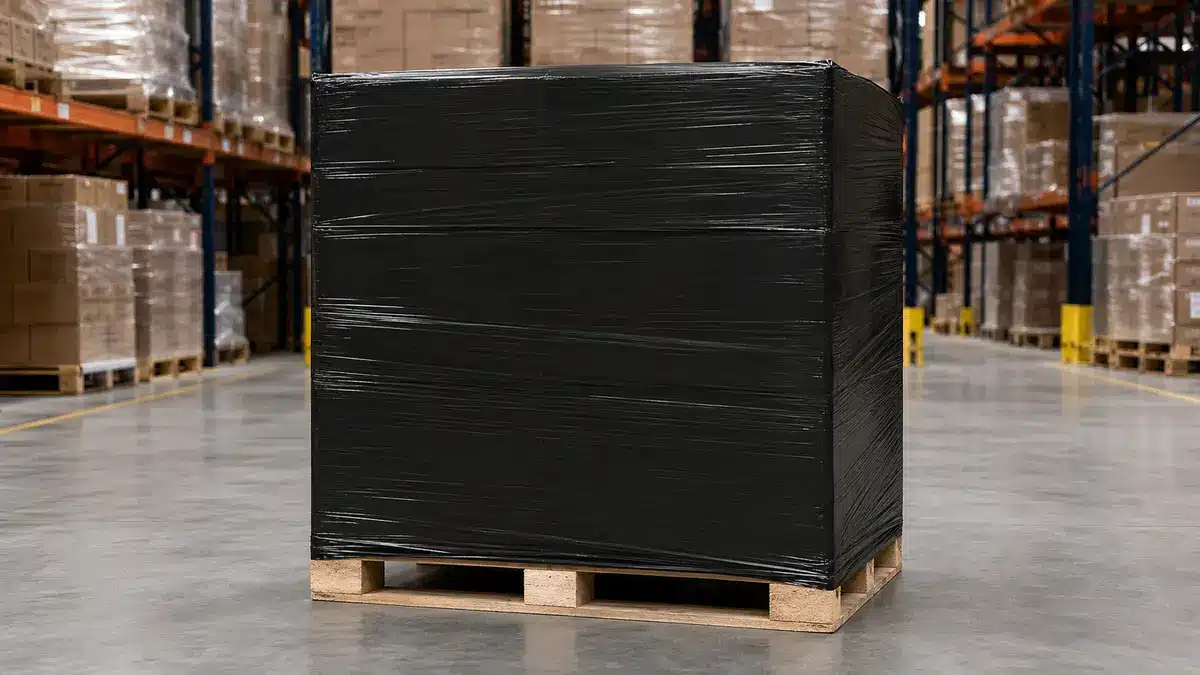
- Outbound pallets of branded or high-value goods: opacity limits casual product identification during staging and transport.
- Third-party logistics and contract warehousing: a color can distinguish customer ownership, service level, route, or exception status.
- Returns, quarantine, and rework: black can mark material that must not re-enter normal stock without review.
- Export or confidential shipments: a uniform exterior reduces visible product detail, while exterior labels preserve required identification.
- Low-volume bundling and irregular loads: hand film can combine loose cartons or components where an operator needs mobility.
- Repeatable production pallets: machine-grade black film can be used when throughput and consistent application justify a wrapper.
Stretch film helps hold items together and can reduce dust and incidental moisture exposure but it is not a weatherproof enclosure Open pallet tops film punctures condensation rain temperature and prolonged sunlight remain separate risks Outdoor staging should use a film with a documented UV-stabilized formulation and an exposure basis appropriate to the location and.
The best application is therefore one with a written reason for opacity, a compatible wrapping method, and measurable acceptance criteria. If operators must inspect every carton, scan labels through the wrap, monitor condensation, or verify product condition without unwrapping, clear or lightly tinted film may be the safer operational choice.
Also consider what happens at receiving. Exterior labels, removal instructions, film collection points, and a safe cutting method should be part of the process. Concealment upstream should not create identification delays or cutting hazards downstream.
Black vs. Clear and Other Colored Stretch Films
Choose the film color by asking what people and scanners must see after wrapping. Then compare mechanical performance using equivalent grades and an applied load trial.
| Decision factor | Clear film | Tinted film | Opaque black film | White or light opaque film |
|---|---|---|---|---|
| Product visibility | High | Partial | Very low | Very low |
| Through-wrap label scanning | Often possible, subject to glare and layers | Must be tested | Usually not possible | Usually not possible |
| Color identification | Low | High | High | High |
| Concealment | Low | Moderate | High | High |
| Heat-sensitive outdoor staging | No color-based conclusion | Specify and test | May absorb more solar heat | May reduce solar heat gain, but still test |
| UV service | Requires a UV specification | Requires a UV specification | Requires a UV specification | Requires a UV specification |
Compare visibility, identification, inspection, and outdoor requirements

Clear film is generally the simplest choice when receiving teams need fast visual checks, warehouse scanners read labels through the wrap, or damage must be visible before removal. Tinted film can add a routing cue while retaining some visibility, although tint, layer count, glare, print contrast, and scanner type should be tested. Opaque black film is preferable when concealment is the controlling need; labels should normally be applied to the final exterior layer.
Do not make a strength decision from color Compare the proposed grades using the same load wrapper settings environment and acceptance criteria Likewise do not equate opacity with UV durability A supplier may offer a black grade with UV inhibitors but the specification should state the additive or claimed exposure.
This comparison makes the trade-off explicit: black film hides information that clear film reveals. That is an advantage only when concealment is worth the added labeling and inspection controls.
Choose Hand, Machine, or Pre-Stretched Black Film
The correct format depends on how many pallets are wrapped, where the work occurs, how variable the loads are, and how consistently the film must be applied. The roll must also match the dispenser or machine in width, core, diameter, unwind, cling orientation, and stretch behavior.
| Format | Best fit | Main control | Trial focus |
|---|---|---|---|
| Hand film | Lower volume, mobile work, irregular loads, rework | Operator method and ergonomics | Layer count, tension, fatigue, consistency |
| Pre-stretched hand film | Manual work where lower pull force is useful | Correct application without overstretching | Puncture, edge protection, containment retention |
| Machine film | Higher throughput and repeatable production loads | Wrapper settings and maintenance | Pre-stretch, film force, pattern, breaks, cycle time |
Match the film format to the wrapping process
Hand application offers flexibility but creates operator-to-operator variation. Define a safe dispenser, start point, travel direction, overlap, number of top/middle/bottom layers, and pallet connection. Pre-stretched film may reduce the force needed during manual wrapping, but it is not automatically suitable for sharp corners or demanding loads. Protect edges and trial the complete load.
Machine application can improve repeatability when the film and wrapper are compatible. Record the film delivery system, pre-stretch ratio or setting, film force, carriage speed, turntable or arm speed, reinforcement bands, and cut-and-clamp behavior. A machine-grade film should not be replaced with a visually similar roll without checking processability and containment.
Compare total applied cost instead of roll price
Roll price hides the variables that matter. Compare film mass per accepted pallet, pallets per roll, labor, cycle time, roll changes, breaks, rewraps, damaged product, and downtime. ASTM D4321 defines film yield as area per unit mass and explains why actual yield matters to the number of units obtained from a mass of film. (ASTM D4321) Use measured results from the trial, not universal “pallets per roll” or savings percentages from a vendor example.
Keep the winning result as a baseline so later quotes can be compared against the same accepted pallet, not against a nominal roll description.
Apply Black Stretch Film for Reliable Load Containment
A reliable wrap pattern is a controlled process, not a request to “add more film.” Start with a stable pallet and a representative load. Remove overhang where possible, repair crushed cartons, protect sharp projections, and make sure the pallet itself is sound.
- Define the load family. Record dimensions, mass, center of gravity, carton stiffness, surface friction, sharp edges, and known failure modes.
- Identify the film and equipment. Record roll code, grade, width, core, lot, wrapper, film-delivery system, and relevant settings.
- Set the pattern. Define bottom wraps and pallet connection, upward overlap, reinforcement bands, top wraps, and the finish.
- Measure applied results. Check containment at the top, middle, and bottom; record film mass per pallet and cycle time.
- Inspect immediately and after dwell. Look for crushed corners, neck-down, breaks, loose tails, load lean, layer shift, and loss of tension.
- Challenge the unit load. Use handling and distribution tests that represent the real route, then document pass/fail criteria.
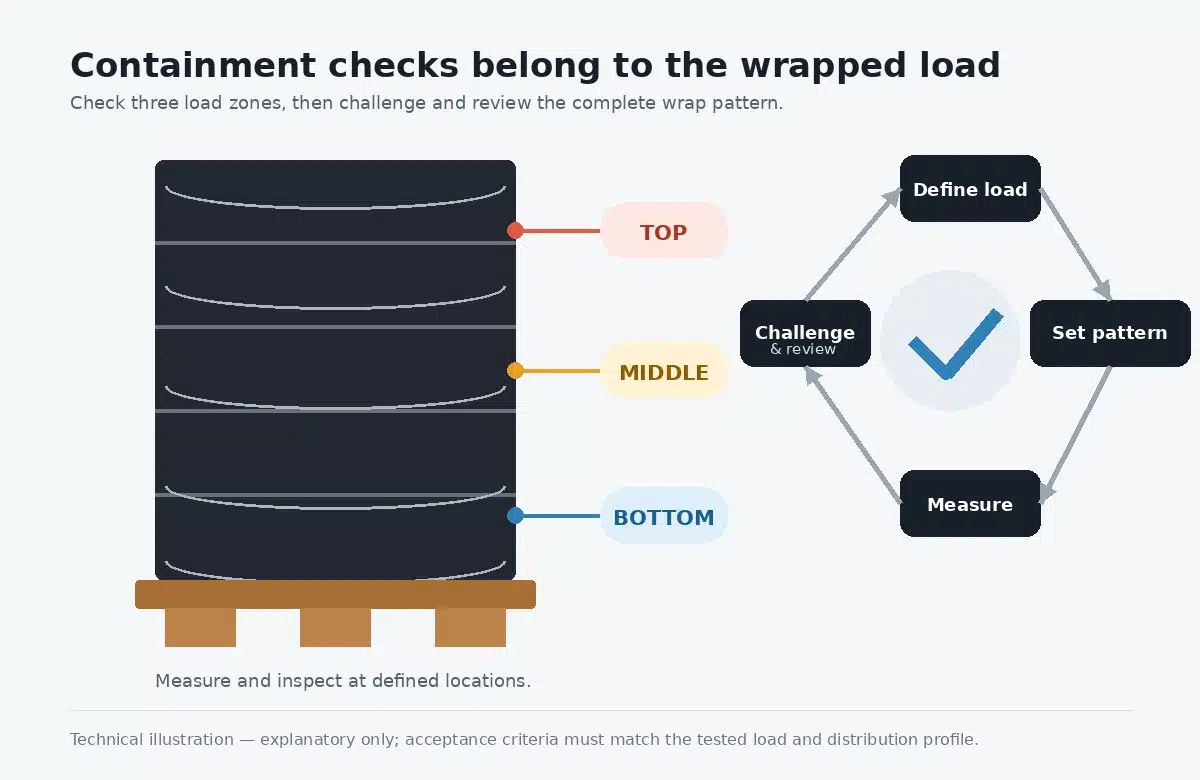
Build and validate a repeatable wrap pattern
Material tests answer different questions. ASTM D882 covers tensile properties of thin plastic sheeting; ASTM D5748 covers slow-rate protrusion puncture resistance of stretch wrap; ASTM D1894 measures static and kinetic coefficients of friction; ASTM D5459 measures elastic recovery, permanent deformation, and stress retention. (D882, D5748, D1894, D5459)
These values help characterize a.
Repeat the trial when the load geometry carton pallet route film construction or wrapper setting changes A result belongs to the tested combination it should not be extended to a different load family without a documented engineering review Photograph the.
Specify and Validate Black Stretch Film Before Buying
A useful RFQ describes the required outcome and the conditions used to verify it. “Black stretch film, 80 gauge” is not enough because nominal gauge and color do not define yield, formulation, stretch response, puncture behavior, cling, roll geometry, processability, or applied containment.
Include the following:
- application method: hand, pre-stretched hand, or a named wrapper and film-delivery system;
- roll width, core dimensions, maximum roll diameter or mass, unwind direction, and splice rules;
- film construction or approved performance grade, nominal thickness and tolerance, and the measurement method;
- opacity or color tolerance, surface appearance, and whether exterior labels must adhere;
- cling and slip side orientation, coefficient-of-friction requirement when relevant, and blocking limits;
- package yield, net roll mass, or usable length with the agreed test method;
- tensile, puncture, recovery, retention, or cling tests needed for incoming control;
- application settings, representative load families, containment targets, and distribution test;
- lot identification, certificate requirements, sampling, nonconformance handling, and change notification.
ASTM D4649 explicitly supports buyer-seller development of stretch-film purchase specifications. ASTM D4321 supplies a method for actual and nominal package yield, while D5459 addresses recovery and stress retention. These are complementary controls, not interchangeable proof of load stability.
Turn the approved trial into an RFQ and change-control record

Run the trial on representative worst-case loads, not only an easy demonstration pallet. Record the film lot, environmental conditions, equipment and settings, pattern, applied film mass, containment readings, dwell time, handling sequence, test profile, and acceptance result. ISTA advises selecting a procedure that fits the distribution mode; its 3E procedure is specific to similar unitized loads in full-truckload shipment. (ISTA procedures)
For relevant European road-transport programs, EUMOS 40509 may be considered for load-unit rigidity, but applicability and certification needs must be confirmed for the market and route. (EUMOS) Once a construction passes, freeze the approved roll and process specification. Require review when resin structure, colorant, additive package, thickness, width, plant, equipment, settings, load pattern, or distribution route changes.
Frequently Asked Questions About Black Stretch Film
Is black stretch film stronger than clear stretch film?
Not because it is black. Strength, puncture resistance, stretch response, and stress retention come from the film formulation, construction, thickness, manufacturing process, and test conditions. Compare the proposed black and clear grades using relevant material tests and the same applied load trial. Color is a visibility attribute, not a strength class.
Does black stretch film provide UV protection?
Opacity may reduce transmitted visible light, but it does not prove outdoor service life. Specify a UV-stabilized grade, the claimed exposure period and climate basis, and any limits for temperature or product sensitivity. ASTM D4649 excludes outdoor-exposure performance, so an indoor stretch-film specification is not enough.
Can black stretch film prevent theft or tampering?
No. It can conceal contents and may reduce casual interest, but ordinary stretch film can be cut, removed, or replaced. Use numbered seals, tamper-evident labels, scans, access controls, cameras, or other chain-of-custody measures when evidence or deterrence is required.
Can barcodes be scanned through black stretch film?
Usually not through an opaque wrap. Put the shipping and operational labels on the final exterior layer, or create and validate a controlled label window. Even with clear or tinted film, test the scanner, label contrast, glare, film layers, and reading angle.
Is black stretch film recyclable or made with recycled content?
Clean polyethylene stretch film may be technically recyclable where a suitable commercial film-collection stream accepts it, but local acceptance, contamination rules, pigmentation, sortation, and end markets determine recovery. APR notes that carbon-black and other dark colorants can impair near-infrared identification unless designed and tested for sortability. (APR) Recycled content is a separate, supplier-documented percentage; it cannot be inferred from color.
When should you choose black stretch film instead of clear film?
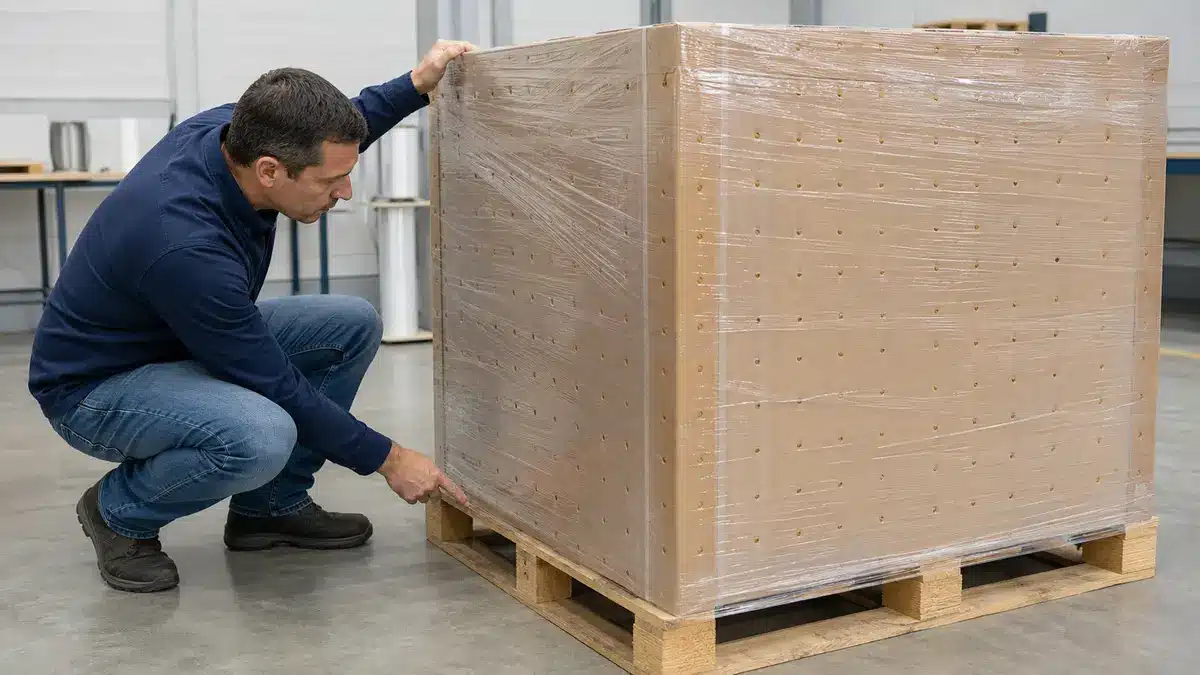
Choose black when concealment or a documented color code matters more than through-wrap inspection and label scanning. Choose clear when receivers need to see products, barcodes, carton condition, or condensation. In either case, select the mechanical grade and validate the complete wrapped load independently of the color decision.
If both needs occur, keep clear film as the default and reserve black film for named load classes with exterior-label and inspection rules.
 English
 Japanese
 French
 Spanish
 Korean
 Italian
 Portuguese
 Dutch
Dutch Arabic
 Russian
 German