
BOPE is biaxially oriented polyethylene film. It is attracting attention in flexible packaging because orientation can give polyethylene greater stiffness, strength, optical quality, and converting utility while keeping the base polymer in the PE family. That combination can help designers build PE-rich or mono-PE packages, but it does not make every BOPE grade sealable, high-barrier, food-contact compliant, or recyclable in every market. The useful question is not simply “Is BOPE good?” It is “Which BOPE construction performs which job in this package, under which verified conditions?”
This guide explains how BOPE is made, why its benefits are conditional, which types are sold, where it is used, and how buyers should specify and validate a film before production.
What Is BOPE Film?
For polymer background, consult the NIH PubChem polyethylene overview before comparing finished-film claims.
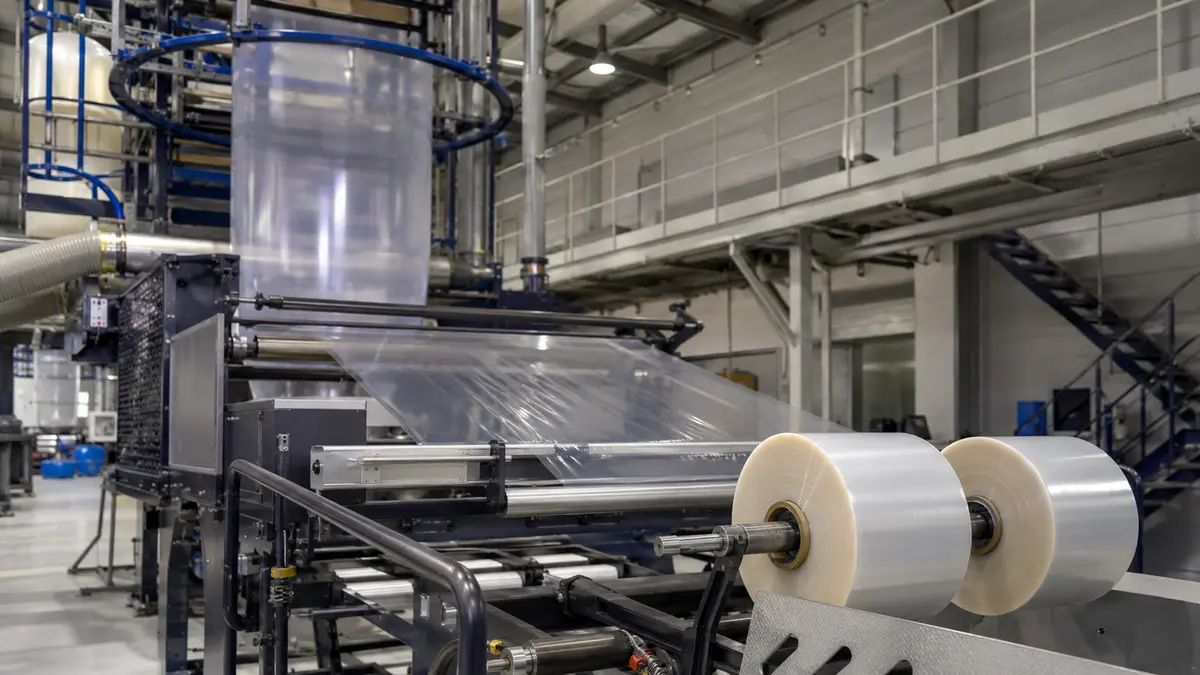
BOPE stands for biaxially oriented polyethylene. A polyethylene-rich sheet is stretched in both the machine direction (MD) and transverse direction (TD), then stabilized and finished for its intended use. The orientation step changes the material structure and can create a thinner, stiffer, clearer, and more balanced web than a relevant non-oriented PE film.
BOPE is a film family, not one formula. Commercial constructions may use LLDPE, HDPE, blends, multiple coextruded layers, sealable skins, treated surfaces, coatings, cavitation, metallization, or other functional features. A supplier’s grade name and technical data sheet therefore matter more than the acronym alone.
How biaxial orientation changes polyethylene
In a common tenter-frame route selected PE resins are melted and coextruded into a thick sheet The sheet is cooled reheated to a controlled stretching range drawn in MD by rollers running at different speeds and stretched in.
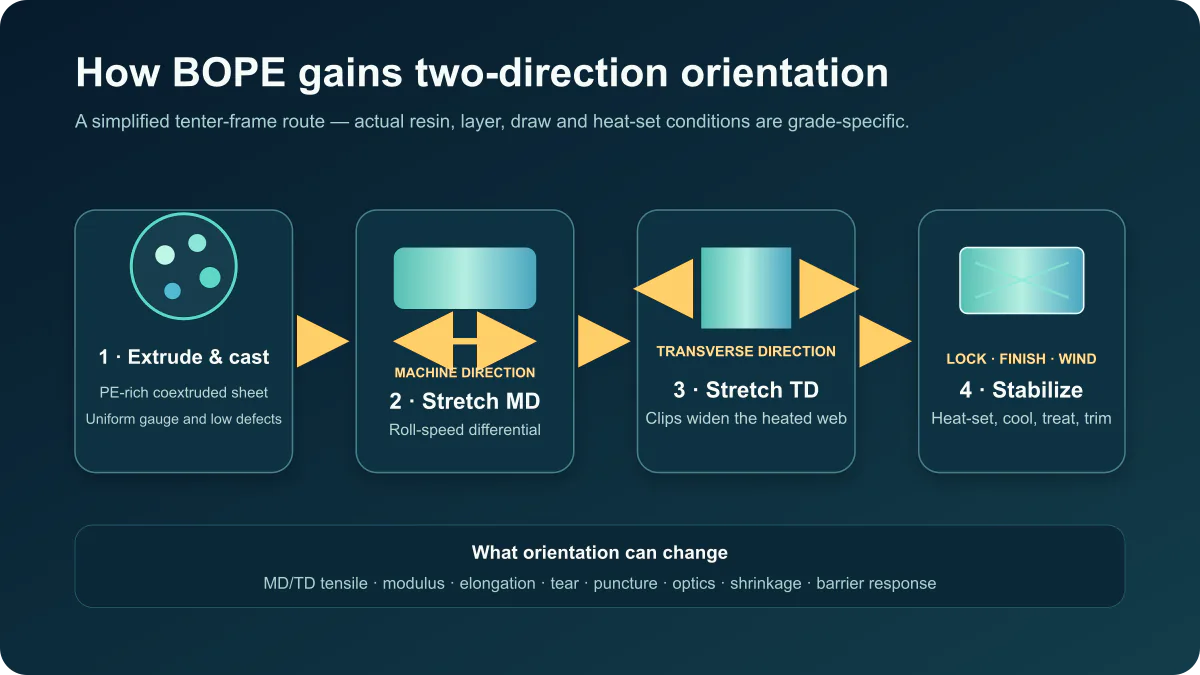
Orientation aligns polymer chains in two directions and changes crystallinity and morphology. The resulting tensile strength, modulus, elongation, tear, puncture, optics, shrinkage, and barrier response depend on the resin architecture, layer design, stretch ratios, temperatures, heat setting, gauge, and process control. The 2026 mini-review by Zhang and Zhuravlev in Polymer describes BOPE technology, raw materials, packaging advantages, and remaining engineering challenges.
Some producers use sequential tenter-frame stretching; other biaxial routes also exist. BOPE should not be confused with MDO-PE, which is primarily oriented in MD. Nor should it be confused with ordinary blown PE simply because all three belong to the polyethylene family.
What the BOPE name does not specify
The name BOPE does not tell a buyer whether the film is:
- LLDPE-based, HDPE-based, or a blend;
- monolayer or coextruded;
- heat-sealable, non-sealable, or sealable on only one side;
- treated on one side, both sides, or untreated;
- clear, opaque, cavitated, matte, coated, or metallized;
- designed as a print web, sealant web, barrier carrier, monoweb, or laminate layer;
- suitable for a particular product, filling process, storage temperature, or shelf-life target;
- compliant for a specific food-contact use and market;
- compatible with the collection, sorting, and recycling system where the finished pack will be sold.
Core rule: Treat BOPE as a material-family starting point. Approve the exact grade, structure, functional sides, test conditions, converting route, and finished package.
Key Benefits of BOPE Film
BOPE’s value comes from combining PE chemistry with two-direction orientation. The benefits below are common reasons to investigate BOPE, but each one must be confirmed for the exact grade and package.
Strength, stiffness, and downgauging potential
Orientation can raise tensile strength and modulus while reducing elongation relative to a comparable non-oriented PE film. The stiffer web can improve handling, print registration, pouch stand-up, and machine control. Higher strength or puncture performance may also support downgauging—using less material while maintaining a defined package function.
Downgauging is a design outcome, not a fixed percentage. A thinner film can change tear initiation, seal behavior, flex durability, barrier, web tension, and package feel. Compare candidate structures at equal finished-package duty, not only equal thickness. ASTM D882-26 also notes that tensile results depend on specimen dimensions, grips, extension measurement, test speed, preparation, and thickness, so supplier data must be normalized before comparison.
Stiffness is not the same as toughness. A high-modulus film may still fail a sharp-edge, drop, tear, or flex-crack requirement. Use the method that represents the expected failure.
Clarity, gloss, and converting performance
Clear BOPE grades can provide attractive transparency and gloss. A controlled, flatter web can support flexographic or rotogravure printing, lamination, coating, slitting, and form-fill-seal operations. Treated surfaces can improve wetting, but treatment level can decay during storage and does not by itself prove ink or adhesive adhesion.
Optical and converting behavior remains grade-specific. Resin density, additives, antiblock, slip, layer structure, orientation, heat setting, surface treatment, and film age can change haze, gloss, coefficient of friction (COF), static, blocking, curl, and winding. Specify both the appearance target and the downstream process that must achieve it.
Potential for PE-rich package design
BOPE can provide an oriented print or structural web while a blown or cast PE layer provides sealing and toughness. This creates a path to replace some PET/PE, BOPA/PE, or other mixed-polymer laminates with PE-rich structures where the full performance requirement can still be met. Brückner reports market examples spanning dry and fresh food, snacks, heavy-duty, and high-barrier packaging, while also describing BOPE as a developing platform that needs value-chain coordination.
“PE-rich” or “all-PE” is not automatically equivalent to “recyclable.” CEFLEX design principles favor mono-PE or mono-PP where possible, but also require attention to barriers, coatings, inks, adhesives, size, construction, and additional features. RecyClass likewise evaluates the complete package and the compatibility of every component. Local collection, sortation, and reprocessing access must also exist.
Common BOPE Film Types
There is no universal BOPE taxonomy. Suppliers group films by resin family, functional surface, appearance, or package role. Use the following categories to build an inquiry, then confirm what each supplier means.
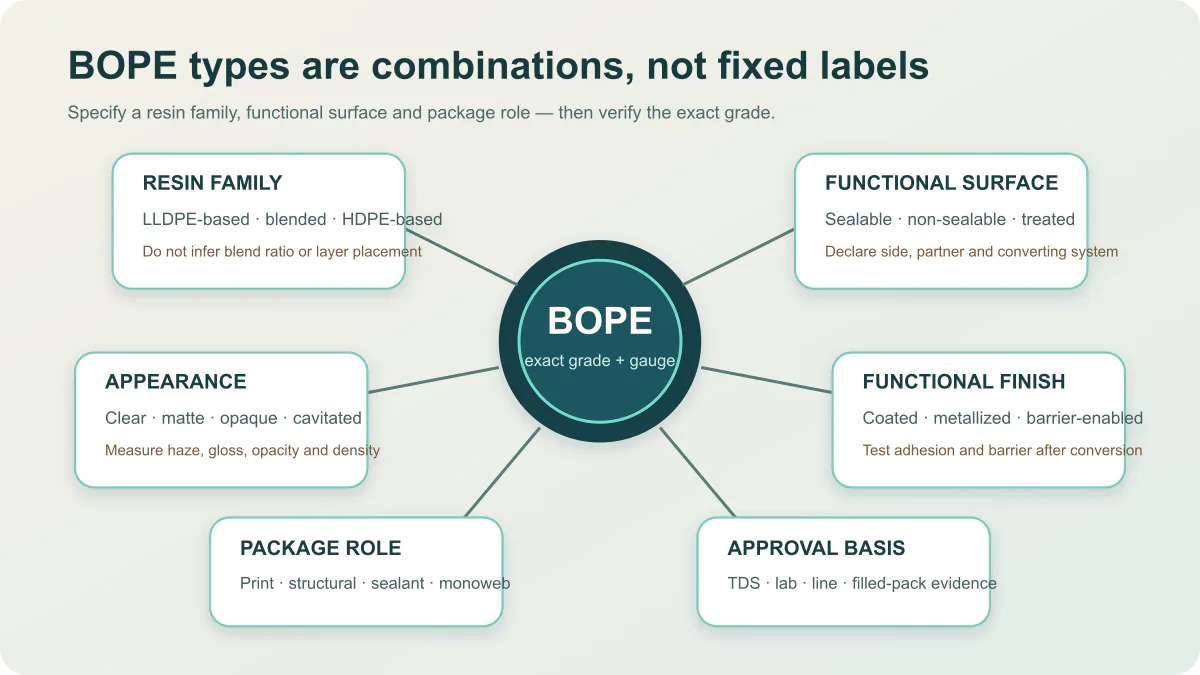
LLDPE-based, blended, and HDPE-based BOPE
- LLDPE-based BOPE is often positioned for toughness, clarity, printing, flexible laminates, or sealable constructions. Exact properties depend on the resin design and skin layers.
- LLDPE/HDPE blended BOPE can balance toughness with higher stiffness, heat response, optics, and coating suitability. Blend ratio and layer placement are proprietary and should not be inferred from the label.
- HDPE-based BOPE may target higher stiffness, thermal resistance, barrier deposition, or an outer-web role. It can behave differently in impact, tear, sealing, and conversion than a lower-density family.
Commercial portfolios distinguish LLDPE-based, LLDPE/HDPE-blended, and HDPE-based families for different printing, coating, lamination, and metallization roles. Those categories demonstrate market practice; they are not a standard that all suppliers follow.
Sealable, non-sealable, and treated BOPE
Non-sealable BOPE commonly serves as a print web, structural layer, coating substrate, or middle ply while another layer forms the seal. Heat-sealable BOPE uses a designed skin or construction and may support a monoweb or BOPE/PE laminate. Surface-treated BOPE is prepared for a specified print, coating, or lamination side.
For a sealable grade, request more than a seal-initiation temperature. Define the seal partner, temperature, pressure, dwell, line speed, hot tack, cooled seal strength, contamination condition, and failure mode. ASTM F88/F88M-23 measures the force required to separate a seal and stresses consistent technique; it does not replace leak, burst, package-integrity, or distribution testing.
For a treated grade, record the treated side, treatment at manufacture, minimum at conversion, storage conditions, film age, and adhesion results with the actual ink, coating, or adhesive after cure and aging.
Clear, matte, opaque, cavitated, coated, and metallized grades
Clear grades emphasize product visibility and print appearance. Matte or opaque grades change shelf presentation. Cavitated BOPE introduces voids to alter density, opacity, stiffness, and feel. Coated or metallized films can add heat resistance, seal behavior, oxygen or moisture barrier, or light protection.
No appearance or finish name proves performance. Coatings and metallization need defined chemistry or construction, coat or metal control, adhesion, optical density where relevant, pinhole criteria, barrier test conditions, and post-conversion testing. Barrier can deteriorate after flexing, printing, lamination, slitting, sealing, or distribution.
Main Applications of BOPE Film
BOPE is most compelling where a package needs an oriented web but the project also wants to remain within, or move closer to, the PE material stream.
| Application | Typical BOPE role | Why it may be shortlisted | What still controls approval |
|---|---|---|---|
| Frozen foods and produce | Printed outer web, sealable web, or laminate layer | Cold toughness, puncture resistance, clarity, PE-rich structure potential | Drop, puncture, seal contamination, freezer aging, fogging, shelf life |
| Dry foods, snacks, and confectionery | Print web, monoweb, coated or metallized layer | Stiffness, optics, moisture contribution, machinability | OTR/WVTR, light and aroma barrier, seals, line speed, shelf-life study |
| Pet food and heavy products | Structural outer or middle web | Strength, puncture, stiffness, downgauging potential | Drop, creep, flex crack, seal integrity, distribution abuse |
| Home and personal care refills | Printed structural web in a PE-rich pouch | Graphics, stiffness, toughness, PE-family construction | Chemical compatibility, stress cracking, drop, leak, seal and spout system |
| Labels and technical laminates | Printable, coated, or structural substrate | Clarity or opacity, dimensional control, surface options | Adhesion, die cutting, dispensing, curl, aging, end-use environment |
Food, frozen, and dry-goods packaging
BOPE can be used in pillow packs, flow wraps, stand-up pouches, premade pouches, and rollstock for dry foods, fresh or frozen produce, snacks, confectionery, cheese, and other products. Its role may be print, stiffness, puncture resistance, a coating carrier, or sealing. The complete structure—not the BOPE name—must provide the required oxygen, moisture, aroma, light, and package-integrity performance.
Food-contact status also belongs to the exact composition and conditions of use. 21 CFR 177.1520 covers specified olefin polymers subject to its provisions and specifications; it does not mean any finished BOPE film is automatically authorized for every food, temperature, or contact duration. Obtain current, grade-specific declarations for the target market and intended conditions.
Home, personal-care, and liquid-product pouches
Laundry, cleaning, and personal-care refill pouches can benefit from BOPE stiffness, print quality, and mechanical performance in PE-rich laminates. However, liquid contents can expose stress-cracking, permeation, swelling, seal, fitment, and drop weaknesses that are not visible in a tensile data sheet.
Test the actual formulation, concentration, headspace, fitment or spout, seal design, storage temperature, orientation, and distribution cycle. A pouch that survives water testing may not survive the real detergent or oil-based product.
Pet food, heavy-duty, industrial, and technical uses
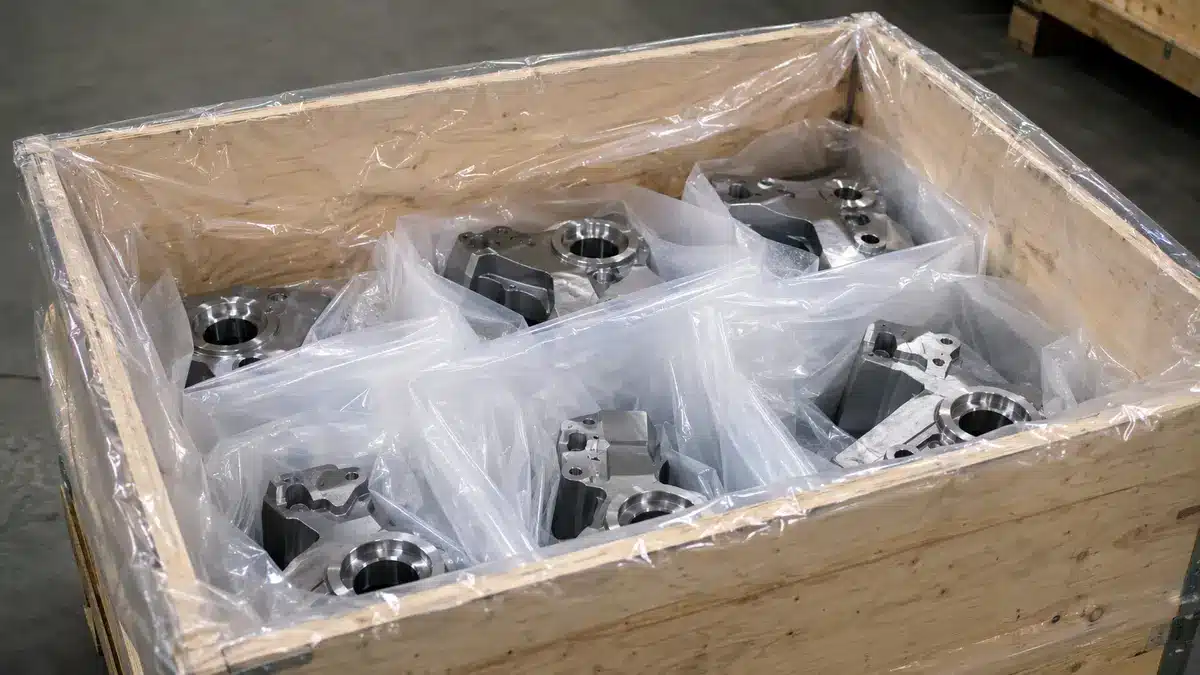
Pet food, rice, dry chemicals, e-commerce packs, and other heavier contents can use BOPE as a structural layer where puncture, creep, drop, and handling matter. Technical uses can include labels, coating substrates, and specialty laminates. These applications often need more than high tensile strength: tear propagation, flex durability, abrasion, surface adhesion, static, dimensional stability, and long-term load behavior can dominate.
Run trials at representative filled weight, package geometry, seals, pallet or case configuration, and environmental conditions. Do not extrapolate a small-lab coupon result to a large filled bag without package testing.
How BOPE Fits a Mono-PE Structure
BOPE often contributes the oriented, printable, or structural web. A blown or cast PE film may supply sealing, toughness, and fitment compatibility. A coating, metallization, or thin barrier layer may be added when the product needs more oxygen, aroma, light, or moisture protection.
Print web, structural web, or sealant web
The role assignment must be explicit. If BOPE is the outer print web, verify printability, thermal stability, web tension, lamination, scuff, and curl. If it is structural, verify MD and TD properties, puncture, tear, flex, and filled-package abuse. If it seals, map the seal window, hot tack, contamination tolerance, and package integrity.
A layer should not be credited with a function it has not been tested to deliver. The outer web may help stiffness but not seal; the sealant may help impact but not print; a barrier coating may meet initial OTR yet crack during conversion.
Recyclability is a finished-package question
A BOPE film is polyethylene, but a commercial pack also contains inks, adhesives, coatings, barriers, labels, zippers, spouts, valves, and product residue. CEFLEX recommends mono-PE structures where possible and gives design rules for these additional elements. The 2025 RecyClass Design Book likewise treats recyclability as a package-design and recycling-system question.
Claims should identify the assessment protocol, version, geography, package configuration, test result, and access to collection and recycling. “Designed for recycling,” “compatible,” “recyclable,” and “recycled at scale” are not interchangeable statements.
Limitations and Failure Modes to Check
BOPE can solve useful packaging problems, but several assumptions create avoidable failures:
- Orientation becomes a universal performance claim. Resin family, gauge, stretch balance, heat setting, and layer design can produce very different MD/TD results.
- Stiffness becomes puncture or impact resistance. These are different properties. Use the failure-specific method on the film and finished package.
- PE becomes high oxygen barrier. Plain PE is usually selected more for moisture behavior than strong oxygen barrier. Coatings, metallization, EVOH, or another solution may be needed and must be tested after conversion.
- A sealable skin becomes a wide operating window. Seal initiation, hot tack, cooled strength, contamination tolerance, and distortion can limit real line speed.
- Treatment becomes permanent adhesion. Surface energy can change with film age, storage, additive migration, handling, and conversion.
- Downgauging becomes automatic material saving. A thinner structure that causes rejects, leaks, breakage, slower lines, or reduced shelf life is not a successful reduction.
- All-PE becomes recyclable everywhere. The complete package and local system determine the claim.
- Polyethylene identity becomes food-contact approval. Exact substances, limitations, food type, time, temperature, and market must match the documentation.
Warning: A favorable technical data sheet screens a BOPE candidate. It does not qualify the printed laminate, seal, pouch, filling process, shelf life, or recycling claim.
How to Choose BOPE Film
Use an application-first sequence:
- Define the product and package. Record product chemistry, sensitivity, filled weight, format, opening method, shelf-life target, storage, distribution, and market.
- Assign BOPE’s job. Decide whether it must provide print, stiffness, puncture resistance, sealing, a coating substrate, barrier support, or a combination.
- Identify dominant failure modes. Consider oxygen, moisture, light, aroma, flex crack, puncture, tear, creep, drop, seal contamination, chemical attack, heat, and line instability.
- Select a construction family. Choose LLDPE-based, blended, or HDPE-based; sealable or non-sealable; clear, opaque, cavitated, coated, or metallized; and treated side.
- Normalize supplier evidence. Compare the same gauge, direction, method, conditioning, units, value type, and sample construction.
- Check design-for-recycling and compliance. Apply the current protocol for the target market to the complete pack and obtain exact-grade regulatory documents.
- Validate progressively. Move from documents to samples, laboratory tests, converting trials, filled-package tests, and a controlled production run.
| Dominant need | BOPE direction to investigate | Essential checks |
|---|---|---|
| Clear printed outer web | Treated clear BOPE with suitable thermal stability | Haze, gloss, treatment, ink adhesion, heat response, lamination, scuff |
| Sealable monoweb or laminate | Sealable BOPE or BOPE paired with a PE sealant | Seal map, hot tack, distortion, contamination, leak, burst, line trial |
| Higher stiffness or barrier deposition | Blended or HDPE-rich BOPE | MD/TD properties, shrinkage, coating/metallization adhesion, flexed barrier |
| Frozen or sharp-edged product | Tougher BOPE construction matched to package geometry | Puncture, drop, cold conditioning, tear, seals, distribution trial |
| PE-rich barrier pouch | BOPE plus compatible barrier/coating and PE sealant | OTR/WVTR after conversion, flex, recyclability protocol, shelf-life study |
What to Put in a BOPE Film Specification
A useful specification separates identity, test conditions, and acceptance rules.
| Specification group | Fields to define | Evidence to request |
|---|---|---|
| Identity and construction | Supplier grade, resin family, layer structure, functional skins, seal and treated sides, coating or metallization | Current TDS, construction statement, approved reference sample |
| Dimensions and roll | Nominal gauge and tolerance, width, length or mass, core, OD, winding direction, joints, roll build | Measurement method, roll map, packing standard |
| Optical and appearance | Haze, gloss, opacity or color, gels, scratches, wrinkles, metal appearance | Test method, specimen side, limits, visual standard |
| Mechanical and thermal | MD/TD tensile, modulus and elongation; tear, puncture, impact, shrinkage or dimensional change as relevant | Methods, conditioning, temperature, units, value type |
| Surface and machinability | Treatment side and minimum at conversion, COF, static, slip, blocking, print/adhesive system | Film age, storage, method, ink/adhesive and line trials |
| Barrier | OTR, WVTR, light or aroma requirement; coating or metal control | Exact temperature, RH, side, gauge, units, method, post-conversion results |
Avoid comparing a supplier’s typical result with another supplier’s guaranteed minimum. State whether each number is typical, target, minimum, maximum, or acceptance range.
How to Validate BOPE Before Production
Qualification should narrow uncertainty in stages:
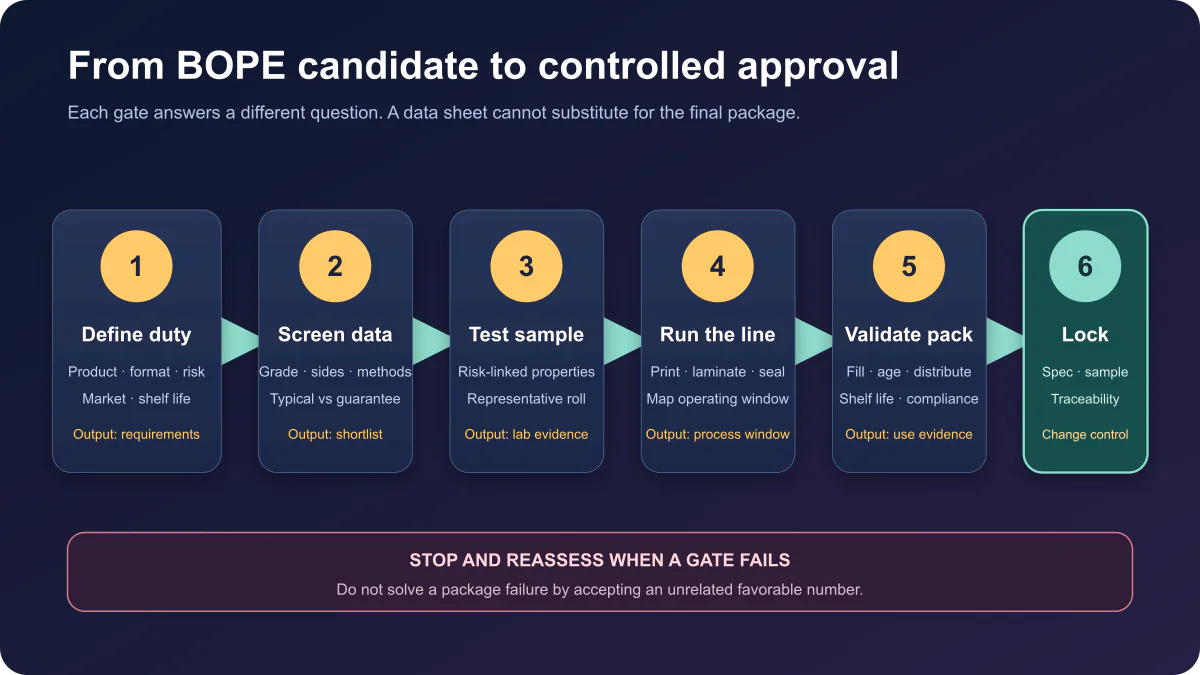
- Document screen: confirm grade identity, construction, functional sides, test methods and conditions, regulatory scope, storage, and shelf life.
- Representative sample checks: measure the properties linked to the package’s main risks. For moisture transmission, ASTM F1249-25 emphasizes agreed sampling, standardization, test conditions, and acceptance criteria.
- Converting trial: use intended inks, adhesives, coatings, cure, web tension, speed, thermal exposure, slitting, and bag-making conditions.
- Operating-window study: map stable settings instead of proving one favorable point. Include start-up, normal variation, speed changes, and anticipated contamination.
- Filled-package validation: test actual product, fill, seals, fitments, aging, drops, compression, vibration, cold or heat exposure, and shelf life as applicable.
- Controlled production run: verify multiple rolls or lots, process capability, defects, yield, and traceability before commercial approval.
- Lock the approval package: retain the signed specification, approved reference, artwork and structure version, process window, evidence, change-control rule, and requalification triggers.
For barrier work, report OTR and WVTR with temperature, relative humidity, gauge, side, units, and method. ASTM F2622-20 treats oxygen transmission as an important determinant of package protection but not its sole determinant. A coupon transmission result is not a package shelf-life guarantee. Seals, pinholes, flexing, product interaction, headspace, and storage still matter.
Frequently Asked Questions
Is BOPE film the same as MDO-PE?
No. BOPE is oriented in MD and TD; MDO-PE is primarily oriented in MD. The processes create different directional, thermal, optical, and tear behavior. Either can be useful in PE-rich packaging, and some structures combine oriented and non-oriented PE layers.
Is every BOPE film heat-sealable?
No. Some grades are non-sealable print or structural webs; others use a sealable skin or coating. Confirm the seal side, partner, temperature, pressure, dwell, hot tack, cooled strength, contamination tolerance, and failure mode for the exact construction.
Is BOPE a high-barrier film?
Not by family name alone. Plain BOPE may provide useful moisture resistance, but oxygen, aroma, and light requirements can need a coating, metallization, barrier layer, or laminate. Test the converted structure after flexing and package making.
Can BOPE be used for food packaging?
Potentially, when the exact resins, additives, coatings, inks, adhesives, and finished construction comply for the intended food, time, temperature, and market. Request current declarations and supporting evidence for the named grade and use.
Is BOPE film recyclable?
BOPE is polyethylene and can support mono-PE design. The final claim depends on the complete package, current design-for-recycling protocol, local collection and sortation, reprocessing compatibility, and claim rules. Evaluate the actual printed, laminated, sealed, and fitted package—not only the base film.
Specify the Role, Not Just BOPE
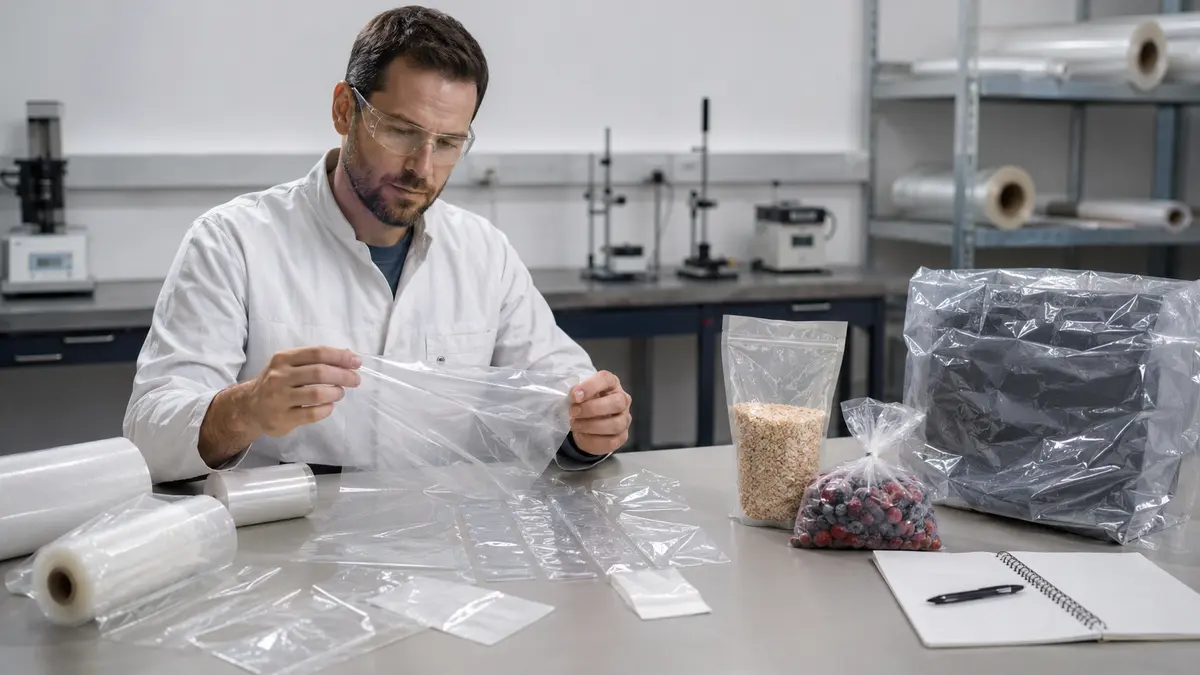
BOPE can combine an oriented film’s stiffness, strength, and appearance with the design flexibility of polyethylene. Its strongest use case is not a universal replacement claim; it is a carefully assigned role in a verified package. Define the product risk, select the correct BOPE family and functional sides, normalize supplier data, test the conversion and filled pack, and document the final recycling and compliance basis. That process turns “BOPE” from a promising acronym into a controlled packaging specification.
Related Bestypack Resources
- The Difference Between Polyolefin, PVC and Polyethylene
- Flexible Food Packaging A Guide to What You
- CPP Films: Optimal Flexible Packaging Solutions
- Heat Sealable Film Guide: Applications, Types, Functions
- Cold Chain Packaging Solutions Of Food
- What Are the Different Types of Common Insulation Packaging?
- The Ultimate Guide: All Types of Foam Packaging
 English
 Japanese
 French
 Spanish
 Korean
 Italian
 Portuguese
 Dutch
Dutch Arabic
 Russian
 German