
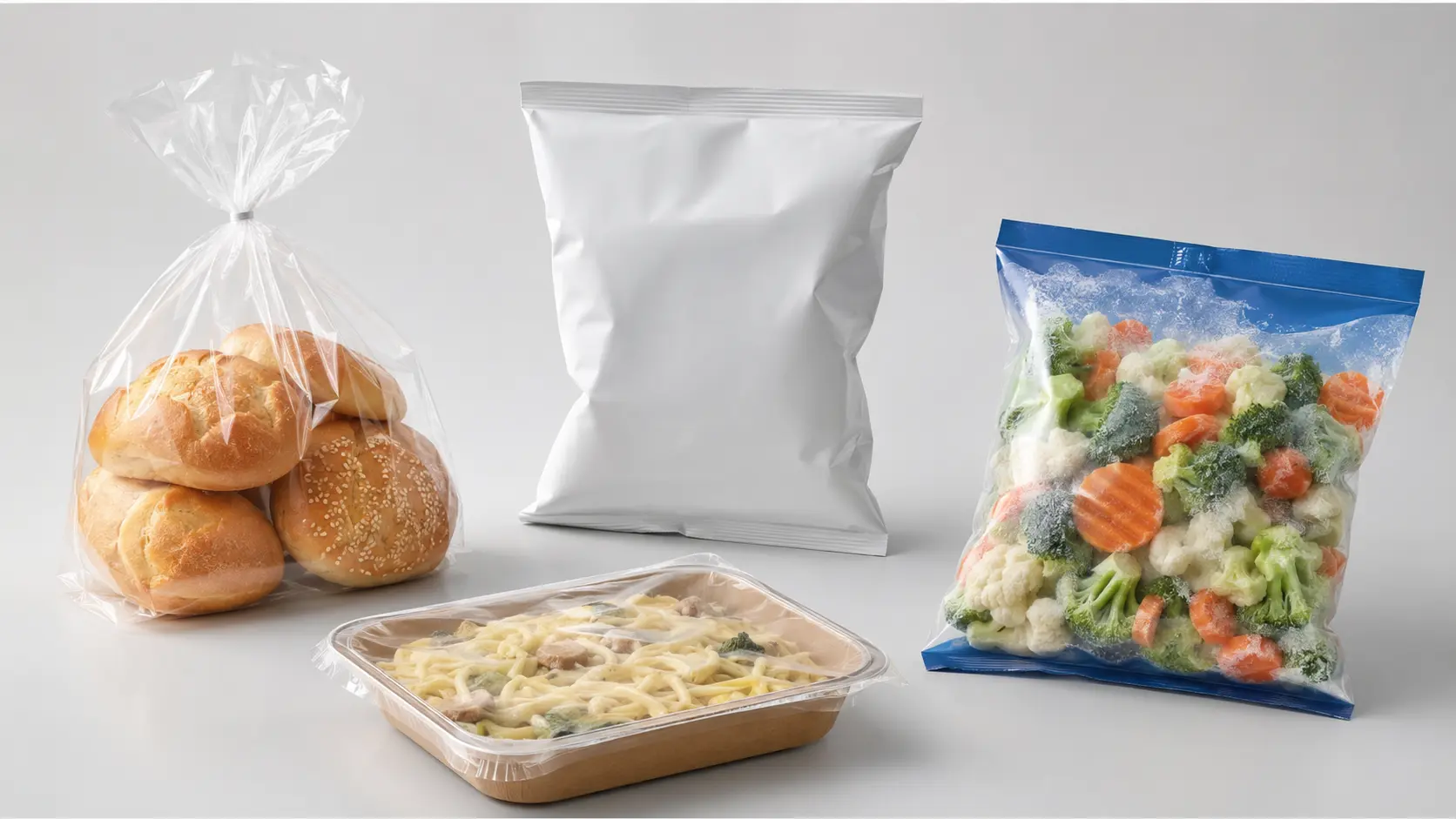
CPP film is cast polypropylene film: a flexible PP web made through flat-die extrusion and rapid cooling on a casting roll. Buyers often consider it for clear bags, sealant layers, laminates, and specialized packaging grades. The name alone, however, does not define seal temperature, barrier, retort resistance, food-contact status, or recyclability. This guide explains the practical characteristics, applications, advantages, limitations, commercial types, and validation steps needed to turn “CPP film” into a usable specification.
What Is CPP Film?
For polymer background, consult the NIH PubChem polypropylene overview before comparing finished-film claims.
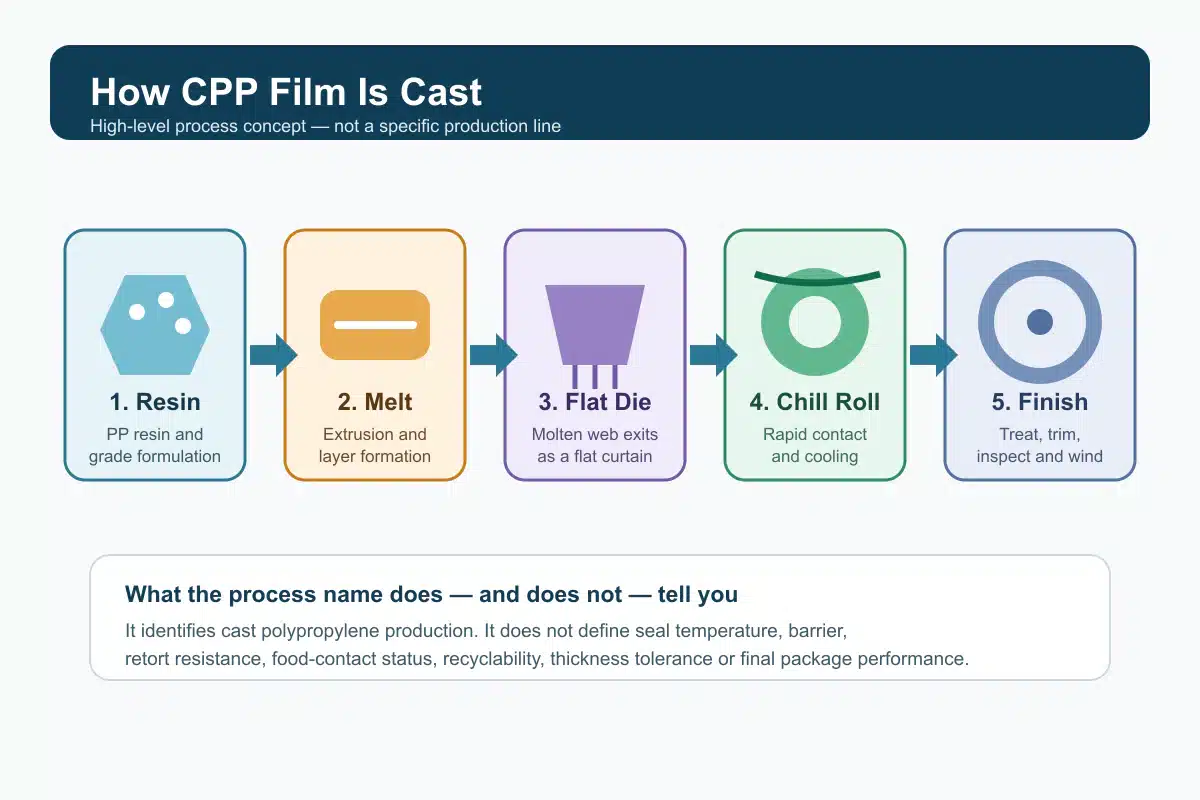
CPP stands for cast polypropylene. Polypropylene resin is melted, delivered through a flat die, laid onto a chilled casting roll, cooled, trimmed, and wound. Depending on the line and formulation, the finished web may contain some machine-direction orientation from draw-down, but it is not biaxially stretched in the way BOPP film is.
That distinction matters because manufacturing history influences how a film behaves. CPP is commonly selected when the design needs a softer, more flexible PP web or a purposeful sealing layer. It may be supplied as a monoweb, a coextruded film with different functional layers, a web for printing or lamination, or the inside sealant of a multilayer package.
“CPP” identifies a material family and process route. It does not identify one universal recipe. Homopolymer, random-copolymer, terpolymer, modifiers, slip and antiblock packages, surface treatment, layer design, thickness, and cooling conditions can all change the result.
How cast extrusion shapes the film
In cast extrusion, the molten web must make stable contact with the casting roll so it cools quickly and evenly. Reifenhäuser, a cast-film equipment manufacturer, describes rapid cooling and complete roll contact as important to transparency and reproducible optical quality. The process can also provide controlled layer distribution and thickness profile when the line, die, feedblock, cooling, and winding systems are properly managed.
Those process advantages should not be converted into an unsupported claim that every CPP film has identical clarity, gloss, thickness tolerance, or mechanical properties. The actual result belongs to a specific formulation, line setup, thickness, and test record.
CPP vs. BOPP in one practical distinction
CPP and BOPP both use polypropylene, but BOPP is stretched in the machine and transverse directions. That biaxial orientation generally creates a stiffer, more dimensionally stable web. CPP is not biaxially oriented and is commonly used where flexibility, toughness, conformability, or seal-layer behavior is more important.
| Decision point | CPP | BOPP |
|---|---|---|
| Process identity | Cast, not biaxially stretched | Biaxially oriented |
| Typical package role | Sealant web, flexible monoweb, specialty functional layer | Print web, stiff outer web, label or overwrap substrate |
| Design tendency | Softer and more flexible | Stiffer and crisper |
| Heat sealing | Often designed as a sealable film or seal layer | May require a heat-sealable skin or coating, depending on grade |
| What still requires data | Seal window, hot tack, COF, optics, mechanics, barrier, compliance | The same grade- and structure-specific evidence |
This is a design shortcut, not a specification table. A modified BOPP and a specialized CPP can behave differently from these general tendencies.
Key Characteristics of CPP Film
The useful question is not Does CPP have good properties It is Which property.
| Characteristic | Practical packaging meaning | What to verify |
|---|---|---|
| Clarity and gloss | Clear grades can provide product visibility and a clean surface appearance | Haze, luminous transmittance, gloss method, thickness, surface condition, and sample age |
| Heat-seal response | Sealable grades can act as a package-closing layer | Seal-initiation definition, temperature-pressure-dwell matrix, seal partner, seal strength, failure mode, hot tack, and contamination tolerance |
| Flexibility and toughness | A less stiff web can conform around products and tolerate handling | Tensile and elongation in MD and TD, tear or puncture method, thickness, conditioning, and final laminate |
| Moisture resistance | PP films are often considered where resistance to water-vapor transfer is useful | WVTR method, temperature, relative humidity, thickness, test side, structure, and units |
| Oxygen, aroma, and light control | Plain clear CPP may need another layer, coating, or metallization for demanding barrier targets | OTR, aroma or light-protection requirement, full structure, flex history, temperature, humidity, and units |
| Surface and machinability | Treatment, slip, antiblock, stiffness, and roll quality influence printing, lamination, unwinding, and line transport | Treatment side and level at test time static and kinetic COF blocking curl gauge profile roll… |
Seal performance is especially easy to overgeneralize. An ExxonMobil cast-PP application case shows that changing a sealing-layer formulation can alter seal initiation and hot-tack behavior. That evidence supports the principle that seal response is tunable; it does not provide a universal CPP sealing temperature. Likewise, ASTM F88/F88M-23 explains that measured seal strength depends on the specimen and tail-holding technique and is used for process validation and control. A useful report must therefore name the method, technique, specimen width, seal conditions, result unit, and failure mode.
Important Never compare two CPP.
Main Applications of CPP Film
CPP appears in many markets.
Food and consumer-goods packaging
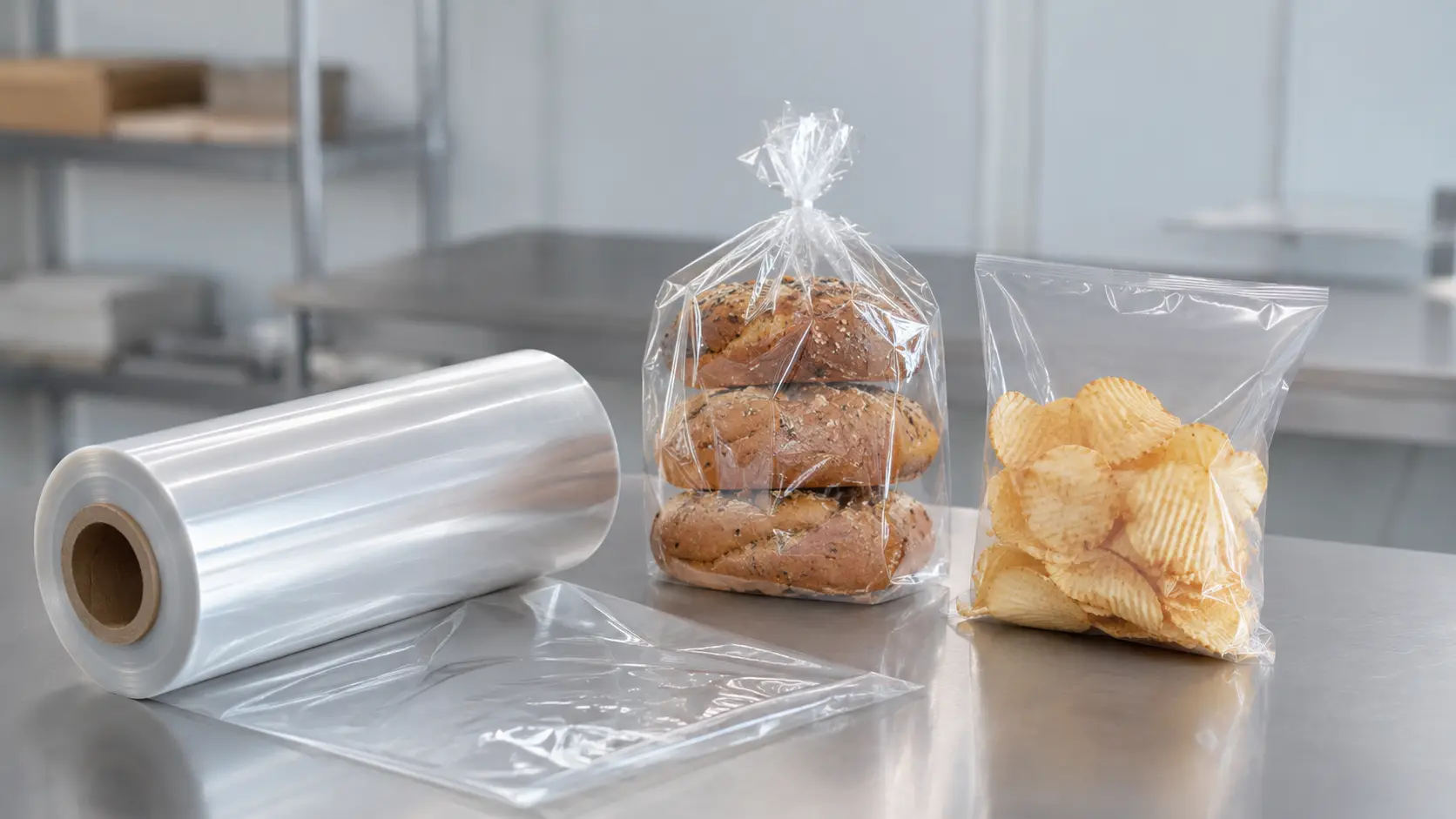
Clear or printed CPP monowebs may be considered for bakery goods, confectionery, produce, textiles, stationery, flowers, and other products where visibility, flexibility, and sealing are relevant. The final selection still depends on product sensitivity, shelf-life target, package format, filling temperature, distribution environment, and sealing equipment.
For food, pharmaceutical, personal-care, or sensitive technical products, the application name does not establish compliance or protection. The buyer needs documentation for the exact resin, additives, film construction, ink, adhesive, coating, and intended contact conditions.
Lamination and sealant-layer applications
CPP is widely used as the inner sealant web of a laminate. The outer web may provide printing, stiffness, heat resistance, or abuse resistance, while the CPP layer provides the sealing surface and contributes flexibility or toughness. Examples include PP-rich laminates and structures that combine CPP with BOPP, PET, PA, foil, coated films, or metallized webs.
The laminate must be evaluated as a system. An outer web changes thermal behavior and machine handling. Adhesive selection and cure affect bond performance. Printing, metallization, coatings, and flex damage can change barrier. The seal forms between the actual inside surfaces, not between generic material names.
Non-food and technical uses
Depending on grade and construction, cast polypropylene film may be used in hygiene-product overwrap, electronics and component packaging, protective or release layers, labels, graphics, decorative laminates, building materials, automotive composites, and other industrial applications. These uses show the flexibility of the cast-PP platform, but they do not mean one packaging-grade film can be transferred directly into a medical, electrical, construction, or automotive specification.
For any technical application, define the stress, temperature, surface, chemical exposure, cleanliness, electrostatic, flammability, weathering, and regulatory requirements before choosing a film family.
Advantages of CPP Film
CPP is attractive because manufacturers can tune a PP-based cast structure for several packaging functions. Its most common conditional advantages are:
- Sealing versatility. Coextruded skins and modifiers can be designed for different sealing behaviors, including lower-temperature initiation, hot-tack, peel, or retort-related requirements.
- Flexibility and conformability. CPP is generally less stiff than biaxially oriented PP, which can help a package wrap or flex around the product.
- Clear-film appearance. Rapid cast cooling can support good transparency and gloss in clear grades when formulation and processing are controlled.
- Toughness options. Film design can emphasize puncture, tear, impact, or flex-crack performance, but the relevant property must be tested on the exact grade and thickness.
- Functional layer design. A coextruded CPP can separate a seal skin, core, and treatment-side function within one web.
- Integration into PP-rich structures. CPP can provide the sealing layer in a package designed around polypropylene webs, subject to package-level performance and recycling assessment.
- Broad converting routes. With the correct surface treatment and formulation, grades can be developed for lamination, printing, metallization, bag making, and form-fill-seal equipment.
These are reasons to evaluate CPP, not reasons to skip testing. A change in slip package, seal skin, core resin, treatment, thickness, or storage time may improve one attribute and weaken another.
Note: “Cost-effective” is not an intrinsic material property. Compare cost per functional package, including yield, scrap, line speed, adhesive and curing steps, barrier layers, rejects, and total validated structure—not price per kilogram alone.
Limitations and Trade-Offs to Check
The main CPP purchasing errors come from treating a material-family name as a finished-package guarantee.
- Barrier is structure-specific. Clear uncoated CPP is not automatically a high oxygen-, aroma-, or light-barrier material. Metallization, coatings, or another laminate layer may be needed. Even then, barrier must be measured on the final structure at stated conditions. ASTM D3985-24 notes that OTR is important but is not the sole determinant of package protection.
- Stiffness may be too low for the intended machine or presentation. The flexibility that benefits one bag can reduce web control, stand-up appearance, or print-web stability in another design.
- Surface treatment can decay or be blocked by additives Printing and lamination need a specified treatment side minimum treatment at the time of.
- Slip and antiblock are not fixed forever. Additive migration, storage temperature, winding pressure, and film age can affect friction, blocking, and line behavior. Test representative aged rolls, not only fresh laboratory film.
- Retort and sterilization are special.
- Food-contact status is not conveyed by “PP.” In the United States, 21 CFR 177.1520 applies subject to its specifications and conditions. In the EU, Commission Regulation (EU) No 10/2011 covers plastic materials and articles and their intended conditions of use. Ask for the applicable declaration and migration support for the finished structure.
- Recyclability is a package-system question. A PP film may be technically reprocessable, while the finished package may include incompatible inks, adhesives, barriers, closures, or other polymers and may not be collected or sorted locally. The RecyClass PP-film evaluation protocol evaluates innovations against a defined recycling stream and explicitly distinguishes protocol testing from an official approval or marketing claim.
The safe conclusion is not that CPP is unsuitable. It is that every claimed advantage has a matching limitation and validation task.
Common Types of CPP Film
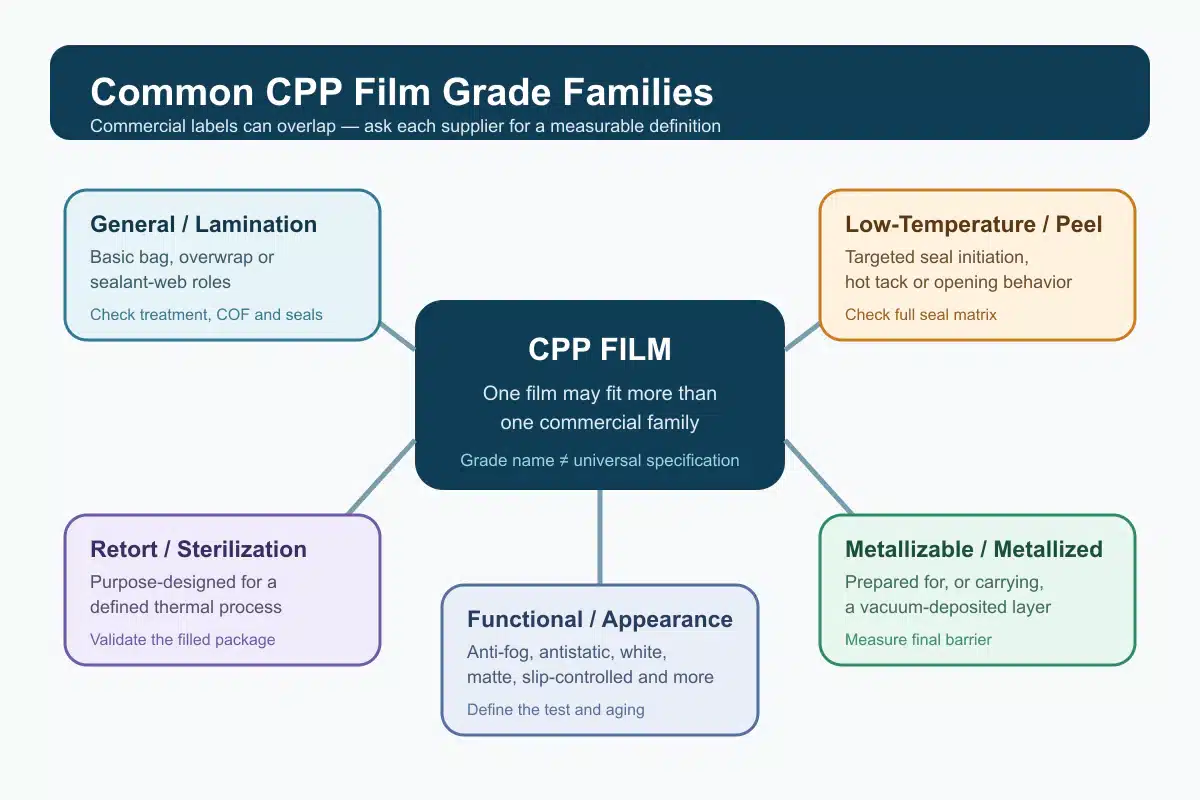
CPP type names are commercial shorthand, not a single international classification system. One supplier may organize grades by process role, another by end use, and another by performance feature. A film can belong to several groups at once—for example, a retort-grade, peelable, treated coextruded CPP.
General-purpose, lamination, and sealant CPP
General-purpose CPP is usually positioned for basic bags, overwrap, or converting where no special thermal or barrier duty is claimed. Lamination CPP is designed to bond to another web, while sealant CPP emphasizes the inside sealing function of a laminate. Confirm treatment side, treatment retention, adhesive compatibility, COF, blocking, and seal-to-seal or seal-to-other-material behavior.
Low-temperature-seal and peelable CPP
Low-temperature-seal grades are formulated to begin sealing at a lower energy input or to provide useful hot tack under a target line condition. “Low” has meaning only against an agreed method and reference film. Ask for a complete temperature-pressure-dwell matrix, not a single initiation number.
Peelable CPP is intended to open in a controlled way against a defined partner surface. Specify the seal partner, peel-force range, test geometry, aging, storage, contamination, sterilization or retort exposure, and desired failure mode. Peel behavior against PP may not predict behavior against another plastic, coated foil, or tray seal surface.
Retort and sterilization-grade CPP
These grades are designed for defined thermal processes, but the film label alone does not validate the pack. Supplier families such as those shown in Profol's cast-PP packaging portfolio demonstrate that retort and sterilization are treated as distinct functional grades. Request the exact allowable process envelope and evidence for the complete laminate and sealed package.
Qualification should include pre-process and post-process bond, seal, appearance, dimensional stability, migration where applicable, drop or handling performance, and shelf-life work. Do not transfer a successful cycle from a different product, thickness, pouch size, adhesive, or filling condition.
Metallizable and metallized CPP
Metallizable CPP is prepared to receive vacuum-deposited metal metallized CPP already carries that layer Metallization can change light oxygen moisture appearance sealing surface and recycling behavior Specify optical density or other agreed deposition control barrier methods and conditions treatment side metal adhesion flex resistance pinhole or defect criteria and.
“Metallized” should never be converted automatically into “high barrier.” The measured barrier belongs to the exact film, deposition, conversion history, and test condition.
Functional and appearance grades
Commercial CPP portfolios may also include anti-fog, antistatic, white or opaque, matte, high-slip, low-slip, tissue-overwrap, cold-resistant, print-grade, release, or thermoforming-related versions. These labels describe the design objective, not a guaranteed result.
For anti-fog film, define the food, temperature gradient, humidity, duration, and visual acceptance method. For antistatic film, define the electrical measurement, conditioning, and aging. For white or opaque film, define color, opacity, light transmission, print requirements, and any effect on recycling sorting. For slip-controlled film, define both surfaces, film age, conditioning, test method, and machine target.
Important: Ask every supplier to define its grade name in measurable terms. Do not assume that “RCPP,” “LTS,” “anti-fog,” or “metallized CPP” from two suppliers represents the same construction or performance window.
How to Choose CPP Film for an Application
Start with the package duty and work backward to the film. This keeps a familiar grade name from becoming the decision by default.
| Package need | Questions to answer | Evidence or validation action |
|---|---|---|
| Reliable seals on a fast line | What surfaces meet? What are jaw type, pressure, dwell, speed, contamination, and cooling conditions? | Seal-window and hot-tack study on the actual structure; report failure mode |
| Clear product display | How much haze, gloss, and distortion are acceptable after conversion? | Test representative thickness and final laminate before and after aging |
| Moisture, oxygen, aroma, or light protection | Which transfer mechanism controls shelf life, and what is the target under storage conditions? | OTR WVTR or other barrier test with method temperature humidity side area and units package shelf-life… |
| Retort, sterilization, pasteurization, or hot fill | What exact time-temperature-pressure and cooling cycle applies? | Supplier evidence plus filled-package process validation on the final laminate |
| Printing or lamination | Which side is treated, how long before conversion, and which ink or adhesive system is used? | Treatment-retention, ink adhesion, bond, cure, residual, and aging checks |
| Tear, puncture, drop, or flex resistance | Which real failure mode must be controlled? | Select a method that represents the load; test MD/TD and the complete package where relevant |
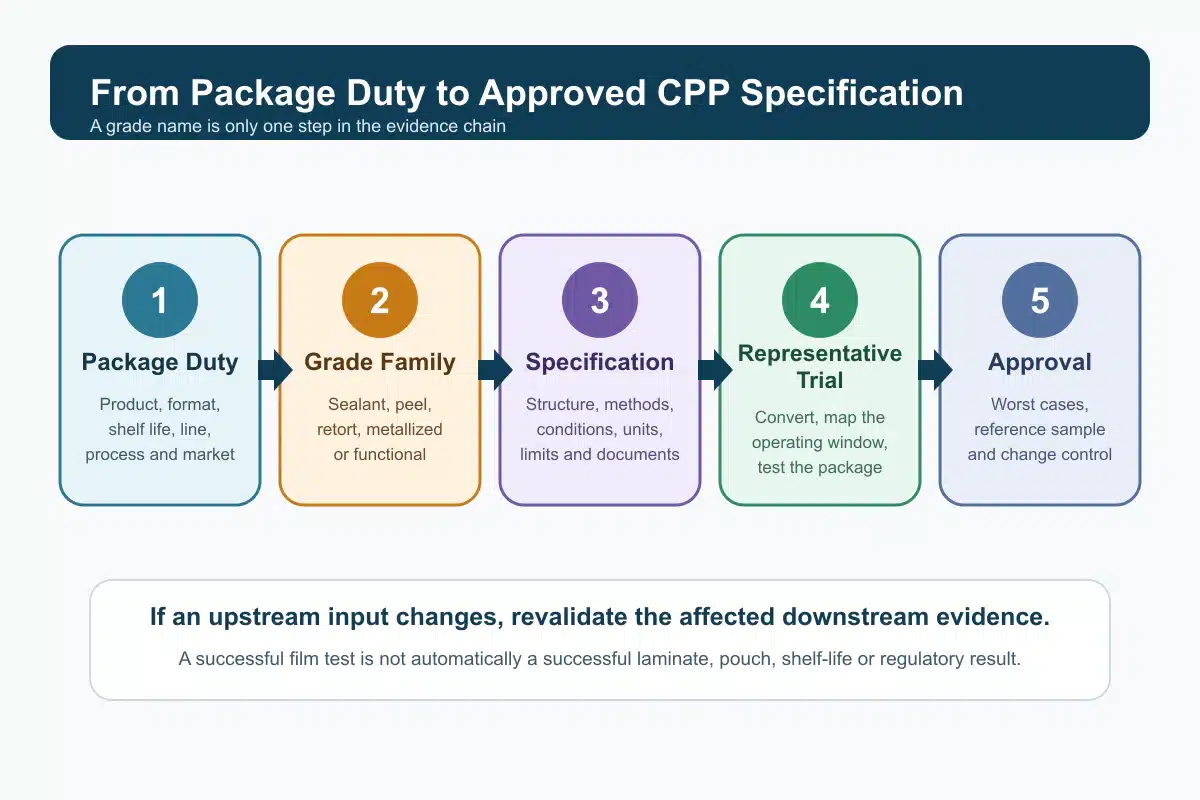
Do not begin with thickness alone. A thicker general-purpose film may still fail a seal, barrier, retort, surface, or regulatory requirement that a purpose-designed thinner or multilayer grade addresses—and the reverse can also be true. Thickness is one controlled input within a larger construction.
What to Put in a CPP Film Specification
A usable CPP specification should let the buyer, converter, supplier, and laboratory talk about the same film. Include at least:
- application, packed product, target market, package format, and whether CPP is a monoweb, print web, lamination web, or sealant layer;
- full layer sequence and nominal total and layer thicknesses, with an agreed tolerance and measurement method;
- resin or grade identity where disclosure is permitted, including functional skins and relevant additives or treatments;
- roll width, roll length or weight, core, winding direction, maximum roll diameter, splice rule, edge quality, and packaging;
- treated side, treatment method, minimum treatment at conversion, and maximum agreed storage age;
- optical requirements such as haze, transmittance, gloss, opacity, or color, with methods and conditions;
- mechanical requirements in MD and TD, with specimen conditioning, thickness, speed, method, and units;
- friction, blocking, curl, shrink or dimensional-change, and winding requirements relevant to the line;
- seal partner, temperature-pressure-dwell matrix, seal strength method and technique, hot-tack method, failure mode, and any contamination condition;
- barrier requirement for the final relevant structure, with test gas or vapor, temperature, humidity, test side, units, and conditioning;
- printing, metallization, coating, adhesive, cure, slitting, bag-making, and machine-interface requirements;
- food-contact, migration, chemical, medical, or other regulatory documents for the target market and intended use;
- recycling-design claim basis, assessment scope, and any package components outside the CPP web;
- sampling plan, lot identification, certificate-of-analysis fields, change-control rule, and approved reference sample.
Specification rule: A test value without material structure, thickness, direction, conditioning, method version, conditions, units, sampling, and acceptance rule is not yet a comparable purchasing requirement.
How to Validate CPP Film Before a Production Order
Use a staged trial so a problem can be traced to the film, laminate, package, or line rather than hidden inside one production run.
- Freeze the intended structure and duty. Record the product, package geometry, layer sequence, thickness, print, adhesive, seal partner, process cycle, storage, distribution, and market.
- Review supplier evidence. Check that the data sheet, declaration, and test reports identify the exact grade or construction and the conditions relevant to the intended use. Separate typical values from guaranteed specifications.
- Measure incoming sample film. Confirm identity, thickness profile, roll condition, treatment side, optics, friction, and the mechanical or functional properties that control conversion.
- Convert a representative trial. Use the intended ink, adhesive, cure, metallization, slitting, and bag-making process. Record film age, environment, and machine settings.
- Map the operating window. Test sealing across a planned matrix of temperature, pressure, dwell, speed, and contamination rather than proving only one favorable setting.
- Test the final package. Evaluate seal strength and failure mode, package integrity, barrier, appearance, opening, drop or handling, thermal cycle, and shelf life as the application requires.
- Challenge worst-case variants. Include thickness limits, aged material, largest and smallest packs, difficult SKUs, start-stop conditions, and distribution stresses.
- Approve with change control. Lock the film grade, structure, treatment, additive or functional design where disclosed, conversion route, test methods, limits, certificate fields, and notification requirements.
Important: A successful laboratory film test does not automatically validate a printed laminate or finished pouch. A successful short line trial does not automatically validate long-term seal consistency, shelf life, migration, retort performance, or every SKU.
Frequently Asked Questions
Is CPP film heat-sealable?
Many CPP grades are designed to be heat-sealable, and CPP is commonly used as a sealant layer. The answer for a particular film depends on its seal skin or formulation, the opposing surface, temperature, pressure, dwell, cooling, contamination, and required failure mode. Request a seal-window and hot-tack study for the actual structure rather than relying on the word “CPP.”
Is CPP film a high-barrier film?
Not as a universal rule. Plain clear CPP may provide useful moisture resistance but may not meet demanding oxygen, aroma, or light-barrier targets on its own. Coextrusion, coatings, metallization, or another laminate layer can change the result. Use measured OTR, WVTR, light, aroma, and shelf-life evidence for the final structure and stated conditions.
Can CPP film be used for retort packaging?
Yes, purpose-designed retort CPP is used as a sealant layer in qualified retort structures. General-purpose CPP should not be assumed suitable. Validate the precise film, laminate, adhesive, seals, product, process schedule, cooling, migration requirements, handling, and shelf life.
Can CPP film be printed?
CPP can be supplied for printing, but ink adhesion is not guaranteed by the polymer name. Confirm the treated side, treatment at the time of printing, ink system, drying or curing, slip and antiblock effects, print method, adhesion after aging, and any lamination or food-packaging restrictions.
Is CPP film recyclable?
CPP is polypropylene and can be mechanically reprocessed under suitable conditions but recyclability claims apply to the complete package and the target collection sorting and recycling system Inks adhesives coatings metallization barriers.
Related Bestypack Resources
- Advantages of CPP Films For Food Packaging
- CPP
- PP Cup Sealing Film 90-95mm
 English
 Japanese
 French
 Spanish
 Korean
 Italian
 Portuguese
 Dutch
Dutch Arabic
 Russian
 German