
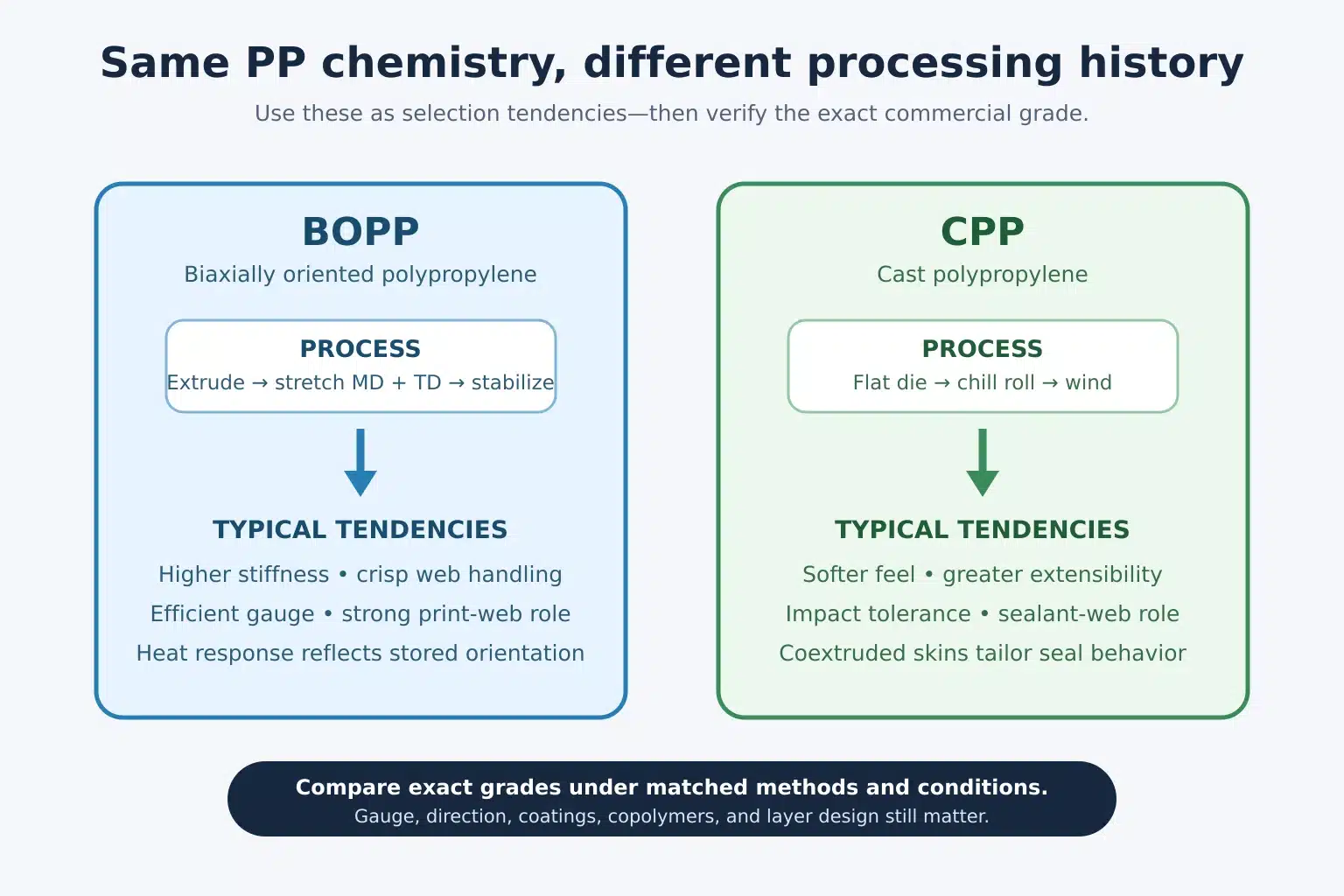
BOPP and CPP are both polypropylene films, but they are not interchangeable. BOPP is stretched in the machine and transverse directions, while CPP is formed by cast extrusion and is generally not biaxially oriented. That processing difference changes stiffness, extensibility, heat response, sealing behavior, impact performance, web handling, and the roles the films usually perform in a package.
In practical terms, BOPP is often selected for a crisp, stiff, printable outer web, label, tape, or overwrap. CPP is often selected for a softer, tougher sealant web or a bag that needs reliable heat seals. These are starting tendencies, not specifications. Coextruded skins, copolymers, additives, coatings, metallization, gauge, and process conditions can make two grades with the same acronym behave very differently.
What Do BOPP and CPP Mean?
For polymer background, consult the NIH PubChem polypropylene overview before comparing finished-film claims.
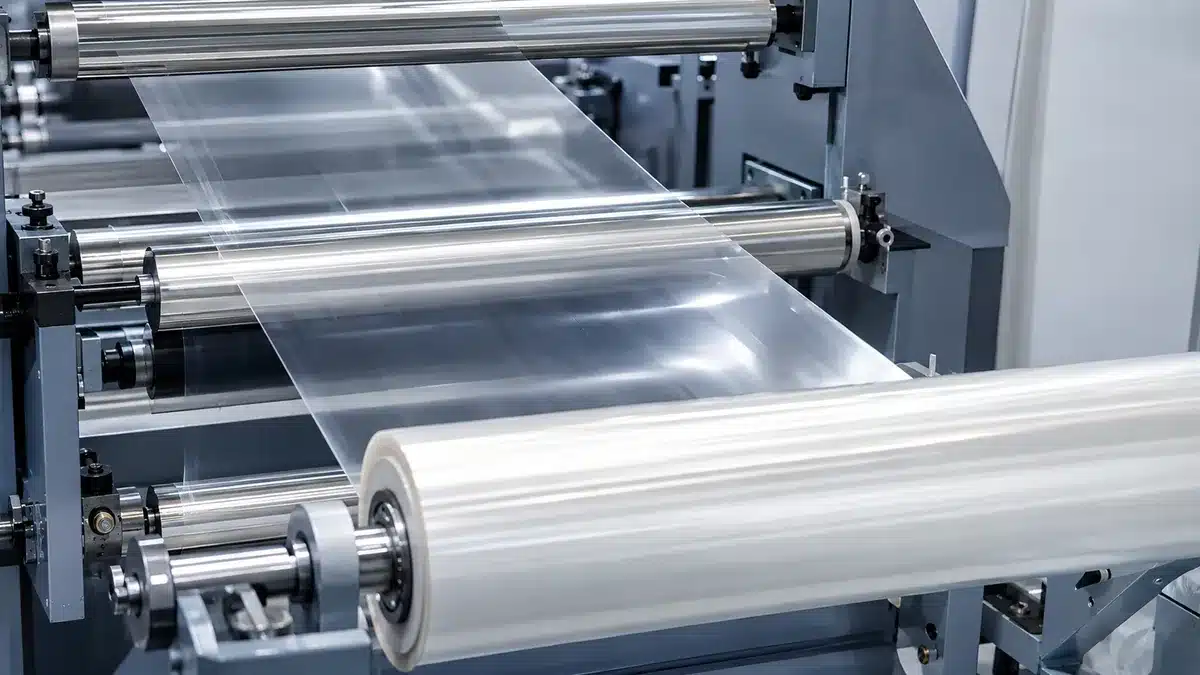
BOPP means biaxially oriented polypropylene. A polypropylene sheet is heated and stretched in both the machine direction (MD) and transverse direction (TD), then heat-set or otherwise stabilized. Orientation aligns polymer chains within the film plane and creates the stiff, strong, thin web commonly associated with packaging, labels, and adhesive tape.
CPP means cast polypropylene. Molten polypropylene is extruded through a flat die onto a chilled roll, which cools and forms the web. Commercial CPP is commonly coextruded so that its core and surfaces can perform different jobs. A seal layer may use a copolymer or other formulation chosen for lower seal initiation temperature, while the core supplies strength and heat resistance.
Neither name is a complete purchase specification. BOPP may be plain, coated, cavitated, metallized, or heat-sealable. CPP may be general-purpose, low-temperature-sealing, high-impact, metallizable, deep-freeze, easy-peel, or retort grade.
The films share a polymer but not a manufacturing history
The most important correction to many comparisons is simple: BOPP and CPP are not different base polymers in the way that polypropylene and polyester are. Both begin with polypropylene chemistry. Their different thermal and mechanical histories reorganize that chemistry.
This distinction prevents two errors: treating a property caused by orientation as inferior polymer chemistry, and generalizing a specialty skin to every film in the family. Resin, layer design, orientation, heat setting, gauge, treatment, and conditioning remain part of the evidence.
How Does Manufacturing Change Their Properties?
Biaxial stretching gives BOPP a strongly oriented structure. It normally increases in-plane modulus and tensile performance, improves dimensional control at ordinary converting temperatures, and enables a stiff web at relatively low thickness. Orientation can also improve clarity and barrier by changing morphology, although the final result still depends on grade and process design.
CPP leaves the cast line without the same biaxial stretching step. It therefore retains greater extensibility and a softer feel than a typical BOPP at comparable application conditions. Cast-film production also supports multilayer structures in which the surface composition is tailored for sealing, slip, treatment, anti-fog behavior, or other functions.
| Manufacturing question | Typical BOPP answer | Typical CPP answer | What the buyer should verify |
|---|---|---|---|
| Film-forming route | Extrusion followed by MD and TD stretching | Flat-die cast extrusion onto a chill roll | Actual orientation and layer structure |
| Mechanical character | Higher stiffness and lower extensibility tendency | Softer, more extensible tendency | MD/TD tensile data at matched gauge |
| Surface design | Plain, coated, or coextruded functional skin | Often coextruded with dedicated seal surface | Treated side, seal side, and winding direction |
| Thermal response | Orientation may shrink or distort when overstressed | No biaxial orientation to release, but grade still matters | Dimensional change at the real time and temperature |
Orientation is the main source of the performance split
Orientation is not a decorative label It is stored processing history When BOPP later encounters heat some residual orientation stress may relax causing shrinkage or dimensional movement The amount depends.
The useful comparison is not “oriented equals good, cast equals bad.” Orientation favors stiffness and efficient gauge; cast processing favors extensibility, impact tolerance, and engineered sealing surfaces. The package determines the useful balance.
How Do Stiffness, Strength, Tear, and Impact Compare?
Typical BOPP feels crisp and resists stretching during printing or converting. That stiffness helps registration, web control, label dispensing, and a premium package feel. Typical CPP is softer and more compliant. It can better tolerate flexing, low-temperature handling, and impact in applications where a rigid web would be vulnerable.
However, “stronger” is not a technically useful verdict. Tensile modulus describes resistance to elastic extension. Tensile strength describes stress at a defined point or failure. Elongation describes deformation. Tear tests measure initiation or propagation under a particular geometry. Dart or pendulum impact tests examine a different loading event. A film can rank high in one test and lower in another.
ASTM D882 covers tensile properties of thin plastic sheeting. Its results depend on specimen geometry, thickness, conditioning, test speed, and direction. ASTM also lists separate film methods for tear and impact because those failure modes are not interchangeable. Buyers should require both MD and TD results where direction matters and should never compare values obtained from unmatched methods or gauges.
Do not use one meaning of strength
For a tight print web, the key risk may be excessive stretch or poor registration; BOPP’s modulus is then highly relevant. For a heavy, irregular product, the dominant risk may be drop impact, puncture, or flex cracking; CPP’s extensibility and impact behavior may matter more. For an easy-open package, controlled tear may be desirable rather than a maximum value.
A useful specification translates the package failure into a test: tensile for web tension, slow puncture or impact for sharp products and drops, tear propagation for opening behavior, and low-temperature conditioning for frozen distribution. The film family narrows the search, but the test determines whether the grade fits.
Which Film Seals and Handles Heat Better?
CPP is commonly used as.
Plain homopolymer BOPP should not be assumed to seal to itself. Yet “BOPP is not heat-sealable” is also too broad. Heat-sealable BOPP grades use coextruded skins or coatings, and commercial portfolios include sealable mono-web and barrier structures. The relevant question is whether the named surface seals to the intended partner under the planned dwell, pressure, jaw temperature, speed, and contamination conditions.
| Seal or heat term | What it actually asks | Why the distinction matters |
|---|---|---|
| Seal initiation temperature | When a defined usable bond begins under stated conditions | Lower is not automatically better if blocking or product resistance suffers |
| Seal strength | Force needed to separate a cooled seal | Must include failure mode and test configuration |
| Hot tack | Strength while the seal is still hot | Critical when product weight loads the seal before cooling |
| Thermal dimensional change | How the web changes after defined heat exposure | Important for registration, curling, and jaw contact |
| Retort resistance | Whether the complete qualified structure survives a specified process | A generic CPP label does not prove retort suitability |
Separate seal initiation, seal strength, hot tack, and retort resistance
ASTM F2029 provides laboratory practices for making heat seals and emphasizes that material construction and thickness affect heat sealability. It also warns that laboratory sealers and manufacturing equipment can produce different outcomes. ASTM F88/F88M measures the force required to separate a sealed strip and identifies failure mode; it does not by itself define hot tack or package integrity.
Retort language requires even tighter control. A retort-grade CPP may be designed for high-temperature processing, but the package still depends on adhesive cure, other webs, barrier layers, product chemistry, seal geometry, and the exact time-temperature process. Choose a documented grade and validate the completed structure. Do not infer retort capability from “CPP.”
How Do Barrier and Optical Properties Differ?
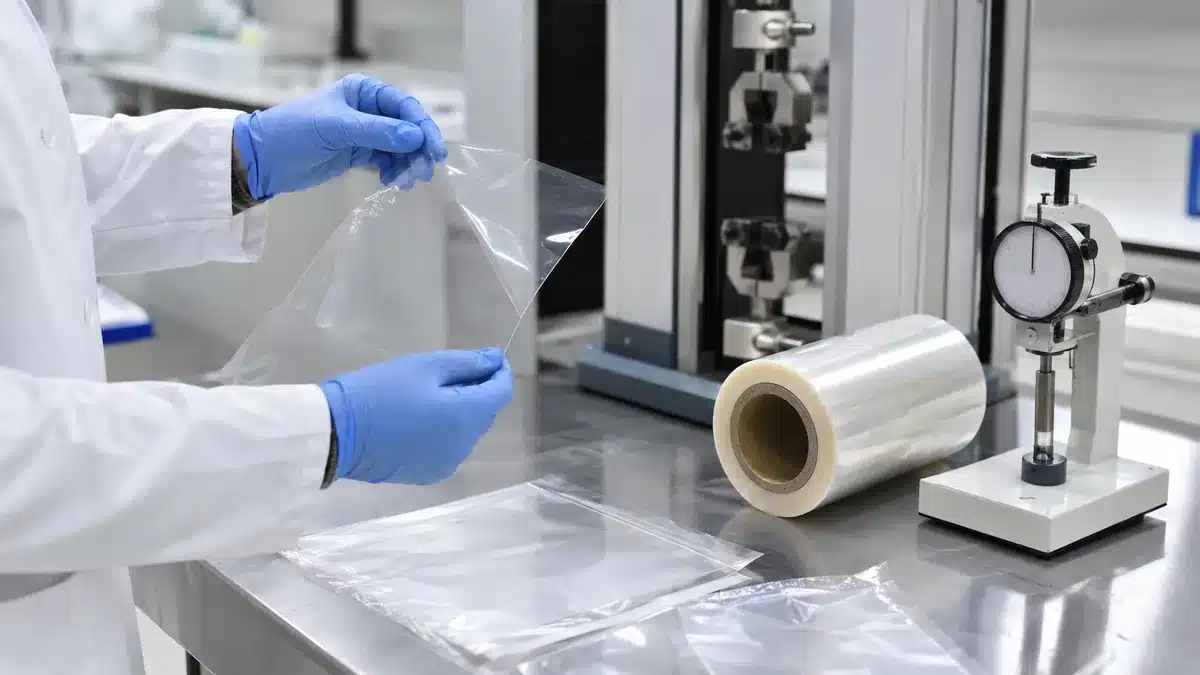
Both BOPP and CPP inherit polypropylene’s useful resistance to water uptake and can provide moisture-barrier value. Orientation often helps BOPP deliver good moisture protection at efficient gauge, which is one reason it is common in dry-food packaging. CPP can also provide useful moisture resistance, especially as a thicker sealant web. The actual water-vapor transmission rate must come from the selected grade or structure.
Neither uncoated family should automatically be called a high oxygen barrier. Metallization, oxide coatings, acrylic or other barrier coatings, and laminate design can dominate the result. A metallized BOPP can perform completely differently from clear plain BOPP; metallizable CPP is also commercially available. ASTM D3985 and ASTM F1249 distinguish oxygen transmission and water-vapor transmission and require controlled test conditions.
BOPP is widely valued for gloss and transparency, while CPP can provide excellent clarity and a softer visual and tactile character. Additives, crystallization, surface texture, thickness, cavitation, and processing can change haze and gloss. ASTM D1003 provides a defined approach to haze and luminous transmittance; subjective terms such as “crystal clear” cannot replace test data.
Gauge, additives, coatings, and test conditions can reverse a ranking
Barrier and optical values are especially easy to misuse. Transmission rates are area-based and thickness-dependent; temperature and humidity can change results. A coated or metallized web must be identified as such, and the metal or coating must survive flexing, sealing, and conversion. Optical comparisons need the same thickness, conditioning, background, and method.
Request the standard, units, temperature, humidity, gauge, and construction. A one-line “BOPP has better barrier” claim is not adequate for shelf-life design.
How Do Printing, Lamination, and Machinability Compare?
Polypropylene has low surface energy, so printing and adhesive bonding normally require a treated or coated surface. BOPP is frequently supplied as a print-grade outer web, and its stiffness supports registration and tension control. CPP can also be printed or laminated when the correct surface is treated, but its softness and extensibility may require different tension, nip, drying, and winding settings.
The treated side and seal side must be identified in the specification and roll diagram. Surface treatment can decay with time or be masked by additives and contamination. A wetting-tension reading is a useful incoming control, but it does not prove final ink adhesion or laminate bond strength. Those depend on ink or adhesive chemistry, coat weight, cure, surface cleanliness, and process conditions.
Machinability also involves coefficient of friction (COF), blocking, static, curl, gauge profile, and roll quality. ASTM D1894 notes that friction is a surface phenomenon affected by equipment and running conditions. Slip additives can migrate, changing COF over time and after lamination or storage. The grade’s aged COF, not merely its initial number, may control line performance.
Surface treatment and friction are grade-specific controls
Ask which surface is corona- or otherwise treated, its target and minimum treatment level at dispatch, the expected retention period, and the test used. Confirm whether printing, metallizing, or adhesive lamination is intended. Then test the real ink and adhesive system after the actual cure and storage window.
For line trials, record tension, tracking, static, nip behavior, sealing temperature, pressure, dwell, and speed. Do not copy BOPP settings blindly to CPP.
Where Does Each Film Sit in a Laminate?
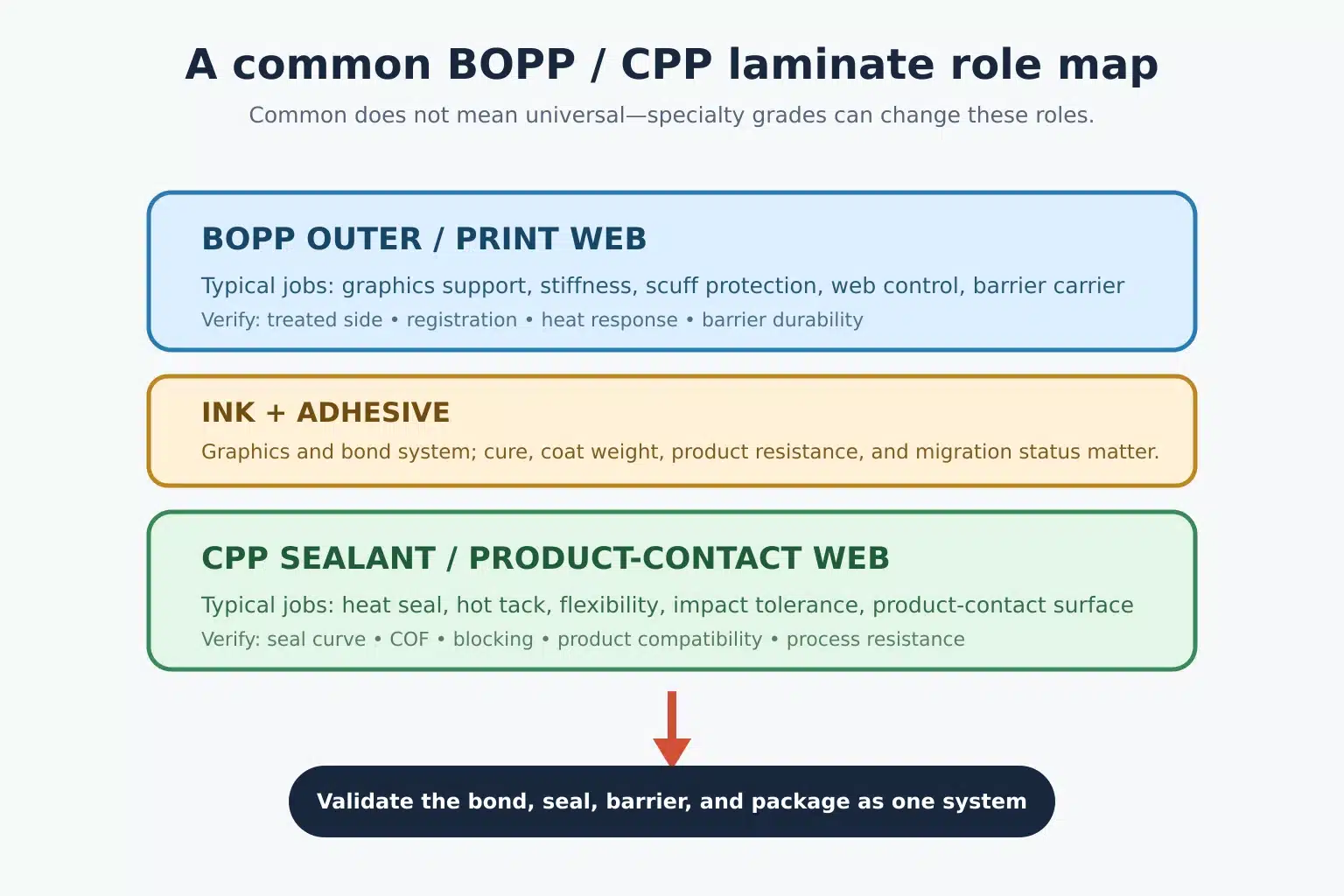
A common all-polypropylene duplex is printed BOPP laminated to CPP The BOPP carries graphics stiffness scuff protection and part of the moisture barrier the CPP supplies the.
That common pattern is not a rule. Heat-sealable BOPP may serve as a mono-web or inner web. Metallized BOPP may be used primarily for barrier. CPP may be surface printed or metallized. A laminate specification should therefore assign functions to layers instead of relying on acronyms.
| Layer function | BOPP tendency | CPP tendency | Qualification question |
|---|---|---|---|
| Outer print web | Frequent choice because of stiffness and print handling | Possible with a treated grade and suitable tension control | Does print register and survive scuff, heat, and handling? |
| Barrier carrier | Clear, coated, and metallized grades available | Metallizable and specialty grades available | Is barrier retained after flexing, sealing, and distribution? |
| Sealant web | Requires an engineered seal skin or coating | Frequent role for coextruded CPP | Does the seal curve fit speed, contamination, and product load? |
| Abuse layer | Crisp and strong in tension | Soft, extensible, and impact-tolerant tendency | Which failure—stretch, puncture, impact, or tear—must be prevented? |
BOPP often carries graphics while CPP often forms the seal
The laminate must be validated as a system. Adhesive selection and cure affect bond and migration performance. The sealant must be compatible with product contact and the package process. Barrier values can be lost through pinholes or flex damage. Curl can arise from tension, shrink, coat weight, or moisture imbalance.
Shared polypropylene chemistry can help a PP-focused design, but it does not make every BOPP/CPP laminate automatically recyclable. Inks, coatings, metallization, adhesives, labels, closures, product residue, collection, sorting, and end markets all matter.
Which Applications Fit BOPP or CPP?
BOPP is often the first family to investigate for snack and confectionery webs, labels, adhesive-tape backing, overwrap, and printable laminations where stiffness, gloss, web control, and efficient yield matter. Heat-sealable and high-barrier BOPP grades extend that range, so the application should be matched to the product datasheet rather than a generic film name.
CPP is often the first family to investigate for bakery and produce bags, textile overwrap, laminate sealant webs, frozen applications, and qualified retort pouches. Its softer feel, extensibility, impact behavior, and seal design are useful when the inner web must form and hold a reliable closure. Retort and deep-freeze uses require grades developed and documented for those conditions.
| Dominant package requirement | First family to investigate | Main disqualifier to test |
|---|---|---|
| Crisp printed outer web or label | BOPP | Heat shrink, seal requirement, puncture or flex demand |
| Tape backing or high-stiffness overwrap | BOPP | Tear behavior and end-use temperature |
| Flexible inner sealant for a laminate | CPP | Seal curve, COF, blocking, product compatibility |
| Soft bag with impact or low-temperature demand | CPP | Web handling, stiffness, barrier, and opening behavior |
| High-barrier PP structure | Specialty coated or metallized BOPP/CPP | Barrier durability after converting and sealing |
| Retort pouch | Documented retort-grade CPP in a qualified structure | Full process survival, adhesive cure, and seal integrity |
Choose by the dominant package failure risk
Start with what can fail: registration, puncture, drop impact, moisture ingress, oxidation, seal contamination, hot-fill deformation, retort delamination, blocking, or difficult opening. Select the film family most likely to control that risk, then test the exact grade.
The package and line define the requirement. BOPP is unsuitable if it cannot meet its assigned sealing role; CPP is unsuitable as label stock if dispensing and registration fail.
How Should Buyers Compare Datasheets and Run Trials?
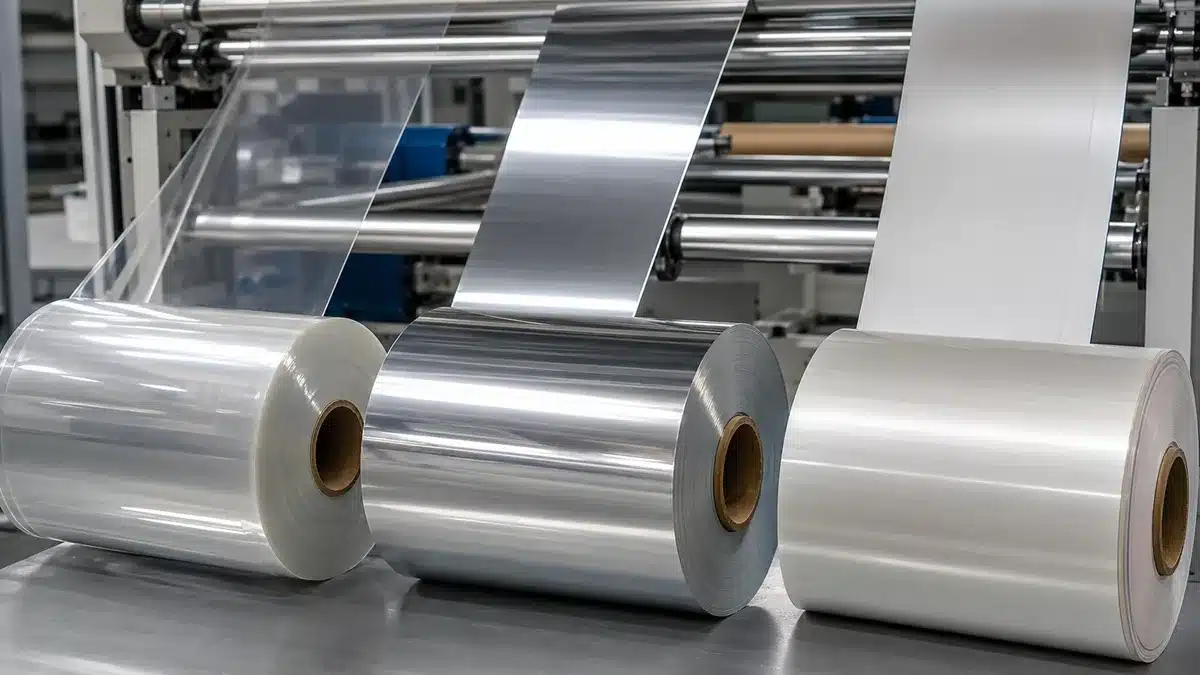
Begin by normalizing the datasheets. Confirm grade code, total and layer thickness, density or yield basis, treatment, winding direction, seal surface, and intended application. For tensile results, match method, specimen direction, test speed, conditioning, and gauge. For haze, barrier, COF, shrink, and seals, record the method and conditions rather than copying a single value into a comparison sheet.
ASTM D1204 measures dimensional changes after defined elevated-temperature exposure. It is useful for comparing thermal behavior only when time, temperature, direction, and specimen condition match. For sealing, build a laboratory curve across temperature at controlled dwell and pressure, test seal strength and failure mode, and then confirm the usable window on production equipment.
| Qualification step | Evidence to collect | Stop condition |
|---|---|---|
| 1. Define package job | Product, shelf life, process, machine, distribution, opening target | Requirements are still described only as “good” or “strong” |
| 2. Screen datasheets | Grade-specific methods, conditions, direction, gauge, treatment, seal side | Values are unmatched or copied from a different construction |
| 3. Laboratory tests | Tensile, tear/impact, barrier, optics, COF, seal curve, dimensional change as relevant | Critical failure remains untested |
| 4. Converting trial | Print, laminate, cure, slit, wind, and age using production materials | Adhesion, curl, blocking, or web control fails |
| 5. Packaging-line trial | Speed, temperature, pressure, dwell, hot tack, contamination, package integrity | Operating window is too narrow or unstable |
| 6. Distribution validation | Conditioned package through actual or simulated distribution and process | Shelf-life or integrity target is not met |
Use matched methods and a controlled qualification ladder
Change one major variable at a time and retain control rolls. Record roll position, age, storage, and treated side. If a BOPP-to-CPP substitution changes both stiffness and sealing behavior, the trial may require new tensions, temperatures, dwell, and package-handling settings rather than a material-only swap.
Finally, distinguish typical data from guaranteed specification limits. Manufacturer literature often states that representative values are not binding specifications. Put critical limits, test methods, sampling, tolerances, and change-notification requirements into the purchase specification.
Frequently Asked Questions
Is CPP the same as polypropylene film?
CPP is one type of polypropylene film: cast polypropylene. The term “PP film” is broader and can include CPP, BOPP, blown PP, and other constructions. Always confirm the process, orientation, layer structure, resin type, treatment, and intended use.
Can CPP replace BOPP?
Sometimes, but not as a drop-in assumption. CPP may replace BOPP where flexibility, impact tolerance, or sealing is more important than stiffness. The change can affect print registration, web tension, yield, barrier, optics, curl, and machine settings, so the exact grade and package need qualification.
Can BOPP replace CPP?
Only when an appropriate BOPP grade supplies every function assigned to the CPP. A heat-sealable or coated BOPP may work in some mono-web or laminate designs, but plain BOPP should not be assumed to provide the required seal curve, hot tack, impact behavior, or process resistance.
Which film is better for heat sealing?
CPP is generally the first choice for a dedicated sealant web because its coextruded surfaces can be engineered for sealing. Heat-sealable BOPP grades also exist. Compare seal initiation, seal strength, hot tack, operating window, blocking, contamination tolerance, and line speed under matched conditions.
Which film is better for retort packaging?
Use a documented retort-grade CPP when CPP is the sealant, then validate the entire laminate and process. Generic CPP is not automatically retortable, and BOPP or any other outer layer must also survive the specified time, temperature, pressure, product, adhesive, and distribution conditions.
Are BOPP and CPP recyclable?
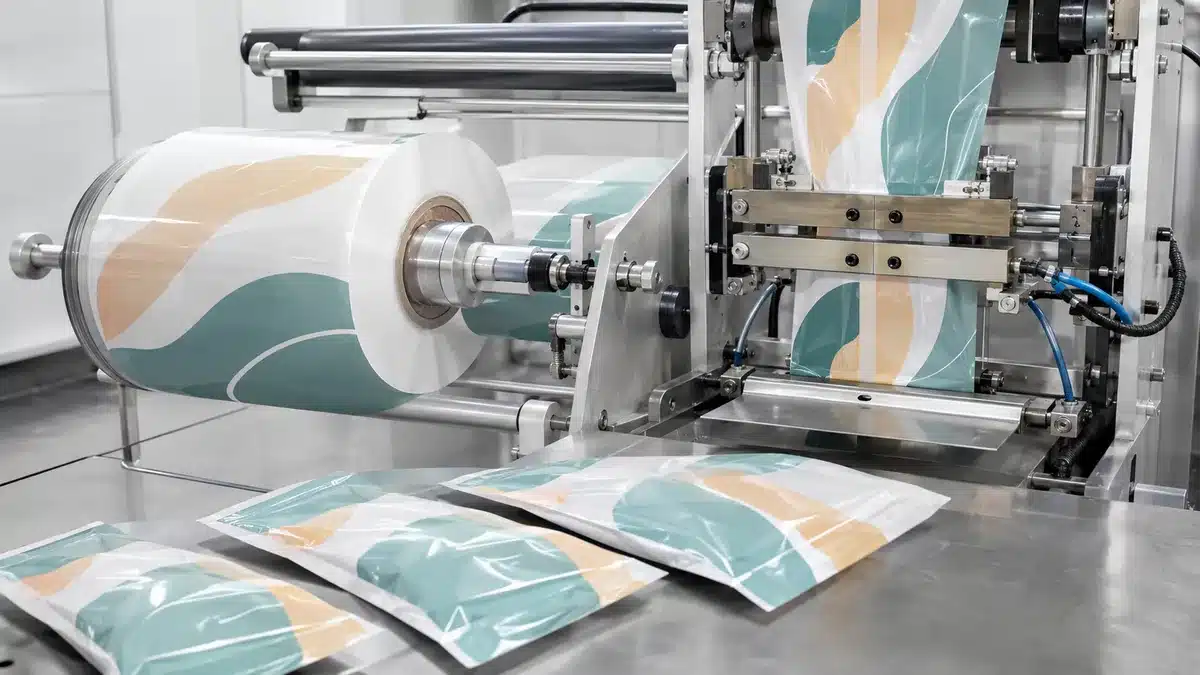
Both are polypropylene, which can support a PP-focused package design. That does not prove that a finished package is recyclable in a particular market. The FTC Green Guides at 16 CFR 260.12 require recyclable claims to reflect actual collection, separation, and recovery availability. Evaluate the complete package—including inks, coatings, metal, adhesives, labels, closures, and local infrastructure—under the applicable design guide and claim rules.
 English
 Japanese
 French
 Spanish
 Korean
 Italian
 Portuguese
 Dutch
Dutch Arabic
 Russian
 German