
BOPP is biaxially oriented polypropylene film. It is widely shortlisted for flexible packaging, labels, overwrap, and tape because suitable grades can combine clear presentation, useful moisture resistance, stiffness, low mass per unit area, and versatile surfaces. Those are film-family tendencies, not purchase specifications. The exact resin, layer design, thickness, treatment, coating, metallization, seal surface, and converting conditions determine whether a grade will work. A sound buying decision therefore moves from application duty to comparable data, samples, line trials, and final-package validation.
What Is BOPP Film?
For polymer background, consult the NIH PubChem polypropylene overview before comparing finished-film claims.
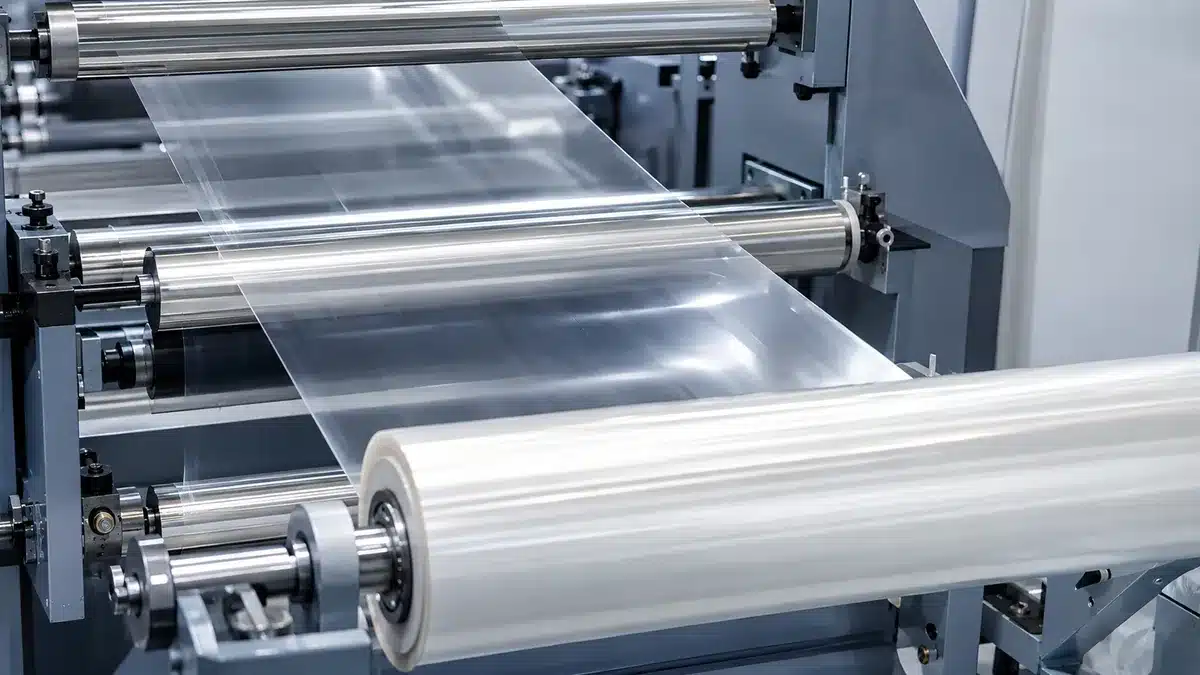
BOPP is polypropylene film stretched in both the machine direction (MD) and transverse direction (TD). Producers may use a sequential or simultaneous orientation route, and they may combine different polypropylene formulations and functional skin layers. The result is a film family rather than one fixed construction.
How biaxial orientation changes polypropylene film
In a common route polypropylene is melted and extruded into a thick sheet cooled reheated to a controlled stretching range extended in MD and TD heat-set surface-treated when required trimmed and wound Orientation aligns polymer chains in both.
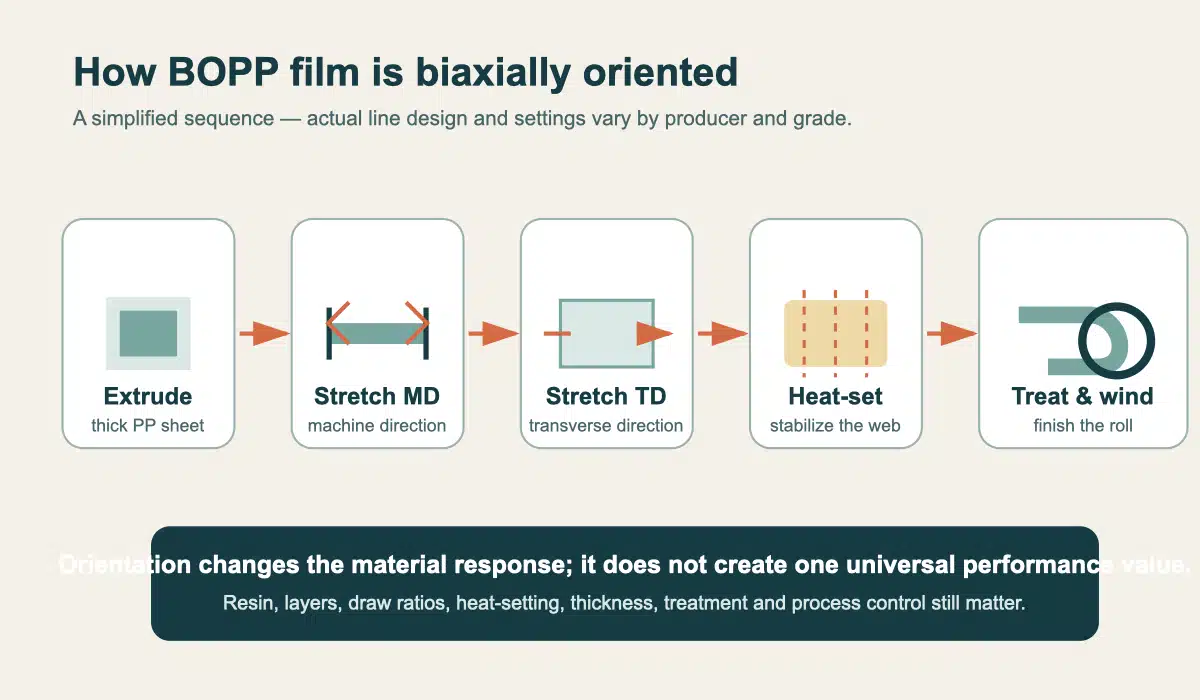
The word “oriented” does not establish a performance value. Draw ratios, resin and additive choices, layer design, heat-setting, thickness, and process control all affect the finished web. MD and TD data should remain separate because biaxial processing does not guarantee identical behavior in the two directions.
What the BOPP name does not specify
The family name alone does not tell a buyer whether the film is:
- monolayer or coextruded;
- treated on one side, both sides, or neither side;
- heat-sealable, non-sealable, peelable, or designed for a particular seal partner;
- clear, white, cavitated, matte, coated, or metallized;
- designed for labels, tape, printing, lamination, overwrap, or a particular packaging process;
- compliant for a specific food, market, contact time, or temperature;
- compatible with a defined recycling stream after inks, adhesives, coatings, labels, and closures are added.
Important: Treat “BOPP” as a starting material family. Approve the exact grade, construction, treatment side, thickness, test methods, and intended package duty.
Key Features and Benefits of BOPP Film
BOPP is attractive because orientation and grade design can create a useful balance of appearance, stiffness, moisture protection, machinability, and yield. Each benefit needs a matching limitation and verification field.
Clarity, gloss, and printable appearance
Clear packaging grades can offer high transparency and gloss, supporting product visibility and bright graphics. Matte, white, pearlized, and cavitated variants deliberately change that appearance. The buyer should therefore specify haze, gloss, color, opacity, and surface-defect expectations with the test method, specimen side, thickness, and acceptance rule.
Printing and lamination usually depend on a treated or coated surface. Corona treatment can raise surface energy, but treatment may decay during storage and can be affected by additives, contamination, humidity, and handling. A dyne reading is useful for screening; it does not by itself prove ink adhesion, adhesive bond, scuff resistance, or performance after aging.
Stiffness, yield, and dimensional behavior
Biaxial orientation commonly gives BOPP useful stiffness and tensile performance for its mass. Because polypropylene has relatively low density, a buyer may obtain more area per unit mass at the same nominal thickness than with a denser polymer film. This can improve material yield, but cost should still be compared per usable area and finished package—not only per kilogram.
Stiffness can support web handling, label dispensing, overwrap appearance, and crisp packaging. It is not a substitute for puncture, impact, tear, or flex-crack performance. ASTM D882-26 also makes tensile results dependent on specimen preparation, dimensions, grips, extension measurement, and test conditions. Supplier comparisons should keep thickness, MD/TD direction, method, conditioning, and value type consistent.
Moisture resistance and barrier options
Many plain BOPP packaging grades provide useful resistance to water-vapor transmission, which is one reason they are considered for dry snacks, confectionery, bakery goods, and overwrap. That does not mean every BOPP grade has the same WVTR or that a single layer will meet the product’s shelf-life target.
Plain BOPP is not automatically a strong oxygen, aroma, or light barrier. Coatings, metallization, and laminate partners may be added when those functions matter. Report OTR and WVTR with the exact grade or structure, thickness, temperature, relative humidity, test side, units, conditioning, and method. ASTM D3985-24 treats OTR as one determinant of package protection, not a shelf-life result. ASTM F1249-25 likewise requires agreed conditions for meaningful WVTR interpretation.
Surface, seal, and appearance versatility
Commercial BOPP families can be designed with treated surfaces, heat-sealable skins, barrier coatings, metallization, matte finishes, cavitation, opacity, anti-fog behavior, controlled shrinkage, release properties, or label-specific performance. This versatility can let a converter select a grade closer to the required role instead of forcing a plain film to perform every function.
The trade-off is that two films described simply as BOPP may not be interchangeable. A slip package can change COF and additive migration; a sealable skin can change temperature response; a coating can alter barrier, adhesion, and recycling assessment; cavitation can change density, opacity, stiffness, and compressibility. The functional layer and test definition must be part of the specification.
Common BOPP Film Types and Functional Grades
There is no single universal BOPP grade taxonomy. Suppliers group products by construction, surface, appearance, converting role, or end use. The following families are useful for inquiry and sample planning, but each supplier’s definition must be checked.
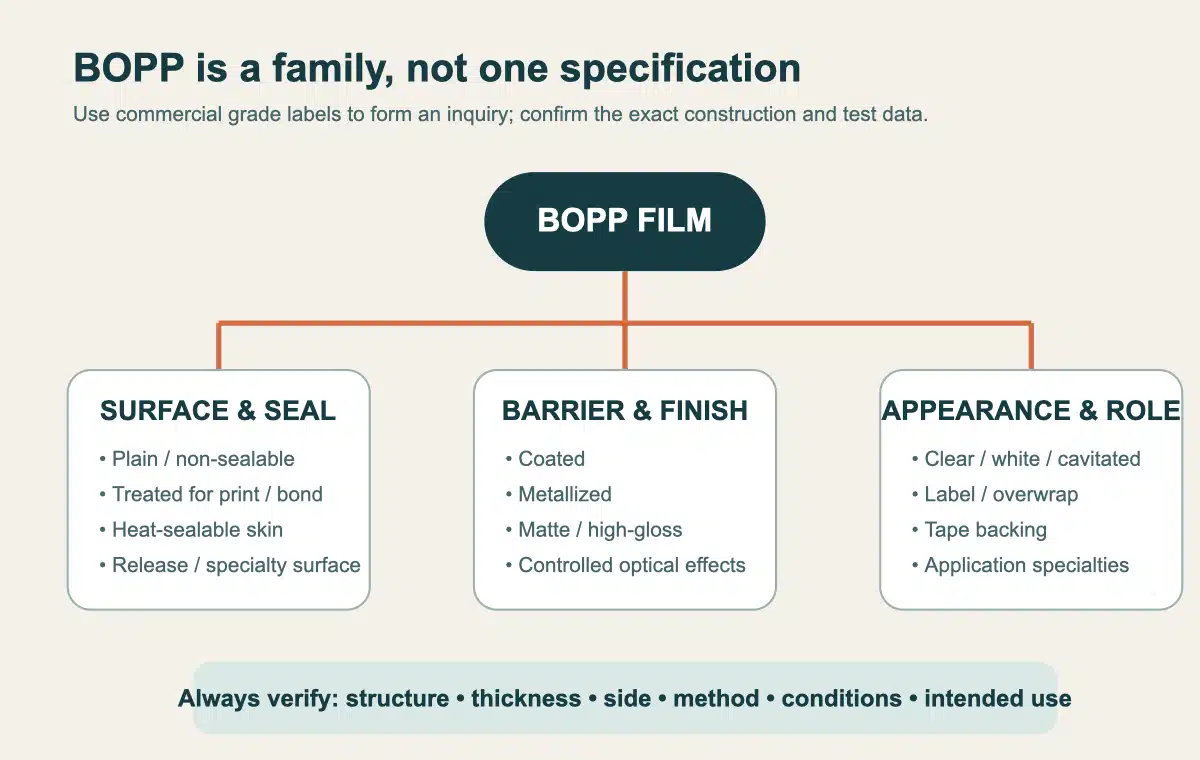
Plain, treated, and heat-sealable BOPP
- Plain or non-sealable BOPP is often used where the web provides print, stiffness, release, tape backing, label stock, or a structural role and sealing is unnecessary or handled by another layer.
- Surface-treated BOPP is prepared for printing, coating, or lamination on a declared side. The buyer should specify treatment side, minimum treatment at conversion, film age, storage, and the actual ink or adhesive system.
- Heat-sealable BOPP uses a designed skin or coating. Approval needs a seal curve or operating window for the exact seal side, partner, temperature, pressure, dwell, line speed, contamination condition, hot tack, cooled seal strength, and failure mode.
Coated and metallized BOPP
Coatings may be used to change sealing, barrier, print, release, or surface behavior. Metallized BOPP adds an aluminum layer that can improve measured gas, vapor, and light barrier when metal coverage and adhesion are suitable. Neither description proves a universal result.
For coated film, record coating chemistry, coated side, coat weight or supplier-defined control, cure, residual requirements where relevant, and compatibility with inks, adhesives, and sealing. For metallized film, include optical density or another agreed metal-control measure, pinholes, metal adhesion, treatment, barrier method, and performance after flexing, printing, lamination, slitting, and package making.
White, cavitated, matte, label, and specialty grades
White or pigmented films provide opacity and a print background. Cavitated films use a cellular internal structure to change density, opacity, yield, stiffness, and feel. Matte grades reduce surface gloss. Label grades may be engineered for wrap-around, pressure-sensitive, or in-mold converting requirements. Other specialty families can include anti-fog, perforated, high-slip, low-static, release, controlled-shrink, or tobacco-overwrap grades.
These names describe intended functions, not automatic compatibility. Confirm thickness, density or yield, opacity, gloss, COF, static, print side, seal behavior, die-cutting or dispensing performance, and any application-specific evidence before replacing one grade with another.
Main Applications of BOPP Film
BOPP appears across packaging and converting because suppliers can vary surface, appearance, seal, and barrier functions. Application names are only a first screen; the package duty and failure risks determine the grade.
| Application area | Typical BOPP role | Why it may be shortlisted | What still controls approval |
|---|---|---|---|
| Dry snacks, confectionery, and bakery packaging | Monoweb, printed web, metallized web, or laminate layer | Moisture resistance, appearance, stiffness, yield, available seal or barrier options | Product sensitivity, OTR/WVTR, light barrier, seals, machinability, shelf-life study |
| Labels | Printable face stock or label film | Clarity or opacity, stiffness, gloss/matte choices, dimensional behavior | Print, ink adhesion, die cutting, dispensing, container fit, shrink or squeeze behavior |
| Overwrap | Clear or specialty wrapping web | Presentation, stiffness, moisture protection, controlled slip or shrink | Fold, static, seal, tear, machine speed, package geometry |
| Adhesive tape | Film backing | Tensile behavior, consistent gauge, surface options | Adhesive anchorage, release, unwind, elongation, tear, aging |
| Laminates and coated structures | Outer print web, barrier-carrying web, or structural layer | Print surface, moisture contribution, metallization/coating options | Ink, adhesive, cure, bond, barrier after conversion, sealant partner, curl |
| Technical and stationery uses | Release, graphic, protective, or converting substrate | Surface and dimensional properties tailored by grade | Exact coating, temperature, stress, aging, and end-use tests |
Flexible food and consumer-goods packaging
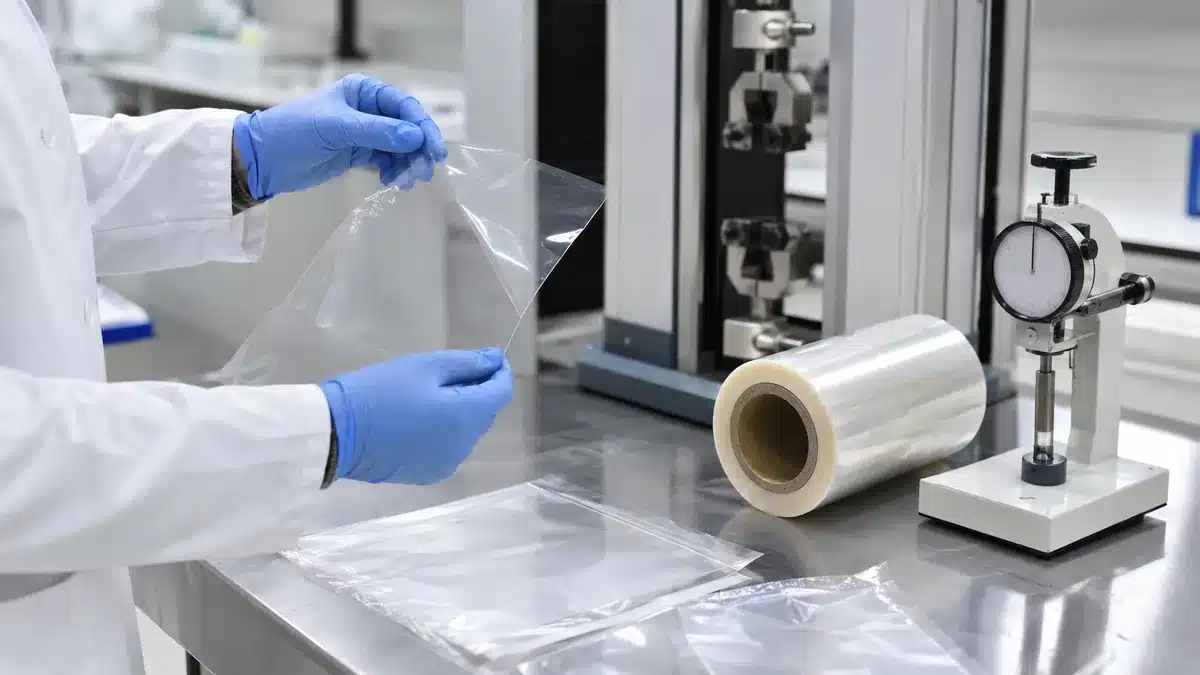
BOPP is commonly shortlisted for dry foods, confectionery, biscuits, bakery items, noodles, personal-care packs, and similar consumer goods where presentation, moisture control, line speed, and cost per area matter. It may be used as a plain printed monoweb, a sealable coextruded film, a metallized barrier web, or an outer layer laminated to a sealant.
The package must still be designed around the product Fat and aroma sensitivity oxygen demand water activity light sensitivity sharp edges filling temperature contamination in the seal distribution abuse and shelf-life target can change the structure Food-contact evidence must match the.
Labels, overwrap, and adhesive tape
Label applications can use clear, white, cavitated, matte, or specialty BOPP face stocks. The critical checks may include print and coating adhesion, opacity, die cutting, dispensing, bottle or container behavior, adhesive compatibility, and dimensional change. Overwrap applications additionally depend on fold, slip, static, seal, tear initiation, shrink control, and machine geometry.
For adhesive tape, BOPP can serve as a backing, but the film and adhesive must be qualified as a system. Tensile strength does not replace elongation, tear, adhesive anchorage, peel, tack, holding power, unwind, aging, and temperature testing.
Lamination, coated structures, and technical uses
In a laminate BOPP may carry reverse printing metallization a coating or structural stiffness while another layer provides sealing toughness or additional barrier The design should assign one or more jobs to.
Technical uses can include release and graphic applications, stationery, decorative webs, protective constructions, and substrates for further coating. These roles can impose very different requirements for heat, surface cleanliness, electrical behavior, dimensional change, winding, and aging, so a packaging grade should not be assumed suitable without application-specific evidence.
Limitations and Failure Modes to Check
The most common BOPP errors begin with a correct general tendency that is treated as a complete specification:
- Useful moisture resistance becomes “high barrier.” The result can be unexpected oxidation, aroma loss, or shelf-life failure when oxygen, light, seals, flexing, or package leakage controls the product. Define OTR, WVTR, light, aroma, and package-integrity needs separately.
- A treated surface becomes “print ready forever.” Treatment decay, additive migration, contamination, film age, storage, and the chosen ink or adhesive can cause poor wetting or bond. Verify treatment at conversion and run adhesion tests after cure and aging.
- A sealable grade becomes “easy to seal.” A narrow seal window, low hot tack, contamination, jaw temperature error, or incompatible seal partner can cause leaks or slow the line. Map the operating window, not one favorable temperature.
- Stiffness becomes toughness. BOPP may be a poor answer when sharp edges, puncture, flex cracking, cold abuse, or high elongation dominate. Use the failure-specific method and compare alternative structures when needed.
- Clear appearance becomes stable high-temperature processing. Heat can cause shrinkage, distortion, registration loss, curl, or seal-through problems. Measure the actual web and laminate under representative tension and thermal exposure.
- A PP-rich package becomes “recyclable everywhere.” Coatings, metallization, inks, adhesives, labels, closures, residues, collection, sortation, and reprocessing all affect the outcome. Apply a current local design-for-recycling protocol to the complete package.
Warning: Do not use one favorable tensile, barrier, seal, or surface reading to approve unrelated failure modes. Film, laminate, seal, and finished-package tests answer different questions.
How to Choose BOPP Film for an Application
Use a sequence that starts with package failure rather than a familiar film name:
- Define the product and process. Record product composition, sensitivity, package format, fill temperature, storage, distribution, opening method, shelf-life target, and target market.
- Assign the film’s role. Decide whether BOPP must provide print, stiffness, moisture resistance, light or gas barrier through a functional layer, sealing, label performance, overwrap, or tape backing.
- Set measurable requirements. Choose relevant fields for thickness, yield, haze, gloss, opacity, tensile, elongation, tear, puncture, shrinkage, COF, static, treatment, adhesion, OTR, WVTR, seal behavior, and winding.
- Identify the required grade construction. Specify clear or opaque, cavitated or solid, treated side, seal side, coating, metallization, surface finish, slip package, and layer structure.
- Normalize supplier data. Compare the same methods, directions, conditioning, thicknesses, units, value types, and acceptance rules.
- Validate conversion and end use. Test representative rolls through printing, coating, lamination, curing, slitting, bag or label making, filling, sealing, aging, distribution, and shelf-life work as applicable.
| Dominant requirement | BOPP direction to investigate | Critical verification |
|---|---|---|
| Clear retail presentation | Clear treated or sealable packaging grade | Haze, gloss, defects, print, seal, scratch, line trial |
| Moisture-sensitive dry product | Plain, coated, or metallized grade depending on the full barrier target | WVTR conditions, OTR/light needs, seals, shelf-life study |
| Opaque or low-density label | White or cavitated label grade | Density/yield, opacity, print, die cutting, dispensing, container behavior |
| High-speed overwrap | Overwrap grade with suitable slip, static, seal, and shrink behavior | Machine speed, fold, seal, static, tear, package geometry |
| Tape backing | Tape-oriented BOPP grade | MD/TD tensile and elongation, adhesive anchorage, unwind, aging |
| High puncture or heat duty | BOPP may need reinforcement, a specialty construction, or another film family | Puncture/flex/thermal tests on the complete structure |
What to Put in a BOPP Film Specification
A useful specification makes quotations comparable and separates typical data from guaranteed limits.
| Specification group | Fields to define | Evidence to request |
|---|---|---|
| Identity and construction | Supplier grade, resin family, layer structure, clear/white/cavitated, coating or metallization, treated and seal sides | Current TDS, construction statement, approved sample |
| Dimensions and roll | Nominal thickness, tolerance, width, length or mass, core, outer diameter, winding direction, joints, roll build | Measurement method, roll map, packing specification |
| Optical and appearance | Haze, gloss, opacity, color, gels, scratches, wrinkles, metal appearance | Method, sample side, limits, visual standard |
| Mechanical and thermal | MD/TD tensile and elongation, tear, puncture or impact where relevant, shrinkage or dimensional change | Test methods, conditioning, temperature, directions, units, value type |
| Surface and machinability | Treatment side and minimum at conversion, COF, static, slip, antiblock, print or adhesive system | Method, film age, storage, ink/adhesive trial, line records |
| Barrier | OTR, WVTR, light or aroma requirement; coated/metallized details | Exact conditions, thickness, test side, units, converted-structure results |
Do not compare one supplier’s typical value with another supplier’s guaranteed limit. Record whether every value is typical, minimum, maximum, target, or acceptance range and who owns the test.
How to Validate BOPP Film Before Production
Approval should narrow uncertainty in stages:
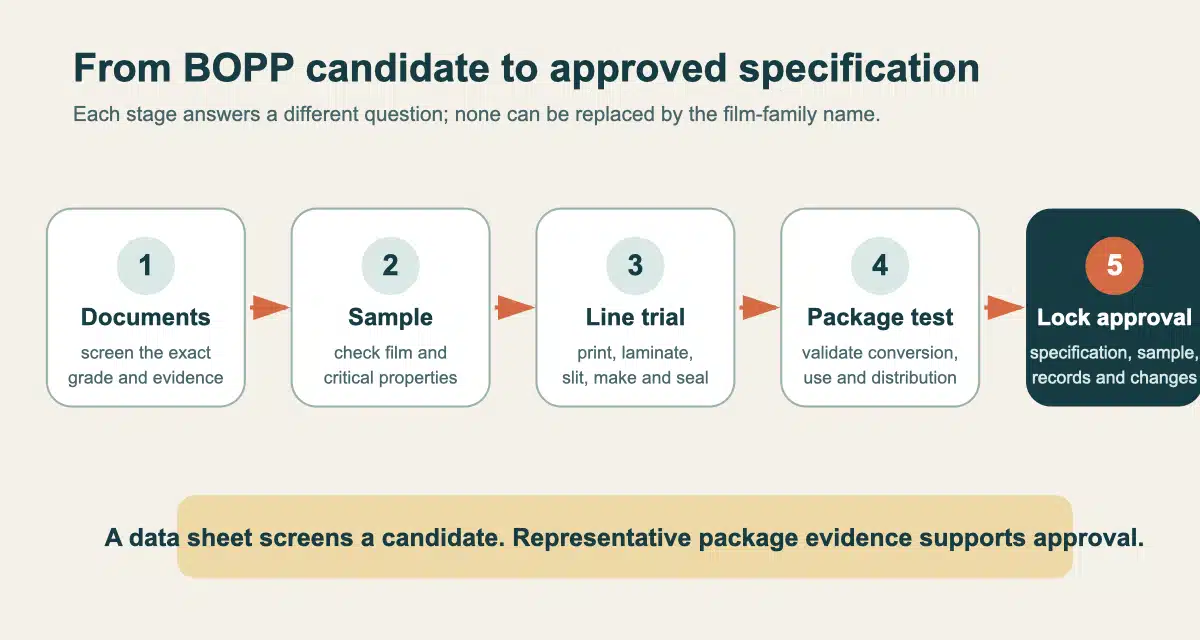
- Screen documents. Confirm grade identity, structure, treatment and seal sides, methods, conditions, typical-versus-guaranteed status, regulatory scope, and evidence dates.
- Inspect a representative sample. Check thickness, appearance, defects, treatment, COF, blocking, curl, winding, and the properties tied to the package’s main failure risks.
- Run converting trials. Use the intended inks, coatings, adhesives, cure, web tensions, speeds, temperatures, slitting, label or bag-making equipment, and storage intervals.
- Map the operating window. For sealing or other sensitive processes, test a range of conditions and record failure modes, not only the best result.
- Test the converted package. Measure relevant barrier, bond, seal, leak, drop, puncture, flex, aging, distribution, opening, and shelf-life performance after representative conversion and handling.
- Lock the approved basis. Retain the signed specification, approved sample, test report set, artwork and structure revision, certificate fields, roll identification, deviations, and supplier change-control requirements.
Important: A data sheet qualifies a candidate for evaluation. It does not prove that printing, lamination, sealing, filling, distribution, shelf life, food contact, or recycling goals have been met by the final package.
Frequently Asked Questions
Is BOPP film heat-sealable?
It depends on the grade and surface. Many BOPP films use a heat-sealable skin or coating, while plain non-sealable grades rely on another layer or are used where no seal is required. Verify the seal side, partner, temperature, pressure, dwell, line speed, hot tack, cooled strength, contamination tolerance, and failure mode.
Is BOPP film a high-barrier film?
Not as an unconditional statement. Many BOPP grades offer useful moisture resistance, but oxygen, aroma, light, and water-vapor performance varies with grade, thickness, coating, metallization, test conditions, conversion, and flexing. Define each barrier target separately and test the exact film or laminate.
Can BOPP film be used for food packaging?
Yes, suitable grades are widely used in food packaging, but the application label does not prove compliance. Review the exact film, additives, coatings, inks, adhesives, and final structure against the target market, food type, contact time, and temperature. The U.S. FDA’s food types and conditions-of-use framework illustrates why intended use is part of the evidence.
Is BOPP film recyclable?
It depends on the complete package and the local system. A plain PP film and a printed, metallized, coated, laminated, labeled, or contaminated package may receive different assessments. Use the current applicable design-for-recycling guideline—such as the relevant RecyClass guidance in its scope—and confirm actual collection, sortation, reprocessing, and end-market conditions before making a claim.
Specify the Grade, Not Just BOPP
BOPP can be an efficient platform for clear or opaque packaging, labels, overwrap, tape, and functional laminates. Its value comes from selecting a construction that fits the film’s assigned job and proving that fit under representative conditions.
Before approval, lock down:
- the exact grade, layer structure, thickness, treatment, coating, metallization, seal side, and winding details;
- comparable MD/TD, optical, surface, friction, thermal, barrier, and seal methods with conditions and limits;
- representative printing, lamination, coating, slitting, labeling, bag-making, filling, sealing, aging, and distribution trials;
- exact-market food-contact or other compliance evidence where relevant;
- complete-package support for any recycling or sustainability statement;
- an approved sample, specification, certificate fields, deviations, traceability, and change-control agreement.
That evidence turns a broad BOPP film guide into a defendable purchasing and packaging decision.
Related Bestypack Resources
- BOPP vs CPP: A Guide to the Differences
- Heat Sealable BOPP Film
- Clear/Transparent BOPP film High Quality
- Overwrap BOPP Film Manufacturer
- BOPP Packaging Film: Types of Different Functions
- BOPP
 English
 Japanese
 French
 Spanish
 Korean
 Italian
 Portuguese
 Dutch
Dutch Arabic
 Russian
 German