
Shrink wrap and stretch wrap tighten in fundamentally different ways. Shrink wrap is placed around a product or bundle and then exposed to controlled heat, which makes the film contract and conform to the pack. Stretch wrap is elongated as it is applied—most often around a pallet load—and its applied tension and recovery help hold the load together. The practical boundary is therefore not “which plastic film is stronger?” but “what packaging job must the system perform?”
Choose around the package level, product geometry, heat sensitivity, distribution hazards, presentation needs, equipment, and validation method. A retail multipack and a warehouse pallet may both need clear film, yet they require different application controls and different evidence of success. Before requesting a quotation, define the product or load, the application method, the failure modes that matter, and how the finished package or unit load will be accepted.
The Short Answer: Heat Shrinkage vs. Elastic Tension
For polymer background, consult the NIH PubChem polyethylene overview before comparing finished-film claims.
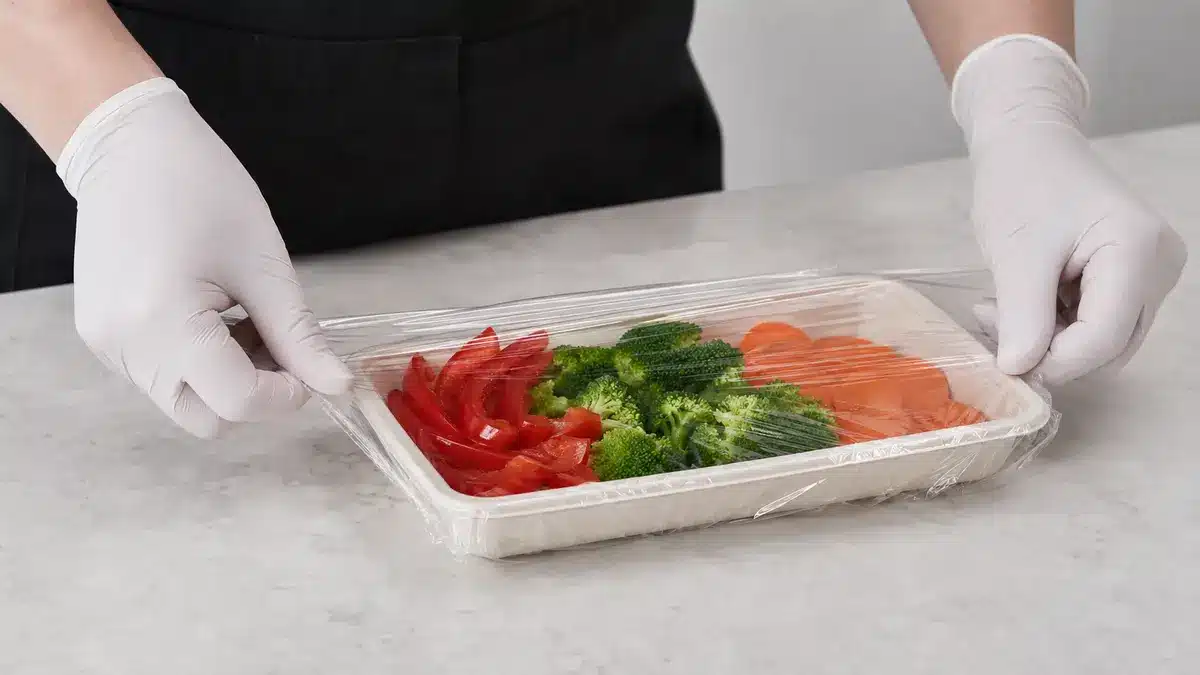
The ISO packaging vocabulary captures the core distinction: shrink film reduces in size when heated so that it conforms to packaged items, whereas stretch wrap elongates during application. That difference determines the equipment, the process controls, and the most common package level for each system.
Shrink wrap is generally selected when the film must become a close-fitting enclosure around an individual product, tray, bundle, or multipack. The operation usually includes film placement, a seal or enclosure step, and a controlled heating step. Stretch wrap is generally selected when a palletized or otherwise unitized load needs restraint during handling, storage, and distribution. It is wrapped under controlled elongation and tension, without a shrink tunnel.
These are typical roles, not absolute prohibitions. Large industrial loads can use heat-shrinkable covers, and narrow stretch films can bundle smaller objects. Identify the required function first:
- If the priority is a conforming product or bundle package, evaluate a shrink system.
- If the priority is stabilizing a unit load through applied tension, evaluate a stretch system.
- If both functions are needed, specify and validate them separately.
Neither name proves finished-package performance. The film, application equipment, product or load, and operating recipe must be specified together.
What Shrink Wrap Is and How It Works
Heat-shrinkable film is manufactured so that molecular orientation is stored in the film structure. When the film is exposed to an appropriate temperature, some of that orientation is released and the film contracts. The amount and force of contraction depend on the material, construction, manufacturing history, direction, temperature, and time. This is why “shrink percentage” by itself is an incomplete buying specification.
ASTM D2732 addresses unrestrained linear thermal shrinkage, while ASTM D2838 addresses shrink tension and related orientation-release behavior. The methods answer different questions: how much an unrestrained specimen changes dimension, and what force it can exert under defined restraint. Neither result, alone, predicts whether a finished pack will have clean corners, sound seals, or acceptable product distortion.
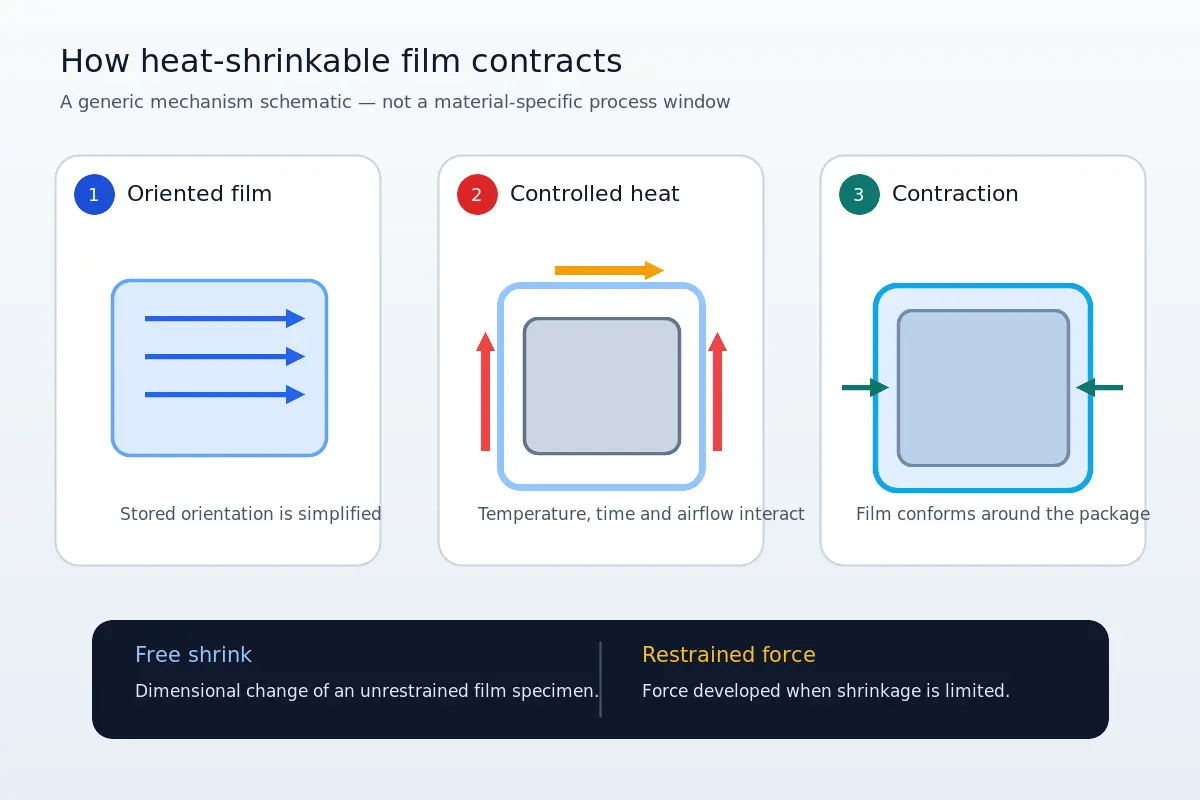
How Heat Makes Oriented Film Contract
A shrink-packaging cycle normally has three linked stages: create an appropriately sized film enclosure, seal it where the package design requires a seal, and expose it to controlled heat. In a tunnel, temperature, conveyor speed, dwell time, airflow, and product spacing work together. OEM guidance from Heat Seal and Kallfass emphasizes trial-based adjustment because films and products do not run at one universal setting.
Excess film, insufficient evacuation, premature film-to-product contact, uneven heat, or unsuitable shrink force can produce wrinkles, dog ears, fish eyes, burn-through, or distortion. A stable process window belongs to a defined film, product, bag size, seal system, tunnel, airflow, and line speed.
Common Shrink-Film Material Families
Commercial shrink-film families include polyolefin and polyethylene constructions, with PVC also present in some markets and applications. Those labels are only a starting point. Film construction, thickness, shrink balance by direction, shrink force, seal behavior, toughness, optics, slip, perforation, and equipment compatibility can vary within the same broad polymer family.
A buyer should avoid assuming that every film described as “POF,” “PE,” or “PVC” has the same temperature range, force, clarity, food-contact status, or recycling route. Request the exact product data, identify the applicable methods and conditions, and run the film on the intended package and equipment.
What Stretch Wrap Is and How It Works
Stretch wrap is applied by elongating the film as it travels around a product group or unit load. The applied film attempts to recover, which contributes to inward force on the load. Cling helps adjacent layers remain together, while the wrap pattern determines where layers accumulate and how the film connects the load to the pallet.
Pre-stretch is important, but it is not a complete performance measure. Film can be elongated in the carriage and then experience additional stretch as it is applied. The final result depends on the film, pre-stretch system, secondary stretch, wrap force, layer count, overlap, top and bottom treatment, load profile, and environmental exposure. A high pre-stretch percentage does not automatically mean adequate containment.
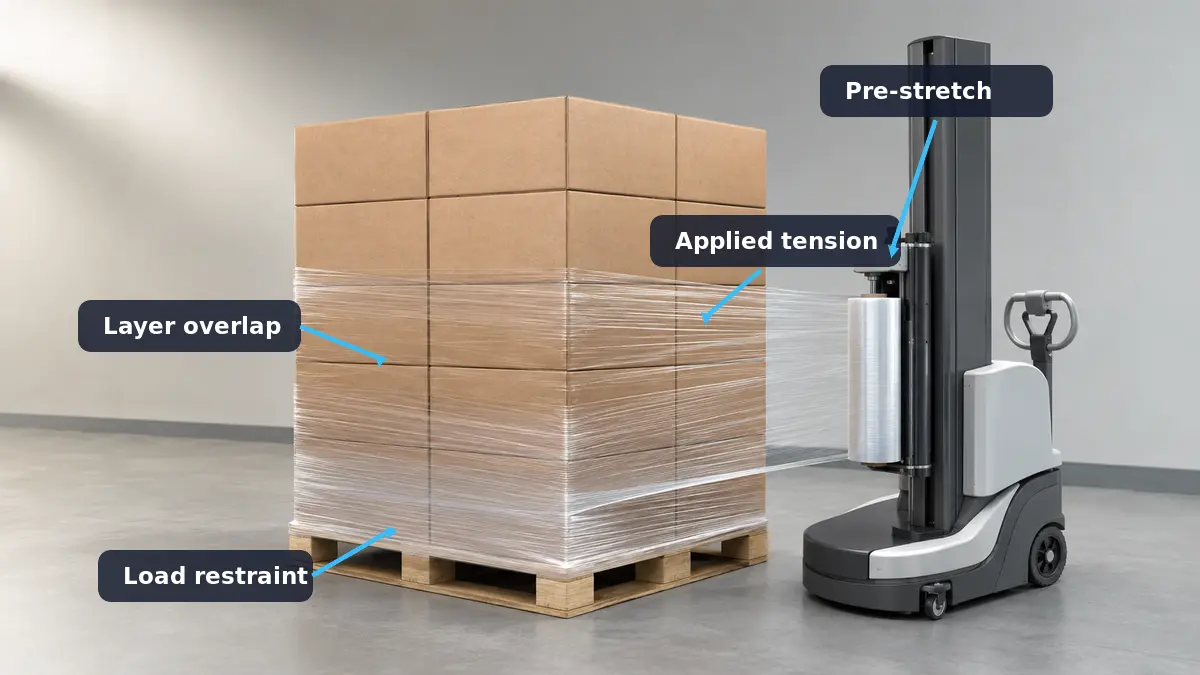
How Pre-Stretch and Elastic Recovery Create Holding Force
A useful operating concept is containment force at a specific height on the load. In a simplified relationship, it reflects the applied wrap force multiplied by the effective number of film layers at that location. Because a wrap pattern places different layer counts at different heights, containment should be checked where the load needs support, not assumed from one machine setting.
The relationship has limits. Transport adds vibration, impact, handling, and time-dependent change; load stiffness, carton strength, friction, voids, overhang, and protrusions also affect stability. ASTM D8314 therefore addresses applied stretch film and wrapping equipment, not just an isolated roll property.
Common Stretch-Film Material Families
LLDPE and related polyethylene resins are common components of stretch-film structures because converters can design combinations of elongation, toughness, puncture resistance, cling, and processing behavior. Cast and blown films can also differ in operating feel and property balance. These are formulation and conversion choices, not universal rankings.
A resin supplier page can explain why a resin family is used, but it cannot prove the performance of a finished roll on a particular pallet. Buyers need the finished-film specification, roll format, equipment compatibility, application conditions, and load-level validation.
Shrink Wrap vs. Stretch Wrap: Side-by-Side Differences
The most useful comparison keeps the axes identical and separates typical fit from proof of performance.
| Decision axis | Shrink wrap | Stretch wrap | What to verify |
|---|---|---|---|
| Tightening mechanism | Film contracts after controlled heat exposure | Film is elongated during application and restrains through applied tension and recovery | Exact film, application recipe, and finished result |
| Typical package level | Individual product, tray, bundle, or multipack | Palletized or unitized load | The actual packaging function, including edge cases |
| Main equipment | Film feed or bagging, sealer where required, heat tunnel or controlled heat source | Hand dispenser, semi-automatic wrapper, or automatic wrapping system | Equipment capacity, film format, controls, guarding, and line integration |
| Product exposure | Product and package experience the shrink-heating process | No shrink heat is needed for conventional stretch wrapping | Heat sensitivity, deformation risk, condensation, and environment |
| Presentation | Can create a close-fitting retail or bundle package | Clear film can maintain load visibility, but overlap and wrap pattern remain visible | Film optics plus seals, wrinkles, overlap, contamination, and process |
| Validation route | Film shrink properties plus seal and finished-package trials | Film properties plus applied-film, load, handling, and transport evaluation | Methods, conditions, hazards, and acceptance criteria |
This table does not produce a universal winner. A business comparison needs site-specific material, labor, energy, uptime, scrap, damage, maintenance, and capital data under equivalent acceptance criteria.
Which Packaging Tasks Fit Each System?
Start with the object being packaged and the risk it must survive. The same product may use shrink film at the sales-unit level and stretch film at the distribution-pallet level. Those layers are not redundant when they perform different jobs.
Retail Products, Multipacks, and Bundles
Shrink wrap is often a practical fit when a.
Stretch bundling can be considered for some small groups or long items when heat is undesirable and a tension-applied wrap is sufficient. It should be treated as a distinct application, not as evidence that pallet stretch film and shrink film are interchangeable.
Pallet Loads, Warehousing, and Distribution
Stretch wrap is the conventional starting point for many pallet loads because it can connect cases or bags into a unit and, when correctly applied, bond the load to the pallet. The load still needs a sound pallet pattern, adequate primary and secondary packaging, manageable overhang, and controls for sharp edges or protrusions.
| Packaging task | Typical system fit | Key input | Verification | Important limitation |
|---|---|---|---|---|
| Tight retail multipack | Shrink | Product geometry, heat sensitivity, presentation | Seal and finished-pack trial | Heat and shrink force may affect the product |
| Tray bundle for handling | Often shrink | Tray stiffness, film force, openings | Bundle integrity and handling trial | Not automatically a transport-ready pallet |
| Stable carton pallet | Stretch | Load profile, pallet bond, route hazards | Applied containment and distribution test | Film cannot repair a poorly built load |
| Irregular or sharp-edged pallet | Stretch with system accessories, or another unitization method | Protrusions, edge protection, load movement | Controlled wrap trial and transport simulation | Puncture and film breaks may dominate |
| Heat-sensitive product group | Usually stretch or a nonheat system | Product temperature limit and required function | Product and package trial | Stretch may not provide the desired retail enclosure |
| Outdoor or prolonged exposure | Application-specific | Weather, UV, duration, top protection | Environmental and route-specific test | Indoor stretch guidance cannot be extended automatically |
The final choice may include trays, corner boards, top sheets, or straps. Evaluate the complete system, not the film alone.
Equipment, Throughput, and Operating Implications
A shrink line coordinates enclosure formation, sealing, heat input, airflow, conveyor movement, and cooling. A stretch operation ranges from a hand dispenser to a fully automatic wrapper with powered pre-stretch, load sensing, automated film attachment, and line controls. The equipment decision should follow the product or load family and the required process control.
Shrink Tunnels, Sealers, and Heat Management
For shrink packaging, throughput depends on product spacing, seal cycle, tunnel recovery, heat distribution, airflow, changeover, cooling, and downstream handling. Raising temperature to compensate for excessive speed can create defects rather than usable output.
Buyers should review product heat sensitivity, guarding, ventilation, maintenance access, control accuracy, and the OEM manual. Ask what stable window produces an accepted package on the intended equipment without product damage.
Hand and Machine Stretch-Wrapping Systems
Hand wrapping offers flexibility and low capital entry, but the result depends heavily on operator technique and roll ergonomics. Automated wrappers can improve repeatability and integrate powered pre-stretch and recipes, while adding space, maintenance, training, and line-interface requirements.
Do not assume a universal throughput or payback point. Document the load mix, containment, wrap cycle, film changes, breaks, operator work, maintenance, uptime, and line constraints. Machine film must match the carriage and controls.
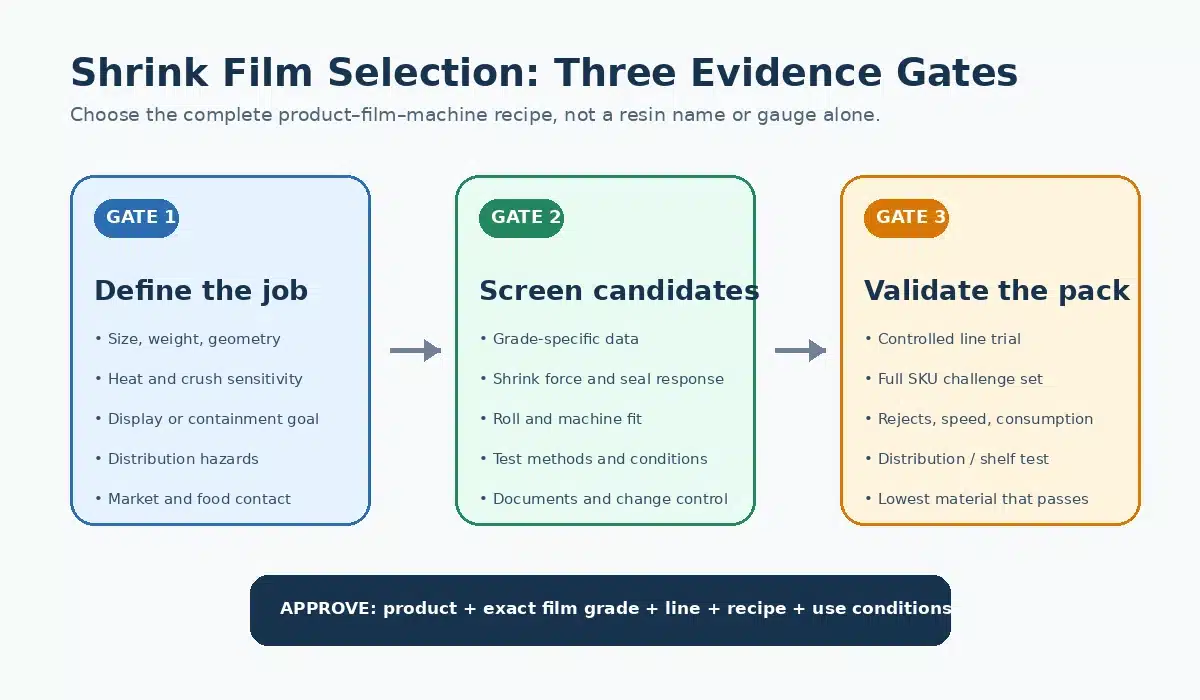
How Buyers Should Specify and Validate the Film System
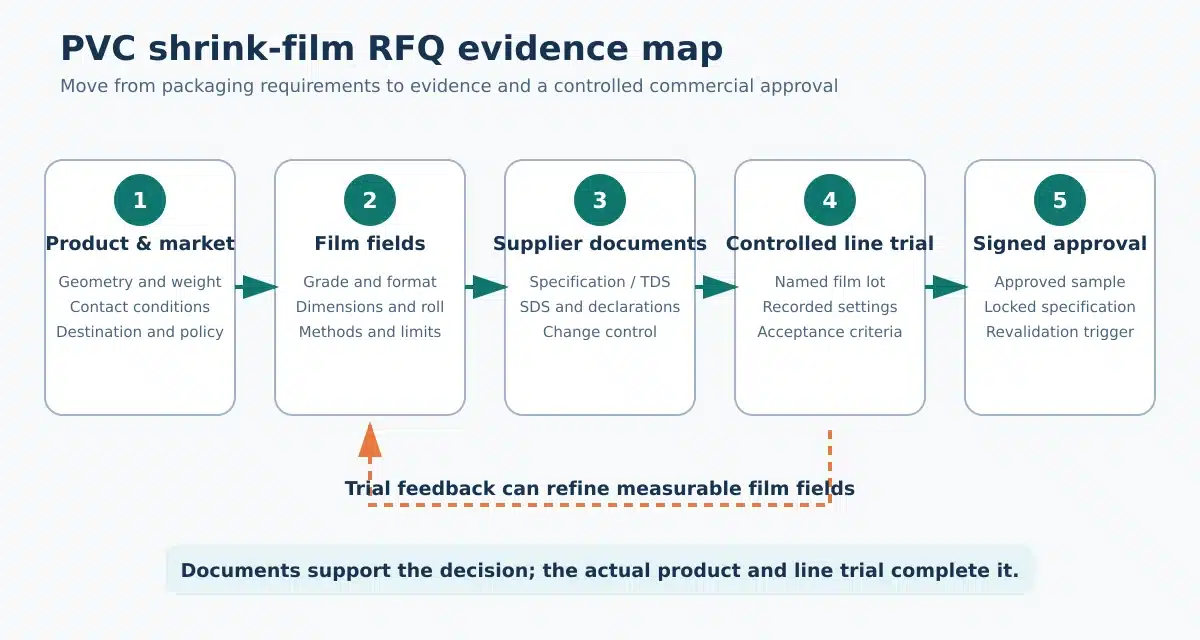
A useful specification separates film identity, application conditions, and finished-system acceptance. It also names the test method and conditions instead of asking for vague properties such as “strong,” “high shrink,” or “heavy duty.”
Build a Complete Supplier Brief
Before quotation, provide as many of these inputs as are available:
- Product, bundle, or unit-load description, dimensions, mass, geometry, and photographs or drawings.
- Package level and required function: presentation, enclosure, bundling, dust protection, pallet stabilization, or another defined job.
- Film format, width, thickness range, roll dimensions, core, unwind direction, and current film identification.
- Equipment make and model, sealing system or pre-stretch carriage, control range, line speed, and changeover constraints.
- Product heat sensitivity for shrink applications; load profile, pallet pattern, overhang, protrusions, and pallet-bond requirement for stretch applications.
- Storage and distribution route, duration, temperature, humidity, handling, vibration, impact, and outdoor exposure.
- Current failures, retained samples, defect photographs, recipes, batch traceability, and material use per accepted package or load.
- Required documents, applicable test methods, sampling plan, acceptance criteria, order volume, and trial quantity.
These fields help a supplier recommend a testable configuration. They do not allow the supplier—or the article—to guarantee a result without trials.
Validate the Applied Package or Unit Load
Use a staged validation workflow:
- Confirm film identity, dimensions, construction, roll format, and relevant product documentation.
- Check film-level properties with named methods and conditions For shrink film distinguish free shrink from shrink.
- Establish an equipment recipe on representative products or loads. Record settings, film mass, observations, defects, and traceability.
- Test the finished package or applied wrap against defined acceptance criteria.
- Simulate relevant handling and distribution hazards, using a suitable protocol such as an ISTA unit-load procedure where appropriate.
- Run a controlled production trial and monitor changeover, uptime, scrap, film breaks, damage, and operator work.
- Approve the specification, recipe range, inspection method, and change-control process.
Standards provide methods, not automatic acceptance thresholds. A buyer must define acceptable seal integrity, product distortion, load movement, damage, and handling outcomes for the actual route.
Common Selection Mistakes and Failure Modes
Troubleshoot the System, Not Just the Film
The most expensive mistake is often diagnosing “bad film” before checking the package system. A disciplined review moves through product or load, film identity, equipment condition, application recipe, environment, and finished-result testing.
Shrink defects can have overlapping causes. Dog ears, wrinkles, fish eyes, weak seals, burn-through, or distortion may relate to film size, perforation, sealing, heat, dwell time, airflow, product contact, or shrink-force balance. A symptom starts an investigation; it does not prove one cause.
Stretch-film breaks can involve protrusions, overhang, damaged rolls, film flaws, threading, carriage condition, clamp faults, settings, or film-equipment mismatch. Instability may reflect the pallet pattern, carton compression, inadequate support, poor pallet bonding, or an untested distribution hazard.
For either system:
- Verify the exact film and lot before changing settings.
- Inspect product or load geometry and equipment condition safely.
- Compare the current recipe with an approved baseline.
- Change one defined variable at a time where practical.
- Retain samples and document defects, settings, environment, and outcome.
- Escalate machine, safety, or product-compatibility questions to the appropriate OEM, film supplier, or packaging test specialist.
Avoid copying generic numeric settings; a correction for one film-product-machine combination may harm another.
Frequently Asked Questions
Can Stretch Wrap Be Heat-Shrunk?
No. Conventional stretch wrap is designed for elongation during application; shrink film is designed to contract under controlled heat. Heating unspecified stretch film does not create a validated shrink package and may cause damage. Use a specified heat-shrinkable film and compatible equipment.
Can Shrink Wrap Be Used on Pallets?
Yes, some industrial systems use heat-shrinkable covers on large loads. Conventional pallet stretch wrapping remains the main unit-load route in stretch-film guidance. Choose by load geometry, protection, heat process, equipment, route, and validation; pallet use does not make the systems interchangeable.
Which Wrap Gives Better Product Visibility?
Both can use clear film. Visibility depends on construction, thickness, haze, gloss, seals, wrinkles, overlap, contamination, and application quality. Compare product-specific optical data and accepted sample packs, not category names.
Which Option Uses Less Film?
Neither always uses less. Compare film mass per accepted package or load under equivalent criteria. Stretch use depends on film, pre-stretch, pattern, layers, and load; shrink use depends on dimensions, thickness, scrap, geometry, and yield. Downgauging counts only if the system still passes validation.
Are Shrink Wrap and Stretch Wrap Recyclable?
Some clean polyethylene films may be compatible with a film-recycling stream, but recyclability is not proven by calling a package “PE.” The full design—including layers, labels, inks, adhesives, metal, color, contamination, and attachments—matters, as explained in the APR PE Flexible guidance. Collection is also local. For example, New York State guidance includes certain clean stretch and shrink films in its film collection context, but that does not establish acceptance elsewhere. Confirm the local program and the exact package design.
What Information Should I Send a Film Supplier?
Send the application, dimensions, mass, images, required function, current film and failures, equipment, process limits, route, volume, documents, methods, criteria, and trial plan. Add heat sensitivity and tunnel details for shrink film; add pallet pattern, load profile, pre-stretch system, wrap pattern, and pallet bond for stretch film.
Choose the System Around the Packaging Job

Choose shrink wrap when the validated job calls for heat-activated conformance around a product, tray, or bundle. Choose stretch wrap when the validated job calls for tension-based unitization around a load. When both functions are needed, specify them as separate layers of the packaging system rather than forcing one film to do every job.
The category name is only the beginning of the specification. Define the object, function, equipment, process, hazards, acceptance criteria, and evidence required. Then trial the exact film on representative products or loads and validate the finished result. A supplier can respond more effectively when the inquiry contains real operating data, and the buyer can compare proposals on an equivalent, testable basis.
 English
 Japanese
 French
 Spanish
 Korean
 Italian
 Portuguese
 Dutch
Dutch Arabic
 Russian
 German