
Stretch film can unitize pallet loads, reinforce bundles, shield surfaces from routine warehouse contamination, and make handling more consistent. Those advantages come from the interaction between the film, the wrap cycle, the load, the pallet, and the distribution environment—not from film thickness alone. For a buyer, the useful question is therefore not simply whether stretch film is “strong.” It is whether a documented film and application method can deliver the required containment with acceptable material use, cycle time, ergonomics, and damage performance in a controlled trial.
What Stretch Film Does in a Packaging System
For polymer background, consult the NIH PubChem polyethylene overview before comparing finished-film claims.
For polymer background, consult the NIH PubChem polyethylene overview before comparing finished-film claims.
Stretch film, also called stretch wrap, is a highly extensible film applied under tension around goods. Most industrial stretch wrap is polyethylene-based, commonly using linear low-density polyethylene formulations, but material family alone does not define the performance of a finished film. Resin selection, layer design, thickness, cling system, processing route, and application conditions all influence the result.
During wrapping, the film is extended and then tends to recover toward its original dimensions. That recovery can maintain force around the load, while film-to-film cling helps the overlapping layers remain together. The applied web may unitize packages to one another, connect the load to the pallet, reinforce selected zones, or provide a sacrificial outer surface.
These functions depend on the complete system. Pre-stretch, applied stretch, wrap force, overlap, film placement, the number of effective layers, corner geometry, package stiffness, and load relaxation all affect containment. A tensile, puncture, cling, or stress-retention result can help compare films under a stated method, but it does not by itself prove that a wrapped pallet will survive its distribution route.
The Main Advantages of Stretch Film
The value of stretch film is best assessed as a set of conditional outcomes. A stable, repeatable wrap cycle can create several advantages, but each one must be matched to the actual load and process.
Load Unitization and Stability
Stretch film can consolidate cartons, bags, trays, or other packages into a unit that is easier to handle as one pallet load. Applied force and elastic recovery can resist relative movement, while layers placed at the pallet base, load body, and upper courses can serve different containment tasks. The result may reduce shifting, leaning, or separation during routine handling.
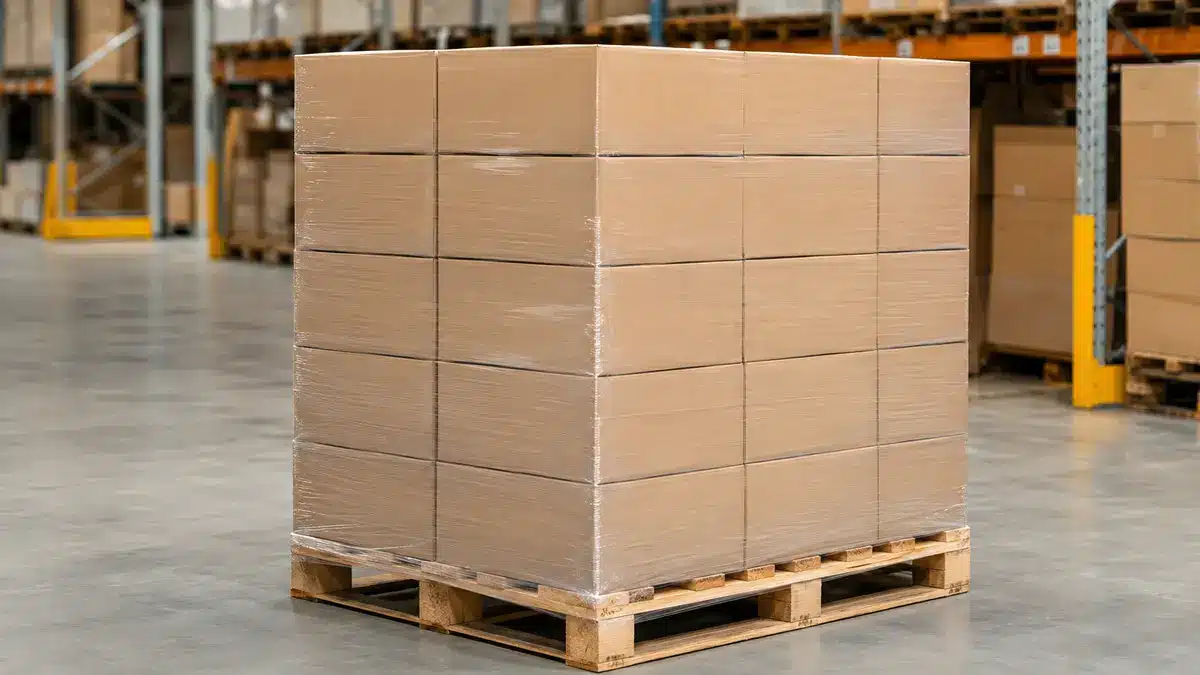
This is not the same as saying that film makes any pallet stable. Pallet condition, load pattern, product rigidity, friction between packages, voids, overhang, height, center of gravity, and transport accelerations remain important. ASTM D5415 uses vibration to compare load-containment performance, while ASTM D5414 evaluates horizontal-impact performance under selected laboratory conditions. Both leave the user responsible for defining test severity and an acceptable result.
Surface Protection and Visual Control
A continuous outer wrap can limit contact with dust, dirt, scuffs, and incidental splash during indoor storage and handling. Clear film can preserve visibility for label checks, barcode reading, or damage inspection when the optics and layer count allow it. Opaque or colored films may conceal contents or support warehouse identification.
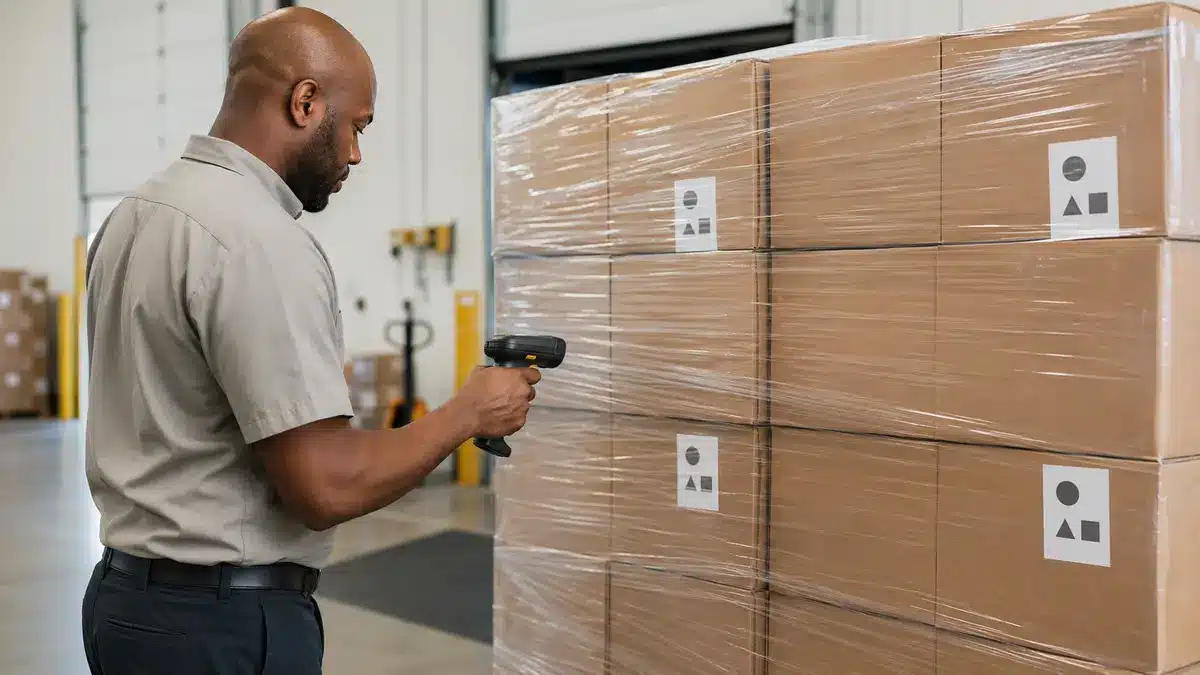
These are limited forms of protection. Openings at the pallet top or bottom, punctures, seams, and damaged areas can admit water or contamination. Clear film is not an inspection guarantee, and opaque film is not a security device. A visible cut or missing section may indicate interference, but stretch film should not be described as tamper-proof.
Material and Process Efficiency
Stretch film can replace several loose handling actions with one unitization step. Machine application may improve repeatability by controlling parameters such as pre-stretch, wrap force, carriage speed, overlap, and reinforcement zones. Hand application remains flexible for low-volume, variable, or backup work, although consistency depends more heavily on the operator and dispenser.
Material efficiency should be measured per acceptable load, not inferred from gauge or roll price. A thinner or higher-stretch film may reduce film mass only if the equipment can use it reliably and the final load continues to meet containment and damage criteria. A lower-cost roll that causes extra revolutions, breaks, rewraps, downtime, or product loss may increase total packaging cost.
Common Applications for Stretch Film
Stretch film is used most often for indoor unitization, reinforcement, and short-term protection. The following applications illustrate where it can fit; they do not prescribe a grade or wrap cycle.
Palletized Cartons, Cases, and Bagged Goods
Uniform corrugated cases are a common application because the load often presents predictable vertical faces and repeatable corners. Stretch film may connect the courses, reinforce the upper or lower zones, and anchor the load to the pallet. Bagged products can also be unitized, but flexible packages may settle, deform, or create slippery interfaces. The trial should reproduce the actual stack pattern, load height, weight, and dwell time.
For crush-sensitive cartons, additional wrap force is not automatically better. Excessive force can deform corners or compress packages, while insufficient force may allow movement. The selected film and cycle must balance containment with package strength.
Irregular, Dense, or Edge-Exposed Loads
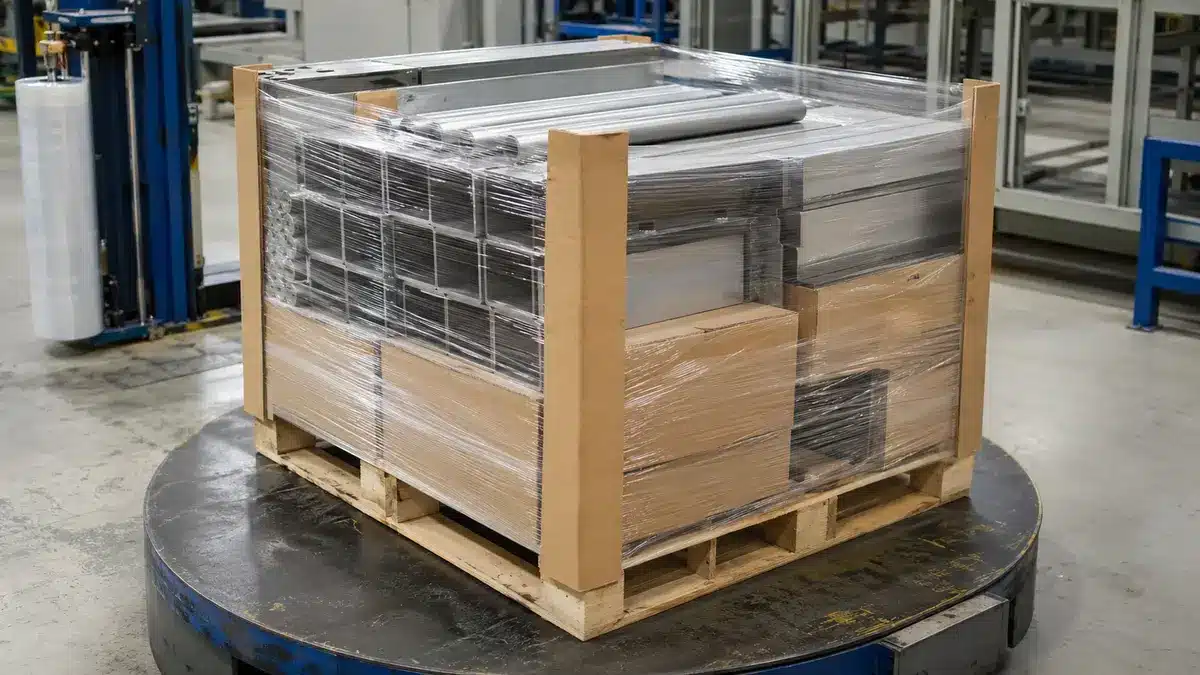
Machinery parts, building products, drums, pails, mixed-SKU pallets, and other irregular loads may benefit from a conformable outer wrap, but they also impose higher puncture and abrasion risks. Protrusions can concentrate stress in a small area. Dense loads can generate high inertial forces even when their shape appears compact.
Film selection should therefore consider puncture behavior, tear propagation, stress retention, and the number and placement of effective layers. ASTM D5748 provides a defined comparison of protrusion puncture resistance under biaxial deformation, but the probe geometry is not every real corner. Edge protection, caps, trays, strapping, or a revised pallet pattern may still be necessary.
Ventilated, Cold-Chain, and Moisture-Sensitive Loads
Some loads need airflow for cooling, respiration, or condensation control. Vented stretch film can provide openings while still contributing to unitization, but aperture size, open area, film strength, wrap pattern, temperature, and product behavior must be evaluated together. A vented web generally changes the available film area and the way stress travels around openings.
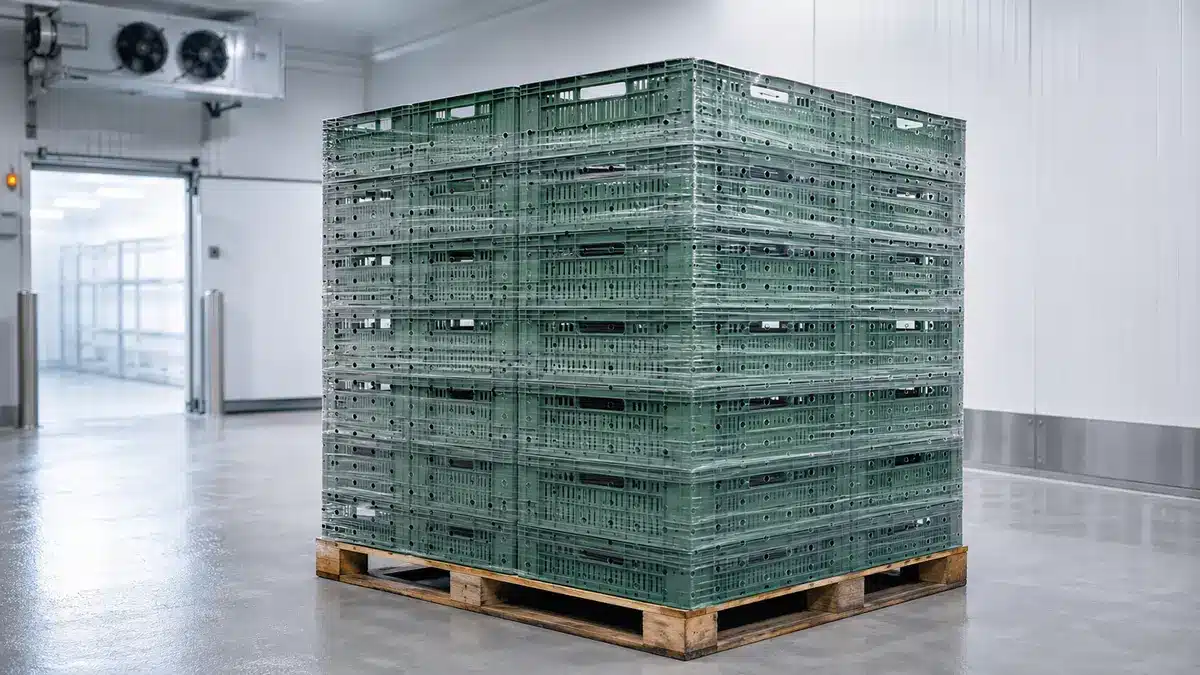
Cold conditions can also change package friction, film response, condensation, and operator conditions. A film that runs well in an ambient trial may not behave the same way in a chilled area. Food-contact or pharmaceutical suitability cannot be inferred from the application name; it requires product- and market-specific documentation for the intended contact conditions.
Bundling and Short-Term Indoor Storage
Narrow rolls can bundle long items, small components, profiles, textiles, or packages that need temporary grouping. Full-width film may reinforce loads during internal transfer or protect warehouse inventory from routine dust and contact. These uses can be convenient because stretch film usually needs no heat tunnel and can conform to different shapes.
The bundle still needs a defined handling method. Film should not create lifting points, and a wrapped group should not be handled as a stable unit unless the packaging and material-handling system has been approved for that action. ASTM D4649 covers indoor unitizing, reinforcing, and palletizing; it does not establish outdoor-exposure performance.
How Load Profile Changes the Value of Stretch Film
The same advantage can matter for different reasons on different loads. Use the matrix as a trial-planning guide, not as a specification.
| Load profile | Primary need or risk | Film and application focus | Verification priority |
|---|---|---|---|
| Uniform corrugated cases | Course movement or leaning | Consistent force, overlap, and base-to-load connection | Containment at multiple heights after dwell and handling |
| Crush-sensitive packages | Package deformation | Controlled force and reinforcement placement | Carton condition plus load movement |
| Mixed or irregular loads | Voids, protrusions, and uneven tension | Conformability, puncture resistance, edge management | Breaks, tears, and local movement at risk points |
| Dense products | High inertial load during starts, stops, or impacts | Stress retention and a system-level unitization design | Representative horizontal impact and handling |
| Flexible bags or sacks | Settling and low interlayer stability | Wrap pattern, friction, and post-wrap relaxation | Load shape and containment after conditioning |
| Chilled or ventilated goods | Condensation, airflow, and temperature effects | Vented format or conditioned film/application trial | Airflow need, film integrity, and cold-area performance |
This comparison shows why thickness is an incomplete selection variable Two films of similar nominal thickness can differ in construction elastic recovery.
Hand, Machine, and Specialty Application Formats
Application format determines how tension is created, controlled, and repeated. The right route depends on load volume, variability, facility layout, operator exposure, required data control, and capital constraints.
Hand Application
Hand film is practical for variable loads, low-volume operations, remote work areas, rework, and backup wrapping. It allows the operator to react to unusual shapes and reinforce a visible risk point. However, applied stretch, wrap force, overlap, walking path, and the number of layers can vary from load to load.
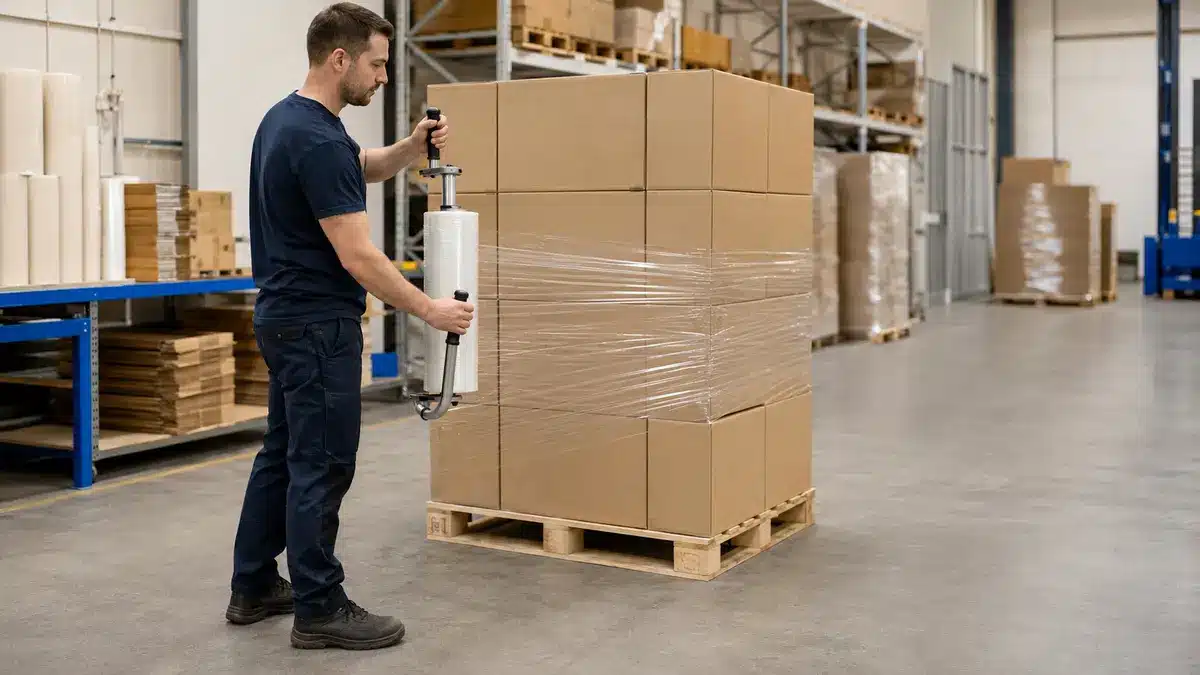
Manual wrapping also deserves an ergonomic assessment. Bending, reaching, walking around the pallet, holding the roll, and pulling film create repeated physical demands. OSHA guidance for grocery warehousing recommends lighter rolls and appropriate handles when manual wrapping is necessary. Load height, access, floor condition, roll weight, dispenser design, and work rate should be included in the assessment.
Machine Application
Semi-automatic and automatic wrappers can improve control over repeatable loads. Depending on the equipment, the operation may set pre-stretch, film force, turntable or arm speed, carriage speed, top and bottom wraps, reinforcement bands, and film cut or clamp functions. Recorded recipes can make changes more traceable.
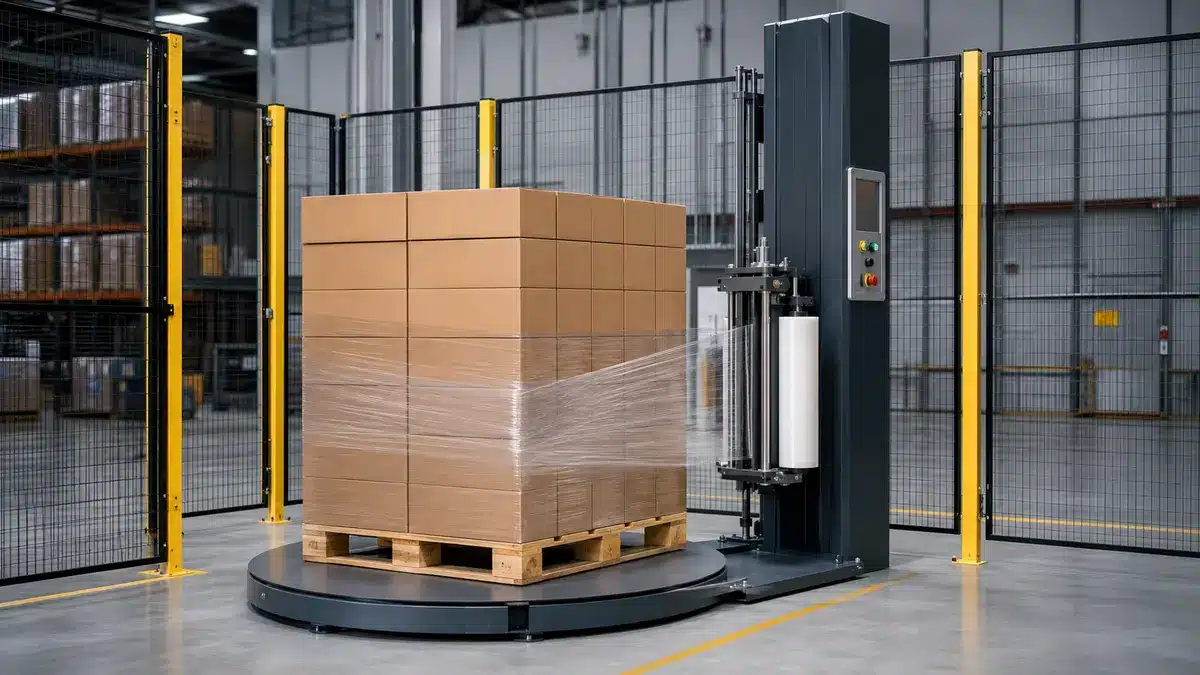
Repeatability is possible only when the machine is maintained and the film is compatible with the prestretch system, rollers, sensors, clamps, and cutting mechanism. A new film may change break frequency, neck-down, force delivery, or roll yield. ASTM D8314 addresses tests for applied film and wrapping equipment, reinforcing the need to evaluate the installed system rather than a film data sheet alone.
Specialty Film Functions
Specialty formats should solve a defined problem Vented film addresses airflow or condensation requirements Opaque or colored film can conceal or identify loads UV-stabilized grades may be considered where sunlight exposure is expected.
Each function changes the evidence request. UV performance needs a defined exposure period and test basis; color requires scan and identification checks; vented film needs airflow and containment evaluation; cling configuration must match the wrap direction and adjacent-contact risk. None of these labels alone proves the complete application.
Limits: What Stretch Film Does Not Guarantee
Problems occur when a useful packaging component is assigned a task that belongs to the full unit-load system. The error leads to under-designed loads, excessive film use, or misplaced confidence.
- Stretch film cannot correct a broken pallet, severe overhang, unstable stacking pattern, weak package, or unsuitable center of gravity.
- It does not automatically replace strapping, corner boards, caps, trays, anti-slip materials, or other restraints required by the load.
- It is not inherently waterproof, hermetic, corrosion-proof, tamper-proof, or suitable for outdoor exposure.
- A polymer name, color, gauge, or recycled-content statement does not prove food contact, chemical compatibility, regulatory acceptance, or end-of-life recovery.
- A single tensile, puncture, cling, or stress-retention result does not prove the performance of the applied wrap cycle.
- A laboratory comparison does not guarantee field performance unless the hazards, load, conditioning, and acceptance criteria represent the intended route.
Important: ASTM D4649’s stated scope covers indoor environments and associated storage or transport. Outdoor use requires a film designed for the exposure and a separate evaluation of sunlight, weather, duration, temperature, and load protection.
These limits do not remove the advantages of stretch film. They define the conditions under which those advantages can be relied upon and identify when a buyer must add another control.
How to Evaluate Stretch Film for a Real Operation
Use a controlled process that keeps the load, equipment, settings, and success criteria traceable.
- Document the load. Record pallet type and condition, footprint, height, total weight, stack pattern, package construction, overhang, voids, sharp edges, center-of-gravity concerns, and any settling or deformation over time.
- Map the distribution hazards. Define internal handling, forklift transfers, acceleration and braking, vibration, impacts, dwell time, stacking, temperature, humidity, and any outdoor exposure. Separate known conditions from assumptions.
- Record the current application. Identify film construction or supplier grade, nominal thickness and tolerance, width, roll length or weight, core, application method, pre-stretch or applied stretch where measurable, wrap force, overlap, effective layers, reinforcement zones, and anchoring method.
- Define candidate requirements. Match puncture, elastic recovery, stress retention, cling, unwind, optics, additives, and equipment compatibility to the documented risks. Request the applicable test method, specimen conditions, units, direction, and variability rather than accepting an isolated typical value.
- Run controlled application trials Use representative loads and keep machine recipes or manual work.
- Challenge the wrapped load. Select handling, vibration, and impact tests that represent the route. ASTM D5415 and D5414 are comparative tools with user-defined severity and acceptance; combine them with field trials or an appropriate distribution protocol when the risk justifies it.
- Approve the system and control changes. Write a purchase specification that links the film, roll format, test basis, equipment recipe or work instruction, load family, sampling plan, and pass criteria. Revalidate when the film, equipment, pallet pattern, package, product, or route changes.
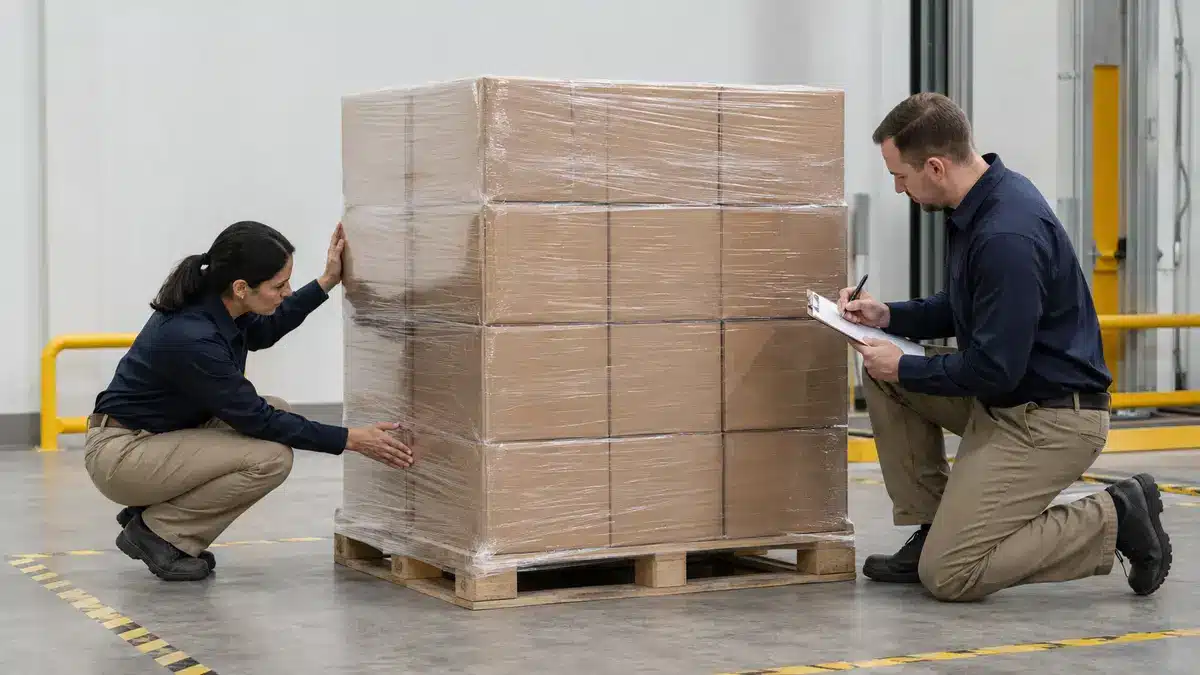
The most useful commercial comparison is total cost per acceptable load. It includes film consumed, labor or machine time, breaks, downtime, rework, damage, disposal or recovery arrangements, and the cost of controls added to compensate for an unsuitable film.
Frequently Asked Questions About Stretch Film
Does stretch film make a pallet safe for transport?
No, not by itself. Stretch film can contribute to unitization and containment, but pallet condition, load pattern, package strength, center of gravity, friction, additional restraints, handling equipment, and route hazards also determine safety and performance. Approve the complete unit load against defined acceptance criteria.
Is thicker stretch film always better?
No. Thickness is only one input. Construction, puncture behavior, elastic recovery, stress retention, cling, unwind, pre-stretch capability, wrap force, and layer placement can matter as much or more. Compare candidates on the same representative load and application equipment, using the same acceptance criteria.
Can stretch film protect products outdoors?
It depends on the film and exposure. Standard indoor stretch film should not be assumed to resist prolonged sunlight, rain, temperature cycling, or wind. An outdoor application needs a defined exposure period, a suitably designed grade, top and bottom protection where needed, and validation of both film integrity and product protection.
What information should a buyer provide before selecting a film?
Provide the load dimensions and weight pallet and stack pattern package type edge and puncture risks indoor or outdoor conditions temperature range distribution route throughput hand or machine equipment details current.
Related Bestypack Resources
- Stretch Film vs. Cling Film: What’s the Difference?
- How Many Pallets Can One Roll of Stretch Film Cover?
- Shrink Wrap vs. Stretch Wrap: What’s the Difference?
- How to Reduce Stretch Film Thickness to Cut Costs?
- Select the Appropriate Stretch Film Width and Thickness
 English
 Japanese
 French
 Spanish
 Korean
 Italian
 Portuguese
 Dutch
Dutch Arabic
 Russian
 German