
Stretch film is most useful during a move as a temporary binder: it holds padding in place, groups compatible items, and keeps light moving parts contained. It is not cushioning, a structural latch, or a rated vehicle tie-down. Use hand stretch film intended for moving, prepare every surface first, and add moving blankets, corner protection, rigid boxes, blocking, or straps where the item requires them. The nine applications below show what the film can do—and the limit that keeps each use practical.
Use 1: Hold Moving Blankets in Place
For polymer background, consult the NIH PubChem polyethylene overview before comparing finished-film claims.
For polymer background, consult the NIH PubChem polyethylene overview before comparing finished-film claims.
Moving blankets provide the impact and abrasion layer stretch film.
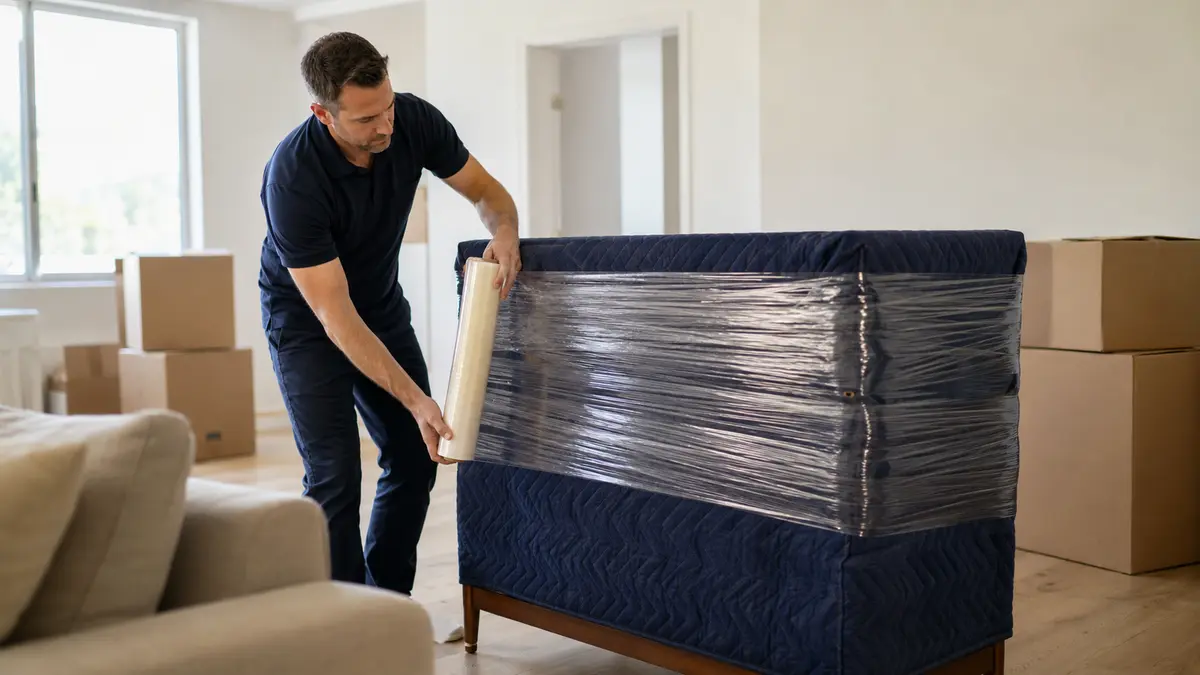
- Clean and dry the furniture, then remove detachable shelves, glass panels, legs, or cushions when the item permits safe disassembly.
- Cover the item with clean moving blankets or furniture pads. Fold loose blanket edges inward so they do not catch on doorways.
- Ask a second person to hold the first blanket fold while you circle the item with moderate, even tension. Overlap the passes enough to keep the blanket from slipping, then press the film end against the wrapped film.
Important: Film does not replace padding. If a corner, edge, handle, or leg can strike a wall or another item, protect that feature before applying the outer wrap.
Use 2: Keep Drawers and Cabinet Doors Closed
Stretch film can keep light drawers and doors from swinging open during carrying but it should not be asked to support heavy contents or substitute for a latch Empty fragile dense loose or valuable contents.
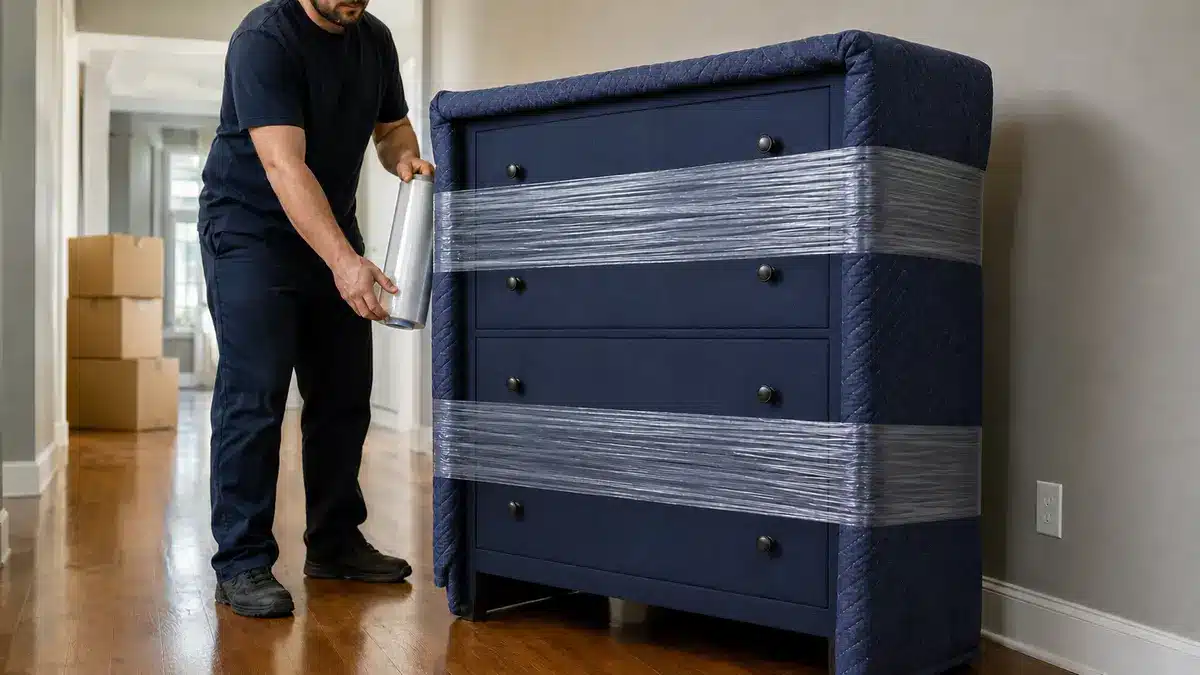
- Close every drawer and door and check that shelves or internal parts cannot slide.
- Place padding over delicate finishes, projecting hardware, and sharp corners.
- Wrap around the cabinet body so the film crosses the drawer or door fronts. Keep tension even and stop if a panel bows or hardware takes the load.
Important: Use a stronger closure method when a door is heavy, spring-loaded, or likely to pull against the film. The wrapped cabinet still needs to be positioned and restrained properly in the vehicle.
Use 3: Bundle Disassembled Furniture Parts
Bed rails, removable legs, support slats, and similar non-fragile parts are easier to track when they travel as a labeled bundle. The key is to prevent finished surfaces and hard edges from rubbing against one another.
- Match only compatible parts from the same item. Photograph or label their orientation before bundling.
- Wrap each finished or easily marked part with paper padding, foam, or a clean textile. Put rigid spacers between parts that could rub.
- Align the parts into a balanced bundle and apply film bands near both ends and, for longer pieces, through the center. Use only enough tension to stop individual parts from sliding.
- Place screws, brackets, and other small hardware in a sealed, labeled bag or rigid parts box. Attach that container only if it cannot press against or scratch the furniture.
Do not combine glass, brittle trim, or sharply different shapes in one flexible bundle. Those parts need packaging designed for their own breakage and edge risks.
Use 4: Secure Cords to Appliances
A neatly contained cord is less likely to trail across a walkway.
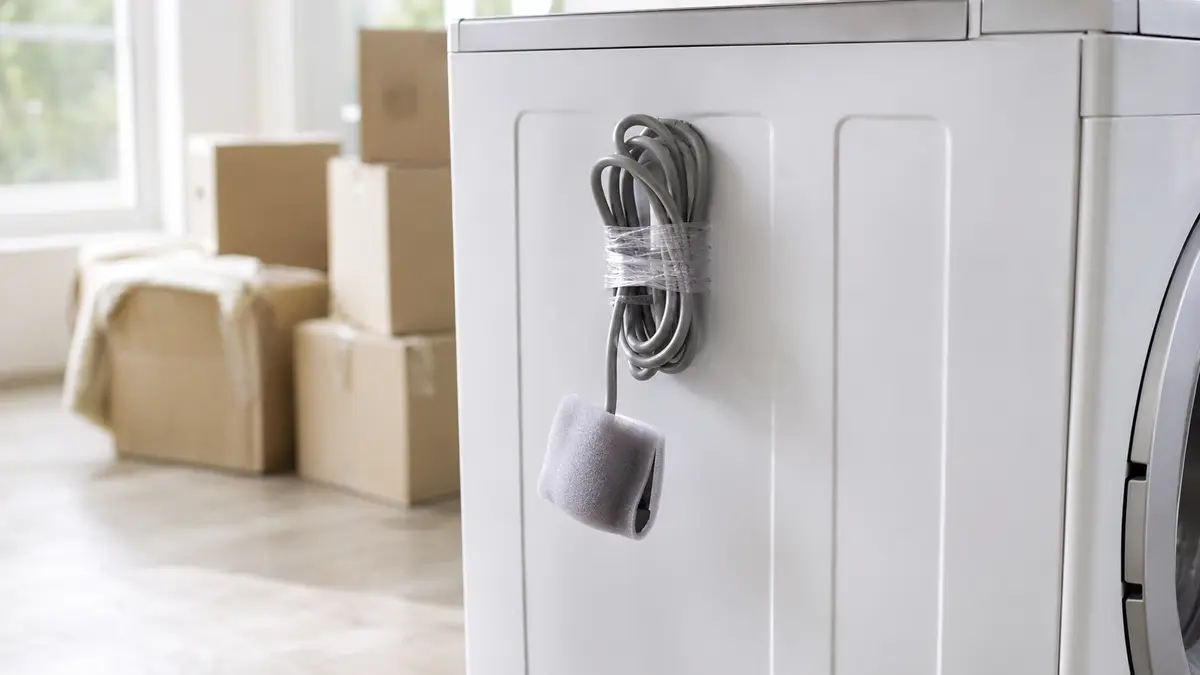
- Disconnect power and any service lines using the correct procedure for the appliance. Do not begin wrapping a hot, wet, or energized unit.
- Coil the cord without tight bends, cover the plug, and place a soft pad between the cord and the appliance finish.
- Use a small film band to hold the coil together, then a separate band to retain it against a broad, non-vented surface.
Keep film away from vents, hinges, controls, wheels, hot components, and areas used as lifting points. Cord management is only one part of appliance preparation; it does not secure internal components or make the appliance ready to tilt.
Use 5: Keep Rugs and Mats Rolled
Film bands can keep a dry rug or mat compact during a short move. Before rolling, check the maker’s care guidance and confirm the item is clean and fully dry. Some rugs should be rolled in a particular direction or around a support tube.
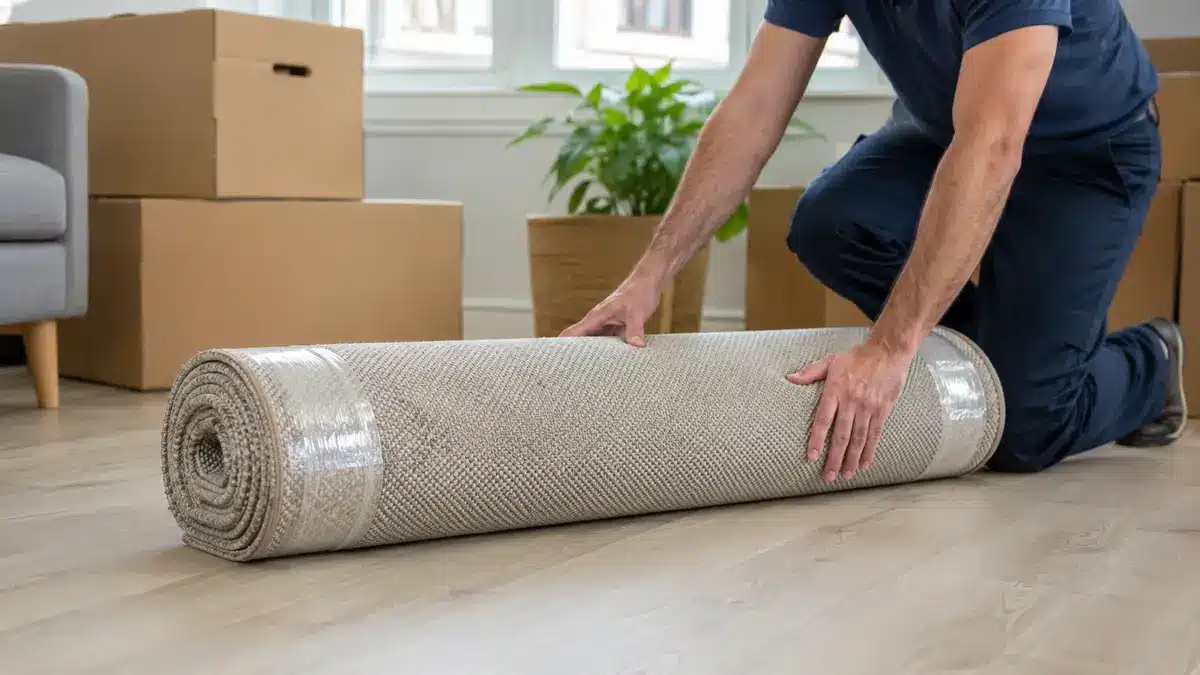
- Roll the rug or mat evenly, keeping the edges aligned rather than forcing a tight coil.
- Add a protective outer layer if the surface can abrade or pick up dirt during handling.
- Apply a film band near each end and add a center band when the roll is long enough to loosen between the ends.
- Carry and store the roll so no narrow band, strap, or heavy object crushes it.
This is a moving-day handling method, not a long-term storage specification. Stretch film can trap existing moisture and does not make a rug suitable for damp, hot, or uncontrolled storage.
Use 6: Bundle Long-Handled Tools and Rods
Rakes, brooms, curtain rods, and similar long items can be grouped for easier counting and handling, provided the bundle remains balanced and safe to lift. Sort before wrapping:
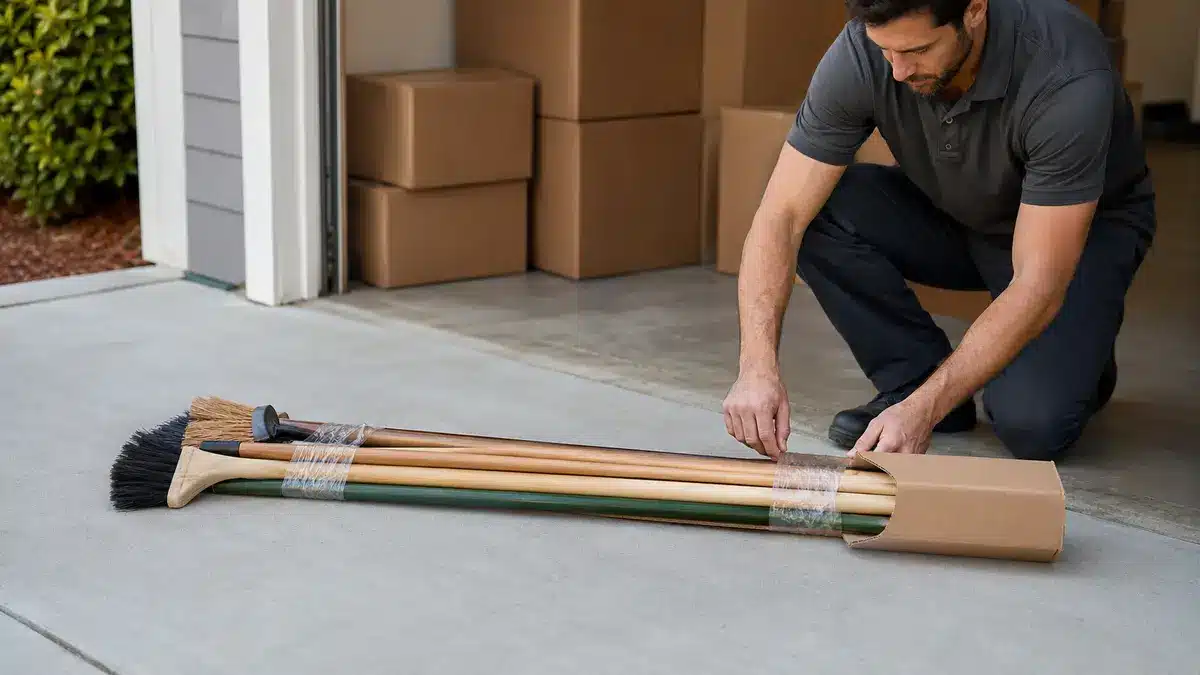
- Group items of similar length and weight so one end does not swing unexpectedly.
- Remove, cover, or separately pack sharp blades, tines, hooks, and pointed ends.
- Clean dirty or oily tools before placing them beside household items.
- Apply film bands near both ends; add a center band if individual pieces can bow outward.
- Keep the finished bundle light enough for the planned handler and route.
Warning: A wrapped bundle is still a long object with pinch and strike hazards. Do not use the film as a carrying handle, and do not assume the bundle is secured inside the vehicle.
Use 7: Close Organizers and Shallow Trays
Rigid organizers, utensil trays, and shallow parts trays can be wrapped to retain lightweight, non-fragile contents during short handling. This works best when the compartments already fit their contents and the tray will remain level.
- Remove sharp, liquid, fragile, dense, or valuable items and pack them separately.
- Place a clean sheet of paper or thin padding over the contents if direct film contact or movement could mark them.
- Cross the tray in two directions with moderate tension so the film acts like a temporary lid.
- Put the wrapped tray upright in a rigid box with suitable void fill; label the box so handlers know which side stays up.
Film makes a retaining layer, not a spill-proof enclosure. Use the organizer’s rigid lid or a closed box whenever mixing, leakage, or impact would create a meaningful loss.
Use 8: Group Clothes on Hangers
For ordinary garments moving directly from one wardrobe to another, film can temporarily group several hangers and keep fabric from spreading across the carrying path. A wardrobe box remains the more protective choice when garments are delicate, valuable, or likely to remain packed.
- Confirm the clothes are clean and dry, and remove garments with beads, hooks, fragile trim, or finishes that could catch.
- Align a small, manageable group of hangers and secure the hanger necks with a light film band.
- Add a loose band around the lower portion of the group only if needed to keep the garments together. Avoid compressing fabric.
- Support the bundle from the hangers or a suitable container; never lift it by the film.
Unwrap promptly at the destination. This method does not provide ventilation, wrinkle prevention, or long-term textile storage.
Use 9: Stabilize Padding Around Framed Décor
Stretch film can stabilize corner protectors, paper, foam, or bubble cushioning around framed décor before the padded piece goes into a suitable picture or mirror box. The padding and rigid package—not the film—manage impact and puncture risks.
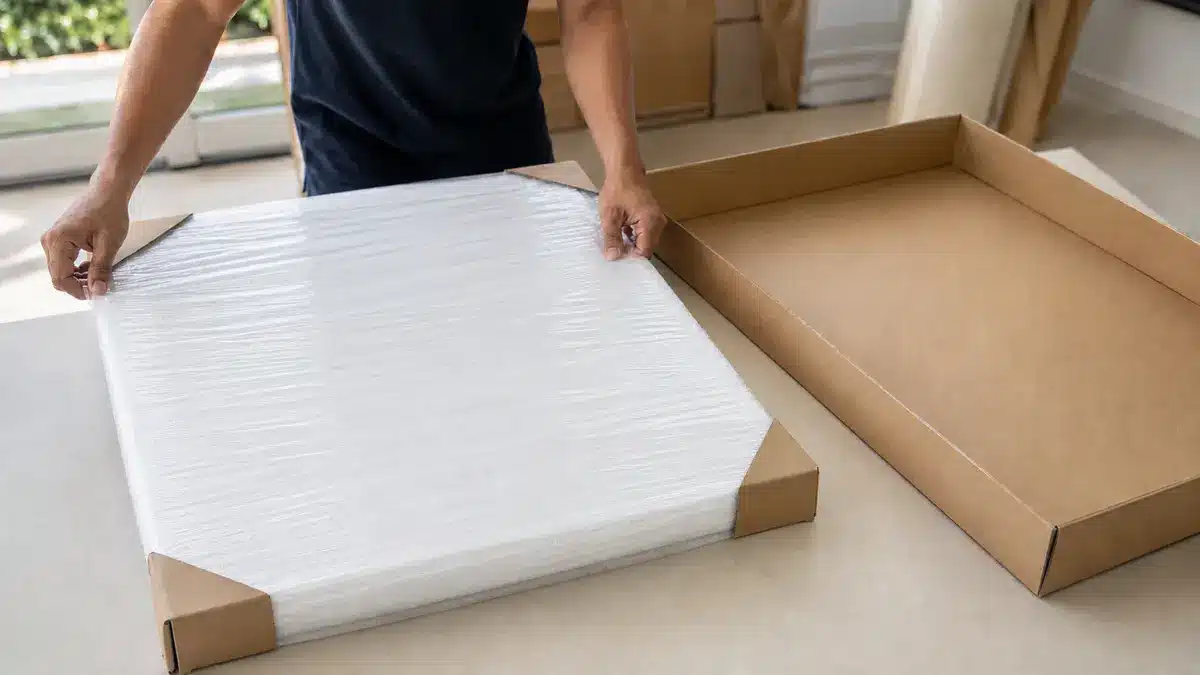
- Remove the frame from the wall and protect projecting hardware. Do not leave loose wire or hooks exposed.
- Fit corner protectors and cover the face, back, and edges with materials compatible with the frame and artwork.
- Apply light film passes around the padding so it stays aligned. Do not press film directly against artwork, a decorative finish, or loose glass.
- Place the padded frame upright in an appropriately sized rigid box and fill movement space with suitable packing material.
Important: Film is not glass containment. Valuable, irreplaceable, unusually large, or damaged pieces may need professional packing and item-specific handling.
Use Stretch Film Safely on Moving Day
The same release rule applies to all nine uses: the wrapped item should be dry, compatible with the materials touching it, stable enough to carry, and packaged for its actual impact and transport risks. Pause when the film is masking a weak box, an overloaded bundle, a sharp edge, or a moving part that needs a stronger restraint.
Prepare Surfaces Before Wrapping
Clean off grit that could be dragged across a finish, and allow every item and pad to dry fully. Test an inconspicuous area or place a compatible barrier between film and sensitive wood, leather, lacquer, paint, textiles, or artwork. Remove loose components when disassembly is safe, and label parts before they disappear inside an opaque layer of padding.
Control Tension and Protect Edges
Use enough tension to hold the pack together, not enough to bow doors, compress cushions, bend frames, or pull on hardware. Pad corners and sharp projections before wrapping; they can puncture the film and create exposed edges. Keep hands clear of pinch points, use a dispenser that gives controlled release, and cut the film with a guarded tool away from the item and the handler.
Use Proper Vehicle Restraint
Stretch film may unitize a small bundle, but it is not automatically a rated cargo-securement device. Use the vehicle’s appropriate blocking, bracing, containment, and rated tie-down equipment for the load and route. For commercial motor vehicles within the scope of U.S. federal cargo rules, 49 CFR 393.100 requires cargo to be contained, immobilized, or secured against harmful shifting, and 49 CFR 393.106 identifies adequate structures, dunnage, shoring bars, tiedowns, or combinations as securement means. Those provisions do not turn ordinary moving stretch film into a rated tie-down.
Related Bestypack Resources
- How Many Pallets Can One Roll of Stretch Film Cover?
- Black Stretch Wrap Film
- Shrink Wrap vs. Stretch Wrap: What’s the Difference?
- Silage Stretch Film: What You Need to Know
- Stretch Film Thickness: What You Need to Know
- Heavy Duty Stretch Film 80 120 Gauge
- Bundling Stretch Film
 English
 Japanese
 French
 Spanish
 Korean
 Italian
 Portuguese
 Dutch
Dutch Arabic
 Russian
 German