
Selecting PE film starts with the package and process, not with a resin acronym or a familiar thickness. A dependable specification connects eight areas: use conditions, film construction, dimensions, mechanical performance, sealing, converting behavior, protection and compliance, and supplier evidence. Together, they let procurement compare quotations on the same basis and give engineering and quality teams a practical sample-approval plan. The goal is not to find a universally “best” PE film, but to define the film that can be verified for one product, line, distribution route, and market.
Standard 1: Define the Product, Package Function, and Exposure
For polymer background, consult the NIH PubChem polyethylene overview before comparing finished-film claims.
For polymer background, consult the NIH PubChem polyethylene overview before comparing finished-film claims.
The first standard is a complete use-case statement. “PE film for a bag” is not enough because a freezer liner, a high-speed pouch sealant, a construction cover, and a heavy-duty sack place very different demands on the film. Start by describing the product, package format, filling process, storage period, distribution hazards, user interaction, and disposal market.
Map the Use Conditions
Use a requirements matrix to separate facts from assumptions. It should be completed before the supplier proposes a resin family, blend, layer structure, or thickness.
| Input | Questions to answer | Why it changes selection |
|---|---|---|
| Product | Is it dry, wet, oily, abrasive, sharp, dusty, or chemically active? | Influences contamination resistance, puncture risk, compatibility, and sealing |
| Pack format | Is the film a bag wall, liner, laminate sealant, lidding layer, shrink web, or stretch web? | Defines which surfaces and functions the film must provide |
| Process | Blown or cast converting, printing, lamination, VFFS, HFFS, bag making, or manual use? | Sets thermal, friction, treatment, stiffness, and roll-handling needs |
| Environment | Ambient, chilled, frozen, hot-filled, humid, outdoor, or UV-exposed? | Changes toughness, dimensional stability, additive, and barrier requirements |
| Distribution | What load, drop, vibration, compression, abrasion, or sharp-edge risks occur? | Determines which mechanical and package tests are relevant |
| Market | Which food-contact, chemical, recycling, labeling, or customer rules apply? | Determines the documents and test conditions required |
For chemical or sensitive-product contact, compatibility cannot be inferred from the word “polyethylene.” The exact resin, additives, contact layer, product, temperature, and duration must be reviewed together. Likewise, an outdoor application may require validated UV stabilization, while a frozen application may prioritize low-temperature impact behavior.
Rank the Failure Modes
Next, rank failures by consequence and likelihood. Typical concerns include puncture by the product, tear propagation from a notch, seal opening during filling, blocking in the roll, web tracking problems, loss of barrier, print or laminate adhesion failure, and roll deformation during transit.
Turn each high-priority risk into an acceptance check. A sharp component suggests puncture and finished-pack trials; a powder-contaminated seal suggests contaminated-seal and hot-tack evaluation; a long distribution route suggests pack-level drop, vibration, or compression work. This risk-first approach prevents a specification from becoming a list of unrelated “good” properties.
Standard 2: Choose the PE Family and Film Construction
PE is a polymer family, not a finished-film specification. LDPE, LLDPE, HDPE, metallocene-catalyzed PE, plastomers, and other ethylene copolymers can be blended or assigned to different layers. Resin grade, molecular architecture, additives, processing route, orientation, layer sequence, and thickness distribution all influence the final film.
Separate Polymer Family from Finished-Film Performance
General tendencies can guide the first prototype.
The RFQ should therefore identify:
- The intended role of the film: standalone web, sealant, print web, liner, stretch film, shrink film, or another function.
- The resin family or approved grade when it is genuinely fixed, plus whether alternatives require approval.
- Monolayer or coextruded construction, with layer sequence and the function of each layer.
- Any orientation, such as MDO-PE or BOPE, and the direction-dependent properties that must be verified.
- Functional additives such as slip, antiblock, antistatic, antifog, UV stabilizer, pigment, or processing aid.
- Surface treatment, coating, printing, adhesive, and laminate interfaces.
An additive can solve one problem and create another. Slip migration can change COF over time; antiblock can affect optics or surface texture; pigments and fillers can affect density, appearance, mechanics, and recycling compatibility. The proposed formulation must be evaluated as a system.
Specify the Layer Architecture
In a coextruded film, “PE” does not explain which layer contacts the product, receives ink or adhesive, carries mechanical load, or seals. Record the layer order from outside to inside, the total thickness, the nominal or controlled distribution by layer, and the intended function of each layer.

For a laminate, include the other web, coating, adhesive, print position, curing conditions, and intended seal interface. A PE sealant layer may contribute moisture protection and sealing, but it does not automatically establish oxygen barrier, package integrity, chemical compatibility, or recycling compatibility for the finished laminate.
Important: A mono-PE description is a design starting point, not proof that the finished package is recyclable. Inks, adhesives, coatings, barriers, closures, contamination, and local collection and sorting systems still matter.
Standard 3: Set Thickness, Width, and Roll Geometry
Dimensional data must describe both the film and the delivered roll. A nominal gauge without tolerance, measurement method, profile requirement, or roll geometry cannot predict yield or machine fit. Dimensions should be stated in one agreed unit system, with conversions shown only when needed.
Control Gauge and Width
Thickness affects material use and many measured properties, but “thicker is stronger” is not a sufficient design rule. Resin choice, orientation, layer distribution, processing, and failure mode also matter. Specify how thickness is measured, how many positions are sampled, whether the requirement covers an average, individual points, or a cross-web profile, and how edge zones are treated.
Width must include its tolerance and reference point, such as slit width. Where tracking or seal placement is sensitive, identify edge quality, camber, gauge bands, and telescoping limits. Record any sampling plan used to accept rolls or lots.
| Field | Minimum specification content |
|---|---|
| Thickness | Nominal value, unit, tolerance, method, sampling locations, and reporting statistic |
| Width | Nominal slit width, tolerance, edge condition, and measurement method |
| Roll length or mass | Declared basis, tolerance, splice treatment, and verification method |
| Core | Material, inner diameter, length, wall condition, and allowable protrusion |
| Roll diameter | Maximum and, where useful, target outside diameter |
| Winding | Winding direction, surface orientation, tension expectations, and roll-hardness or defect criteria |
Define Roll Build and Winding
The roll must fit the unwind, lifting method, storage system, and line limits. Define maximum roll mass and outside diameter, core dimensions and condition, winding direction, treated or seal surface orientation, splice count and marking, and packaging for transit.

Roll defects can make acceptable film unusable. Agree on acceptance language for telescoping, starring, blocking, wrinkles, loose edges, crushed cores, offset layers, contamination, gels, specks, and edge damage. These are visual and handling criteria, so inspection lighting, sample length, defect size, frequency, and disposition rules should be clear enough for both parties to apply consistently.
Standard 4: Match Mechanical Performance to the Failure Mode
Mechanical approval should use tests that reproduce or screen the relevant failure mechanism. Tensile strength alone does not describe puncture, tear initiation, tear propagation, impact, creep, load retention, or finished-package survival.
Select the Right Mechanical Tests
| Risk or design question | Useful measurement category | Conditions to record |
|---|---|---|
| Web tension and stiffness | Tensile strength, elongation, and modulus, such as ASTM D882 where applicable | MD/TD, thickness, specimen geometry, grip separation or extensometer use, speed, conditioning |
| Sudden impact | Dart impact, such as ASTM D1709 where applicable | Method, specimen preparation, thickness, conditioning, failure definition |
| Notch or edge propagation | Elmendorf or other appropriate tear method | MD/TD, notch geometry, method, thickness, conditioning |
| Sharp product contact | Puncture or probe-impact method agreed for the structure | Probe geometry, speed, support, side tested, failure criterion |
| Pallet or stretch use | Stretch, holding force, load retention, or containment test | Pre-stretch, application equipment, load geometry, time, temperature |
| Finished package | Drop, vibration, compression, leak, or other pack-level test | Pack mass, fill, seals, conditioning, sequence, acceptance criterion |
ASTM D882 covers tensile properties of thin plastic film and sheeting, but results still depend on specimen preparation, direction, thickness, strain measurement, speed, and conditioning. The standard identifies how to measure; it does not set the correct target for an unspecified package.
Compare Results Only Under Matching Conditions
Compare supplier data only when.
Important: Use laboratory tests to screen and control material, then confirm the finished package under realistic filling, handling, storage, and distribution conditions. A film-property result does not automatically prove package performance.
If downgauging is a goal, test the proposed thinner structure against the approved reference at equal package conditions. Evaluate defects, sealing, line waste, pack failures, and yield—not only one headline strength number.
Standard 5: Specify Sealing and Thermal Behavior
For a sealant web or seal layer, define a workable process window rather than one seal-strength value. The relevant behavior depends on the two surfaces being sealed, jaw design, temperature, pressure, dwell time, line speed, cooling, contamination, and the package load applied before the seal fully develops.
Define the Seal Window
Use a controlled sequence:
- Identify the exact seal pair, including which layers touch and whether the seal is PE-to-PE, PE-to-another polymer, or PE-to a coated surface.
- Set the expected machine range for temperature, pressure, dwell time, speed, and cooling.
- Create seals across that range using representative equipment or laboratory settings.
- Measure seal strength and record the failure mode using an agreed method such as ASTM F88/F88M where applicable.
- Evaluate hot tack when the package loads the seal before it has cooled.
- Repeat with realistic contamination, product residue, folds, or thermal history when these are credible process conditions.
ASTM F88/F88M measures the force required to separate a seal strip and identifies how the specimen fails. Results are influenced by specimen configuration and material deformation. Report the technique, width, pull rate, conditioning, sealing settings, peak or average basis, and failure mode rather than quoting an isolated number.
Verify the Whole Package, Not Just a Seal Strip
A strong strip can coexist with channel leaks, wrinkles, contamination, weak corners, or damaged film. After defining the laboratory window, run the target packaging line with production-representative rolls. Challenge startup, normal speed, planned maximum speed, stops, restarts, and expected ambient variation.
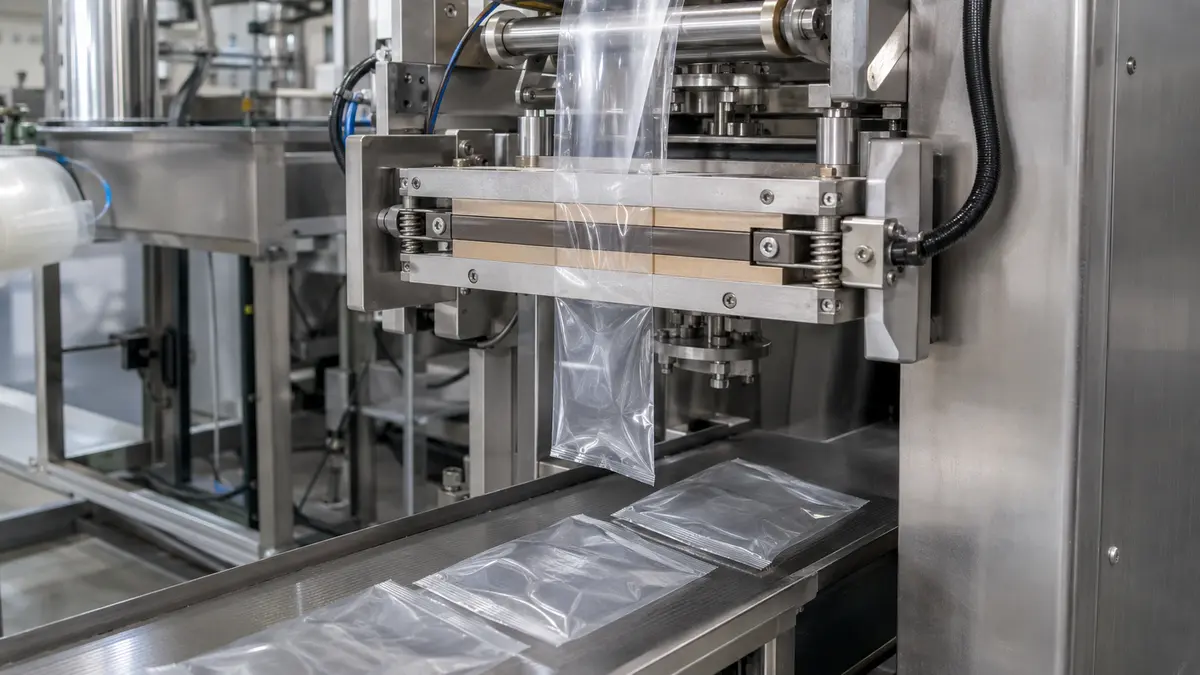
Inspect seals and perform the package-integrity tests appropriate to the format and product. Record whether failure occurs within the seal, at the seal edge, through the film, or elsewhere in the package. Thermal exposure outside sealing also matters: freezer use, hot fill, heat tunnels, storage near warm equipment, or sterilization can change film and seal behavior and must be validated separately.
Important: “Low-temperature seal,” “wide seal window,” and “strong hot tack” require defined materials, equipment settings, test methods, and acceptance limits. They are not transferable from a resin brochure to every finished film.
Standard 6: Control Surface, Optical, and Converting Properties
The film surfaces interact with metal guides, belts, forming collars, ink, adhesive, product, and other film layers. Their behavior can drift with additive bloom, storage time, temperature, treatment decay, contamination, and processing. Surface and optical requirements therefore need a time point, test method, and intended interface.
Match COF, Blocking, and Treatment to the Process
| Property | What to define | Why it matters |
|---|---|---|
| Static and kinetic COF | Surface pair, inside/outside identity, method, conditioning, age after manufacture, and test temperature | Influences unwind, tracking, stacking, feeding, and package handling |
| Blocking | Contact surfaces, pressure, time, temperature, and separation criterion | Screens unwanted adhesion in rolls or stacked bags |
| Surface treatment | Treated side, method, target and minimum at agreed time, test method, storage, and retreatment policy | Supports wetting and adhesion for inks, coatings, and laminating adhesives |
| Cleanliness | Particle, gel, speck, odor, residue, and handling limits | Protects printing, sealing, appearance, and sensitive products |
ASTM D1894 measures static and kinetic COF under specified conditions. It also warns that surface age and the time-dependent blooming of slip additives can affect results. For that reason, identify when COF is measured and test the exact surface pairing used on the line. A universal “ideal COF” does not exist.
Printing and lamination approval must include the actual ink, primer, coating, or adhesive and its supplier instructions. A surface-energy reading can support process control, but it does not by itself prove bond strength, ink rub resistance, cure, or long-term laminate performance.
Set Appearance Criteria with Test Methods
Clarity, haze, gloss, color, opacity, and surface texture may matter for product inspection, reverse printing, barcode reading, or brand presentation. Use applicable methods such as ASTM D1003 for haze and luminous transmittance or ASTM D2457 for specular gloss, while recording thickness, specimen condition, instrument geometry, and tested surface.
Add visual defect limits where appearance is critical. Define the inspection area, lighting, viewing distance, defect type, size threshold, frequency, and acceptable count. This is more repeatable than terms such as “premium clarity” or “clean film.”
Standard 7: Verify Barrier, Regulatory, and End-of-Life Requirements
Barrier, food-contact, and recycling statements answer different questions. They should not be bundled into a vague claim that a film is “safe, protective, and sustainable.” Each needs a target use, method, market, and document trail.
Condition Barrier Claims
PE often serves as a moisture-control or seal layer, but barrier performance varies with resin, thickness, orientation, additives, layers, coatings, temperature, humidity, and the complete package. If shelf life depends on water-vapor or oxygen protection, start with the product’s sensitivity and an acceptable change over time, then establish the package-level requirement.
| Requirement | Evidence to request | Critical conditions |
|---|---|---|
| WVTR | Test report using an agreed method such as ASTM F1249 where applicable | Temperature, relative humidity or vapor-pressure difference, thickness, test side, area, units |
| OTR | Test report using an agreed oxygen-transmission method | Temperature, humidity, oxygen concentration, thickness, test side, area, units |
| Light or aroma protection | Method suited to the product and complete structure | Wavelength or compound, exposure, package format, acceptance limit |
| Shelf life | Protocol and data for the finished package and product | Fill, headspace, seals, storage distribution, sampling schedule, failure criterion |
ASTM F1249 notes that buyer and seller should agree on sampling, standardization, conditions, and acceptance criteria. It also cautions against assuming simple relationships between WVTR, thickness, and vapor-pressure difference for every material. Report conditions with every result and avoid the unqualified phrase “high barrier.”
Bind Compliance and Recycling Claims to the Target Market
For U.S. food contact, 21 CFR 177.1520 covers specified olefin polymers subject to stated provisions, specifications, and conditions of use. It does not make every PE film “FDA approved.” Additives, colorants, coatings, adhesives, recycled content, multilayer components, food type, temperature, and contact duration can change the applicable evidence.
In the European Union, Regulation (EU) No 10/2011 controls plastic food-contact materials through composition rules, restrictions, migration limits, test conditions, and supply-chain documentation. Request a declaration and supporting migration rationale or test data that match the exact finished structure and intended use.
Recycling design must be assessed against the intended market’s current guidelines and infrastructure. Evaluate the complete package—including other polymers, inks, pigments, coatings, barriers, adhesives, zippers, valves, labels, and residues—against the targeted PE recycling stream. Technical compatibility does not prove that every locality collects, sorts, and recycles the pack.
Important: Do not use unconditional claims such as “food grade,” “FDA approved,” “EU compliant,” or “100% recyclable” without product-, structure-, use-, market-, and document-specific support.
Standard 8: Approve Samples, Supplier Evidence, and Change Control
The final standard converts the seven technical areas into a controlled purchasing and quality process. A quotation should identify the same structure, units, methods, conditions, and delivery format for every supplier. Otherwise, a low price or attractive property value may represent a different film.
Build a Comparable RFQ and Approval Plan
The RFQ should state:

- Product, package function, contact status, equipment, speed range, environment, distribution route, and target market.
- Film family, grade restrictions, layer sequence, total and layer thickness, additives, color, treatment, and print or laminate interfaces.
- Width, length or mass basis, core, maximum roll diameter and mass, winding direction, splice rules, roll protection, and defect criteria.
- Mechanical, seal, thermal, surface, optical, barrier, and package-test methods with units, conditions, sampling, and acceptance limits.
- Required food-contact, chemical, recycling, quality, origin, or customer documents, each tied to its scope and validity.
- Trial quantity, approved-reference process, change rules, forecast volume, packing method, and data required with each lot.
Use a staged approval: document review, laboratory screening, converting trial, packaging-line trial, filled-package testing, and controlled production qualification. Retain the approved film and package samples under suitable conditions, along with the settings and results that created the decision.
Lock Traceability and Change Notification
Define the identifiers that connect a delivered roll to production records: product or grade code, lot or batch, line and date where appropriate, roll number, dimensions, inspection status, and certificate of analysis fields. Agree on lot sampling, nonconformance handling, containment, investigation, replacement, and record-retention expectations.
Change notification should cover resin grade or supplier blend or layer ratio additives pigment orientation extrusion line or major.
A management-system certificate can support.
Related Bestypack Resources
- BOPP Thermal Lamination Film
- Laminating Film Guide: What You Need to Know
- Differences:BOPP Film VS BOPET Film VS BOPA Film
- Shrink Wrap vs. Stretch Wrap: What’s the Difference?
 English
 Japanese
 French
 Spanish
 Korean
 Italian
 Portuguese
 Dutch
Dutch Arabic
 Russian
 German