
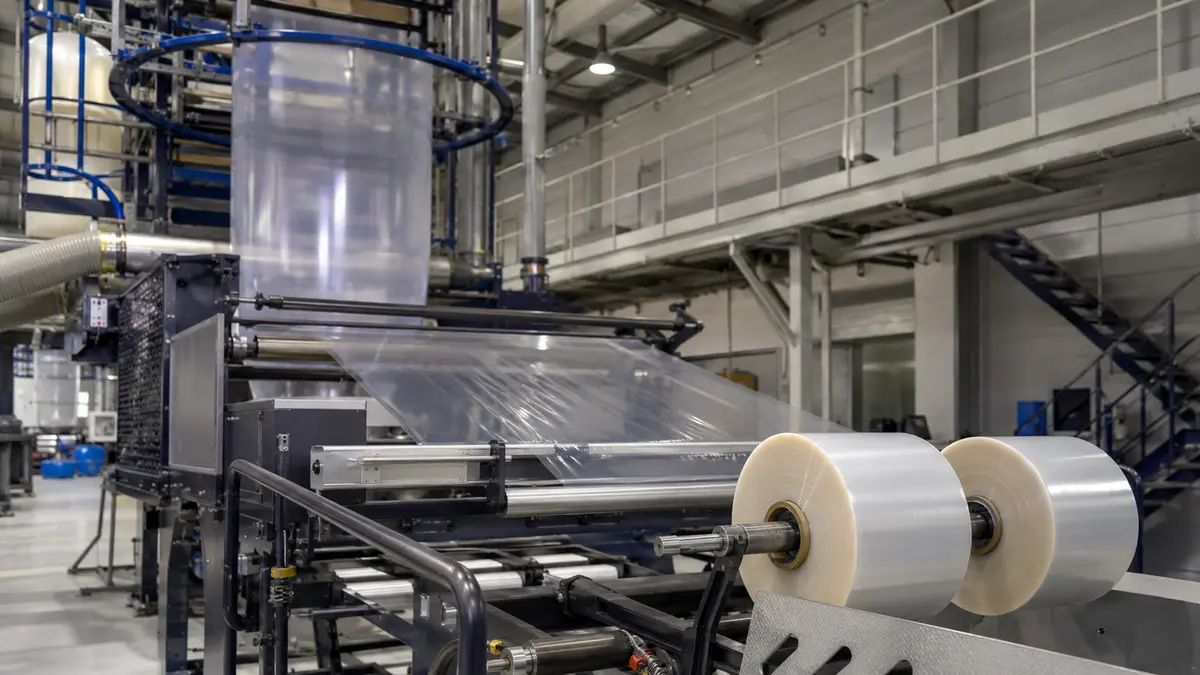
“Polyolefin,” “polyethylene,” and “PVC” are often presented as three equal film choices. Chemically, that framing is wrong: polyethylene is one member of the polyolefin family, while PVC is a separate polymer. Commercial packaging language adds another complication because “POF” commonly refers to a class of shrink films, not a complete formulation. A useful comparison must therefore move from taxonomy to the finished film, the packaging process, the test conditions, and the target market.
Start With the Taxonomy: PE Is a Polyolefin, PVC Is Not
For U.S. food-contact context, review the eCFR polymer provisions before approving a finished-film claim.
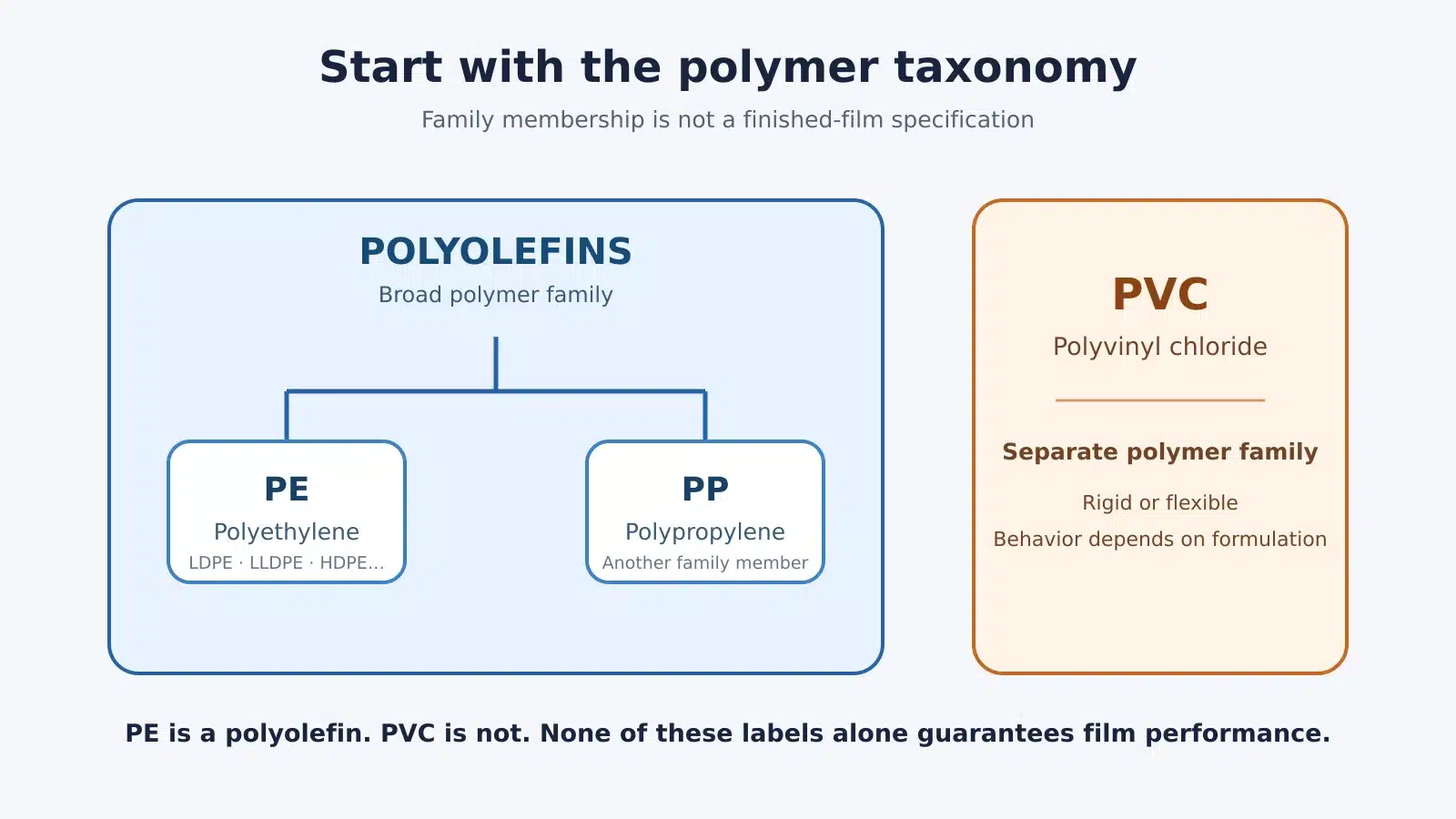
The first purchasing risk is a category error. “Polyolefin” is a family name; “polyethylene” identifies part of that family; and “PVC” identifies a different polymer. If an RFQ lists all three as parallel resins, two suppliers may interpret the request in different ways and still believe they answered it correctly.
Polyolefins Are a Polymer Family
Polyolefins are thermoplastic polymers produced from olefin monomers. In packaging discussions, polyethylene and polypropylene are the two most familiar members. The family also covers many grades and copolymers, so the word polyolefin alone does not state density, comonomer, orientation, additive package, layer structure, or finished-film performance.
This distinction is practical, not merely academic. A polypropylene-rich oriented film, an LLDPE stretch film, and a multilayer polyolefin shrink film can all fall under the broad polyolefin umbrella while serving very different packaging jobs.
Polyethylene Is One Member of That Family
Polyethylene, or PE, is made from ethylene-derived repeat units and is sold in multiple grade families. LDPE, LLDPE, MDPE, and HDPE differ in chain architecture and density ranges. Those differences influence how closely chains pack and affect properties such as stiffness, toughness, melt behavior, and seal response. The grade designation is useful, but it still is not a complete film specification.
A finished PE film can be blown or cast, mono- or multilayer, unoriented or directionally oriented, and formulated with slip, antiblock, processing aids, pigments, or other additives. Film gauge and converting history matter as well. Consequently, the safe statement is “PE is a polyolefin”; the unsafe shortcut is “all polyolefin films are PE films with the same behavior.”
PVC Belongs to a Separate Chlorine-Containing Polymer Family
Polyvinyl chloride, or PVC, is not a polyolefin. Its repeat structure contains chlorine, and commercial PVC can be formulated into rigid or flexible products. Packaging film is generally discussed on the flexible side of that range, where the compound and its additives strongly influence handling and performance.
The taxonomy tree is therefore simple:
- Polyolefins: a broad family that includes PE and PP.
- Polyethylene: one polyolefin member with several grade families.
- PVC: a separate polymer whose film behavior depends strongly on formulation.
This tree prevents naming errors, but it does not rank films. Performance decisions belong to the finished construction and its verified data.
What “POF” Usually Means in Packaging Film Discussions
In packaging sales and operations, POF usually means polyolefin shrink film. It is useful shorthand for a commercial film category, especially in retail shrink wrapping, but it should not be mistaken for a single resin identity. Supplier literature shows that commercial POF products may be multilayer and coextruded; some grades are crosslinked or biaxially oriented. The precise combination varies by product.
That is why a specification reading only 60-gauge POF is incomplete It gives a film family and a thickness indication but may not identify the dominant polymers layer functions orientation crosslinking status shrink balance seal window approved use or recycling design Even two.
For sourcing, treat POF as the beginning of a supplier conversation. Request the technical data sheet and ask for the finished-film construction at a level the supplier can disclose, nominal thickness and tolerance, MD/TD shrink data with test conditions, seal guidance, food-contact documentation when relevant, and any recycling claim basis. This keeps commercial shorthand from becoming a false technical specification.
How Polymer Structure and Formulation Change Film Behavior
Film behavior is built through several levels: polymer chemistry, grade architecture, additive package, layer design, orientation, thickness, and conversion conditions. Comparing only the resin name skips most of the variables that the packaging line actually encounters.
PE Density and Branching Create Different Film Grades
PE chains can have different amounts and types of branching. Fewer branches generally allow closer chain packing and higher density; branching and comonomer choices alter crystallinity and molecular organization. Manufacturers use these levers, together with molecular-weight distribution and melt index, to create grades with different balances of stiffness, toughness, drawdown, optics, sealability, and processability.
LDPE often contributes melt strength and processing stability. LLDPE families can provide toughness and flexibility across blown- and cast-film applications. HDPE grades can offer a different stiffness and density profile. These are useful directions, not guaranteed film rankings. A thin, oriented, multilayer HDPE-containing film cannot be fairly compared with a thicker monolayer LDPE film by resin acronym alone.
PVC Film Properties Depend Heavily on Formulation and Additives
PVC resin can be transformed through compounding. Plasticizers are used when flexibility is needed, while stabilizers, lubricants, pigments, processing aids, and other additives may be selected for manufacturing and end-use requirements. The identity and amount of those components are formulation-specific.
This makes broad statements such as “PVC is always soft,” “PVC always seals at one temperature,” or “all PVC film has the same food-contact status” unreliable. The finished compound, thickness, manufacturing route, and intended conditions of use must be known. The same discipline applies to PE and POF: additives, layers, and orientation can change surface friction, seal behavior, optics, shrink response, and recycling compatibility without changing the broad family label.
Polyolefin, PVC, and PE Films Compared on the Same Axes
The table below compares decision categories, not guaranteed values. “Polyolefin film” is intentionally separated into commercial POF shrink film and PE film so that a family label is not treated as a single resin specification.
| Decision axis | Commercial POF shrink film | Flexible PVC film | PE film |
|---|---|---|---|
| Identity | A supplier-defined polyolefin shrink-film construction often multilayer and possibly crosslinked… | A flexible compound based on PVC resin plus a formulation… | A film based primarily on one or more PE grades… |
| Typical packaging direction | High-clarity retail shrink and other supplier-qualified shrink formats | Certain shrink overwrap sleeve and specialty formats where the formulation… | Bags liners stretch or collation bulk shrink seals and many… |
| Process variables | Seal system shrink balance film gauge tunnel heat airflow and… | Formulation seal system heat history gauge and line conditions | Grade blend extrusion route gauge slip antiblock seal conditions and… |
| Mechanical evidence | Request tensile tear impact seal and shrink data for the… | Request finished-film mechanical and shrink data for the exact formulation | Request finished-film data in MD and TD where direction matters |
| Optical evidence | Haze gloss and appearance should be measured on the supplied… | Clarity and appearance depend on formulation and surface condition | Optics vary widely with grade crystallinity processing additives and gauge |
No row establishes a universal winner. A film can be well suited to one format and poorly suited to another. It can also satisfy a laboratory property while failing on the line because friction, seal geometry, shrink balance, perforation, heat exposure, or product shape was not represented in the comparison.
Match the Film to the Packaging Format and Process
Start with the package job. Retail display shrink around a book or multipack is different from heavy-duty collation shrink, pallet stretch containment, a lidding web, or a high-barrier food package. A candidate that is appropriate in one format may not even be processed by the same equipment in another.
| Packaging situation | Primary need or risk | Candidate direction to investigate | Trial limit |
|---|---|---|---|
| Clear retail shrink | Presentation, balanced shrink, clean seals, limited product distortion | Supplier-qualified POF or PVC shrink grade; PE shrink only when the construction and line fit the job | Confirm optics, seal appearance, shrink force, corners, and heat exposure on the product |
| Bulk or collation shrink | Load containment, puncture resistance, film yield, robust handling | PE shrink constructions are common candidates | Confirm holding performance, tunnel capacity, cooling, and distribution abuse |
| Stretch containment | Elastic recovery and load stability without a shrink tunnel | Stretch-film construction, commonly PE-based | Do not substitute a shrink-film label for stretch-film performance data |
| Food overwrap or lidding | Seal integrity, fog/optics, barrier, product compatibility, regulatory documents | A qualified finished structure, which may be multilayer | Validate the whole package, food, storage, time, and temperature conditions |
Next, map the line. The sealer type, seal-bar design, available temperature control, jaw pressure, dwell time, tunnel length, airflow, conveyor speed, product dimensions, and heat sensitivity define the operating window. Some machines can run multiple film families, but compatibility does not mean identical settings.
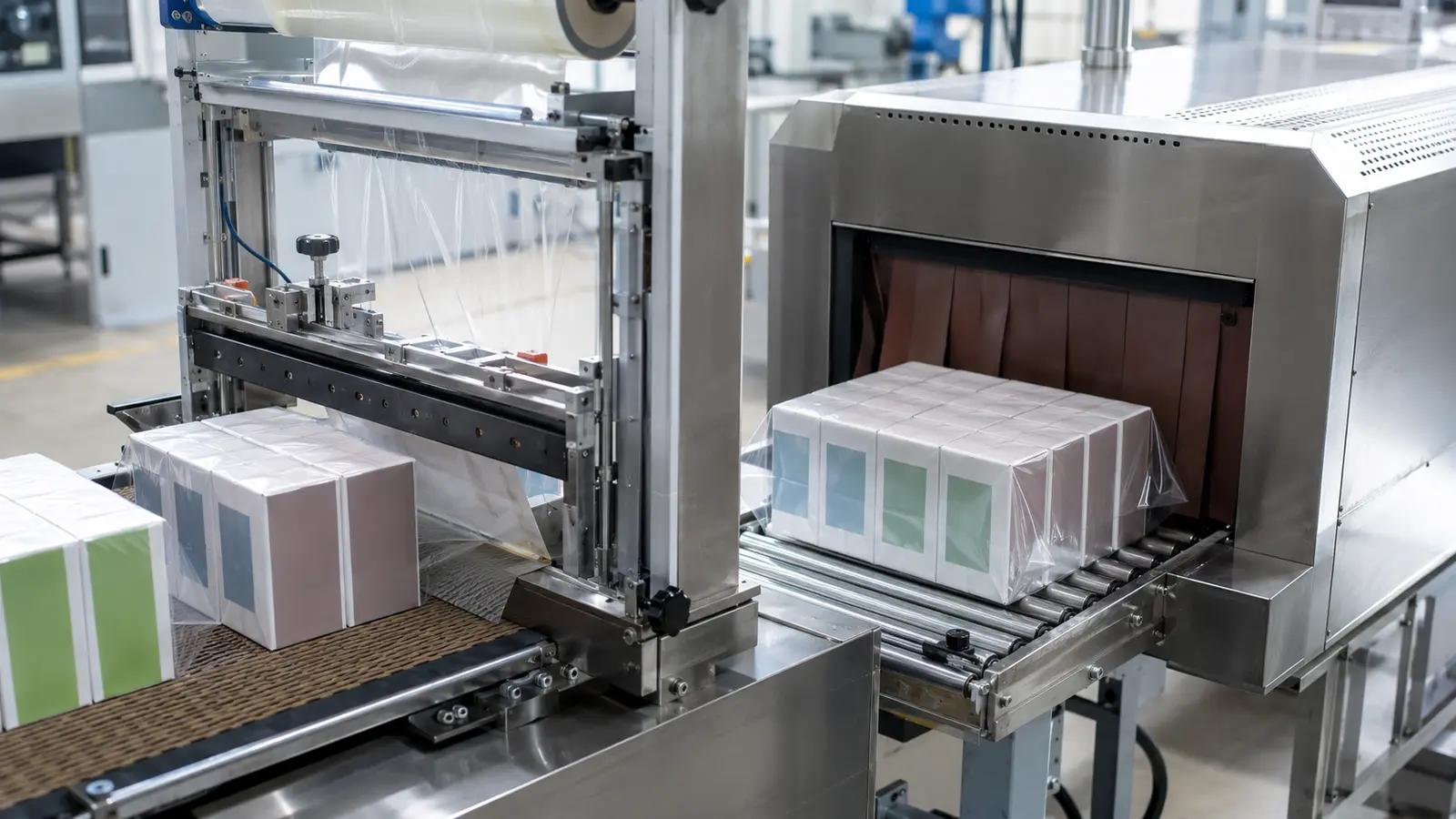
Finally, include distribution and presentation. Sharp edges, heavy products, refrigerated condensation, long storage, print requirements, tamper evidence, and opening behavior can change the best direction. The result of this stage should be a short list for testing—not a purchase decision based only on a polymer name.
Test the Finished Film, Not Just the Polymer Name
A reliable data package connects each decision to a method, specimen, conditions, and reporting unit. The exact current method edition should be confirmed when the RFQ or test plan is issued; the matrix below identifies common ASTM method families without reproducing proprietary procedures.
| Buyer question | Method family example | Conditions or reporting details to retain | What the result can support |
|---|---|---|---|
| How does the film respond in tension? | ASTM D882 for thin plastic sheeting | Gauge, specimen dimensions, MD/TD, conditioning, strain rate, units | Relative tensile behavior under the stated method, not package abuse by itself |
| Will surfaces slide consistently? | ASTM D1894 | Film-to-film or film-to-other surface, side tested, temperature, dwell/loading details | Static and kinetic friction under stated surface conditions |
| How clear is the film? | ASTM D1003 for haze and luminous transmittance | Gauge, specimen condition, instrument/procedure identification | Optical transmission and wide-angle scattering, not shelf appearance alone |
| How strong is the seal? | ASTM F88/F88M | Materials sealed, seal conditions, specimen width, technique, rate, failure mode | Seal separation force and failure mode; package integrity requires more validation |
| How does the film resist impact or tear? | ASTM D1709 and D1922 families | Gauge, method variant, orientation, conditioning, units | Method-specific impact or tear response; methods are not numerically interchangeable |
| What are the gas and moisture barriers? | ASTM D3985 for OTR; ASTM F1249 for WVTR | Temperature, RH, specimen thickness, test side, area basis, gas, units, equilibrium criteria | Transmission through the tested film or structure under those conditions |
Shrink films also need shrink percentage or dimensional-change data shrink force where relevant and seal-window information under stated conditions Production qualification should add machinability visual defects seal integrity pack geometry throughput distribution simulation and shelf-life work appropriate.
Qualify Food-Contact and Regulatory Claims by Market and Use
Food-contact status is not a universal property of “PE,” “POF,” or “PVC.” It is a legal and technical conclusion about specified substances or articles under specified conditions in a defined market.
For the United States, 21 CFR 177.1520 addresses certain olefin polymers subject to identities, specifications, extractive limits, food types, and conditions of use. FDA also makes clear that authorizations can be tied to intended use and limitations. The correct question is not “Is PE FDA approved?” but “Does every relevant component of this finished structure comply with an applicable authorization for the intended food and time/temperature conditions?”
For the European Union, Regulation (EU) No 10/2011, as amended, establishes rules for plastic materials and articles intended to contact food. Composition, Union-list restrictions, overall or specific migration, declarations of compliance, supporting documentation, and testing conditions may all be relevant. Regulation (EU) 2025/351 amended the framework, so an old declaration should not be assumed current without review.
Why a Material Listing Is Not a Blanket Approval
A base polymer listing does not automatically cover every additive, colorant, adhesive, ink, coating, recycled-content source, or layer in a finished package. Nor does it prove suitability for every food category, storage period, hot-fill condition, retort process, or repeated use.
Ask the supplier for a declaration or letter tied to the exact grade or film construction and destination market. It should identify the regulatory basis, intended food-contact side, applicable food types, time and temperature limits, and any functional barrier or migration assumptions. When the pack is multilayer, responsibility must extend beyond the sealant resin. Product-specific claims require product-specific evidence; this article makes no compliance claim for a BestY Pack grade.
Evaluate Recycling and Sustainability in the Actual Package Stream
“Polyolefin” or “PE” on a data sheet does not by itself make a package recyclable. Current design-for-recycling systems evaluate the complete package. Layers, coatings, labels, inks, adhesives, closures, attachments, pigments, fillers, dimensions, residue, and optical sorting behavior can change the result.
The APR Design Guide treats recyclability as a whole-package assessment. RecyClass likewise provides stream-specific guidance and evaluation protocols for PE flexible packaging, including testing routes for innovations and non-PE components. These frameworks answer a technical compatibility question. They do not prove that a municipality or store program will collect the item.
That access distinction is especially important for flexible films. The US EPA advises that bags, wraps, and films generally should not be placed in household curbside bins and may instead be accepted at participating retail locations; local instructions control. A technically compatible PE film can therefore lack convenient collection in a particular market.
PVC requires equally precise language. It should not be called “never recyclable,” because dedicated PVC recycling activity exists. At the same time, evidence for a dedicated PVC route does not establish compatibility with a PE flexible-film stream. Keep these questions separate:
- Which stream is the package designed for?
- Does the entire package meet the current technical guide for that stream?
- Is the package collected and sorted at meaningful scale in the target market?
- What consumer instruction and claim wording are legally supportable there?
Use named guidance, version dates, test results where required, and local access evidence. Avoid vague claims such as “eco-friendly,” “green,” or “100% recyclable” without a complete, market-specific basis.
Build a Defensible RFQ and Machine-Trial Plan
A strong RFQ converts “Which material is better?” into defined inputs and acceptance evidence.
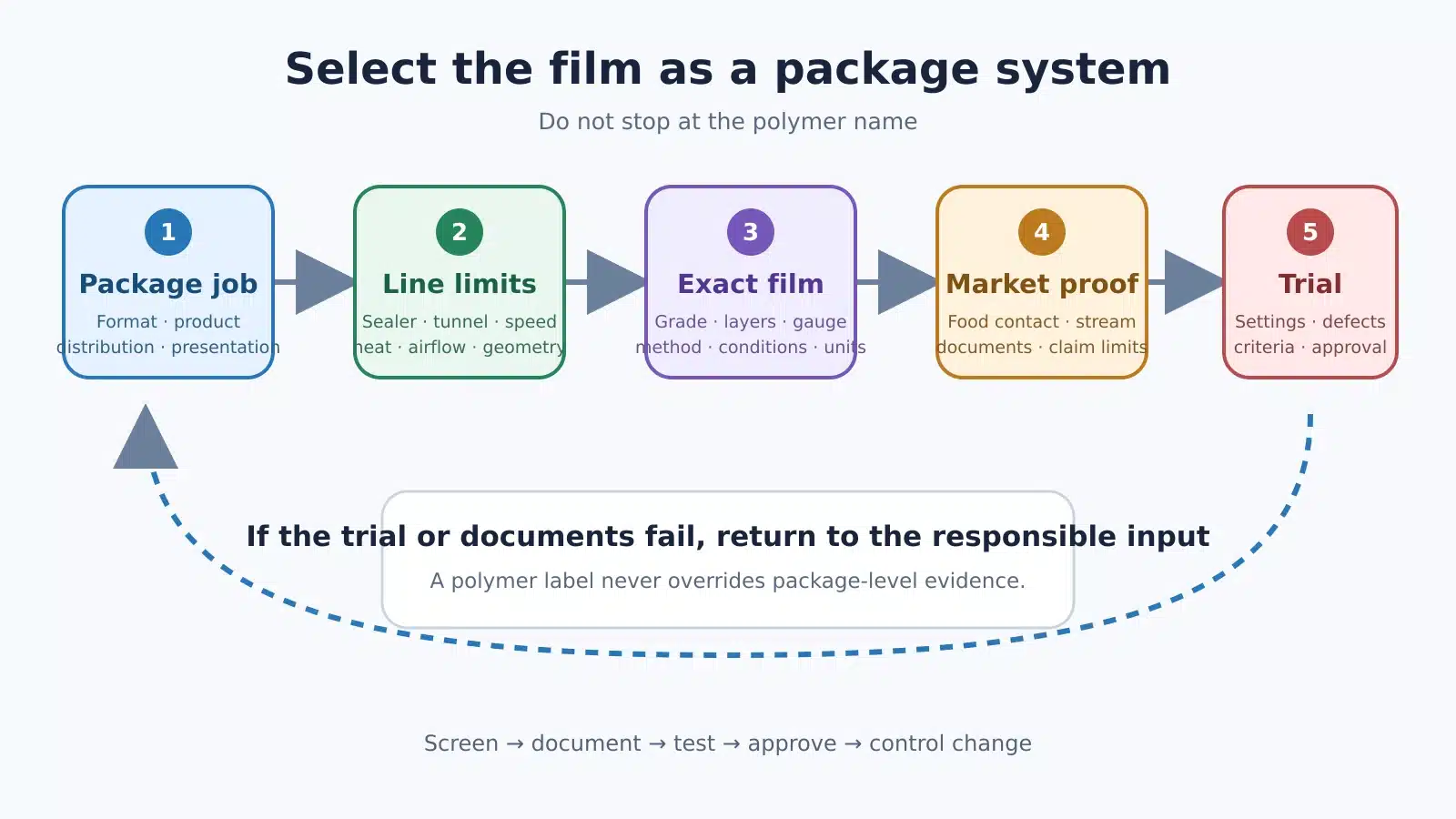
- Define the pack and product. State format, product dimensions and weight, sharp edges, heat sensitivity, food or nonfood use, storage, distribution, presentation, opening, and tamper requirements.
- Define the film request. State whether the need is shrink, stretch, lidding, bagging, or another format. Request polymer family and disclosed construction, nominal gauge and tolerance, width, surface treatment, additives relevant to running, orientation or crosslinking status, shrink balance, and roll requirements.
- Define the equipment and process. Identify wrapper/sealer model, seal system, tunnel dimensions, available temperature and airflow controls, conveyor range, target throughput, product spacing, and known operating constraints.
- Define the evidence package. Request a current technical data sheet; test methods, editions, units, conditioning, and MD/TD data; food-contact documents for each target market when applicable; recyclability assessment basis; safety and handling information; traceability; and change-control terms.
- Define the trial protocol. Record film lot, gauge, width, seal time/temperature/pressure, tunnel temperature, airflow and conveyor speed, line speed, ambient conditions, product configuration, perforation, observed defects, scrap, downtime, and repeatability.
- Define approval criteria before the run. Include seal integrity, appearance, shrink fit, product distortion, throughput, roll handling, downstream distribution, shelf-life or barrier results where relevant, and document acceptance.
Change one controlled variable at a time where practical. If a film change also alters gauge, width, perforation, and tunnel settings, a successful package does not reveal which factor produced the result. Retain the approved sample, settings, test report, supplier revision, and deviation record. A later formulation or manufacturing change can then be reviewed against a known baseline.
Frequently Asked Questions
Is polyethylene the same thing as polyolefin?
Not exactly. Polyethylene is a polyolefin, but the polyolefin family is broader and also includes polypropylene and other olefin-based polymers and copolymers. In an RFQ, use PE when you mean polyethylene. Use polyolefin only when a broader family is intentional, then add the grade, construction, and performance requirements.
Does POF always mean a polyethylene film?
No. In packaging, POF commonly means a commercial polyolefin shrink film category. A product may contain multiple polyolefin layers or components and may be crosslinked or oriented. The label does not prove a PE-only composition. Request the supplier’s construction disclosure and technical data for the exact grade.
Is PVC film always unsuitable for food packaging?
No blanket answer is defensible. Suitability depends on the finished formulation, every relevant component, the target market, intended food, contact time and temperature, and supporting compliance documentation. A generic PVC name neither proves suitability nor proves prohibition.
Which film is better for shrink packaging?
The better film is the one qualified for the package and line. Clear retail shrink, irregular products, bulk collation, heat-sensitive goods, and food applications create different requirements. Screen POF, PVC, and PE constructions against those requirements, then compare exact grades using conditioned test data and a controlled machine trial.
Can a PE film replace PVC without changing machine settings?
Do not assume it can. Seal response, shrink curve, gauge, stiffness, friction, perforation, and heat demand may differ. Some equipment can process several film families, but temperature, dwell, airflow, conveyor speed, or film handling may need adjustment. Treat the change as a controlled qualification, not a drop-in substitution.
What documents and test data should a buyer request?
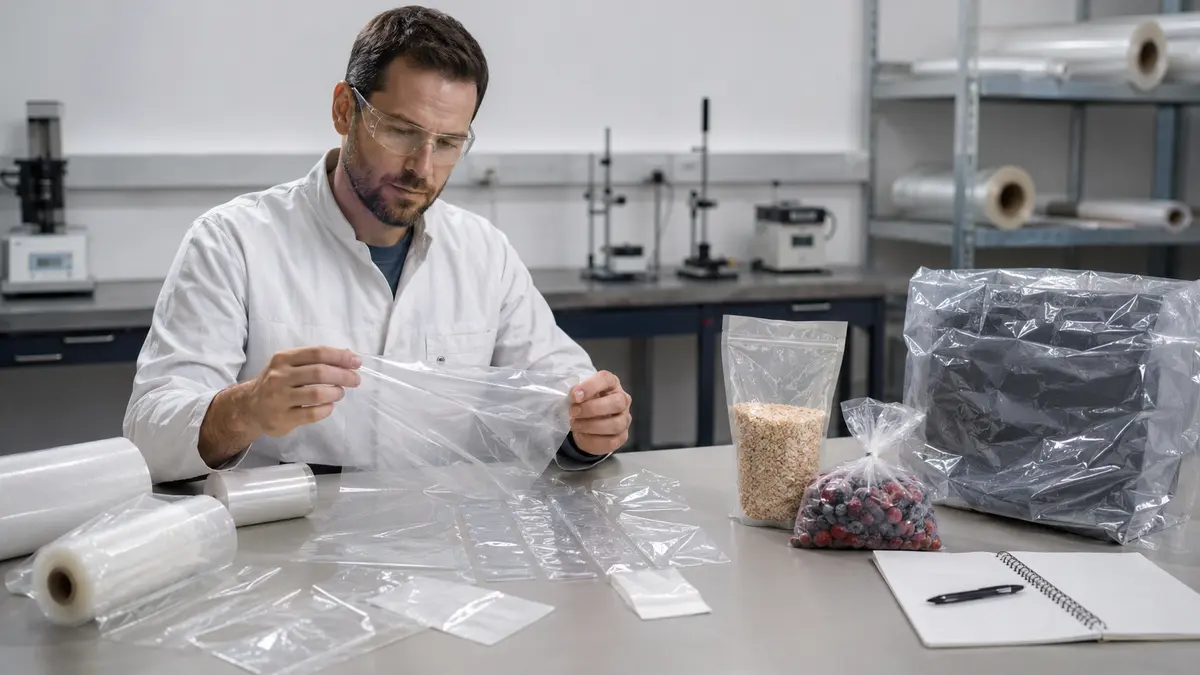
Request the technical data sheet and finished-film construction; nominal gauge and tolerance; relevant MD/TD mechanical, optical, shrink, seal, friction, and barrier data with method versions and conditions; market- and use-specific food-contact documents where applicable; recycling assessment and local claim basis; roll and traceability specifications; safety information; approved samples; machine-trial records; and supplier change-control commitments.
The final selection should be documented as a package-system decision. Polymer taxonomy prevents an early naming error, but the finished film, the actual machine, the intended market, and the recorded evidence determine whether the package is fit for use.
Reference sources
- Plastics Europe: Polyolefins
- Plastics Europe: Polyvinyl chloride (PVC)
- LyondellBasell: A Guide to Polyolefin Film Extrusion
- ASTM International: Plastics Standards
- eCFR: 21 CFR 177.1520 Olefin polymers
- EUR-Lex: Regulation (EU) No 10/2011, consolidated text
- APR Design Guide Overview
- RecyClass: Design for Recycling Guidelines
- US EPA: How Do I Recycle Common Recyclables?
 English
 Japanese
 French
 Spanish
 Korean
 Italian
 Portuguese
 Dutch
Dutch Arabic
 Russian
 German