
Polyolefin shrink film, usually shortened to POF, is a heat-shrinkable packaging film made from polymers in the polyolefin family. Commercial films are commonly oriented and may use several co-extruded layers to balance sealing, shrink response, toughness, and appearance. Heat activates the stored orientation so the film contracts around a product. For a buyer, however, “POF” is only a material-family description. The exact grade, thickness, roll format, seal window, shrink behavior, compliance documents, and performance on the intended line still need to be specified and tested.
What Is Polyolefin Shrink Film?
For polymer background, consult the NIH PubChem polypropylene overview before comparing finished-film claims.
For polymer background, consult the NIH PubChem polypropylene overview before comparing finished-film claims.
POF is a flexible film designed to be sealed around an item and then exposed to controlled heat. As the film contracts, it follows the product profile and forms a fitted overwrap. The result can improve presentation, keep loose components together, and provide a clean handling surface. Those outcomes depend on the actual film and process; the name alone does not establish package strength, barrier performance, or regulatory status.
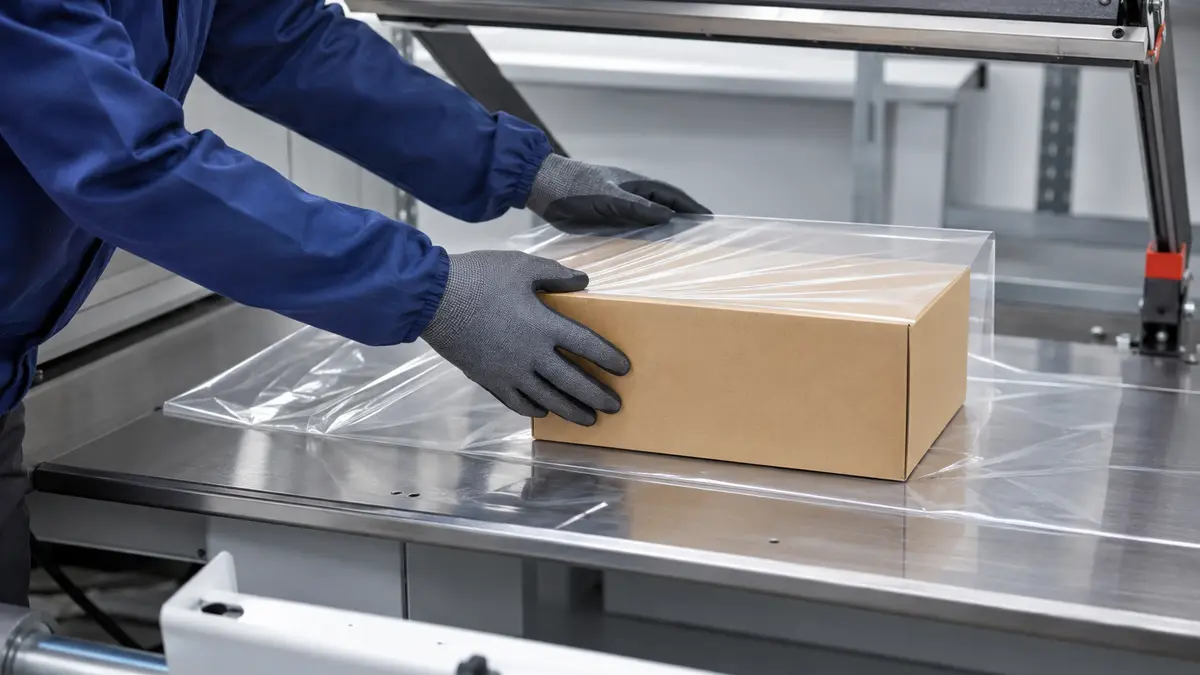
The Polyolefin Family
“Polyolefin” names a family of thermoplastics that includes polyethylene (PE) and polypropylene (PP). In shrink packaging, POF commonly refers to oriented film formulations based on polyolefin resins rather than to one single polymer, recipe, or standard grade. Two films sold as POF can therefore differ in resin selection, additives, layer count, crosslinking, orientation, thickness, surface treatment, and seal layers.
This distinction matters in purchasing. A statement that is true for one supplier’s five-layer crosslinked film cannot automatically be applied to a different non-crosslinked film. The correct comparison is between identified grades with matching test methods and conditions.
Typical Film Construction
Many commercial POF films are co-extruded multilayer structures. Different layers can be designed for functions such as sealing, bulk mechanical response, optics, slip, or processing stability. Some films are crosslinked, some are not, and specialized products may add anti-fog behavior or other functions. Supplier data sheets from Clysar and Sealed Air demonstrate that multilayer, crosslinked, biaxially oriented products exist, but they do not prove that every POF film uses the same design.
Orientation is a central feature of heat-shrinkable film. During manufacturing, the film is stretched in the machine direction (MD), transverse direction (TD), or both, then cooled in a controlled state. The construction and orientation process influence how the film later seals, shrinks, and loads the product. Exact layer sequence, thickness distribution, additives, and orientation conditions remain grade-specific information.
How Polyolefin Shrink Film Works
POF packaging involves two connected operations: making a seal around the product and shrinking the enclosed film with heat. A good-looking pack requires both operations to work together. A strong laboratory seal does not compensate for poor air evacuation, and high free shrink does not guarantee that a delicate product will tolerate the film’s force.
Orientation Stores Shrink Potential
When a film is stretched during manufacture, its polymer structure is oriented. Cooling helps hold that oriented state. The film then contains stored dimensional potential rather than behaving like an ordinary, unoriented sheet. The amount and balance of orientation in MD and TD influence the direction and extent of contraction.
Orientation can also affect tensile behavior, tear propagation, stiffness, and impact response. Those properties should not be inferred from orientation alone. They must be measured using the stated thickness, specimen direction, conditioning, test method, and units.
Heat Releases the Oriented Structure
In use, a product is placed in centerfold film, flat film, tubing, or a premade bag. The film is closed with a compatible sealing system, and excess air needs a controlled escape path. Heated air then raises the film temperature so the oriented structure relaxes and contracts. A shrink tunnel is common on production lines; chamber systems and carefully controlled heat tools may suit other volumes or formats.
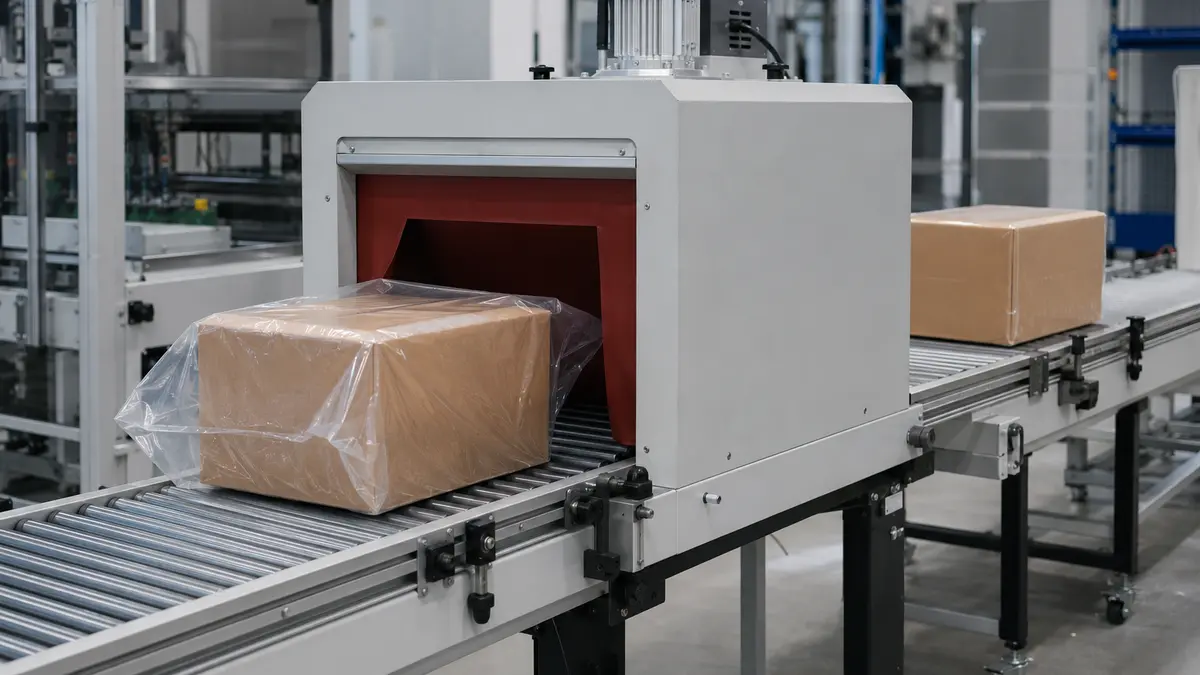
The result depends on film temperature rather than on the tunnel setpoint alone. Conveyor speed, airflow, tunnel-zone balance, package mass, product shape, film thickness, ambient conditions, and the distance between the film and product all affect heating. Settings therefore have to be established on the actual equipment.
Free Shrink Is Not the Same as Shrink Force
Free shrink describes dimensional change when a film specimen can contract without restraint. ASTM D2732 covers unrestrained linear thermal shrinkage at specified specimen temperatures. Shrink force or shrink tension describes the force developed under a defined restraint condition; ASTM D2838 addresses shrink tension, shrink force, and orientation release stress at predetermined temperatures.
These measurements answer different questions. A film can show substantial free shrink yet exert a force profile that is unsuitable for crush-sensitive cartons, deformable trays, or soft products. Conversely, a low-force film may require careful sizing and heat distribution to avoid loose areas.
Important: Compare shrink data only when the grade, thickness, MD/TD direction, specimen preparation, temperature, exposure time, restraint condition, method, and units are stated. A percentage without those conditions is not a usable specification.
Common Forms and Functional Variants
POF films are sold in different converting formats and functional variants. An RFQ should identify both axes. “Crosslinked POF” describes a material or processing feature, while “centerfold” describes how the film is supplied; one term cannot replace the other.
Centerfold, Flat Film, and Bags
Centerfold film is folded lengthwise on the roll. An L-bar or side-seal system can place a product between the two film webs and close the remaining sides. Flat film is supplied as a single web and may be used on equipment that brings separate webs together or forms a package around the product. Premade shrink bags or tubing can simplify lower-volume or shape-specific loading.
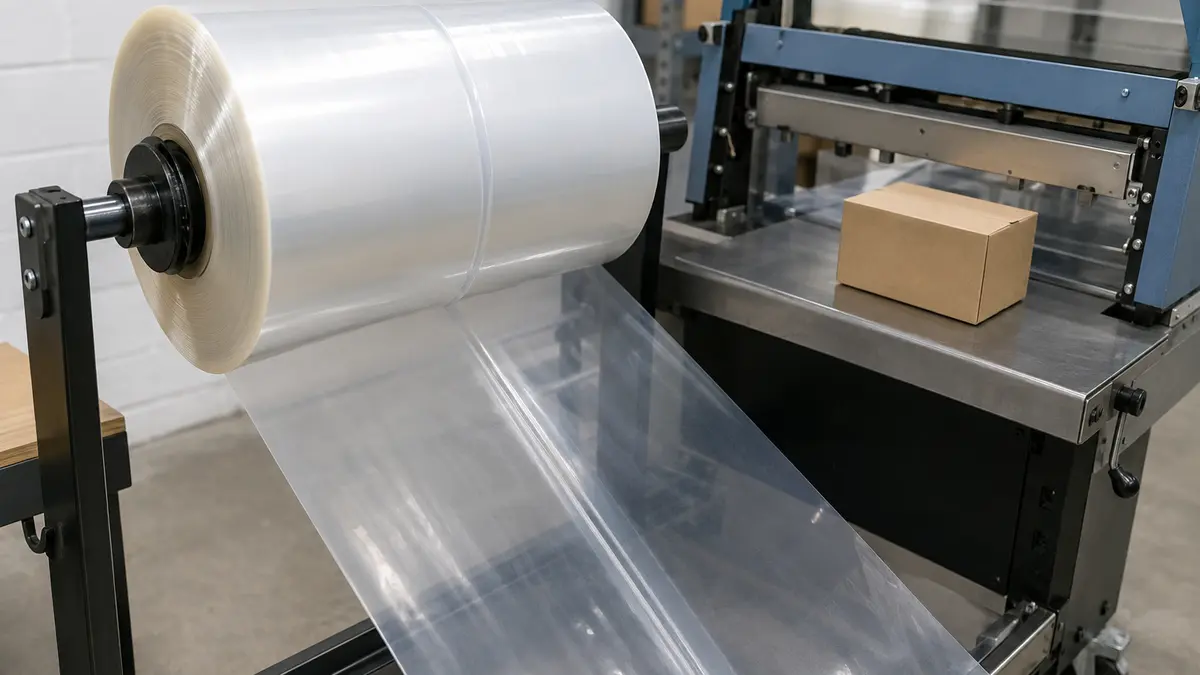
For any format, specify nominal width, thickness or gauge, roll length, core inside diameter, maximum roll outside diameter, winding direction, splice policy, and dimensional tolerances. With centerfold film, state whether width is quoted as layflat width and how usable opening is defined.
Crosslinked and Non-Crosslinked Options
Crosslinking creates bonds between polymer chains and can change hot strength, seal behavior, toughness, and processing response. Commercial crosslinked POF films are available, including grades marketed for demanding or higher-speed applications. Non-crosslinked films are also available and may be appropriate when their verified operating window and package performance meet the requirement.
Crosslinked should not be treated as an automatic quality ranking. The useful question is whether the exact film provides a stable seal-and-shrink window, acceptable optics, sufficient abuse resistance, and reliable machinability at the required speed. These points require grade-specific data and a line trial.
Anti-Fog, Perforated, and Other Specialized Films
Specialized POF variants may address a defined package problem:
- Anti-fog films are intended to reduce visibility loss from condensed droplets under specified conditions.
- Perforated films provide intentional air-release paths or ventilation patterns.
- Low-force grades may reduce distortion risk for sensitive products.
- Hot-slip or similar surface designs may be offered for particular tunnel or handling conditions.
- Printed or print-receptive grades require matched surface treatment, inks, curing, and shrink-distortion control.
These labels are not complete specifications. Ask how the function was tested, how long it is expected to persist, which side is treated, and what storage or converting conditions can change it.
Benefits and Limitations
POF is widely evaluated because it can combine a clear retail appearance with useful toughness and a broad range of packaging formats. The benefit is the balance, not an unlimited level of any single property. The same film that runs well on one product can wrinkle, split, distort, or seal poorly on another.
Potential Packaging Benefits
Depending on the grade and process, POF may offer:
- Clear presentation and gloss for products that need to remain visible.
- A fitted overwrap that keeps components together and limits routine surface contact.
- Useful resistance to puncture or tear initiation at relatively thin gauges.
- Bidirectional shrink response for products with varied profiles.
- Seal-and-shrink windows suitable for manual, semi-automatic, or automatic systems.
- Options such as crosslinked, anti-fog, perforated, or low-force film.
These are screening advantages. They become purchasing claims only after the supplier identifies the grade, method, conditions, and limits.
Limits That Require Application Testing
POF is not automatically the right film for every load. Sharp corners can concentrate stress and create burn-through or puncture. Large voids can produce dog-ears or loose areas. Excess shrink force can bow cartons or distort trays. Insufficient air evacuation can balloon the package or leave wrinkles. Excessive heat can damage the product, print, adhesive, coating, or seal.
A conventional POF overwrap also should not be assumed to provide oxygen or moisture barrier, a hermetic seal, sterility maintenance, or validated tamper evidence. Those functions require a defined complete-package construction and appropriate test methods. Heavy beverage bundles or transit packs may need a PE shrink film designed for higher load duty rather than a presentation-oriented POF film.
Common Packaging Applications
POF is commonly considered for retail overwrap, grouped products, and packages where a fitted transparent film is useful. Application lists should be read as starting points. Product sensitivity, package geometry, distribution hazards, market rules, and the actual sealing and shrinking process determine fitness.
Retail and Printed Products
Books, stationery, games, boxed cosmetics, software, household items, and other retail goods can use POF overwrap for presentation and routine handling protection. The film can keep multipiece sets together and show whether the overwrap has been visibly disturbed. It does not, by itself, prove a formal tamper-evident system.
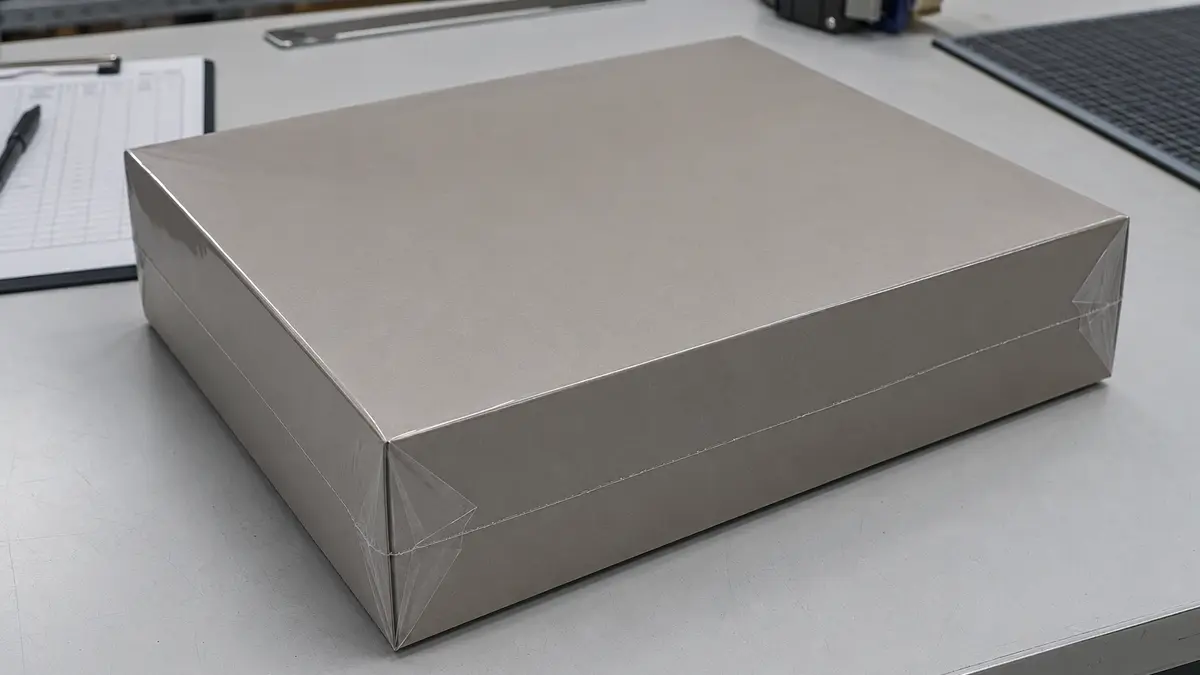
For printed cartons and paper goods, trial heat exposure and film force. Coatings can scuff, inks can block or change gloss, and light cartons can bow. Confirm that seal placement does not cover required information or create a sharp edge against the product.
Food and Temperature-Sensitive Products
POF is used in some bakery, produce, frozen, and prepared-food packaging applications, but the exact film must be authorized for the intended food-contact use. The package design must also address condensation, ventilation, sealing, product temperature, storage, and shelf-life evidence. The material name is not a food-safety approval and does not show that a package preserves a specific food.
Temperature-sensitive products need a thermal review. The film may receive controlled heat for a short time, but the product surface, tray, adhesive, label, and contents can respond differently. Use temperature indicators or other suitable measurements during trials when heat exposure is a risk.
Multipacks and Irregular Shapes
POF can bundle light consumer items or conform around shapes that are difficult to package in a rigid outer format. A properly sized film can reduce loose material and improve appearance. However, protrusions, deep recesses, mixed heights, and sharp edges can create thin spots or high local force.
For irregular products, evaluate orientation, film width, bag length, air-release position, seal location, tunnel airflow, and support fixtures together. If the pack must carry substantial weight during distribution, test the complete bundle or select a film family designed for that duty.
Polyolefin vs. PVC and PE Shrink Film
POF, PVC, and PE shrink films can all contract with heat, but they are not interchangeable material names. The comparison below describes common purchasing tendencies, not guaranteed properties. Exact grades can depart from the pattern.
| Decision Axis | Polyolefin (POF) | PVC Shrink Film | PE Shrink Film |
|---|---|---|---|
| Typical role | Clear retail overwrap and light bundling | Clear presentation overwrap in selected non-food and other authorized uses | Heavier bundling, transit packs, and industrial shrink duties |
| Construction | Often oriented, multilayer polyolefin; crosslinked and non-crosslinked grades exist | Plasticized or otherwise formulated PVC structures vary by grade | Usually PE-based structures selected for load and shrink duty |
| Processing focus | Balance seal window, tunnel response, optics, and force | Control temperature, ventilation, deposit/odor considerations, and product compatibility | Manage higher film mass, shrink energy, seals, and bundle strength |
| Compliance question | Verify exact formulation, market, and intended use | Verify exact formulation, additives, market, and intended use | Verify exact formulation, market, and intended use |
| Selection risk | Treating “POF” as one universal specification | Treating family-level concerns as proof about a particular compliant grade | Assuming every PE shrink film has the same clarity, force, or load capacity |
Polyolefin vs. PVC Shrink Film
POF is often shortlisted when buyers want a clear overwrap with a broad processing window and wish to avoid a PVC structure. PVC films can offer useful clarity and shrink behavior in appropriate applications, but formulation, heating, workplace controls, market restrictions, and end-of-life considerations must be reviewed for the exact product. It is inaccurate to declare every PVC film prohibited or every POF film automatically safer and compliant.
Compare actual samples for seal appearance, shrink balance, force on the product, optics, storage behavior, deposits on sealing components, odor under defined processing conditions, documentation, and total operating cost. A material-family comparison cannot replace these checks.
Polyolefin vs. PE Shrink Film
POF is generally associated with thinner, clear retail presentation films, while PE shrink film is widely used for heavier bundles and distribution packs. The categories overlap: both belong to the broader polyolefin family, and commercial structures vary. The term “polyolefin shrink film” in retail packaging commonly means POF as a distinct market category, whereas “PE shrink film” identifies a predominantly polyethylene film family.
Select by duty. A lightweight carton overwrap and a multi-bottle transit bundle impose different seal, force, puncture, carrying, and distribution requirements. Compare finished-package performance rather than assuming that the lowest nominal thickness or lowest roll price gives the lowest cost per accepted pack.
What to Include in a POF Film Specification
A useful specification identifies the exact item to be supplied, the methods used to characterize it, the packaging system it must run on, and the evidence required for approval. Avoid a one-line request such as “60-gauge food-grade POF,” which leaves construction, tolerance, test conditions, roll configuration, and regulatory scope unresolved.
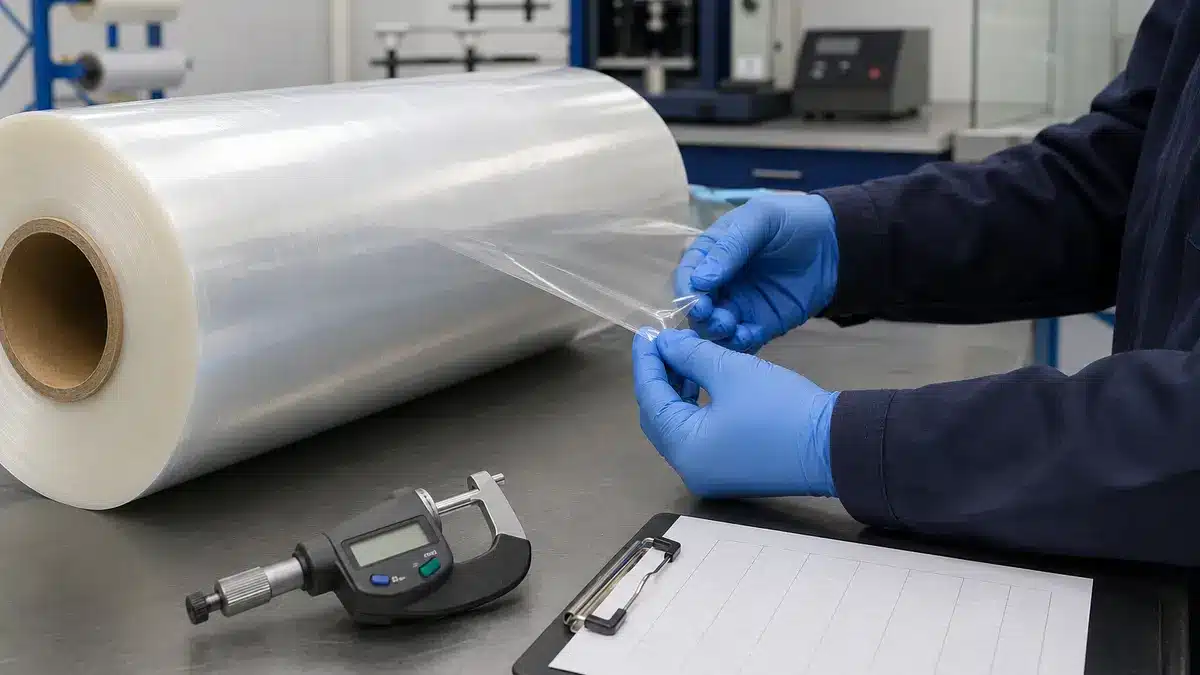
Roll and Converting Details
Record at least:
- Supplier, grade or SKU, revision, and manufacturing location when traceability requires it.
- Film type, crosslinking status, layer information available to the buyer, and treated side.
- Nominal thickness with unit, tolerance, measurement method, and sampling plan.
- Centerfold, flat, tubing, or bag format; nominal width and tolerance; bag dimensions if applicable.
- Roll length, core inside diameter, maximum roll outside diameter, winding direction, and allowable splices.
- Perforation pattern, anti-fog side, print treatment, slip requirement, or other special feature.
- Packaging, storage, shelf-life, and conditioning instructions for incoming rolls.
Gauge terminology can vary by market. Put micrometres or another agreed unit beside any gauge description and state how thickness is verified.
Shrink, Seal, Mechanical, and Optical Data
Ask for test methods, conditions, directions, units, and typical-versus-limiting status. Relevant fields may include:
- Free shrink in MD and TD at stated temperatures and exposure times.
- Shrink force or shrink tension using a defined restraint procedure.
- Seal initiation behavior and a practical seal window with temperature, pressure, dwell time, cooling, seal-layer pairing, and peel method.
- Tensile strength and elongation in MD and TD under ASTM D882 or another agreed method.
- Tear, impact, or puncture data using methods appropriate to the failure risk.
- Haze, luminous transmittance, gloss, and coefficient of friction under stated methods.
Do not compare values from different thicknesses, methods, specimen orientations, or conditioning as though they were equivalent.
Application and Compliance Documents
Provide the product dimensions, weight, surface, sharp features, temperature, orientation through the machine, expected line speed, sealer type, tunnel dimensions, heat source, conveyor, airflow configuration, and downstream handling. State the defects that are unacceptable: open seals, burn-through, wrinkles, dog-ears, distortion, blocked vents, unreadable print, or unstable bundles.
For regulated or claimed uses, request the current declaration, authorization basis, migration support where applicable, restrictions, market, food type, contact time, temperature, and complete structure coverage. Also request change-notification terms, lot traceability, and a controlled sample for approval. A management-system certificate does not replace product compliance or performance evidence.
How to Validate Polyolefin Shrink Film on Your Line
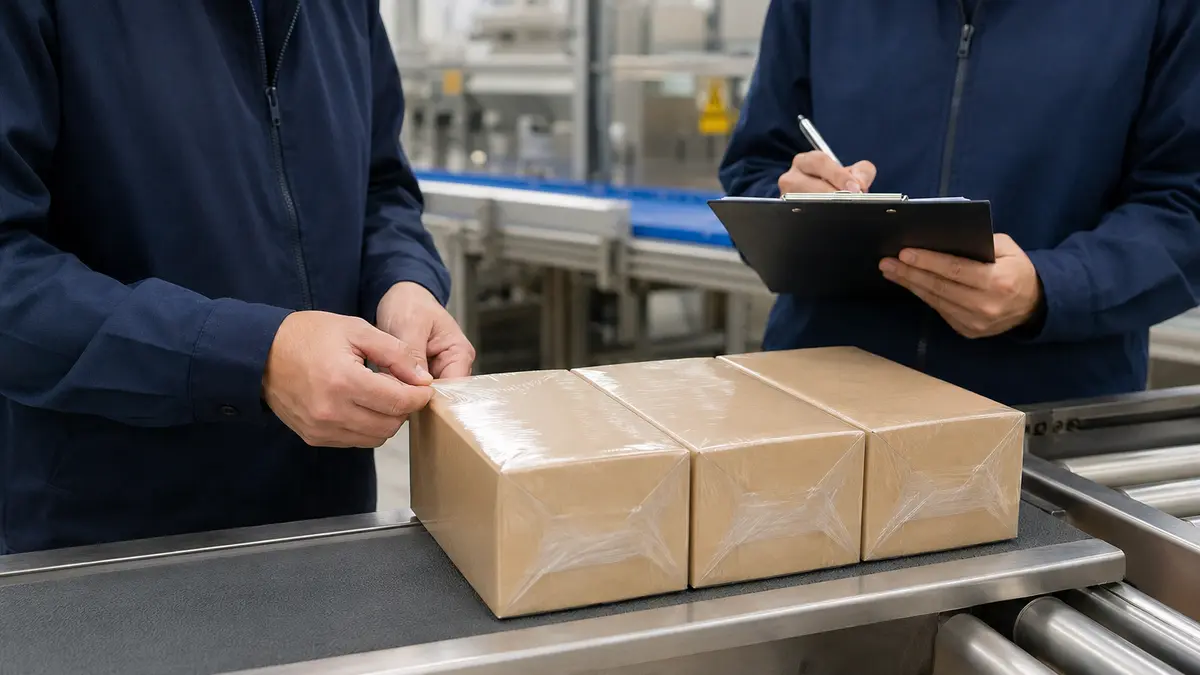
Run a controlled trial with the intended product, exact film grade, production sealer, and shrink equipment. Define acceptance criteria before changing settings. The objective is not to find one attractive pack; it is to identify a repeatable operating window that tolerates normal variation.
Confirm the Sample and Baseline
Verify the roll label, grade, thickness, width, format, lot, storage history, and technical documents. Condition the film and product as agreed. Record the existing material and settings if the trial is a replacement project. Inspect products for dimensional and surface variation that could be mistaken for film variation.
Establish a Seal Window
Create seals across a controlled range while holding other variables as constant as practical. Record jaw or wire configuration, set temperature or power level, measured temperature if available, pressure, dwell time, cooling, line speed, and film orientation. Inspect for open seals, thinning, cut quality, contamination sensitivity, and seal distortion.
If seal strength is measured, define specimen width, conditioning, peel angle or fixture, speed, and failure mode. A single peak value does not describe the entire usable window.
Evaluate Shrink and Finished-Pack Performance
Once a stable seal condition is identified, evaluate shrink in a deliberate sequence:
- Start from a documented, conservative condition appropriate to the equipment and supplier guidance.
- Change one main variable at a time, such as conveyor speed, airflow, or zone temperature.
- Measure product or package temperatures when heat sensitivity matters.
- Inspect all sides for loose film, wrinkles, dog-ears, burn-through, holes, seal pullout, carton bowing, tray distortion, blocked openings, and print changes.
- Test the complete pack for its real handling, storage, and distribution duty.
Important: Tunnel display temperature is not proof of film temperature. Product mass, airflow, dwell time, film spacing, and loading pattern can change the heat received by the film.
Record the Trial for Scale-Up
Document accepted settings as a range, not only a preferred point. Record sample size, defect counts, product and film lots, operators, environmental conditions, startup behavior, line stops, changeovers, and cleaning observations. Retain accepted and rejected examples where practical.
Scale-up should confirm roll-to-roll consistency, normal product variation, sustained speed, and downstream handling. If a film, product, machine component, or regulatory document changes, define when revalidation is required.
Food Contact and Sustainability Claims
Food-contact and environmental statements are separate from ordinary line performance. A film can run well and still lack the documents for an intended regulated use. It can also be made from a commonly recycled resin family while the complete printed, sealed, or labeled package has no practical collection route.
Food Contact Must Match the Intended Use
In the United States, FDA food-contact authorizations include specifications and limitations. Food Contact Notifications are specific to the submitting company and specified use, while other authorization routes have their own scope. In the European Union, Regulation (EU) No 10/2011 establishes requirements for covered plastic materials and articles, including relevant multilayer categories, with compositional and migration controls.
Ask whether the exact supplied film, including additives and layers, is covered for the target market, food type, contact time, and temperature. Confirm whether the film contacts food directly or sits outside another package. Do not use “food grade,” “FDA approved,” or “EU compliant” as an unqualified material-family statement.
Recyclability Depends on the Complete Package and Local System
PE and PP are polyolefins, but that fact alone does not prove that a POF package is recyclable in a particular market. Crosslinking, incompatible layers, pigments, inks, adhesives, labels, residues, dimensions, sorting technology, design-for-recycling rules, collection programs, and end-market demand can all affect the outcome.
Separate four questions: Was the package designed against a recognized protocol? Has the complete structure been assessed? What claim and label are allowed in the target market? Is the format actually collected and processed where it will be sold? Use qualified language such as “designed for a specified recycling pathway” only when the supporting assessment and local limitations are clear.
Warning: Avoid unconditional terms such as “100% recyclable,” “eco-friendly,” “zero waste,” or “biodegradable” unless the exact package, claim rules, evidence, and disposal conditions support them.
Frequently Asked Questions
Is All Polyolefin Shrink Film Crosslinked?
No. Crosslinked and non-crosslinked POF films are both commercially available. Crosslinking can modify processing and mechanical behavior, but the effect depends on the complete construction. Ask the supplier to identify the exact grade and provide relevant seal, shrink, mechanical, and line-use data rather than inferring performance from the word “crosslinked.”
Can POF Film Run on Any Shrink-Wrapping Machine?
No. A film may run on several equipment types, but compatibility depends on format, width, gauge, unwind, static control, sealing system, air evacuation, tunnel size, airflow, heat source, conveyor, product, and speed. Check the machine limits and film guidance, then run a controlled trial. Do not assume that a roll fitting the unwind means it can seal and shrink reliably.
Does Thicker Film Always Perform Better?
No. Thickness can influence toughness, stiffness, heat demand, seal behavior, material use, and cost, but it is only one variable. A thicker film may increase tunnel demand or shrink force without solving a geometry or sealing problem. Compare exact grades at controlled conditions and evaluate the finished pack. Specify a minimum performance window and thickness tolerance rather than selecting by gauge alone.
Final Qualification Checklist
POF is best treated as a candidate film family, not a finished specification. Before approval:
- Identify the exact grade, construction, thickness, format, roll configuration, and revision.
- Match shrink, force, seal, mechanical, and optical data to stated methods and conditions.
- Confirm the film and product fit the sealer, tunnel, speed, and normal process variation.
- Define finished-pack acceptance criteria and validate the actual handling and distribution duty.
- Verify food-contact, environmental, or other claims for the complete structure, market, and intended use.
- Lock the accepted operating window, documents, traceability, and change-control requirements.
Approve only the tested combination of film, product, equipment, settings, and evidence. Any material change should trigger a documented review and, when needed, a new trial.
Related Bestypack Resources
- Shrink Wrap vs. Stretch Wrap: What’s the Difference?
 English
 Japanese
 French
 Spanish
 Korean
 Italian
 Portuguese
 Dutch
Dutch Arabic
 Russian
 German