
Shrink film and BOPP film can both produce clear, attractive flexible packages, but they are not parallel material names. Shrink film is defined mainly by what it does when heated; BOPP is defined by its polypropylene chemistry and biaxial orientation process. That distinction affects equipment, package shape, sealing, graphics, testing, and purchasing. This guide compares the two without assuming that every grade has the same structure or performance.
The Short Answer
For polymer background, consult the NIH PubChem polypropylene overview before comparing finished-film claims.
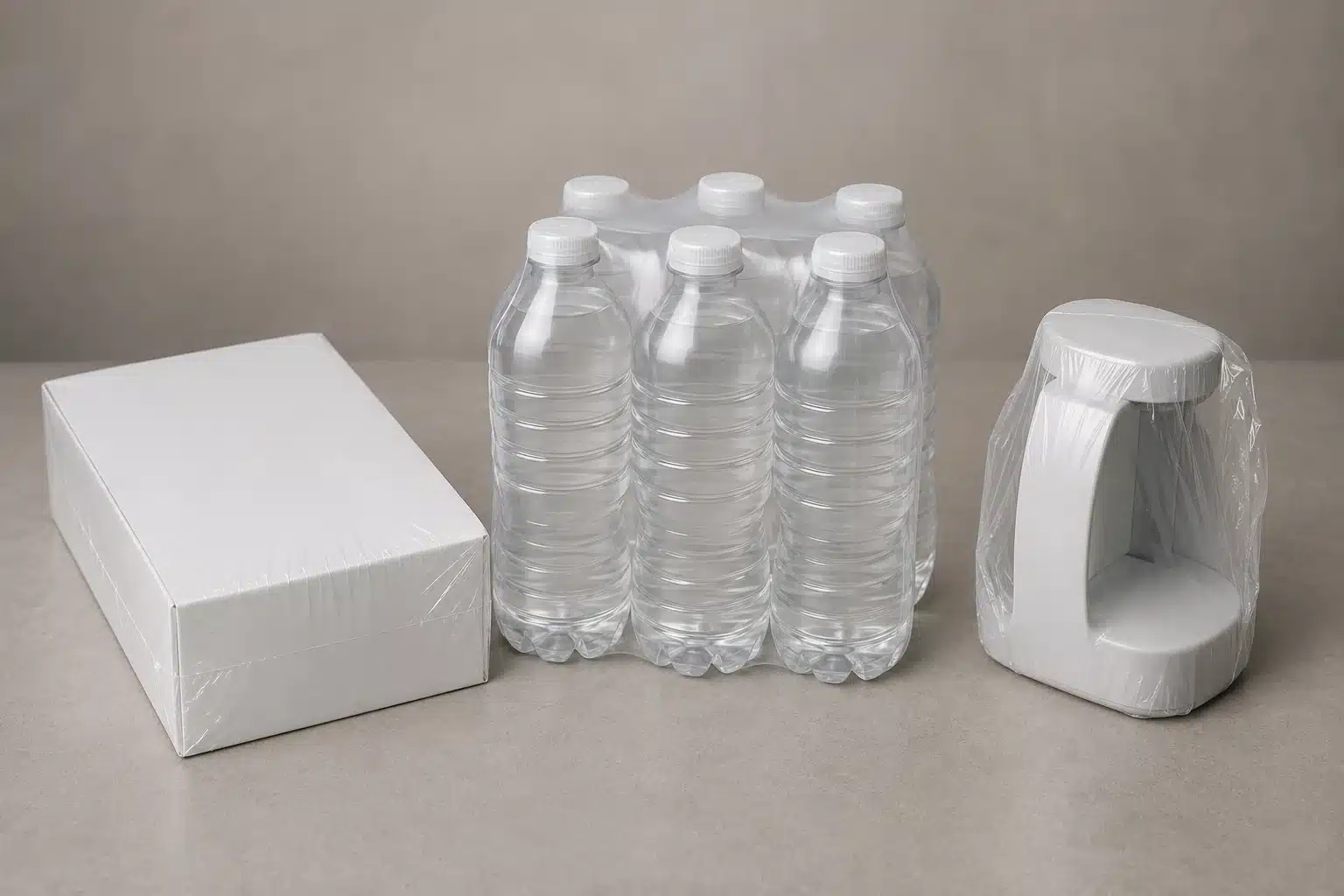
Choose shrink film when the package must contract around a product or bundle after heat is applied Choose a standard BOPP packaging film when the job calls for a dimensionally controlled web for overwrapping flow wrapping printing lamination labels or tape However do not treat.
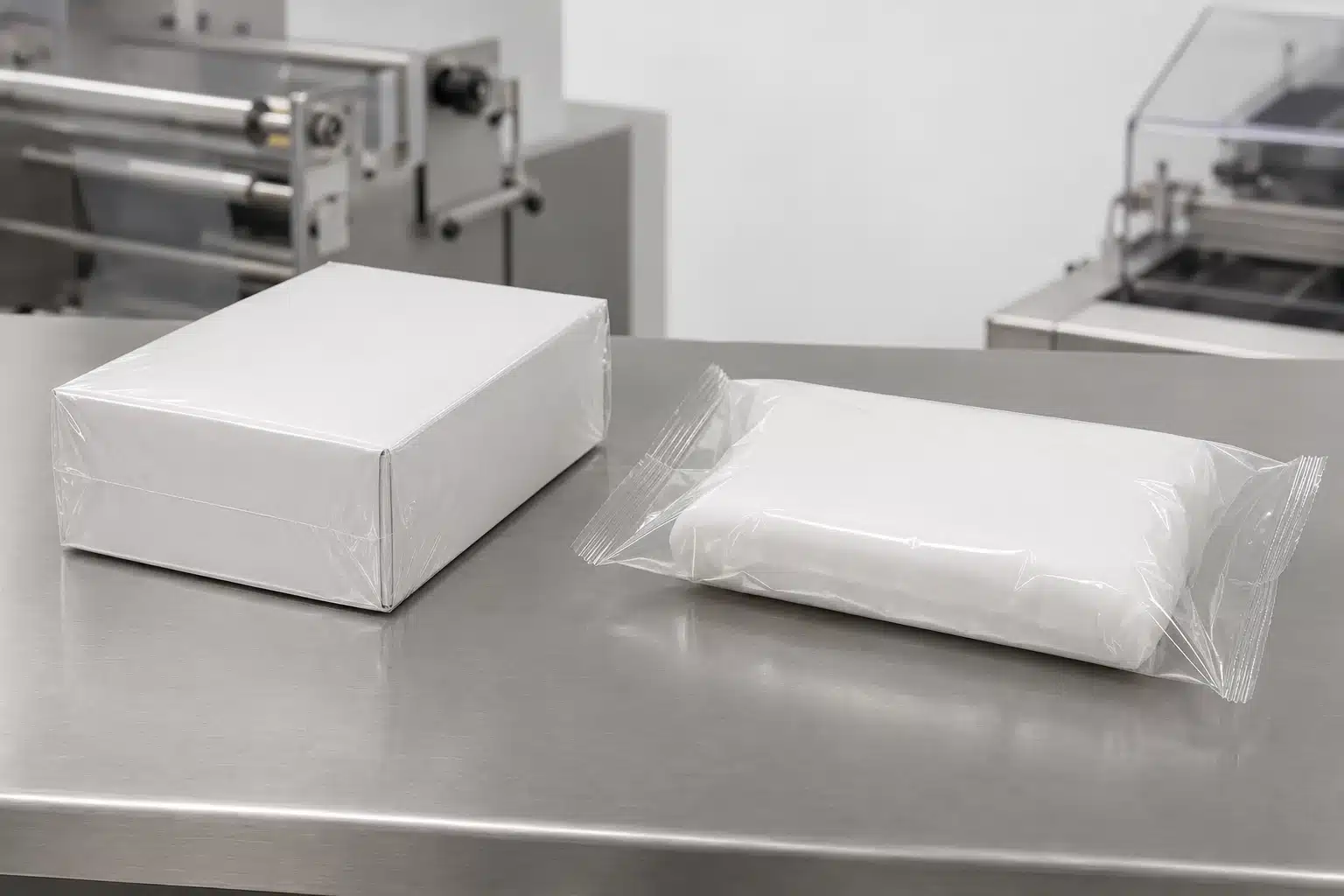
The fastest useful distinction is:
- Shrink film describes a packaging function. The film is sealed around the item and then exposed to a controlled heat cycle so it contracts.
- BOPP describes a material and manufacturing route. Polypropylene film is stretched in the machine direction (MD) and transverse direction (TD) to create an oriented film.
- The exact grade still controls performance. Resin, layer structure, orientation, coating, seal layer, thickness, perforation, treatment, and test conditions can change the result.
First, Compare the Right Categories
Shrink Film Is a Functional Category
“Shrink film” does not identify one polymer. Commercial shrink films may be based on polyethylene, polyolefin blends or coextrusions, PVC, polypropylene, PET-based materials, or other purpose-designed structures. They may also be supplied as single-wound film, centerfold film, tubing, bags, or bundling film.
What joins these products is controlled dimensional contraction under heat During manufacture orientation and internal stress are introduced into the film A later heat cycle releases part of that stored.
This broad category includes films optimized for different jobs. A clear retail-display wrap, a heavy beverage-bundle film, and a shrink sleeve label may all be called shrink film, yet their polymers, thicknesses, shrink curves, shrink forces, sealing behavior, and equipment requirements can be very different.
BOPP Is a Material-and-Process Description
BOPP means biaxially oriented polypropylene. The polypropylene web is stretched in both MD and TD during manufacture. Orientation can increase stiffness, tensile behavior, dimensional control, and optical performance compared with an unoriented polypropylene web, but the usable properties still depend on the formulation and construction.
BOPP is commonly converted into clear white matte coated metallized printable heat-sealable label tape overwrap and lamination grades A basic.
Standard BOPP overwrap and flow-wrap films are normally selected to remain controlled through the packaging process rather than to contract tightly in a shrink tunnel. Specialty shrinkable BOPP is the important exception. Therefore, the procurement question is not simply “shrink film or BOPP?” It is “Which exact film function and grade does this package and line require?”
Shrink Film vs BOPP Film: Key Differences
The table compares common roles, not guaranteed properties. A supplier’s technical data sheet and a controlled line trial must confirm the exact grade.
| Comparison axis | Shrink film | Standard BOPP packaging film |
|---|---|---|
| Category basis | Functional category defined by heat-induced contraction | Polypropylene film defined by biaxial orientation |
| Primary package action | Contracts around a product, tray, carton, or bundle | Wraps, folds, seals, laminates, labels, or reinforces without relying on tunnel shrink |
| Heat exposure | Usually needs a controlled shrink stage after sealing | May use sealing heat but standard grades do not rely on a shrink tunnel to form… |
| Material range | Can include several polymer families and multilayer structures | Polypropylene-based; coating, metallization, and seal layers vary by grade |
| Typical package appearance | Tight, conformal enclosure; final appearance depends on shrink balance and tunnel setup | Crisp web control, print surface, and fold or wrap appearance; depends on stiffness and machinability |
| Common converting formats | Centerfold, single-wound, tubing, bags, and bundling film | Single-wound web for flow wrap, overwrap, lamination, labels, and tape |
How Each Film Runs on Packaging Equipment
A Typical Shrink-Film Line
A typical retail shrink process begins by placing a product inside a film envelope or forming film around it. A sealing system closes the film, often leaving trim or a seal area. The pack then passes through a heat tunnel or receives controlled hot air. The film contracts, air escapes through the package opening or designed perforations, and cooling helps set the final shape.
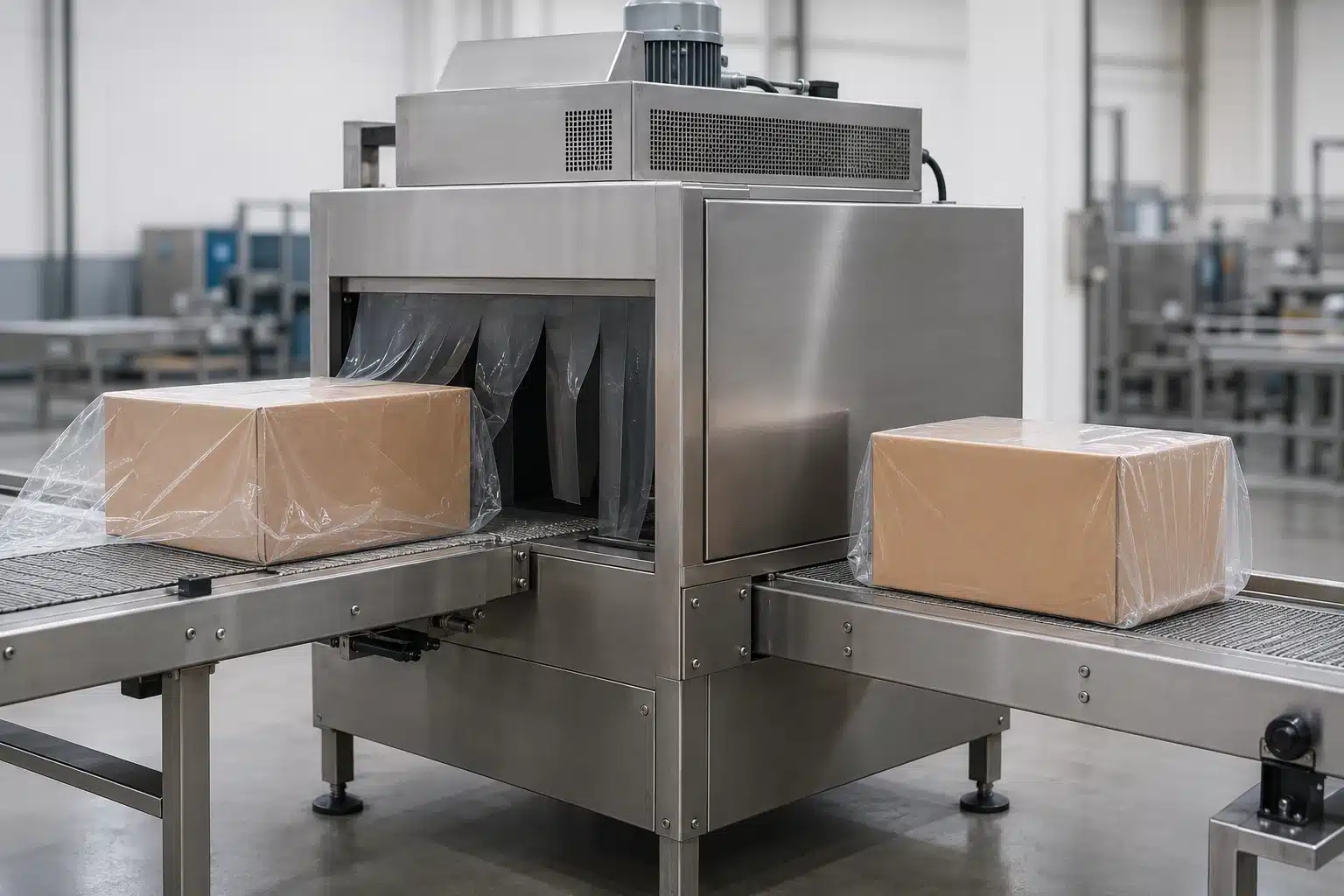
The sequence matters:
- Form the film around the product. The film width, length, and presentation must leave enough material for a sound enclosure without excessive loose film.
- Create the seal. Temperature, pressure, dwell time, contamination, and film construction affect seal quality.
- Apply a controlled heat profile. Air temperature alone is not a complete setting; exposure time, airflow, conveyor speed, pack geometry, and product heat sensitivity all matter.
- Inspect the cooled pack. Wrinkles, “dog ears,” ballooning, burn-through, open seals, distortion, and corner tears can indicate a mismatch among film, package design, and tunnel conditions.
A film that looks acceptable in an unrestrained laboratory shrink test may still perform poorly on a real pack because the product restrains contraction and creates uneven heat exposure. Package trials are therefore essential.
A Typical BOPP Overwrap or Flow-Wrap Line
In a standard BOPP overwrap or horizontal flow-wrap process the web is unwound under controlled tension guided and folded around the product sealed with a compatible seal surface and cut into individual packs Printed work may also require registration.
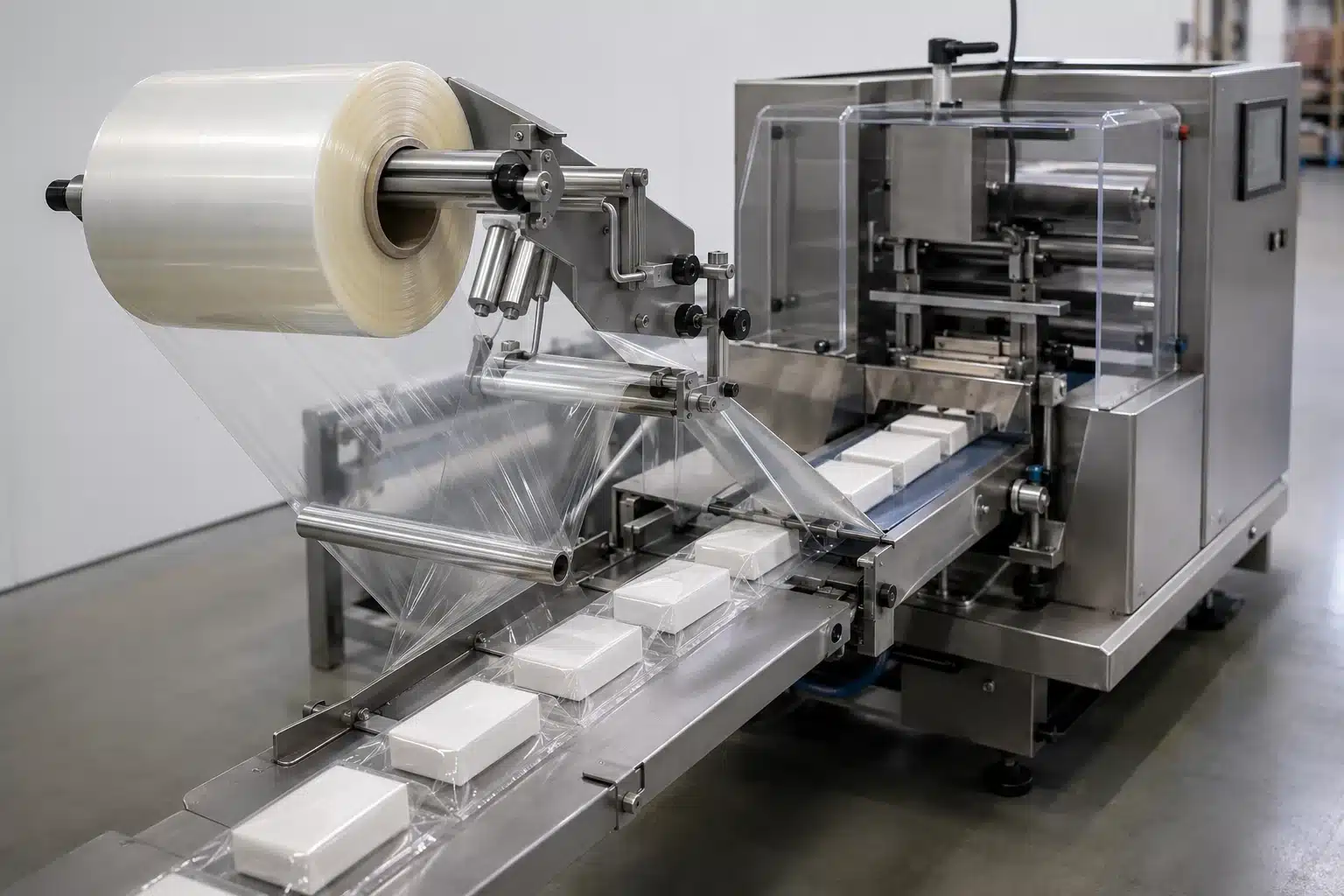
For this line, key variables include unwind direction, roll dimensions, splice quality, film stiffness, thickness consistency, static behavior, treatment level, COF, seal-layer orientation, sealing temperature, pressure, dwell time, cooling, and line speed. BOPP used as a print or lamination web also requires compatibility with inks, adhesives, coatings, and curing conditions.
Heat-sensitive products do not automatically make every BOPP grade suitable. Sealing can still expose the package to localized heat, and the complete process must be evaluated. The important distinction is that standard BOPP does not need whole-pack heat contraction to create its final shape.
Where Each Film Commonly Fits
Common Shrink-Film Jobs
Shrink film is commonly considered when the film must follow the outside shape of a pack or stabilize several items as one unit. Examples include:
- clear display wrapping around cartons, printed matter, games, household items, and prepared packs;
- multipacks and transport bundles, where the exact polyethylene-based film and load design must be validated;
- irregular products that benefit from a conformal enclosure, provided corners and protrusions do not exceed the film’s puncture and tear capability;
- tamper-evident outer bands or sleeves, when the complete closure design meets the application’s requirements; and
- shrink labels or sleeves, using a grade designed for the container geometry, print process, and shrink profile.
These examples do not make one shrink film interchangeable with another. A display-grade POF film is not automatically a replacement for a heavy PE bundling film or a high-shrink sleeve-label film.
Common BOPP Film Jobs
Standard BOPP is often considered where web stiffness, controlled machinability, print presentation, or a polypropylene-based converting surface is useful. Common jobs include:
- flow-wrapped snacks, bakery items, confectionery, and other products after the full structure and barrier needs are defined;
- carton and pack overwraps that use folding and sealing rather than tunnel shrink;
- print or outer webs in laminated flexible structures;
- pressure-sensitive and wraparound labels;
- adhesive-tape backing; and
- graphic lamination and protective surface applications.
BOPP may be only one layer of the final package. The sealant, barrier layer, coating, metallization, adhesive, ink, and product-contact layer can determine whether the complete structure works. Naming only the BOPP layer is not enough to specify a finished package.
Performance Claims That Need Grade-Specific Data
Shrink Response and Shrink Force
A procurement sheet should not state only “high shrink” or “balanced shrink.” It should identify the method and report MD and TD results at relevant temperatures and exposure times. The full shrink curve can be more useful than a single maximum because a tunnel creates a time-temperature history, not one isolated point.
Shrink force or shrink tension is different from free shrink. Two films can contract by a similar percentage while applying different force to the product. Excess force may distort a light carton, tray, cap, or soft product; insufficient force may leave a loose pack. The acceptable result therefore depends on both the film and the packaged item.
Seal, Strength, Optics, and Barrier
Broad claims such as “BOPP has better barrier” or “shrink film is tougher” are unsafe without narrowing the comparison. Shrink film covers multiple polymers, while BOPP covers many constructions and surface treatments. Thickness and test direction can change mechanical results; perforation can change package behavior; metallization and coating can change barrier; and a seal layer can change sealing performance.
Use matched methods and conditions:
- ASTM D882 can support tensile testing of thin plastic sheeting, but the report must identify thickness, specimen direction, conditioning, and test settings.
- ASTM D1894 covers static and kinetic coefficients of friction for film surfaces. Surface aging, additives, contacting surfaces, and method differences affect comparability.
- ASTM F88/F88M measures seal strength in flexible barrier materials, but the film pair, sealing conditions, specimen configuration, and failure mode must be recorded.
- ASTM D1003 can be used for haze and luminous transmittance; “clear” should not replace measured optical data when appearance is critical.
- ASTM D3985 addresses oxygen transmission through defined films and structures. OTR needs the structure, thickness, temperature, relative humidity, test side, gas, and units.
Important: A resin family, generic film name, or isolated typical value does not prove the performance of a printed, coated, laminated, perforated, or production-scale package.
A Practical Selection Framework
Use the packaging task to select the film, then use testing to select the grade.
- Define the final package action. Decide whether the web must contract around the pack, form a non-shrinking wrap, become a printed laminate layer, function as a label, or stabilize a bundle.
- Describe the product and geometry. Record dimensions, mass, edges, protrusions, ventilation needs, heat sensitivity, compression sensitivity, oil or moisture exposure, and expected shelf or distribution conditions.
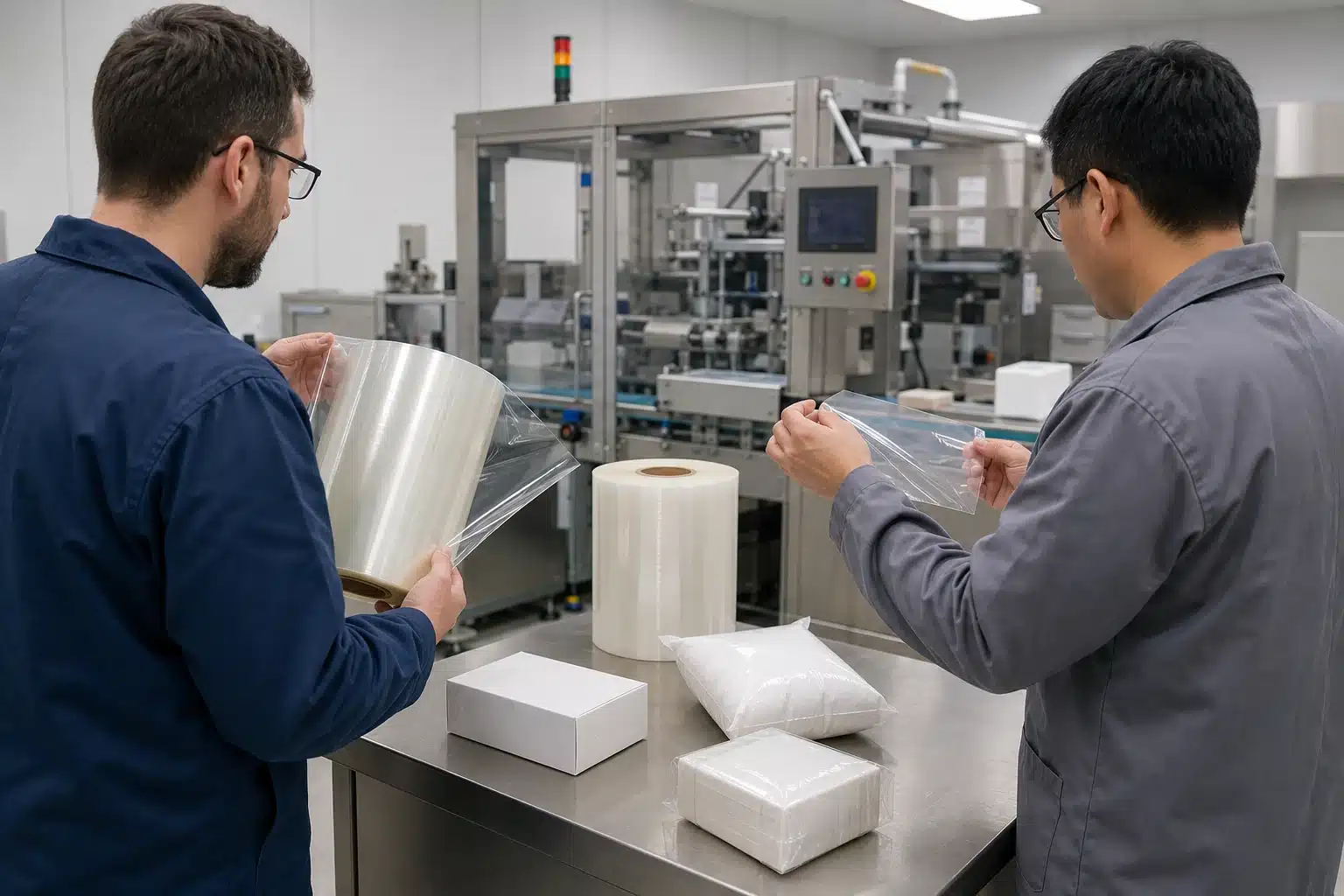
- Map the existing equipment. Identify the sealer, heat tunnel, flow wrapper, overwrapper, labeler, laminator, web width, core, unwind direction, maximum roll diameter, speed range, and control limits.
- Define package performance. Set measurable requirements for appearance, shrink balance, shrink force, seal integrity, puncture or tear behavior, stiffness, COF, barrier, print adhesion, and tamper evidence as applicable.
- Request exact-grade data. Compare documents only when the material, structure, thickness, method, units, and conditions are equivalent.
- Run a controlled trial. Record film lot, machine settings, ambient conditions, speed, scrap, downtime, defect types, package temperature, and finished-pack results.
- Evaluate total operating impact. Compare yield, roll changes, energy, throughput, rework, rejects, maintenance, and protection—not roll price alone.
- Lock the approved specification. Reference the approved sample, grade, construction, roll format, critical test limits, documents, change-control expectations, and acceptance plan.
If the application changes, repeat the relevant checks. A film approved for one SKU, machine, or structure should not automatically be extended to another.
What to Ask Suppliers to Document
A useful request for quotation or technical review should ask for comparable, grade-specific evidence:
- product name, grade, polymer family, layer sequence, seal layer, coating, metallization, additives or treatments relevant to the application;
- total thickness and tolerance, layer thickness where relevant, width, roll length, core, roll diameter, unwind direction, and splice limits;
- for shrink grades, MD/TD shrink results across the relevant temperature range, exposure time, test method, shrink force or tension where needed, and recommended process window;
- seal initiation behavior and operating seal window, including temperature, pressure, dwell time, mating surface, test method, peel configuration, and failure mode;
- tensile, tear, puncture, and impact data with method, thickness, MD/TD direction, conditioning, and units;
- haze, transmittance, gloss, surface treatment, print adhesion, and COF data with method and surface identification;
- OTR and WVTR only when required, with complete structure, thickness, temperature, humidity, test side, gas, and units;
- compatibility statements for the intended ink, adhesive, coating, print process, sealing method, and machine;
- food-contact or other market-access documents tied to the exact grade, structure, intended food type, contact condition, temperature, time, and destination market; and
- sample-roll identity, lot traceability, change-control process, and a written trial and acceptance plan.
Marketing labels such as “food grade,” “premium,” “high barrier,” or “recyclable” are not substitutes for scoped documentation. Ask what each document proves—and what it does not.
Frequently Asked Questions
Can BOPP Film Also Be a Shrink Film?
Yes. Specialty BOPP grades can be designed with controlled shrink behavior. This is why “shrink film versus BOPP” is not a chemically exclusive comparison. When a supplier offers shrinkable BOPP, request the MD/TD shrink curve, shrink force, sealing construction, dimensional tolerances, and intended machine/application. Do not apply assumptions from standard BOPP overwrap film to that grade.
Which Film Costs Less?
It depends. Price per kilogram or roll is not enough. Gauge, density, package area, usable yield, roll length, speed, energy, tunnel demand, scrap, downtime, maintenance, printed structure, and rejected packages can reverse an apparent material-price advantage. Compare cost per accepted package at the validated operating window.
Can I Switch Between Shrink Film and BOPP Without Changing Equipment?
Usually not as a simple drop-in change A shrink line relies on package formation sealing and controlled whole-pack heating A standard BOPP flow-wrap or overwrap line relies on stable web transport folding or forming compatible sealing surfaces and cutting Even when one machine can run several film families tooling temperature tension dwell speed perforation and handling settings.
Is Either Film Automatically Suitable for Food Packaging?
No. Polymer name alone does not establish food-contact suitability. The exact resin, additives, coatings, inks, adhesives, layer arrangement, manufacturing controls, intended food, contact time, temperature, and destination market determine which documentation and migration or compliance evidence is required. Review current official requirements and product-specific declarations before approval.
Conclusion: Choose by Package Function, Not Film Name
Shrink film and BOPP solve different packaging tasks in their most common forms. Shrink film uses controlled heat-induced contraction to create a conformal pack or bundle. Standard BOPP supplies an oriented polypropylene web for wrapping, printing, laminating, labeling, or tape without relying on a tunnel to shape the package. Specialty shrinkable BOPP is the exception that proves why grade-level language matters.
Before choosing, confirm three things:
- the final package function and product constraints;
- the exact film construction and measured performance under stated methods and conditions; and
- compatibility on the intended line through a documented production trial.
That evidence produces a defensible specification. A generic film name does not.
Related Bestypack Resources
- BOPP Thermal Lamination Film
 English
 Japanese
 French
 Spanish
 Korean
 Italian
 Portuguese
 Dutch
Dutch Arabic
 Russian
 German