
Flexible food packaging is a system, not a single film. A dependable specification connects the food, intended shelf life, filling process, distribution hazards, package format, functional layers, seal behavior, food-contact evidence, and end-of-life goal. Material names alone cannot make those connections. Buyers and engineers should define the application first, compare candidate structures under stated test conditions, and approve the final package on representative equipment with product-specific shelf-life and integrity evidence.
What Flexible Food Packaging Includes
For regulatory context, consult the U.S. FDA’s food-packaging guidance before approving an intended food-contact use.
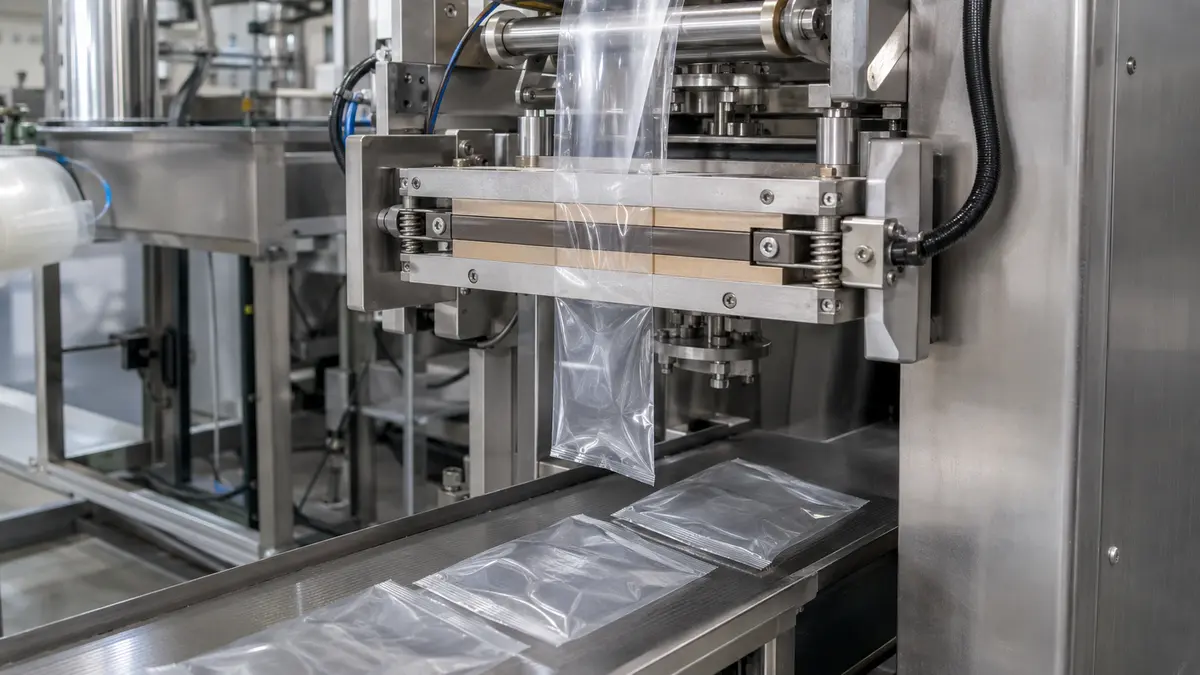
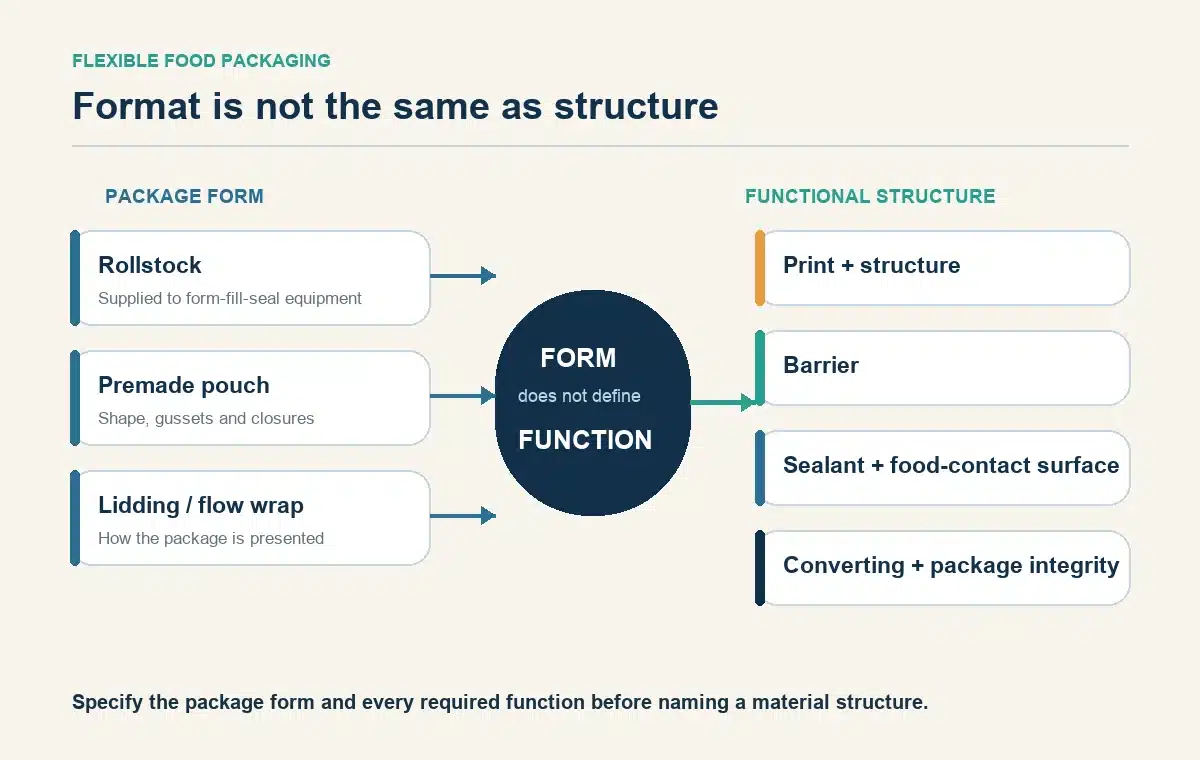
Flexible food packaging includes materials that bend readily and package formats made from them. Common examples are rollstock for horizontal or vertical form-fill-seal equipment, flow-wrap webs, lidding films, sachets, pillow bags, vacuum bags, and premade flat or stand-up pouches. Paper, foil, plastic film, coatings, adhesives, inks, and closures may appear alone or in a combined construction.
Format and structure answer different questions. “Stand-up pouch” describes a package shape; it does not identify the polymers, barrier layer, sealant, thickness, or process window. “PET/PE” names two material families but does not define grades, layer thicknesses, adhesive, print position, surface treatment, or finished-package performance. Likewise, “recyclable pouch” is a claim requiring a defined final construction and a relevant collection and recycling pathway. A useful discussion therefore starts with what the pack must do, then identifies the format and functional structure that may do it.
Start With the Food, Process, and Distribution Requirements
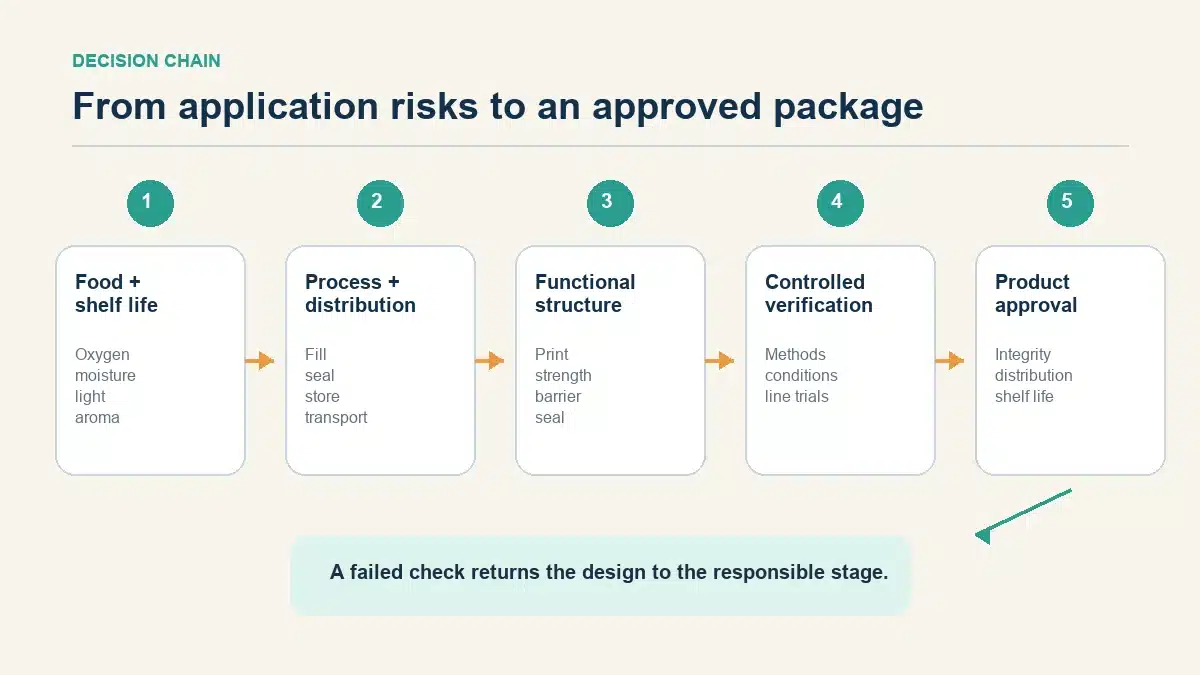
The same package can perform differently when the food, filling method, storage humidity, or transport profile changes. Before asking for a structure, create an application brief that separates known requirements from assumptions to be tested.
Map Product and Shelf-Life Risks
Record the food’s sensitivity to oxygen, moisture gain or loss, light, aroma loss, grease, and flavor scalping. Note whether particles, bones, sharp edges, or a high fill weight create puncture or flex-crack risks. Product chemistry, water activity, headspace, preservatives, and the desired sensory endpoint affect the shelf-life study, but they do not produce a universal OTR or WVTR target by themselves.
Shelf life is a property of the packed product and its conditions, not a generic property of a resin name. Define the target period, acceptance criteria, storage temperature and humidity, likely temperature excursions, and the measurements used to judge failure. Barrier data can support candidate selection, but the final decision still requires a product-specific shelf-life protocol.
Record Filling, Packing, Storage, and Distribution Conditions
Document the fill temperature, product contamination risk in the seal area, vacuum or modified-atmosphere conditions, sterilization or pasteurization exposure, and whether the product is frozen, chilled, or ambient. Add line type, direction of unwind, registration needs, sealing-jaw geometry, nominal speed, dwell-time range, and package dimensions.
| Requirement area | Questions to answer | Evidence or trial needed |
|---|---|---|
| Food and shelf life | What failure mode ends acceptable life? | Product-specific shelf-life protocol |
| Filling and sealing | What temperature, pressure, dwell time, speed, and seal contamination occur? | Lab seal curve plus representative-line trial |
| Distribution | What drops, vibration, compression, altitude, cold, or heat may occur? | Relevant distribution and integrity tests |
| Consumer use | Is easy opening, reclosure, microwave use, freezing, or portioning required? | Usability and use-condition confirmation |
| Market | Where will the package be sold and used? | Food-contact and labeling dossier for that market |
This requirement matrix is the control document for material selection. If a field is unknown, label it as an open item rather than letting a supplier infer it.
Build the Structure by Function, Not by Material Name
A flexible structure may be a monofilm, a coextrusion, a coated film, or an adhesive laminate. The correct number of layers is the number needed to deliver verified functions without unnecessary complexity. Each layer, coating, ink, adhesive, tie layer, and closure should have an identified job.
Outer Web and Structural Functions
The outer web may provide printability, stiffness, heat resistance at the sealing jaws, dimensional stability, scuff resistance, gloss or matte appearance, and mechanical support. Orientation can change stiffness, tensile behavior, tear propagation, shrink response, and converting performance, so “PP,” “PET,” or “PE” is not a complete description. Print side, ink system, treatment level, lamination bond, and expected curing or aging conditions also belong in the construction record.
Mechanical design must reflect package geometry and abuse. A film that performs well as flat rollstock can behave differently after folds, gussets, zipper insertion, laser scoring, or repeated flexing. Finished-package tests are needed wherever converting introduces stress concentrators.
Barrier and Food-Contact Sealant Functions
Barrier functions control transfer of oxygen, water vapor, aroma, and light. A barrier may come from a base polymer, a coextruded layer, a coating, metallization, or foil. Its performance can change with thickness, humidity, flexing, pinholes, coating continuity, and downstream converting. The final structure—not an isolated resin data sheet—must be evaluated under relevant conditions.
The inner layer normally provides the food-contact surface and seal response It must be compatible with the food sealing process storage temperature and desired opening behavior A sealant grade influences seal-initiation behavior hot tack contamination tolerance and cooled seal strength but the package result also depends on pressure dwell time jaw condition cooling and geometry Food-contact status must.
Match Material Families to Roles and Trade-Offs
Material families provide a starting vocabulary, not a finished specification. Grades, orientation, additives, coatings, and combinations can change performance substantially. Use the table as a shortlist tool and verify the actual construction.
Polyolefin Sealants and Oriented Polyolefin Webs
PE-based layers are widely used where flexibility moisture resistance toughness and heat sealing are important Different densities molecular designs and additives affect stiffness hot tack seal range low-temperature behavior coefficient of friction.
PP can appear as an oriented outer web, a cast sealant web, or part of a retort-capable construction. Oriented PP commonly contributes stiffness, clarity, and moisture resistance; CPP may provide heat sealing and temperature resistance. Those descriptions are conditional. Low-temperature brittleness, seal window, barrier, and line speed depend on the exact grade and structure.
Polyester, Polyamide, Foil, and Barrier Technologies
Oriented PET is often considered.
EVOH, PVdC, oxide coatings, metallization, and other barrier technologies have different sensitivities and converting constraints. For example, humidity, cracking, layer protection, and coating continuity may change the barrier delivered by the finished pack.
| Family or technology | Roles often considered | Important trade-offs to verify |
|---|---|---|
| PE-based films | Sealant, toughness, moisture resistance | Seal window, hot tack, stiffness, COF, temperature exposure |
| Oriented PP / CPP | Outer web or sealant, clarity, stiffness, moisture resistance | Low-temperature behavior, sealability, oxygen barrier, shrink |
| Oriented PET | Structural and print web, dimensional stability | Requires a compatible sealant; flex and end-of-life design |
| Polyamide | Toughness and puncture resistance | Moisture response, cost, compatibility with recycling target |
| EVOH or coatings | Oxygen or aroma barrier | Humidity sensitivity, flex durability, coating continuity |
| Metallized film or foil | Light and gas barrier | Pinholes, flex cracking, inspection, metal detection, end of life |
Do not compare values across different methods, thicknesses, directions, or climates. The shortlist is complete only when it links each role to an acceptance test.
Specify Barrier Performance Under Defined Conditions
OTR describes oxygen transmission rate; WVTR describes water-vapor transmission rate. Both are rates for a stated specimen and test environment. They are not timeless material constants, and neither rate alone proves the shelf life of a filled package.
ASTM D3985-24 covers a coulometric method for oxygen transmission through films, laminates, coextrusions, and coated materials. ASTM F1249-25 covers a modulated-infrared method for water-vapor transmission through flexible barrier materials. A purchase specification should name the adopted method and edition or require the parties to confirm the current adopted edition for the project.
Report Method, Temperature, Humidity, Thickness, Test Side, and Units
| Required field | Why it matters |
|---|---|
| Complete structure and total/layer thickness | Barrier can change with construction and gauge |
| Test method and edition | Different instruments and procedures are not automatically interchangeable |
| Temperature and relative humidity on each side | Permeation and some barrier layers are condition-sensitive |
| Test gas, test side, and specimen conditioning | Direction and preparation can affect interpretation |
| Units and reporting basis | Prevents hidden area, time, or pressure differences |
| Sample identity, lot, and converting state | Distinguishes base film from printed, laminated, flexed, or formed material |
Important: translate the shelf-life risk into a candidate barrier range through modeling or experiments, then confirm it with the actual packed food. Do not label a structure “high barrier” without the conditions and the product decision it supports.
Engineer Sealing and Package Integrity as a System
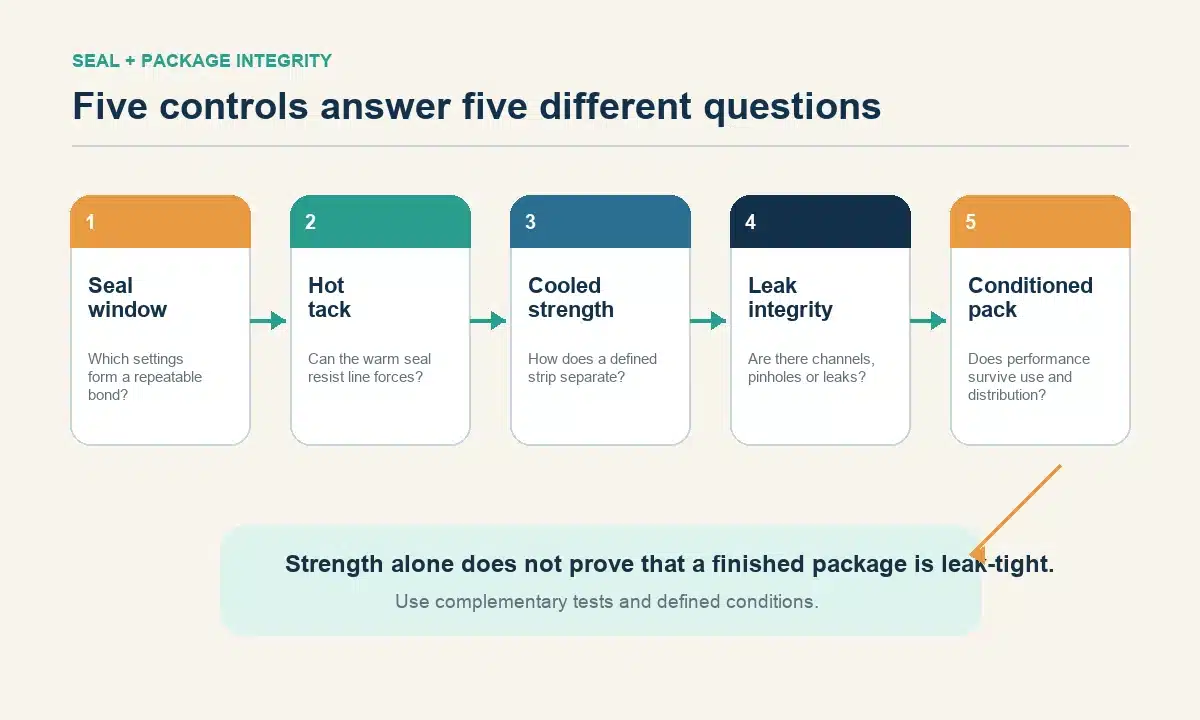
Sealing has at least four related controls: the conditions that form a bond, the strength while the seal is hot, the strength after cooling, and the absence of leak paths in the completed package. A single pull value cannot represent all four.
Establish a Seal Window and Hot-Tack Requirement
Build a laboratory seal curve across a justified range of jaw temperatures while holding and recording pressure, dwell time, specimen width, conditioning, and peel configuration. The useful window is not simply the lowest temperature that makes any bond; it is the region that consistently meets the application’s strength, failure-mode, appearance, and integrity criteria.
ASTM F1921/F1921M-12(2023) addresses instrumented hot-tack measurement immediately after sealing. Hot tack matters when product weight or machine motion loads a seal before it cools. ASTM F88/F88M-23 measures the force to separate a seal strip and identifies failure mode. The F88 holding technique, specimen geometry, rate, width, and reported maximum or average force must remain consistent when results are compared.
Use this validation sequence:
- Define the failure modes and acceptance criteria for the package.
- Screen candidate structures with controlled seal curves and hot-tack work where relevant.
- Run each candidate on representative equipment across normal and credible edge settings.
- Test cooled seal strength, visual defects, and an appropriate integrity method.
- Recheck after conditioning, distribution simulation, and shelf-life exposure.
Separate Seal Strength From Leak Integrity
A strong peel result does not exclude a channel wrinkle pinhole or contaminated seal Conversely a package may be leak-tight at one moment but lack adequate margin for distribution or aging Integrity methods have different detection limits and outputs Visual inspection can reveal process variation but cannot replace a sensitive leak test Bubble.
Treat the system as a chain: material and sealant behavior → jaw settings and contamination control → cooled strength and failure mode → package leak integrity → distribution and shelf-life confirmation. A failure at any link returns the design to the responsible step.
Treat Food-Contact Compliance as Use-Specific Evidence
Food-contact evidence is not a generic badge. It depends on the complete material or article, substances used, food type, contact time and temperature, repeated or single use, and destination market. A supplier statement should identify the construction and scope it covers, plus exclusions and supporting documents.
Match the Authorization or Declaration to the Intended Use
In the United States, FDA explains that food-contact substances that are food additives require an applicable authorization, and Food Contact Notifications are specific to the identified manufacturer or supplier and intended use. In the European Union, Regulation (EU) No 10/2011 applies specific requirements to plastic materials and articles, including plastic multilayers and plastic layers in multi-material multilayers. The applicable consolidated text and amendments should be checked for the project.
Request, as relevant:
- exact product, grade, formulation, and layer identity covered;
- intended food types and conditions of use;
- declaration, authorization, migration basis, and supporting test scope;
- treatment of inks, coatings, adhesives, set-off, recycled content, and non-intentionally added substances;
- document owner, issue date, market, limitations, and change-notification terms.
Warning: do not convert a resin supplier statement into a compliance claim for a printed, laminated, converted package. Final responsibility and required documentation vary by market and supply-chain role; obtain qualified regulatory review for the actual use.
Evaluate Sustainability Without Performance Shortcuts
Sustainability work should begin with preventing food loss and unnecessary packaging while maintaining required protection. After that, evaluate material use, manufacturing yield, transport, reuse where practical, recycled content, and compatibility with the relevant collection, sorting, and recycling system. “Mono-material” describes a design direction; it does not by itself prove that the final printed package will be collected or recycled at scale.
Separate four questions: Is the structure technically sortable and recyclable under a named protocol? Is it actually accepted in the target market? Do inks, adhesives, coatings, barriers, zippers, valves, and contamination stay within the protocol? Is the public claim supported under current law and guidance? Compostability, biodegradability, bio-based content, and recycled content are different attributes and need separate evidence.
For the EU, Regulation (EU) 2025/40 on packaging and packaging waste entered into force on 11 February 2025 and generally applies from 12 August 2026. Its requirements and implementing details should be checked against the date and market of the project. A redesign should be revalidated for barrier, seals, line performance, food contact, shelf life, and consumer use; an environmental goal does not waive those controls.
Turn Requirements Into an RFQ and Validation Plan
A useful RFQ tells the supplier what must be protected and how success will be judged. It also asks the supplier to return a construction, tolerances, evidence, and change controls that can be audited.
Send a Complete Requirement and Evidence Checklist
Provide the food description, fill weight, package format and dimensions, target shelf life, headspace or atmosphere, filling temperature, sterilization or freezing exposure, expected line and speed range, storage and distribution climates, mechanical hazards, opening/reclosure needs, destination markets, and sustainability objective.
Ask the supplier to return:
- complete layer sequence, material/grade identities, total and layer thicknesses, tolerances, and roll geometry;
- print, treatment, ink, adhesive, coating, curing, slip, and COF information needed for converting;
- OTR/WVTR and mechanical data with methods, conditions, direction, units, sample identity, and limitations;
- seal curve, hot-tack or seal-strength data where relevant, including pressure and dwell time;
- food-contact documentation for the intended market and use;
- end-of-life claim basis, quality plan, certificate-of-analysis fields, traceability, and change-notification agreement.
This checklist is not a demand for every possible test. It is a way to make each claimed function traceable to a requirement and an appropriate verification method.
Validate Samples, Pilot Runs, and Production Changes
Approve in stages. First, review documents and obvious incompatibilities. Second, test candidate materials in the laboratory. Third, run enough material on representative equipment to observe start-up, steady state, splices, speed changes, sealing-window edges, registration, tracking, static, curl, and package handling. Fourth, test finished packages after relevant conditioning and distribution exposure. Finally, complete the product-specific shelf-life study and document the approved construction and process window.
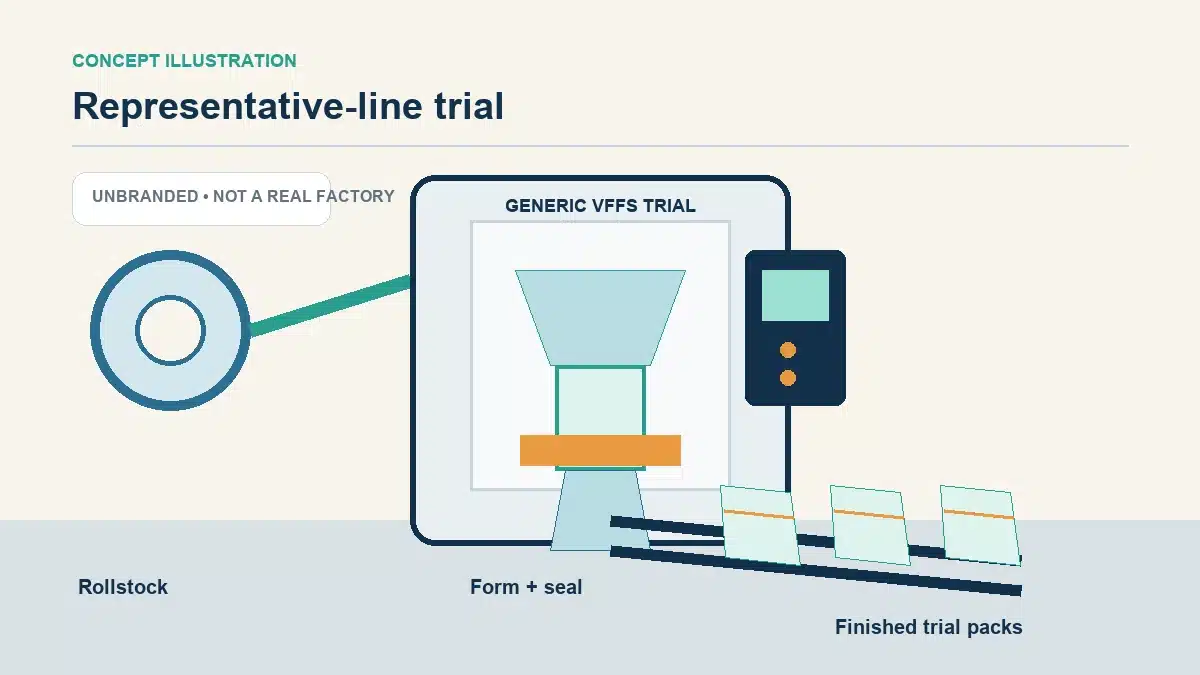
Retain reference samples and define what triggers requalification. Resin grade, layer thickness, barrier technology, adhesive, ink, coating, treatment, manufacturing site, process, or critical additive changes may alter performance even when the commercial product name stays the same. Change control turns a one-time successful trial into a maintainable specification.
Frequently Asked Questions About Flexible Food Packaging
Is Flexible Food Packaging Always Multilayer?
No. Some applications can use a monofilm, while others need coextruded, coated, or laminated structures to combine print, stiffness, barrier, toughness, and sealing functions. The choice depends on the food, shelf-life target, process, package geometry, and end-of-life goal. Count functions and verified risks rather than assuming more layers are always better.
Which Flexible Packaging Material Is Best for Food?
There is no universal best material. PE, PP, PET, polyamide, foil, coatings, and barrier polymers solve different problems and introduce different trade-offs. Define the food and process requirements, build candidate structures by function, and compare the finished constructions through controlled tests and representative-line trials.
What Is the Difference Between OTR and WVTR?
OTR measures the rate of oxygen transmission through a specimen under stated conditions. WVTR measures water-vapor transmission. A food may be sensitive to one, both, or neither at a demanding level. Each result needs the method, temperature, humidity, thickness, test side, units, and sample identity, and neither result alone establishes finished-product shelf life.
Does a Strong Heat Seal Prove That a Package Will Not Leak?
No. Seal strength measures resistance to separation under a specified test, while integrity testing looks for leak paths or defects. A strong seal can still contain a channel or contamination, and a currently tight package may lack distribution margin. Use complementary strength, integrity, conditioning, and distribution tests selected for the package and failure risks.
Does Food-Contact Compliance Apply to Every Food and Temperature?
No. Authorizations, declarations, and migration evidence have a scope that can depend on the substance or article, manufacturer, food type, contact time, temperature, repeated use, and market. Match the documentation to the complete construction and intended conditions; do not extend a supplier statement beyond what it explicitly supports.
Can Flexible Food Packaging Be Recyclable and High Barrier?
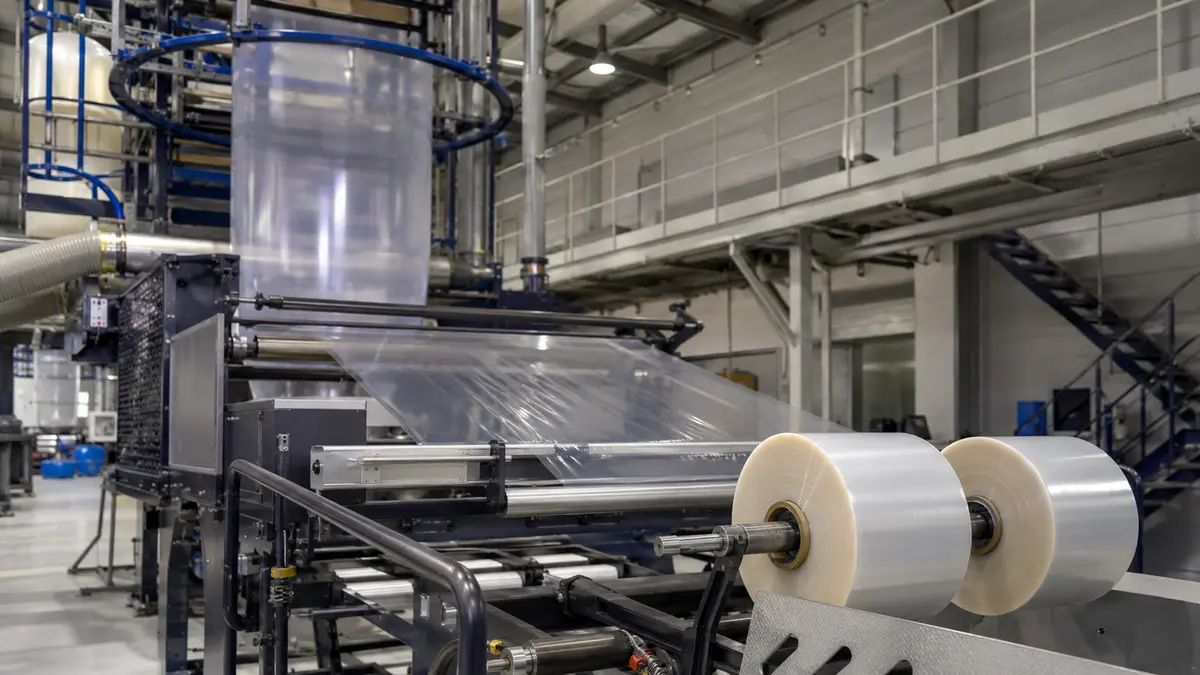
It can be possible, but the answer depends on the barrier technology, total construction, inks, adhesives, closures, target recycling protocol, local infrastructure, and performance required by the food. Treat recyclability and barrier as two specifications to validate together. Do not remove protection in a way that increases food loss, and do not publish an unqualified claim without current market-specific evidence.
Related Bestypack Resources
- Cold Chain Packaging Solutions Of Food
- What Are the Different Types of Common Insulation Packaging?
- Heat Sealable Film Guide: Applications, Types, Functions
- The Difference Between Polyolefin, PVC and Polyethylene
- The Ultimate Guide: All Types of Foam Packaging
- Ultimate Guide to BOPE Film: Benefits, Applications, Types
 English
 Japanese
 French
 Spanish
 Korean
 Italian
 Portuguese
 Dutch
Dutch Arabic
 Russian
 German