
For most clear retail overwraps, a suitable polyolefin shrink film (POF) is the strongest general-purpose starting point. That answer changes when the film is the primary package: fresh meat, cheese, and other barrier-dependent foods may need a purpose-built multilayer shrink bag, while heavy tray or bottle bundles often suit polyethylene (PE). The best choice is therefore not a polymer name. It is the specific grade and construction that meet the food-contact, shelf-life, seal, shrink, handling, and equipment requirements of the intended use.
The Short Answer: Which Shrink Wrap Is Best for Food?
For regulatory context, consult the U.S. FDA’s food-packaging guidance before approving an intended food-contact use.
For regulatory context, consult the U.S. FDA’s food-packaging guidance before approving an intended food-contact use.
The quickest defensible answer is to select by packaging role. POF, barrier shrink bags, and PE solve different problems; a film that performs well in one role can fail badly in another.
| Packaging job | Usual starting shortlist | Why it is shortlisted | What still needs proof |
|---|---|---|---|
| Clear retail overwrap around a tray, carton, or multipack | POF shrink film | Clarity, balanced shrink, sealability, and general retail versatility | Food-contact status if contact is possible, seal and shrink window, appearance, abuse resistance, and line fit |
| Vacuum-and-shrink primary pack for sensitive food | Purpose-built multilayer barrier shrink bag | Tight pack presentation plus a construction designed around barrier, sealing, and abuse needs | Exact layer structure, OTR/WVTR conditions, seal and leak results, process limits, shelf-life study, and market documents |
| Heavy secondary bundle | PE shrink film | Toughness and suitability for heavier collation and distribution tasks | Bundle stability, tear/puncture behavior, tunnel fit, openings, print needs, and distribution performance |
Best General-Purpose Overwrap: POF
POF is often the best general-purpose shortlist for food-related retail overwrap because commercial grades can combine clarity, toughness, useful sealing behavior, and controlled shrink around regular or moderately irregular packs. Typical formats include centerfold film, single-wound film, and premade bags used around trays, cartons, bakery packs, produce packs, or grouped retail items.
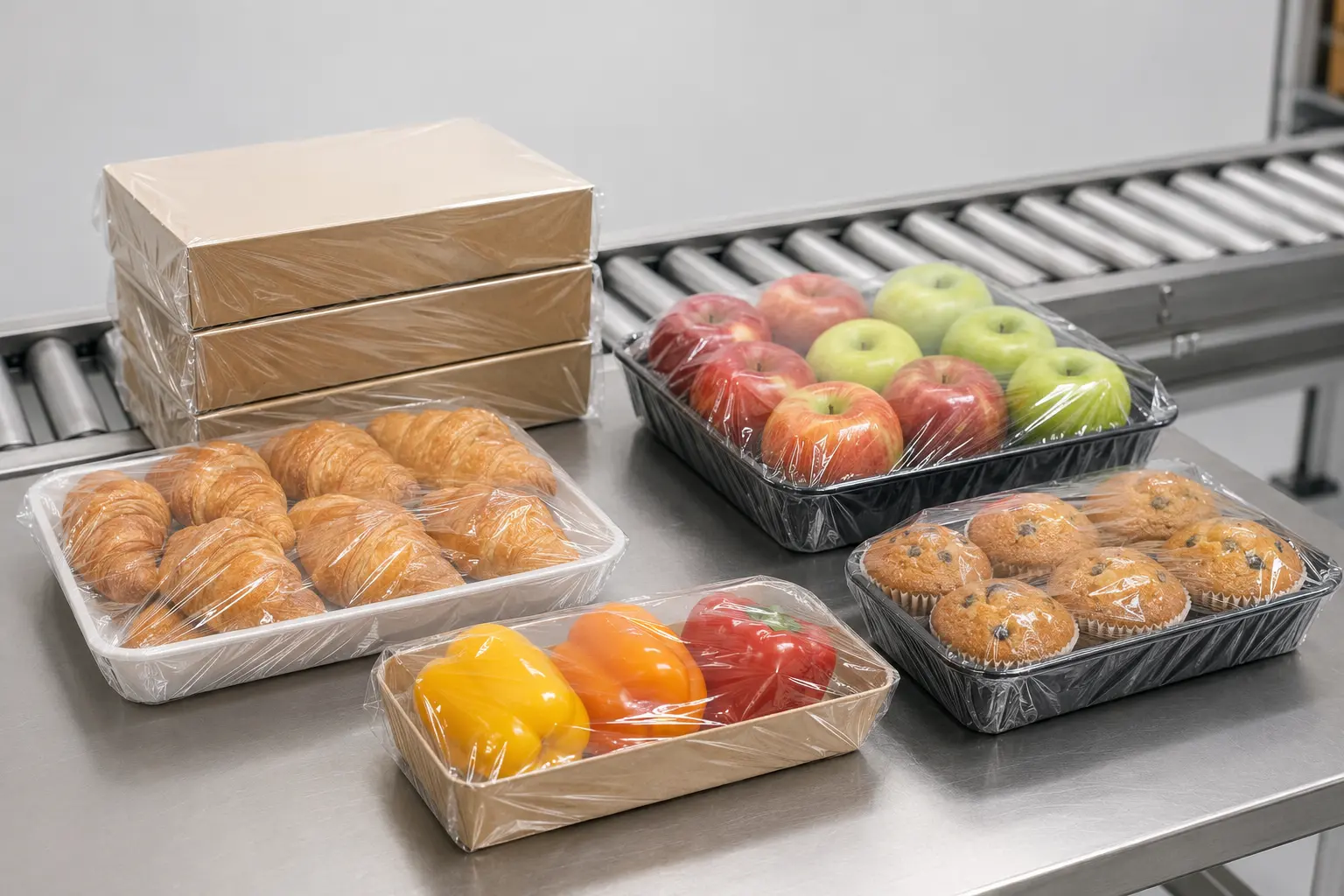
This is not a blanket approval POF describes a broad polyolefin film family not one recipe or one legal status If the film touches food or can reasonably be expected to touch it the buyer should obtain intended-use documentation for the exact grade.
Best for Barrier-Dependent Foods: A Specialized Shrink Bag
Standard retail overwrap should not be assumed to deliver the oxygen, moisture, aroma, seal, or abuse performance needed for a shelf-life-critical primary package. Fresh red meat, processed meat, poultry, seafood, and cheese are common examples where a processor may evaluate a vacuum shrink bag designed as a multilayer package.
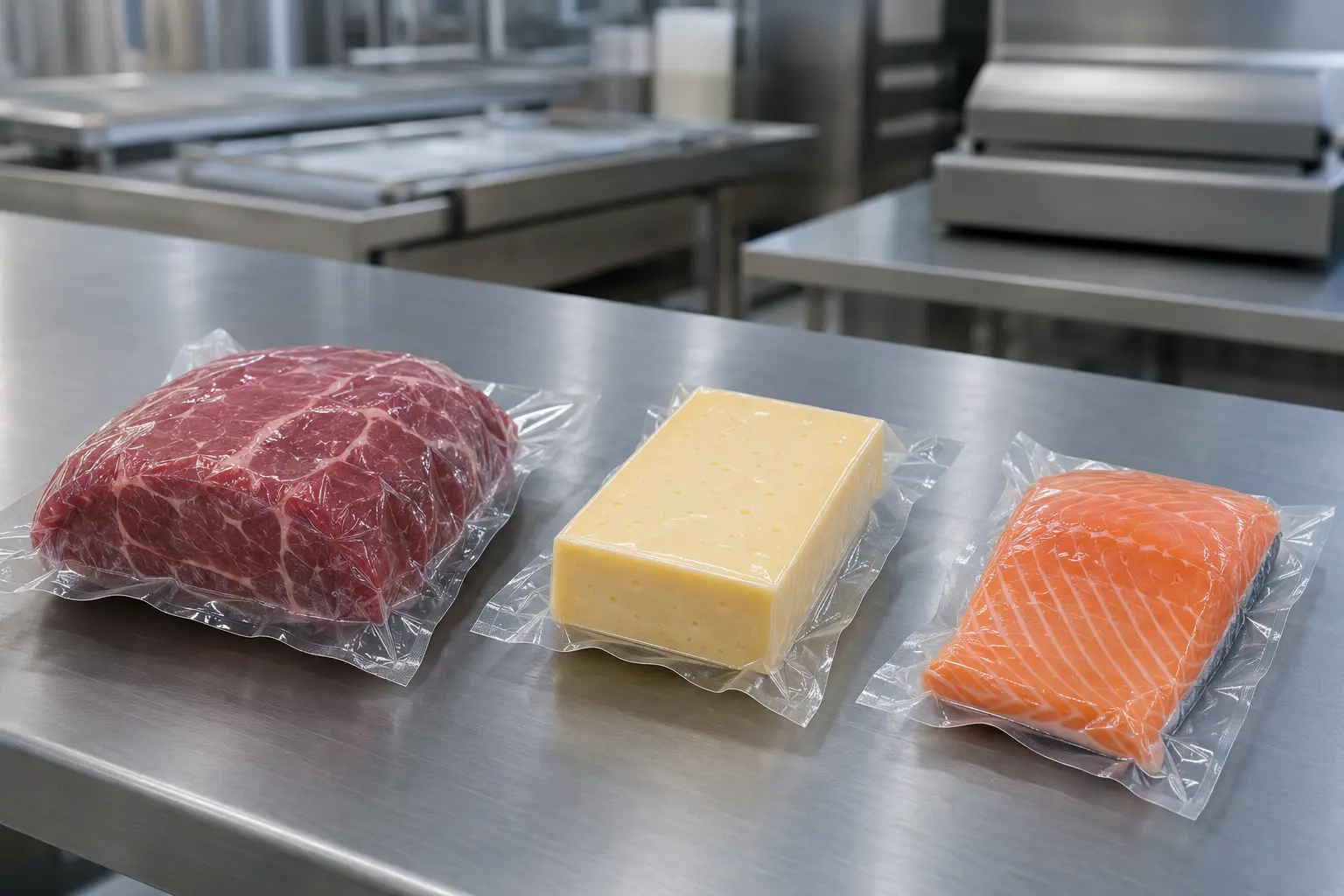
The word “barrier” must be quantified. The supplier should identify the construction and report oxygen transmission rate (OTR) and water-vapor transmission rate (WVTR) with the method, units, temperature, relative humidity, thickness, and tested face. Package-level shelf life still requires product-specific storage and distribution validation.
Best for Heavy Secondary Bundles: PE
PE shrink film is a common starting point for heavier bundles such as bottled beverages, canned goods, jars, or grouped trays. Compared with thin retail display overwraps, these applications typically prioritize toughness, carrying integrity, and distribution handling over very high clarity or a close cosmetic finish.
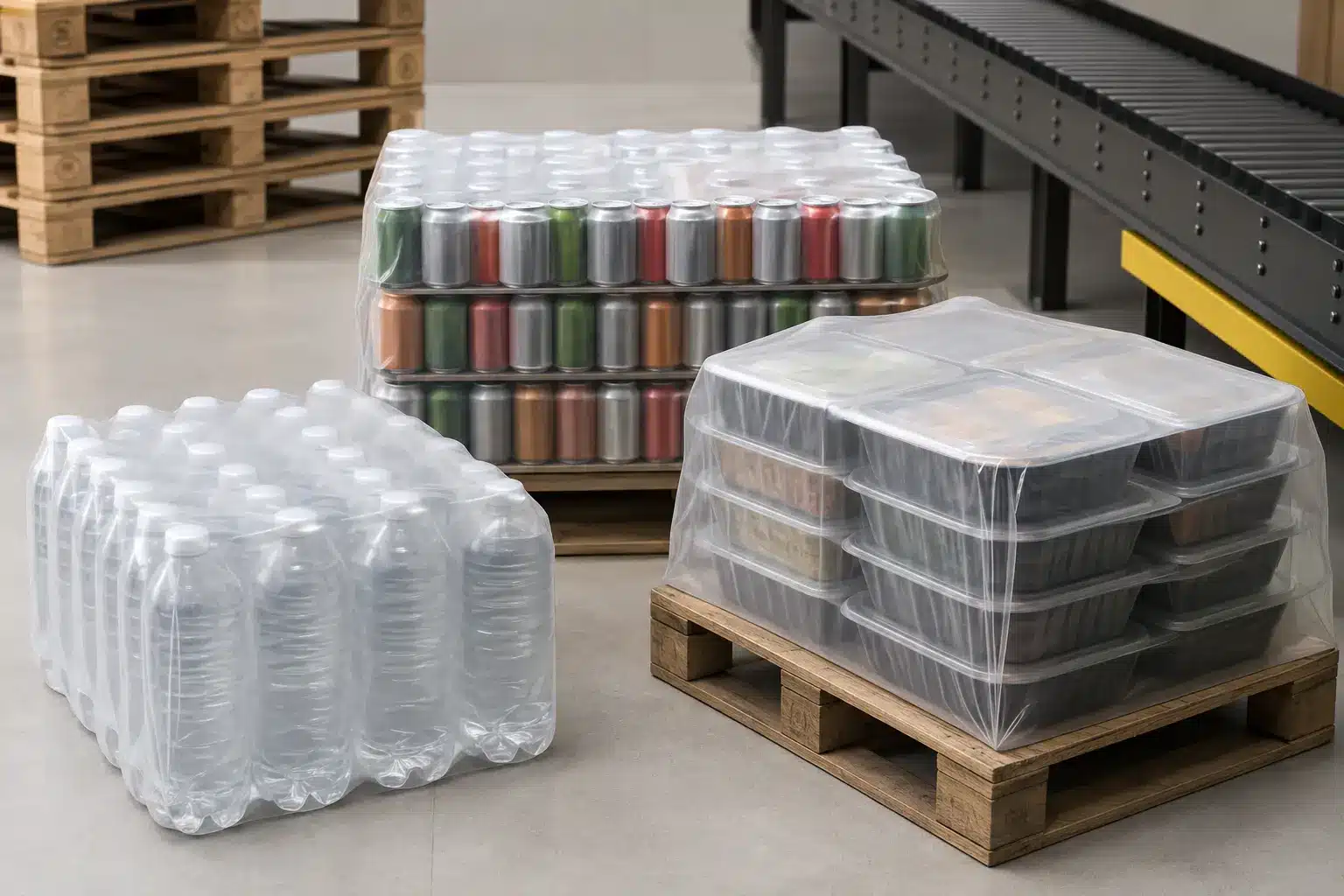
Secondary use does not remove the need for a clear specification. Openings, handle features, print, bundle geometry, unsupported spans, film thickness, shrink pattern, cooling, stacking, and transport hazards all affect performance. If the PE can contact food because of the package design or a foreseeable failure, its food-contact status must also be addressed.
Important: “Food grade” is not a complete specification. Approval must apply to the exact film or bag, food, contact conditions, process, destination market, and finished package.
First, Define What “Shrink Wrap” Must Do
Buyers often ask for “food shrink wrap” before defining where the film sits in the package. That reverses the correct order. First classify the film’s job; then compare constructions capable of doing it.
Primary Food-Contact Packaging
A primary shrink package directly contains the food. A vacuum shrink bag around meat or cheese is one example. In this role, the film may need to control oxygen or moisture, maintain seals through shrinking and handling, tolerate bones or sharp edges, survive cold or heat exposure, and release or vent gas in a controlled way.
Every component matters: polymers, tie layers, sealant, coatings, inks, additives, and any treatment on the contact side. The U.S. FDA explains that food-contact substances include packaging and its components, while the overall regulatory status depends on the substances that comprise the article and their intended use. EU plastic food-contact rules likewise address single- and multilayer plastic materials intended to contact food.
Retail Overwrap Around a Tray or Carton
A retail overwrap may provide presentation, pack unity, scuff protection, or tamper indication around a tray, carton, or already sealed package. It may be in direct contact with food, separated by a tray, or fully outside the primary package. Those are different exposure cases and should be recorded explicitly.
Overwrap can improve containment and appearance, but it should not be credited with shelf-life barrier unless the complete design has been tested for that purpose. Holes, seals, folds, and open package interfaces can dominate gas and moisture exchange even when the film itself has a measured transmission rate.
Secondary Bundling and Distribution Wrap
Secondary shrink wrap groups several consumer packs for handling, sale, or transport. Its main duties may be bundle stability, protection from abrasion or dust, a carrying feature, or a printable communication surface. The underlying consumer packs usually supply the food barrier.
This role shifts the specification toward load geometry, film toughness, shrink force, tear behavior, stacking, conveyor events, and distribution trials. A high-clarity film designed for a light retail carton is not automatically the economical choice for a heavy beverage bundle.
POF vs Barrier Shrink Bags vs PE vs PVC
The table below compares usual tendencies, not guaranteed properties. Grade, layer structure, thickness, orientation, additives, treatment, print, and converting conditions can change the outcome.
| Film family | Usual food-packaging role | Relative strengths to investigate | Main limitation or qualification question |
|---|---|---|---|
| POF | Clear retail overwrap; selected direct-contact uses when documented | Optics, balanced shrink, sealability, toughness, broad retail use | Does the exact grade have intended-use food-contact support and enough barrier or abuse performance? |
| Multilayer barrier shrink bag | Vacuum primary pack for meat, cheese, poultry, seafood, or processed foods | Tight conformance, designed barrier, seal system, abuse options | What is the exact construction, process window, barrier result, package integrity, and validated shelf life? |
| PE | Heavy secondary bundles and grouped packs | Toughness, carrying performance, larger collation formats | Is the optical finish acceptable, and can the line deliver stable shrink without weak spots or distortion? |
| PVC | Selected legacy or specialized shrink applications | Optics and shrink behavior may suit some equipment or pack styles | Are composition, migration, market, retailer, emissions, disposal, and line controls acceptable for the exact use? |
Polyolefin Shrink Film (POF)
POF shrink film is usually a multilayer, oriented film made from polyolefin components. Commercial grades differ in seal behavior, crosslinking, shrink response, slip, antifog function, perforation, thickness, and suitability for contact with particular foods. The term therefore cannot replace a technical data sheet.
POF is attractive for retail food packs when a buyer needs a clean transparent presentation and a forgiving overwrap. It is not automatically a high-barrier primary package, a cook-in film, or an abuse-resistant meat bag. Those roles require constructions designed and documented for the actual conditions.
Multilayer Barrier Shrink Bags
Barrier shrink bags combine shrinking, sealing, and package-protection functions in a coextruded or laminated structure. Different layers may contribute sealing, mechanical support, oxygen barrier, moisture control, adhesion, puncture resistance, or processing behavior. The polymer names alone do not reveal the layer sequence or performance.
A buyer should ask whether the bag is intended for vacuum packing, hot-water shrinking, cook-in processing, pasteurization, bone-in product, freezing, maturation, or gas-producing cheese. Each case changes the test plan. A bag designed for one food and process should not be transferred to another solely because both are called “barrier shrink bags.”
Polyethylene Shrink Film (PE)
PE shrink films are commonly produced for larger or heavier collation packs. They can be supplied in different densities, blends, layer structures, thicknesses, print formats, and shrink balances. Their value often comes from toughness and bundle performance rather than the polished appearance expected from a thin retail overwrap.
The relevant comparison is cost per accepted bundle, not price per kilogram or film thickness alone. A lower-cost roll can become expensive if it increases tunnel energy, film use, downtime, weak bundles, rework, or transport damage.
Polyvinyl Chloride Shrink Film (PVC)
PVC shrink film remains available for some packaging uses, and it is inaccurate to state that all PVC food packaging is universally banned. It is equally unsafe to assume that any PVC shrink film is acceptable. Composition, plasticizers and other additives, migration authorization, food type, contact conditions, destination market, customer policy, equipment ventilation, and end-of-life constraints all matter.
For a new food application, many buyers first evaluate documented POF or PE-based options because they can simplify some material and operational concerns. PVC should be selected only when the exact grade, use, market, risk controls, and business requirements are clearly justified—not because a legacy line happens to run it.
Match the Film to the Food and Package
Food category is only a starting point. Fat content, acidity, aroma sensitivity, respiration, sharp features, fill temperature, freezing, reheating, storage time, and distribution all influence the package.
Bakery, Produce, and Prepared Retail Items
POF overwrap is often shortlisted for bakery items, produce trays, prepared-food cartons, and similar retail displays where clarity and pack containment matter. The actual grade may need antifog performance, perforation, controlled shrink force, or a suitable food-contact declaration.
Respiring produce introduces a gas-exchange question. A tight clear film is not automatically the correct atmosphere-control system; perforation pattern, product respiration, temperature, and pack volume must be developed together. Warm bakery products can also create condensation or seal contamination, so cooling and packing conditions belong in the trial.
Fresh Meat, Poultry, Seafood, and Cheese
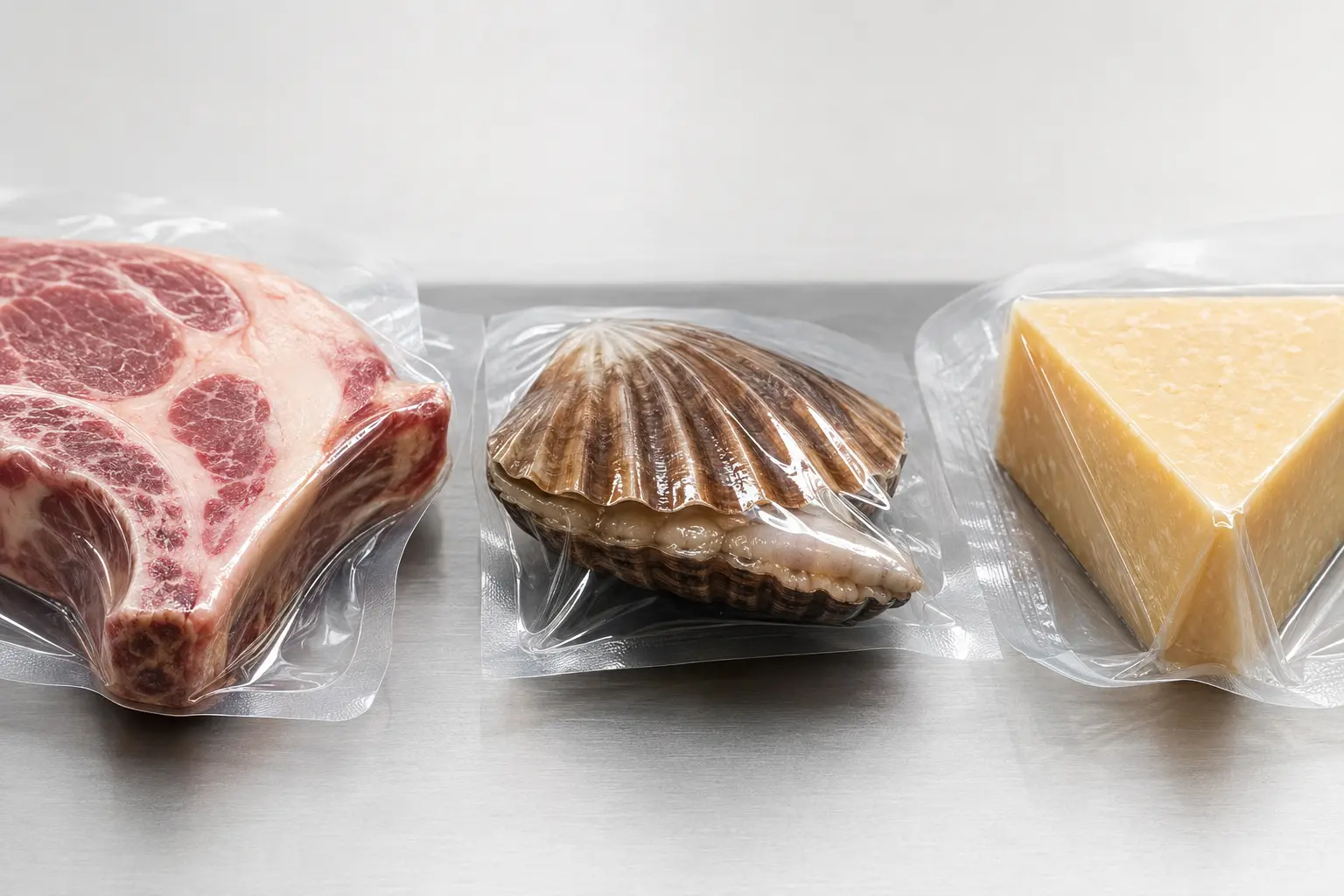
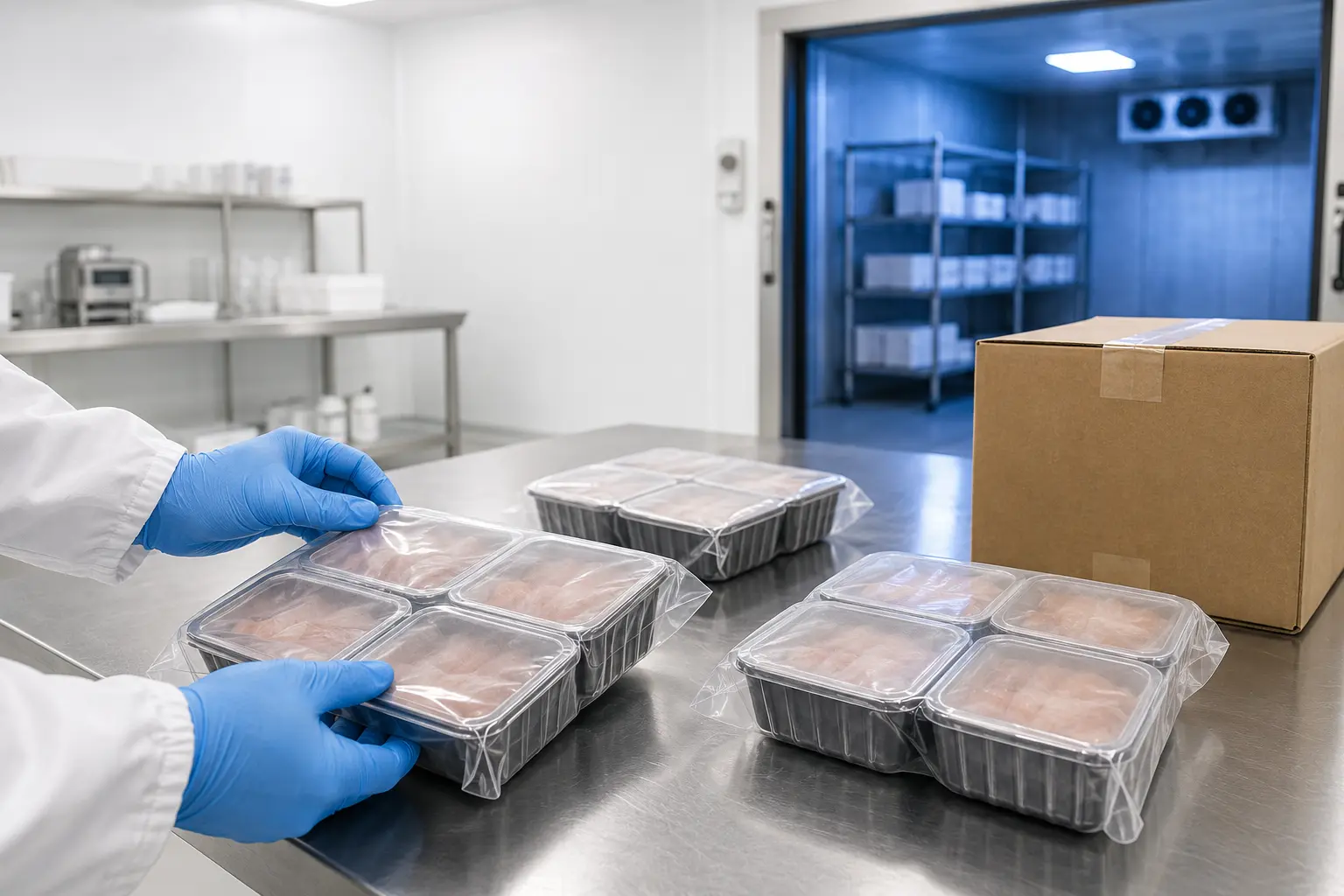
These foods often place more demanding requirements on oxygen barrier, purge control, seal integrity, puncture resistance, and refrigerated shelf life. A purpose-built vacuum shrink bag is generally a more relevant shortlist than standard retail POF overwrap.
Product geometry matters. Bones, shells, clips, and hard cheese edges can create localized stress. The trial should examine loading damage, vacuum evacuation, seal contamination, shrink response, leaks, purge, storage appearance, and distribution abuse. Some cheeses also produce gas during maturation, requiring a structure designed for that behavior rather than a generic high-barrier claim.
Frozen and Chilled Foods
Cold conditions can change film stiffness, seal stress, puncture response, and package handling. A film that looks acceptable immediately after the tunnel may crack, loosen, or fail when frozen, stacked, dropped, or flexed. Condensation and frost can also influence optics and sealing.
Specify the lowest and highest product and storage temperatures, freeze rate, thaw cycle, handling events, and expected storage duration. If reheating, hot filling, pasteurization, or cook-in exposure is involved, use only a construction explicitly designed and documented for that time–temperature process.
Trays, Cartons, and Multipacks
For a light tray or carton, a clear POF film may produce a neat retail pack. For grouped bottles, jars, or cans, a PE bundle film may better manage the weight and unsupported areas. Tray corners, carton windows, vents, labels, and protrusions change how the film shrinks and where stress concentrates.
The package should be evaluated as a system. A strong film cannot correct a collapsing carton, a sharp tray flange, an incompatible label, or an unstable bundle pattern. Conversely, modifying pack geometry may permit a lighter or more efficient film.
Note: Application examples identify sensible trials; they do not prove food-contact compliance, shelf life, or production acceptance for a particular film.
Key Criteria for Choosing Food Shrink Film
The best supplier discussion begins with functions and evidence, not with “send your standard food-grade film.” Five criteria separate a useful technical proposal from a generic quotation.
Food-Contact Status for the Intended Use
Request documentation for the exact grade and finished construction. It should address the destination market, food types, contact side, repeated or single use, contact time, and highest intended temperature. Include inks, coatings, adhesives, and additives when they form part of the supplied article.
In the United States, a food-contact substance that is a food additive must be authorized for its intended use through an applicable route. In the EU, Regulation No 10/2011 sets specific requirements for plastic materials and articles, including multilayer plastic structures and migration controls. Neither framework supports “FDA approved” or “EU compliant” as a polymer-wide slogan.
Oxygen and Moisture Barrier
Start with the food’s failure mode and shelf-life target. Oxygen ingress may affect color, flavor, oxidation, or microbial ecology; moisture gain or loss can change texture, weight, or package condition. Different foods require different balances, and some packages need controlled gas release rather than the lowest possible transmission.
OTR and WVTR results must identify the construction, total and layer thickness where relevant, method, units, temperature, relative humidity, conditioning, and test face. ASTM D3985 and ASTM F1249 are examples of method families for oxygen and water-vapor transmission. Film data is an input to shelf-life design, not a shelf-life guarantee.
Seal Window and Seal Integrity
The seal must form consistently at production speed despite variation in temperature, pressure, dwell time, jaw condition, film tension, wrinkles, and product contamination. A single peak seal-strength result does not describe the full operating window.
ASTM F88/F88M measures seal strength for flexible barrier materials and can support process development and control when specimen geometry and technique are defined. Package integrity requires additional evidence appropriate to the design, such as visual inspection, leak testing, burst testing, or storage observation. The chosen method and acceptance criteria must suit the actual pack.
Shrink Curve, Shrink Force, and Product Distortion
Percent shrink at one temperature does not predict the complete tunnel outcome. Buyers should consider shrink onset, shrink across a temperature range, machine-direction and transverse-direction balance, shrink force, heat exposure, airflow, dwell, cooling, and the resistance of the packaged product.
ASTM D2732 covers unrestrained linear thermal shrinkage of film at specified specimen temperatures. It does not by itself reproduce a constrained package in a tunnel. Soft bakery products, lightweight trays, print registration, labels, and carton panels may require lower force or a different shrink profile to avoid deformation.
Puncture, Abuse, Optics, and Presentation
Mechanical requirements should match the likely damage mode: puncture from bones or tray corners, tear propagation from a nick, abrasion in distribution, seal stress, or impact at cold temperature. Tensile strength alone cannot represent all of these behaviors.
For retail packs, clarity, haze, gloss, wrinkles, dog-ears, burn-through, and seal appearance may matter alongside strength. State which features are acceptance criteria and inspect them after storage and handling, not only immediately after shrinking.
Warning: Results are comparable only when the grade, structure, thickness, direction, method, units, conditioning, and test conditions are aligned.
Equipment Compatibility Matters as Much as Material
A technically suitable film can still perform poorly on an incompatible sealer or tunnel. Line fit is part of the material specification.
Film Form and Sealer Type
Centerfold film commonly pairs with L-sealers, while single-wound film may suit flow wrappers or side-seal systems. Tubing, bags, and PE bundling film use different forming and sealing arrangements. Confirm web width, fold quality, roll diameter, core, winding, treatment side, perforation, and splice requirements before a trial.
Seal-wire, hot-knife, impulse, constant-heat, and other systems interact differently with film and contamination. A proposal should identify the intended equipment rather than simply state that the film is “machine compatible.”
Tunnel Heat, Airflow, and Dwell Time
Shrink is produced by a heat history, not one temperature setpoint. Air velocity and direction, tunnel-zone balance, conveyor speed, pack spacing, product heat sink, film thickness, and ambient conditions influence the result. A displayed tunnel temperature may not equal the film temperature.
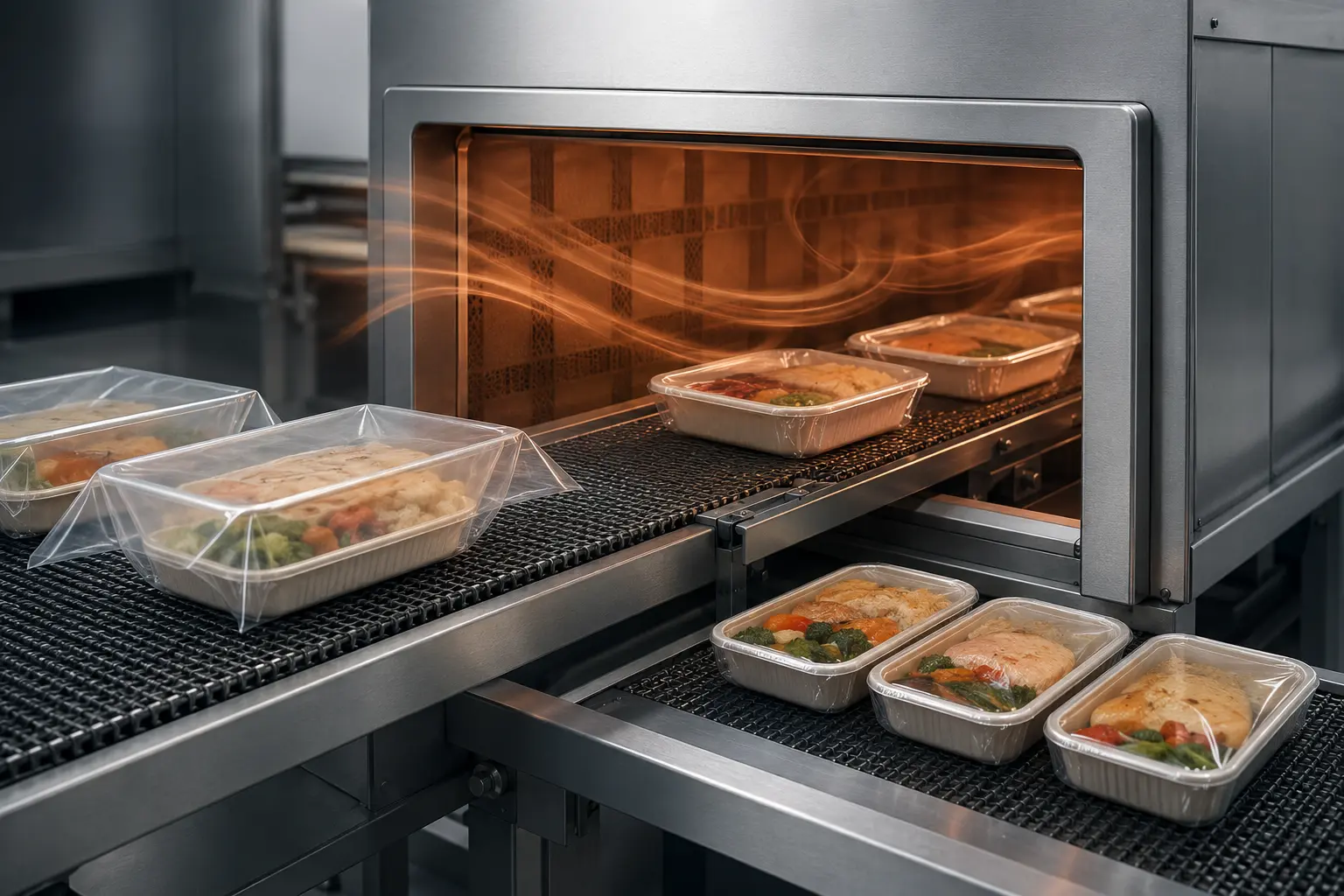
Too little or uneven heat can leave wrinkles and loose areas. Excessive exposure can cause holes, brittle seals, distorted trays, scorched cartons, or unnecessary energy use. Establish a repeatable operating window around acceptable packs instead of tuning one perfect sample.
Line Speed, Changeovers, and Scrap
Film economics include uptime and conversion loss. Track roll changes, splice handling, seal buildup, static, tracking, miswraps, rework, start-up scrap, changeover time, and accepted packs per roll. A thinner or less expensive film is not a saving if the line becomes less stable.
Trials should cover normal speed, planned high and low operating conditions, start–stop events, and product-size changes. Record settings and defects so the supplier and line team can distinguish material variation from equipment or product variation.
How to Validate a Shrink Film Before Approval
Validation should move from a defined application to comparable evidence and then to production-representative trials. Approve a grade and construction—not a generic material family.
Build the Application Brief
Document the information that controls risk:
- Identify the food, composition, contact side, pack format, fill state, product temperature, and any sharp or irregular features.
- Define whether the film is the primary package, retail overwrap, or secondary bundle.
- State the destination markets, shelf-life target, storage and transport temperatures, process heat exposure, and distribution hazards.
- Record the sealer, tunnel, conveyor, line speed, film form, roll limits, and current failure modes.
- Set measurable acceptance criteria for compliance documents, seals, leaks, shrink appearance, distortion, barrier, abuse, throughput, and scrap.
Request Comparable Documents and Test Data
Ask each supplier to return the same fields:
- Exact grade, material and layer structure, total thickness, width, film form, roll construction, treatment, coatings, additives, and intended sealing surfaces.
- Current food-contact declarations or supporting references tied to the destination market and intended food/contact conditions.
- Shrink data with MD/TD direction, temperature points, method, specimen conditioning, and any shrink-force information relevant to the pack.
- Seal-window data with surfaces, temperature, pressure, dwell, specimen geometry, peel technique, and failure mode.
- OTR/WVTR, puncture, tear, optical, and other required data with methods, units, conditions, and applicable thickness or construction.
- Change-control, traceability, storage, shelf-life, and certificate-of-analysis arrangements appropriate to the purchase.
Do not rank incomplete data as if it were comparable. Mark missing conditions and request clarification before drawing a technical conclusion.
Run Line, Package, Storage, and Distribution Trials
Begin with a controlled line trial that includes the proposed operating window, not only the supplier’s nominal setting. Sample across the roll and run, inspect seals and shrink appearance, measure the defined quality characteristics, and document throughput and scrap.
Then challenge the finished package under relevant storage and distribution conditions. A primary barrier pack may require barrier, leak, seal, product-quality, and shelf-life evaluation. A secondary bundle may require handling, stacking, vibration, impact, or retailer-distribution trials. Approval should state the tested grade, construction, settings, product, protocol, sample size, limits, and change conditions that trigger requalification.
Frequently Asked Questions
Is POF Shrink Film Always Safe for Direct Food Contact?
No. Many POF grades are marketed for food applications, but the polymer-family name does not prove that every formulation, additive, coating, ink, or use is authorized. Verify the exact film against the destination market, food type, contact side, temperature, and duration. If the supplier cannot tie its declaration to those conditions, treat the status as unconfirmed.
Can Standard POF Shrink Film Extend Shelf Life?
It depends. An overwrap may reduce handling exposure and keep a retail pack together, but standard POF should not be assumed to supply a specified oxygen or moisture barrier. Shelf life depends on the food, initial quality, hygiene, atmosphere, complete package, seals, storage, and distribution. Barrier-sensitive products require measured package data and a shelf-life study.
Is PVC Shrink Film Banned for Food Packaging?
Not universally. Rules and authorized uses vary by jurisdiction and formulation, while retailer or customer policies may be stricter than law. The correct question is whether the exact PVC grade and all relevant components are authorized and acceptable for the intended food, temperature, duration, market, process, and disposal system. If that evidence is weak, evaluate a documented alternative.
Is Polyolefin Shrink Film Recyclable?
Sometimes, but not automatically. Technical compatibility depends on the film composition and the complete pack, including labels, inks, coatings, adhesives, perforations, contamination, and other materials. Actual recycling also depends on local collection, sorting, and reprocessing. Make a claim only for the defined package and market using the applicable design guidance and evidence.
Related Bestypack Resources
- POF vs PVC Shrink Films: The Ultimate Comparison
- shrink film
 English
 Japanese
 French
 Spanish
 Korean
 Italian
 Portuguese
 Dutch
Dutch Arabic
 Russian
 German