
PVC shrink film is an oriented polyvinyl chloride packaging film that contracts when exposed to controlled heat. It can form a clear, tight overwrap, band, or sleeve around a product. Yet “PVC” alone does not define the film’s shrink curve, seal window, food-contact status, or line performance. Buyers must connect the exact grade to the package, equipment, destination market, and disposal route. This guide explains that decision path and shows what to specify, test, and document before commercial approval.
What Is PVC Shrink Film?
For U.S. food-contact context, review the eCFR polymer provisions before approving a finished-film claim.
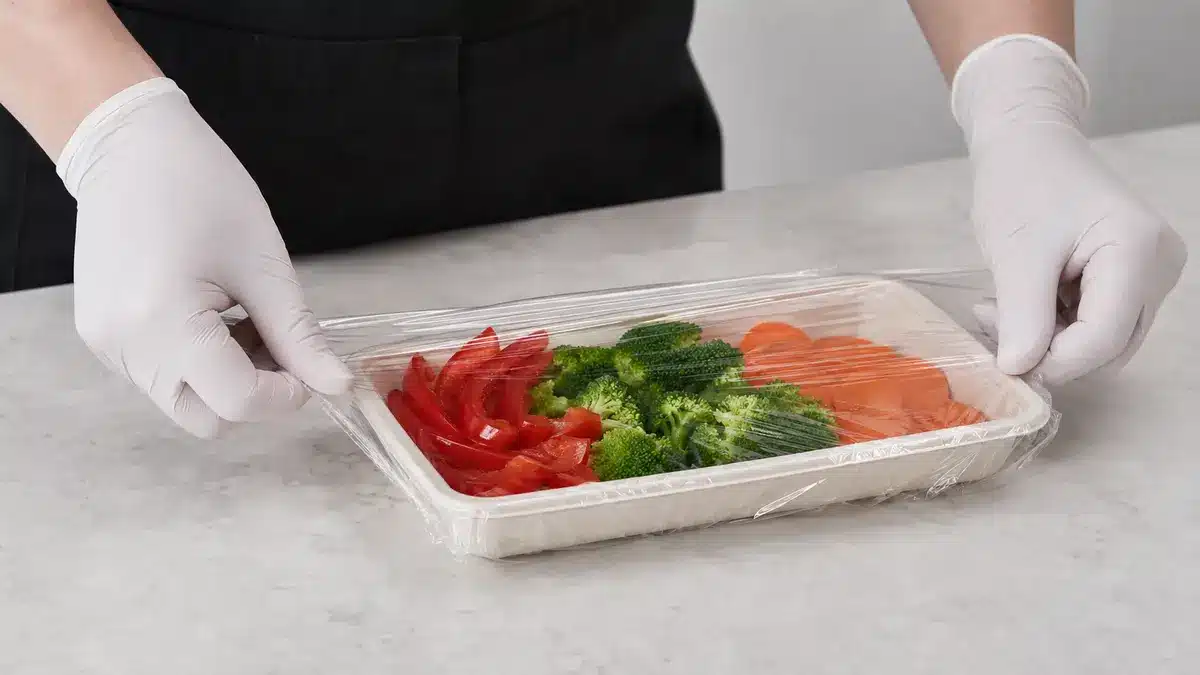
PVC shrink film is a PVC compound converted into film and deliberately oriented during manufacture. That orientation stores stress in the film. Controlled reheating releases part of the stress, so the film contracts around a product.
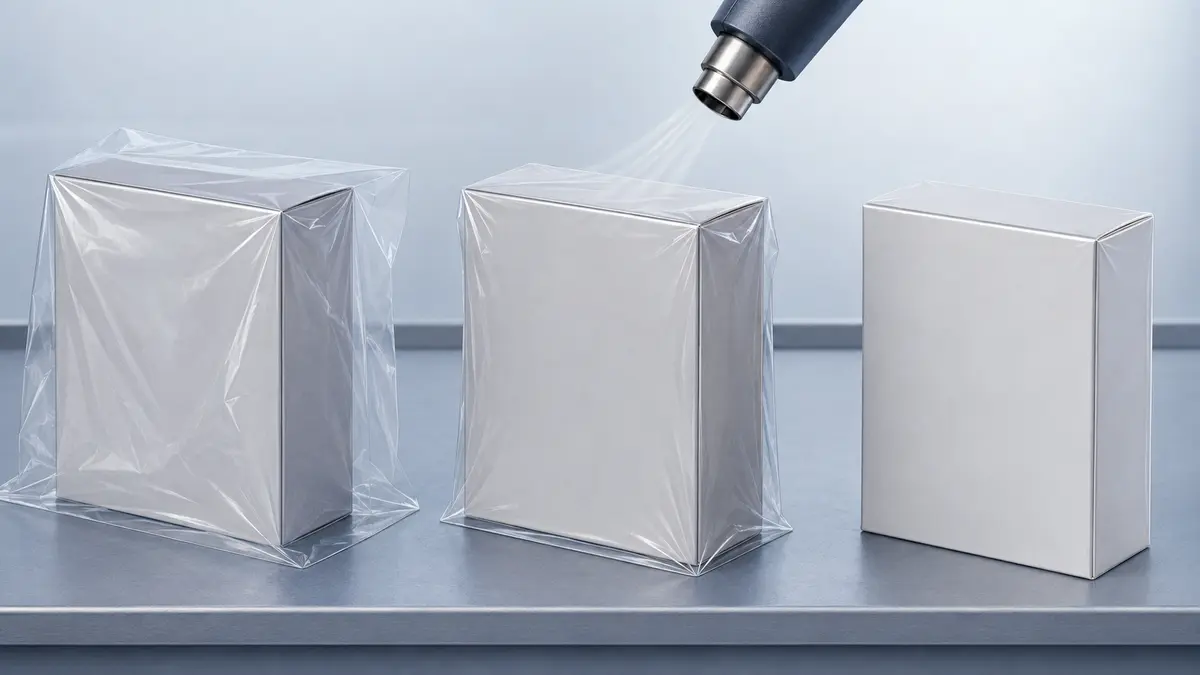
The useful definition has three parts:
- Material: the base polymer is polyvinyl chloride, or PVC.
- Formulation: stabilizers, plasticizers, modifiers, lubricants, pigments, and other additives may be used to obtain grade-specific behavior.
- Function: the film is engineered to shrink after heat exposure, not simply to stretch around a load.
- Format: it may be supplied as centerfold film, single-wound film, tubing, bags, bands, or sleeves.
- Evidence boundary: the material name does not prove a particular shrink percentage, food-contact status, or machine setting.
Buyer boundary: Treat “PVC shrink film” as a material family. Approve a named grade, specification, and compliance package—not a generic resin label.
PVC Shrink Film vs. Stretch Film
Shrink film and stretch film may look similar on a roll, but they secure products in different ways. Stretch film is pulled under tension, usually around a pallet load. Its elastic recovery and cling help hold the load together. Shrink film is placed loosely around an item, sealed when required, and then heated until it contracts.
The distinction affects equipment and risk. A shrink operation needs a controlled heat source, such as a tunnel or a suitable heat application system. A stretch-wrapping operation needs controlled tension. Substituting one process for the other can produce weak containment, damaged products, or unsafe improvisation.
The Role of Resin, Additives, and Orientation
PVC resin is only the starting polymer. Compounders select an additive system to support processing and the required balance of flexibility, stiffness, stability, optics, slip, and other properties. Not every PVC shrink film uses the same additives or concentration.
Orientation is a separate manufacturing step. It determines how strongly the film tends to recover in the machine direction, transverse direction, or both. Two clear PVC films can therefore behave differently in the same tunnel. A buyer needs the exact grade data and a line trial to know whether either film fits the pack.
How Does PVC Shrink Film Work?
Shrink film works through controlled orientation and thermal recovery. During manufacturing, the film is stretched in one or more directions while its structure can be oriented. It is then cooled so that the oriented state is retained. Later, heat gives the polymer chains enough mobility to relax toward a less oriented state.
The practical sequence is simple:
- the film is oriented during production;
- cooling holds that orientation;
- the film is wrapped around a product;
- heat initiates recovery;
- the film contracts until it meets the product or reaches its available shrink;
- further recovery can create force against the package.
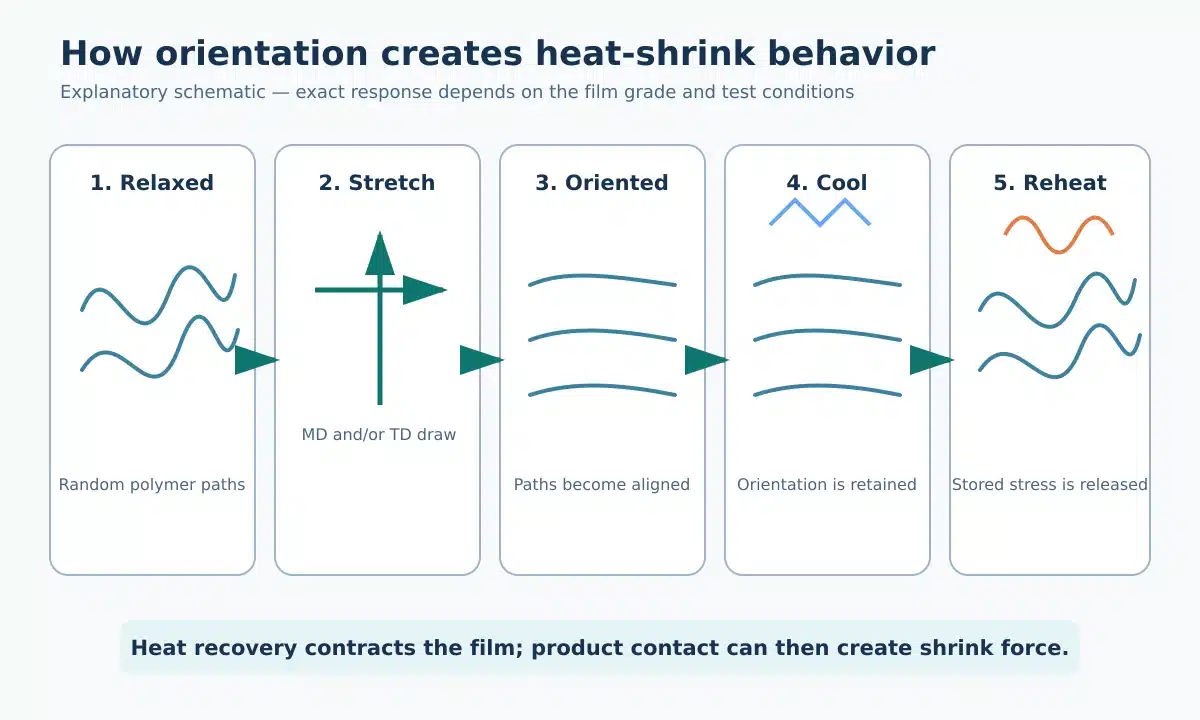
This mechanism explains why temperature alone cannot predict the result. Exposure time, heat transfer, film thickness, orientation, package geometry, and restraint all influence the finished pack.
Stored Orientation and Heat Recovery
The film does not need to melt to shrink. Instead, heat releases stresses introduced during orientation. The recovery response follows a curve rather than a single on/off temperature. A technical data sheet may therefore report free shrink at several temperatures or show a directional shrink curve.
In a tunnel, the product also acts as a heat sink. A heavy carton, cold product, irregular shape, or reflective surface changes how quickly the film heats. Air temperature on the control panel is not the same as film temperature. Dwell time and airflow must be considered with the setpoint.
Machine Direction, Transverse Direction, and Shrink Force
Machine direction, or MD, follows the film’s travel through production and unwinding. Transverse direction, or TD, runs across the web. A film can have different shrink behavior in each direction, so an RFQ should request both values and the conditions used to measure them.
Free shrink and shrink force are also different. Free shrink measures dimensional change when the specimen can contract without restraint. Shrink tension or force measures the force generated under defined restraint and temperature conditions. High free shrink does not automatically mean a film will apply the right force to a delicate carton. Buyers should match both the shrink curve and force profile to the package.
How Is PVC Shrink Film Made and Supplied?
The manufacturing route varies by producer and grade, but the generic flow links formulation, film formation, orientation, cooling, and conversion. Each step can change the film that reaches the packaging line.
- Compound the resin. PVC resin is blended with the additive system needed for processing and end use.
- Form the film. The compound is converted into a continuous film through a suitable extrusion or film-forming process.
- Orient the film. Controlled stretching develops shrink potential in MD, TD, or both.
- Cool and stabilize. Rapid cooling retains the oriented state for later heat recovery.
- Convert and wind. The web is slit, folded, formed, printed, perforated, or made into bags, sleeves, or bands.
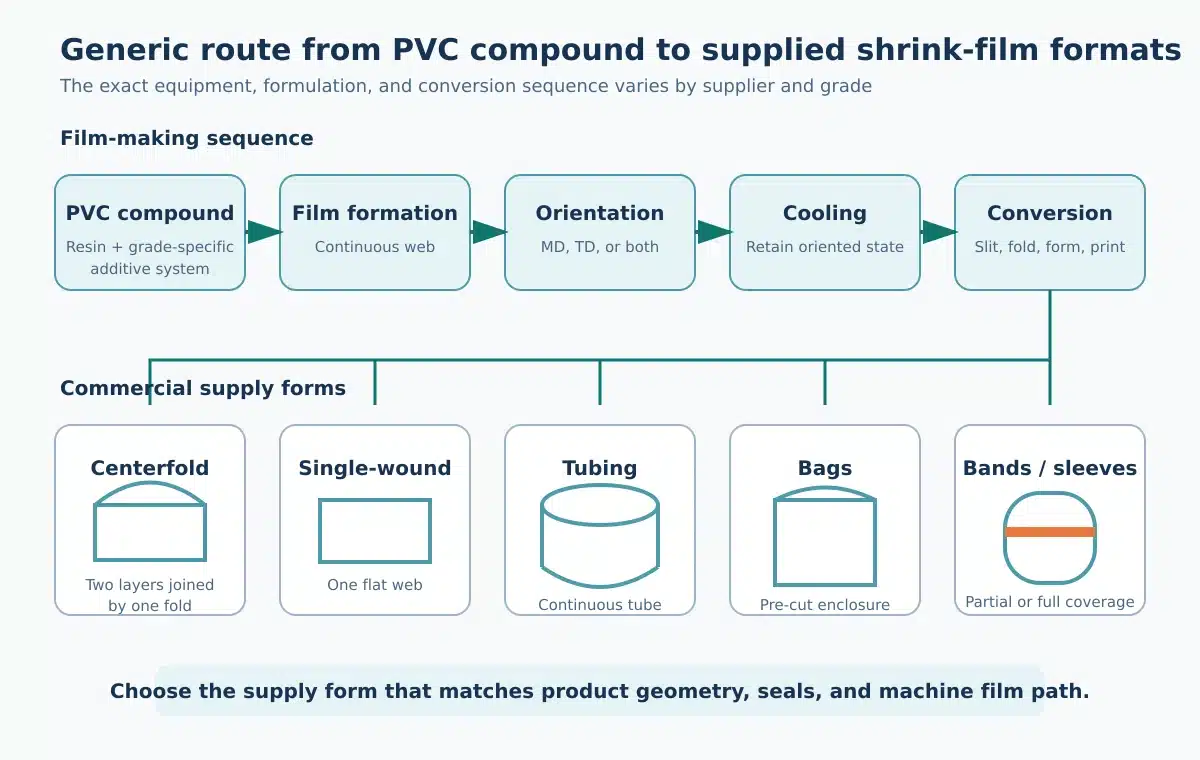
This is a process map, not a proprietary recipe. Buyers should not infer a layer structure, additive package, or orientation method without supplier evidence.
From Compounding and Extrusion to Orientation
Formulation and processing work together. A compound that processes well may not deliver the required shrink curve, seal behavior, or storage stability unless orientation and cooling are also controlled. Likewise, an orientation target that suits a rigid box may generate too much force for a crush-sensitive pack.
The finished roll is the evidence-bearing unit. Its lot identity should connect to the supplier’s specification, certificate records where applicable, and sample-approval history. This link becomes important when a line suddenly behaves differently after a roll or lot change.
Centerfold, Single-Wound, Tubing, Bags, and Sleeves
Centerfold film is folded once lengthwise before winding. It provides two layers joined by a fold and is commonly opened into a pocket before the remaining sides are sealed. Single-wound film is a flat, one-layer web and suits machines designed to form the required wrap or sleeve.
Tubing is a continuous tube, while bags are pre-cut enclosures. Bands cover a limited part of a container, often around a closure. Sleeves can cover part or most of a container and may also carry printed graphics. The correct format depends on product geometry, seal placement, throughput, changeover method, and the film path supported by the machine.
What Are the Main Properties of PVC Shrink Film?
Buyers often start with clarity and shrink percentage, but a useful specification covers the whole packaging system. The test object must be a named grade and thickness. Results also need direction, method, conditioning, temperature, time, and units.
Clarity, Gloss, Stiffness, Shrink Response, and Sealing
The main evaluation dimensions are:
- Optics: haze, luminous transmittance, gloss, and visual uniformity affect shelf presentation and code readability.
- Handling: stiffness, slip, and coefficient of friction affect unwinding, product loading, web tracking, and blocking.
- Mechanical behavior: tensile, tear, and puncture properties influence resistance to edges and handling damage.
- Shrink behavior: MD and TD free shrink, shrink onset, curve shape, and shrink force affect fit and product distortion.
- Sealing: seal initiation, usable operating window, dwell, pressure, contamination tolerance, and hot strength affect pack integrity.
- Dimensions: thickness, width, tolerance, core size, roll length, and winding quality affect consistency and machine fit.
These properties are interdependent. A thicker film may improve protection but require a different heat profile. Higher force may tighten a rigid pack yet bow a lightweight carton. More slip may improve movement but complicate stacking or feeding.
Where Grade, Gauge, Storage, and Test Conditions Change the Result
A manufacturer data sheet can illustrate what good evidence looks like. One PVC shrink-sleeve grade, for example, reports directional shrink at several temperatures and specifies storage conditions. Those figures belong to that grade and test context. They are not universal PVC values.
ASTM methods help define the measurement question. ASTM D2732 addresses unrestrained linear thermal shrinkage. ASTM D2838 addresses shrink tension and orientation release stress. Other methods cover thickness, haze, gloss, friction, tensile behavior, and tear. A test name alone is still incomplete if the specimen, direction, conditioning, and procedure are missing.
Store rolls according to the supplier’s written limits. Heat, sunlight, humidity, poor roll orientation, and excessive storage time can alter handling or promote blocking. Record storage history when investigating a line problem.
Where Is PVC Shrink Film Commonly Used?
PVC shrink film has been used where a clear, tight presentation and controlled heat response are valuable. Application history does not establish current compliance or best fit. Screen each use against the exact film, package, process, market, and recovery route.
Retail Overwraps, Multipacks, Tamper-Evident Bands, and Sleeves
| Application role | What the film does | What to verify | Common boundary |
|---|---|---|---|
| Retail overwrap | Creates a close, clear outer wrap around a rigid item or carton | Optics, seal appearance, corner resistance, product heat tolerance | Sharp edges, cold distribution, or retailer PVC policies may change the choice |
| Small multipack | Holds several light, rigid items together for display or promotion | Shrink force, unit movement, seal strength, pack rigidity | Heavy transport bundles often need a tougher or thicker PE solution |
| Tamper-evident band | Fits tightly around a cap or closure and must show visible damage when opened | Band design, perforation, identifying feature, application quality, applicable rules | A band is not compliant merely because it shrinks |
| Shrink sleeve | Conforms around part or most of a container and may carry graphics | Directional shrink, container shape, print distortion, seam, tunnel type | High-contour shapes may require another sleeve material or grade |
For U.S. over-the-counter drug packaging, FDA guidance explains that a film wrapper or heat-shrink band must be properly designed and applied to leave visible evidence of entry. That is a system requirement. Material selection, graphics, perforation, application, and inspection all contribute.
Before shortlisting PVC, ask whether the product is rigid enough for the expected force, whether it tolerates the heat process, whether the film touches food or another sensitive product, and whether the destination market or customer has a PVC restriction.
PVC vs. POF vs. PE Shrink Film: Which Fits the Job?
PVC, polyolefin shrink film (POF), and polyethylene shrink film (PE) occupy overlapping but different roles. Compare actual candidate grades under the same conditions. Family-level descriptions are useful for screening, not final approval.
Compare Materials on the Same Packaging Requirements
| Requirement | PVC shrink film | POF shrink film | PE shrink film |
|---|---|---|---|
| Typical screening role | Clear retail overwrap, bands, and some sleeves | General-purpose retail overwrap and many tougher applications | Thicker bundling, multipacks, and transport protection |
| Presentation | Often selected for clear, glossy appearance | Often selected for clear presentation with a softer feel | Usually secondary to toughness and load handling |
| Toughness and edges | Grade-dependent; validate puncture and post-shrink brittleness | Many grades are designed for toughness and a broad operating window | Common choice when thicker, robust bundling film is needed |
| Shrink and force | Can offer directional and relatively responsive shrink; verify force on the product | Balanced or grade-engineered shrink and force are widely available | Often lower free shrink but useful force and durability in bundling grades |
| Equipment fit | May run at comparatively low heat exposure for a specific grade | Often runs on common sealers and tunnels after setting changes | Usually associated with bundlers or equipment suited to thicker film |
| Food-contact path | Requires exact formulation and intended-use evidence | Requires exact grade and intended-use evidence | Requires exact grade and intended-use evidence |
Conditional selection Shortlist PVC when.
Do not compare one supplier’s PVC number with another supplier’s POF number unless thickness, method, direction, temperature, dwell, and units align. Total cost should include film yield, energy, labor, changeovers, scrap, downtime, and damaged product—not only price per kilogram.
How Should Buyers Specify PVC Shrink Film?
An effective RFQ turns the packaging job into measurable inputs and evidence requests. Vague terms such as “high shrink,” “food grade,” or “premium clarity” leave too much room for mismatched assumptions.
A Practical RFQ and Sample-Approval Checklist
- Describe the product. Provide length, width, height, weight, edge profile, rigidity, temperature sensitivity, and any openings or moving parts.
- Define the pack. State whether it is an overwrap, multipack, bag, band, or sleeve. Mark seal positions and the desired finished appearance.
- Describe contact and markets. Identify direct or indirect contact, product type, use temperature and time, destination countries, retailer policies, and restricted-substance requirements.
- Document the line. Name the wrapper, sealer, tunnel, heat-transfer type, line speed, current film, operating window, roll unwind, and available core and roll dimensions.
- Specify the film. Request grade, construction, nominal thickness and tolerance, width and tolerance, format, core, roll length, winding, perforation, treatment, and print requirements.
- Name the performance evidence. Request MD/TD shrink curves, shrink force where relevant, optics, friction, mechanical data, sealing conditions, storage limits, and the methods and units behind each value.
- Request compliance documents. Ask for the declaration or regulatory basis that matches the exact grade, construction, contact use, temperature, time, and destination market. Request the current SDS.
- Approve by sample and trial. Define the sample quantity, acceptance criteria, defect limits, inspection method, run duration, and change-control process.
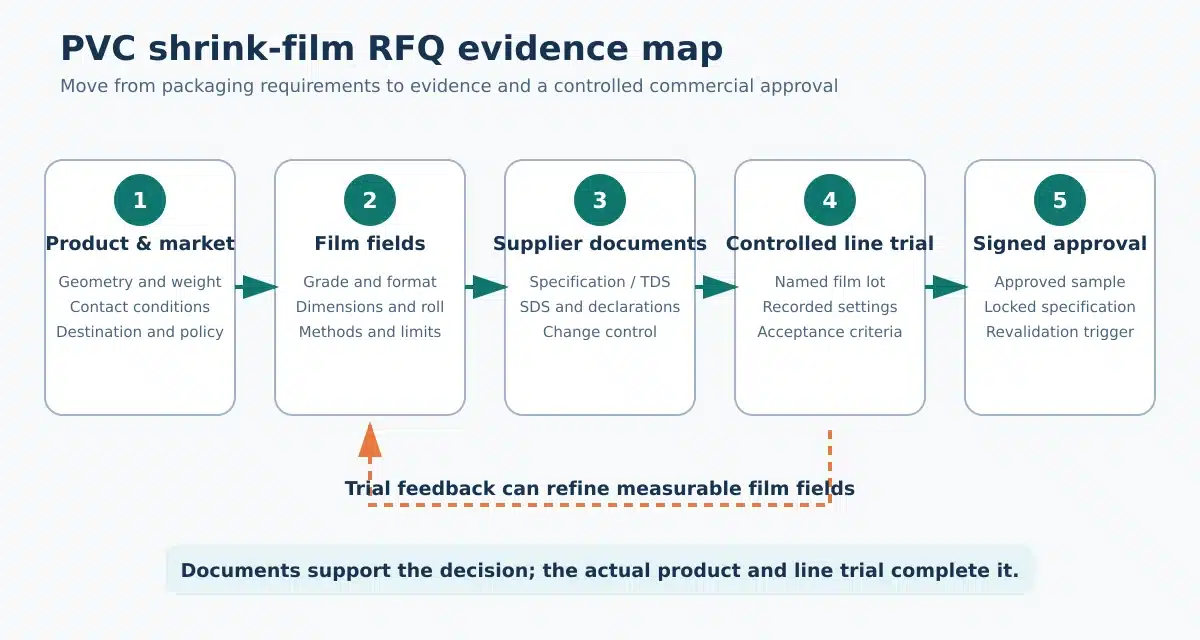
The evidence map should run in one direction: product and market requirements → measurable film fields → supplier documents → controlled line trial → signed approval. If a field cannot be measured or documented, record it as an open item rather than turning it into a promise.
Include commercial variables such as minimum order, lead time, roll yield, changeover frequency, and complaint response. These belong beside technical acceptance because a stable film that causes fewer stops may cost less per approved pack than a cheaper roll.
How Do You Run and Troubleshoot PVC Shrink Film?
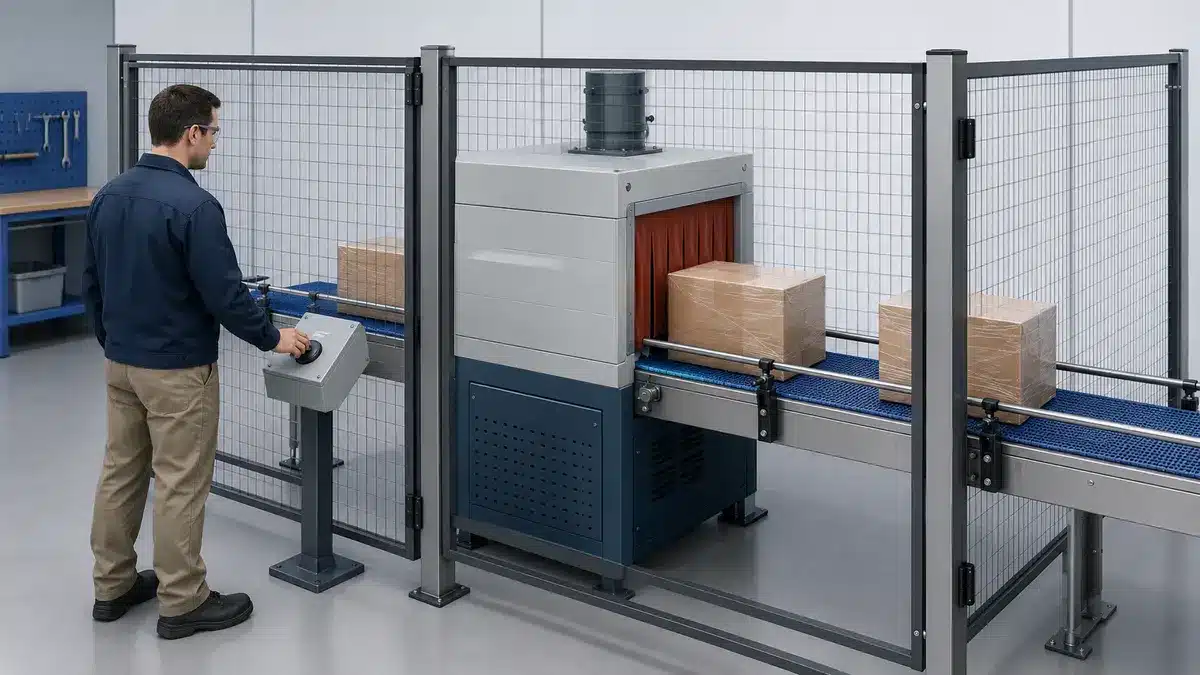
Start with the exact film supplier’s operating guidance and the equipment manual. Confirm ventilation, guarding, maintenance, and operator training before changing process settings. A generic internet temperature is not a safe commissioning recipe.
A Seal-and-Shrink Trial Before Commercial Production
Use a controlled sequence:
- Verify film identity, lot, width, thickness, format, storage history, and roll condition.
- Confirm product dimensions, pack orientation, seal position, and venting.
- Inspect the sealer, wire or knife, pressure surfaces, belts, fans, vents, and temperature controls.
- Establish a repeatable seal at the lowest practical supplier-supported setting.
- Run a small tunnel matrix using controlled changes to temperature, conveyor speed, and airflow. Change one variable at a time.
- Record appearance, seal integrity, wrinkles, holes, force-related distortion, and dimensions after cooling.
- Repeat across enough packs to expose normal variation, then retain settings and approved samples.
| Symptom | Possible variables | Safe first checks |
|---|---|---|
| Open, jagged, or weak seal | Heat, dwell, pressure, contamination, tension, worn components | Make an empty-bag seal; inspect the sealing surface; compare with supplier settings |
| Wrinkles or loose areas | Film size, venting, low or uneven heat, short dwell, blocked airflow, product geometry | Check bag dimensions and air escape; inspect tunnel airflow; change one setting at a time |
| Burn-through, holes, or brittleness | Excessive heat exposure, long dwell, thin or damaged film, sharp edges | Reduce exposure within supplier guidance; inspect edges and film condition |
| Pack distortion | Excessive shrink force or heat, weak carton, poor orientation | Confirm force requirement; protect or redesign vulnerable areas; test another grade |
| Blocking or poor unwind | Storage heat, pressure, roll damage, slip mismatch | Review storage records; condition and inspect the roll; compare a retained lot |
An empty-bag seal test is.
What Safety, Compliance, and End-of-Life Limits Matter?
Treat safety, market access, and disposal as separate approval gates. Passing one does not satisfy the others.
| Gate | Required evidence | Owner question |
|---|---|---|
| Worker and process safety | Current SDS, equipment instructions, ventilation assessment, local workplace controls | Can the film be run within the documented process without overheating or uncontrolled exposure? |
| Food or sensitive-product contact | Exact-grade declaration, regulatory basis, migration or supporting evidence where required, defined contact conditions | Is this construction authorized for this product, time, temperature, and destination market? |
| Customer and market policy | Restricted-substance declarations, retailer or brand requirements, change-control records | Does the customer permit PVC and this additive package? |
| End of life | Whole-package design review, local collection acceptance, sorting compatibility, and an end market | Where will the actual used package go, and is it explicitly accepted there? |
OSHA notes that overheating PVC can produce hydrogen chloride. This does not mean every normal shrink run creates a hazardous exposure. It means the operation should prevent overheating, follow the SDS and equipment instructions, and use an appropriate ventilation and workplace-risk assessment. Odor is not a substitute for exposure control.
Food-contact status is formulation- and use-specific. In the United States, a food-contact substance must have an applicable authorization for its intended use. EU plastic food-contact rules also set composition, migration, and compliance requirements. Ask for evidence that matches the exact film, contact type, temperature, time, food category, and destination.
Recyclability also needs qualified wording. A recycling design guide may evaluate compatibility, but access, acceptance, sorting, and end markets still matter. Do not place PVC film in a polyethylene store-drop-off stream unless that program explicitly accepts it. Check local instructions for the complete package, including labels, inks, adhesives, and contamination.
Frequently Asked Questions About PVC Shrink Film
Is PVC Shrink Film the Same as Cling Film?
No. PVC can be used in different film products, but shrink film and cling film perform different jobs. Shrink film is oriented to contract after controlled heat exposure. Cling film is designed to adhere to itself or a surface without a shrink-tunnel step. Do not use kitchen cling film as a substitute for packaging shrink film.
Can PVC Shrink Film Be Used for Food Packaging?
Only when the exact finished film and intended use have the required regulatory support. The word “PVC” does not prove or disprove food-contact suitability. Ask the supplier for evidence covering the grade, additives, printing or coatings, contact type, food category, temperature, time, and destination market. Validate the entire package construction, not only the base resin.
What Temperature Shrinks PVC Film?
There is no universal PVC shrink temperature. A specific technical data sheet may report shrink at several temperatures, but tunnel performance also depends on thickness, MD/TD orientation, airflow, dwell time, heat-transfer method, product mass, and geometry. Begin with the supplier’s operating window and equipment instructions, then establish a controlled line setting through trials.
Is PVC Shrink Film Recyclable?
It may be technically recyclable in a compatible PVC system, but that is not enough for an unqualified claim. The complete package must be designed for the process, collected, accepted, sorted, and supported by an end market. Many flexible-film collection programs focus on polyethylene codes 2 and 4. Verify local acceptance before labeling or directing disposal.
Why Does PVC Shrink Film Wrinkle or Split?
Wrinkles can result from incorrect sizing, trapped air, uneven heat, poor airflow, short dwell, product geometry, storage effects, or the wrong grade. Splits can come from excessive or insufficient seal heat, poor pressure, contamination, film tension, roll damage, sharp edges, or too much heat exposure. Record the symptom location and change one variable at a time.
When Should You Choose POF Instead of PVC?
Choose a POF grade when trial evidence shows it better meets the job’s toughness, operating-window, cold-chain, food-contact documentation, customer policy, or recovery-route requirements. That is a conditional choice, not a universal rule. Compare named PVC and POF grades at the same thickness basis, on the same product and line, using the same acceptance criteria and total-cost model.
 English
 Japanese
 French
 Spanish
 Korean
 Italian
 Portuguese
 Dutch
Dutch Arabic
 Russian
 German