The environmental impact of PVA film remains a frequently debated topic. Let’s look at PVA’s environmental impact and discuss whether we should limit its use. We hope this article provides the information you require to select products suited to your needs.
What is PVA film?
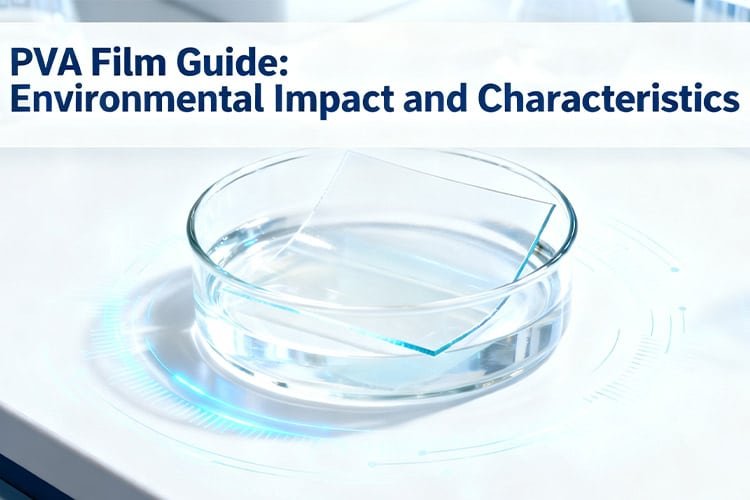
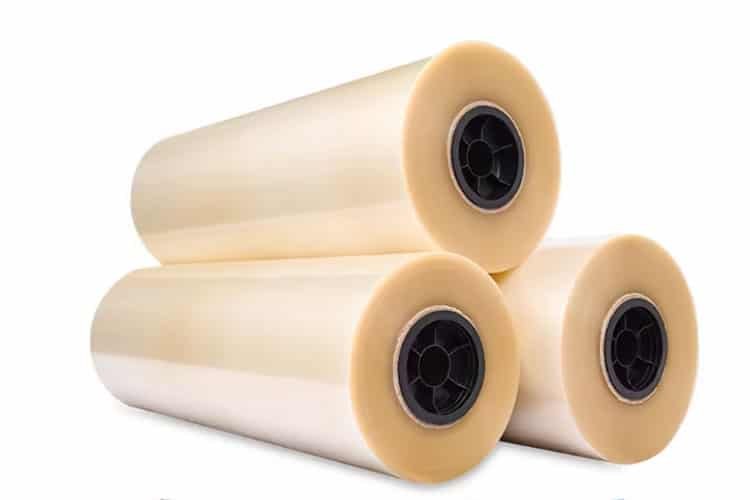
PVA film is a water-soluble plastic film manufactured from polyvinyl alcohol. It is commonly employed in packaging for laundry capsules, detergent pods, and cleaning products. While PVA film dissolves completely in water, it does not vanish entirely. Research indicates that portions of dissolved PVA transform into microplastics. These ultimately enter natural cycles, persisting in land or water resources.
What are the characteristics of the PVA film?
Water-soluble:
PVA film is fully soluble in water, exhibiting excellent water solubility. Dissolution speed is determined by water temperature and the degree of PVA polymerization. PVA agricultural film is popular in farming. It helps protect the environment, cuts down on pollution, and saves time on film recovery.
Biodegradability:
PVA film degrades less rapidly and effectively than natural materials, but it does break down over time. Ultimately, it is decomposed by soil microorganisms, leaving no toxicity or pollution.
Chemical and Thermal Stability:
PVA film exhibits excellent chemical and thermal stability. It resists corrosion while maintaining superior physical properties. It remains functional even under high-temperature conditions.
Barrier Properties:
PVA film provides effective barriers against gases and oily liquids. It reliably prevents the ingress of harmful gases and oxygen while blocking the permeation of oily substances. This offers distinct advantages in food packaging applications.
Mechanical Properties:
PVA film is compatible with various processing machinery. Its high tensile strength and elongation at break make it suitable for machine processing.
Durability:
PVA film is reusable and exhibits excellent abrasion resistance. It’s great for the textile industry. Water-soluble PVA film boosts embroidery production quality.
Tensile Strength:
PVA film possesses good tensile strength, capable of withstanding high tensile forces. PVA film can be used to package building materials such as lime, preventing damage. It dissolves directly in water, reducing human contact and minimizing skin irritation.
In which fields is it applied?
Water-soluble, eco-friendly packaging:
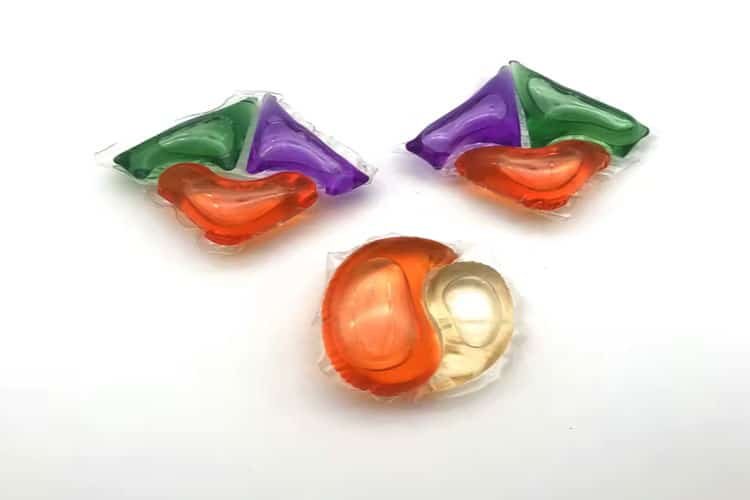
PVA is a water-soluble material. It’s an ideal packaging option for specialized products. It finds extensive use in food and cleaning products, such as laundry capsules, detergent pods, and food packaging.
Textile Industry Applications:
PVA offers exceptional durability, enhancing surface friction to maintain stitch stability. It also provides excellent dye adhesion, effectively preventing dye migration. Within the textile industry, water-soluble PVA film is used for embroidery.
Medical Field:
PVA film serves in pharmaceutical preparations. It keeps powdered medication safe during delivery. This allows for targeted release by controlling how it dissolves and adjusting the formulation. In medicine, it serves as a pharmaceutical capsule membrane.
Construction sector:
PVA film is suitable for packaging building materials. For instance, it can contain cement and sand for direct dissolution during the construction process.
Daily necessities sector:
PVA film is employed in packaging everyday items, particularly hair care, skincare, and cosmetics. Its use in encapsulating laundry pods significantly enhances efficiency and saves time.
Printing Industry:
PVA FILM serves as a transfer substrate, effectively carrying ink while preventing dye diffusion. This enhances print quality and enables high-definition transfers.
What environmental impact does PVA have?
Biodegradability of PVA films
PVA dissolves in water, yet this does not imply complete degradation under natural conditions. PVA breaks down in certain conditions. It needs microorganisms and enzymes to degrade. Additionally, it is significantly influenced by water temperature and duration of immersion.
Is PVA film toxic?
PVA is generally considered non-toxic. However, the PVA film encountered in everyday products is rarely pure PVA material. It often contains additives and plasticizers that may have potential effects.
Impact of PVA on Humans and the Planet
Research indicates PVA plastics may accumulate within the human body. Prolonged accumulation poses potential health risks. For the planet, while PVA dissolves in water, complete degradation remains challenging. Undegraded PVA re-enters water resources and soil via the water cycle.
Furthermore, the production of PVA has an impact on the environment. Each tonne of PVA production emits about 0.8 kg of methanol on average. However, some factories use closed-loop recycling systems.
The Sustainable Future of PVA
Research and production of PVA film continue to advance. Sustainable and biodegradable PVA film represent a significant breakthrough in this field. Biodegradable PVA film breaks down faster thanks to special blends of natural materials and additives.
Manufacturers are working to create eco-friendly production methods. They aim to cut harmful emissions and reduce resource use. This minimizes environmental impact while meeting consumer demand for eco-conscious products.
As the industry evolves, sustainability will define the future trajectory of PVA film development.
Choose BestY Pack
BestY Pack is an experienced PVA film manufacturer serving multiple partners. We offer advanced customization services, swiftly designing tailored solutions to meet client requirements. Our specialized technical team has delivered satisfactory PVA film solutions to numerous companies.
We are a film manufacturer committed to environmental protection and sustainable development. Our comprehensive PVA film range includes water-soluble PVA seed tape, embroidery water-soluble PVA film, and laundry pod PVA water-soluble film. Each product undergoes meticulous R&D with a focus on sustainability. We aim to share our expertise to help you select the most suitable solution.
FAQ
Does PVA degrade over time?
PVA can gradually degrade over time. However, since PVA is not a natural material, its degradation process is slower. Furthermore, PVA requires specific conditions to degrade. PVA possesses excellent water-soluble properties, and aquatic and soil environments provide favorable microbial conditions for PVA, aiding its degradation. Multiple factors influence the degradation rate of PVA. These include temperature, the composition of the PVA film, the microbial environment, and the duration of immersion in water. Once degraded, PVA breaks down into water and carbon dioxide, posing no toxicity or pollution to the environment.
What are the disadvantages of PVA materials?
Complete degradation is challenging: dissolving in water ≠ does not necessarily mean degradation. PVA’s biodegradation requires specific environmental conditions. It needs specific microorganisms and enzymes. Without them, PVA might go back into nature and build up in the human body.
- Lacks moisture resistance: Its inherent water-soluble nature means PVA lacks moisture-resistant properties, making it unsuitable for packaging products with high moisture content.
- Relatively high cost: Compared to traditional plastics, PVA material may not be a mainstream packaging choice, incurring higher costs.
- Strict storage requirements: During storage, PVA film must be kept in sealed environments or locations with precisely controlled air conditions.
Where can I purchase PVA?
We are a specialized PVA film manufacturer in China. We offer distinct PVA water-soluble film variants tailored to various industrial sectors. For the embroidery industry, we provide embroidery-grade water-soluble PVA film; for agriculture, PVA seed tape (thickness 20-40 μm, dissolution temperature <40 °C); and embroidery film (cold-water rapid dissolution type). For everyday laundry care packaging, we provide standard water-soluble PVA packaging film. We guarantee the quality of our films and offer optimal PVA packaging solutions. Whether regarding dimensions, thickness, or specialized formulations and processing for diverse industrial applications, we strive to meet your requirements to the fullest extent possible.
What are the best PVA films for encapsulating liquid detergent?
Soluble PVA is excellent for liquid packaging. The most common examples in daily life are laundry detergent pods and portable hand sanitizers. Detergent capsules with a hydrolysis degree of 85% to 90% represent the optimal water-soluble packaging. They encapsulate liquid detergent without dissolving in it. At room temperature, they dissolve rapidly in water. They are easy to carry and convenient to use, solving the hassle of laundry.
Where Can I Purchase PVA?
We are a specialized PVA film manufacturer in China. We offer distinct PVA water-soluble film variants tailored to various industrial sectors.
- For the embroidery industry, we provide embroidery-grade water-soluble PVA film.
- For agriculture, PVA seed tape (thickness 20-40 μm, dissolution temperature <40 °C), and embroidery film (cold-water rapid dissolution type).
- For everyday laundry care packaging, we provide standard water-soluble PVA packaging film.
We guarantee the quality of our films and offer optimal PVA packaging solutions. Whether regarding dimensions, thickness, or specialized formulations and processing for diverse industrial applications, we strive to meet your requirements to the fullest extent possible.

Hello, customers
My name is Jack Yu. I am the Business Manager at BestY Pack Plastic Products. My areas of expertise include film packaging, cold chain transportation packaging, and shrink products. Additionally, our factory manufactures protective gloves, and I can provide you with professional solutions to help you increase your market share and enhance consumer trust.
Email: ᅠjackyu@bestypack.com
Tel: +86 18368319351