
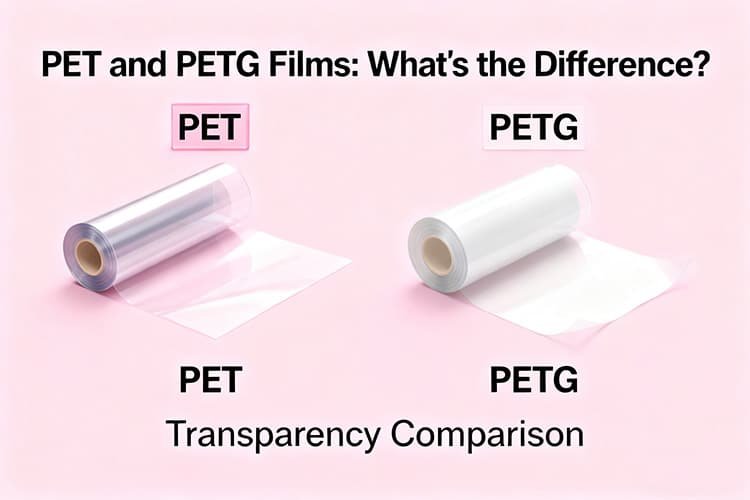
PET and PETG are transparent thermoplastics widely used in the packaging industry, though demand for PETG is skyrocketing. According to a 2025 market report, PETG’s share in the 3D printing and medical packaging sectors is projected to increase by 20%. This article details the key differences between PET and PETG.
What are PET and PETG?
PET:
PET (Polyethylene terephthalate) is a standard thermoplastic polyester commonly used for mineral water bottles. It boasts over 92% transparency, strong chemical resistance, and rigidity, with tensile strength reaching 70 MPa. PET is widely recognized for these properties.
PET:
PET (Polyethylene terephthalate) is a standard thermoplastic polyester commonly used for mineral water bottles. It boasts over 92% transparency, strong chemical resistance, and rigidity, with tensile strength reaching 70 MPa. PET is widely recognized for these properties.
PETG:
PETG is a copolymer modification of PET, achieving enhanced flexibility through the addition of 1,4-cyclohexanedimethanol (CHDM) rather than pure ethylene glycol. As a thermoplastic material, its impact strength is 2-3 times that of PET, making it suitable for higher-toughness applications.
PETG represents a modified and upgraded form of PET, where the ‘G’ denotes glycol-modified. PETG is produced through copolymerization with ethylene glycol, thereby acquiring additional properties. Compared to PET, the incorporation of ethylene glycol confers PETG with superior strength and durability. It also achieves significant advancements in protective capabilities and operating temperature ranges.
| Property | PET | PETG |
|---|---|---|
| Mechanical | Higher tensile strength Strong rigidity Strong tear resistance | Better impact resistance |
| Thermal | Precise temp. control for high-temp forming Easy crystallization & embrittlement | Lower processing temp. Low haze/crystallization risk Easier heat forming |
| Chemical Resistance | Good | Stronger, no odor |
| Sterilization | Supports some methods | Compatible with all (γ-ray, EtO) |
| Optical | High transparency Strong visibility | Strong transparency (less than PET) |
| Aesthetics | Strong | Strong |
| Cost | Lower | Slightly higher |
| Eco | Recyclable | Recyclable, more resource-efficient |
| Electrical | Average anti-static | Non-toxic for home/health use |
Physical Properties Comparison of PET and PETG (Laboratory Test Results)
| Property | PET | PETG |
|---|---|---|
| Recycling Rate | 100% | 68% |
| Young’s Modulus | 2300 MPa | 2020 MPa |
| Elongation at Break | 375% | 23% |
| Tensile Strength | 58 MPa | 51 MPa |
| Yield Strain | 6% | 5.85% |
| Flexural Strength | 103 MPa | 70 MPa |
PET:
It is employed in manufacturing plastic bottles, such as those for cola, with annual production exceeding 50 billion units.
It serves in electronic components like cassette casings, exhibiting superior UV resistance compared to PETG.
Within food packaging, PET finds broader applications; for instance, in food packaging boxes.
It is suitable for daily-use packaging, like cosmetic bottles and powder compact cases, meeting FDA food-safety standards.
It can be employed in electronic packaging, such as protective casings for sensitive electronic components.
PETG:
PETG dominates the 3D printing market with a shrinkage rate of <0.5%, significantly lower than ABS’s 1-2%. It is also suitable for multiple sectors, including food packaging.
Medical device packaging, such as syringe casings, conforms to ISO 10993 biocompatibility standards.
Applications include beverage bottles, mineral water containers, and condiment bottles.
Used for display stands and shop windows, offering easy coloration and transparency exceeding 90% to enhance visual appeal.
Machinery protective packaging: Machine casings manufactured from PETG provide robust wear resistance and an extended service life.
Are PET and PETG recyclable?
Sustainability is a key metric for businesses pursuing green development. While PET and PETG share many similarities, their environmental credentials differ.
PETG boasts exceptional performance, being virtually unbreakable. It is durable, wear-resistant, long-lasting, inexpensive, and offers excellent value for money. Processing requires high temperatures, significantly higher than standard PET. While recyclable, achieving comprehensive collection and secondary processing takes time, often resulting in incineration or landfill disposal.
Compared to PETG, PET achieved a 33% recycling rate in the US in 2023, with a mature recycling chain. It is relatively inexpensive. Should you require it, we also offer customized services.
BestY Pack
We are a specialist PET film manufacturer based in China. With years of production experience, our products are exported worldwide. Our well-established production lines operate comprehensively and efficiently, reducing labor costs and enhancing economic benefits. We produce bespoke products for you, offering personalized solutions. Whether it’s PET film or PETG film, we can manufacture films of varying dimensions, thicknesses, and performance characteristics.
We aim to share our expertise through our blog, helping consumers select packaging materials.
Frequently Asked Questions

Hello, customers
My name is Jack Yu. I am the Business Manager at BestY Pack Plastic Products. My areas of expertise include film packaging, cold chain transportation packaging, and shrink products. Additionally, our factory manufactures protective gloves, and I can provide you with professional solutions to help you increase your market share and enhance consumer trust.
Email: ᅠjackyu@bestypack.com
Tel: +86 18368319351