
PE film is a plastic film manufactured from polyethylene as its raw material. PE film is vital in packaging. It protects goods during transport and boosts efficiency. Given the varying quality of PE film available on the market, how does one select high-quality PE film? This article provides a detailed guide on eight key aspects.
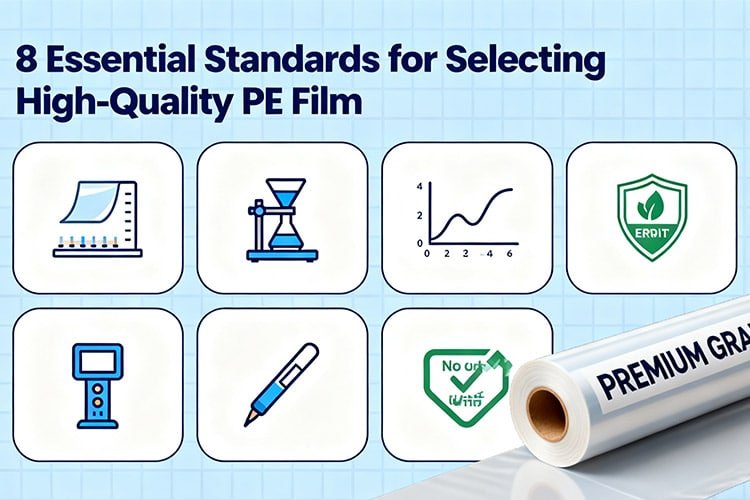
Introduction to PE Film
What is PE film?
PE film is a plastic film manufactured from high-quality polyethylene pellets through cast or blown molding processes. It is widely used in many industries for flexible packaging. This includes agriculture, food, construction, and chemicals. It possesses excellent properties, such as high transparency, high strength, and low weight. Highly stable, it adapts to diverse usage scenarios, effectively protecting products and equipment.
The market for PE film continues to expand. The Global Polyethylene Film Market Report 2023-2029 shows that the PE film market will hit US$40.46 billion by 2029. It will grow at a compound annual growth rate (CAGR) of 3.8% during this period.

the Importance of Selecting Suitable PE Film
Firstly, choosing appropriate PE film is fundamental to safeguarding goods. PE film needs enough tear resistance and strength to protect products well.
Furthermore, different PE films vary in performance and quality. Market offerings exhibit inconsistent quality, with substandard PE films failing to deliver sufficient protection. Unsuitable types likewise prove ineffective, increasing risks during transportation.
Moreover, selecting the appropriate PE film can reduce packaging costs. A suitable film minimizes material usage, conserves resources, and consequently lowers packaging expenses.
Standards for High-Quality PE Film
Material Selection (Physical Properties)
The quality of PE film hinges primarily on material selection. Utilizing premium polyethylene resin compliant with ASTM D882 ensures the film meets performance benchmarks. Material choice fundamentally influences the film’s quality and properties, thereby playing a critical role in product protection.
Film Thickness (Flexibility, Strength, Durability)
The precise uniformity of PE film thickness directly impacts its performance and reflects overall quality. Accurate thickness control and ensuring uniformity are vital evaluation criteria.
This affects the film’s lifespan, strength, and flexibility. The balance between strength and flexibility depends on the specific application scenario. Excessively thick film becomes overly rigid, hindering packaging machinery operation; conversely, overly thin film is prone to tearing. Uniform and optimal thickness accommodates packaging requirements for diverse product shapes, facilitating seamless wrapping and minimizing resource wastage.
Physical Property Testing
PE film production necessitates regular physical property testing, particularly for critical metrics such as tensile strength, tear resistance, and impact resistance. These directly reflect the protective capabilities of PE film. Per ISO 527 standards, high-quality PE film must exhibit a tensile strength of at least 40 MPa (approximately 400 kp/cm²), proven in practice to withstand typical transport stresses. Requirements for tear resistance and impact resistance vary across products. Customization is essential based on user opening requirements and industrial machinery specifications (e.g., compliance with EU REACH regulations) to ensure regulatory adherence.
Additive Compatibility
The incorporation of additives into PE film confers diverse functionalities. These include colorants, stabilizers, and other fillers. Such additives must fully integrate with the polyethylene resin to maintain film integrity. Different colors within PE film can serve for product marking and privacy protection. For instance, additives like UV inhibitors enhance the film’s performance.
Processing Technology and Equipment
PE film production requires not only material selection but also precise control of processing conditions, including temperature, humidity, and pressure. This largely depends on the equipment and technological sophistication of the manufacturing facility.
Advanced production techniques let PE film reach desired traits like transparency, thickness, and strength.
Surface Characteristics
The surface properties of PE film are also a crucial criterion for assessing its quality. Appropriate surface treatments can improve adhesion and printability.
For instance, metallisation enhances the film’s gas barrier and moisture resistance while increasing reflectivity for a more attractive appearance. Common treatments also include corona treatment and adhesive coating.
Environmental Resistance
Environmental resistance is a key indicator for assessing the versatility of PE film applications. The broader its applicability, the higher its value. This encompasses the film’s heat resistance, moisture resistance, UV resistance, and overall stability. According to ASTM D543 testing, maintaining stable performance at elevated temperatures (>80°C) and resisting corrosion from common chemicals (such as acidic or alkaline solutions) are critical benchmarks.
Quality Control
Quality control for PE film is paramount. This directly impacts consumer satisfaction. Manufacturers adhering to stringent quality control significantly enhance finished product quality. This prevents consumers from receiving substandard, low-quality film. It also elevates reliability and credibility.
| Standard | Weight | Note |
|---|---|---|
| Material Selection | 20% | Base performance |
| Film Thickness | 15% | Strength & flexibility |
| Physical Testing | 20% | Core protection |
| Additive Compatibility | 10% | Functional enhancement |
| Processing Technology | 15% | Process defines quality |
| Surface Properties | 8% | Adhesion & aesthetics |
| Environmental Resistance | 8% | Multi-scenario use |
| Quality Control | 4% | Reliable delivery |
Choose BestY Pack
We aim to assist you in selecting the most suitable PE film through our expertise. As a Chinese specialist manufacturer with 15 years of experience in PE film production, BestY Pack is dedicated to helping you choose the optimal PE film solution. We are pleased to assist you in resolving your packaging challenges.
With over 15 years of experience in plastic packaging production and ISO 9001 Quality Management System certification, BestY Pack is confident in delivering premium service. Our film production offers bespoke customization to meet your requirements. Our engineering team has delivered tailored solutions for over 500 global clients, earning high praise from numerous partners.
We guarantee on-time delivery for 98% of orders. Products undergo third-party laboratory testing, with customer feedback indicating our cost-effectiveness exceeds industry averages. For any plastic packaging needs, please contact us. We will promptly provide the optimal solution.
Frequently Asked Questions

Hello, customers
My name is Jack Yu. I am the Business Manager at BestY Pack Plastic Products. My areas of expertise include film packaging, cold chain transportation packaging, and shrink products. Additionally, our factory manufactures protective gloves, and I can provide you with professional solutions to help you increase your market share and enhance consumer trust.
Email: ᅠjackyu@bestypack.com
Tel: +86 18368319351