
Flexible packaging film is not one material. It may be a single polymer film, a coated or metallized web, a coextrusion, or a laminate in which each layer performs a different job. The right choice depends on the packaged product, required shelf life, sealing system, converting and filling equipment, distribution hazards, appearance, target market, and end-of-life design. Use film-family names to build a shortlist, then verify the exact grade, structure, thickness, test conditions, compliance documents, and trial results before approval.
What Counts as a Flexible Packaging Film?
For regulatory context, consult the U.S. FDA’s food-packaging guidance before approving an intended food-contact use.
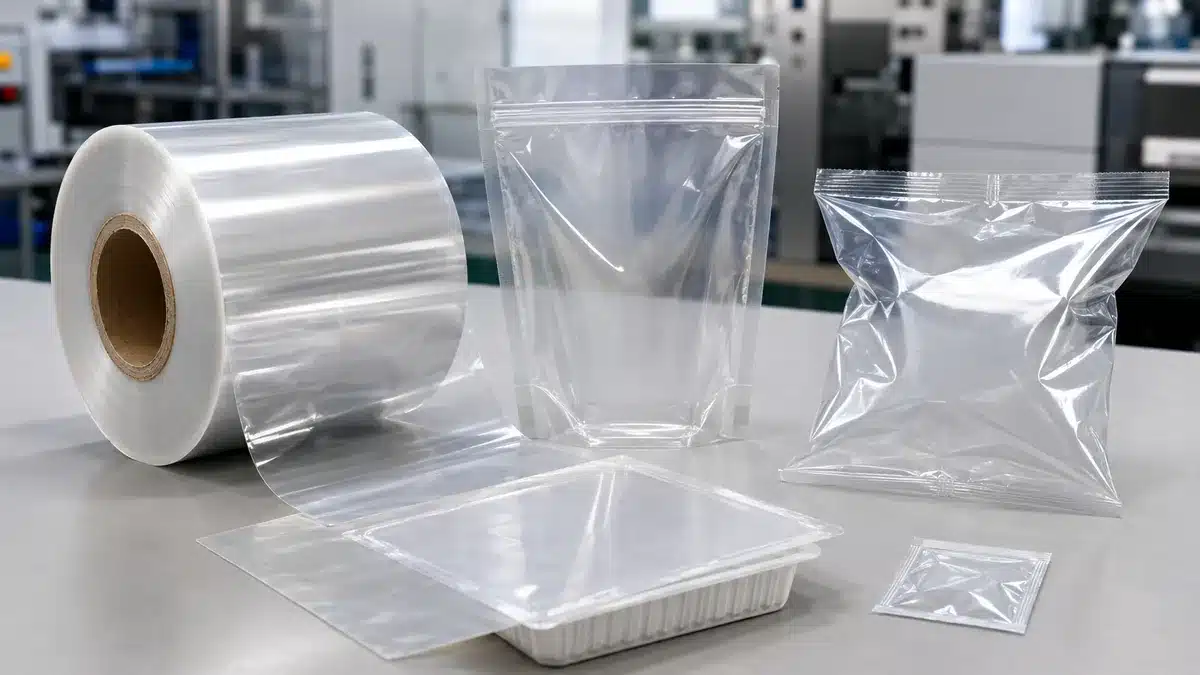
A flexible packaging film is a thin, continuous web that can be converted into wraps, lidding, sachets, bags, pouches, labels, or a layer within another flexible structure. The word film describes the physical form; it does not identify one chemistry or one performance level.
Commercial names often combine different classification axes. PE, PP, PET, PA, and EVOH identify polymer families. BOPP, BOPET, and BOPA identify oriented film forms; CPP identifies cast polypropylene. “Metallized” describes a deposited metal layer, while “laminate” and “coextrusion” describe ways of combining layers. A buyer therefore needs more than a material acronym. Grade, orientation, additives, treatment, coating, layer order, thickness, adhesive, print location, and sealant all influence the finished structure.
Main Types of Flexible Packaging Films
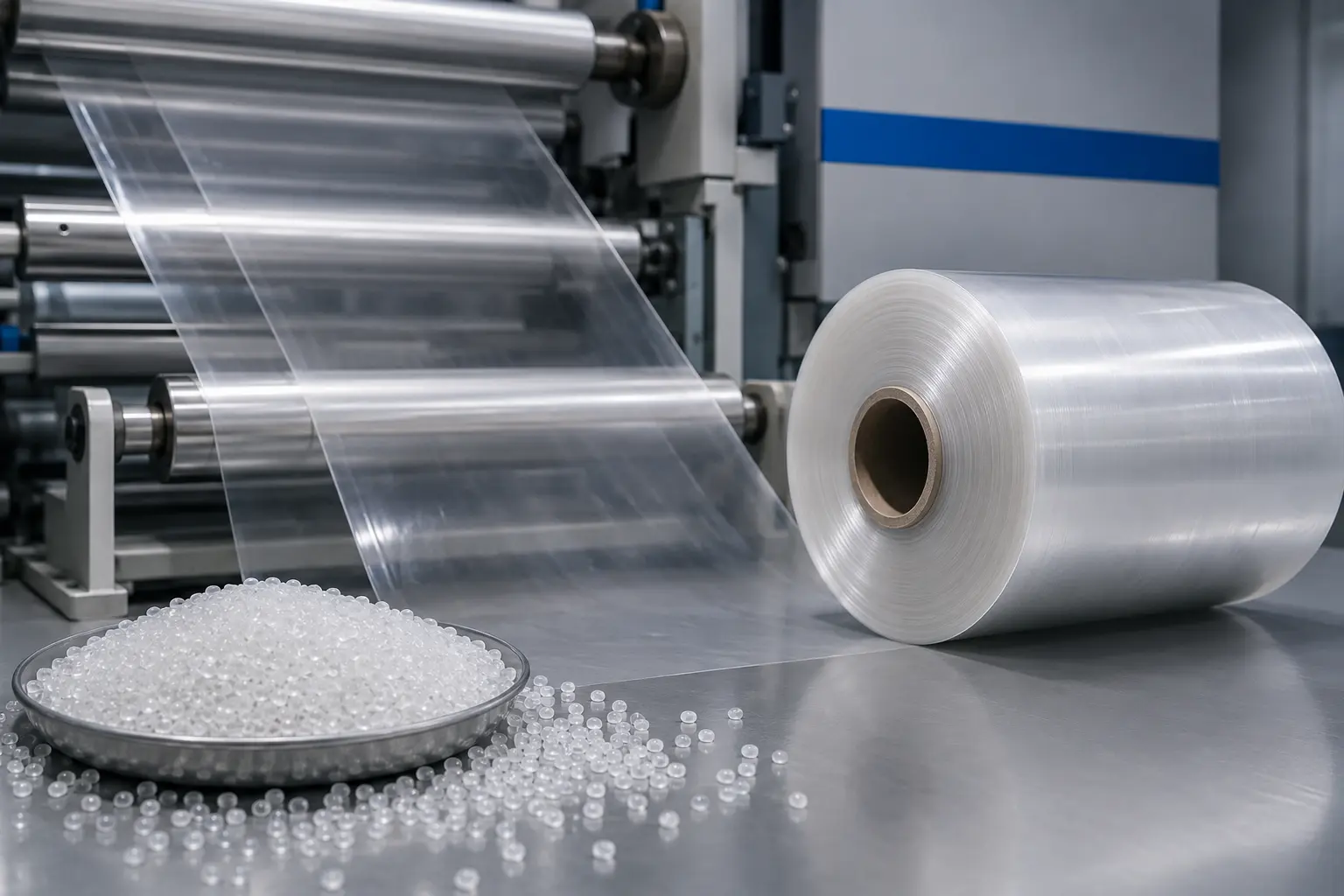
The most useful way to compare film families is by the role a specific grade may perform in a structure. The descriptions below are starting points, not universal specifications.
Polyethylene (PE)
PE includes several resin families and film forms, including LDPE, LLDPE, HDPE, metallocene-based grades, and blends. In flexible packaging, a PE layer is often considered when flexibility, toughness, and heat-seal behavior are important. Some PE grades are designed for cast or blown film, while others target seal initiation, hot tack, clarity, stiffness, or puncture performance.
Those properties are not interchangeable across PE grades. A sealant resin that performs well at one jaw temperature, pressure, dwell time, line speed, and contamination level may behave differently on another machine or against another sealing surface. Ask for the exact resin or film designation and validate the complete seal window rather than treating “PE” as a specification.
Polypropylene (PP)
PP films include cast polypropylene and oriented polypropylene, among other forms. Orientation changes the film’s mechanical, optical, shrink, and processing behavior, so CPP and BOPP should not be treated as synonyms. BOPP is commonly evaluated where a clear, stiff, printable web or moisture-management role is needed; CPP may be considered where a non-oriented PP sealant or converting layer is suitable.
Actual barrier, heat resistance, sealability, coefficient of friction, and machinability depend on the resin, orientation, thickness, surface treatment, coatings, and structure. A coated or coextruded PP film may behave very differently from an uncoated homopolymer film. Compare supplier data only when the sample construction and test conditions are equivalent.
Polyester (PET)
Packaging PET film is commonly supplied as biaxially oriented PET, often called BOPET. Specific grades may offer dimensional stability, mechanical strength, optical clarity, surface treatments, coatings, heat-seal functions, or metallization. These characteristics can make PET a candidate for a print or structural web, but the base polymer name alone does not establish barrier or seal performance.
A plain PET web, a barrier-coated PET, and a metallized PET are different materials. Record the exact coating or metallization, treated side, print and adhesive interfaces, thickness, and intended heat exposure. If a PET grade is not itself a sealant, the package will need a compatible seal layer or coating.
Polyamide (PA or Nylon)
PA is a polymer family that includes different nylon chemistries and oriented or non-oriented film forms. Packaging teams often evaluate PA where toughness, flex durability, or resistance to puncture and pinholing matters. Biaxially oriented PA, or BOPA, is one commercial form, but it is not representative of every PA grade.
Moisture can affect the behavior of some polyamides, and different grades vary in barrier, stiffness, thermoforming response, heat resistance, and adhesion. Define the conditioning state and test environment when comparing results. In a laminate or coextrusion, also confirm tie layers or adhesives and how the PA layer interacts with the product, process, and distribution conditions.
Barrier Layers, Coatings, and Foil
Some structures add a functional barrier layer rather than relying on the main structural or sealant film. EVOH is one example of an oxygen-barrier polymer used in multilayer constructions. Its performance is sensitive to composition and environmental conditions, including humidity, so surrounding layers and test conditions matter. Barrier coatings and deposited metal can also change oxygen, moisture, light, aroma, or surface performance, but the coating chemistry, coat weight, continuity, flexing, and converting history must be known.
Aluminum foil is used when a strong light, oxygen, and moisture barrier is required, yet the converted package still needs appropriate thickness, flex-crack control, pinhole control, lamination quality, and seal integrity. Metallized polymer film is not the same as foil. Its barrier depends on the metal layer, substrate, defects, handling, and final structure.
| Material or layer family | Common reason to evaluate it | Key items to verify |
|---|---|---|
| PE | Flexibility, toughness, or sealant function | Grade, density family, blend, thickness, seal window, hot tack, COF, treatment |
| PP | Stiff clear web, oriented web, or PP sealant role | CPP or BOPP form, coating, treatment, thickness, shrink, seal behavior |
| PET | Structural or print web, dimensional stability, or coated/metallized substrate | Grade, orientation, treated side, coating or metal layer, thickness, seal layer |
| PA | Toughness, flex or puncture-critical role | PA chemistry, orientation, conditioning, thickness, adhesion, thermoforming conditions |
| EVOH or barrier coating | Oxygen, aroma, or other functional barrier | Chemistry, thickness or coat weight, humidity, test side, protective layers |
| Aluminum foil | Light, oxygen, and moisture barrier role | Foil thickness, pinholes, flex cracks, adhesive, converting damage, seal integrity |
Single-Layer Films vs. Multilayer Structures
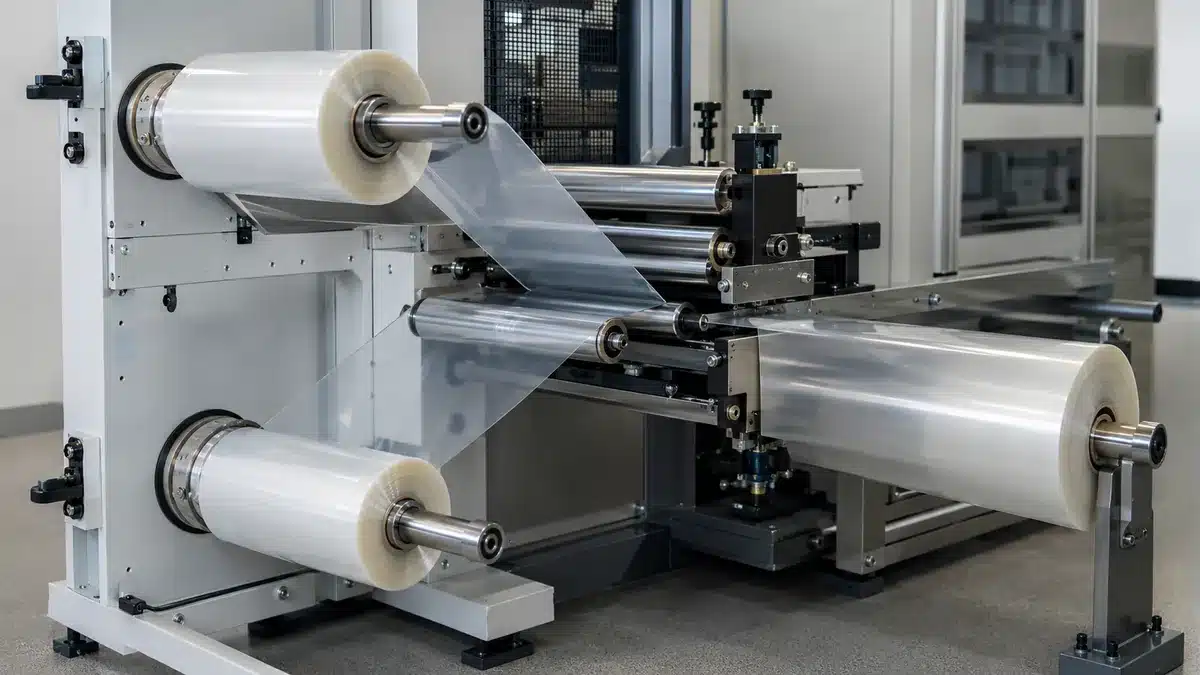
A single-layer film can be appropriate when one material meets the required mechanical, optical, barrier, sealing, processing, and regulatory needs. It simplifies the bill of materials and may simplify end-of-life assessment, but neither “single layer” nor “mono-material” proves that the finished package is compatible with a particular recycling stream.
Multilayer structures combine functions One layer may carry print and provide stiffness another may provide oxygen or light barrier and an inner layer may create the product-contact and heat-seal surface Layers may be combined by coextrusion adhesive lamination extrusion lamination coating or metallization The benefit is functional tailoring.
| Construction | Why it may be selected | Main trade-off | Verification focus |
|---|---|---|---|
| Single-layer film | One grade can meet the application brief | Fewer ways to separate functions | Grade consistency, sealing, mechanics, barrier, and machine trial |
| Coextruded film | Multiple polymer layers are formed in one film-making operation | Layer compatibility and thickness control are critical | Layer sequence, tie layers, individual and total thickness, die and line stability |
| Laminated structure | Separate webs provide complementary print, barrier, stiffness, or seal roles | Adhesive, curing, bond and residual considerations | Web identity, adhesive system, bond strength, cure, migration, delamination risk |
| Coated or metallized film | A thin functional surface changes barrier, sealing, print, or optical behavior | Defects, flexing and surface damage can reduce function | Coating or metal continuity, adhesion, treatment, flex durability, conditioned barrier |
| Foil laminate | Very strong light and gas-barrier role is needed | Pinholes, flex cracking and recycling complexity require control | Foil gauge, converting damage, laminate bond, seal and whole-package integrity |
Important: A layer data sheet does not establish the performance of a printed, laminated, converted, filled, and sealed package. Validate the final construction and package under representative conditions.
How Film Properties Affect Packaging Performance
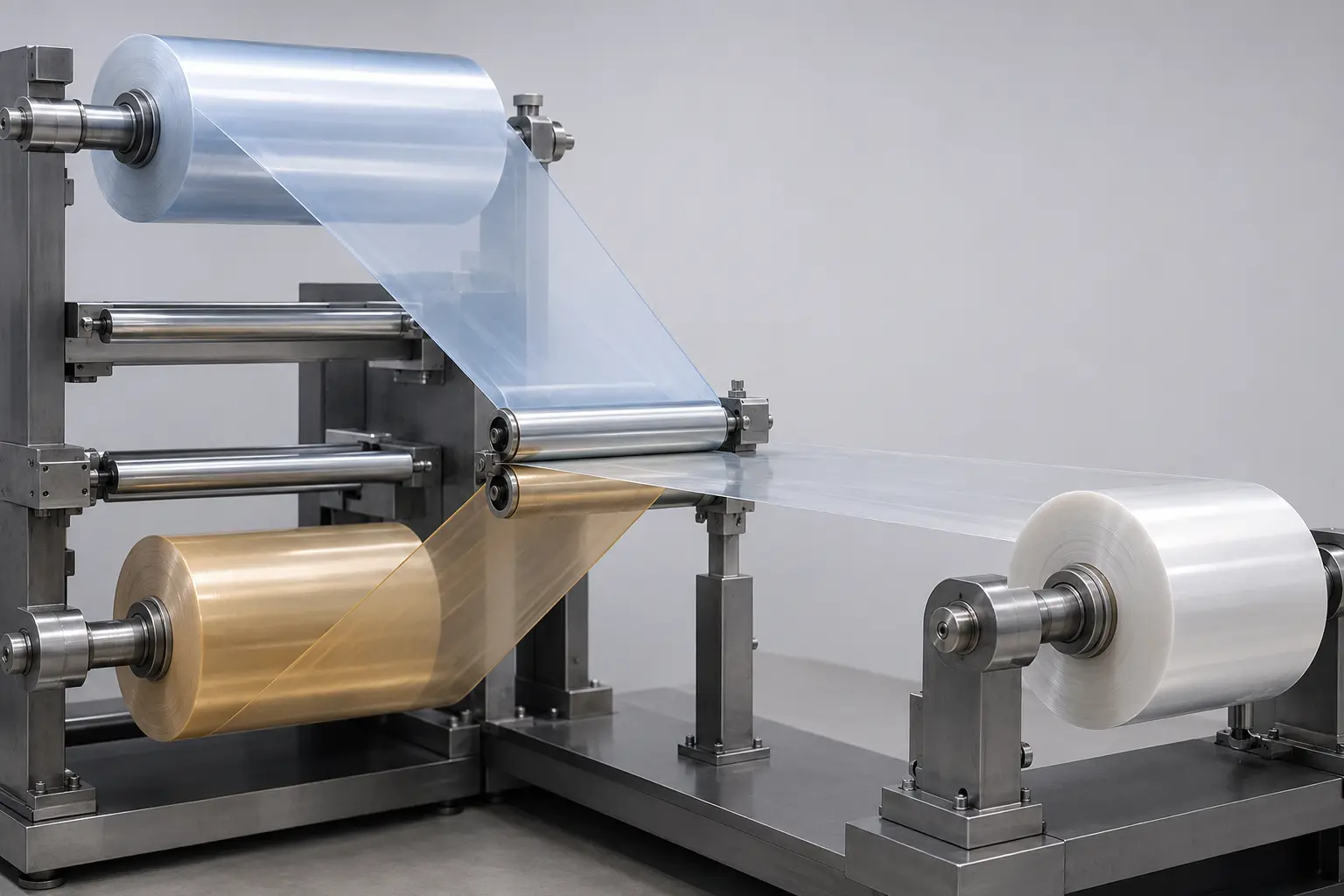
Property words become useful specifications only when they are connected to a sample, method, unit, direction, and environment. “Strong,” “clear,” “high barrier,” and “easy sealing” are not comparable requirements by themselves.
Barrier and Shelf-Life Requirements
Start with the product’s deterioration mechanisms. Oxygen sensitivity, moisture gain or loss, aroma transfer, light exposure, grease, chemicals, and microbial risks are different problems. A film that controls one may not control another. Shelf life also depends on the package format, seal area, headspace, filling process, storage temperature, distribution time, and product itself.
For oxygen transmission rate and water-vapor transmission rate, define the test method, temperature, relative humidity, specimen thickness, test side, gas or vapor conditions, and units. Distinguish a resin’s typical permeability from the measured transmission of a finished coextrusion or laminate. If the package will be flexed, creased, pasteurized, retorted, frozen, or stored at changing humidity, test the relevant conditioned and post-process state.
Sealing and Package Integrity
Seal performance is a system property. The sealing layer, opposing surface, contamination, jaw design, temperature, pressure, dwell time, cooling, line speed, and package geometry all contribute. A seal-strength result should identify the specimen width, peel configuration, test speed, conditioning, failure mode, and units. It should not be presented as a universal value detached from the method.
Seal strength is also not the same as total package integrity. Leak, burst, creep, dye penetration, vacuum-decay, or distribution tests answer different questions. Select methods that match the package and failure risk, then define acceptance criteria before the trial. For easy-open packaging, both the lower integrity limit and the upper opening-force objective may matter.
Mechanical and Optical Requirements
Mechanical requirements may include tensile strength and elongation in machine and transverse directions, modulus, tear, puncture, dart impact, flex durability, blocking, slip, and dimensional stability. Method, specimen geometry, direction, thickness, conditioning, and test speed affect results. Do not compare MD data with TD data or values generated by different methods as if they were equivalent.
Optical and surface requirements may include haze, transmittance, gloss, color, print appearance, surface energy, coefficient of friction, and scuff resistance. These properties can change after treatment, printing, coating, lamination, curing, and aging. Machine trials should evaluate web tracking, tension, static, registration, forming, cutting, sealing, and package handling—not only the roll’s laboratory data.
| Requirement | Minimum context for a comparable result | What the result does not prove by itself |
|---|---|---|
| OTR or WVTR | Method, temperature, RH, thickness, test side, units, sample structure | Actual shelf life or performance after every converting step |
| Seal strength | Method, seal materials, temperature, pressure, dwell, specimen width, peel setup, failure mode | Leak tightness or distribution survival of the whole package |
| Tensile or elongation | Method, thickness, MD/TD, conditioning, test speed and specimen geometry | Tear, puncture or machine behavior |
| Haze, gloss or COF | Method, surface pair or side, conditioning and treatment state | Print quality, line speed or consumer acceptance |
| Package integrity | Package-specific method, filled or empty state, conditioning and acceptance limit | Compliance for a different format, product or distribution route |
How to Choose a Flexible Packaging Film
- Define the packaged product and failure risks. Record composition, sensitivity to oxygen, moisture, light, aroma or chemicals, sharp edges, fill temperature, and expected interaction with the package.
- Define the package and distribution conditions. Specify format, dimensions, fill weight, headspace, storage temperature and humidity, distribution duration, drops, vibration, compression, flexing, freezing, heating, pasteurization, or retort exposure where applicable.
- Translate risks into functional requirements. Identify required seal behavior, barrier, toughness, stiffness, optics, print surface, opening behavior, and handling. Use measurable criteria and agreed methods where evidence is available.
- Map functions to layers. Decide which web provides print and structural control, which layer provides barrier, and which layer contacts the product and seals. Avoid choosing the whole package from one material acronym.
- Check converting and filling compatibility. Record printing, coating, adhesive, curing, slitting, forming, jaw type, temperature range, dwell time, line speed, web tension, COF needs, and detection systems.
- Review compliance and end-of-life requirements. Tie food-contact, migration, recycled-content, recyclability, compostability, or other claims to the target market, final structure, intended use, and supporting documents.
- Run controlled samples and package trials. Approve the exact structure only after comparing supplier evidence, incoming-film tests, machine performance, sealed-package tests, and representative shelf-life or distribution validation.
What to Put in an RFQ or Sample Trial
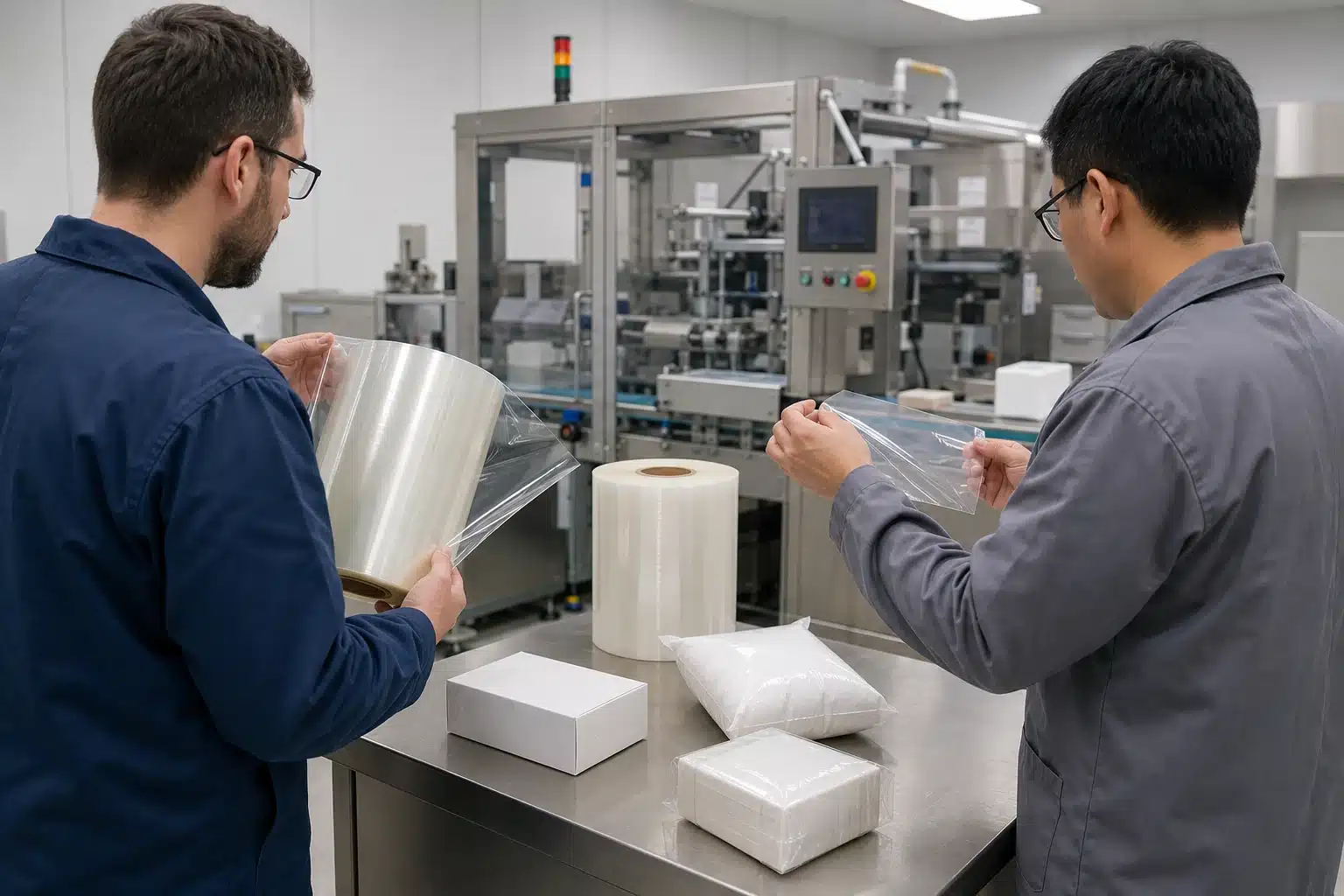
A technically complete RFQ allows suppliers to propose comparable structures and state what their evidence actually covers. Include:
- packaged product, ingredients or chemical-contact concerns, fill state, fill temperature, and target shelf life;
- package format, nominal dimensions, fill weight, opening feature, seal geometry, and any valve, zipper, spout, label, or fitment;
- target structure if known, including layer order, total and layer thickness, print location, treatment, coating, metallization, adhesive, and sealant;
- converting and filling equipment, web width, core, roll diameter or weight limits, unwind direction, line speed, tension, jaw type, temperature, pressure, dwell time, and registration needs;
- required mechanical, optical, barrier, sealing, and package-integrity tests with methods, conditions, units, directions, sampling, and acceptance criteria;
- storage and distribution conditions, including temperature, humidity, flexing, compression, vibration, drop, freezing, hot fill, pasteurization, or retort exposure as applicable;
- target country or region, food-contact or other regulated use, contact time and temperature, and requested declarations, migration reports, test reports, or certificates;
- end-of-life objective and the specific recycling or composting system, guideline, protocol, and complete-package features to be assessed;
- sample quantity, trial plan, change-control expectations, traceability, approval responsibility, and the exact evidence the supplier must return.
If a target value is not yet known, label it as a development item rather than inventing a tolerance. Keep approved samples, specifications, test methods, and change records tied to the exact grade and structure.
Compliance and Sustainability Checks

Food-contact suitability is not established by a polymer name a logo or the phrase food grade The evidence chain must connect the exact formulation and finished structure.
Recyclability is also design- and system-specific. The base polymer, density, color, printing, coatings, adhesives, barrier layers, metallization, labels, zippers, spouts, and product residue can affect compatibility with collection, sorting, and reprocessing. A design-for-recycling assessment does not automatically prove that the package is collected and recycled in every location.
- Problem: a broad claim such as “recyclable” or “EU compliant” is attached to an unspecified film.
- Cause: evidence for one resin, layer, sample, or market is generalized to the complete package.
- Consequence: the claim may not match the final construction, use conditions, local infrastructure, or current rules.
- Control: identify the exact structure and market, apply the current official rule or protocol, obtain product-specific documents, and retain the assessment with the approved specification.
Important: Biobased content, biodegradability, industrial compostability, home compostability, recycled content, and recyclability are different claims. Each needs its own definition, test or chain-of-custody evidence, market scope, and disposal conditions.
Key Takeaway: Select the Structure, Then Verify It
PE, PP, PET, PA, EVOH, coatings, metallized films, and foil are building blocks—not complete answers. First define the product, package, process, distribution, market, and end-of-life requirements. Then assign each required function to a grade and layer, document the exact construction, and test it under representative conditions. The final approval should be tied to supplier documents, controlled samples, machine trials, package-integrity results, and any required shelf-life, migration, or recyclability assessment. When a condition changes, reassess the evidence instead of assuming the previous result still applies.
Related Bestypack Resources
- BOPP Thermal Lamination Film
 English
 Japanese
 French
 Spanish
 Korean
 Italian
 Portuguese
 Dutch
Dutch Arabic
 Russian
 German