
PVA film can solve a very specific packaging problem: holding a measured product until water is supposed to release it. That simple description hides the real selection work. “PVA” can refer to different polymers, water solubility is grade- and condition-dependent, and a film that disappears from view has not automatically met a biodegradation or compliance claim. This guide explains the material, its trade-offs, common applications, and the evidence a packaging buyer should request before approval.
What Is PVA Film?
For U.S. food-contact context, review the eCFR polymer provisions before approving a finished-film claim.
For U.S. food-contact context, review the eCFR polymer provisions before approving a finished-film claim.
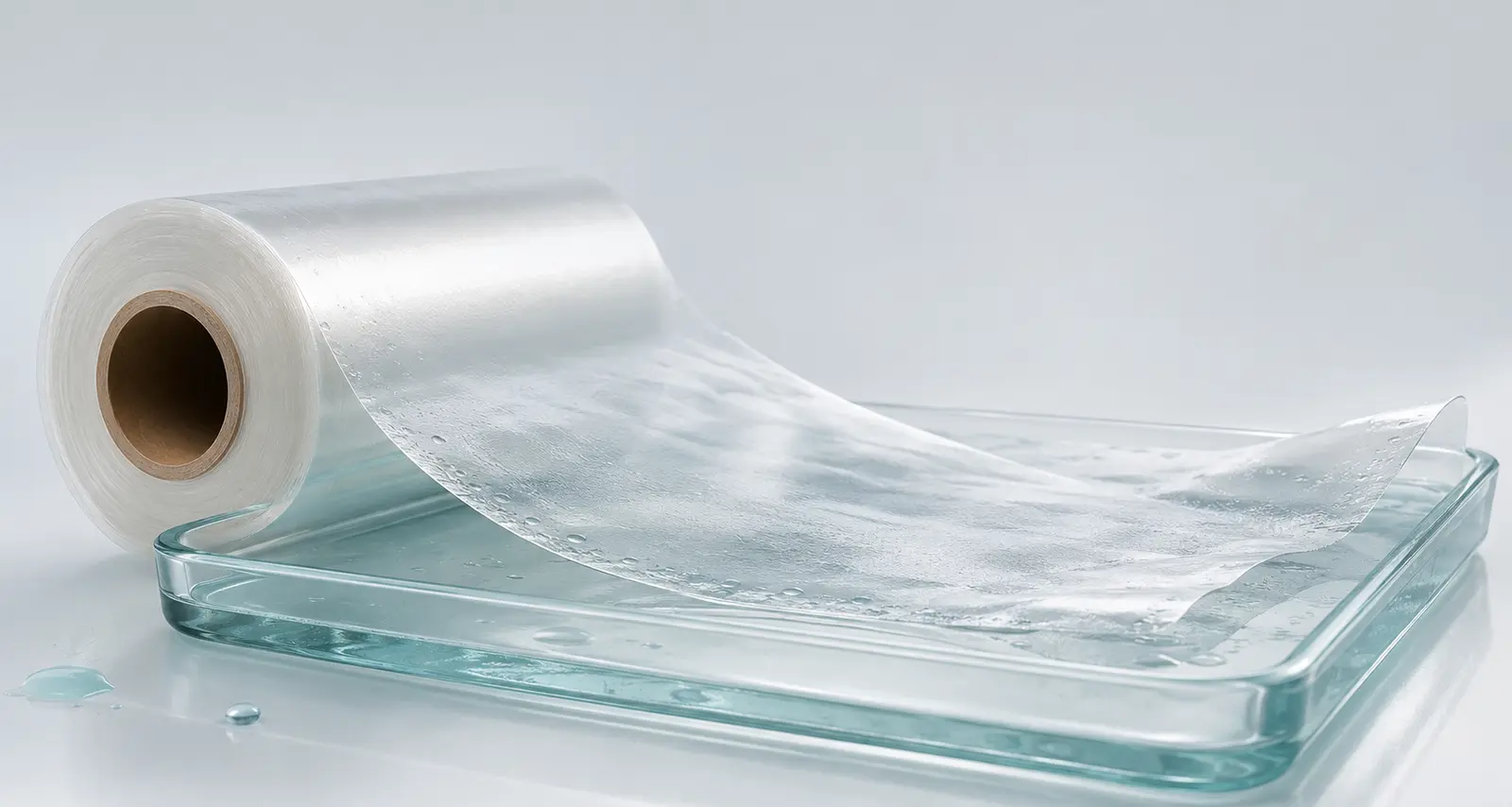
In water-soluble packaging PVA film normally means film based on polyvinyl alcohol a synthetic polymer also written as PVOH Its large number of hydroxyl groups gives it a strong affinity for water and useful film-forming behavior Commercial film.
PVA, PVOH, and Polyvinyl Acetate Are Not the Same
PVOH is the clearer abbreviation for polyvinyl alcohol because PVA is sometimes used informally for polyvinyl acetate Polyvinyl alcohol is generally made by hydrolyzing or alcoholyzing polyvinyl acetate The extent of that conversion is called.
An unambiguous supplier specification should therefore state “polyvinyl alcohol (PVOH)” and identify the grade or film family. The polymer name alone does not reveal the film’s additives, residual acetate content, thickness, seal layer, dissolution profile, or intended application.
Important: Do not approve a film described only as “PVA.” Confirm the full polymer name, the finished-film grade, and the application-specific data sheet.
How PVA Film Is Made
PVOH resin begins upstream with polyvinyl acetate and a controlled hydrolysis step. To make film, a producer must turn the resin and any approved formulation components into a continuous web. Industry routes include solution-based film formation followed by controlled drying, as well as melt-processing approaches for formulations designed to tolerate that process.
Plasticizers and other additives may be used to adjust flexibility, processing, sealing, or water response. Drying and thermal history can also affect the film. Those choices are supplier-specific. A buyer should not infer a recipe, layer structure, or production route from the words “PVA film.”
How PVA Film Dissolves in Water
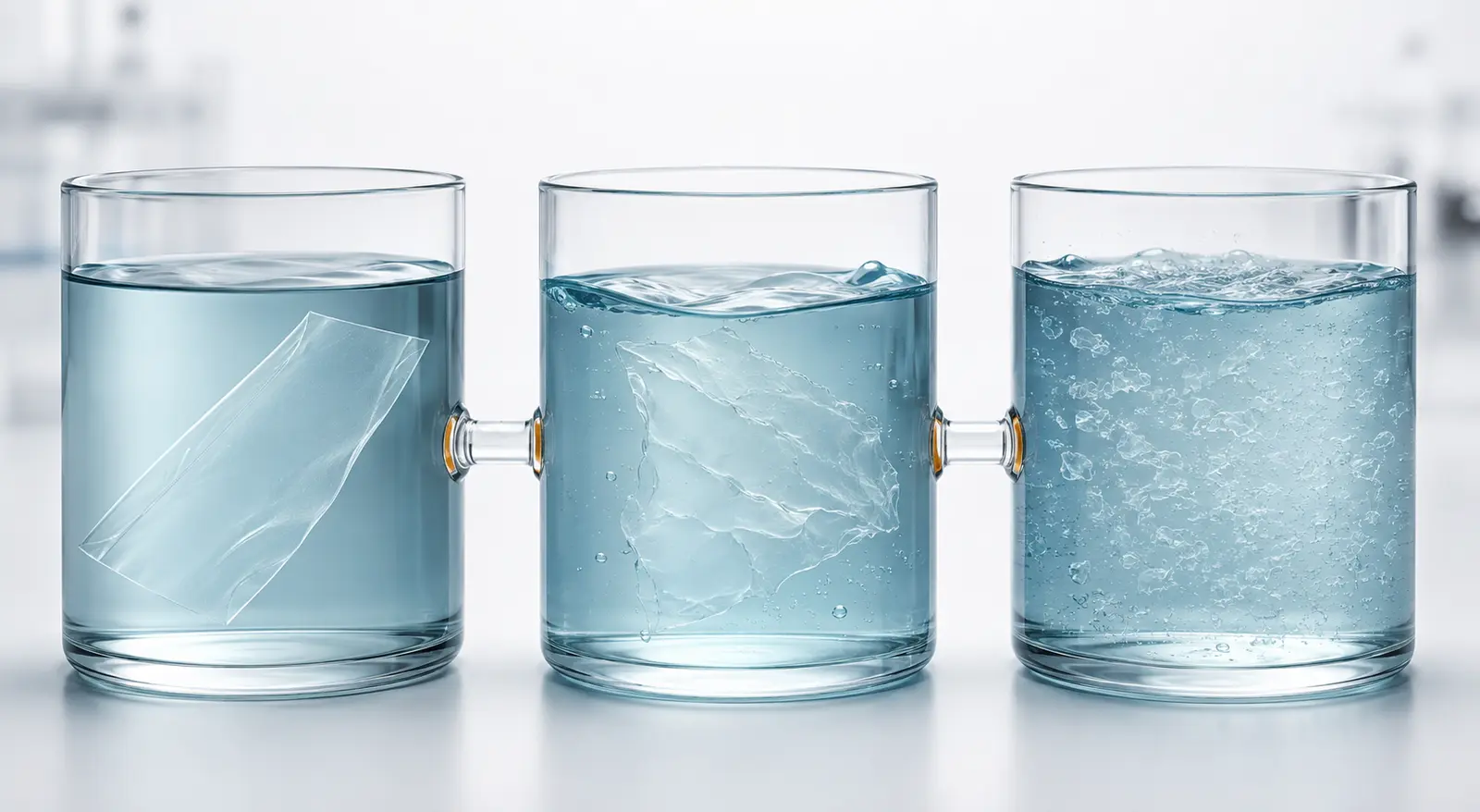
Dissolution is a mass-transfer process, not a single material constant. Water first contacts the film, penetrates and plasticizes it, and allows polymer chains to separate into the surrounding liquid. The package may rupture before the polymer is fully dispersed. For that reason, “opens,” “disintegrates,” “is no longer visible,” and “is fully dissolved” are different endpoints.
Film and Polymer Factors
The supplier’s grade design sets the starting point. Kuraray’s technical discussion of PVOH shows that solubility changes with degree of hydrolysis, degree of polymerization, concentration, temperature, time, and agitation under the specific conditions tested. That resin behavior is useful for understanding the variables, but it is not a finished-film guarantee.
| Film or polymer factor | Why it matters | What the buyer should request |
|---|---|---|
| Degree of hydrolysis | Changes intermolecular bonding and water response | Grade identification and supplier dissolution profile |
| Molecular-weight-related grade characteristics | Can affect chain mobility, solution viscosity, and film behavior | Grade data and the method used to characterize it |
| Formulation | Plasticizers, fillers, coatings, inks, or other components can change response | Finished-film composition statement at the level the supplier can disclose |
| Thickness and construction | More material or multiple functional layers can change the release sequence | Total thickness, tolerances, and layer/function description |
| Thermal history | Drying, sealing, or later heating can change structure and water response | Converting limits and data from representative processed film |
No row in this table predicts a dissolution time by itself. Compare finished films only when the test specimen, conditioning, water conditions, agitation, endpoint, and reporting units match.
End-Use Conditions
The receiving water is part of the packaging system. Temperature, volume, agitation, hardness, pH, and dissolved ingredients can all change wetting and dispersion. The packed formulation matters too: concentrated surfactants, salts, solvents, high or low pH, or water migrating from the product can alter the film during storage and use.
A useful dissolution protocol should define:
- the water temperature range, volume, and movement;
- the film area, thickness, seal geometry, and conditioning history;
- the packed product or a justified simulant;
- the required opening time and the separate full-dissolution endpoint;
- the test duration, observations, residue assessment, and acceptance rule.
Important: “Cold-water soluble” is not a complete specification. It still needs a temperature range, test setup, endpoint, and acceptance time for the finished package.
Key Properties and Trade-Offs
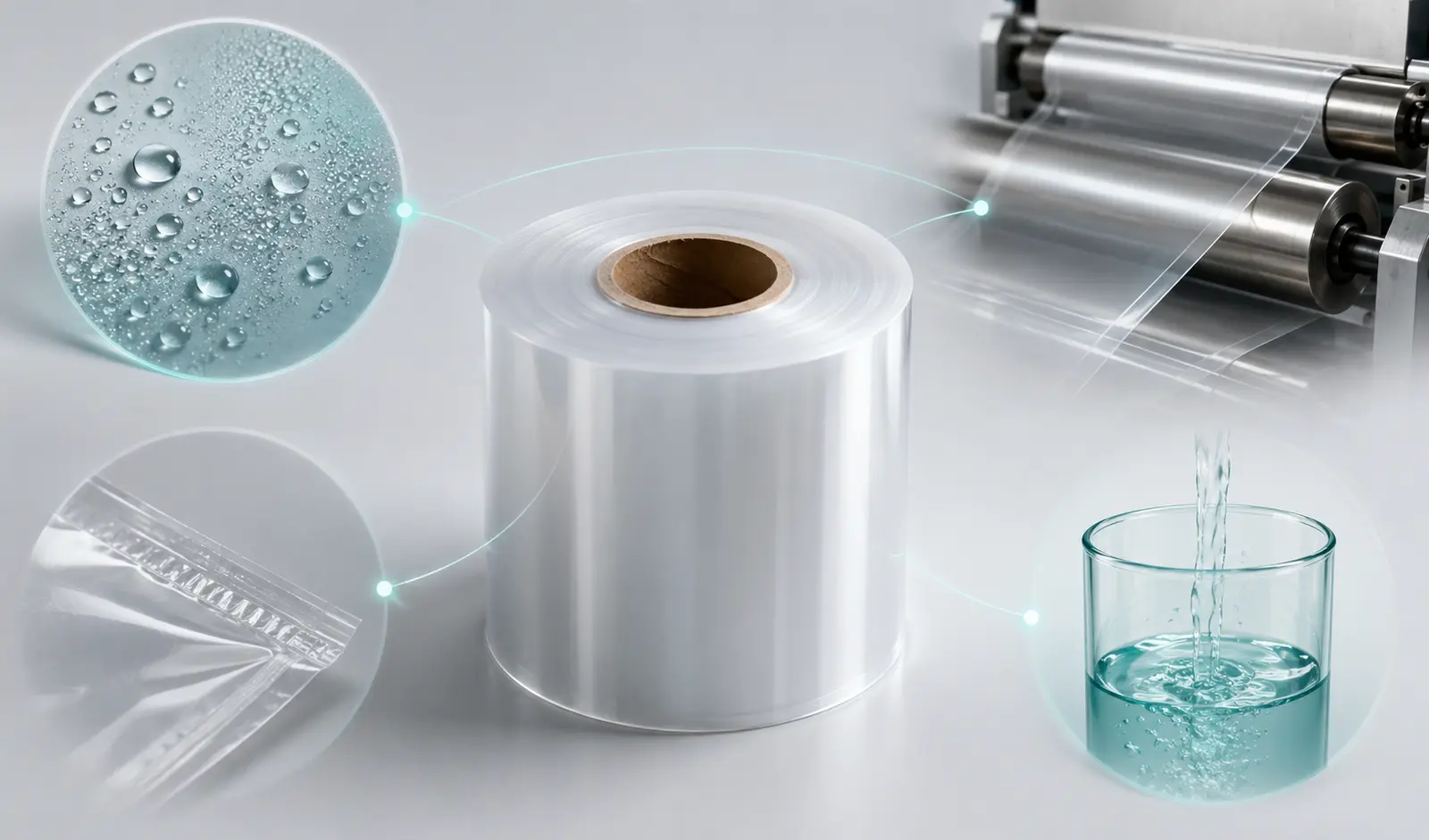
PVA film is selected because it can combine temporary containment with a controlled response to water. The same hydrophilic character that enables release also makes moisture control central to storage and conversion.
Moisture Sensitivity
Ambient humidity can change the amount of water held by the film. Depending on grade and conditioning, added moisture may soften the web, alter dimensions, increase tack, or change friction. Drier conditions may make a film stiffer or more brittle. These effects can show up as blocking, wrinkling, tracking changes, inconsistent feeding, or seal variation.
This is why a supplier’s storage and conditioning instructions belong in the quality specification. A warehouse target copied from another grade is not reliable. Record the unopened package condition, storage duration, actual temperature and relative humidity, acclimation practice, and time between opening and use.
Mechanical, Seal, and Chemical Compatibility
Film strength must be sufficient for unwinding, forming, filling, sealing, packing, transport, and consumer use—but it must be measured under relevant conditioning. Tensile strength, elongation, tear behavior, puncture resistance, and friction are method-, direction-, thickness-, and humidity-dependent. MD and TD results should not be merged into one generic “strength” claim.
Sealing is equally system-specific. The operating window depends on the finished film, seal geometry, jaw design, temperature, pressure, dwell time, contamination, and line speed. A single seal-strength number does not establish a robust window. If the pouch contains a liquid or gel, the formulation must also be screened for migration, swelling, plasticization, leakage, or premature weakening over the intended shelf life.
The practical trade-off is clear: improving early water resistance, dry handling, or heat resistance can change the release behavior. Buyers should evaluate these properties together rather than optimizing one result in isolation.
Where PVA Film Is Used
PVA film is most useful when the package should contain a measured quantity during handling and then release it into a defined water-based process. The application determines whether the priority is accurate dosing, reduced direct contact, hygienic transfer, temporary separation, or a sacrificial process aid.
Unit-Dose Packaging
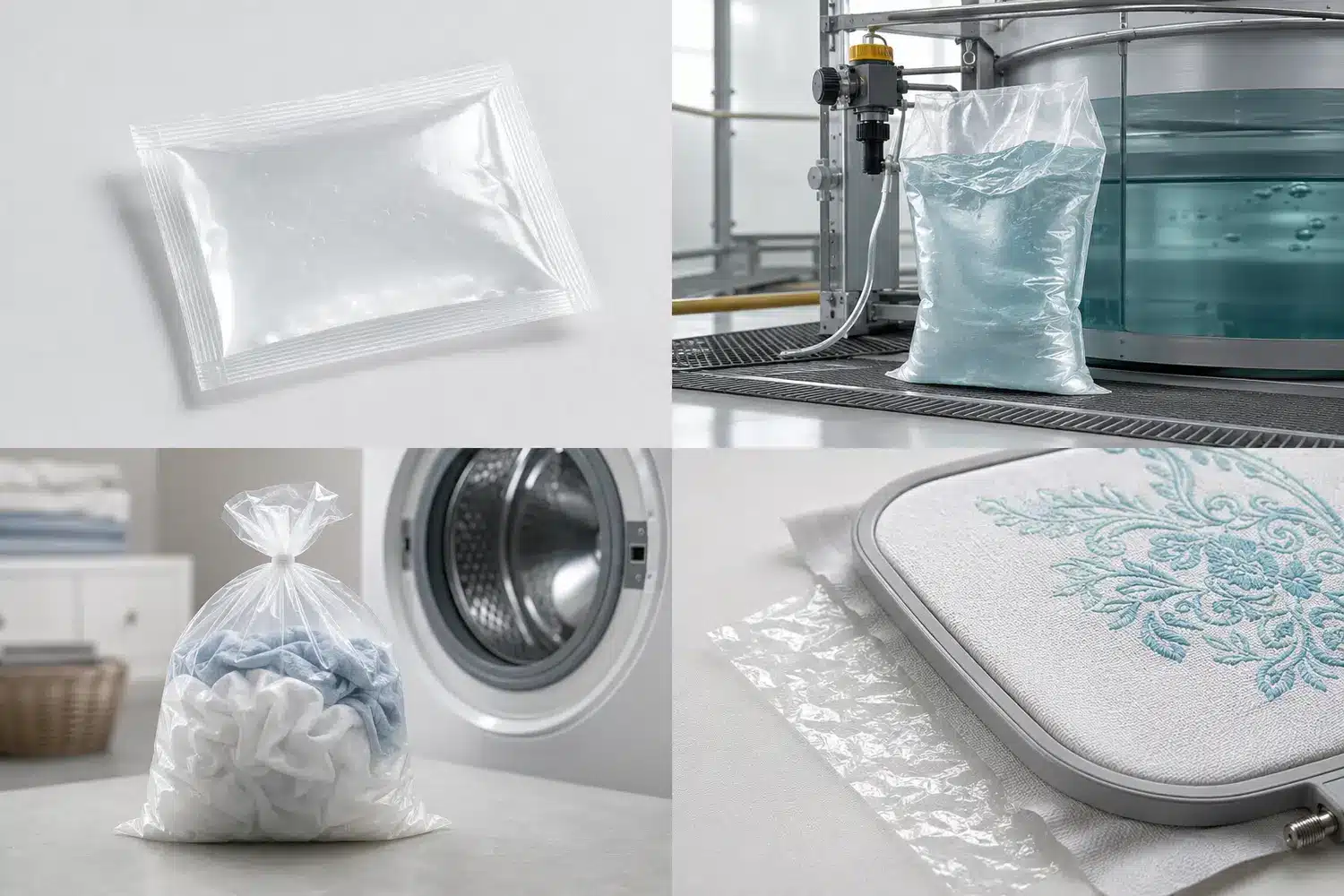
Commonly discussed applications include laundry and dishwashing doses, cleaning concentrates, and other products intended to enter a known volume of water. The format can reduce measuring steps and direct handling, but it creates a demanding compatibility problem between the film, the formulation, the seal, and the storage climate.
Consumer unit doses also require package-system safety controls outside the film specification, including clear instructions, secondary packaging, and market-specific requirements. A water-soluble film does not by itself establish safe use.
Industrial and Process Applications
PVA/PVOH films are also used or evaluated for water-treatment chemicals, agrochemical dose packs, contaminated-laundry bags, embroidery backing, mold-release or transfer films, and other processes where the film is intended to release or wash away.
| Application pattern | Primary need | Critical validation | Boundary |
|---|---|---|---|
| Detergent or cleaning dose | Controlled dose and release | Long-term formulation compatibility plus use-cycle dissolution | Consumer safety and market rules remain package-level duties |
| Industrial chemical dose | Reduced measuring or direct handling | Chemical compatibility, seal integrity, and process release | Hazard controls cannot be replaced by film selection |
| Contaminated-laundry bag | Less manual handling before washing | Wet handling, closure integrity, and actual wash-cycle behavior | Facility procedures and infection controls still apply |
| Agrochemical dose pack | Measured addition to water | Exact formulation, water conditions, handling, and regulatory review | Product registration and worker protection are separate |
| Embroidery or process support | Temporary structure that can be removed with water | Removal conditions and effect on the substrate | Residue and downstream process limits must be defined |
These are application families, not approvals. The same nominal polymer can perform differently when the film grade, thickness, formulation, seal, storage history, or end-use water changes.
How to Select PVA Film for a Packaging Project
Start with the release event, then work backward through the product, equipment, and supply chain. Selecting a grade from a generic property list before defining the use conditions reverses that logic.
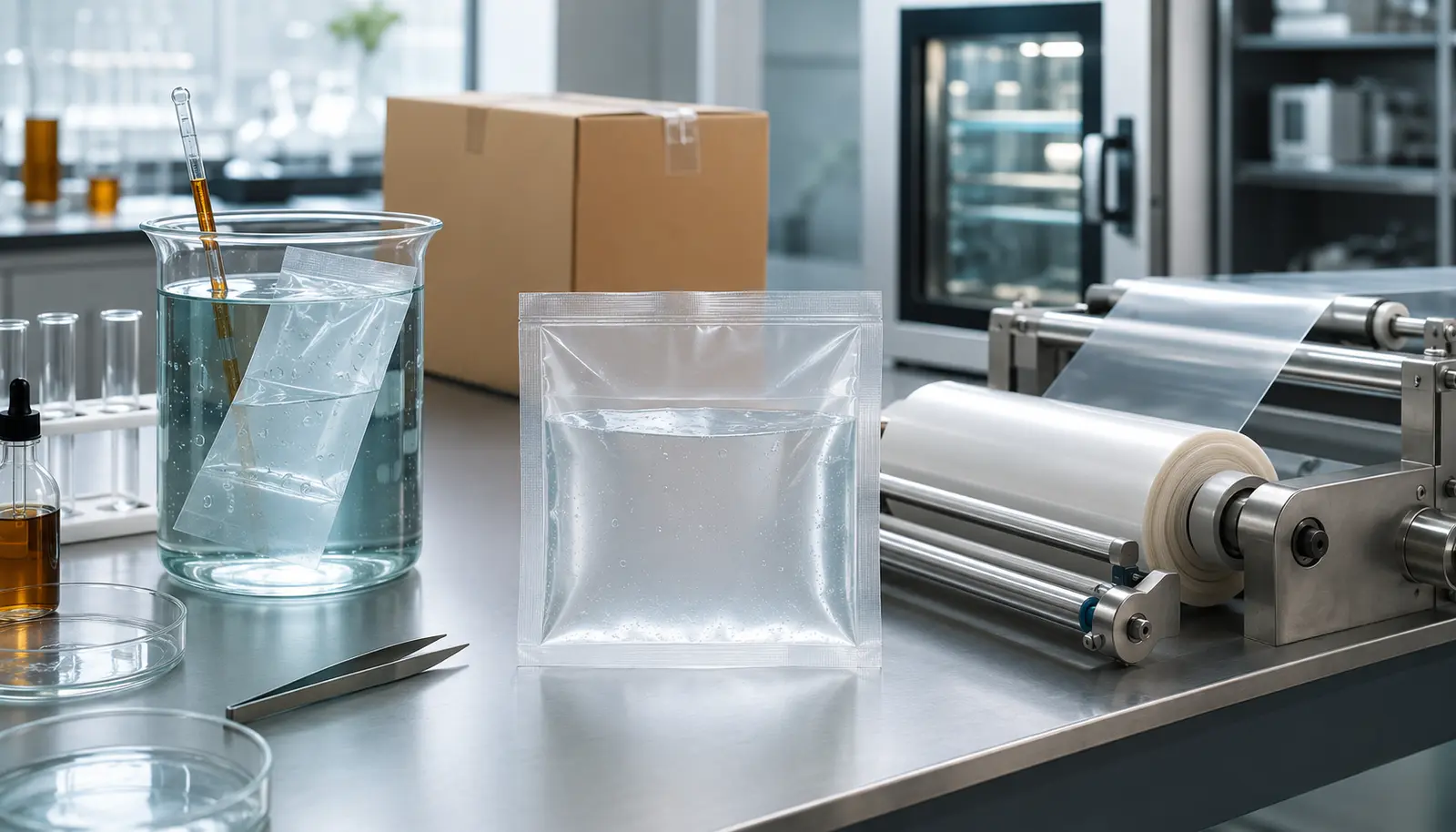
Define the Release Requirement
- Describe the packed product, dose mass or volume, and intended user or process.
- Define the water temperature range, volume, agitation, chemistry, and available time.
- Separate the required pouch-opening time from the full-dissolution or residue endpoint.
- Define conditions in which the package must not weaken, including expected humidity, splash, and accidental water contact.
- Write measurable pass/fail criteria for leakage, release, dispersion, and visible or measured residue.
This brief gives the supplier a testable target. “Fast dissolving” or “hot-water grade” does not.
Verify Product and Equipment Compatibility
- Test the actual formulation whenever practical. If a simulant is necessary, justify why it represents the relevant water activity, pH, salts, surfactants, solvents, and other active components.
- Run aged compatibility work at justified storage conditions. Look for mass change, swelling, haze, tack, brittleness, seal loss, leakage, or a shift in dissolution.
- Establish a converting window on representative equipment. Record web tension, line speed, forming conditions, sealing temperature, pressure, dwell time, and cooling.
- Measure film and package performance with agreed methods. For example, tensile, friction, seal, leakage, and dissolution results should identify specimen direction, thickness, conditioning, apparatus, units, and endpoint.
Important: A resin data sheet is not a substitute for a finished-film data sheet, and a finished-film result is not automatically proof of filled-package performance.
Validate Storage, Transport, and End Use
- Challenge the unopened roll and finished pack across the justified supply-chain climate, not an arbitrary “worst case.”
- Include transport and handling stresses that can affect seals, folds, or abrasion.
- Repeat dissolution after aging because a new pouch and a shelf-aged pouch may not behave identically.
- Test the complete use cycle with the intended water, equipment, dose, and load.
- Freeze the approved film grade, construction, thickness range, formulation, process window, test protocol, and change-control requirements.
Approval should be based on the combined evidence. A passing dissolution demonstration cannot compensate for an unstable seal or a failed shelf-life study.
Storage, Converting, and Failure Prevention
Moisture-sensitive film needs a controlled chain from supplier packaging to the converting line. The objective is not to keep every facility at one generic condition; it is to keep the film within the exact supplier limits and document deviations.
Control the Environment and Handling
- Keep rolls in the supplier’s protective packaging until the defined conditioning period begins.
- Record storage temperature, relative humidity, duration, and packaging condition.
- Acclimate sealed rolls as instructed so condensation or abrupt moisture exchange is not introduced.
- Limit open exposure and protect roll edges from water, dirt, and mechanical damage.
- Use clean, controlled unwind and forming paths; track web tension and friction changes.
- Rewrap or quarantine partial rolls according to an approved procedure.
- Preserve roll, lot, and conversion records so a change in performance can be traced.
Numeric limits must come from the approved film supplier and grade documents. They should not be copied from a competitor article or a different PVOH formulation.
Diagnose Common Failure Modes
Blocking or tack can point to excessive moisture uptake, pressure, temperature, or packaging damage. Brittle edges and breaks can point to over-dry conditioning, aging, mechanical damage, or unsuitable tension. Wrinkles and poor tracking can come from dimensional change, uneven conditioning, gauge profile, or web handling. Weak or variable seals can involve film condition, contaminated seal areas, worn tooling, or a narrow process window. Slow or incomplete release can result from the wrong grade, changed film construction, low water temperature, insufficient water or agitation, formulation interaction, aging, or an imprecise endpoint.
Do not solve these symptoms by changing several variables at once. Quarantine the affected lot, confirm its identity and history, compare retained samples, verify instruments, and change one controlled factor at a time. Record both the immediate correction and the evidence for root cause.
Sustainability, Biodegradability, and Compliance
Environmental and regulatory statements require more discipline than saying that a film “dissolves.” A physical observation in a beaker is not an environmental fate study, and a regulation that covers one use is not a global material approval.
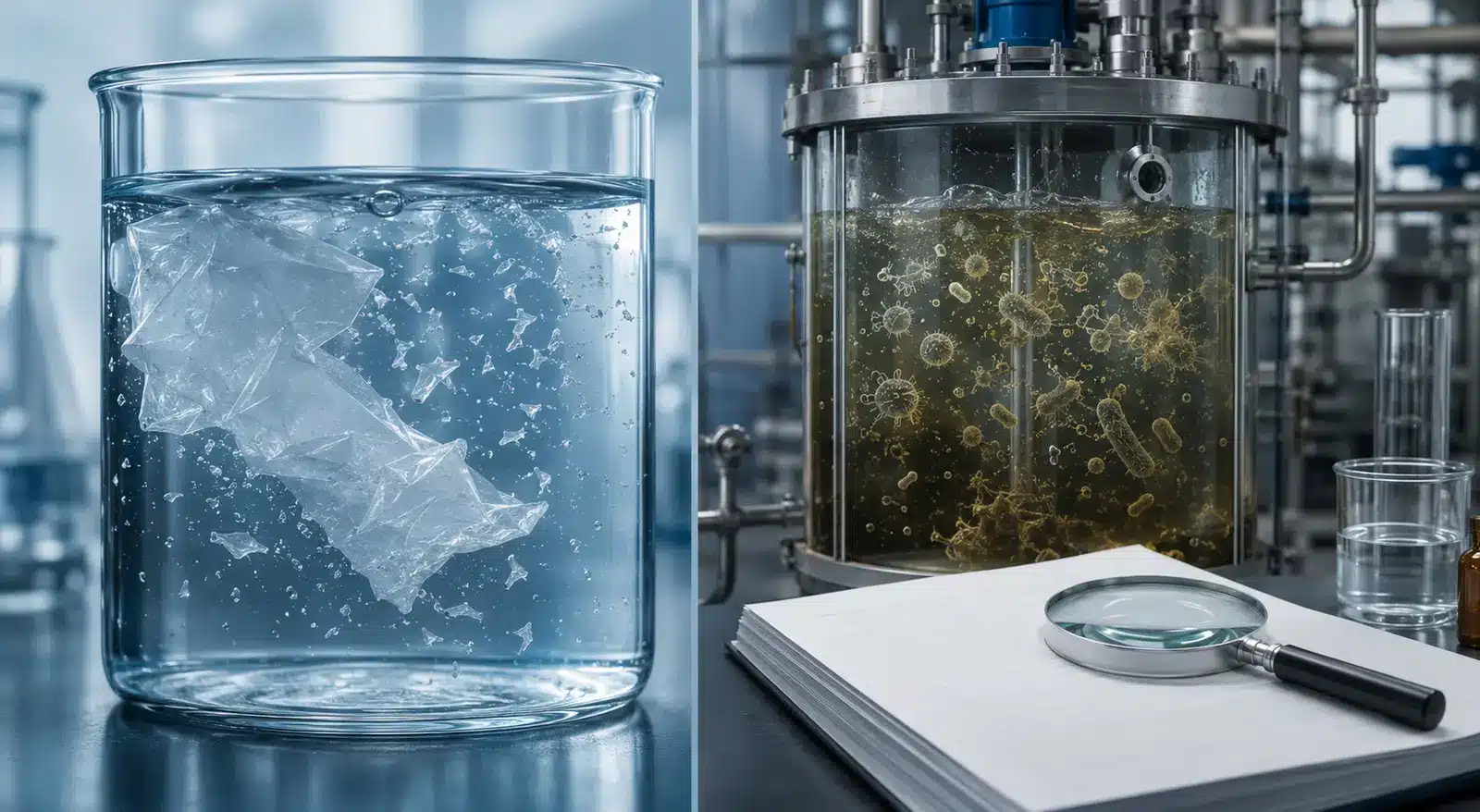
Dissolution Is Not Biodegradation
When PVOH film dissolves polymer molecules disperse into water.
The OECD’s review of biodegradability testing describes PVA as inherently degradable under cited test conditions, including the role of acclimated sludge. In 2023, the U.S. EPA denied a TSCA petition requesting specific testing and regulation of soluble PVA used in detergent pods and sheets, explaining that the petition had not established the statutory basis on the record presented. That decision is not a universal certificate of harmlessness, and the petition itself is not proof that every PVA formulation persists. Both sources reinforce the need to identify the exact material, test, endpoint, and receiving environment.
| Statement | Evidence it would need | What does not prove it |
|---|---|---|
| “Dissolves under the use conditions” | Finished-package protocol with water conditions, time, and endpoint | Polymer name or a visual demonstration under different conditions |
| “Biodegradable” | Exact formulation tested with a recognized method, result, time, and environment | Dissolution alone |
| “Leaves no residue” | Defined analytical or visual endpoint and detection limit | The film becoming invisible |
| “Plastic-free” | A defensible definition and complete material composition | Water solubility |
| “Suitable for wastewater discharge” | Local discharge requirements plus material- and process-specific fate assessment | A generic biodegradability statement |
Scope Every Regulatory and Environmental Claim
For food contact, identify the market, food type, contact time and temperature, film composition, and any applicable migration or compositional requirements. In the United States, 21 CFR 177.1670 addresses polyvinyl alcohol film only for specified food types and prescribed conditions. It does not mean every PVA film is “FDA approved,” and it does not establish suitability in another market.
The same discipline applies to.
Warning: Avoid unconditional terms such as “eco-friendly,” “100% biodegradable,” “no residue,” “non-toxic,” or “food grade.” Each compresses several testable claims into a phrase that may exceed the available evidence.
PVA Film Buyer Checklist
Before comparing quotations or samples, request:
- the full polymer name, finished-film grade, and commercial designation;
- a construction description, including whether the film is mono-layer or contains functional layers or coatings;
- nominal thickness, tolerance, width, roll length, core, winding, and roll-diameter limits;
- formulation or additive disclosure appropriate to the risk and regulatory review;
- storage, shelf-life, unopened packaging, conditioning, and open-roll handling instructions;
- dissolution data for the finished film, with water conditions, agitation, specimen details, time, and endpoint;
- mechanical, friction, optical, and seal data with method, direction, conditioning, thickness, units, and variability;
- formulation-compatibility and aged-package evidence relevant to the actual contents;
- converting guidance and a documented operating window for representative equipment;
- food-contact, chemical, environmental, or other declarations limited to the target market and use;
- lot identification, certificate-of-analysis fields, change-control rules, and nonconformance process;
- samples from a traceable lot for converting, aging, transport, and end-use validation.
Compare only like with like. If two suppliers use different test conditions or endpoints, ask for aligned testing rather than ranking the reported numbers directly.
Frequently Asked Questions
Is PVA Film the Same as Polyvinyl Acetate?
No. In water-soluble film, PVA generally means polyvinyl alcohol, preferably abbreviated PVOH. Polyvinyl acetate is a different polymer, commonly abbreviated PVAc, and is the precursor from which PVOH is generally produced. Spell out the name in specifications.
Does PVA Film Dissolve in Cold Water?
It depends on the finished grade and the definition of “cold.” Degree of hydrolysis, molecular-weight-related characteristics, formulation, thickness, thermal history, water temperature, volume, agitation, contents, and endpoint all matter. Require a finished-package result in the project’s actual temperature range.
Is PVA Film Biodegradable?
It can biodegrade under specified test conditions, but the claim needs the exact formulation, method, result, time, and environment. Dissolution is not proof of biodegradation. Avoid converting a result from one PVOH grade, laboratory method, or wastewater scenario into a universal statement.
Can PVA Film Be Used for Food Packaging?
Potentially, but only when the exact film and intended conditions meet the target market’s requirements. U.S. 21 CFR 177.1670 is limited to prescribed PVA film composition and specified food-contact categories and conditions. It is not a blanket approval for every film, food, temperature, or country.
What to Verify Before Approval
PVA/PVOH film should be treated as an engineered release component, not a commodity identified by one polymer name. Approval requires a chain of matching evidence:
- a project brief that defines contents, storage, conversion, water conditions, release timing, residue endpoint, and market;
- a supplier specification that fixes the finished grade, construction, dimensions, handling limits, and change control;
- representative samples and package prototypes made on relevant equipment;
- conditioned, aged, transport, seal, compatibility, and end-use results produced under agreed methods;
- regulatory and environmental documents that name the exact material, scope, market, and limitations.
If any link is missing, narrow the claim or keep the film at evaluation status. The safest decision is the one supported by the exact finished film, filled package, use conditions, and current evidence.
Related Bestypack Resources
- PVA Water-Soluble Film: How Is It Produced?
- PVA Water Soluble Film Manufacturer&Supplier
- PVA Water Soluble Seed Tape
- PVA Film Guide: Environmental Impact and Characteristics
 English
 Japanese
 French
 Spanish
 Korean
 Italian
 Portuguese
 Dutch
Dutch Arabic
 Russian
 German