
Silage stretch film is a polyethylene-based wrapping film used to help limit air and rain entry into compacted forage bales while they ferment and remain in storage. Its performance depends on more than the roll itself: bale density and shape, wrapper condition, pre-stretch, overlap, applied layers, handling, sunlight, and storage time all matter. Buyers should therefore specify the film and the wrapping system together, then verify dimensions, mechanical and oxygen-transmission data, weathering scope, and machine compatibility before approving a supply.
What Is Silage Stretch Film and How Does It Work?
For polymer background, consult the NIH PubChem polyethylene overview before comparing finished-film claims.
For polymer background, consult the NIH PubChem polyethylene overview before comparing finished-film claims.
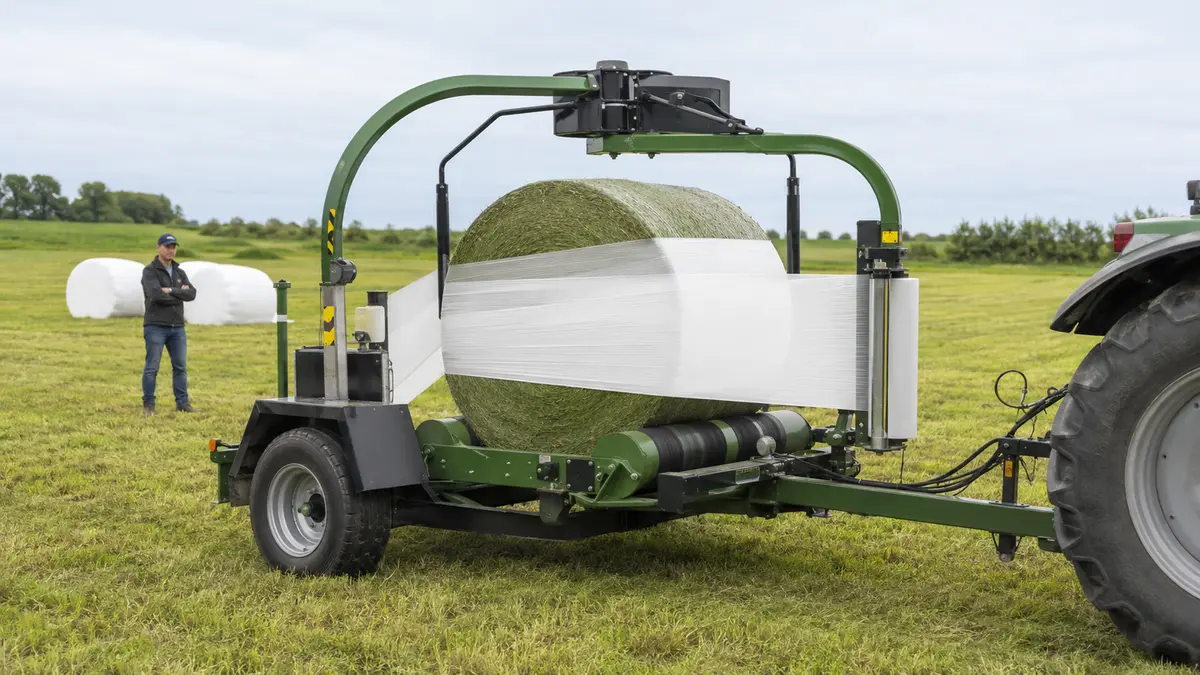
Silage stretch film is designed to be stretched by a bale wrapper and applied in overlapping layers around forage bales. The stretched film conforms to the bale, while adhesion between successive layers helps the wrap behave as a continuous protective envelope. This envelope is one part of the preservation system; the forage, bale, wrapper, handling method, and storage site are the other parts.
The Role of Oxygen Exclusion
After forage is baled, desirable fermentation depends on limiting continued oxygen entry. Oxygen supports aerobic activity that consumes dry matter and can contribute to heating and spoilage. The University of Minnesota Extension therefore treats oxygen control and plastic maintenance as central storage controls.
Stretching, overlap, layer adhesion, and intact coverage work together to slow air exchange. The correct technical wording is important: a roll of film is not automatically an airtight bale. Seal performance is created only after the correct film has been applied to a suitable bale with the intended equipment and coverage.
What the Film Cannot Fix
Even a well-specified film cannot compensate for a loose or misshapen bale, unsuitable forage condition, excessive delay before wrapping, damaged dispensing equipment, inadequate coverage, repeated rough handling, or ignored holes during storage. Purdue University Extension identifies dense, similarly shaped bales, prompt wrapping, sufficient plastic, a drained storage site, and frequent inspection as connected controls.
This system boundary should also shape purchasing claims. A supplier can provide evidence about a film sample or roll, but that evidence does not by itself guarantee fermentation, feed value, mould prevention, or a storage period in the buyer’s field conditions.
How Silage Stretch Film Is Constructed
The current European product standard, EN 14932:2025, applies to white, black, or coloured thermoplastic stretch films based on polyethylene materials for wrapping forage bales. Polyethylene is a material family, not a complete specification. Resin selection, coextruded construction, pigments, stabilizers, and adhesion systems can all vary by grade.
Polyethylene and Multilayer Design
Coextrusion allows a manufacturer to distribute functions across a multilayer film, but the number of layers alone does not prove performance. A higher layer count may give a converter more design flexibility; it does not automatically establish better puncture resistance, oxygen transmission, cling, or outdoor durability. Those outcomes still require data for the exact construction and test conditions.
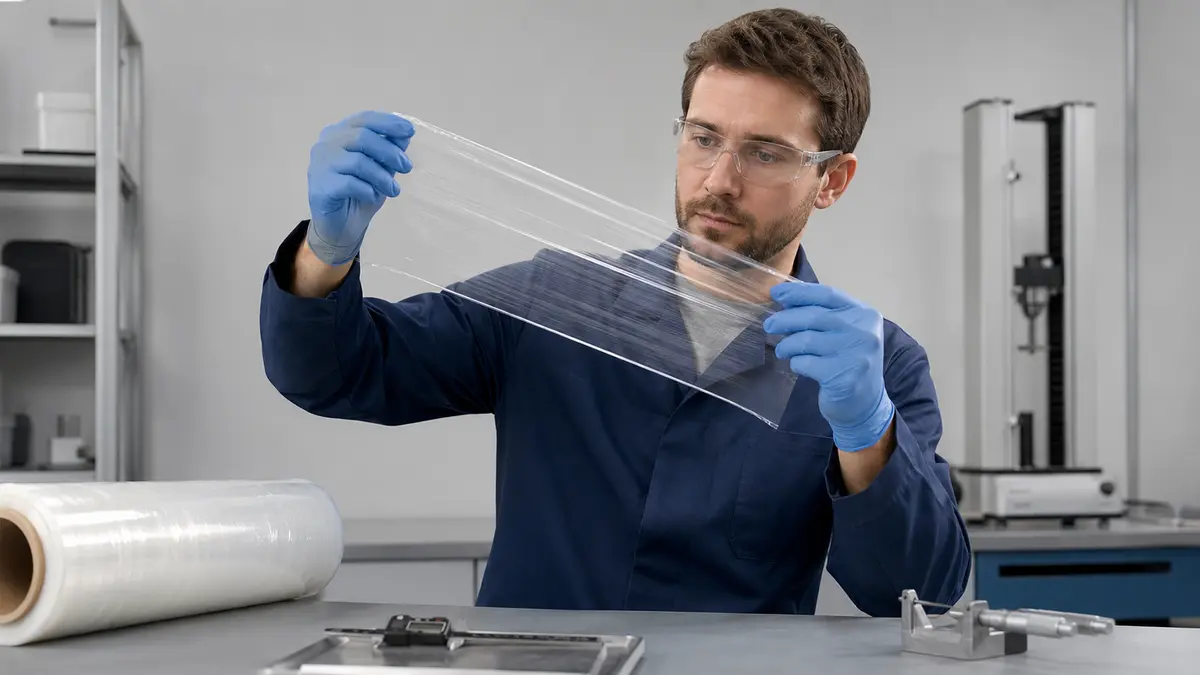
When comparing constructions, ask for:
- The material family and whether the quoted grade is a coextruded film.
- The total nominal thickness, tolerance, and measurement method.
- The intended wrapping direction and any designated cling side.
- The function claimed for the construction, followed by the test that supports that claim.
- Confirmation that the supplied roll, width, colour, and production lot fall within the document scope.
Cling, Stretch, and Holding Force
These terms describe related but different behaviours.
- Cling or adhesion describes how overlapping film surfaces stay in contact. It can be affected by film orientation, contamination, temperature, storage history, and pre-stretch.
- Stretch response describes how the film elongates in the dispensing unit without unacceptable tearing, neck-in, or uneven thinning.
- Holding or tightening force describes the force the stretched film maintains around the bale. Too little can leave a loose envelope; too much may load weak bale edges or magnify damage.
A single elongation percentage cannot represent all three behaviours. Buyers should request the relevant method, specimen orientation, film thickness, conditioning, and result definition before comparing supplier data.
Strength, UV Durability, and Optical Behaviour
Tensile, tear, impact, and puncture performance answer different questions. A film that resists one failure mode is not automatically superior in another. Direction also matters: machine-direction and transverse-direction results should be identified and should not be exchanged.
Outdoor durability likewise needs a stated exposure basis. A UV or weathering claim should identify the test method, exposure conditions, colour, intended geography or radiation class, and the storage or service term it is meant to support. Contact with certain agricultural chemicals, heat, or poor roll storage can fall outside that scope.
Colour affects appearance and solar reflectance, but it is not a stand-alone quality grade. The 2025 standard includes solar-reflectance measurement within its optical scope. Buyers should compare measured classifications or conditions rather than assuming white, green, or black film will always perform a certain way.
Which Specifications Matter When Buying?
A useful specification connects the roll to the wrapper, the bale, the storage plan, and the evidence package. It should distinguish nominal dimensions from tolerances and laboratory properties from field acceptance.
Dimensions and Roll Compatibility
| Specification field | What to record | Why it matters |
|---|---|---|
| Film width | Nominal width, tolerance, and measurement method | Must match the wrapper and planned overlap pattern |
| Roll length | Declared length, tolerance, and verification basis | Affects roll changes and cost comparison |
| Total thickness | Nominal thickness, tolerance, sampling plan, and method | Influences material use and interpretation of mechanical or transmission data |
| Core | Internal diameter, length, material, and permitted protrusion | Must fit the dispenser and remain stable in field conditions |
| Roll diameter and mass | Maximum values and permitted variation | Affect machine clearance, handling, and braking |
| Winding and surface orientation | Winding direction and designated cling side, if any | Helps prevent incorrect loading and poor layer adhesion |
The 2025 edition of EN 14932 covers film widths from 250 mm to 1,500 mm, but that is a standard scope—not proof that every size fits a particular wrapper.
Performance Claims and Test Conditions
| Claim area | Evidence to request | Conditions that must travel with the result |
|---|---|---|
| Tensile behaviour | Test report using the stated tensile method | Thickness, specimen direction, conditioning, speed, and units |
| Tear resistance | Report for the specified tear method | MD/TD direction, specimen preparation, and units |
| Impact or puncture resistance | Exact method and result | Striker geometry, drop or test mode, temperature, thickness, and units |
| Oxygen transmission | Report for the quoted film | Temperature, relative humidity, test gas, film thickness, test face, and units |
| Cling or adhesion | Method, sample preparation, and acceptance range | Stretched or unstretched state, contact time, temperature, and film faces |
| UV or weathering durability | Exposure method and claimed scope | Radiation source or climate basis, duration, colour, and pass criteria |
Important Do not compare two headline values until the methods directions thicknesses units and test conditions are aligned A supplier's typical value is not automatically a contractual minimum and.
Colour and Storage Context
Colour selection should begin with the storage environment and any measured solar-reflectance or weathering evidence. It may also involve visibility, farm identification, heat management, pigment stability, or local recycling-scheme preferences. Because pigment and stabilizer packages differ, colour should remain part of the exact grade definition.
Ask whether the same UV or durability claim applies to every colour, and whether rolls need protection from heat, sunlight, moisture, dust, or chemicals before installation. A strong field film can still be compromised by poor storage before it reaches the wrapper.
How to Match Film to the Bale and Wrapper
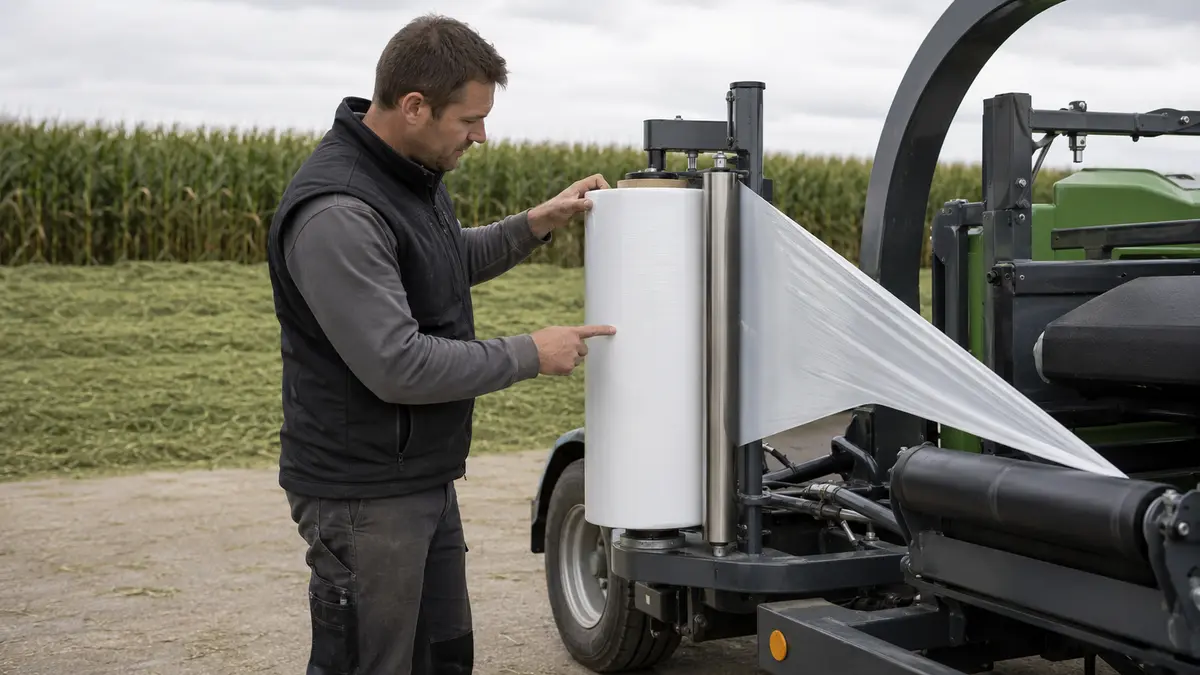
The correct roll is the one that the wrapper can control consistently on the intended bale. Compatibility should be checked with the machine manual, the film supplier’s instructions, and a measured trial—not inferred from width alone.
Round vs Square Bales
Round and square bales present different edge geometry, rotation, load distribution, and overlap challenges. The performance basis cited by EN 14932:2025 uses at least six film layers and distinguishes pre-stretch ranges: 60% to 70% for round bales and 55% to 65% for square bales. These figures describe the standard’s basis and do not override a wrapper or film instruction.
Square-bale corners can concentrate stress and make coverage consistency more demanding. Round bales can suffer from poor overlap when the dispenser is misaligned with the bale centre or when the bale profile is uneven. In either case, the correct response is to verify geometry and coverage rather than simply increasing the brake setting.
Crop, Bale Shape, and Handling Risk
Coarse stems, irregular surfaces, low-density edges, and damaged net or twine can raise puncture risk. Dense, uniform bales generally give the film a more predictable surface. Handling after wrapping introduces another risk: spikes, sharp clamps, rough ground, branches, birds, rodents, and repeated movement can all damage a previously sound envelope.
| Use condition | Main risk | What to verify | Limitation |
|---|---|---|---|
| Dense, uniform round bale | Underlap from alignment or speed variation | Bale centre alignment, overlap, stretch, and full coverage | Uniform shape does not remove storage-damage risk |
| Square bale with pronounced corners | Local stress and bridging at edges | Corner coverage, film strength evidence, pre-stretch, and handling method | More film cannot correct a badly formed bale |
| Coarse or stemmy forage | Puncture during or after application | Bale surface, binding, puncture evidence, and layer plan | Laboratory data may not reproduce the exact crop |
| Long outdoor storage | Weathering, animal damage, and unnoticed holes | UV scope, storage duration, inspection frequency, and repair materials | A UV claim does not cover mechanical damage |
| High-output contracting | Inconsistent setup and roll changes | Roll consistency, traceability, dispenser maintenance, and operator checks | Throughput should not replace coverage verification |
Wrapper Setup and Pre-Stretch Guidance
Pre-stretch is created by the dispensing unit and should be measured under operating conditions. Too little stretch may leave a loose wrap and reduce roll yield. Too much can narrow or thin the film, reduce puncture reserve, worsen overlap, or trigger breaks. Dirty rollers, worn gears, incorrect brake settings, misalignment, temperature, and roll storage can all change the actual result.
Before production, record the wrapper model, dispenser type, roller condition, target and measured pre-stretch, film width before and after stretching, overlap, bale dimensions, and operator. If the film supplier and machine maker give different ranges, resolve that conflict in a controlled trial before approving routine use.
How Much Film Should Be Applied?
The amount of film on a bale is determined by more than the nominal number of layers. Overlap pattern, neck-in, missed areas, bale geometry, film thickness, pre-stretch, damage risk, intended storage, and wrapper design all affect the applied barrier.
Overlap and Layer Count Work Together
At a nominal 50% overlap, each new pass covers half of the preceding strip, allowing coverage to build in a predictable pattern when alignment is correct. The University of Kentucky Forage Extension Program describes a four-layer 2+2 approach with 50% overlap for an individual wrapper, while also warning that inadequate plastic permits oxygen penetration. That guidance is an extension baseline, not a universal film specification.
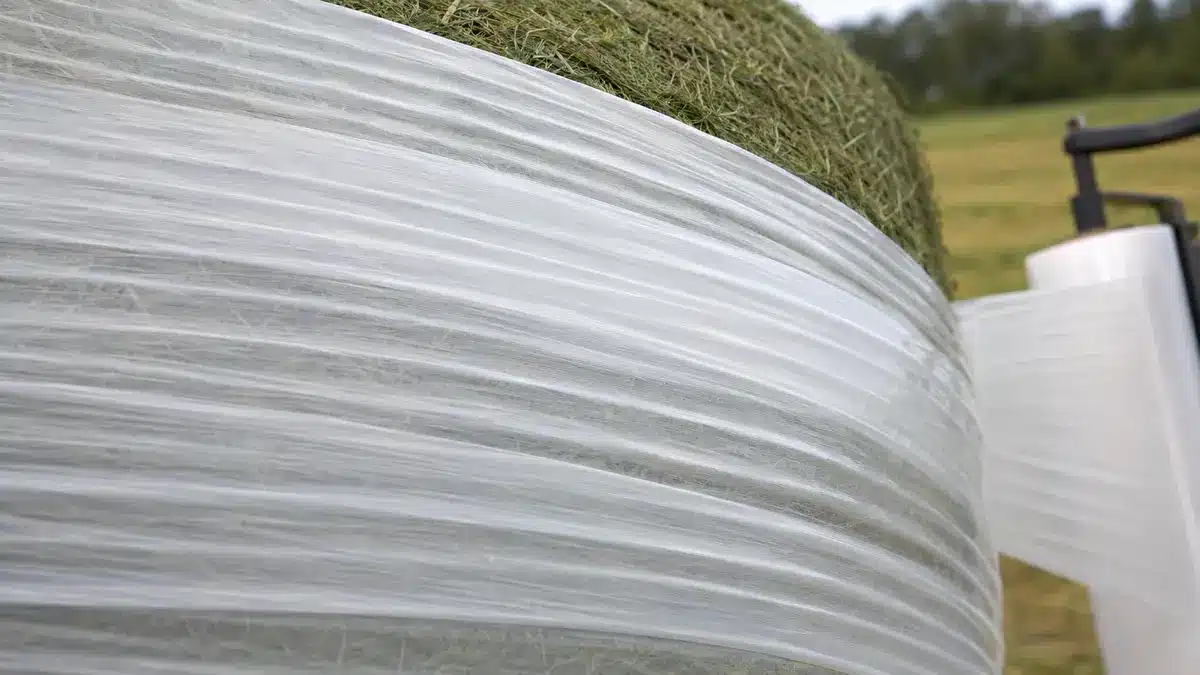
EN 14932:2025 uses at least six layers as the basis for conforming film performance. The difference illustrates why a buyer must state the governing standard, wrapper, bale format, storage plan, and local advisory practice rather than copying a number from an unrelated source.
Why Generic Numbers Need Context
Teagasc discusses at least four layers under its management guidance and advises six layers for prolonged storage of nine months or more. Purdue Extension recommends six to eight layers of sunlight-resistant, 1 mil plastic in its baleage guidance. These are not interchangeable rules; they reflect different advisory contexts.
Important: Treat layer count as one controlled input. If overlap is lost, film necks in excessively, the bale has sharp edges, or handling creates holes, an additional nominal layer count may still fail to produce continuous coverage.
For an RFQ or work instruction, name the source of the layer rule, the required overlap, film grade and thickness, bale format, target pre-stretch, storage duration, climate or UV basis, and inspection plan. Then verify the actual wrapped bale.
How to Wrap, Store, Inspect, and Repair Bales
Good practice is chronological: prepare the bale and equipment, control the application, move the wrapped bale carefully, and maintain the envelope throughout storage. The sequence below is general guidance and should be reconciled with the film instructions, wrapper manual, forage advice, and local safety rules.
Before Wrapping
- Produce a dense, even bale with a stable shape and no exposed sharp binding.
- Move the bale to the intended wrapping or storage area with the least practical delay.
- Inspect the film roll, core, edges, winding, label, lot, and storage condition.
- Clean and inspect the dispenser rollers, gears, brake, cutter, and alignment.
- Confirm the film orientation, target overlap, applied layers, and pre-stretch method.
Prompt wrapping helps limit continued air exposure. Purdue advises wrapping as soon as possible, ideally within four hours; local forage guidance may specify a shorter window. Record the actual delay rather than assuming it was acceptable.
During Wrapping and Handling
- Centre the dispenser relative to the bale and observe the first full rotation.
- Check that stretching is uniform and that the film does not show abnormal whitening, splitting, edge damage, or excessive neck-in.
- Verify overlap at several locations instead of judging only one visible strip.
- Count applied rotations or layers using the wrapper’s validated method.
- Cut and secure the film without leaving a loose tail that can open during handling.
- Use a suitable bale handler and minimize movement after wrapping.
If a roll repeatedly breaks, stop and check the roll edge, film temperature, dispenser cleanliness, roller speed differential, brake, bale surface, and alignment. Replacing the roll without recording these conditions can hide the real cause.
During Storage
- Use a level, well-drained, clean area away from sharp debris and obvious animal hazards.
- Follow local requirements for distance from water, stack height, and potential silage effluent.
- Inspect bales on a planned schedule and after storms, transport, or animal activity.
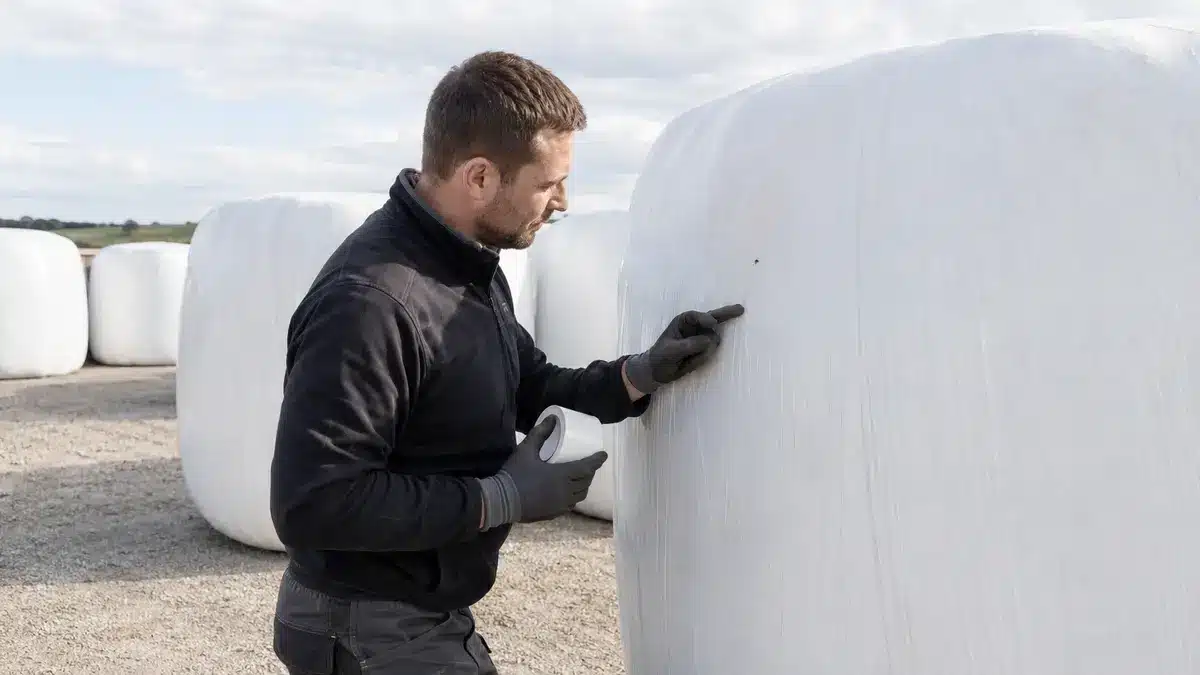
- Mark and repair small holes promptly with UV-resistant tape intended for silage film; do not rely on ordinary duct tape.
- Isolate and assess bales with extensive damage, heating, leakage, or visible spoilage under appropriate farm and feed-safety guidance.
- Keep records that link damage to the bale, film lot, wrapping date, operator, machine, and repair.
Common Silage Film Failures and What They Usually Indicate
A visible defect is a symptom, not a complete root-cause report. Review the failed location, unused roll, wrapper settings, bale condition, handling history, weather exposure, and storage records before concluding that the film itself is responsible.
Tears or Punctures
Possible causes include rough forage, a sharp bale edge, damaged roll edges, excessive local tension, dirty or seized rollers, handling contact, wildlife, or storage debris. Note whether the damage repeats at the same machine position, follows bale geometry, or appears only after storage.
Check the roll and bale for a repeating pattern, retain an unused sample, photograph the damage with scale, and record the film lot and machine settings. Laboratory tear or impact values may help, but only when the method and specimen direction match the claim being investigated.
Poor Layer Adhesion or Loose Wrap
Poor adhesion can result from incorrect film orientation, contamination, dust, water, cold conditions, aged or badly stored film, insufficient pre-stretch, or a cling value outside the required range. A loose bale envelope may also reflect poor bale density or changing bale shape.
Verify which film surfaces are meant to contact, inspect roll storage, measure actual pre-stretch, and examine overlap. Do not increase tension blindly: if the real issue is contamination or a damaged dispenser, more tension can cause a second failure.
Uneven Coverage or Neck-In
Uneven bands, uncovered areas, or excessive width reduction often point to dispenser misalignment, incorrect speed differential, worn rollers, unstable bale rotation, or film that is not compatible with the set-up. Measure the stretched film width at several points and check overlap around the entire bale.
The research on stretch-film consumption and overlap shows that bale, film, and wrapper geometry interact, and that mathematically efficient overlaps may be sensitive to real operating variation. A robust setting needs margin for the actual machine and bale, not just a theoretical minimum.
Early Weathering
Cracking, embrittlement, loss of strength, or surface change earlier than expected may involve radiation exposure, colour-specific formulation, heat, chemical contact, pre-use storage, excessive stretching, or a claim whose geographic and time scope did not match the site.
Ask for the exact weathering method, exposure class or location basis, colour, pass criteria, and declared service conditions. Also check for fertilizers, pesticides, oils, or other chemicals near the rolls or bales. Appearance alone cannot identify the responsible mechanism.
What to Ask a Supplier Before You Buy
A strong RFQ makes suppliers answer the same questions in the same units. It also separates published typical values from contractual requirements and identifies which evidence still needs a sample or field trial.
Documents and Test Evidence
Request a current technical data sheet for the exact grade and colour, dimensional tolerances, core and roll data, storage instructions, application guidance, safety information where applicable, and traceability format. If EN 14932:2025 is specified, ask the supplier to state exactly which characteristics and tests are covered and to provide evidence for the quoted product.
For every performance report, record the document owner, report number and date, tested construction, thickness, colour, batch or sample description, method edition, conditioning, MD/TD direction, units, and acceptance criteria. A standard reference on a brochure is not the same as a conformity statement or a report.
RFQ Checklist
| RFQ item | Buyer input | Supplier response required |
|---|---|---|
| Bale and wrapper | Round or square bale dimensions; wrapper and dispenser model | Compatible roll sizes, orientation, and approved setting range |
| Forage and handling | Crop, bale density target, surface risk, handling method | Relevant application limits and puncture or handling evidence |
| Storage | Location, expected duration, exposure, stacking plan | UV or weathering scope, colour applicability, and storage instructions |
| Roll specification | Width, length, thickness, core, mass, diameter | Nominal values, tolerances, methods, and lot traceability |
| Application | Target pre-stretch, overlap, layers, throughput | Supplier instructions and any required operating window |
| Performance | Required mechanical, adhesion, OTR, and optical properties | Methods, conditions, units, typical or minimum status, and reports |
Sample and Field Validation
Run the candidate film on the actual wrapper and representative bales before a large order. Define the trial in advance: film lot, bale dimensions and condition, weather, operator, machine settings, measured pre-stretch and film width, overlap, layers, break rate, roll changes, visible damage, storage location, and inspection dates.
Agree on acceptance criteria that can be measured. Examples include roll fit, stable feeding, absence of unacceptable breaks, verified coverage, traceable dimensions, and an inspection outcome after the relevant period. A successful short trial supports compatibility under those recorded conditions; it does not prove every season, crop, operator, or storage site.
How to Handle Used Silage Film Responsibly
Plan film recovery before wrapping begins. Used film may be technically capable of recycling, but local collection, contamination limits, colour rules, transport duties, and end-market demand determine whether it will actually be accepted.
- Keep film separate from net wrap, twine, soil, forage, water, chemicals, and other waste as required by the collector.
- Shake or scrape off contamination only by an approved, safe method; do not wash film where runoff would create pollution.
- Store recovered film securely so it does not blow away or collect additional dirt and water.
- Confirm the collector’s accepted polymer types, colours, preparation method, minimum quantity, fees, and documentation.
- Use an authorized waste route and keep any transfer records required in the local jurisdiction.
- Do not burn, bury, or dump agricultural film.
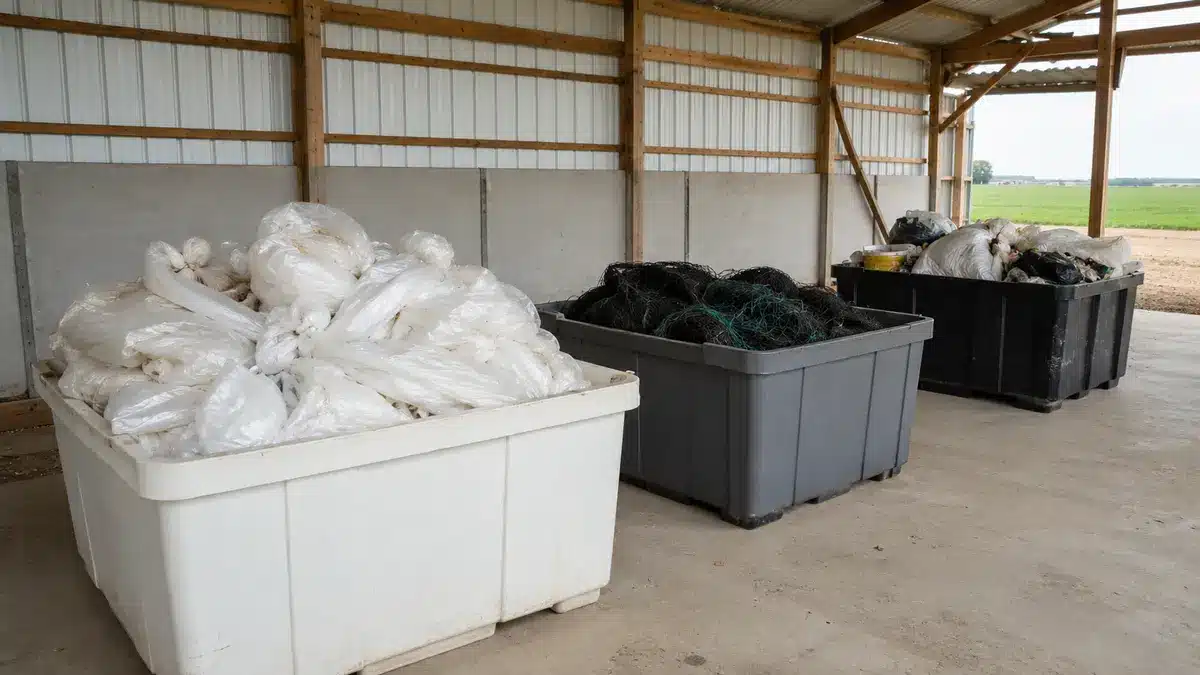
For example, UK government guidance requires checks on waste carriers or sites and transfer documentation in its jurisdiction. Other countries and regions have different rules. A polyethylene material declaration or design-for-recycling statement is not evidence of local collection.
Key Takeaways
Silage stretch film should be specified as part of a complete baleage system. The decisive questions are not simply “how many layers?” or “how many film layers were coextruded?” but whether the exact roll fits the wrapper, produces controlled stretch and overlap, survives the bale and handling risks, and has evidence matched to the intended storage conditions.
- Define the bale, wrapper, forage, handling, climate, storage duration, and local advisory basis first.
- Specify dimensions, tolerances, core, orientation, traceability, and test conditions in writing.
- Treat cling, stretch, holding force, tear, impact, oxygen transmission, weathering, and optical behaviour as separate evidence areas.
- Verify actual pre-stretch, overlap, coverage, roll feeding, and bale condition in a recorded trial.
- Inspect and repair wrapped bales throughout storage.
- Confirm the local end-of-life route instead of making an unconditional recyclability claim.
Product-specific conclusions still require the quoted grade’s TDS, reports, application instructions, representative samples, and acceptance criteria. Without that evidence, the safe conclusion is a specification and validation plan—not a performance guarantee.
Related Bestypack Resources
- How Many Pallets Can One Roll of Stretch Film Cover?
- Select the Appropriate Stretch Film Width and Thickness
- How to Reduce Stretch Film Thickness to Cut Costs?
- Stretch Film Thickness: What You Need to Know
- Machine Stretch Film Blown & Cast
- Stretch Film vs. Cling Film: What’s the Difference?
- Black Stretch Wrap Film
Related Bestypack Resources
- How Many Pallets Can One Roll of Stretch Film Cover?
- Select the Appropriate Stretch Film Width and Thickness
- How to Reduce Stretch Film Thickness to Cut Costs?
- Stretch Film Thickness: What You Need to Know
- Machine Stretch Film Blown & Cast
- Stretch Film vs. Cling Film: What’s the Difference?
- Black Stretch Wrap Film
 English
 Japanese
 French
 Spanish
 Korean
 Italian
 Portuguese
 Dutch
Dutch Arabic
 Russian
 German