
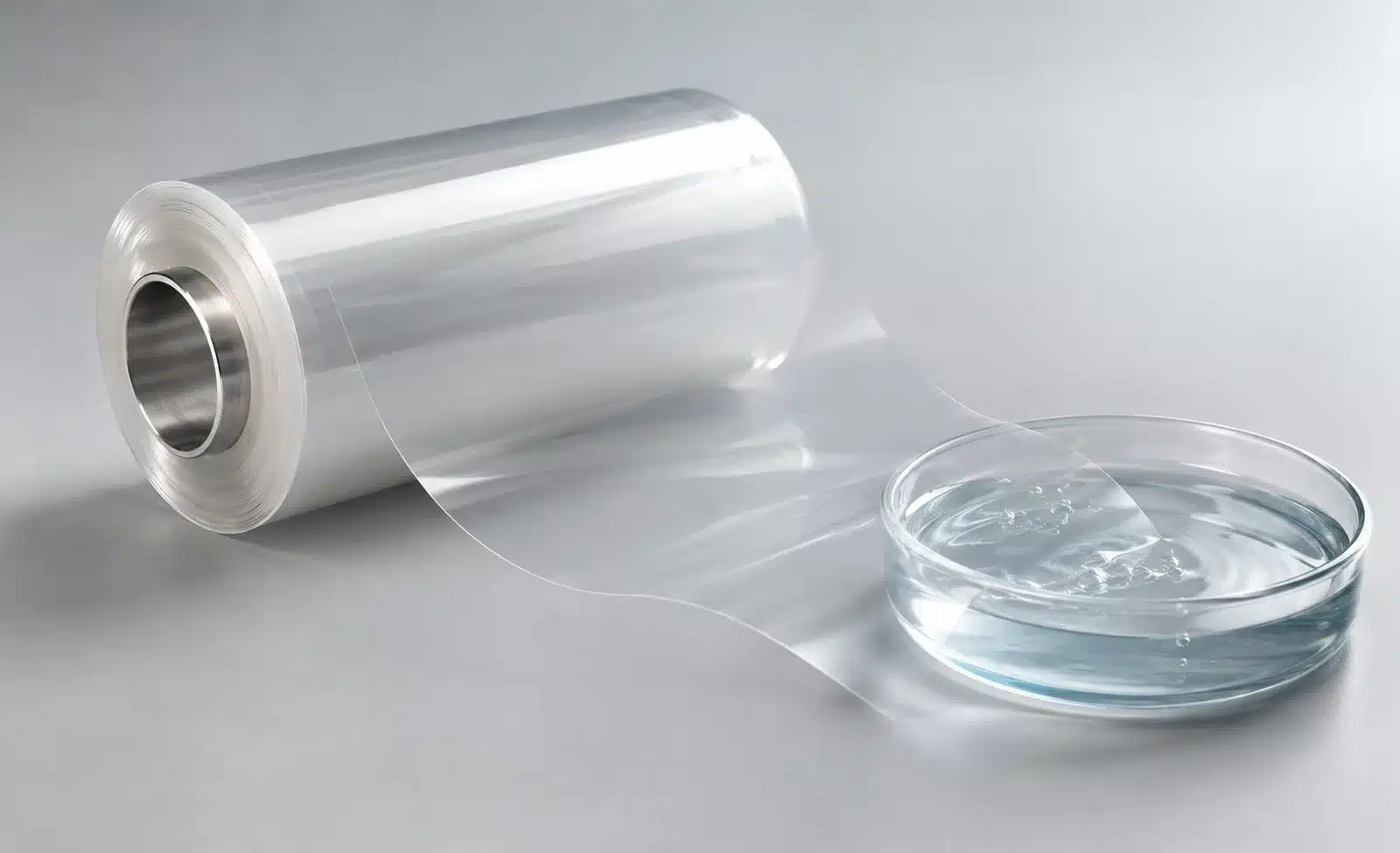
PVA water–soluble film is usually made by converting a carefully selected polyvinyl alcohol resin into a uniform film through solution casting. The resin is dissolved and formulated in water, cleaned of particles and bubbles, cast onto a moving surface, dried, conditioned, slit, and wound. Thermoplastic melt extrusion is another route, but it requires a PVOH grade and formulation designed for a narrow processing window. In either case, finished-film approval depends on controlled test conditions—not on the material name alone.
PVA or PVOH: The Resin Behind Water-Soluble Film
For regulatory context, consult the U.S. FDA’s food-packaging guidance before approving an intended food-contact use.
For regulatory context, consult the U.S. FDA’s food-packaging guidance before approving an intended food-contact use.
“PVA” is widely used in packaging to mean polyvinyl alcohol, although “PVOH” is the less ambiguous technical abbreviation because PVA can also mean polyvinyl acetate. The resin is water-soluble and film-forming, but those labels do not define a finished film. Resin chemistry, formulation, converting conditions, moisture history, and the intended packed product all influence the result.
From Vinyl Acetate to PVOH Resin
Polyvinyl alcohol is not normally made by directly polymerizing vinyl alcohol. Industrial production first polymerizes vinyl acetate monomer to polyvinyl acetate (PVAc). A subsequent hydrolysis or saponification step converts acetate groups into hydroxyl groups, producing PVOH. This upstream chemistry creates the resin used by a film converter; it is separate from the later film-forming operation.
Kuraray’s technical explanation describes polymerization and hydrolysis as the two core steps in PVOH manufacture. SEKISUI’s solution-preparation guide likewise notes that PVOH grades vary in molecular weight and hydrolysis level. Neither source, by itself, establishes the formulation or performance of a particular commercial film.
Grade Variables That Shape Film Processing
Two resin descriptors are especially important. Degree of polymerization relates to chain length and strongly influences aqueous-solution viscosity and film strength. Degree of hydrolysis describes how extensively acetate groups have been converted and affects water response, solution preparation, and film behavior. Chemical modification can further adjust processing or dissolution characteristics.
The converter then combines the selected resin with a controlled formulation Depending on the intended film that formulation may include plasticizers and limited processing aids Their identities and amounts are product-specific an additive that improves flexibility or handling can also change moisture sensitivity sealing or dissolution For that reason a generic online recipe should never substitute for the resin.
The Main Production Route: Solution Casting
Solution casting forms the film from an aqueous PVOH solution. It is widely reported as the principal route for PVOH film because it avoids forcing an unmodified polymer through a conventional melt-processing window. The production sequence is:
- Formulate and dissolve the resin.
- Filter, deaerate, and meter the solution.
- Cast a controlled wet layer onto a moving belt or drum.
- Remove water under a controlled drying profile.
- Release, condition, slit, inspect, and wind the film.
Each manufacturer sets the concentration, temperature, residence time, filtration, web speed, and drying profile for its own resin, formulation, equipment, and target film. The sequence is general; the operating recipe is not.
1. Formulate and Dissolve the Resin
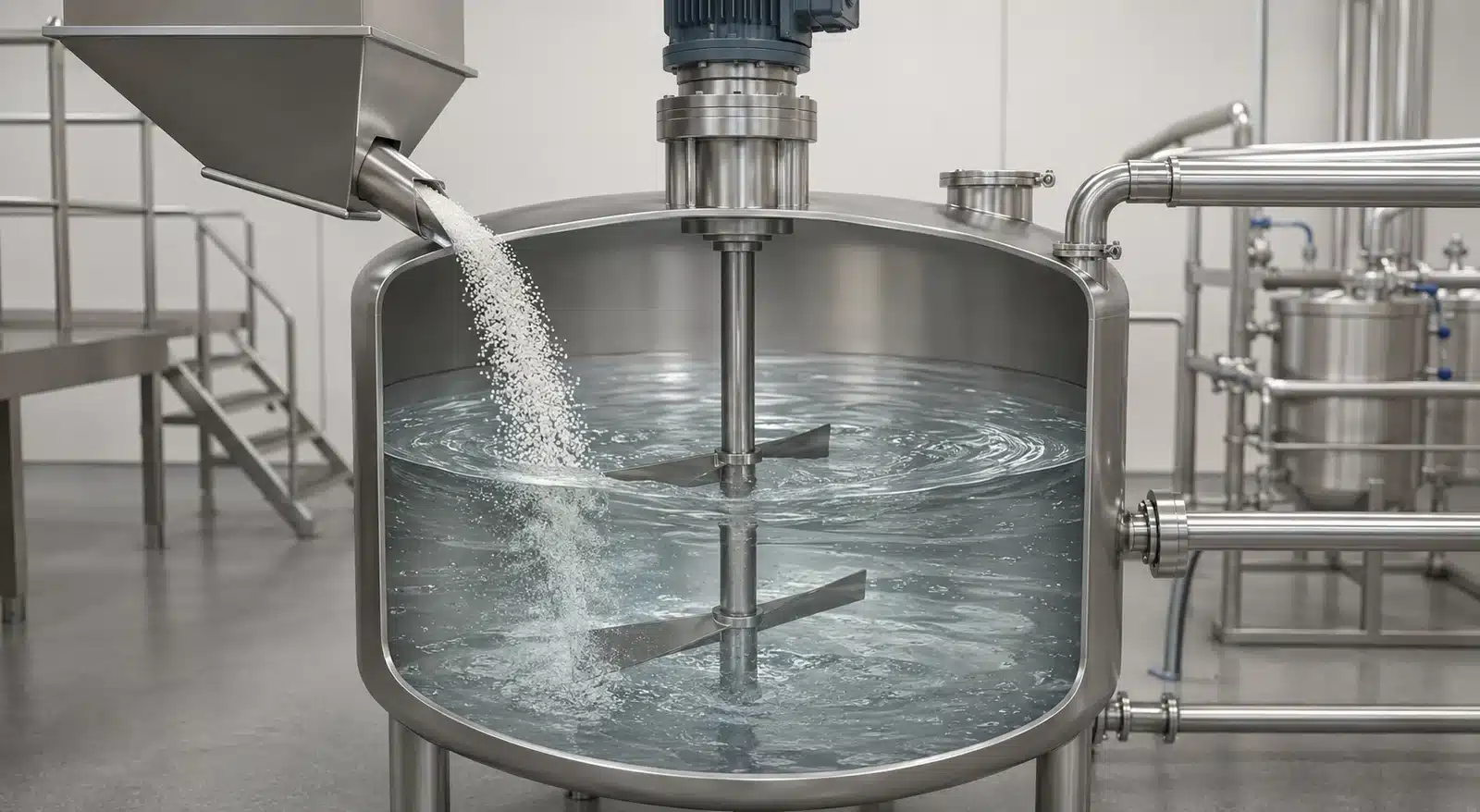
Production begins by charging water and PVOH resin into a mixing system under a defined order of.
Plasticizers or other authorized formulation components are incorporated under controlled conditions. Operators monitor variables such as solids content, temperature, viscosity, mixing time, and appearance. A stable solution is essential because the casting head can reproduce upstream variations as streaks, gauge changes, weak spots, or optical defects in the dry film.
2. Filter, Deaerate, and Meter the Solution
The prepared solution passes through filtration selected for the process. This removes foreign particles and undissolved material that could mark the film or disrupt the casting gap. Filtration must be managed as a process control: a changing pressure differential or unexpected residue can signal a raw-material, dissolution, or contamination problem.
Entrained air is also removed, commonly with controlled residence and vacuum deaeration. Bubbles that reach the casting surface can become pinholes, craters, or local weak points. The clean, bubble-controlled solution is then held and metered to the casting head at a stable flow and temperature.
3. Cast onto a Moving Belt or Drum
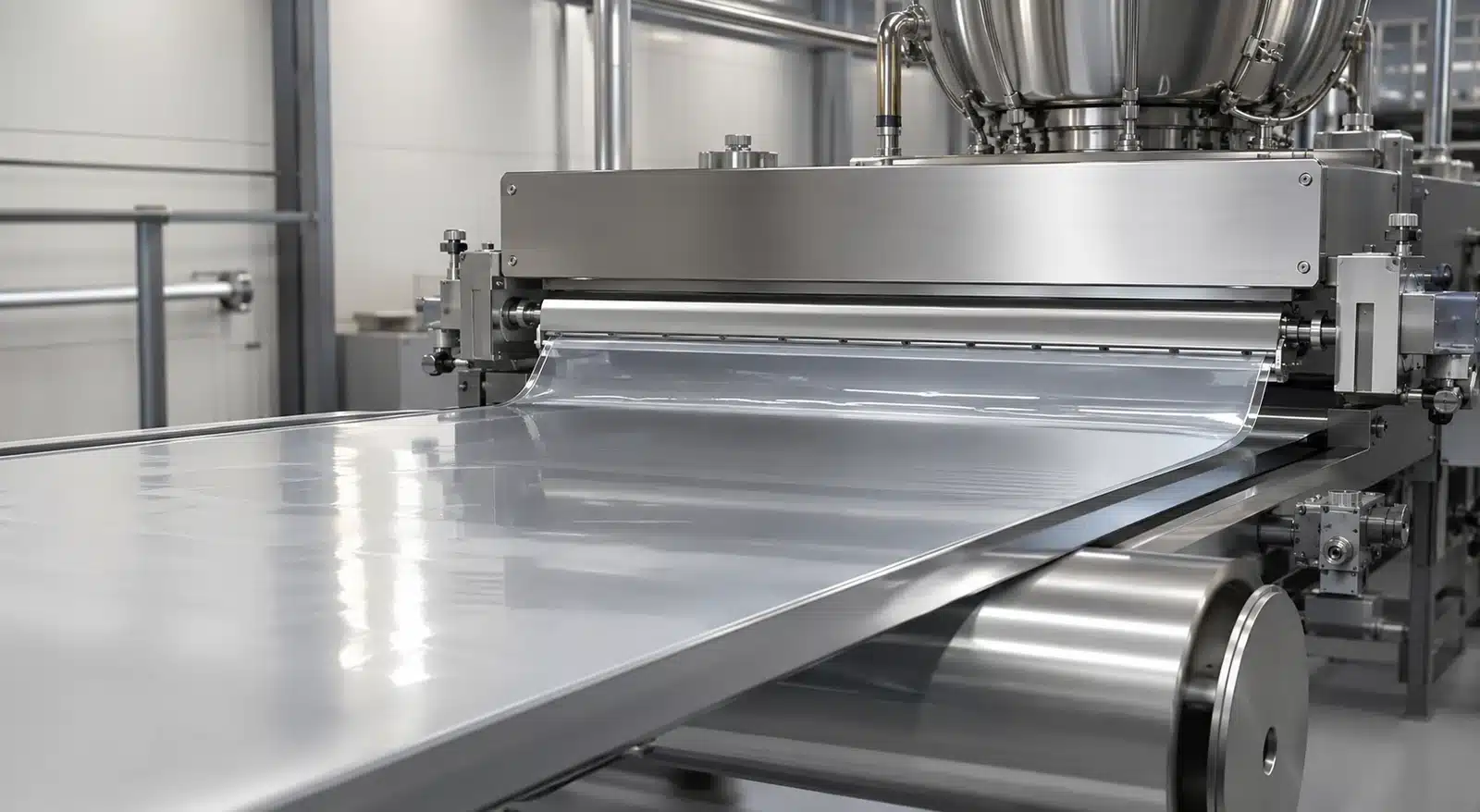
A casting die or coating head lays the solution onto a smooth, moving carrier—typically a belt or drum. The wet-layer profile depends on solution rheology, head geometry, gap or metering settings, carrier condition, line speed, and flow stability. The objective is not merely to spread liquid; it is to establish a uniform wet web that will dry into the required thickness profile.
Carrier cleanliness and surface condition affect release and surface quality. Edge control also matters because unstable edges can reduce usable width or create winding problems later. Online measurement may be used where the line design permits, but offline gauge mapping remains important for confirming the finished roll.
4. Dry Under Controlled Conditions
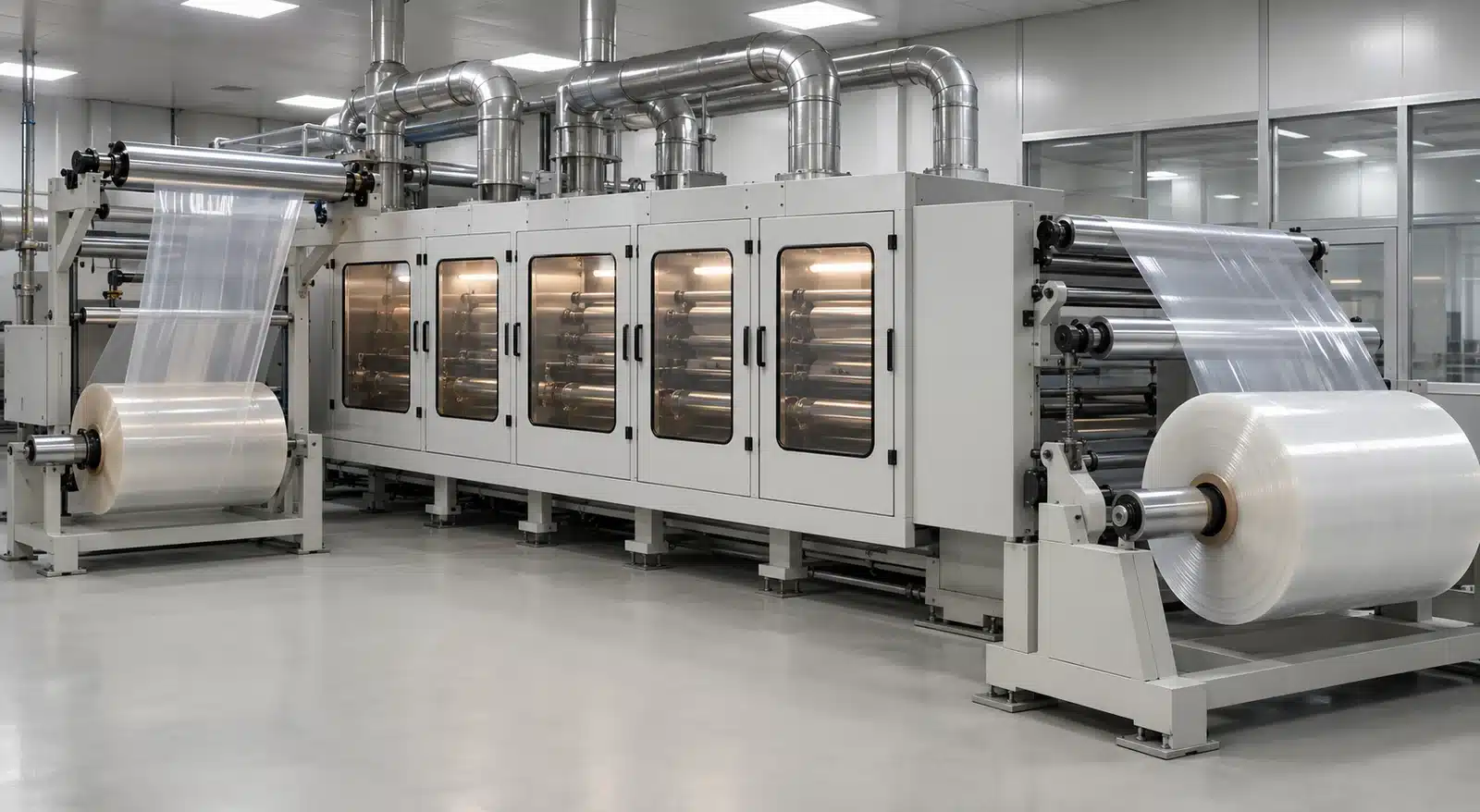
The wet web passes through heated drying zones, where water is removed progressively. Air temperature, humidity, velocity, exhaust, web temperature, residence time, and wet-film thickness interact. Drying too aggressively can form a surface skin while water remains below it, encouraging bubbles, internal stress, curl, or uneven moisture. Drying too slowly can limit output and leave a film that is difficult to release or wind consistently.
The target is a stable film with controlled residual moisture—not simply the driest possible web. PVOH is moisture-sensitive, and its moisture condition affects flexibility, blocking tendency, dimensions, handling, and test results.
Important: A published temperature or drying time is not a transferable production setpoint. The valid profile belongs to the exact resin, formulation, wet thickness, equipment, airflow, line speed, and quality target.
5. Release, Condition, Slit, and Wind
After sufficient drying, the film is peeled from the carrier and guided through finishing. Edge trim is removed, and the web may be conditioned so moisture and temperature stabilize before final inspection and winding. Tension, nip pressure, alignment, roll hardness, and contact surfaces must be controlled to avoid wrinkles, telescoping, blocking, stretching, or surface damage.
The master roll is slit to the required width and wound on specified cores. Finished rolls are protected from uncontrolled humidity and temperature during storage and transport. Packaging is therefore part of process control: a roll that leaves the line within specification can still change if its moisture barrier, sealing, or warehouse conditions are unsuitable.
Alternative Route: Thermoplastic Melt Extrusion
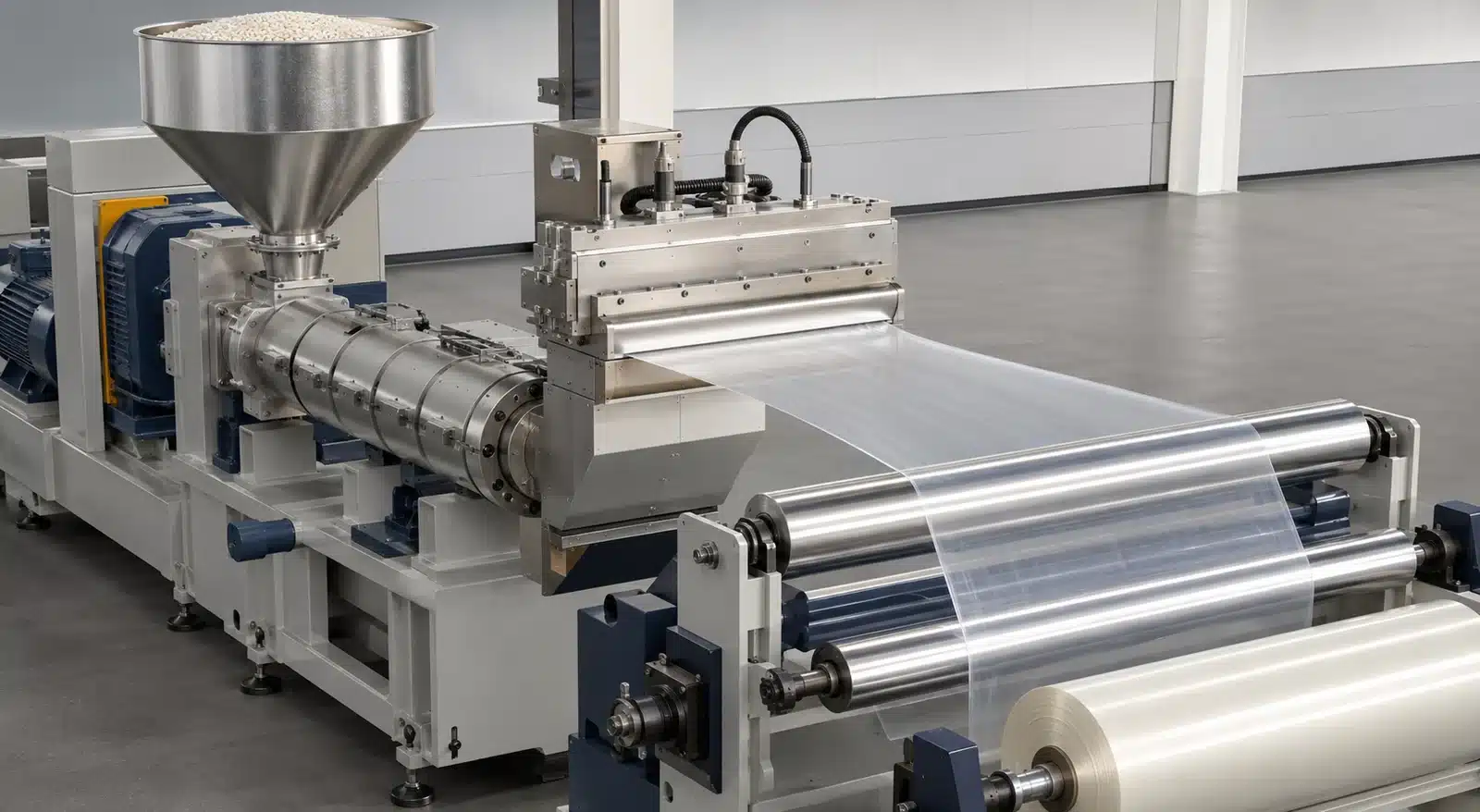
PVOH film can also be produced through thermoplastic processing, including blown-film or cast-extrusion configurations. This is a separate route—not a finishing step after solution casting. Research comparing manufacturing processes treats solution casting, blown-film extrusion, and extrusion casting as distinct techniques, and it shows why results must be tied to the route and formulation used.
Why PVOH Is Harder to Melt-Process
Conventional thermoplastics are heated until they flow, shaped through a die, and cooled. PVOH is more difficult because its hydrogen-bonded structure and thermal sensitivity can leave a relatively narrow practical window between adequate flow and material degradation. Moisture, plasticization, grade design, shear, residence time, and temperature history all matter.
If a resin/formulation is not designed for thermoplastic processing, the line can face unstable flow, gels, discoloration, deposits, bubbles, or degraded mechanical and dissolution behavior. A melt route therefore begins with an extrusion-suitable system rather than with the assumption that any solution-grade PVOH powder can be fed into a standard film extruder.
What Changes in an Extrusion-Grade System
An extrusion-grade system is compounded to achieve controlled flow and stability. Feed moisture and plasticizer distribution are managed; the material is conveyed and mixed through the extruder; melt pressure and temperature history are controlled; and the film is formed through a flat or annular die before cooling, gauging, trimming, and winding.
| Comparison point | Solution casting | Thermoplastic melt extrusion |
|---|---|---|
| Starting feed | A filtered, deaerated aqueous PVOH formulation | A thermoplastically processable PVOH compound |
| Film formation | A wet layer is metered onto a belt or drum | A hot, pressurized material is shaped through a die |
| Major removal step | Water must be removed in controlled drying zones | Bulk casting water is avoided; heat must be removed after shaping |
| Critical controls | Solution homogeneity, rheology, bubbles, drying, residual moisture | Feed condition, plasticization, shear, residence time, thermal history |
| Main qualification question | Is the cast-and-dry process stable for the target gauge and moisture condition? | Is the grade/formulation validated for the equipment and thermal window? |
Neither route is automatically superior. The right choice depends on the available resin technology, target film properties, scale, energy and water management, equipment, quality capability, and application validation.
Process Controls That Determine Film Quality
Film quality comes from the interaction of material, formulation, equipment, environment, and operating discipline. A defect is evidence to investigate, not proof of one cause. Manufacturers need traceable batch records and trend data to separate raw-material variation from dissolution, casting, drying, extrusion, or winding effects.
Solution Quality and Rheology
For a cast process, solids content, viscosity, temperature, mixing history, and the dispersion of formulation components affect how the solution flows through filters and across the casting head. Particles, gels, foam, or contamination may lead to lines, specks, pinholes, weak areas, or die deposits. Stable solution age and hold conditions also matter because a solution can change while waiting to be cast.
Drying Profile and Residual Moisture
Drying establishes more than line speed. The evaporation profile affects surface formation, internal stress, release, curl, and the moisture condition entering winding. Residual moisture then influences flexibility and blocking during conversion and storage. Because PVOH exchanges moisture with its environment, conditioning and test atmosphere must be controlled when batches are compared.
Thickness, Surface, and Winding Control
Gauge variation can originate in metering, die or head condition, web speed, carrier geometry, thermal profile, or transverse flow. Surface marks may come from the carrier, contamination, handling, or contact rolls. Winding defects can reflect tension, alignment, nip, roll hardness, edge profile, or uneven moisture.
| Observation | Possible process directions to investigate | Verification |
|---|---|---|
| Bubbles or pinholes | Wet-out, foam, deaeration, contamination, rapid surface drying | Solution inspection, filter/deaeration records, transmitted-light inspection |
| Gauge bands or streaks | Metering stability, head condition, rheology, web speed, carrier condition | Cross-web thickness map and process trend |
| Curl or poor flatness | Uneven drying, residual-moisture gradient, web tension | Conditioned flatness check and moisture review |
| Blocking or difficult unwinding | Moisture, surface condition, winding pressure, storage environment | Roll-unwind assessment under defined conditioning |
| Brittleness or stretch variation | Formulation, moisture condition, thermal history, gauge variation | Conditioned mechanical testing in both machine and transverse directions |
This table is a diagnostic map, not an acceptance standard. The same visible symptom can have more than one cause, so corrective action should be based on measured evidence.
How Manufacturers Verify the Finished Film
Release testing should connect the manufacturing controls to the intended conversion and use. A certificate value is meaningful only when it identifies the film, lot, test method, specimen direction, conditioning, unit, and acceptance criterion.
Thickness and Visual Uniformity
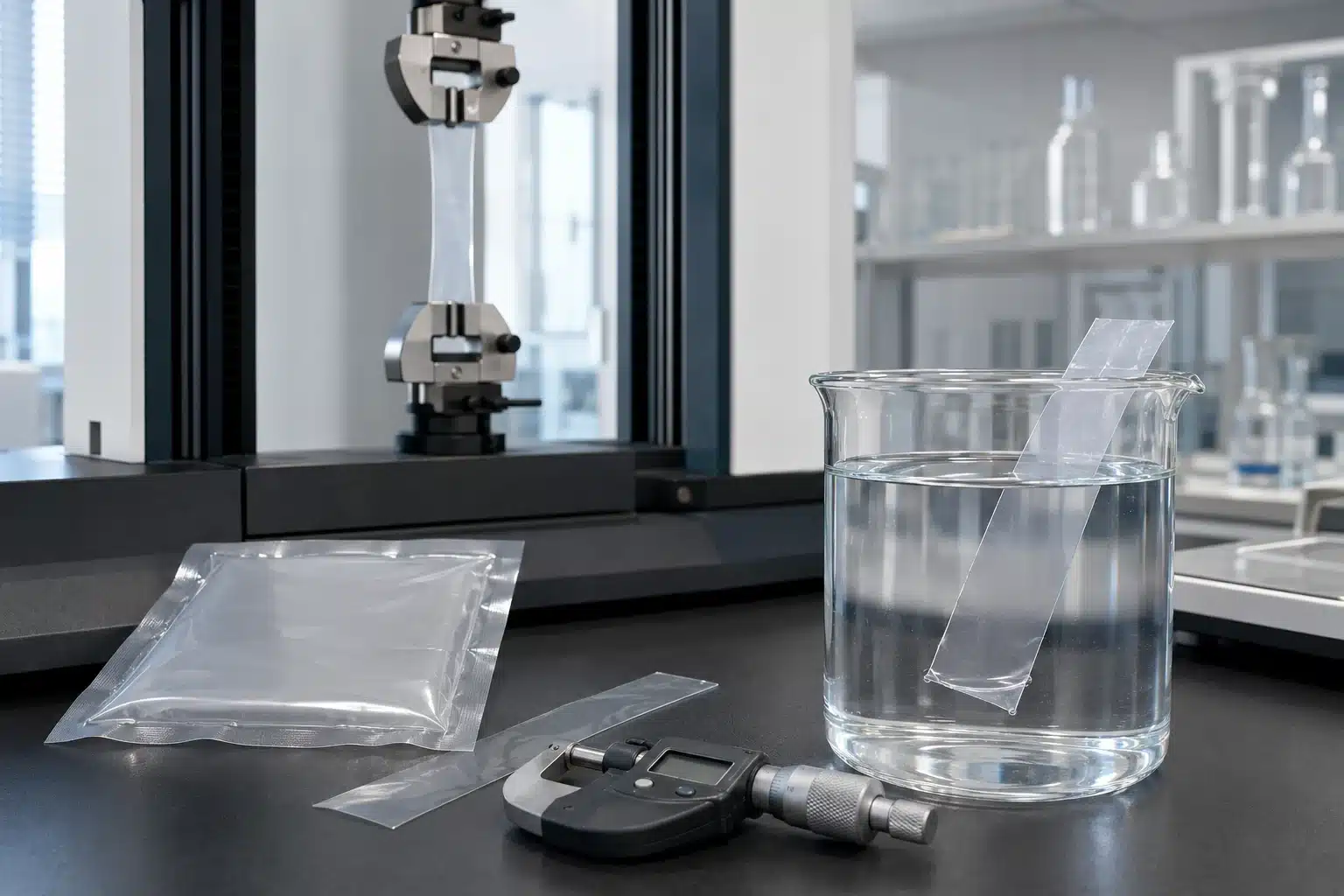
Thickness is measured across and along the web using a defined sampling plan ASTM D6988 is one guide.
An average alone can hide profile variation. Buyers should ask how many positions and layers are sampled, whether minimum and maximum values are reported, and how the method relates to the promised roll tolerance.
Mechanical and Sealing Behavior
ASTM D882 covers tensile testing for thin plastic sheeting within its stated scope. For PVOH film, the report should identify machine or transverse direction, specimen thickness, conditioning atmosphere, test speed, grip arrangement, and failure behavior. Values from different directions or conditions should not be directly compared without qualification.
If the film will be heat sealed, the seal must be made under defined jaw temperature, pressure, dwell time, geometry, and conditioning. ASTM F88/F88M measures seal strength and identifies failure mode for flexible barrier materials, but it does not set a universal acceptable value or prove complete package integrity.
Dissolution and Product Compatibility
“Water-soluble” is incomplete without a method. Dissolution or disintegration results can change with water temperature, water chemistry, agitation, specimen dimensions, film thickness, conditioning, exposure time, and the endpoint used. A useful specification states all of those conditions and distinguishes film rupture, disintegration, and complete dissolution where relevant.
The packed product can also.
Important: A film data sheet or isolated film test does not approve a finished package. Qualification must include the filled and sealed system, its storage distribution, and its end-use water conditions.
What Buyers Should Specify Before Approving a PVA Film
A useful specification starts with the application rather than with a generic request for “PVA film.” Before approval, align the following inputs with the supplier and converter:
- Packed product: composition, concentration, water activity, pH, solvents or surfactants, fill temperature, dose, and known incompatibilities.
- Use conditions: target water temperature range, water chemistry, agitation, exposure time, and the defined dissolution endpoint.
- Film construction: resin or grade family, modification where relevant, nominal thickness, tolerance, width, roll length, core, winding direction, and roll protection.
- Conversion process: printing or registration needs, forming, filling, heat-seal settings, allowable seal contamination, line speed, and web-tension range.
- Storage and transport: temperature and relative-humidity limits, barrier-packaging requirements, shelf-life protocol, and acclimation before converting.
- Release tests: sampling plan, thickness method, visual defect criteria, mechanical directions and conditioning, seal method and failure mode, and dissolution method.
- System validation: filled-package compatibility, seal integrity, aging, transport, and end-use trials on the actual equipment and product.
- Documentation and change control: lot traceability, certificate fields, approved-sample status, formulation/process change notification, and requalification triggers.
These inputs let a supplier propose and validate an appropriate film. They do not replace trials on the buyer’s own filling, sealing, storage, and use system.
Key Takeaway
Most PVA PVOH water-soluble film is described as being produced by solution.
Related Bestypack Resources
- Laundry Detergent Pods PVA Water Soluble Film
- PVA Shrink Film Water Soluble Shrink Film
- PVA Water Soluble Film Manufacturer&Supplier
- PVA Water Soluble Seed Tape
- PVA Film Guide: Environmental Impact and Characteristics
- PVA Guide: What You Need to Know
 English
 Japanese
 French
 Spanish
 Korean
 Italian
 Portuguese
 Dutch
Dutch Arabic
 Russian
 German