
Cling film is not one uniform material. PVC, polyethylene (PE), PVDC and PVDC-containing designs, and newer compostable options use different formulation strategies and can behave differently in cling, stretch, clarity, barrier, dispensing, and heat exposure. For a B2B buyer, the polymer name is only a starting point. A safe selection also requires the intended food, contact conditions, temperature and time, equipment or dispenser, target market, finished-film documentation, and a controlled sample trial.
What Is Cling Film?
For environmental claims, compare the design with the U.S. EPA’s recycling guidance and the actual local collection system.
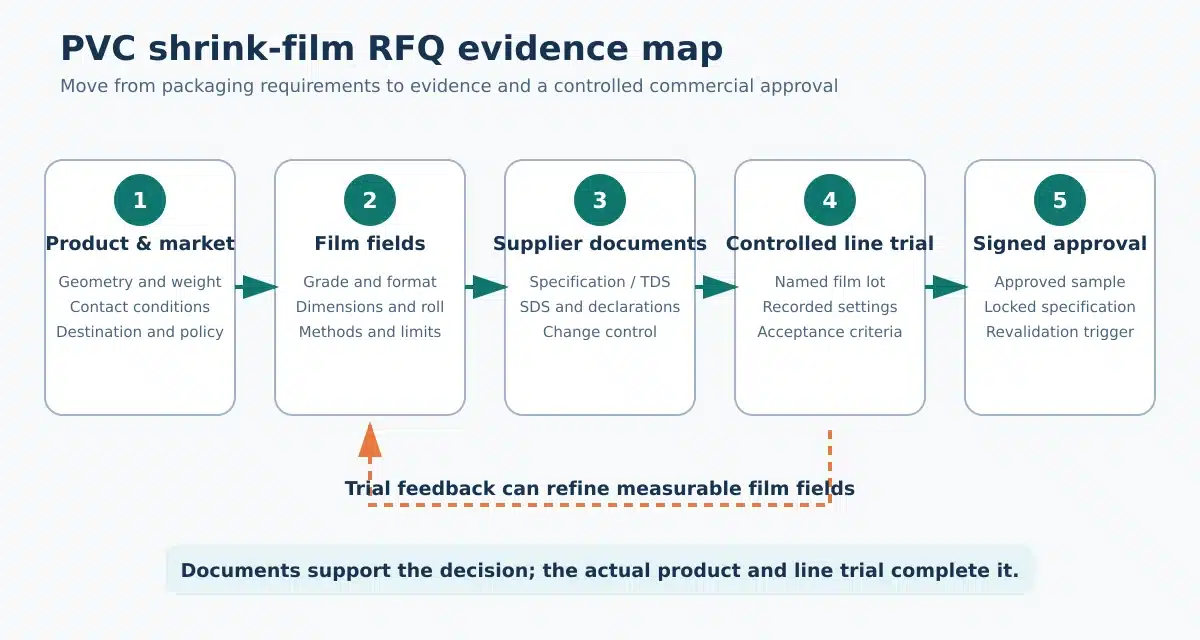
For environmental claims, compare the design with the U.S. EPA’s recycling guidance and the actual local collection system.
Cling film is a thin flexible wrap designed to conform around food trays bowls or containers and remain in place through controlled surface cling Depending on the formulation the film may cling to itself to a smooth container rim or to both Its practical job is usually to.
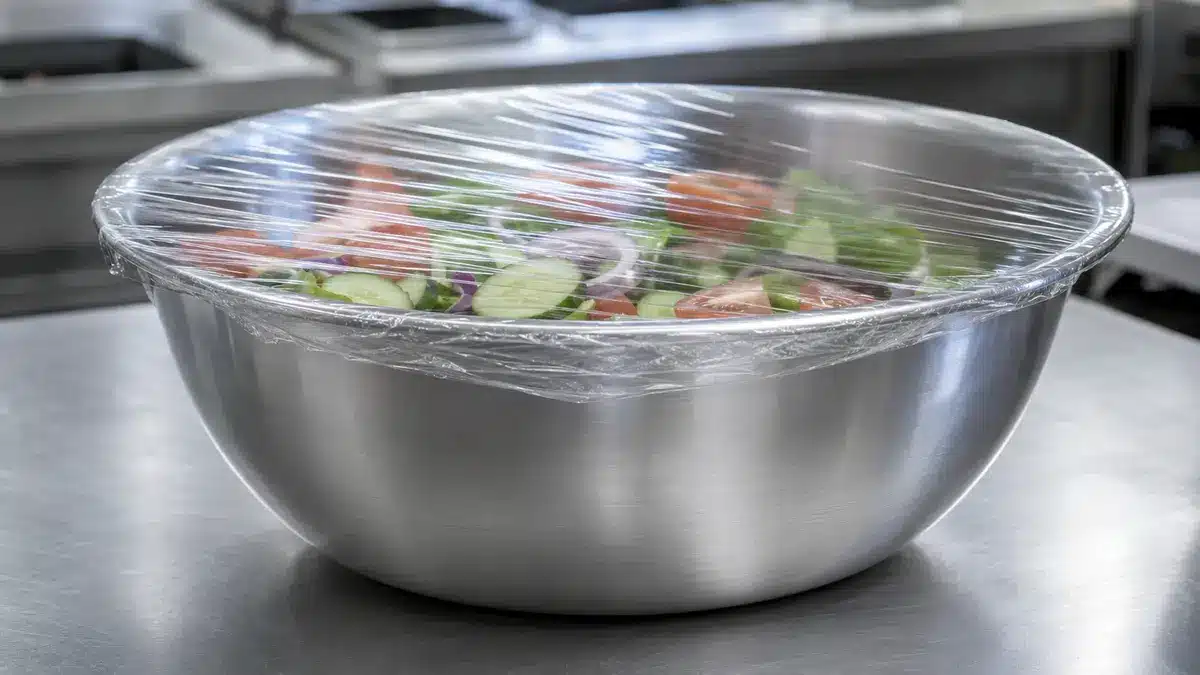
The term describes a function, not a complete material specification. Two films sold as “cling film” may use different polymers, additives, layer designs, thicknesses, and dispensing formats. They may also carry different restrictions for direct food contact, fatty foods, refrigeration, freezing, or microwave reheating.
Cling Film vs. Pallet Stretch Film
Food cling film and pallet stretch film may both stretch and adhere to themselves, but they are designed for different tasks. Food cling film is evaluated as a food-contact article when it is intended to touch food. It is commonly supplied in relatively narrow rolls for hand use, foodservice dispensers, tray wrapping, or other food-packaging operations.
Pallet stretch film is designed to unitize loads through stretch, elastic recovery, containment force, and puncture resistance. It may be a hand or machine film and is commonly much wider. A pallet film should not be assumed suitable for direct food contact, even when it is made from a familiar PE family. Its additive package, manufacturing controls, roll format, and intended-use documentation may be entirely different.
Cling Film vs. Shrink Film
Cling film conforms through stretch, drape, and surface cling; it normally does not require a heat tunnel to take its final shape. Shrink film is applied with some looseness and then exposed to controlled heat so that it contracts around a product or bundle.
The distinction affects equipment and performance criteria. A cling-film trial focuses on unwind, cut, stretch, recovery, rim adhesion, self-cling, fogging, and handling. A shrink-film trial focuses on shrink percentage and force, temperature profile, dwell time, seal behavior, optics after shrinking, and compatibility with the tunnel. Using the terms interchangeably can send an RFQ toward the wrong material and process.
How Cling Film Is Classified
A reliable classification uses three separate axes: material family, finished-film construction, and delivery format. Keeping these axes separate prevents a common purchasing error—assuming that a resin name already specifies cling level, thickness, barrier, heat resistance, compliance, and machinability.
Material Family
Common food-wrap discussions usually group cling films into:
- Plasticized PVC films, whose flexibility and cling depend on the complete PVC formulation.
- PE films, often based on LDPE, LLDPE, related copolymers, or blends designed for softness, stretch, and controlled cling.
- PVDC or PVDC-containing designs, investigated where barrier is a prominent requirement.
- Alternative films marketed with bio-based, biodegradable, or compostable claims.
These are broad families. Grade, comonomer, molecular design, additives, processing route, orientation, and layer arrangement can all change the result. The family name is useful for shortlisting, but not for final approval.
Formulation, Layer Design, and Surface
Cling can come from the film’s surface chemistry, a migrating or non-migrating cling system, a tack-modified layer, controlled electrostatic effects, or a combination of surface and mechanical behavior. A film can be monolayer or coextruded, and two sides may be designed differently. Additives may also be used for antifog, slip, processing stability, or other functions.
That construction should be described explicitly. Buyers should ask which side is intended to contact the food or container, whether cling is one-sided or two-sided, whether the structure contains coatings or distinct layers, and whether the supplier’s food-contact documents cover the complete formulation. “PE,” “PVC,” or “PVDC” alone does not answer these questions.
Format and Dispensing Method
Roll format can turn an acceptable film into an operational failure. A household roll with a carton cutter, a foodservice refill roll, and an automatic tray-wrap roll may share a resin family yet require different unwind force, roll hardness, core dimensions, width tolerance, splice rules, and winding quality.
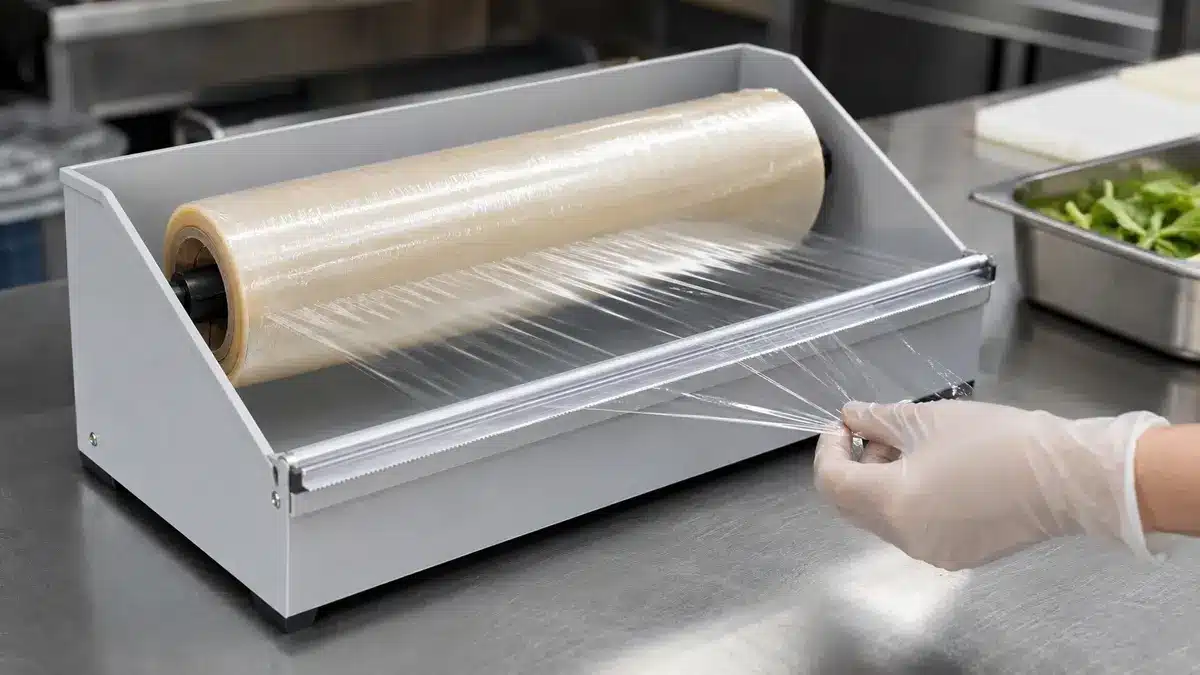
Define at least:
- Nominal width, length, and thickness, with tolerances and measurement methods.
- Core inside diameter, core material, maximum roll outside diameter, and roll weight.
- Hand dispenser, cutter box, foodservice dispenser, or wrapping-machine details.
- Preferred cling side, unwind direction, and acceptable blocking or telescoping limits.
- Storage and conditioning requirements before use.
PVC Cling Film
PVC cling film is produced from a PVC resin system formulated to make a very thin wrap flexible, extensible, and able to cling. Its commercial appeal is often associated with close tray conformity, clear presentation, smooth handling, and reliable contact with common foodservice or retail surfaces. Those tendencies are formulation-dependent and should be verified on the intended package.
Typical Design Profile
PVC by itself is comparatively rigid, so a flexible cling film uses plasticizers and may include antifog, stabilizer, processing, or surface-control components. The identity and amount of those components matter. They influence flexibility, tack, odor, migration behavior, temperature limits, and how the film changes during storage.
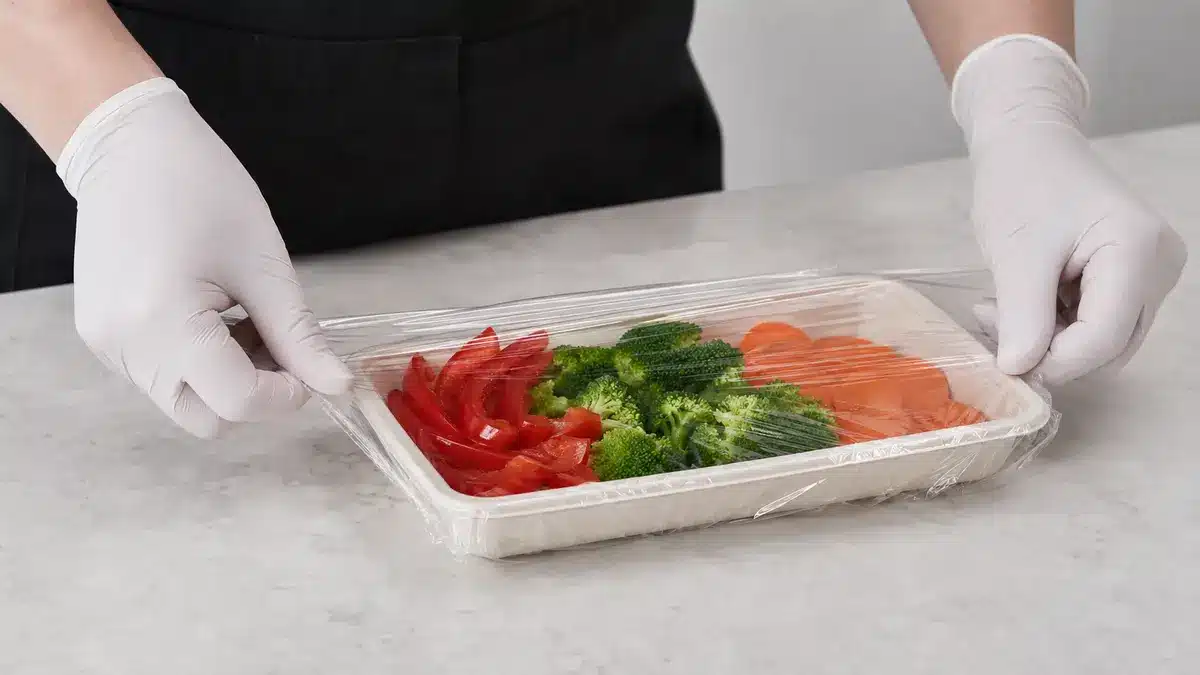
For tray wrapping, a buyer may value easy stretch, recovery around corners, surface gloss, and a consistent seal against the tray rim. For a commercial kitchen, cutter performance and repeatable unwind may matter more than retail optics. Neither use case can be approved from a generic “PVC food wrap” description; the exact formulation, food type, contact time, temperature, and market have to match the supplier’s documentation.
Key Limitations and Verification Needs
Food-contact rules do not treat “PVC” as a universal pass or fail. In the United States, permitted polymer components and plasticizers are tied to identities, use levels, food categories, temperatures, thicknesses, and other restrictions. In the European Union, the finished plastic article must be supported within the applicable food-contact framework, including composition, migration, good manufacturing practice, and declaration requirements.
Important: Do not approve PVC cling film for fatty food, hot contact, or microwave use from the polymer name or a general “food grade” statement. Review the finished-film declaration, supporting migration conditions, intended-use limitations, and the on-pack instructions for the target market.
The same caution applies to performance. Ask for thickness and tolerance, cling test method, tensile or puncture method where relevant, optical method, and any barrier data under stated temperature, humidity, test side, and units. If the supplier cannot connect a result to the offered formulation and roll specification, treat it as background information rather than an acceptance value.
Polyethylene (PE) Cling Film
PE cling film uses the natural flexibility of polyethylene-based resins together with film design, processing, and surface-control choices. PE is a broad family, not a single recipe. An LDPE-rich hand wrap, an LLDPE-rich commercial film, and a coextruded PE structure can differ significantly even when their labels use the same general material name.
LDPE- and LLDPE-Based Designs
LDPE can contribute softness, drape, optical behavior, and processability. LLDPE and related copolymers can contribute toughness, stretch, and puncture behavior. Formulators may blend resin families, choose different comonomers or catalysts, and place cling or antifog functionality in a surface layer. The balance depends on the target dispenser, food, wrap geometry, and storage condition.
PE can be made flexible without the plasticizer approach used for flexible PVC, but that does not mean the film contains no additives or that every formulation has the same regulatory status. A complete specification should identify the resin or copolymer family at an appropriate level, the layer arrangement, the cling system, the intended contact side, and any functional additives relevant to food contact or performance.
Key Limitations and Verification Needs
PE should not be described as automatically microwave-safe, freezer-proof, high-barrier, or suitable for every food. Heat behavior depends on density, resin blend, thickness, draw history, additives, contact, and the actual heating cycle. Consumer testing has also shown that products within the same broad material family can behave differently under cooking conditions.
Important: For microwave reheating, use only a film whose instructions explicitly allow the intended use. Follow the stated time, power, venting, clearance, and food-contact limits. U.S. food-safety guidance advises using microwave-safe wrap, keeping it from touching food, and venting it so steam can escape.
For cold storage, define the lowest use temperature, storage duration, handling immediately after removal, and whether brittleness, tear initiation, loss of cling, or condensation is acceptable. For produce, meat, bakery, or prepared foods, do not infer shelf life from PE alone. Validate the finished package, because respiration, oxygen exposure, moisture loss, condensation, and microbial risk depend on the food and total packaging system.
PVDC and PVDC-Containing Cling Films
PVDC is associated with strong gas, aroma, and moisture-barrier potential compared with many common uncoated films. In a cling-film project, it may appear as the primary film material or as part of a structure designed to add barrier. The precise layer sequence and food-contact side must be identified before its role can be evaluated.
Barrier-Oriented Design Role
A barrier-oriented cling film may be useful when ordinary short-term coverage is not enough and the package must control oxygen, water vapor, aroma loss, or odor transfer more tightly. That does not mean the material alone establishes shelf life. Barrier performance changes with polymer grade, thickness, humidity, temperature, orientation, processing history, and layer integrity.
For a meaningful comparison request oxygen transmission rate and water-vapor transmission rate only with the test method specimen thickness temperature relative humidity test gas test side conditioning and units Compare results only when those conditions are equivalent If the film is multilayer.
Key Limitations and Verification Needs
PVDC-containing structures may raise additional questions about layer identification, sealing or cling surface, recycling compatibility, and regional waste-management routes. The buyer should also confirm whether the food contacts PVDC or another layer and whether coatings, adhesives, inks, or other components are present.
Important: Heat resistance and microwave suitability are finished-product claims, not automatic properties of every PVDC film. A past consumer test found different heat behavior among labeled products, but those results cannot be generalized to all current films. Use the offered film’s current instructions, declaration, and test evidence.
Where barrier is the reason for considering PVDC, set a package-level target and validate the wrapped food or container. A low laboratory transmission rate does not automatically prove an acceptable seal around an irregular tray, a leak-free overlap, or the desired shelf life in distribution.
Bio-Based, Biodegradable, and Compostable Cling Films
Alternative cling films are often described with environmental terms that answer different questions. A film may contain renewable feedstock yet remain non-biodegradable. Another may be designed to biodegrade only under defined industrial conditions. A third may meet a compostability specification but still lack a practical collection route in the market where it is sold.
These Terms Are Not Interchangeable
Bio-based describes the origin of some or all carbon in a material. It does not by itself describe end-of-life behavior.
Biodegradable describes conversion by biological activity under stated conditions and over a stated period. Without the environment, method, time, and pass criteria, the claim is incomplete.
Compostable is a more specific claim tied to a defined composting environment and standard or certification scheme. Industrial and home composting are different conditions. A material that is accepted in one system may not be accepted in the other.
Recyclable concerns compatibility with a collection, sorting, reprocessing, and end-market system. Thin, food-contaminated flexible film can face practical collection barriers even when the polymer is technically reprocessable.
Evidence Buyers Should Request
Ask the supplier to state the exact claim, the finished article covered, the test method or certification scheme, the certificate holder, validity, target market, and disposal environment. Confirm whether printing, color, coatings, labels, cores, cutters, or other components change the claim. A certificate for a resin or masterbatch does not automatically cover the finished cling-film roll.
Important: Avoid unqualified terms such as “eco-friendly,” “100% biodegradable,” or “fully recyclable.” Translate each claim into a defined material scope, test, market, and available collection or treatment route.
Performance still requires verification. Alternative films should be trialed for cling, cutting, tear, puncture, storage stability, food-contact use, temperature limits, and package performance. Environmental positioning does not waive food safety or operational requirements.
Cling Film Types Compared
The table below summarizes common design tendencies, not guaranteed properties. A supplier’s finished-film specification and supporting evidence take priority over the family-level description.
| Type | Typical design focus | Cling and handling questions | Barrier questions | Heat and food-contact questions |
|---|---|---|---|---|
| Plasticized PVC | Flexible, conformable wrap with strong tray presentation and cling potential | Plasticizer system, unwind, recovery, rim adhesion, antifog, aging | Request finished-film OTR/WVTR only if barrier is part of the requirement | Confirm food categories, fatty-food limits, contact time, temperature, migration support, and label instructions |
| PE, including LDPE/LLDPE designs | Soft, stretchable wrap using PE blends, layers, and cling-control systems | Resin blend, one- or two-sided cling, blocking, cut behavior, puncture, cold handling | Do not assume “high” or “low” barrier; compare equivalent test conditions | Confirm additives, food types, temperature range, freezing or microwave instructions, and market documents |
| PVDC or PVDC-containing | Barrier-oriented wrap or layer design | Identify the cling surface, layer sequence, stiffness, unwind, and sealing behavior | Require method, thickness, temperature, humidity, test side, gas, and units | Confirm which layer contacts food, current use instructions, migration support, and temperature limits |
| Certified compostable or other alternative design | Defined environmental claim combined with food-wrap functionality | Verify shelf stability, cling, cut, tear, puncture, and storage conditions | Confirm whether barrier is measured on the finished construction | Confirm food-contact scope independently from environmental certification |
No row is a universal winner. PVC may be investigated for a particular tray-wrapping behavior, PE for a different compliance or handling profile, PVDC for a defined barrier target, and a compostable design for a verified disposal program. The correct outcome depends on the complete application.
How to Choose Cling Film for an Application
Use a fixed sequence so that material selection follows the package requirements. A practical order is:
- Define the food and whether direct contact will occur.
- Define storage, reheating, and maximum time-temperature conditions.
- Describe the container, tray, overlap, and required cling surfaces.
- Specify hand, dispenser, or machine operation and roll geometry.
- Identify the target market and required food-contact evidence.
- Define package performance and end-of-life acceptance criteria.
Define Food and Contact Conditions
Start with the food category, fat and oil content, acidity, alcohol content if relevant, water activity, exposed surface, and whether the film will touch the food. State contact duration and temperatures from packing through storage and use. Distinguish refrigeration, frozen storage, room-temperature holding, hot food coverage, microwave reheating, and any other thermal exposure.
Also describe the preservation task. Covering a bowl for a few hours, overwrapping a fresh-food tray, and controlling aroma transfer during longer storage are different jobs. If shelf life is a target, define the food, starting quality, storage profile, microbiological controls, and package-level acceptance method. The film alone cannot establish food safety.
Match the Film to Handling and Dispensing
Describe how the operator or machine pulls, stretches, cuts, overlaps, and closes the film. Provide tray or container material, rim geometry, corner sharpness, wrap path, cycle rate, dispenser model, cutter type, and any pre-stretch. State whether cling is required to the container, to the film itself, or on a specific side.
Turn subjective terms into measurable trial observations. “Easy to use” can be separated into unwind force, clean cutting, no uncontrolled neck-in, no excessive blocking, reliable edge location, limited tearing at the cutter, acceptable recovery around corners, and consistent hold after a defined storage period.
Confirm Regulatory and End-of-Life Requirements
For the United States confirm that the identities intended use food types and conditions of use are supported through applicable FDA regulations effective notifications or another valid basis For the European Union.
Other markets require their own review. A U.S. basis is not an EU declaration, and an EU declaration is not a global approval. End-of-life claims need the same market discipline: identify the collection or treatment system, applicable test or certification, labeling rules, and whether the complete used package is likely to be accepted.
What to Include in an RFQ and Sample Trial
A structured RFQ prevents suppliers from quoting films that share a name but not the same application. The sample trial then tests the offered construction on the real dispenser, container, food-contact scenario, and storage cycle.
RFQ Data Checklist
Provide:
- Application, food category, direct or indirect contact, contact time, and temperature profile.
- Target market, required declaration language, and document list.
- Film material preference, prohibited substances if applicable, layer or cling-side expectations, and color.
- Nominal thickness, width, length, and their tolerances and measurement methods.
- Core inside diameter, core width, roll outside-diameter limit, roll weight, unwind direction, and splice policy.
- Hand dispenser, cutter box, foodservice dispenser, or machine make and model.
- Tray or container material and dimensions, rim shape, corner geometry, and wrap pattern.
- Required cling, stretch, recovery, puncture, tear, antifog, optical, or barrier criteria with test methods and conditions.
- Storage, transport, shelf-life, labeling, and end-of-life requirements.
Ask the supplier to return a product identifier, material and layer description, total thickness, functional additives relevant to the claim, intended use, limitations, food-contact declaration, migration or other supporting reports, test methods, tolerances, shelf-life conditions, and change-control process. Do not accept an unrelated generic technical data sheet as proof for the quoted item.
Sample Trial and Acceptance Plan
Run the evaluation in a controlled order:
- Verify roll identity, dimensions, core, winding, packaging, and conditioning.
- Record the dispenser or machine setup and the film orientation.
- Measure or rate unwind, cutting, blocking, edge behavior, stretch, recovery, puncture, and overlap hold using agreed methods.
- Wrap the intended tray or container and check corners, rim contact, fogging, appearance, leakage, and hold after the defined storage cycle.
- If barrier or shelf life matters, test the complete package under the agreed temperature and humidity profile.
- Compare results with pre-agreed acceptance limits, record sample and lot identity, and retain the approved specification.
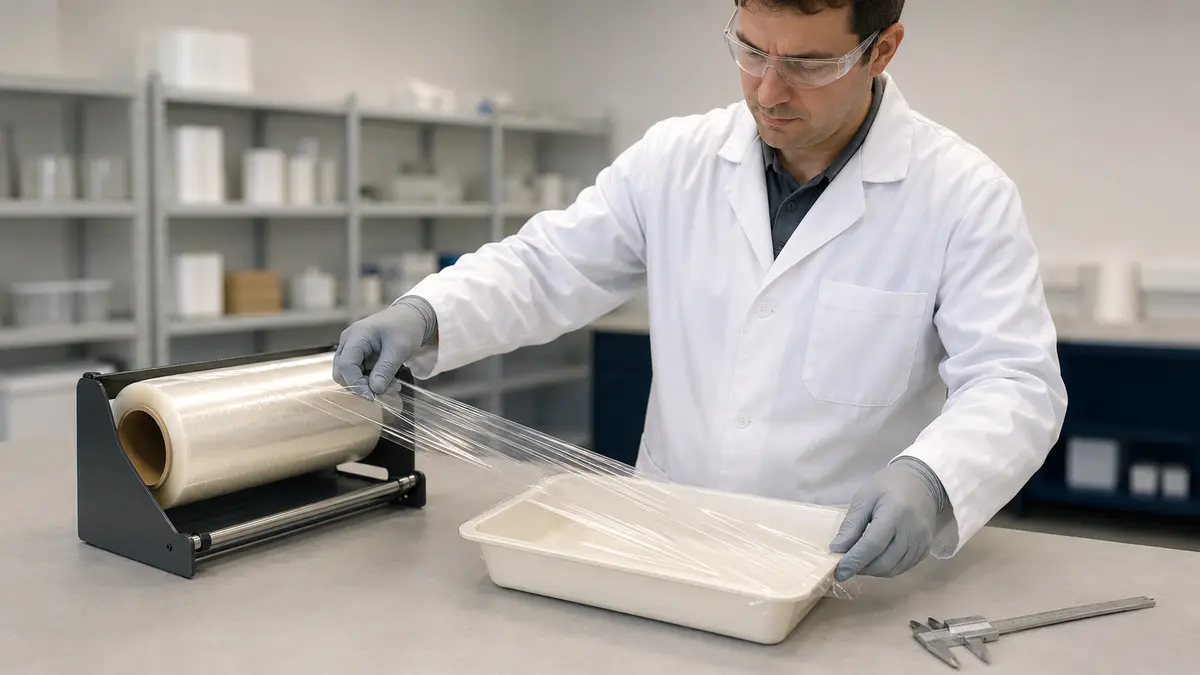
A successful trial supports that offered sample under the tested conditions. It does not automatically guarantee every thickness, construction, factory, or future batch. Procurement and quality teams should connect approval to change notification, incoming checks, and the agreed specification.
Common Questions About Cling Film Types
Is PVC Cling Film Always Unsafe?
No. “PVC” alone is not a sufficient safety conclusion. A finished PVC cling film may be suitable for defined foods and conditions when its complete formulation and use comply with the target market’s requirements. Plasticizer identity, use level, film thickness, food category, temperature, contact time, and migration support can all matter. Reject both blanket reassurance and blanket condemnation; review the exact article and its restrictions.
Is PE Cling Film Always Microwave-Safe?
No. PE is a broad polymer family, and a resin authorization does not make every finished PE wrap suitable for every microwave cycle. Use only a product specifically labeled and documented for the intended reheating conditions. Follow directions for power, time, venting, clearance, and food contact. If those conditions are absent or the film may touch hot fatty or sugary food, use a validated microwave-safe lid or another suitable covering.
Is Compostable Cling Film Automatically Better?
It depends. A compostable film may support a program that has compatible collection and treatment, but the claim does not establish food-contact suitability, cling performance, shelf life, or practical acceptance in the buyer’s location. Compare the finished-film certification scope, actual disposal route, package performance, and risk of contaminating another recycling stream. A verified use-and-disposal system matters more than an isolated green label.
Can Food Cling Film Replace Pallet Stretch Film?
No. Food cling film is not designed or validated as a pallet-load containment system. It may lack the width, roll build, puncture resistance, stretch control, recovery, and containment force required for transport. Conversely, pallet stretch film should not be assumed suitable for direct food contact. Specify each film for its intended packaging task.
Final Selection Checklist
Before approving a cling film, confirm that:
- The film category matches the packaging task, and it is not being confused with pallet stretch or shrink film.
- The supplier identifies the material family, relevant formulation features, layer design, cling side, and offered product code.
- Food type, direct contact, time, temperature, storage, reheating, and market are all defined.
- Width, thickness, length, core, roll diameter, winding, dispenser, and tolerances are documented.
- Performance requirements use agreed methods and conditions rather than vague adjectives.
- Food-contact declarations and supporting evidence apply to the finished offered film and intended use.
- Environmental claims identify the finished article, test or certification, market, and available disposal route.
- The sample passes the real dispenser or machine, container geometry, storage cycle, and package-level acceptance plan.
- The approved specification includes change control and does not extend one result to untested structures or conditions.
The main material families provide useful starting points, but no polymer name completes the decision. Approval should rest on the finished construction, the actual use conditions, applicable documentation, and repeatable trial evidence.
Related Bestypack Resources

- Stretch Film vs. Cling Film: What’s the Difference?
- Shrink Wrap vs. Stretch Wrap: What’s the Difference?
- Comparison of Stretch Hood or Shrink Hood
 English
 Japanese
 French
 Spanish
 Korean
 Italian
 Portuguese
 Dutch
Dutch Arabic
 Russian
 German