
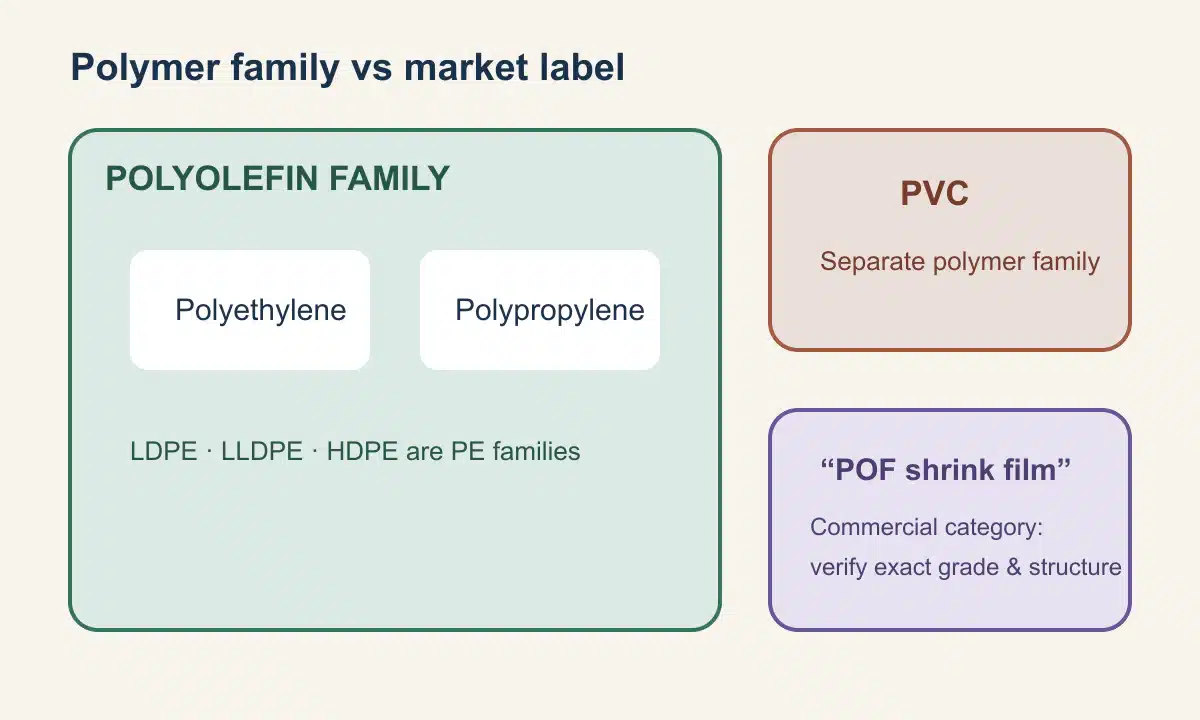
Polyolefin is a polymer family, polyethylene is one member of that family, and PVC is a separate chlorine-containing polymer. In packaging trade, however, “POF” often means a formulated shrink film sold separately from PE shrink or stretch film. That naming shortcut can cause purchasing errors. The right choice therefore depends on the exact grade, film construction, package duty, sealing and shrinking equipment, regulatory use, and verified test results—not on the material name alone.
First, Clarify the Terms: Polyolefin Is a Family
Polyolefin is the broadest of the three terms. It describes polymers made from olefin monomers; polyethylene and polypropylene are its dominant commercial members. PVC, or polyvinyl chloride, belongs to a different polymer family. This taxonomy matters because a comparison phrased as “polyolefin versus polyethylene” is not chemically parallel: it compares a family with one of its members.
For packaging procurement, resolve the language before comparing performance. Ask whether “POF” identifies a particular shrink-film grade, a supplier’s product family, or polyolefins in general. Then record the exact resin or multilayer construction, thickness, treatment, additives, and intended use. Without that clarification, two suppliers may answer the same RFQ while quoting fundamentally different films.
Why polyethylene is a polyolefin
Polyethylene is produced by polymerizing ethylene. Britannica’s polyethylene reference identifies it as part of the polyolefin resin family and explains that its chains may be more linear or more branched. Those structural differences help distinguish HDPE, LDPE, and LLDPE, but even these names do not fully specify a film. Molecular-weight distribution, comonomer, additives, processing route, orientation, and thickness can all change packaging behavior.
Plastics Europe likewise separates LDPE, LLDPE, HDPE, and polypropylene within the polyolefin family. A buyer should therefore avoid treating “polyolefin” as one fixed property set or “PE” as one interchangeable grade.
Why packaging suppliers still list POF and PE separately
The commercial distinction is functional. In shrink packaging, “POF shrink film” commonly labels thin, display-oriented shrink films offered in standard, crosslinked, anti-fog, or other formulated grades. “PE film” may instead refer to shrink bundling film, stretch film, flexible-packaging sealant webs, bags, liners, or heavy-duty protective film. These categories can overlap chemically while differing greatly in construction and use.
Importante: A commercial label is not a composition certificate. Confirm the exact grade and layer structure from the supplier’s current technical documentation.
Polyolefin vs PVC vs Polyethylene at a Glance
The following table is a screening tool, not a specification. It compares common commercial packaging positions. Exact performance can reverse when grade, formulation, thickness, orientation, or equipment conditions change.
| Eixo de decisão | O filme de PVC | Commercial POF shrink film | Filme PE |
|---|---|---|---|
| Material identity | Polyvinyl chloride formulation; flexible grades may use plasticizers and stabilizers | Market category for formulated polyolefin shrink films; structure varies by grade | Polyethylene family such as LDPE, LLDPE, HDPE, or blends |
| Common packaging formats | Retail shrink film, sleeves, neck bands, and selected overwraps | Display shrink wrap for individual products or multipacks | Shrink bundling film, stretch film, bags, liners, and flexible-packaging webs |
| Typical screening strengths | Clear presentation, close conformation, established use on some shrink lines | Broad retail-shrink versatility, toughness options, and specialty grades | Wide grade range, toughness and flexibility options, and heavy-duty formats |
| Main qualification questions | Formulation, shrink behavior, ventilation, cold/heat exposure, compliance | Construction, shrink force and curve, seal window, crosslinking, anti-fog package | PE family, film format, thickness, holding or shrink function, optics and sealability |
| Application boundary | Never infer food-contact or environmental status from “PVC” alone | Never infer composition or authorization from “POF” alone | Never assume all PE grades behave alike or suit the same process |
Several packaging guides, including Embalagem Industrial e U.S. Packaging & Wrapping, organize the market around these three commercial labels. Their application observations are useful for candidate discovery, but they do not replace supplier data, regulatory documents, or trials.
Nota: “Best” is not a material-level answer. It is the grade that meets agreed package, line, distribution, compliance, and end-of-life requirements with acceptable evidence.
What PVC Film Brings to Packaging
PVC can be formulated from rigid to flexible. Packaging films use formulations designed for the required flexibility, clarity, sealing, shrink response, and processing stability. This tunability is useful, but it also makes broad statements risky: one PVC film cannot prove the properties or regulatory status of another.
Common screening advantages include clear presentation, good conformation in suitable shrink applications, and familiarity on equipment already developed around PVC. Common qualification concerns include sensitivity of shrink appearance to the heating profile, storage-temperature behavior, the exact stabilizer and plasticizer system, ventilation and process controls, and the end-of-life route in the target market.
Do not write “PVC contains phthalates” as a universal rule. The FDA’s current phthalates page explains that some phthalates have been used as plasticizers, most commonly in PVC, while food-contact authorizations and market use have changed. The correct procurement question is which substances are present in the exact formulation and what authorization supports the intended use.
Where PVC shrink film is commonly considered
PVC shrink film may be considered for lightweight retail packs, printed or clear sleeves, tamper-evident neck bands, and products already qualified on a compatible shrink line. These are candidate roles, not automatic approvals. Confirm:
- the product’s sensitivity to heat and shrink force;
- the film’s shrink response across the tunnel profile;
- seal appearance and strength at the chosen dwell, pressure, and temperature;
- low- and high-temperature storage behavior;
- formulation-specific food-contact or other regulatory documentation; and
- waste handling and recycling constraints for the completed package.
PVC can be a rational choice where its verified properties fit the duty and the line is controlled for that grade. It should not be selected merely because it is familiar or rejected solely because of a family-level slogan.
What Commercial POF Shrink Film Brings to Packaging
Commercial POF shrink film is generally positioned as a versatile display-shrink option for products ranging from printed cartons and household goods to some food packs. Compared with a generic material name, the useful purchasing information is the grade’s actual construction, gauge, shrink curve, shrink force, seal window, puncture behavior, optics, slip package, and storage limits.
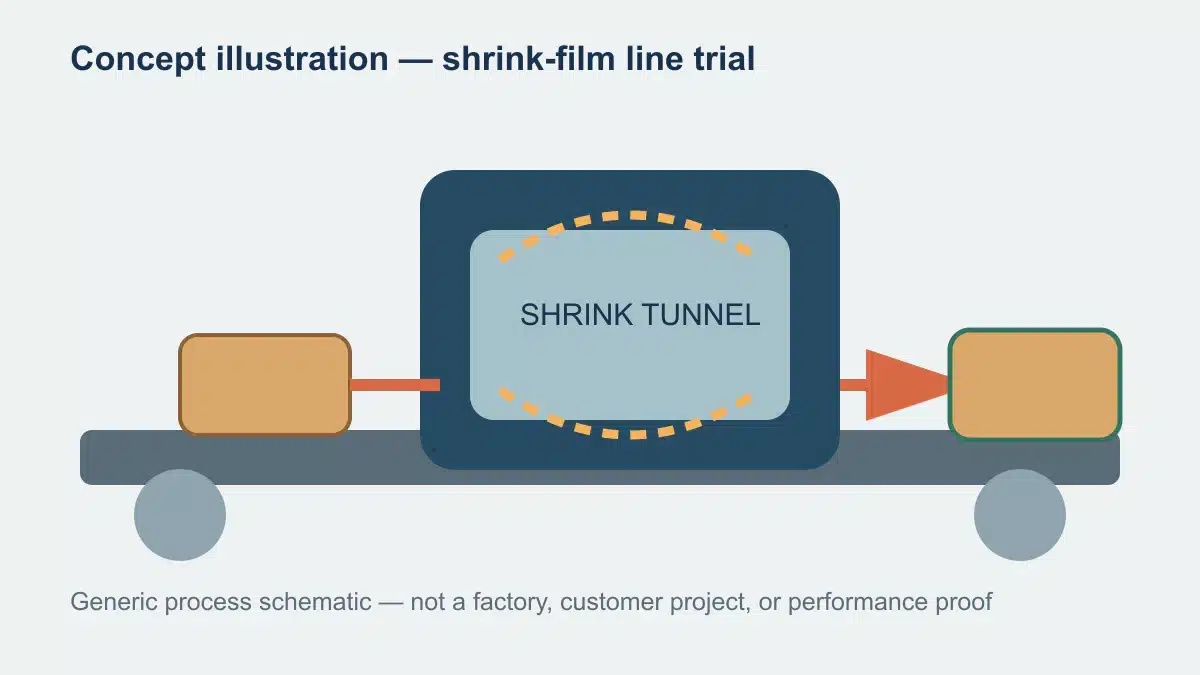
POF grades may help when a pack needs clear presentation, resistance to handling damage, and a broad operating window. Yet those outcomes depend on product geometry, sharp edges, tunnel airflow, conveyor speed, seal-jaw design, and film orientation. A film that runs well on one line can show dog-ears, burn-through, weak seals, distortion, or excessive force on another.
Supplier guides consistently describe POF as a retail-shrink candidate, but they differ in composition and performance claims. Treat that disagreement as a reason to request evidence, not as a reason to average the claims.
Crosslinked, anti-fog, and other grade options
Crosslinked grades are marketed for added toughness or processing stability; anti-fog grades are designed to manage condensation in suitable applications; lower-force or lower-temperature options may be offered for sensitive products. Each modifier creates a new qualification question. Ask what the feature means, how it was measured, and whether it affects sealing, migration, printing, storage, or recycling.
- For crosslinked film, request the exact mechanical and shrink data relevant to the package.
- For anti-fog film, define the food, temperature cycle, condensation challenge, and test method.
- For printed film, verify treatment, ink system, scuff resistance, shrink distortion, and registration.
- For direct food contact, obtain documentation for the exact grade and intended conditions.
No feature label replaces a line trial or finished-pack validation.
What Polyethylene Film Brings to Packaging
PE provides one of the widest packaging toolkits. Depending on resin family and film design, it can serve as a soft sealant web, a tough bag, a stretch film, a shrink bundling film, a liner, or a component in a multilayer structure. This range is why “PE film” is an incomplete specification.
PE films are often screened for flexibility, toughness, moisture resistance, and scalable converting. But clarity, stiffness, puncture, tear, hot tack, seal initiation, shrink behavior, cling, and holding force can vary substantially. Additives used for slip, antiblock, antistatic behavior, UV stability, processing, or surface function may also change downstream performance.
LDPE, LLDPE, and HDPE are not interchangeable
LDPE commonly contributes softness, processability, and sealing behavior. LLDPE is often selected where toughness, stretch, or puncture performance matters. HDPE generally provides a stiffer, more crystalline option and can be used in thin films, bags, or blends. These are broad tendencies only. A metallocene LLDPE, conventional LLDPE, LDPE blend, and HDPE-rich film can behave differently even at the same nominal thickness.
For any comparison, record total thickness and tolerance, layer structure, density or grade designation, MD and TD direction, conditioning, test method, and units. A result from one film cannot be transferred to another PE family or to the completed package.
PE shrink film, stretch film, and flexible packaging film
PE shrink film is designed to contract after controlled heating. PE stretch film is applied under elongation and relies on elastic recovery, cling, and holding force rather than a shrink tunnel. A flexible-packaging PE web may be designed mainly for sealing, toughness, or moisture protection in a laminate or mono-material concept.
Confusing these functions can lead to the wrong equipment and acceptance tests. A shrink-film RFQ needs shrink percentage and force versus temperature; a stretch-film RFQ needs stretch, holding force, cling, and load-containment criteria; a sealant web needs seal and hot-tack behavior under the actual structure and line conditions.
How the Three Options Differ in Packaging Performance
Material names help organize candidates, but performance must be measured. The most useful comparison axes are those that connect directly to package failure, line efficiency, shelf appearance, and compliance.
Clarity, stiffness, toughness, and puncture resistance
Clarity and gloss affect display, yet haze and gloss results depend on thickness, surface texture, additives, orientation, and measurement method. Stiffness influences web handling and package feel; toughness and puncture resistance affect sharp corners and distribution abuse. Tear behavior can also be directional.
Request data produced with recognized methods and comparable conditioning. For thin-film tensile testing, specify method, thickness, specimen direction, temperature, humidity, and speed. For haze, coefficient of friction, tear, or impact, confirm the method and sample orientation. Do not compare a supplier’s “typical” value with a guaranteed limit or compare results from different methods as though they were equivalent.
Shrink curve, shrink force, sealing, and temperature exposure
Shrink percentage describes dimensional change; shrink force describes the force applied as the film contracts. They answer different questions. ASTM D2732-14(2025) notes that unrestrained linear shrinkage varies with temperature and manufacturing history, and recommends characterization across the shrink range. Report MD and TD results, specimen temperature, exposure time, and method.
Seal performance also needs a window, not one temperature. Record sealant-to-sealant construction, jaw temperature, dwell, pressure, cooling, peel rate, and failure mode. For heat-sensitive or crushable products, evaluate distortion and force on the actual pack. For cold distribution, inspect brittleness, seal durability, and appearance after conditioning. The control chain is simple: define the risk, choose the method, record conditions, compare like with like, and verify the complete package.
Match the Film to the Package and Application
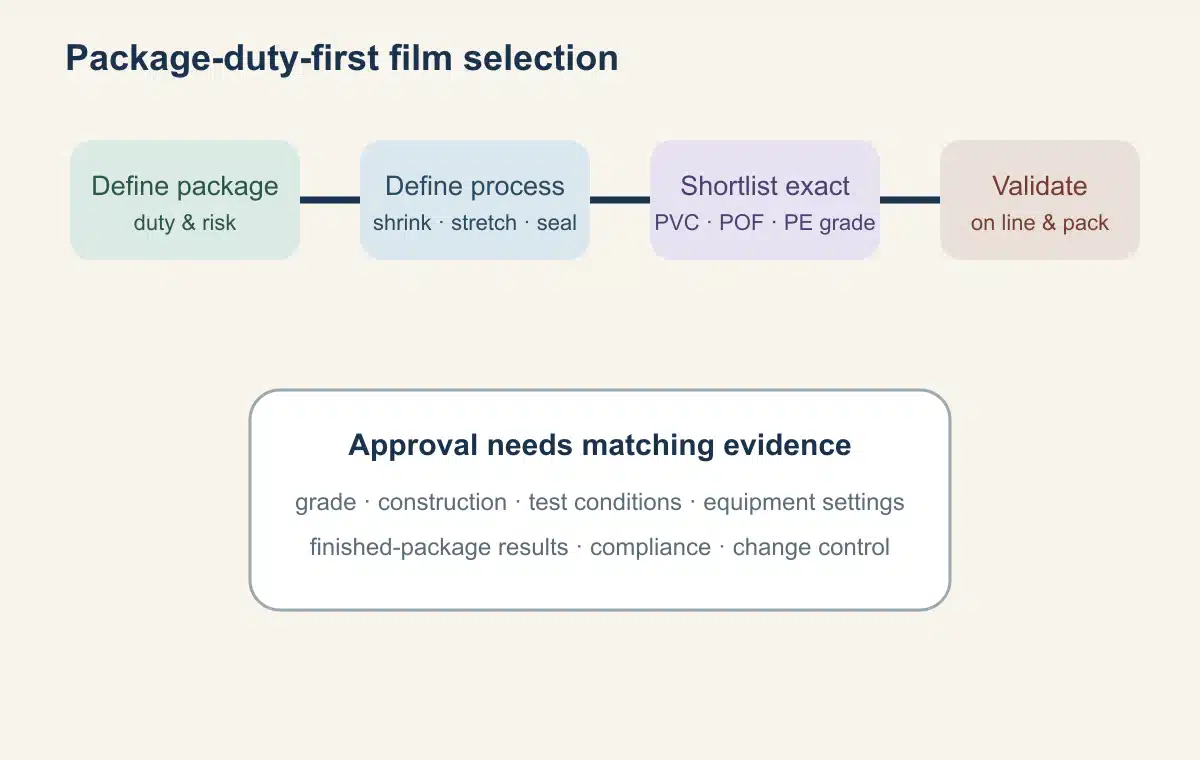
Start from package duty, not from a favorite resin. The matrix below identifies trial candidates and the evidence that should accompany them.
A practical application-fit matrix
| Package scenario | Main need or risk | Candidate to investigate | Validação necessária | Limite / Fronteira |
|---|---|---|---|---|
| Clear retail unit pack | Appearance, seals, corners, shrink force | Qualified PVC or commercial POF shrink grade | Tunnel profile, seal window, optics, corner durability | Product heat sensitivity may rule out an otherwise attractive film |
| Food multipack or direct-contact wrap | Authorization, condensation, seals, handling | Exact authorized POF or PE grade; other materials only with exact evidence | Intended-use compliance file, migration basis, anti-fog trial if needed | Material-family claims are insufficient |
| Beverage or can bundle | Load strength, bullseyes, tunnel efficiency | PE shrink bundling film | Shrink curve, force, openings, handle integrity, transport test | Do not substitute retail POF assumptions |
| Pallet load containment | Holding force, puncture, load stability | PE stretch film or qualified hood/shrink system | Stretch settings, cling, containment, puncture, transport trial | Stretch and shrink processes are not interchangeable |
| Tamper-evident neck band | Conformity, visible opening evidence, print | Qualified PVC or alternative shrink-sleeve grade | Fit, shrink profile, opening evidence, ink and compliance review | The closure system must be validated as a whole |
| Flexible pouch or laminate sealant | Seal window, hot tack, toughness, migration | PE-based sealant structure or another qualified layer | Full-structure seal, hot tack, migration, drop and leak tests | A standalone resin value cannot prove the laminate |
After shortlisting, request samples from the intended production lot or a documented equivalent. Trial more than one gauge or grade when the risk justifies it, and define pass/fail criteria before the run.
Validate the Film on Your Equipment and Package
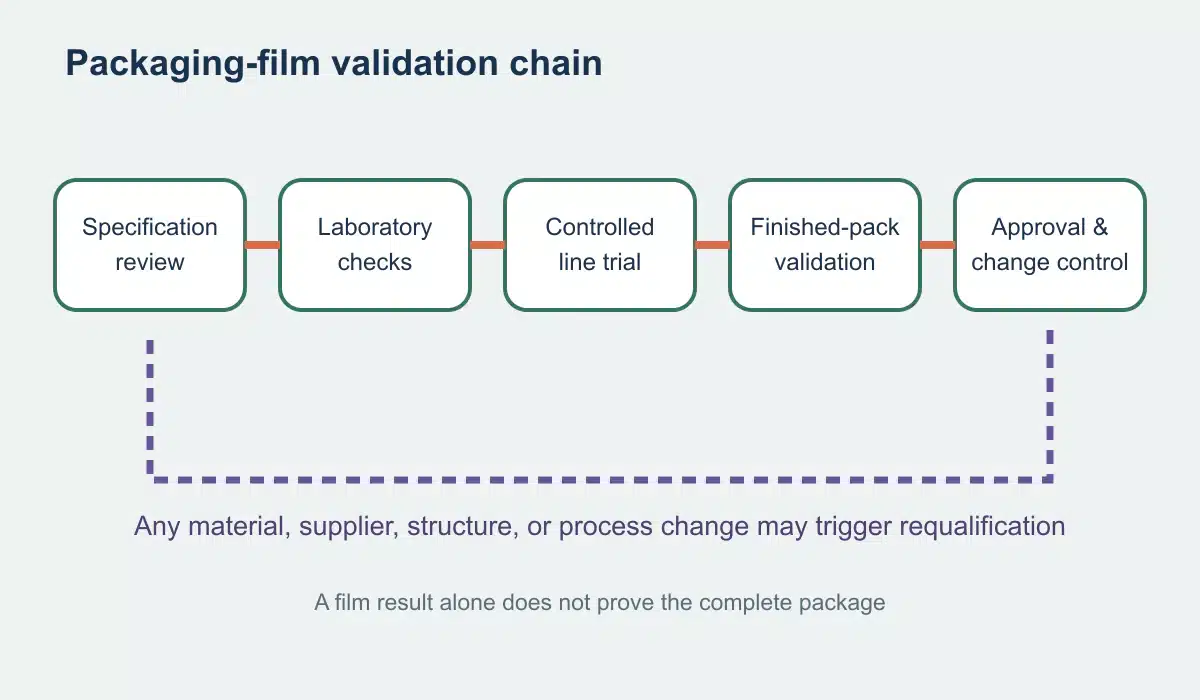
A controlled qualification process prevents a promising datasheet from becoming an expensive line problem.
- Freeze the requirement. Record product geometry, weight, edges, sensitivity, package format, distribution, shelf-life conditions, target market, and line speed.
- **Identificar o filme exato.**. Capture supplier, grade, resin or layer structure, thickness and tolerance, treatment, additives or functional options, roll width, core, roll diameter, winding, and storage limits.
- Review comparable data. Check whether every value states method, units, specimen direction, conditioning, and typical-versus-guaranteed status.
- Run relevant laboratory checks. Select mechanical, optical, friction, shrink, seal, hot-tack, barrier, migration, or other methods based on failure risk. Do not test irrelevant properties merely because they appear on a standard form.
- Conduct a controlled line trial. Record sealer and tunnel settings, dwell, pressure, airflow, conveyor speed, film tension, ambient conditions, downtime, scrap, and visual defects.
- Evaluate the finished pack. Inspect seals, corners, distortion, openings, print, scuffing, package integrity, load stability, and performance after storage and transport simulation.
- Aprove com controle de alterações. Link the accepted sample, specification, compliance documents, settings window, test results, supplier, manufacturing site, and revision. Define which changes require requalification.
Importante: Passing a film test does not automatically prove a bag, sleeve, multipack, pallet load, or food-contact application. Approval belongs to the defined packaging system and conditions.
Check Food-Contact and End-of-Life Claims Carefully
Food-contact status attaches to substances and articles under defined uses, not to an informal family name. The regulamentações da FDA describes food-contact substances as packaging and other components intended to contact food without a technical effect in the food. A supplier must identify the applicable authorization for the exact composition and intended food type, temperature, and contact duration.
In the EU, Regulamento (UE) n.º 10/2011 da Comissão establishes specific requirements for plastic food-contact materials, including authorized substances, restrictions, and migration concepts. Compliance still depends on the complete material, declarations, intended use, and applicable testing. “FDA approved,” “food grade,” or “EU compliant” should never be accepted as a stand-alone family-level statement.
End-of-life claims need similar discipline. A base PE or polyolefin layer may be technically recyclable under some design guidance, yet labels, inks, adhesives, coatings, barriers, closures, pigments, contamination, local collection, and sorting can change the outcome. PVC streams also depend on local collection and product design. Avoid “100% recyclable,” “eco-friendly,” or universal material rankings unless a current target-market assessment supports the completed package.
What to request in a supplier RFQ and compliance file
- exact product and grade, manufacturing site, and document revision;
- resin and layer structure, total and layer thickness, additives, treatment, print, coating, and adhesive information relevant to the claim;
- typical and guaranteed properties with methods, units, conditioning, MD/TD direction, and tolerance;
- food-contact declaration or authorization references matched to food type, contact time, and temperature;
- migration or other test reports where required, including laboratory, sample, date, method, simulant, and conditions;
- target-market recycling or design assessment for the complete decorated package;
- statement of what the evidence supports and what it does not; and
- change-notification and requalification rules.
Perguntas Frequentes
Is polyethylene the same thing as polyolefin?
No. Polyethylene is one member of the broader polyolefin family. Polypropylene and other olefin polymers also belong to that family. In packaging sales, “POF” may additionally mean a commercial shrink-film category, so ask the supplier which meaning is intended and request the exact grade and construction.
Is POF shrink film always made from the same resin structure?
No. Commercial POF shrink films can differ by resin selection, layer design, orientation, crosslinking, additives, surface treatment, and functional options. The label alone cannot establish composition or performance. Use the current TDS, declaration, and sample qualification for the exact grade.
Which film is best for shrink packaging?
It depends. A qualified PVC grade may suit some retail packs or neck bands; a commercial POF grade may suit many display-shrink applications; and PE shrink film may suit heavier bundling. Compare product sensitivity, appearance, shrink force, seal window, equipment, distribution duty, compliance, waste route, and total operating cost before approving a grade.
Can polyethylene be used as both shrink film and stretch film?
Yes, but not as the same functional product by default. PE shrink film is engineered to contract with heat, while PE stretch film is applied under elongation and relies on recovery, cling, and holding force. Specify the process and test the matching film type on the intended equipment.
Are PVC, POF, and PE films suitable for food contact?
It depends on the exact formulation and use. None of the three family labels alone proves suitability. Request applicable U.S., EU, or other target-market documentation for the exact grade, food type, contact duration, temperature, and completed structure. Confirm migration or other testing where the intended use requires it.
Which of these films is recyclable?
It depends on the completed package and local system. PE and other polyolefin structures may fit some film-recycling routes when design, collection, and sorting requirements are met. PVC may have different, often more limited local routes. Evaluate labels, inks, adhesives, barriers, closures, contamination, collection, and the target recycler’s current acceptance criteria rather than relying on the resin name.
Related Packaging Guides
- Embalagens Flexíveis para Alimentos: Um Guia sobre o que Você Precisa Saber
- Filmes de CPP: Soluções Ideais de Embalagem Flexível
- Guia de Filme Selável a Quente: Aplicações, Tipos, Funções
- Guia Definitivo sobre Filme BOPE: Benefícios, Aplicações, Tipos
- O Guia Definitivo: Todos os Tipos de Embalagens de Espuma
- Quais São os Diferentes Tipos de Embalagens de Isolamento Comuns?
- Cold Chain Packaging Solutions of Food
- Filme Esticável de LLDPE: O Guia Definitivo
 English
 Japanese
 French
 Spanish
 Korean
 Italian
 Portuguese
 Dutch
Dutch Arabic
 Russian
 German