
POF shrink film can be a practical retail pack for selected fruits and vegetables, but it is not a one-film solution for every commodity. The right package depends on the produce’s respiration and moisture behavior, the chosen pack format, the film’s verified seal and shrink response, the packaging line, and the distribution temperature profile. Buyers should therefore specify functions rather than rely on labels such as “breathable” or “food grade,” then confirm the result through product-specific line, distribution, shelf, and food-contact review.
Where POF Shrink Film Fits in Produce Packaging
For regulatory context, consult the U.S. FDA’s food-packaging guidance before approving an intended food-contact use.
For regulatory context, consult the U.S. FDA’s food-packaging guidance before approving an intended food-contact use.
POF is a commercial family description not a complete material specification It commonly refers to heat-shrinkable films based on polyolefin resin families but the exact polymers layer sequence additives orientation treatment gauge and manufacturing route are supplier and grade-specific Those details determine.
What POF Can Contribute
For a suitable application a clear shrink film can form a close enclosure around an individual item a supported tray or a retail bundle The package may improve containment reduce direct handling hold loose units together and limit moisture loss compared with fully exposed produce A tight clear pack.
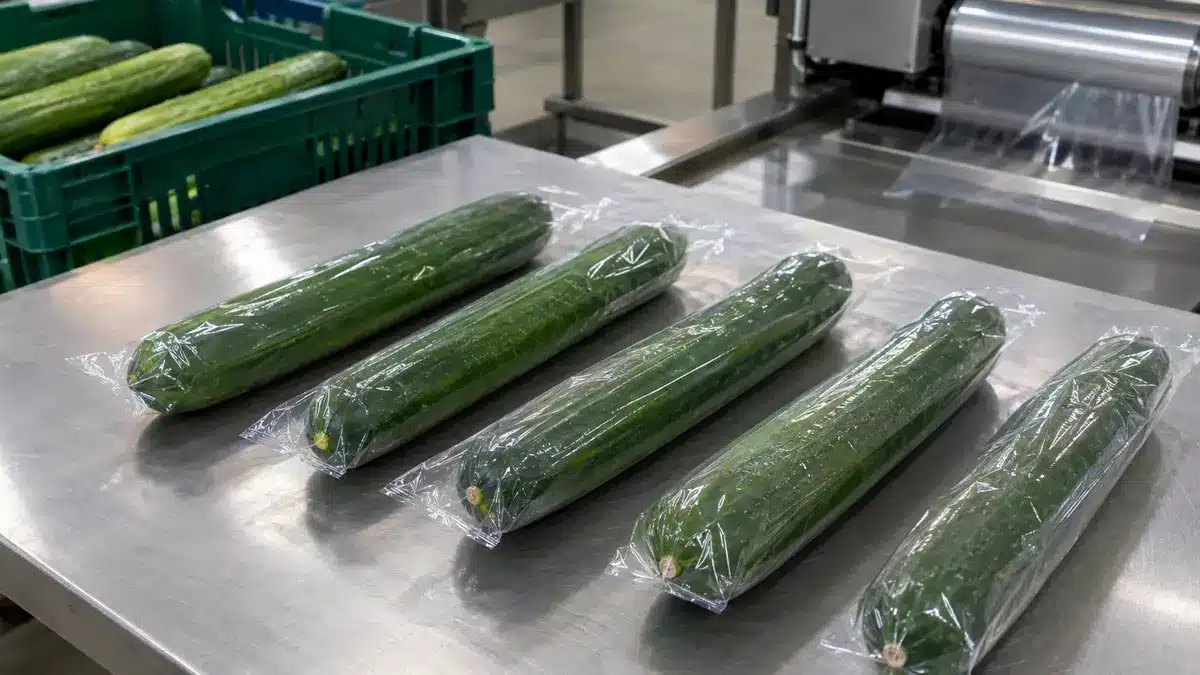
These are packaging functions, not guaranteed outcomes. The useful combination depends on the selected grade and the whole package:
- The produce must tolerate the wrapping and shrink process.
- The pack must provide appropriate gas and moisture exchange.
- The film must seal to itself under the actual jaw conditions.
- Shrink force and shrink balance must not bruise the product or distort the tray.
- The completed package must survive handling, cooling, storage, and display.
What POF Cannot Prove by Itself
The word “polyolefin” does not establish oxygen transmission, water-vapor transmission, perforation flow, anti-fog response, puncture resistance, seal strength, shrink force, or a safe tunnel setting. It also does not prove direct-food-contact suitability, a shelf-life extension, microbial safety, or acceptance in a local recycling program.
Important: Treat “POF,” “food grade,” “breathable,” and “anti-fog” as starting descriptions. Approval should rely on the exact film construction, its supporting documents, and a trial using the intended produce, pack, line, and distribution conditions.
Why Produce Respiration Changes the Film Decision
Fresh fruits and vegetables remain biologically active after harvest. They consume oxygen, release carbon dioxide, lose water, and generate heat. Cutting, maturity, cultivar, handling, and temperature can change those rates. A package that works for one commodity or season may therefore create the wrong atmosphere or moisture balance for another.
Match Gas Exchange to the Commodity and Temperature
A sealed plastic enclosure restricts air movement. As the produce respires, oxygen can fall and carbon dioxide can rise inside the package. Gas also moves through the film and any perforations. The eventual atmosphere is a system result involving the produce mass and respiration rate, temperature, headspace, film area, film permeability, perforation pattern, seal integrity, and time.
This is why “breathable film” is too vague for engineering approval. The buyer should identify the commodity, variety, cut or whole condition, maturity, pack weight, expected temperature profile, and target distribution time. The supplier should then state whether gas exchange comes primarily from the film structure, defined perforations, package openings, or a combination.
Fresh-cut produce needs particular caution. USDA Agricultural Research Service work shows that film oxygen transmission and the starting headspace interact with the respiration of fresh-cut products. A shrink overwrap should not be treated as a designed modified-atmosphere package unless its gas balance, product quality, and food-safety controls have been validated for the exact product and process.
Treat Moisture Control and Condensation as Separate Decisions
Restricting water-vapor loss can reduce dehydration and weight loss, but a humid headspace also creates a risk of droplets when product or package temperature changes. Condensation can appear on the produce, the tray, or the inner film surface. Pre-cooling, dry product surfaces, cold-chain stability, airflow, headspace, film water-vapor transmission, ventilation, and absorbent components can all affect the result.
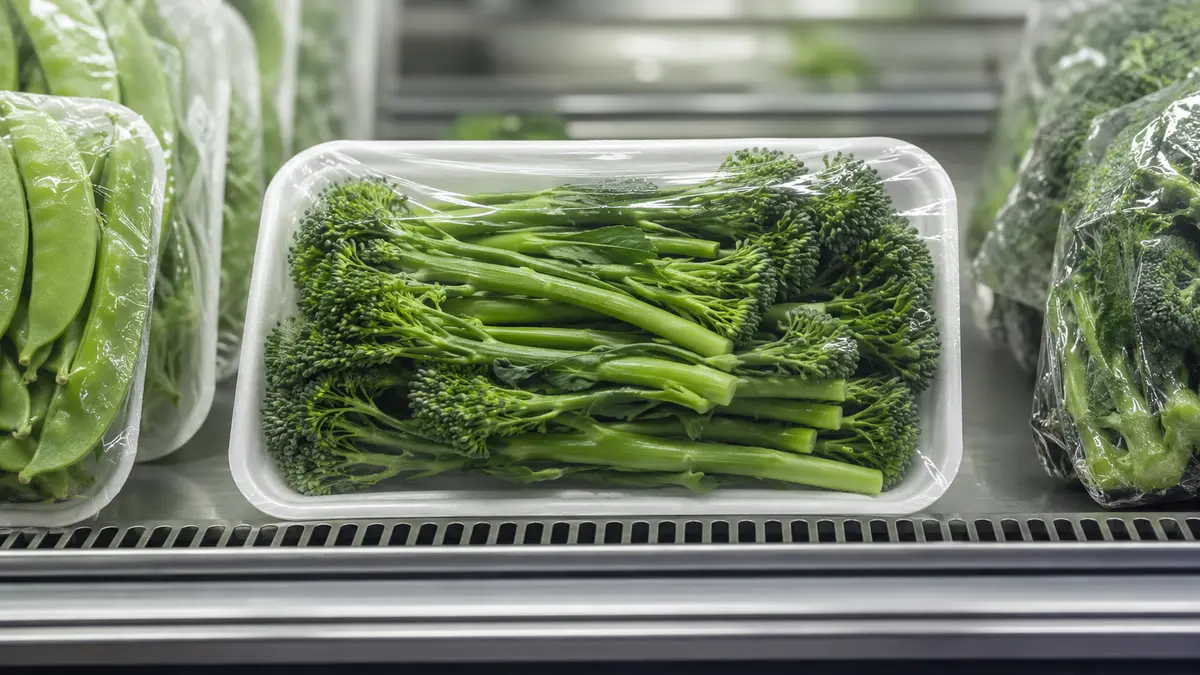
Anti-fog technology addresses visibility by changing how condensed water wets the film surface. It may spread discrete droplets into a more transparent layer, but it does not remove water from the package, control oxygen and carbon dioxide, or correct a poor temperature profile.
Warning: Do not solve visible fog alone while ignoring free water, product temperature, gas balance, or decay. Record both optical appearance and actual condensation during the trial.
Configure the Film Around the Pack Format
Choose the physical pack before fixing the film specification. An individual wrap, tray overwrap, and retail multipack create different headspace, support, sealing, ventilation, shrink-force, and handling conditions.
Individual Wraps for Whole Produce
Individual wrapping can suit whole, relatively robust items when a close pack helps limit moisture loss or direct handling. Long or regular shapes may be easier to present smoothly than produce with deep stems, sharp projections, or highly variable geometry. The trial should examine surface marking, heat exposure, seal location, perforation placement, label adhesion, opening by the consumer, and whether the wrap traps water around natural cavities.
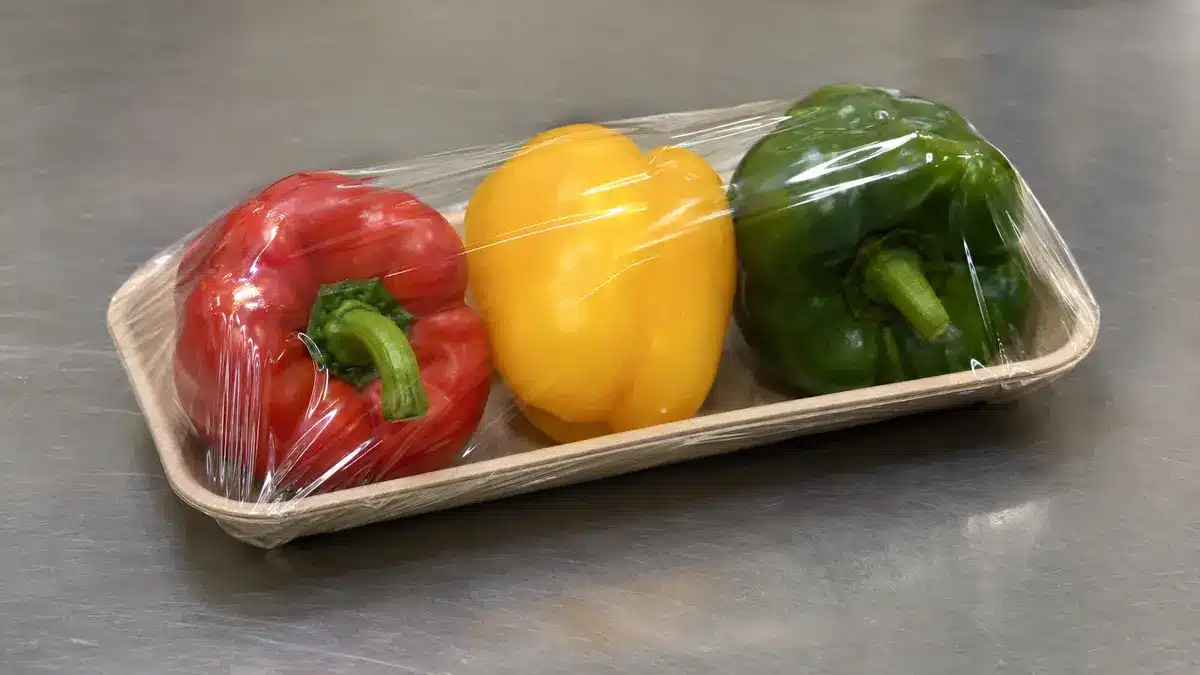
Tray Overwraps for Fragile or Mixed Items
A tray can support small, irregular, mixed, or bruise-sensitive produce while the film provides containment and visibility. The design must consider tray stiffness, rim geometry, vents, headspace, contact points, pad or insert compatibility, and the risk of tray distortion during shrinking. If the film or seal contacts food, that contact mode belongs in the food-contact review.
Retail Multipacks and Bundles
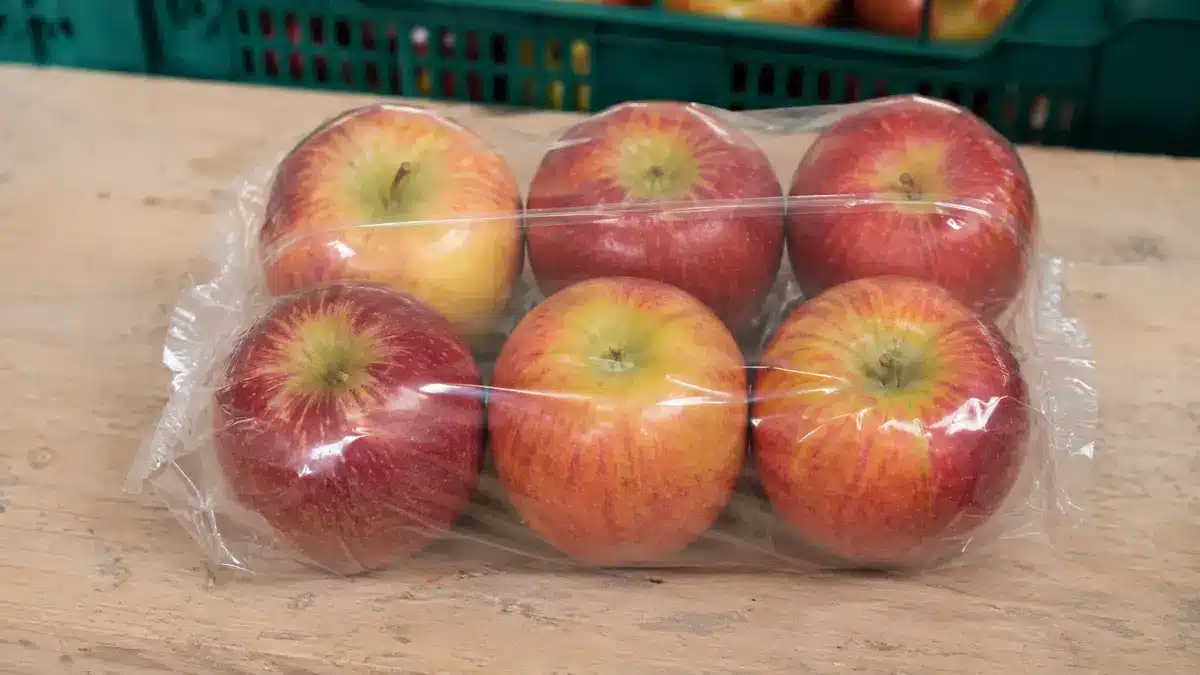
A shrink bundle can group several fruits or vegetables for retail handling without forcing a close wrap around every surface. The design still needs adequate ventilation, stable unit count, resistance to tearing at stems or edges, and a shrink force that does not squeeze or mark the contents. A secondary bundle should not be assumed to control the produce atmosphere in the same way as a sealed primary pack.
| Pack format | Main reason to consider it | Primary risk | What to verify |
|---|---|---|---|
| Individual wrap | Close presentation and reduced direct exposure | Heat or shrink pressure on the commodity | Surface condition, gas exchange, seal position, opening |
| Tray overwrap | Support for small, mixed, or fragile items | Tray distortion, trapped moisture, or poor vent alignment | Tray compatibility, headspace, vents, seals, condensation |
| Retail multipack | Unitization and shelf handling | Compression, tearing, or restricted cooling | Bundle stability, ventilation, puncture points, cooling rate |
Specify Perforation, Anti-Fog, Seal, and Shrink Behavior
Perforation, anti-fog, sealing, and shrinking solve different problems. Combining them under a general “produce film” label makes RFQs difficult to compare and trials difficult to diagnose.
Choose Non-Perforated or Perforated Film Deliberately
A non-perforated film is not necessarily gas-impermeable; gases and water vapor can still move through the polymer structure at rates that depend on the exact film and test conditions. A perforated film adds defined openings that can dominate air and moisture exchange. Micro- and macro-perforation are useful commercial terms, but the name alone does not specify hole dimensions, open area, pattern, registration, or flow.
For a perforated option, request the perforation method, nominal hole geometry, pattern across the web, tolerance, orientation on the finished pack, and inspection method. Evaluate the formed package, not just a flat film sample. Sealing, shrinking, folds, labels, and tray rims can block or relocate the effective openings.
For a non-perforated option, request gas- and water-vapor-transmission data for the exact structure and gauge under stated temperature, humidity, test-side, and unit conditions. Do not transfer a resin value or another gauge’s data to the proposed film.
Use Anti-Fog for Visibility, Not as a Ventilation Claim
Specify when clear viewing is required, how quickly the anti-fog effect should develop, the storage and display temperatures, the expected humidity cycle, which film surface carries the function, and how long performance must persist. Inspect both the film and the food-facing environment.
An anti-fog result should be judged against an agreed optical method or visual scale under controlled conditions. It should not be reported as evidence that the package has enough oxygen, releases enough carbon dioxide, removes free water, or extends shelf life.
Define the Seal and Shrink Window for the Pack
The supplier should provide a seal window and shrink response for the exact film rather than one “recommended temperature.” Seal evaluation needs the sealing layer, jaw configuration, temperature, pressure, dwell time, cooling, peel direction, and failure mode. Shrink evaluation needs the machine conditions, film direction, shrink balance, shrink force, and appearance criteria.
The acceptable operating window is the overlap where seals remain intact, the film shrinks uniformly, vents stay functional, the tray and produce are not damaged, and line speed is stable. Test the low, nominal, and high sides of that window because a single attractive package does not show process tolerance.
Important: Gauge is only one variable. A thicker film is not automatically more puncture-resistant, easier to seal, or safer for produce; construction, orientation, additives, perforations, and process conditions also matter.
Match the Film to the Packaging Line and Heat Exposure
Film selection and machine selection are linked. A grade that seals and shrinks well on one line may behave differently when jaw design, tunnel airflow, conveyor support, line speed, or cooling changes.
Map the Sealer, Tunnel, Conveyor, and Cooling Step
Document the process in sequence before the trial:
- Record unwind direction, web width, fold, tension control, and product loading.
- Record sealer type, jaw coating and condition, seal geometry, pressure, dwell time, and temperature control.
- Record tunnel zones, air velocity and direction, conveyor type, exposure time, and load spacing.
- Record the cooling step and the time before packs are stacked, cased, or moved into cold storage.
- Identify where perforations, labels, tray vents, or product projections can contact jaws, guides, or hot surfaces.
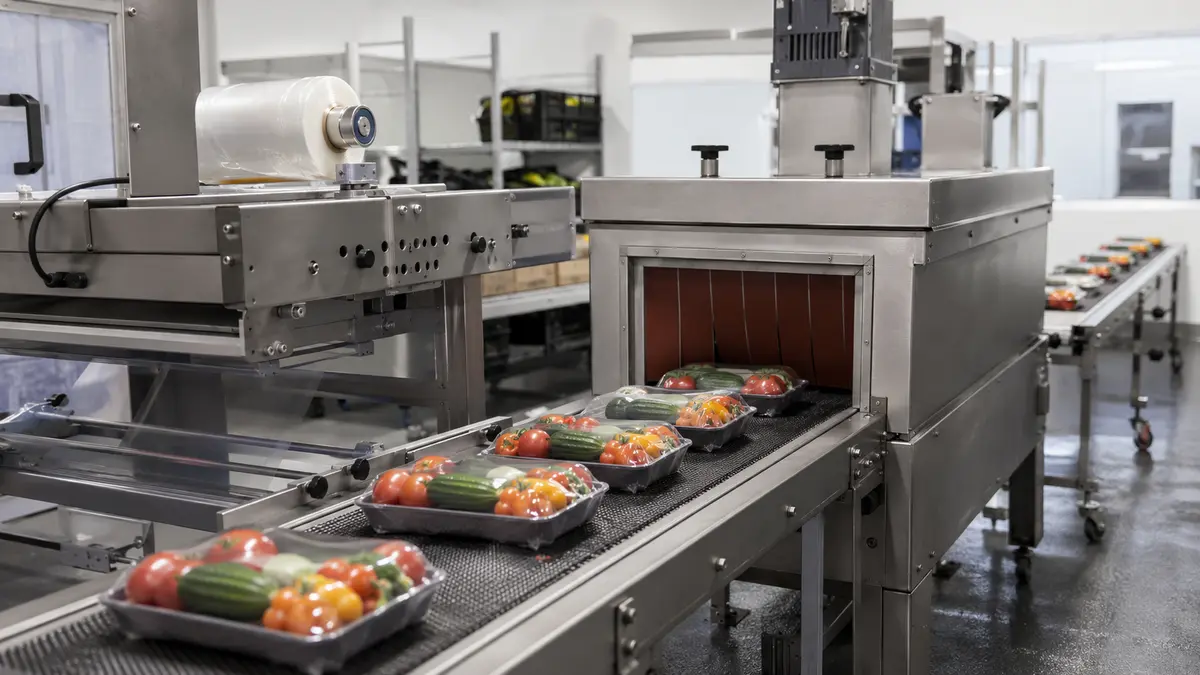
This map makes defects easier to trace. Weak seals may come from contamination, insufficient dwell, excessive tension, or cooling rather than from the film alone. Wrinkles and “dog ears” may reflect bag size, air evacuation, tunnel balance, or product geometry.
Protect Heat-Sensitive Produce and Trays
The heat source acts on the film, but the produce and tray also experience a time-temperature history. Sensitive commodities may show surface dehydration, softening, discoloration, or other quality changes after a seemingly brief exposure. Lightweight trays can curl or collapse, changing headspace and vent alignment.
Start with the machine supplier’s limits and the film supplier’s technical data, then use instrumented or otherwise controlled trials with sacrificial product. Measure or indicate temperature at relevant product and package locations instead of assuming the tunnel setpoint equals product temperature.
Warning: A visually tight pack is not proof that the produce tolerated the process. Inspect immediately and again after the intended storage and display period.
Build an RFQ That Suppliers Can Answer
A useful RFQ describes the decision problem and asks for comparable evidence. If the buyer sends only a product name and roll width, the supplier must guess at the most important variables.
| RFQ field | Buyer should provide | Supplier should return | Evidence or acceptance basis |
|---|---|---|---|
| Produce | Commodity, variety, whole or cut, maturity, pack mass, surface condition | Declared application assumptions | Sample identification and trial lot record |
| Pack architecture | Individual, tray, or multipack; dimensions; headspace; contact mode | Proposed film format and web dimensions | Dimensioned pack drawing or approved sample |
| Film construction | Required gauge range, fold, width, print or label, treatment | Polymer/layer description permitted for disclosure, nominal gauge, tolerances | Product-specific TDS and specification |
| Gas and moisture exchange | Respiration data, temperature profile, target distribution time | Film transmission data and/or perforation specification | Test method, conditions, units, gauge, side, tolerance |
| Anti-fog | Viewing requirement, humidity and temperature cycle, duration | Anti-fog type, treated side, handling limits | Agreed optical or visual test under trial conditions |
| Seal and shrink | Sealer, tunnel, conveyor, line speed, tray and produce constraints | Seal window, shrink response, shrink force guidance | Supplier data plus line-trial process window |
The completed table should reveal missing evidence early. If a value is not yet known, label it as a trial variable rather than converting a typical value into a guaranteed specification.
Validate the Pack Before Commercial Release
Commercial approval should follow a controlled trial, not a successful hand sample. Use traceable film and produce lots, a written process window, a comparison pack where useful, and a pre-agreed sampling plan.
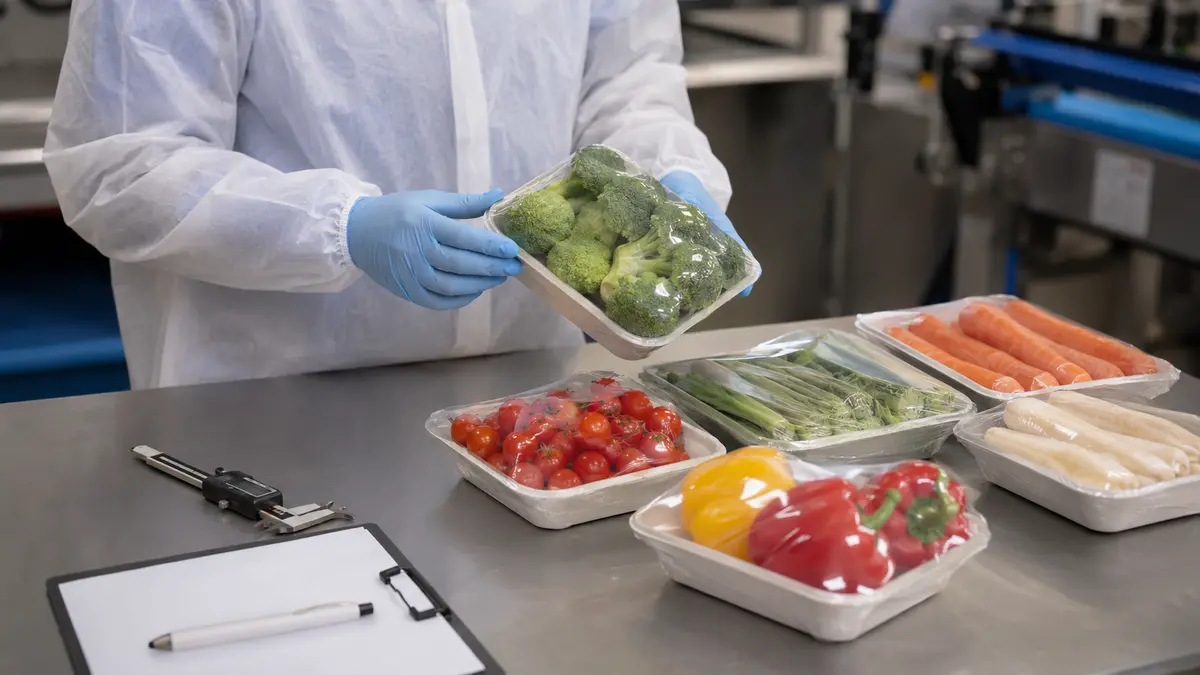
Run a Controlled Line Trial
Begin with safe machine settings supported by the equipment and film suppliers. Change one major variable at a time so the cause of a defect remains visible.
- Confirm film identity, gauge, width, winding, treated side, and perforation orientation.
- Establish seal formation at low, nominal, and high process conditions within the safe equipment range.
- Adjust air evacuation and shrink for an acceptable package without excessive product or tray exposure.
- Run long enough to observe warm-up, steady state, roll change, and normal operator intervention.
- Record rejects, seal defects, tears, wrinkles, vent blockage, tray distortion, downtime, and actual output conditions.
Retain samples from defined positions in the run. A short run of only the best-looking packs can hide process drift and material variation.
Simulate Distribution and Shelf Conditions
Move trial packs through the intended temperature, humidity, handling, case-packing, transport, storage, and retail-display sequence. Include realistic transitions, because rewarming and temperature fluctuations can create condensation even when a steady cold-room check looks acceptable.
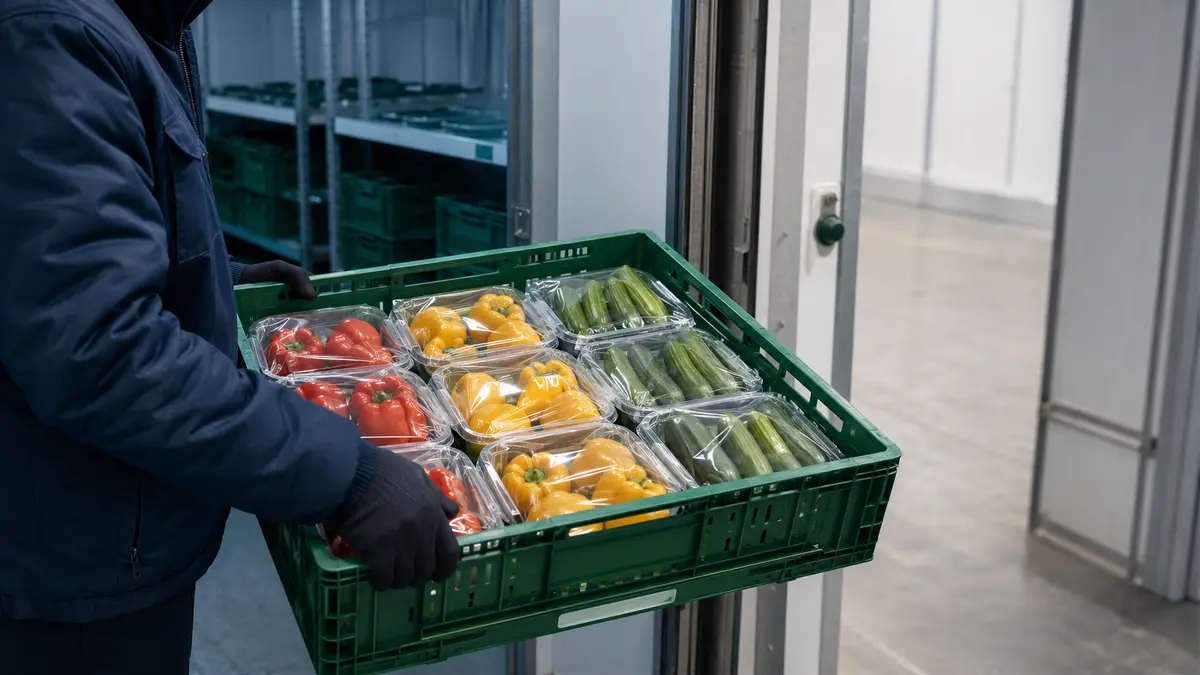
Inspect seals, punctures, abrasion, pack tightness, blocked vents, fog, free water, product surface, weight change, color, texture, odor, and visible decay at scheduled points. Where the pack is intended to control atmosphere, measure headspace gases with a defined method. Where food safety or shelf-life is claimed, use an appropriate validated protocol and qualified laboratory rather than visual inspection alone.
Set Acceptance Criteria Before the Test
Acceptance criteria should cover the package, product, process, and documents:
- Seal integrity and failure mode under defined conditions
- Shrink appearance without unacceptable product pressure or tray distortion
- Perforation presence, position, and freedom from blockage
- Condensation and anti-fog performance on an agreed scale
- Product quality at defined time and temperature points
- Package survival after the chosen handling and transport sequence
- Stable operation within an agreed process window and reject limit
- Complete food-contact and specification documentation
Define sample size, allowable defects, measurement method, decision owner, and how a failed criterion will be investigated. This prevents appearance from overriding a safety, quality, or compliance failure.
Verify Food-Contact and Environmental Claims
Performance approval and regulatory approval are separate gates. A film can run well and still lack the documents required for the target use, or it can have appropriate food-contact support and still fail on the line.
U.S. and EU Evidence Is Use-Specific
In the United States, 21 CFR 177.1520 covers specified olefin polymers subject to stated identities, specifications, and limitations. FDA food-contact notifications and other authorizations also have defined substances, intended uses, conditions, and restrictions. The commercial label “POF” is not itself an approval.
For a U.S. project, request documentation for the exact finished film and its components, identify the food type and direct or indirect contact, and confirm the intended time and temperature conditions. Check whether the basis is a regulation, an effective notification, another applicable authorization, or a supported no-migration position.
In the European Union Regulation EC No 1935 2004 provides the framework Regulation EU No 10 2011 sets specific rules for plastic materials and articles and Regulation EC No 2023 2006 addresses good manufacturing practice For the proposed film request a current declaration of compliance where required supporting composition.
Do Not Turn Polyolefin into a Recyclability Claim
Resin family alone does not prove that a finished produce pack will be collected, sorted, reprocessed, or accepted locally. The film may include multiple polyolefin types, additives, inks, labels, adhesives, perforations, pads, trays, or food residue. Each can affect the recycling pathway and the wording permitted in the target market.
Ask for the complete package construction, evidence behind any design-for-recycling statement, instructions for separating components, and confirmation from the relevant local collection or assessment system. Keep source reduction, technical recyclability, recycled content, and actual recycling rates as separate claims.
Important: Avoid unqualified terms such as “eco-friendly,” “100% recyclable,” or “zero waste.” Environmental language needs a defined package, geography, recovery system, and substantiation.
Frequently Asked Questions
Is All POF Shrink Film Suitable for Direct Food Contact?
No. Suitability depends on the exact film construction and the applicable authorization for the intended food, contact mode, time, temperature, and market. Request current product-specific documentation rather than relying on the resin-family name.
Does Anti-Fog Film Make a Package Breathable?
No. Anti-fog changes the way condensed moisture appears on the film surface. Gas exchange depends on the film structure, area, perforations, openings, seals, temperature, and package geometry.
Can One Perforation Pattern Work for Every Fruit and Vegetable?
No. Required gas and moisture exchange varies with commodity, variety, cut condition, maturity, pack mass, temperature, headspace, and distribution time. Treat the perforation pattern as a trial variable supported by respiration and package data.
What Information Should a Buyer Send with a Sample Request?
Send the produce identity and condition, pack format and dimensions, contact mode, film and roll constraints, machine details, temperature profile, ventilation and anti-fog needs, target market, expected distribution time, known failure risks, and written acceptance criteria. Photos or drawings can clarify geometry, but they do not replace measurements or approved specifications.
A Safe POF Solution Starts With the Product and the Trial
POF shrink film is best treated as a configurable packaging platform rather than a finished answer. Start with the commodity, temperature profile, pack format, and contact mode. Convert those inputs into explicit requirements for gas and moisture exchange, perforation, anti-fog, sealing, shrinking, mechanical protection, and line fit. Then review product-specific food-contact evidence and validate the full package through the intended process and distribution route. Without those steps, clarity and a tight wrap remain appearance features—not proof of freshness, safety, compliance, or commercial readiness.
Related Bestypack Resources
- What Is The Best Shrink Wrap For Packaging Food?
- Polyolefin POF Shrink Films Supplier
- PVA Shrink Film Water Soluble Shrink Film
- POF vs PVC Shrink Films: The Ultimate Comparison
- What Size POF Shrink Film Do I Need?
- Is Pof Shrink Film Biodegradable?
 English
 Japanese
 French
 Spanish
 Korean
 Italian
 Portuguese
 Dutch
Dutch Arabic
 Russian
 German