
Pre-stretch film is stretch wrap that has been elongated before it reaches the load, either during roll production or inside a powered stretch-wrapper carriage. The approach can reduce the force needed at application and make film delivery more repeatable, but it does not guarantee lower cost or better load stability by itself. Buyers should match the film and application method to the pallet, distribution hazards, equipment, and acceptance tests before changing a wrap specification.
What Is Pre-Stretch Film?
For polymer background, consult the NIH PubChem polyethylene overview before comparing finished-film claims.
For polymer background, consult the NIH PubChem polyethylene overview before comparing finished-film claims.
“Pre-stretch” describes when elongation occurs, not a complete material specification. The term is commonly used for two different systems: a factory pre-stretched hand roll and a machine process that stretches film immediately before it reaches the pallet. Confusing them can lead to the wrong roll format, equipment setting, or performance expectation.
Factory Pre-Stretched Hand Film
Factory pre-stretched hand film is elongated under controlled conditions and then rewound onto a roll. Because much of the elongation has already occurred, an operator normally needs less pulling force to dispense and apply it than is needed to stretch a conventional hand film at the pallet.
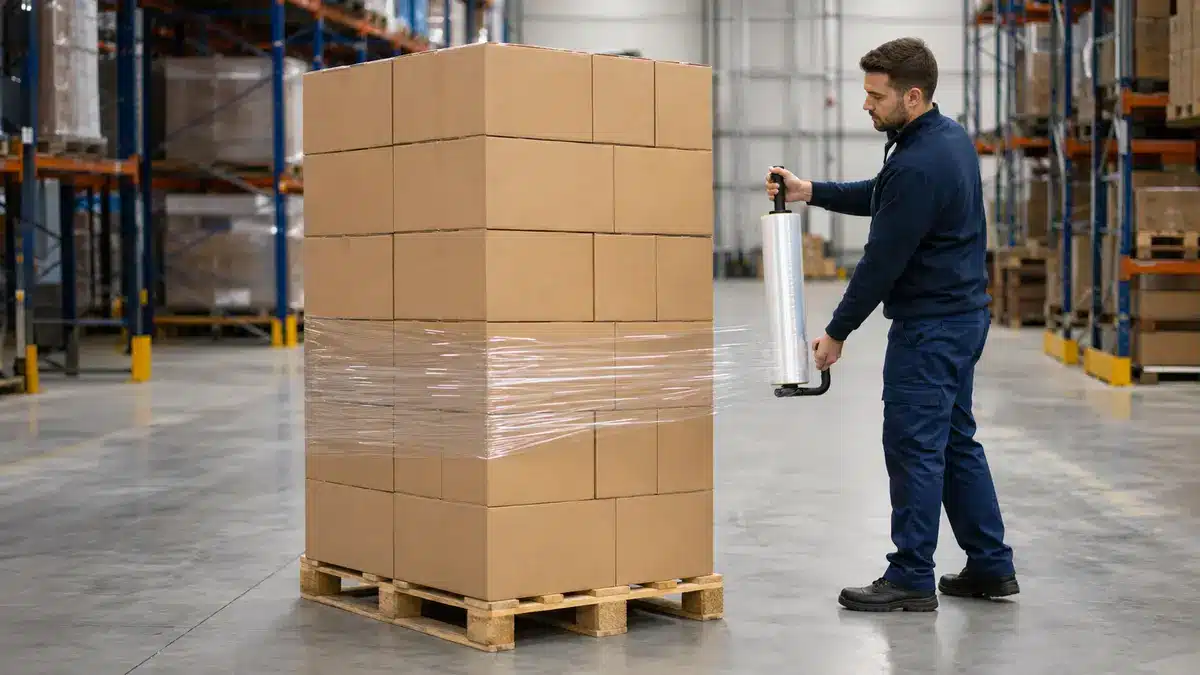
The label does not identify the polymer grade, layer structure, supplied thickness, tolerance, cling arrangement, or remaining stretch. Those details are specific to the supplier and grade. A purchasing specification should therefore record the film identity and the thickness after factory stretching, rather than relying on a conversion from the film’s original gauge.
Machine Pre-Stretch
Machine pre-stretch is an application process In a powered pre-stretch carriage the film passes between rollers operating at different surface speeds The speed differential elongates the film before controlled film force is applied to the load The carriage ratio film feed load rotation and.
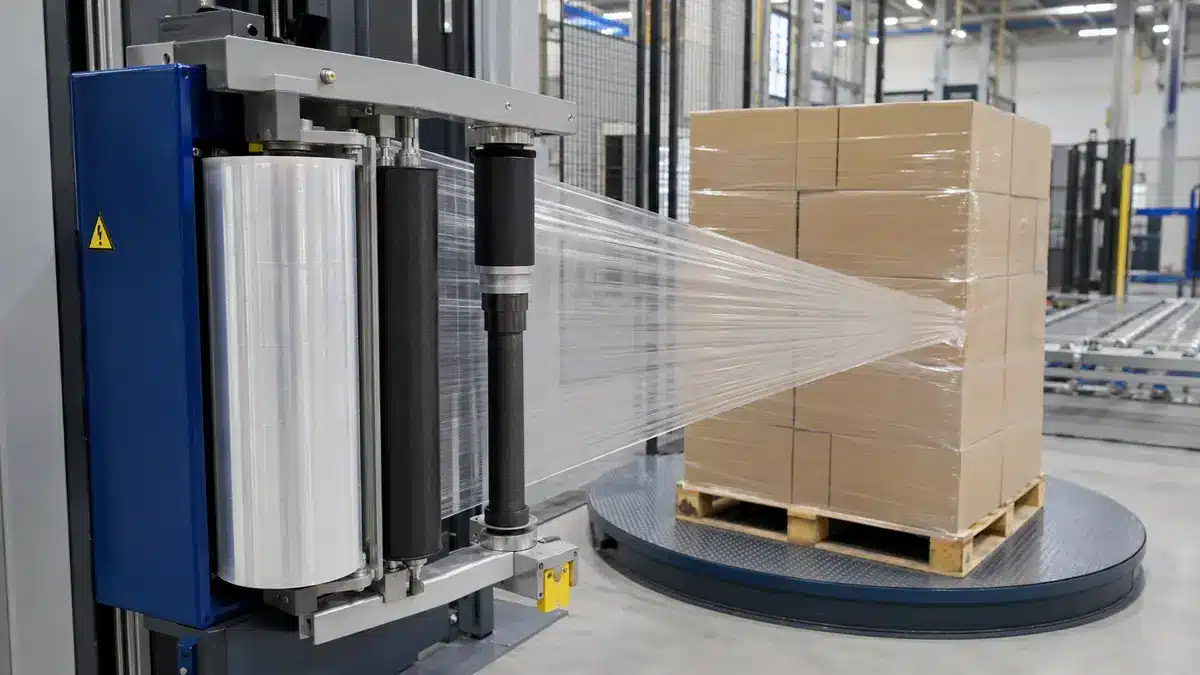
A machine pre-stretch setting is not interchangeable with a factory pre-stretched hand roll. The roll dimensions, film properties, carriage design, and operating recipe must be compatible. A nominal pre-stretch percentage also does not describe the complete wrap result.
Key Features of Pre-Stretch Film
Pre-stretch products and systems are selected for a combination of handling and process features. Each feature should be verified for the proposed grade and application:
- Lower application effort: Factory pre-stretched hand film generally requires less operator-generated elongation, while a powered carriage creates elongation mechanically.
- More controlled film delivery: Factory processing or a defined roller ratio can reduce variation in how much film is stretched before it reaches the load.
- Potentially lighter hand rolls: A thinner supplied film can reduce roll mass, but roll weight, length, core, and usable area must be compared from actual specifications.
- Reduced neck-down in some applications: Less width loss during dispensing can improve coverage, although the result depends on film construction, remaining stretch, tension, and wrapping technique.
- Elastic recovery and stress retention: These properties help an applied film remain snug as the load and film relax, but they require defined extension, conditioning, and test methods.
- Film-to-film cling: Cling helps successive layers stay together. Cling side, stretch state, contamination, and test conditions affect the result.
- Repeatable process settings: A controlled roll and wrap recipe can reduce operator-to-operator variation, provided overlap, wrap count, film force, and load preparation are also controlled.
Important: These features describe mechanisms to evaluate, not guaranteed outcomes. Film consumption, ergonomics, containment, damage, and total cost still depend on the complete film–equipment–load–distribution system.
Pre-Stretch Film vs. Conventional Stretch Film
The most useful direct comparison is between factory pre-stretched hand film and conventional hand film. Machine pre-stretch should be evaluated separately as an equipment process. The table below uses common buying criteria and intentionally avoids universal percentage or load claims.
| Decision factor | Factory pre-stretched hand film | Conventional hand film | What to verify |
|---|---|---|---|
| Where primary elongation occurs | Before rewinding the sale roll | Mainly while the operator wraps the pallet | Supplier definition of factory stretch and remaining stretch |
| Operator-generated force | Usually lower | Usually higher because the operator creates more elongation | Dispenser, wrap technique, force, and operator trial |
| Supplied thickness | Often lower, but grade-specific | Available across a broad thickness range | Actual thickness, tolerance, method, and usable roll length |
| Width control | May show less neck-down at comparable application conditions | Width may narrow more as the operator pulls | Applied width, overlap, and coverage on the target load |
| Elastic behavior | Recovery and stress retention depend on the final film state | Recovery and stress retention depend on achieved stretch | Method, extension level, dwell time, and temperature |
| Puncture and tear response | Formulation and thickness dependent | Formulation and thickness dependent | Comparable puncture, tear, and applied-load trials |
Neither option is automatically stronger, cheaper, or more sustainable. Compare film mass per accepted load, the wrap pattern, damage and rework, labor, and disposal or recovery routes under the same operating conditions.
Common Applications for Pre-Stretch Film
Pre-stretch approaches are most useful when they solve a defined application problem. A scenario can justify a trial, but it cannot replace load-specific validation.
Manual Pallet Wrapping
Factory pre-stretched hand film can suit operations with occasional pallets, variable wrapping locations, or no dedicated stretch-wrapper station. Lower pulling demand and a lighter roll can make repeated handling easier, while controlled film delivery may help standardize the wrap.
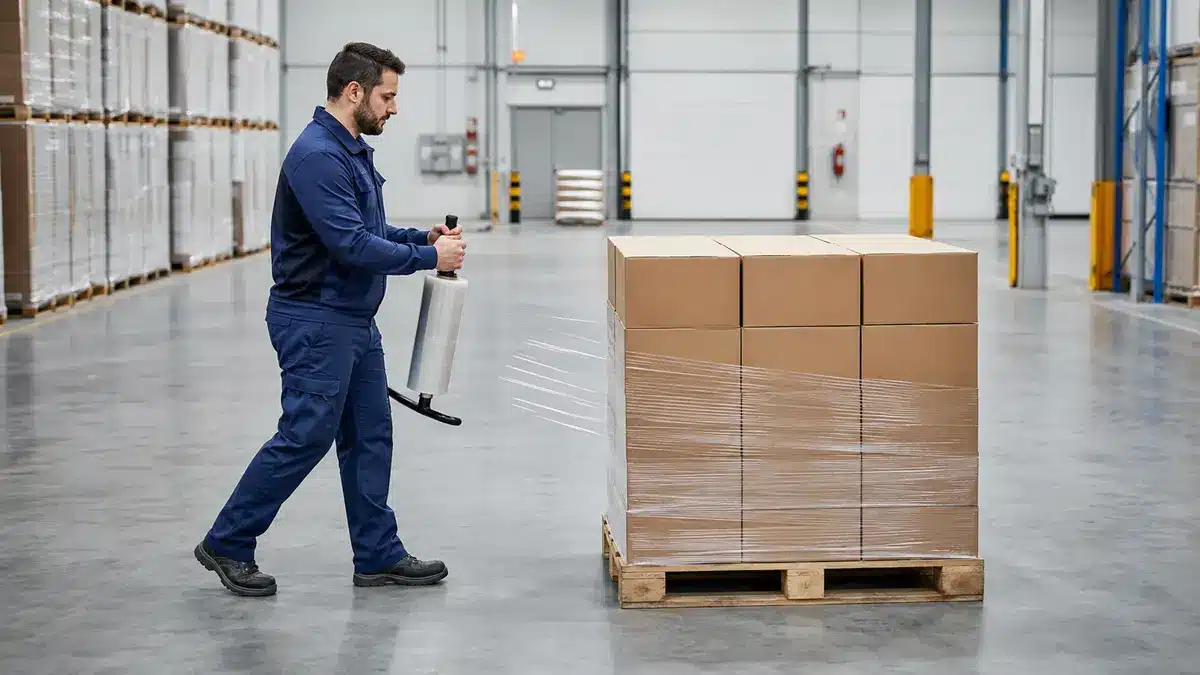
The operating method still matters. Define the dispenser, starting attachment, bottom and top wraps, overlap, travel direction, and finish. Training should also address walking path, posture, and keeping hands away from pallet damage and sharp edges.
Mixed or Irregular Loads
Mixed-SKU and irregular pallets can benefit when a compliant film follows changing contours without demanding high operator pull. This can be useful for warehouse consolidation, retail distribution, returns, and short-run shipments.

Irregular does not mean automatically suitable Protruding corners gaps overhang unstable tiers and crushable products can concentrate stress or allow the load to move under the film Rebuild the pallet where possible protect critical edges and.
Machine-Wrapped Unit Loads
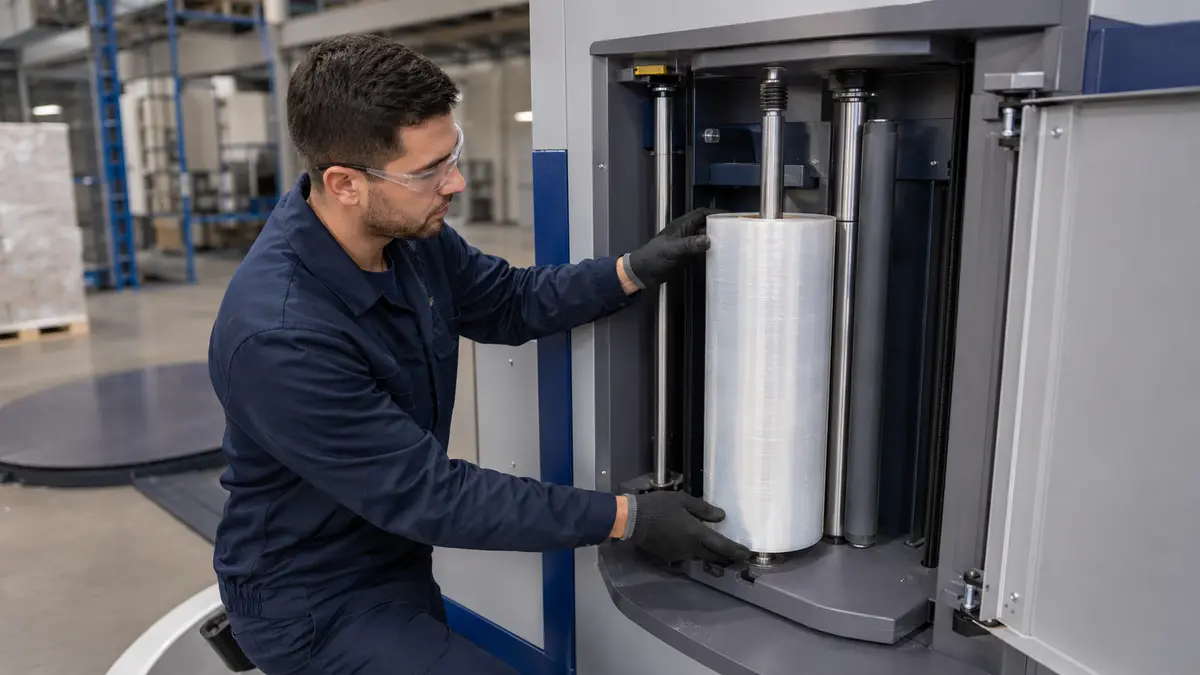
Powered machine pre-stretch is commonly evaluated for repeatable or higher-volume pallet flows. A controlled carriage can apply a defined elongation and film feed more consistently than a manual process. It can be used with turntable, rotary-arm, or other suitable stretch-wrapping systems when the film, carriage, load, and speed are compatible.
Do not transfer a machine recipe between loads without review. A tall light load, a dense stable load, and a compressible load may require different film force, overlap, number of layers, top and bottom reinforcement, and cycle speed.
Warning: A stable-looking pallet immediately after wrapping may still relax, tear, crush, or shift during storage and distribution. Approval should include a defined dwell period and hazards representative of the shipping route.
When Pre-Stretch Film May Not Be the Best Fit
Lower application force is useful only when the selected film and wrap pattern can survive the load and distribution cycle. Treat the following conditions as screening triggers:
- Sharp corners or protrusions → puncture or tear → loss of coverage or containment. Improve pallet geometry, use edge protection, evaluate a more puncture-tolerant film, or change the wrap pattern before approval.
- Crushable cartons or light products → excessive wrap force → deformation or compression damage. Measure applied containment at several heights and reduce film force or change the recipe without sacrificing stability.
- Unstable stacking or excessive overhang → product movement under the wrap → progressive load failure. Correct the pallet pattern first; stretch film should not be expected to repair poor unitization.
- Extreme temperature or outdoor exposure → changed film behavior or weathering → reduced performance. ASTM D4649 is scoped to indoor environments and notes that extreme temperatures can negatively affect performance. Use application-specific evidence for other conditions.
- Frequent changes in load geometry → one fixed recipe → inconsistent results. Create approved load families and documented recipes rather than forcing one film setting across every pallet.
- Incompatible roll or carriage → poor unwind, damaged edges, or uncontrolled film feed → downtime and variable wraps. Confirm width, core, roll diameter, winding, cling orientation, and equipment settings before the trial.
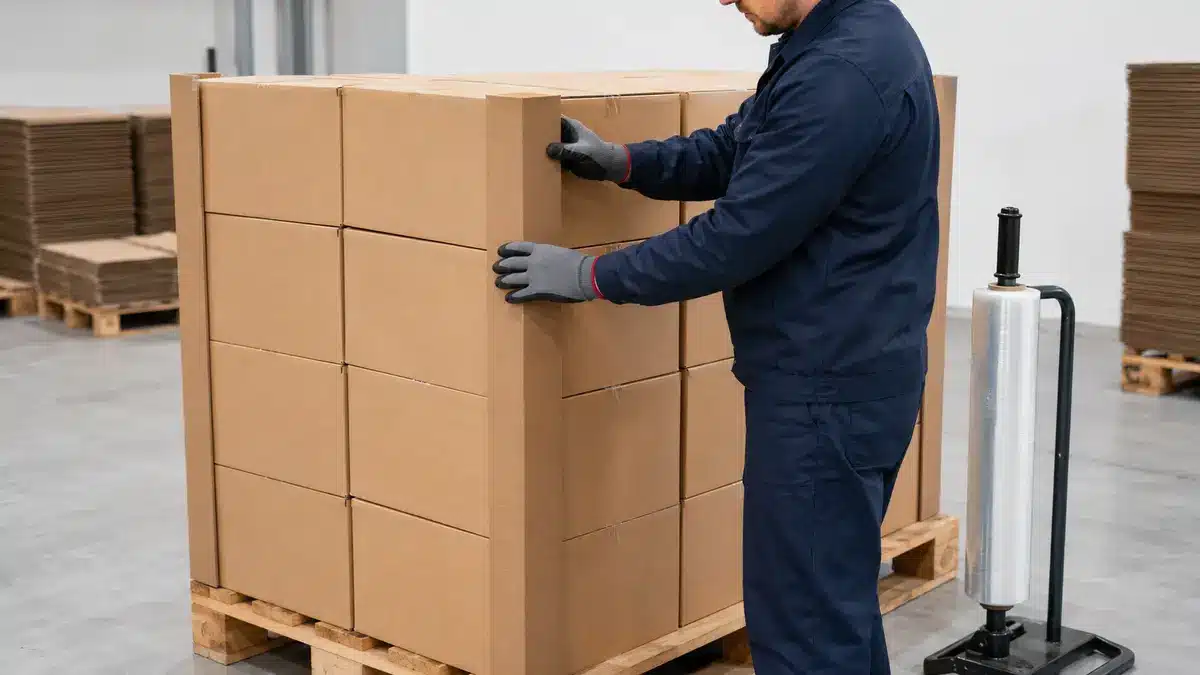
These conditions do not automatically reject pre-stretch film. They indicate where conventional film, a different grade, better pallet preparation, added protection, another wrapper setup, or a more demanding validation plan may be safer.
How to Choose a Pre-Stretch Film
Selection works best as an ordered process: define the load and route, compare films on equivalent fields, then match the application method. Starting with a target gauge or a claimed savings percentage reverses that logic.
- Define the load and distribution profile.
- Compare film and roll specifications on equivalent fields.
- Match the application method and document its settings.
Define the Load and Distribution Profile
Document pallet dimensions total mass center of gravity stacking pattern overhang sharp edges voids and.
Group loads only when their risks and acceptance criteria are genuinely similar. A mixed retail pallet and a uniform case load may need different wrap patterns even if their dimensions and weight are close.
Compare Film and Roll Specifications
Ask suppliers to return the same fields in the same units. At minimum, compare the following:
| Specification field | Required detail | Why it matters |
|---|---|---|
| Film identification | Grade, polymer description, layer or construction statement if disclosed, and lot traceability | Prevents comparison of unnamed or changing products |
| Thickness | Nominal value, unit, tolerance, measurement method, and sampling plan | Avoids treating a marketing gauge as an exact value |
| Roll format | Width, usable length, core inside diameter, roll diameter, winding direction, and roll mass | Confirms handling and dispenser or carriage fit |
| Pre-stretch definition | Factory process or machine setting, stated basis, and remaining-stretch guidance | Prevents confusion between product and equipment terms |
| Cling | Cling side and test condition, such as stretched or unstretched under ASTM D5458 | Affects layer-to-layer attachment |
| Recovery and stress retention | Extension level, conditioning, dwell time, direction, and method such as ASTM D5459 | Describes time-dependent snugness under stated conditions |
Do not compare isolated values from different methods, directions, thicknesses, or conditions. A resin name or generic “LLDPE” description is also insufficient to predict the performance of a finished multilayer stretch film.
Match the Application Method
For hand use, specify the dispenser, roll position, operator method, overlap, wrap count, reinforcement zones, and finish. For machine use, record the wrapper model, carriage type and ratio, film-feed and force controls, turntable or arm speed, carriage speed, number of top and bottom revolutions, and load recipe.
Check that the roll physically fits and unwinds in the correct direction. Then confirm that the resulting wrap stays inside the film’s usable operating window. A film that runs on one wrapper or load is not automatically approved for another.
How to Test Performance Before Approval
Use two linked evidence levels. Film tests compare controlled material properties; applied-load trials determine whether the film and wrapping process work together on the real unit load. One level cannot replace the other.
Film-Level Tests
Select methods that match the risk and record the full conditions. ASTM D882 covers tensile properties of thin plastic sheeting; for stretch film, report thickness, specimen direction, conditioning, test speed, and the exact result and unit. ASTM D5458 measures peel cling between two film layers in stretched and unstretched conditions. ASTM D5459 addresses machine-direction elastic recovery, permanent deformation, and stress retention at specified extensions. ASTM D5748 measures protrusion puncture resistance at defined test conditions.
These tests help compare samples and lots, but they do not reproduce every pallet corner, wrap pattern, temperature, impact, or vibration event. Do not rank products by a single “strength” value taken from different methods.
Applied-Load Trials
ASTM D8314 covers performance testing after stretch film has been applied by hand or machine to a unit load or test structure. Build the trial around the intended load family and distribution route. Record the film lot, roll data, pallet and product configuration, application equipment, pre-stretch setting or factory film identity, film force, overlap, number of layers, wrap zones, cycle speed, and dwell time.
Define acceptance criteria before testing. Useful observations can include film mass per accepted load, applied containment at the bottom, middle, and top, tail retention, tears or holes, carton deformation, load shift, pallet overhang, and performance after appropriate handling, impact, vibration, or storage simulation. The criteria should reflect the organization’s actual damage and stability risks rather than an invented universal threshold.
A published unit-load study tested several pre-stretch levels and found that higher pre-stretch alone did not produce a significant increase in initial or final containment force in that system. The result is not universal, but it reinforces the need to validate the complete film, wrap pattern, load, and distribution combination rather than treating pre-stretch percentage as a performance guarantee.
Important: Freeze the trial method before comparing candidates. Changing the load, overlap, wrap count, film force, or acceptance rule between runs makes the result unsuitable for a controlled sourcing decision.
Frequently Asked Questions
Is Pre-Stretch Film Always Thinner Than Conventional Film?
No. Factory pre-stretched hand films are often sold at a lower supplied thickness than common conventional hand films, but “pre-stretch” describes processing, not a universal gauge. Compare the actual thickness in micrometers or mils, its tolerance and method, roll dimensions, usable length, and tested performance.
Does More Pre-Stretch Automatically Mean Better Load Containment?
No. Pre-stretch changes film elongation and material delivery, while containment also depends on film force, elastic behavior, wrap pattern, number and location of layers, load geometry, dwell, and distribution hazards. A higher setting can reduce film mass in some controlled systems, but it must remain inside the film and wrapper’s stable operating window.
Can One Pre-Stretch Film Specification Cover Every Pallet?
Usually not without defined load families and validated recipes. Uniform, irregular, tall, heavy, crushable, chilled, or sharp-edged loads can impose different demands. A common film may be possible, but each approved load family should have documented application settings and acceptance evidence.
How Should Material Savings Be Verified?
Run a controlled before-and-after comparison using equivalent loads and acceptance criteria. Measure the mass of film consumed per accepted load, not just roll price, nominal length, or wrap count. Also track damage, rewraps, rejected pallets, downtime, and labor under the same observation period. Report the load mix, equipment, recipe, film specification, and sample size with the result.
A Practical Approval Checklist
Pre-stretch film should be approved as part of a controlled load-unitization system, not from a label or headline percentage. Before release, confirm:
- the term “pre-stretch” is defined as factory pre-stretched hand film or a machine-carriage process;
- the film grade, construction statement, thickness, tolerance, roll format, winding, and lot traceability are documented;
- the load family, pallet pattern, sharp or crushable features, storage, handling, and distribution route are recorded;
- the hand dispenser or machine model, carriage, settings, overlap, wrap count, and reinforcement zones are fixed;
- film-level tests use comparable methods, directions, thicknesses, conditioning, units, and extension levels;
- applied-load trials use predetermined acceptance criteria and representative dwell and distribution hazards;
- film consumption is measured by mass per accepted load together with damage, rework, downtime, and labor;
- any food-contact, recycling, recycled-content, or environmental statement is supported separately for the exact product, market, use, and supply chain; and
- the approved specification and recipe identify what must trigger revalidation.
With those controls in place, pre-stretch film can be evaluated on measurable application performance rather than on gauge, marketing equivalence, or pre-stretch percentage alone.
Related Bestypack Resources
- Select the Appropriate Stretch Film Width and Thickness
- Machine Stretch Film Blown & Cast
- Stretch Film Thickness: What You Need to Know
- Heavy Duty Stretch Film 80 120 Gauge
- How to Calculate the Usage of Stretch Film?
- stretch film
 English
 Japanese
 French
 Spanish
 Korean
 Italian
 Portuguese
 Dutch
Dutch Arabic
 Russian
 German