
Filme stretch is not classified on one single scale. A roll may be described at the same time as machine film, cast film, and UV-stabilized film because those labels answer different questions. The most useful way to understand the market is to sort film by application method, manufacturing process, and special function. This guide explains those overlapping categories and shows buyers how to move from a type name to a controlled load trial.
A Practical Classification of Stretch Film
For polymer background, consult the NIH PubChem polyethylene overview before comparing finished-film claims.
Stretch film, also called stretch wrap, is an extensible film applied under tension to unitize items, often on a pallet. Its recovery after stretching helps maintain force around the load. Unlike filme retrátil, it does not need heat to contract around the goods. ASTM D4649 addresses the selection, specification, and use of stretch films for unitizing and palletizing in indoor environments, which is an important scope limit: a generic “stretch film” label does not establish outdoor performance.
Three classification axes keep the terminology clear:
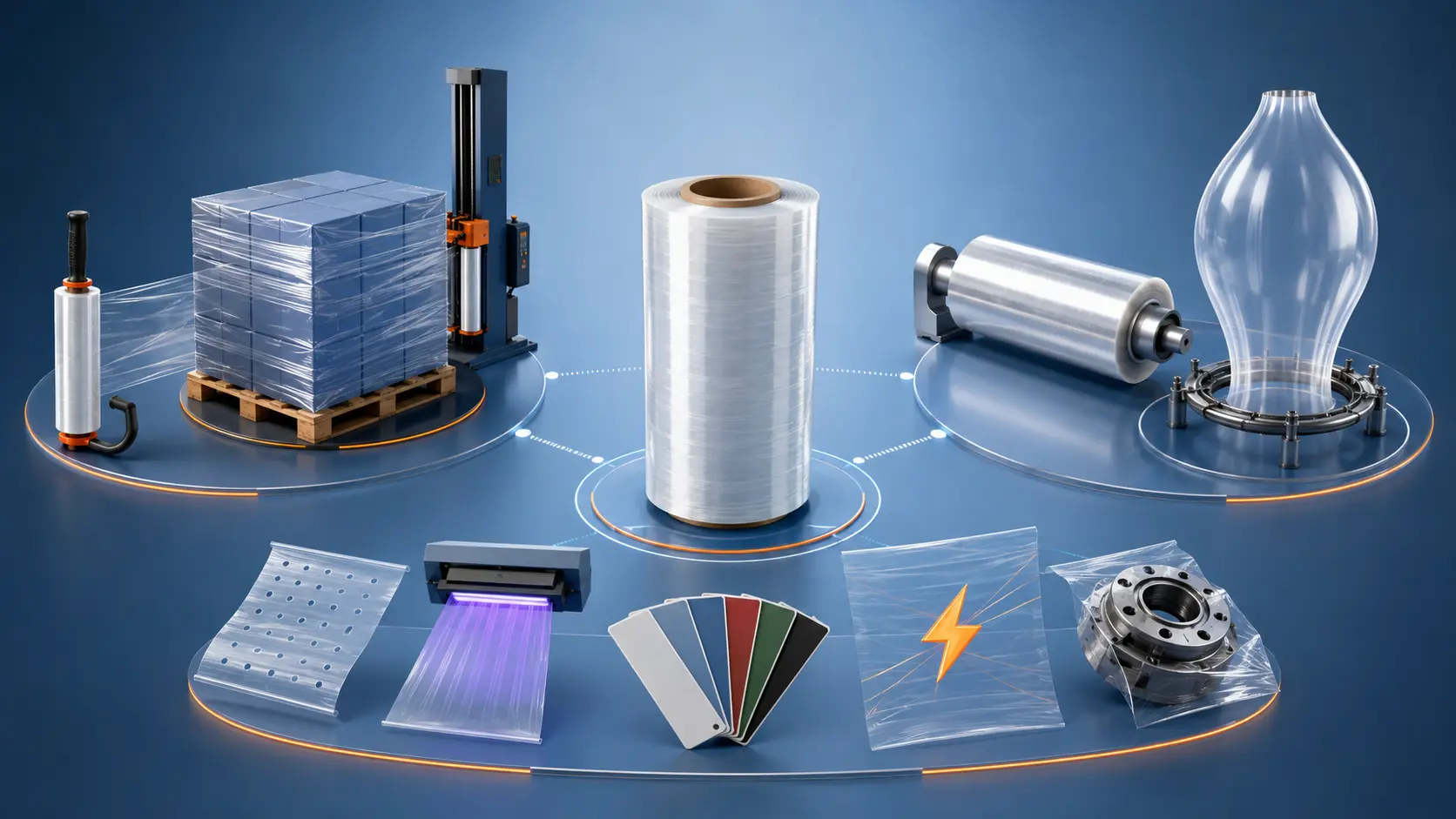
- Application method: hand, machine, or supplied in a pre-stretched form.
- Processo de fabricação: cast or blown extrusion.
- Special function: venting, UV stabilization, color or opacity, anti-static behavior, corrosion inhibition, or another documented feature.
These axes overlap. For example, a film can be machine-applied, made by cast extrusion, and colored. “Cast” does not mean “hand film,” and “pre-stretched” does not identify the extrusion process. Buyers should therefore compare full specifications, not isolated type names.
Types by Application Method
Application method is the first practical filter because it determines roll format, operator interaction, and compatibility with wrapping equipment.
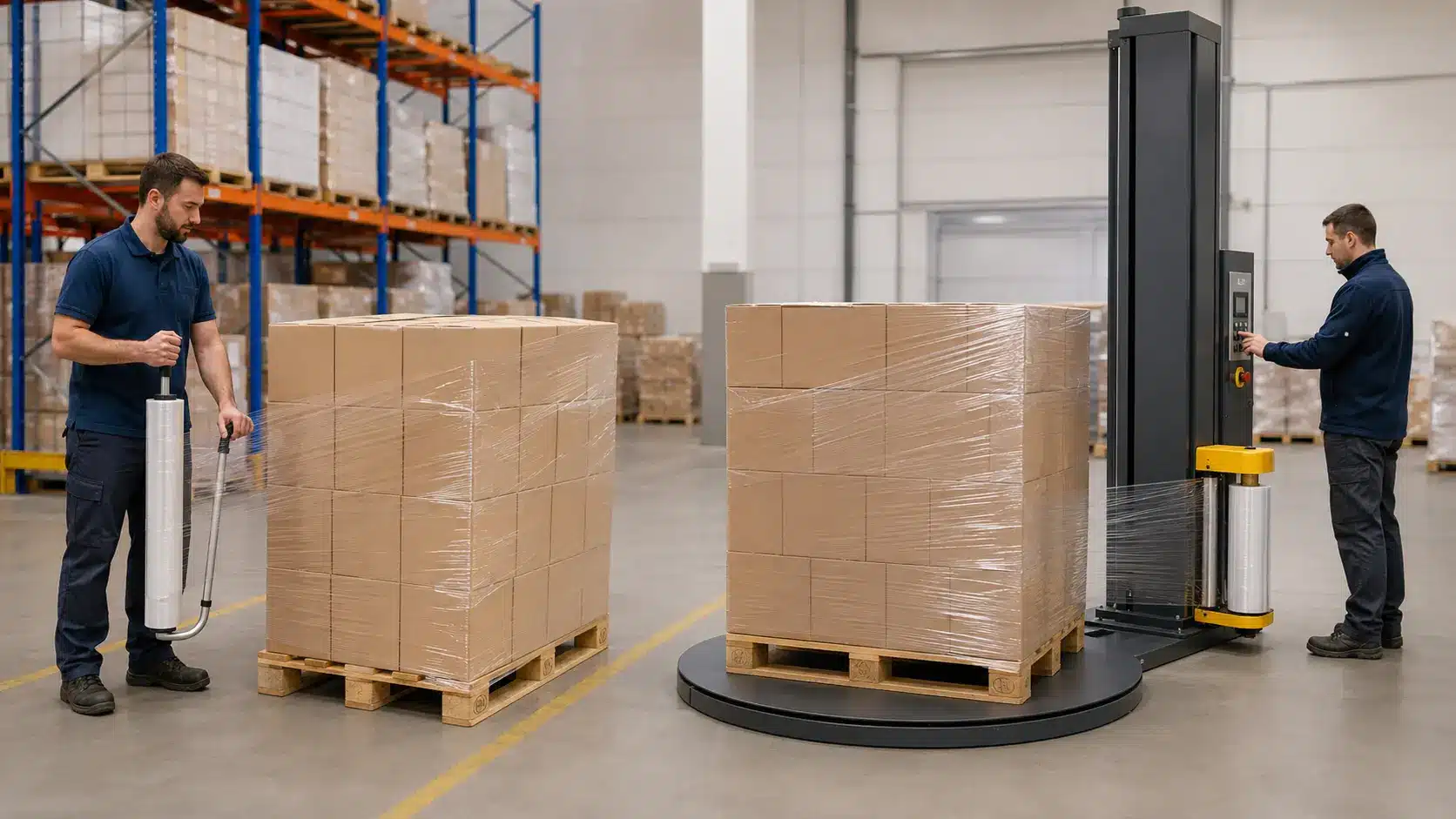
Filme Estirável Manual
Hand stretch film is designed for manual application, usually with a dispenser. It is useful where wrapping is intermittent, loads are handled in different locations, or access around a pallet is limited. The operator controls film tension and overlap, so results can vary with technique, load geometry, fatigue, and the dispenser.
Manual wrapping also creates ergonomic considerations. The U.S. Occupational Safety and Health Administration advises using rolls that weigh as little as practical and a handle when manual wrapping is necessary. An operation should assess reach, bending, pulling force, repetition, roll handling, and training rather than choosing hand film only because the initial equipment cost is low.
Importante: There is no universal pallet-per-day threshold that automatically makes hand or machine film correct. The decision depends on load risk, required consistency, labor exposure, available space, and the economics of the complete wrapping process.
Filme Esticável para Máquina
Machine stretch film is engineered for use on a compatible semi-automatic or automatic wrapper. The film, roll dimensions, core, unwind behavior, stretch capability, and tension response must suit the film-delivery system. A properly set process can apply a more repeatable wrap pattern than uncontrolled manual application, but the machine does not make every film interchangeable.
The equipment supplier’s settings and the film supplier’s operating window should be treated as starting inputs. The trial must confirm film breaks, corner behavior, applied tension, overlap, top-to-bottom containment, load deformation, cycle reliability, and film use per accepted load. Changing the film while keeping every machine setting fixed can produce a misleading comparison.
Filme Pré-Esticado
Pre-stretched film has already been elongated before it is wound onto the finished roll. It generally requires less pull during application than a conventional film that is stretched mainly while being wrapped. Pre-stretched formats are available for manual use and can also be part of machine-film strategies, so “pre-stretched” is a condition of supply rather than a separate extrusion family.
The buyer should verify the supplied roll length, width after neck-down, residual stretch, roll handling, and the force achieved on the actual load. A lighter-feeling application is not proof that the finished pallet has adequate containment.
Types by Manufacturing Process
Cast and blown are the two most common process families used to describe stretch film. The process affects film morphology and typical handling characteristics, but finished performance also depends on resin selection, layer construction, additives, thickness, orientation, and quality control.
Filme Esticável Fundido
Filme fundido (cast film) is formed through a flat die and cooled rapidly on chilled rolls. Commercial cast stretch films are commonly selected when clarity, smooth and relatively quiet unwind, and consistent machine handling are important. Clear film can make labels and pallet contents easier to see.
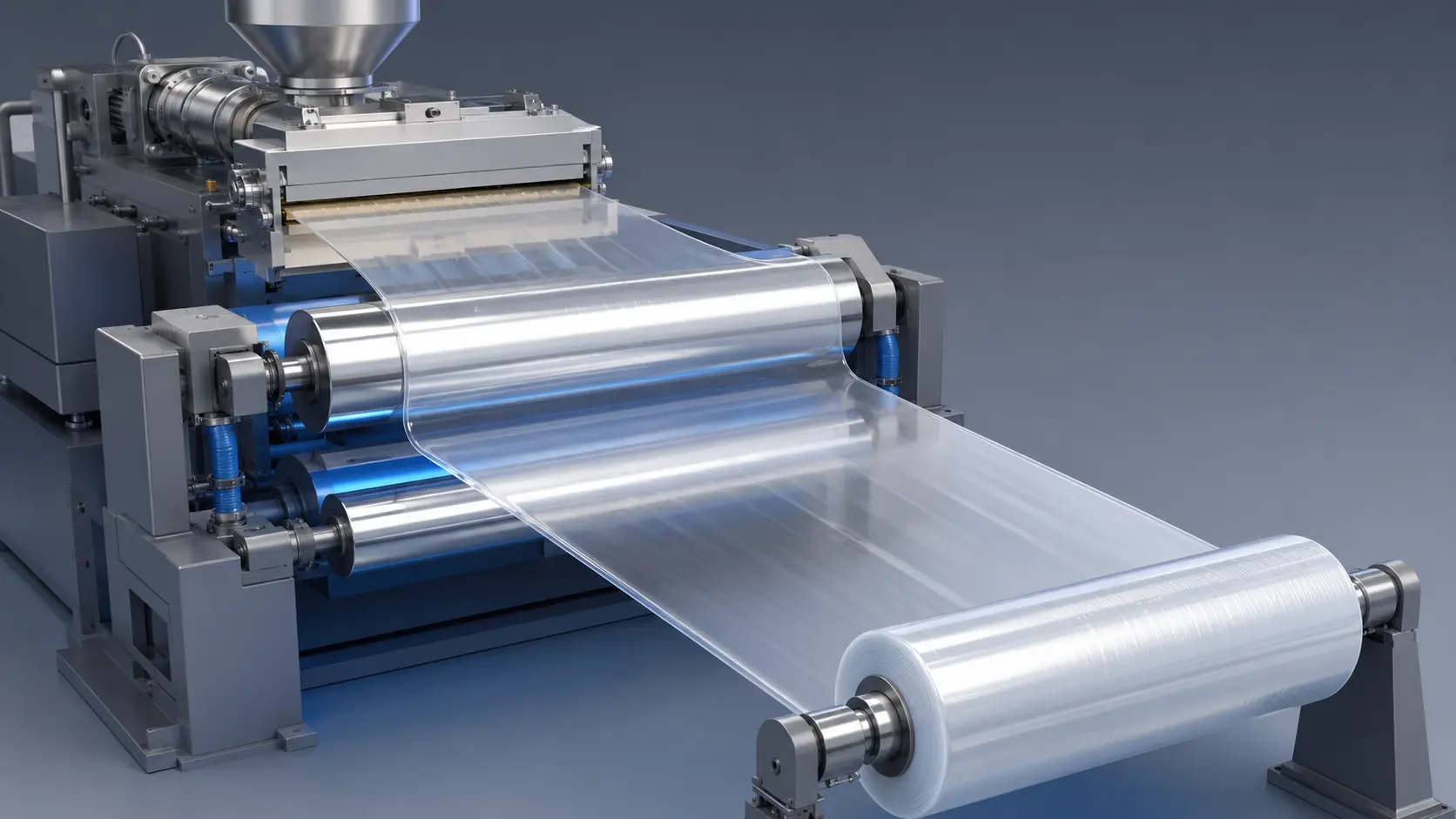
Those are typical tendencies, not guaranteed values. A buyer comparing cast grades should request test methods and results for properties that matter to the load, such as puncture behavior, tear propagation, cling, elongation, elastic recovery, and force at the intended application conditions.
Filme Stretch Soprado
Filme soprado (blown film) is extruded through an annular die as a tube, inflated, cooled, collapsed, and converted into rolls. Blown stretch films are often considered where puncture challenge, irregular geometry, or demanding load retention is a priority. They may also have a hazier appearance and a louder unwind than many cast products.

The labels alone do not establish a winner. A high-performance cast construction may outperform a particular blown construction on one measured property, while the reverse may be true on another. The following table shows what to investigate without turning typical tendencies into specifications.
| Decision dimension | Cast film: common tendency to verify | Blown film: common tendency to verify |
|---|---|---|
| Visual access | Higher clarity is common | More haze is common |
| Unwind | Smoother and quieter is common | Louder unwind is common |
| Resposta a perfuração e rasgo | Grade-specific; test sharp corners and tear propagation | Often shortlisted for demanding puncture or irregular loads |
| Stretch and recovery | Depends on grade and application settings | Depends on grade and application settings |
| Melhor uso | Stable loads where clarity and process consistency matter | Loads where puncture challenge and recovery justify evaluation |
| Approval evidence | Actual-load trial plus applicable test data | Actual-load trial plus applicable test data |
Specialty Stretch Films
Specialty films add a function to an application and process combination. The function should be defined in measurable terms, supported by current supplier documentation, and tested under the intended storage and distribution conditions.
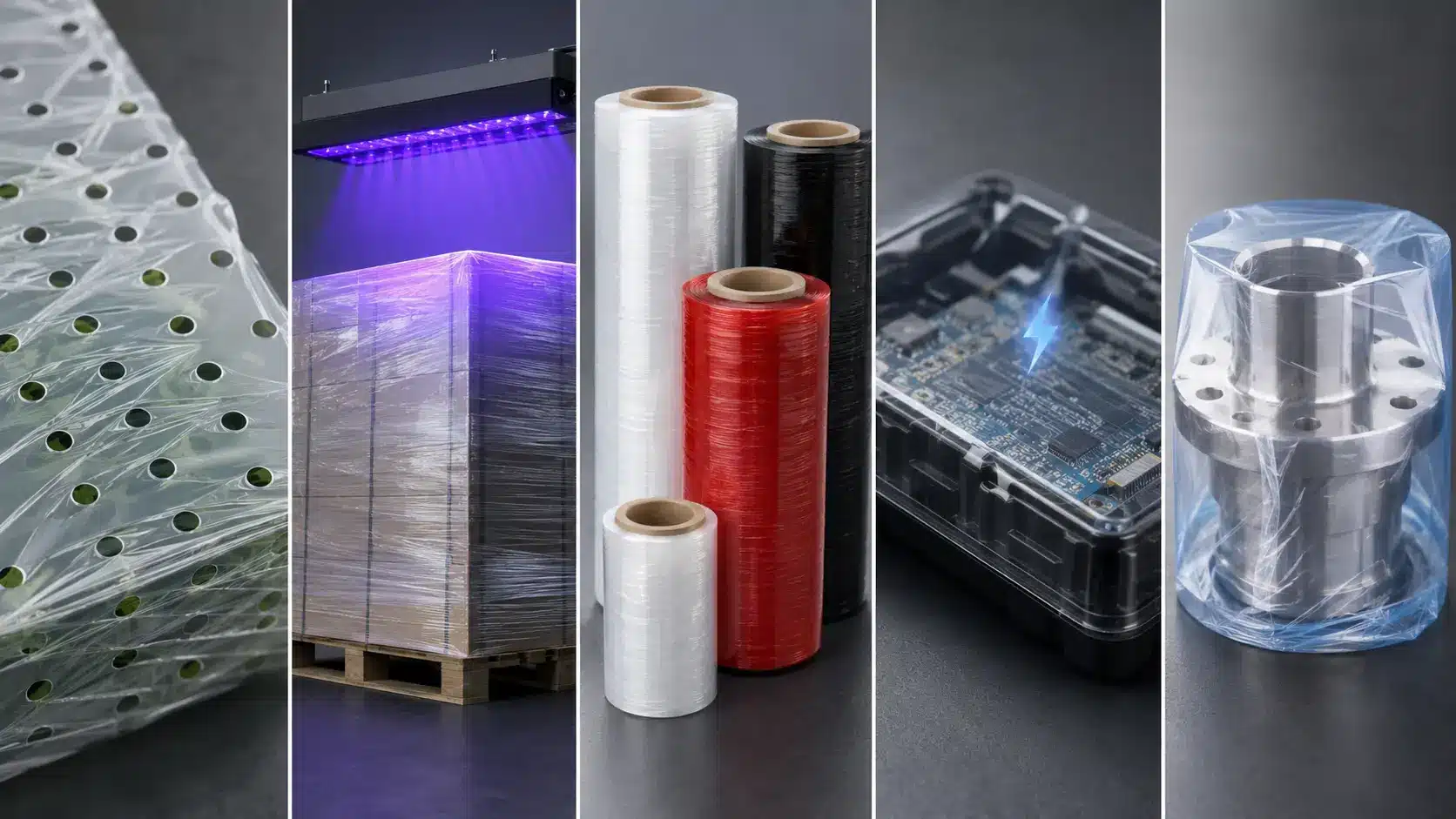
Filme Estirável Ventilado
Vented film contains openings that allow airflow and vapor movement through the wrap. It may be considered for products that release heat or moisture, loads that need faster cooling, or goods where condensation control matters. The openings also change the way the film carries force and responds to edges.
A trial should examine ventilation, hole growth, tearing, load stability, dust or splash exposure, and compatibility with the wrapper. “Breathable” does not mean that every moisture or temperature problem is solved.
UV-Stabilized, Colored, and Opaque Film
UV-stabilized film is formulated to resist defined ultraviolet exposure for a stated period and set of conditions. The buyer should request the test basis, exposure conditions, expected service window, storage requirements, and any limitations. ASTM D4649’s indoor scope is a reminder that ordinary stretch-film guidance cannot be extended to outdoor storage without additional evidence.
Colored film can support visual identification, while opaque film can conceal load contents. Color is not proof of UV resistance, security, traceability, or regulatory status. If a color-coding system carries an operational meaning, document the color definitions and control changes between suppliers or lots.
Anti-Static and VCI Stretch Film
Anti-static stretch film is intended to control static behavior for a defined use. A valid specification should state the relevant property, test method, conditioning, units, acceptance range, and duration. The term should not be treated as a blanket guarantee against electrostatic discharge risk for an entire packaging system.
VCI film incorporates vapor corrosion inhibitor technology for compatible metal protection under specified conditions. Its suitability depends on the metal, cleanliness, package enclosure, storage environment, exposure period, and supplier instructions. It does not replace a corrosion-control assessment, and generated or generic marketing claims cannot substitute for product-specific documentation.
| Specialty function | Trigger condition | What to request | Main limitation to check |
|---|---|---|---|
| Vented | Heat, moisture, or airflow must move through the wrap | Vent pattern, mechanical data, wrapper guidance | Openings alter containment and exposure |
| UV-stabilized | Defined UV or outdoor exposure | Test basis, exposure conditions, service window | Ordinary film claims do not establish outdoor life |
| Colored or opaque | Identification or concealment is required | Color tolerance, opacity, lot controls | Color does not prove UV or security performance |
| Propriedades antiestáticas | Static behavior must be controlled | Property, method, conditioning, range, duration | Film alone may not control system-level ESD risk |
| VCI | Compatible metals need corrosion protection | Metal compatibility, enclosure and storage instructions | Performance is condition- and metal-specific |
Aviso: Specialty labels are claims that need scope. Do not infer food-contact status, recyclability, outdoor life, ESD protection, or corrosion protection from appearance or a generic product name.
How to Choose the Right Type
Use a sequence that starts with the operation and ends with evidence from the finished load:
- Define the wrapping process. Record whether the film will be applied by hand or on a named machine, including core and roll limits, pre-stretch system, tension controls, and expected line conditions.
- Describe the load. Capture pallet dimensions, weight distribution, stack pattern, product fragility, edge and puncture hazards, coefficient-of-friction concerns, overhang, and whether the load can tolerate compression.
- Define the environment. Record storage time, indoor or outdoor exposure, temperature range, humidity, condensation risk, handling, transport mode, and any cleanliness or static-control requirements.
- Select a short list across all three axes. For example, the result may be “machine-applied cast film with a documented UV package,” not merely “machine film.”
- Run a controlled wrapping trial. Hold the load configuration constant and record the film grade, thickness, roll, machine settings, wrap pattern, overlap, film breaks, applied force at several heights, load deformation, and material use.
- Validate the unit load. Evaluate stability and damage through handling and an applicable distribution test. ISTA Procedure 3E, for example, is a general simulation for certain unitized loads and can evaluate load stability, but its conditions do not represent every distribution system.
- Approve a specification and control changes. Define acceptable results and require review when the film grade, construction, thickness, supplier, machine settings, load, or route changes.
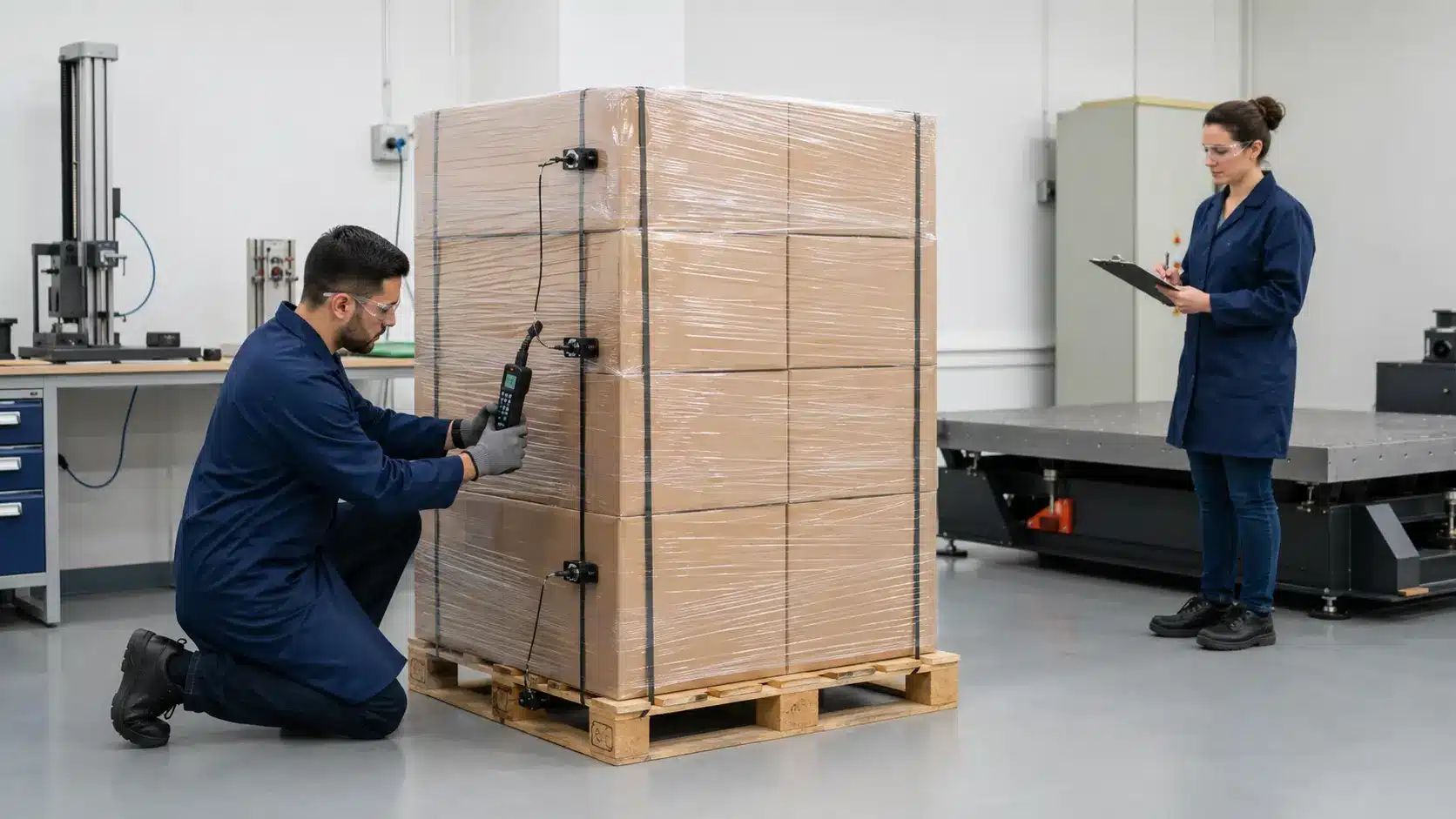
Importante: A successful film test and a successful unit-load test answer different questions. Film-property data helps compare materials; the wrapped pallet must still be validated as a system.
What to Confirm Before You Buy
Ask suppliers for information that allows an equal comparison and supports a repeatable trial:
- Exact grade or product code, intended hand or machine application, and cast or blown process family.
- Nominal thickness and tolerance, width, roll length, core dimensions, roll diameter, and net film weight.
- Material or layer description at the level the supplier is authorized to disclose, including relevant additives or specialty function.
- Test methods, editions, specimen conditioning, direction, units, and typical or specification values for the properties used in your decision.
- Recommended application window, compatible equipment, pre-stretch and tension guidance, and known limitations.
- Cling configuration, unwind orientation, and any special storage or handling requirements.
- For specialty films, the exact claim, test basis, duration, environmental conditions, applicable materials, and exclusions.
- Change-control expectations and traceability for the trial rolls and approved production supply.
- A joint trial plan with acceptance criteria for film use, breaks, load deformation, containment, handling, and distribution performance.
Gauge alone is not an.
Perguntas Frequentes
Is Stretch Film the Same as Shrink Film?
No. Stretch film is elongated and wrapped under tension; its recovery helps hold the load. Shrink film is applied with slack and then exposed to heat so it contracts. The materials, equipment, process risks, and validation methods are different.
Can One Film Type Be Used for Every Pallet?
No A film may work.
Is a Thicker Film Always the Better Choice?
No. Thickness is only one input. Construction, puncture and tear behavior, elongation, recovery, cling, application settings, wrap pattern, and load geometry all influence performance. Compare films using declared test methods and confirm the wrapped load under the actual process and distribution conditions.
 English
 Japanese
 French
 Spanish
 Korean
 Italian
 Portuguese
 Dutch
Dutch Arabic
 Russian
 German